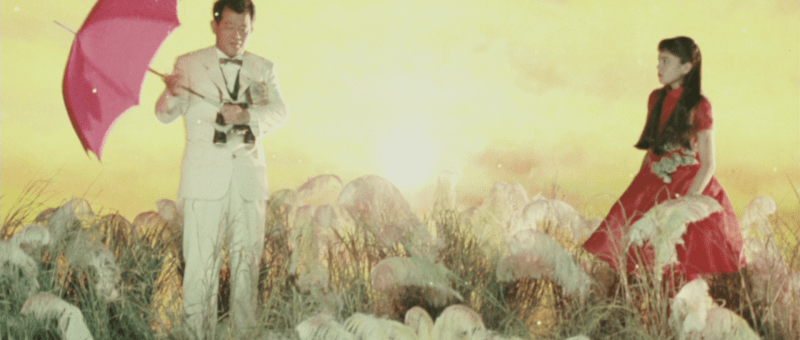
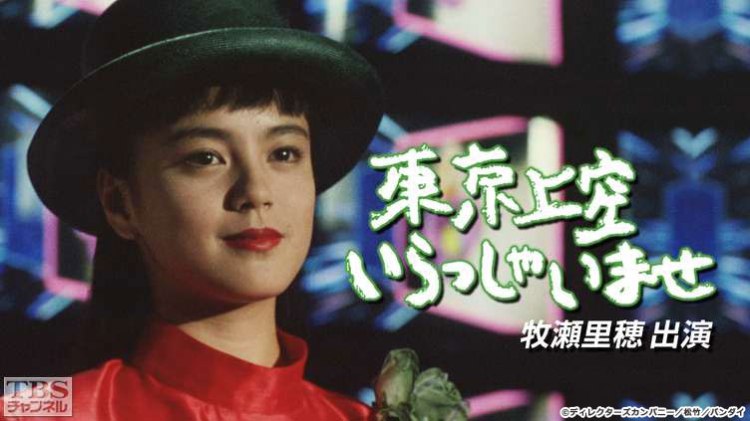
In Japan, Shinji Somai is a well known and highly regarded director yet few of his films have ever made it overseas and he remains almost unknown in the West. Even by these standards, Tokyo Heaven (東京上空いらっしゃいませ, Tokyo Joukuu Irasshaimase) seems to be something of a forgotten episode in Somai’s career and is difficult to find even on unsubtitled DVD.
Set in 1990, the film begins with spoilt brat, up-and-coming idol star, and soon to be campaign girl Yu (Riho Makise) at a glitzy launch party. It’s time for 16-year-old Yu to be heading home, but sleazy producer Shirayuki (Tsurube Shofukutei) has other plans and instructs his underlings to set her up with him which they, guiltily, do. However, during the cab ride home Yu eventually escapes his molestations by jumping out into the middle of the road where she’s immediately mown down by an oncoming car. Waking up in a pastoral vision of heaven, Yu meets her guide, “Cricket”, who looks exactly like Shirayuki, the last face she had in her mind before she died. Given the opportunity to return to Earth but not as her old self, Yu tells Cricket to make her the girl on her campaign posters. Waking up in the room of one of the advertising executives working on her account, Fumio (Kiichi Nakai), she discovers resurrection isn’t all it’s cracked up to be.
Taking its queue from A Matter of Life and Death, Tokyo Heaven is first and foremost a fantasy romance (in the broadest sense) though leaning more towards bittersweet comedy than heartrending tragedy or profound human truths. Yu has returned to Earth but is unable to make contact with her family or let her presence be known to anyone other than Fumio. She no longer appears in photographs or mirrors and gradually comes to the realisation that her life really has ended and this small reprieve is only temporary. Many of Somai’s films focus on the emotions of younger people and the irony here is that Yu only grows up once she’s technically dead. Having had the chance to experience a “normal” adolescence with a part-time job at a fast food restaurant and a tentative romance Yu eventually feels ready to move on.
At only 16 years old, Yu was about to become a the face of a large scale advertising campaign. Her image haunts the streets of Tokyo and the loathsome Shirayuki is desperately trying to spin the tragic events into some kind of narrative that will both cover-up his entirely inappropriate behaviour with a school girl in the back of his chauffeur driven car and save some of the hard work already in place on the campaign itself. Hence, no one other than the girl’s parents is being told that Yu is dead and all previous commitments are being cancelled due to “poor health” or “taking a break” etc. Even after death, Yu’s image is being exploited and her soul ignored.
The conflicted trombone player, Fumio, comes to appreciate Yu for who she really is during their brief time together, resents Shirayuki’s treatment of her and wants the campaign to go ahead in an attempt to prolong her “presence” even if in image only. Through his contact with the increasingly vivacious Yu, Fumio who has previously been berated by his brother for not wanting to join their family bathroom fittings business and labeled as someone with an impenetrable shell who prefers his own company by his sometime girlfriend from downstairs, also comes to appreciate the joys of being alive a little more and reconsider some of his previous life choices.
Bearing Somai’s trademark long yet dynamic takes, Tokyo Heaven is a colourful tribute to Tokyo right before the bubble burst. Almost a prescient warning about the dangers of praising image over reality, the film becomes a poignant tale of learning to appreciate the sheer pleasure of being alive. Its slightly strange and perhaps abrupt ending has the potential to be misread, but the general message about the transience of life and the importance of living the way you want to live is one that cannot be overstated.
Screened from film as part of the London Japanese Embassy Filmshow programme on 19th November 2015.
There isn’t even a trailer available for this but if you can understand Japanese there’s a talkshow event with star and comedian Tsurube Shofukutei recorded at the recent Tokyo Filmex Somai retrospective in 2011.
And a musical scene from the film featuring Yosui Inoue’s Kaeranai Futari


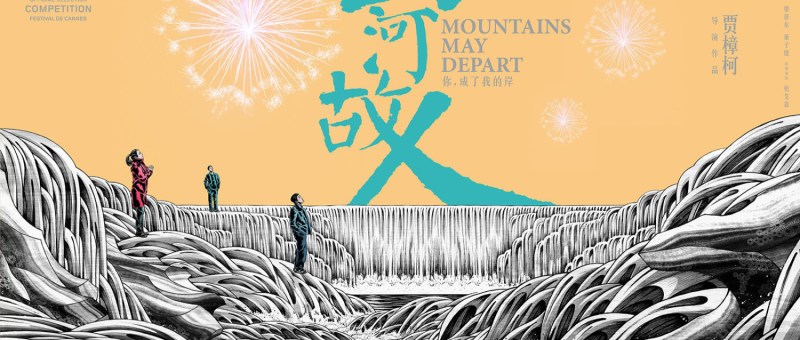
 Jia Zhangke has made something of a career out of charting his nation’s history through the lives of ordinary people caught up in the business of living when everything about them is changing. Mountains May Depart (山河故人, Shānhé gùrén) isn’t the first of his films to span a comparatively wide period of time, though it is the first to venture into the “future” if only by a decade or so. Through a story of dislocation and isolation both cultural and personal, Jia has traversed the melancholy odyssey of those who grow up to discover that all the wrong choices have already been made.

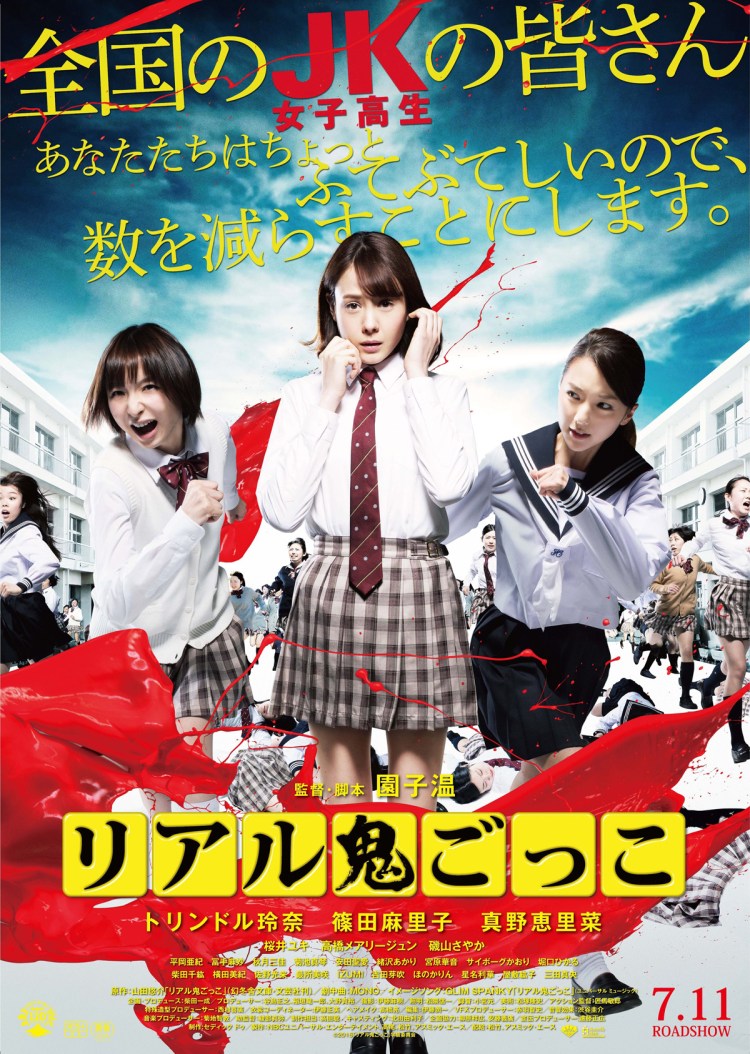 You could say Sion Sono is back, though with six films released within a year it’s almost as if he just nipped out to make a cup of tea. At first look Tag (リアル鬼ごっこ, Riaru Onigokko) seems as if it might be towards the bottom of the pile – school girls running away from things for 90 minutes whilst contending with awkward gusts of wind, but this is Sion Sono after all and so there’s a whole world of craziness going on below the surface.

 Windows on Worlds