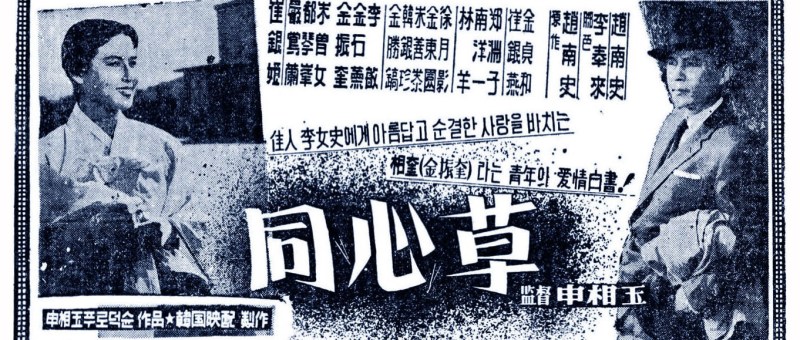
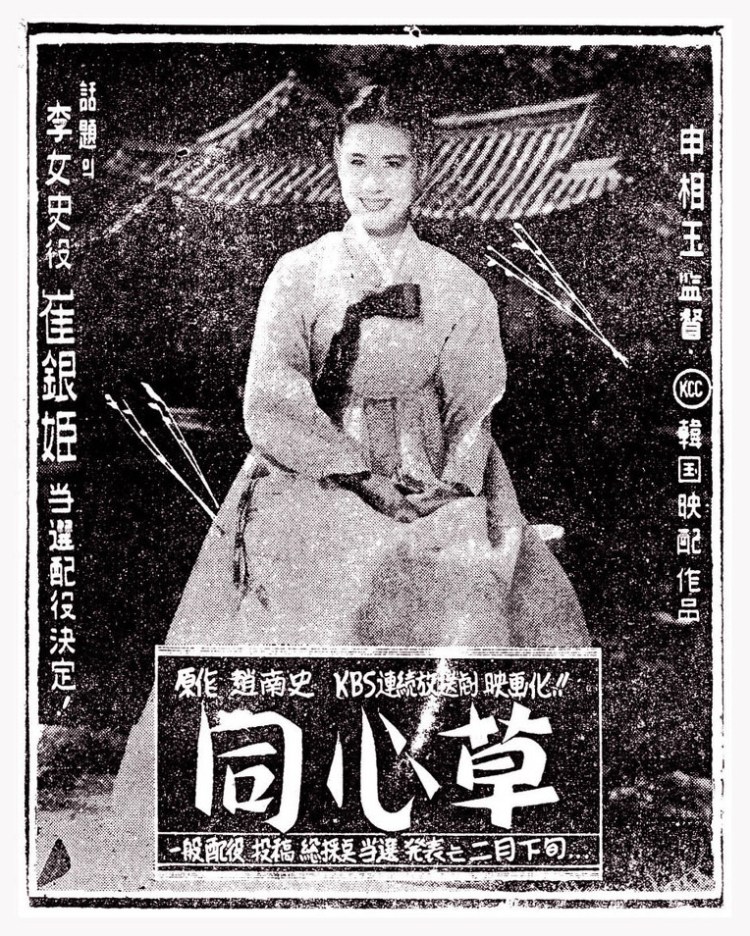
Dongsimcho (동심초, Shin Sang-ok, 1959)

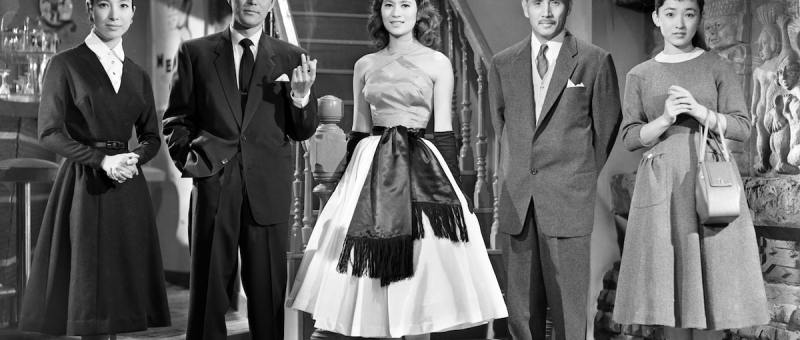
The Korea of 1959 was one of change, but the hardest thing to change is oneself and oftentimes the biggest obstacle to personal happiness is the fear of pursuing it. The pure hearted heroine of Shin Sang-ok’s Dongsimcho (동심초) describes herself as “a woman who thirsts for love, yet foolishly gives in to fear first”. A war widow, she’s fed up with society’s constant prejudice but too afraid of what they might think if she chose to choose love, embrace her desire, and marry again for no other reason than personal happiness. Yet for all that she’s a mother with a grown up daughter, she’s a woman too, and young, only 38, but nevertheless consigned to a life of loneliness because of a series of outdated social codes. 

When we first meet Suk-hee (Choi Eun-hee) she’s rushing to the station but arrives too late and can only watch the man she loves board a train through an iron gate that perpetually divides them. Her husband having died in the Korean War, Suk-hee once had a dress shop but was conned out of all her money and the business failed. The kind hearted brother of a friend, Sang-gyu (Kim Jin-gyu), helped her out. Through the course of his managing her affairs, they became close and fell in love, but Sang-gyu is now engaged to the boss’ daughter, Ok-ju (Do Keum-bong), and their romance seems more impossible than ever. 

Suk-hee never quite dares to hope that Sang-gyu might break off his engagement, decide against a bright middle-class future, and start again with her. She’s an old fashioned kind of woman. Despite the fact she once owned a dress shop, she only ever wears hanbok and lives in an improbably spacious Korean-style house alone with her college student daughter, Kyeong-hee (Um Aing-ran), and a maid. The debt that exists between herself and Sang-gyu is the force that both binds them and keeps them apart. The money rots their relationship, but neither of them want it to be repaid because then they’d have no more excuse to continue meeting. They are both perfectly aware of each other’s feelings but entirely unable to acknowledge them because in some sense they already know that their future is impossible. 

On discovering her mother’s “secret”, Kyeong-hee is mildly scandalised, confronted by the realisation that a mother is also a woman just as she is now. She worries about the moral ambiguities of her mother’s position and of what people might say, but quickly reconsiders, deciding to be happy for her and actively support her chances of a happier future. As a younger woman coming of age in the post-war era, Kyeong-hee feels freer to shake off social convention and strike out for personal happiness rather than being content to be miserable while upholding a series of social codes which lead only to additional suffering. 

Only slightly younger than Suk-hee, Sang-gyu is beginning to feel the same. His widowed older sister, Suk-hee’s friend, has turned to religion to escape her loneliness while staking all of her hopes on Sang-gyu’s economic success. It’s she who’s set him up with the marriage to Ok-ju and is pressuring him to accept it because it will assure her own future seeing as she is obviously not planning to defy convention and remarry. Sang-gyu, however, is filled with doubts. Eventually he tells his associate, Gi-cheol (Kim Seok-hoon), that he cannot go through with the marriage, adding that he doesn’t want advice or a warning he merely needed to tell someone. In a strange coincidence, Gi-cheol was once Kyeong-hee’s tutor, and has a surprisingly conservative attitude. Questioned by Ok-ju, he tells her to “act more lovingly” to cure Sang-gyu’s obvious lack of enthusiasm for their relationship, explaining that love doesn’t just happen but is a result of concerted effort. He tells Sang-gyu that he’s being childish and irresponsible and should think about “social ethics and morality”. In short, he should forget about the past and marry Ok-ju like a good boy. But Sang-gyu quite reasonably asks him who’s going to be responsible for what happens after that. If he marries Ok-ju now, he will merely be condemning her to a cold and loveless marriage filled with intense resentment in which the spectre of the woman he loved and lost will always stand between them. 

Kyeong-hee unexpectedly arrives part way through the conversation having followed Gi-cheol with whom she has perhaps also begun to fall in love despite the difference in their attitudes. She jumps in to defend Suk-hee, taking Sang-gyu’s side in berating Gi-cheol for insulting her mother, asking if he thinks a woman like her has no worth. Her mother is a woman too, and though she was originally confused and scandalised, after getting to know Sang-gyu and giving it some thought she’d like to give them her blessing though of course they don’t need it. Kyeong-hee is still young enough to fight for love, and the world in which she lives gives her the courage to believe it might be possible. 

The generation gap between herself and her mother, who it has to be remembered is only 38, cold not be more obvious. Suk-hee struggles against herself. She loves Sang-gyu, but the world tells her that it’s wrong and she must deny her feelings for the sake of social propriety. She can’t stand the way people look down on war widows, and she’s too afraid to give them any more ammunition. Given the relative mildness of the sanction on their relationship, in moral terms at least, it would be easy enough to read it as a metaphor for something else, especially with the repeatedly pregnant dialogue about the pain of not being permitted to marry the person that you love, that no one has the right to judge others for their personal lives, Sangyu’s sister’s aside about being “one of those people”, and finally Sang-gyu’s rather strange confession to Ok-ju that he “may have a personality disorder” in being unable to give up on his love for Suk-hee. It is definitely the case, however, that the gate that stands between them is a rigid an unforgiving society which denies love in fear of disrupting the social order.  

Suk-hee feels guilty not only for her feelings, but feeling as if she’s getting in the way of Sang-gyu’s bright and rightful future. Meanwhile, no one seems to give much thought to poor Ok-ju, used as a pawn by all while pinning for Sang-gyu despite her conviction that he’s in love with someone else and will never truly be with her. Even Gi-cheol implies it’s her own fault not being “loving” enough, while she is left with nothing but sympathy for Suk-hee as another woman forever separated from Sang-gyu because of what other people think. This world is not, it seems, entirely ready for love. Suk-hee makes the “right” choice by many people’s reckoning, one filled with nobility and self sacrifice, yet it’s a choice that becomes increasingly impossible to accept and stands only in stark condemnation of the society which convinced her that misery was virtue. 


Dongsimcho is the second of three films included in the Korean Film Archive’s Shin Sang-ok’s Melodramas from the 1950s box set. It is also available to stream via the Korean Film Archive’s YouTube Channel.

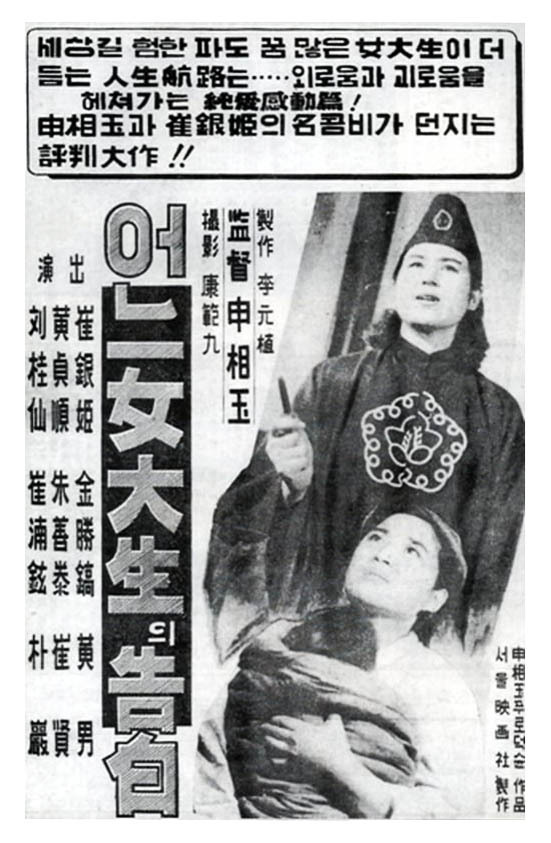
A College Woman’s Confession (어느 女大生의 告白 / 어느 여대생의 고백, Shin Sang-ok, 1958)

Five years after the end of the Korean War, South Korean society was both economically unstable and battling the increasingly authoritarian government of Rhee Syngman. Nevertheless, there was perhaps an aspiration for a brighter democratic future which many hoped would materialise after the protests which eventually brought down Rhee’s regime in 1960 but unfortunately led only to the even more repressive Park Chung-hee era. Released in the same year as Flower in Hell, Shin Sang-ok’s A College Woman’s Confession (어느 女大生의 告白 / 어느 여대생의 고백, Eoneu Yeodaesaengui Gobaek) is perhaps a reflection of that aspiration in its broadly humanist condemnation of an inherently unfair, rigidly patriarchal society which forces good people to act in ways which offend their sense of justice solely in order to survive. 

From a poor family, law student So-young (Choi Eun-hee) finds herself in dire straits after her grandmother who’d been supporting her and paying her tuition fees suddenly dies. She tries to find a part-time job that will let her carry on with her studies, but is either turned away or placed in difficult situations with men who abuse her trust. A sleazy boss interviewing her for a secretarial position pauses after hearing she’s a student after part-time work to suggest a “night job”, crudely leaning over as he offers her money to become his mistress. So-young slaps him across the face and leaves, but faces something much the same from the husband of her landlady who promises to stop pressuring her for the back rent in return for sexual favours. She turns him down too, but even though he backs off in fear she’ll tell his wife that he tried it on, his suddenly relaxed attitude only makes her landlady suspicious. 

At her wits end and about to quit school, So-young turns to her comparatively better off friend Hee-sook (Kim Sook-il) who dreams of becoming a novelist. Hee-sook brings up a diary she’s been reading that was found in some old furniture sold to her family’s store which recounts the sad life story of a girl who was seduced and betrayed by a man who left her to marry a wealthy woman. With too much time on her hands, Hee-sook has identified the man in the diary as prominent politician Choi Rim (Kim Seung-ho) and taken it upon herself to send him a letter telling him that he has a daughter named So-young from the love of his youth. Despite the fact that the diary says the woman’s baby died, Hee-sook suggests So-young pose as Choi’s long lost daughter so he’ll support her through the rest of uni. So-young is not convinced, but finds herself heading over to visit Choi after exhausting all her other options and being reluctant to go back to the boarding house without money. Choi absentmindedly turns her away, only to think better of it and send his secretary after her, but she ends up getting hit by a car trying to avoid yet another creepy old man who sees her in distress in the street and offers her money for sex. 

Creepy men are indeed everywhere. Even the wily Hee-sook finds herself bothered by an unpleasant man in a cafe who repeatedly pesters her even after she makes a point of ignoring him and pointedly switches seats. He doesn’t give up even after So-young arrives, abruptly offering to buy both women dinner, after which Hee-sook ushers So-young out declaring that this cafe is too “weird” to stay in any longer. Men are, it seems, content to exploit the desperation of vulnerable women for their own satisfaction. As So-young puts it in trying to defend another woman after she’s successfully become a lawyer, “vulgar men see women only as objects to satisfy their sexual desires”. 

This feeds back in to the sin the otherwise kindhearted Choi is trying to expiate. He made a choice in his youth, sometime in the colonial era, to abandon a woman he claimed to love to make a dynastic match. Though it’s not clear whether or not he knew there was a child, he seems to harbour a deep sense of guilt over his decision to essentially use two women in different ways. Faced with the “resurfacing” of So-young, he immediately explains everything to his wife (Yoo Gye-seon) but tries to pass it off as “all in the past” while earnestly asking her to help him make amends by accepting So-young into their home in place of the daughter they apparently lost. She fires back at him that it must be very convenient for men who can forget about things that are “all in the past” while women have to live the rest of their lives with the harm that they cause. Choi doesn’t argue with her, but nor does he ask for forgiveness, only understanding. Mrs. Choi answers that she ought to tell him no in revenge for the all the wrongs he’s done her (this appears not to be a terribly happy marriage), but agrees that it’s not So-young’s fault and so of course she can come because “it’s the right thing to do as a human being”. 

Mrs. Choi, however, remains suspicious, unconvinced by So-young’s story but also by her distance from her. That could of course be explained by embarrassment in being the child of the “other woman”, but Mrs. Choi is right to sense guilt in her reserve as she becomes ever more conflicted about the necessity of deceiving people who have been nothing but kind to her. It’s this sense of guilt which is intensified after she becomes a lawyer and achieves her dream of helping other disadvantaged women by defending a single-mother, much like the woman from the diary, who was seduced and betrayed by a man whom she later killed in a crime of passion. In her passionate defence of the extremely repentant Soon-hee (Hwang Jung-seun) is who is around the same age as she is, So-young reflects on the relative similarities between them and that the only reason they are standing in their respective positions is circumstance. 

“The purpose of the law is not only punishment but to awaken goodness in all our hearts” So-young reminds the judges, determined to offer “an earnest plea on behalf of desperate women”. Soon-hee admits her guilt and asks for no leniency, but is brought to tears as So-young outlines the social factors which explain why she found herself stabbing the man who had caused her so much suffering and then got on with his life without giving her a second thought. Her only transgression being sex before marriage, Soon-hee did everything else right but was condemned to a life of poverty and forced to consider sex work in order to buy medicine for her sickly baby. As a pure hearted woman, she can’t go through with it and considers robbery instead (apparently a “lesser” crime) only to bump into an old friend but be too ashamed to ask her for help. 

Earlier on, after her graduation ceremony, So-young had explained her ambitions to help women and children in poverty to Choi’s kindly secretary Sang-ho (Choi Hyeon) who has obviously taken a liking to her. He’s broadly supportive, but reminds her that if she wants to improve society perhaps she should think about fostering greater social change through political action (as he is perhaps doing), but she shakes her head and points out that he’s never known what it is to be hungry or desperate and that there are people who need the kind of help that only she can give them, such as women like Soon-hee. Yet in defending another woman she’s reminded only of her own “sin” in having wilfully deceived Choi and his wife, burdened by the need to keep her secret and convinced the only thing she can do is to confess all. 

Yet Mrs. Choi proves unexpectedly supportive, explaining that she’s known all along that So-young lied and has come to love her as a daughter anyway. She can see how happy she makes Choi who is proud and excited to have such an amazing young woman in his life, and finding out the truth would only break his heart. So-young’s confession would be for herself alone, to ease her own conscience, while the burden of carrying this secret is perhaps the price of her happiness. In an odd way, So-young has repaired their marriage, and with her success in the courts has perhaps completed the integration of their family with the implication that Sang-ho may later join it too. Fiercely condemning the evils of a patriarchal society, A College Woman’s Confession suggests that the literal truth might not be as important as the emotional, and that a rigid morality serves no one, while offering the vision of a brighter, more equal society founded on compassion and understanding rather than cold authoritarian paternalism. 


A College Woman’s Confession is the first of three films included in the Korean Film Archive’s Shin Sang-ok’s Melodramas from the 1950s box set. It is also available to stream via the Korean Film Archive’s YouTube Channel.

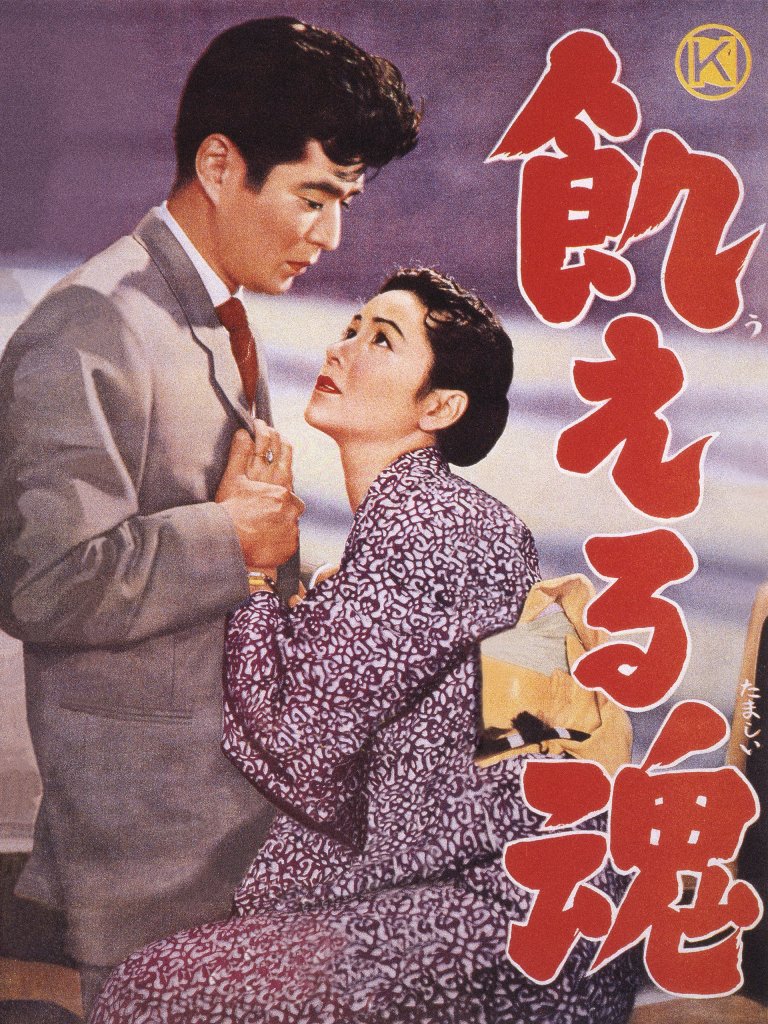
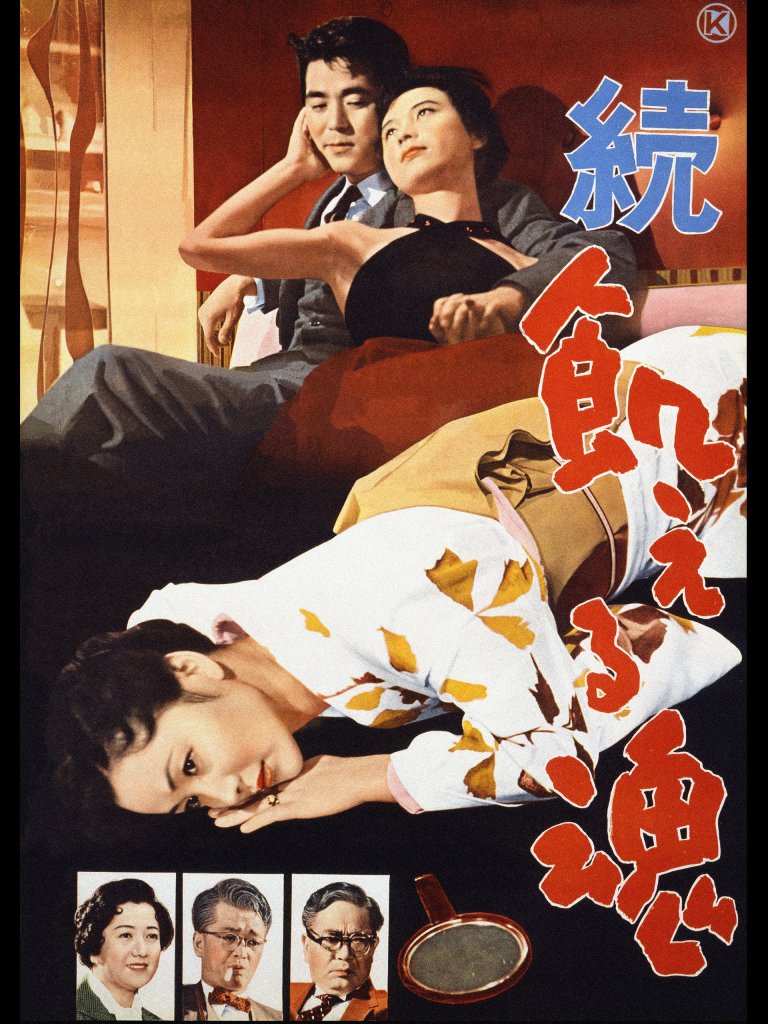
Hungry Soul / Hungry Soul, Part II (飢える魂 / 続・飢える魂, Yuzo Kawashima, 1956)

When you think of the family drama, you think of a young woman getting married and that her marriage is an unambiguously good and righteous thing despite the pain it may bring to her parents who will obviously miss her yet must comfort themselves that they’ve done everything right. In melodrama, however, we get quite a different picture of the “modern” marriage in which it is not quite so unambiguously good or righteous but a patriarchal trap enabled by a kind of gaslighting which tells women that suffering is the natural condition of life and that they should wear their unhappiness as a badge of honour.  

Nowhere does this seem truer than in the films of Yuzo Kawashima who in general takes quite a dim view of romance as a path to freedom and finds his heroines struggling to escape outdated social codes to seize their own freedom. Hungry Soul (飢える魂, Ueru Tamashii) finds one still comparatively young woman and another middle-aged discovering that they want more out of life than their society thinks a woman is supposed to have but continuing to wrestle with themselves over whether or not they have the right to pursue their personal happiness in a rigidly conservative society. 

Reiko (Yoko Minamida), a woman in her early 30s, married Shiba (Isamu Kosugi), 23 years her senior, 10 years previously apparently out of a mix of youthful naivety and post-war desperation. Shiba has supported her financially and apparently enabled her brother’s career, but it’s clear that he thinks of her as little more than a glorified housemaid, treating her with utter contempt even in public. He makes her carry her own bags at the station rather than wait for a porter and forces her to accompany him on business trips where he shows her off to colleagues and then retires her to the hotel with nothing to do all day. Tyrannised, Reiko has been been raised to be obedient and does her best to be a good wife, but Shiba repeatedly reminds her that he bought her while openly talking about his relationships with other women even at one point bringing a geisha home with him while Reiko cringes in the front seat next to the driver. 

Perhaps what she’s learning is that obedience is not an unambiguously good quality, but still she struggles to let go of the necessity of measuring up to the standards of social propriety. When Shiba unwittingly introduces her to handsome politician Tachibana (Tatsuya Mihashi), her accidental attraction to him awakens her to all the ways her married life is a hell of disappointment. Shiba reminds her that he keeps her in comfort, little understanding that she may hunger for something more than the material, while Reiko realises that she may starve to death for lack of love but has been conditioned to think that a woman’s emotional needs are not only unimportant but entirely taboo. 

Mayumi (Yukiko Todoroki), meanwhile, has known love but feels obliged to live on the memory of her late husband and fulfil herself only though caring for her two teenage children. To do that, paradoxically, she has seized her independence as a working woman with a job in real estate, later hoping to manage a ryokan traditional style hotel, only for her children to resent her perceived rejection of motherhood in favour of individual fulfilment. “School is for people who have two parents” her son tells her, threatening to move out into a dorm, while her daughter at one point considers suicide simply because she suspects her mother may be sleeping with her late father’s best friend. 

In Reiko’s case, her desire for liberation is kickstarted by a hunger for love, though as we later realise Tachibana is also perhaps looking to break with the past and with conventional male behaviour in that he has been a womanising playboy involved in relationships with women from the red light district which to him were always casual while they, like Reiko and Mayumi, longed for more. Mayumi’s relationship with Shimozuma (Shiro Osaka), by contrast, is complicated by the fact he is married to a woman with a long-term illness, though what he craves (besides Mayumi herself for whom he seems to have been carrying a torch for many years) is a conventional family home, jokingly chiding Mayumi that her interest in business may be making her less “womanly”.  

Both women try, and fail, to break free of patriarchal control to claim their own agency, discovering that romance is not the best way to find freedom. Despite her love for and possibly misplaced faith in Tachibana, Reiko is both too brutalised by her abusive husband and constrained by the taboo of being a woman ending a marriage for another man to definitively escape Shiba’s control. Mayumi, meanwhile, is shamed by the reflection of herself in her children’s eyes and motivated to reassume her maternity but does so also as a way of rejecting easy romantic fulfilment in the hope of discovering more of herself as a middle-aged woman embracing all the freedom that might offer while her children, though grateful to have her return to them, are also chastened and guilty in having realised that their mother is a woman too and ultimately they just want her to be happy. As often in Kawashima, no one quite gets what they wanted, but they do at least find a kind of resolution. Their souls may still be hungry, but their appetites have returned and there is the promise of future fulfilment if still tempered by the restrictions of a cruelly repressive society.


Hungry Soul opening (no subtitles)

Hungry Soul, Part II opening (no subtitles)

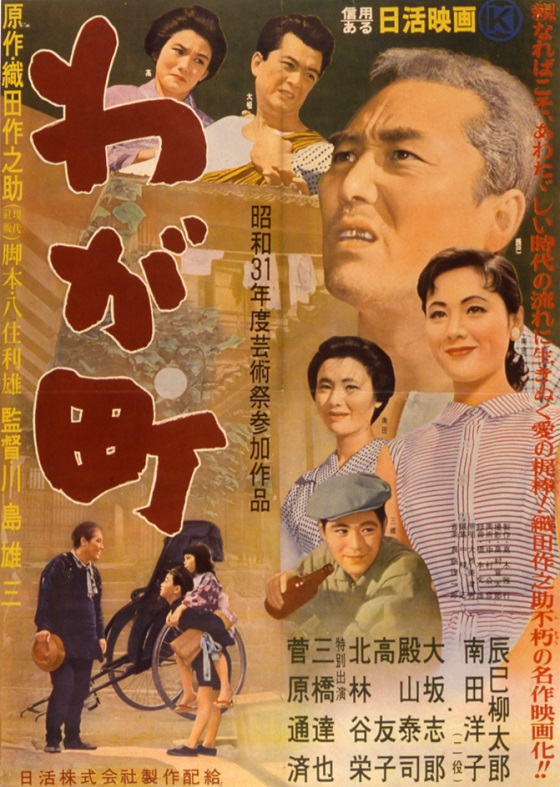
Our Town (わが町, Yuzo Kawashima, 1956)

“They tricked me and you and everyone! It’s so stupid” a stammering man tries to explain to his deluded friend, but some people just don’t want to hear the truth. Spanning 30 years of tumultuous 20th century history, Yuzo Kawashima’s Our Town (わが町, Waga Machi) charts a course of authoritarian fallacy as its puffed up hero refuses to give up on the imperialism of his youth and condemns all around him to lives of misery out of misguided faith in an outdated code of patriarchal and national pride. Too late he will perhaps begin to realise that his unforgiving rigidity has done nothing more than alienate the people that he loves, but his story is both a lament for past folly and a warning for the freer post-war future. 

Back in the 1900s, the tail end of the Meiji era, Taa (Ryutaro Tatsumi) was one of 1200 Japanese construction workers who travelled to the Philippines to help build a road intended to boost the economy of the recently independent nation. Now, around this time, Japan was also embarking on the the first of its 20th century wars fought against the Russians. While Taa was breaking his back on the Benguet road, other young men were busy painting themselves in glory as imperial soldiers contributing to the expansion of the burgeoning Japanese Empire. In his own way, and quite literally, Taa was also building the Japanese Empire and intensely resents that no one recognises his contribution as the self-styled “Taa of Benguet” who apparently kept his fellow Japanese going even when it became clear that they were just exploited workers, hung out to dry once the job was done and left to die of poverty or tropical disease. 

Taa’s life philosophy is that humans are born to work and that suffering in youth builds character. He wanted to show the world what Japanese people are made of and feels he made Japan proud building the Benguet roadway, but there are no flag waving parades for his return as there were for Hanai who went away to war, nor is there any real work. Embarrassed about his illiteracy, he didn’t even write any letters home which is one reason why he didn’t know that a casual girlfriend, Tsuru (Yoko Minamida), whom he’d perhaps long forgotten, had given birth to his child, Hatsue, who is now four. Despite his initial surprise, Taa submits himself to the role of husband and father, earning money as a rickshaw driver, but never forgets that he is “Taa of Benguet” or that the meaning of life is suffering through hard work. 

Old fashioned and patriarchal even for the times in which he lives, Taa’s attitudes continue to destroy the lives of those around him. He wasn’t there to support Tsuru and so she worked herself to death in his absence. Hatsue (Tomoko Ko) grows into a beautiful young woman and falls in love with Shintaro (Shiro Osaka) the son of a bucket maker who, though athletic, is not perhaps built for hard work in the same way as Taa had been. He tries to force his philosophies on the younger generation, pressuring Shintaro to go to the Philippines to make a man of himself, not quite understanding that much has changed in the previous 15 years, nor that Shintaro may not be able to endure the kind of hardship he regards as indicative of a productive life. 

Taa learns nothing from his mistakes, eventually pressuring his granddaughter Kimie (Yoko Minamida) in the same way he’d done his daughter, objecting to her desire to marry a man of her own choosing even though he embodies many of his oft spoken ideals including dedication to hard work. Jiro (Tatsuya Mihashi) is the son of his old rival Hanai and was himself in the war. Like Taa and the men of his generation, he too was “tricked” into working overseas for a mistaken ideal of Japanese imperialism but he’s also a man of the post-war generation and has no more illusions about things like glory or suffering.

Kimie too, as she later tells Taa, is a post-war woman. She feels no obligation towards her grandfather simply because he raised her, nor will she allow her life to be ruined in the same way her mother’s and grandmother’s were by Taa’s patriarchal authoritarianism. “You’ve got to start listening to the younger generation” Jiro tries to explain, but Taa is not someone used to listening. “Every single thing you’ve ever done has been pointless” Kimie tells him, “trapped in your own happy bubble, getting in the way of everyone else”. All Taa’s philosophy has ever caused is pain and suffering, trying to make the lives of all the men who died building a road in a foreign land mean something while ironically propping up the same ideology that robs men like him of their freedom and possibility. You could say something broke in 1905, but it also broke 40 years later, people are wiser now and they know there’s no glory in suffering. Taa sees the error of his ways, but also that there’s no place for him in the kinder post-war era where there’s no sin in working hard, but no life without freedom. 


Titles and opening (no subtitles)

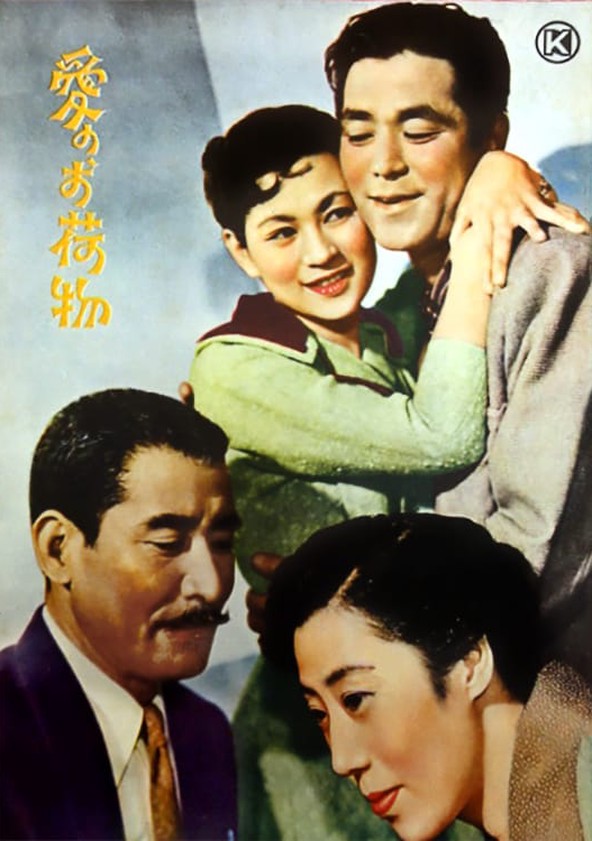
Burden of Love (愛のお荷物, Yuzo Kawashima, 1955)

Two decades into the new century, Japanese society finds itself gripped by a population crisis. Supposedly “sexless”, young people constrained by a stagnant economy and a series of outdated social conventions have increasingly turned away from marriage and children to the extent that the birth rate is currently at the lowest it’s ever been. How strange it is then to revisit Yuzo Kawashima’s baby boom paranoia comedy Burden of Love (愛のお荷物, Ai no Onimotsu) in which the very same anxieties now expressed for the declining population are expressed for its reverse – that it will damage the economy, that it is the result of a moral decline, and that society as we know it is on the brink of destruction. 

All of these arguments are made by the Minister for Health, Araki (So Yamamura), as he tries to chair a committee meeting put together to find a solution to the baby boom crisis. The government policy he’s putting his name to is a birth control advocacy programme coupled with greater education to discourage couples from having so many children. Some object on the grounds that encouraging the use of birth control will inevitably lead to promiscuity and sexual abandon, which is why Araki’s government intends to limit its use only to married couples to be used for proper family planning. A feminist politician challenges him again, first citing the go forth and multiply bits from the bible to imply she objects to birth control on religious grounds only to trap Araki by reminding him that that is exactly what the government encouraged people to do during the wartime years. She thinks limiting birth control to married couples is little more than thinly veiled morality policing which will fail to help those really in need, suggesting that if this is the road they want to go down perhaps they should think about relaxing abortion laws so that those who become pregnant without the means to raise a child will have another option. Predictably, Araki is not quite in favour, but takes her point. In any case, events in his personal life are about to overtake him. 

The first crisis is that his son, Jotaro (Tatsuya Mihashi), is in a secret relationship with Araki’s secretary Saeko (Mie Kitahara), who has now become pregnant and is quite smug about it because Jotaro will finally have to sort things out with his family so they can marry. There are several reasons why he’s been dragging his feet: firstly, Saeko is a very good secretary and it’s customary for women to stop working when they marry (though as we later find out Jotaro is a progressive type who has no intention of stopping Saeko working if she wants to even after they marry and have children), secondly, his mother Ranko (Yukiko Todoroki) and younger sister Sakura (Tomoko Ko) are old fashioned and may feel marrying a secretary is beneath him, and thirdly he’s just a lackadaisical sort who doesn’t get round to things unless someone gives him a push. Sakura has an additional concern in that she’s engaged to an upperclass dandy from Kyoto (Frankie Sakai) and worries his family might object if they know that Jotaro has undergone a shotgun wedding to someone from the “servant class”. Araki’s oldest daughter, Kazuko (Emiko Azuma), is happily married to a gynaecologist (Yoshifumi Tajima) but ironically has been unable to conceive after six years of marriage. All of which is capped by the intense irony that his own wife at the age of 48 may be expecting a late baby of their own. 

The press is going to have a field day. Araki, for all his faults, is a surprisingly progressive guy, a moderate in the conservative party but one who, worryingly, doesn’t seem to believe in much of what he says as a minister of government, merely doing what it is he thinks he’s supposed to do. It’s perhaps this level of hypocrisy that Jotaro so roundly rejects, insisting he wants neither a career in the family’s pharmaceuticals company (which, it’s worth saying, also produces the birth control Araki’s policy seeks to promote), or a career in politics, and insists on being his own man. Tinkering with various bits of modern technology, he eventually gets a job in research and development of cheap TV sets, signalling his allegiance to the new all while dressing in kimono to visit kabuki clubs with Saeko. Saeko too is a modern woman – she speaks several languages and has a university degree, supporting herself independently even though she is “only” secretary albeit to a cabinet minister. Sakura, a more traditional sort, originally looks down her for being all those things, but later comes to a kind of admiration especially when she finds herself in need of advice from another modern woman. Jotaro’s mother, however, only comes around when she hires a detective who discovers Saeko might be posh after all. 

“Children have their own worlds to live in” one of Araki’s grownup kids later emphases, unwilling to rely their father for money or career advancement, they want to make their own way in the world. Jotaro, a kind man and something of a socialist, wonders if they shouldn’t be using some of this money the government has earmarked for defence on social welfare, suggesting perhaps that’s the best way to deal with the population crisis rather than pointlessly trying to police desire. Burden of Love was released in 1955, which is immediately before Japan instituted its anti-prostitution law doing away with the Akasen system that existed under the American occupation. Araki goes to visit an establishment in the red light district and declares himself horrified, but is unable to come up with a good solution when the women working there point out that they support entire families who will starve without their income. He may have a point that the pimp’s identification of himself as a social worker is disingenuous because he profits from the exploitation of women, but Araki’s later visit to a tavern staffed by geisha raises a series of questions about a continuing double standard. 

Araki exposes his own privilege when he tells Jotaro that he’d do anything for a single slice of bread before he’d ever do “that”, which is ignoring the fact that it’s very unlikely he’d ever have to consider it. Araki’s father, himself a retired politician, is also a fairly progressive sort who actively gets involved in the kids’ nefarious plans to get around their parents so they can marry the people the want when they want to marry them, while Araki remains largely preoccupied with his political position, even suggesting to his wife, despite what he said in the committee meeting, that she get an abortion to spare him the embarrassment caused by increasing the population while proposing a series of population control policies. Ranko is distraught because to her the child is the product of their love, even if to Araki it is also a “burden”, but being a traditional sort thinks first of her husband and is minded to do as he says. The younger generation think and feel differently. They want to make decisions for themselves, not just about what they do but who they love and how they live. The lesson is perhaps that this isn’t something to be overly worried about. Children are the “burden” of love, but we carry them together, and it’s a happier society that is content to figure it out rather than trying  to pointlessly police forces beyond its control. 


Original trailer (no subtitles)

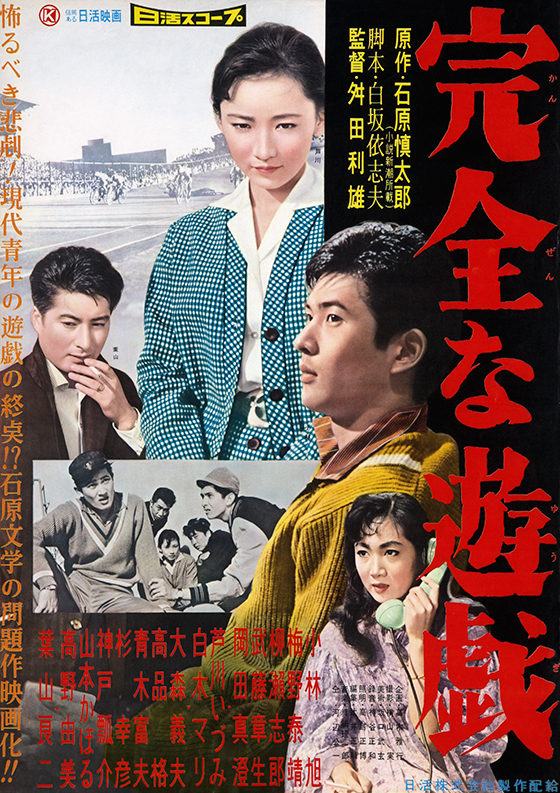
The Perfect Game (完全な遊戯, Toshio Masuda, 1958)

In the mid-1950s, Nikkatsu had courted controversy with a series of films depicting the amoral excesses of the immediate post-war generation. The “Sun Tribe” movies embedded themselves in a world of new bright young things who were largely independently wealthy and thoroughly bored by the ease of their lives. Nikkatsu was forced to halt production on the Sun Tribe films after only three (Toho and Daiei added one each of their own), but they did precipitate a wholesale shift towards youth movies which became the studio’s signature theme. 

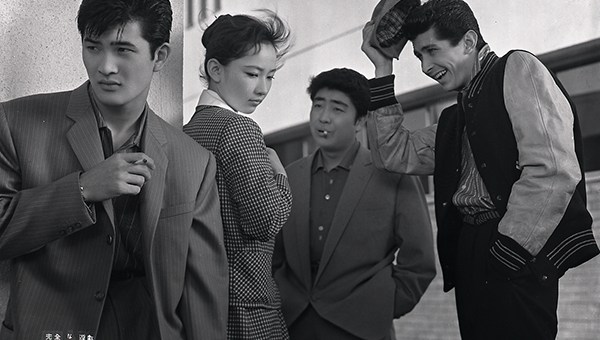
Best remembered for his contributions to Nikkatsu’s action noir, Toshio Masuda’s The Perfect Game (完全な遊戯, Kanzenna Yugi, AKA The Tragedy of Today) arrived two years after the Sun Tribe craze but neatly picked up the baton dropped by Kon Ichikawa’s Punishment Room in its tale of nihilistic college boy amorality. As the film opens, our four heroes are playing mahjong and lamenting their lack of funds. They are all, it goes without saying, middle class boys largely supported by their parents who, as far as we know, are high ranking salarymen. They are not hungry, or worrying about how to pay rent or tuition, they are just bored and want extra money to go out having fun before they they are forced into the corporate straightjacket with the regular salaryman jobs many of them already have in the bag thanks to the tremendous power of nepotism. 

As the the opening text implied, they viewed their money making exploits as a game, proving how clever they think they are in getting one over on the universe, but all too quickly it spirals out of control. Toda (Yasukiyo Umeno), the ring leader, has come up with an ingenious money making scheme. It turns out that there’s an illegal betting office some distance away from the bicycle racing stadium that keeps taking bets until someone rings from the track and tells them who won, which means there’s about a five minute delay between the winner being declared and bets being called. The boys figure that if they can somehow beat the lag they can win big. To make it work, they ask their “friend” Kazu (Masumi Okada), who they seem to regard as a bit dim, to join them as well as recruiting an old codger to call the race before the boards go up. Surprisingly it works out, but unfortunately the yakuza-backed bookmaker, Matsui (Ryoji Hayama), wasn’t banking on such a big win and doesn’t have the funds to pay out in one go. 

Toda in particular is pissed off. The wind taken out of his sails, he’s not sure what to do which is when So (Akira Kobayashi), the pretty boy of the group, suggests an ironic punishment. Matsui had joked that he’d put up his adorable kid sister Kyoko (Izumi Ashikawa) as collateral if he couldn’t pay out, so why don’t the boys take him at his word and kidnap her. Rewinding a little, these snotty college boys are about to become kidnappers, adding a little blackmail on the side. This isn’t a fun game anymore, someone is going to get hurt whatever happens even if they can’t know the extent to which their plan to earn a few bucks to blow on jazz bars and pool rooms is going to incur collateral damage. 

Unlike the boys, Kyoko is a working class girl. She wants to keep her head down and work hard, not quite approving of her brother’s involvement with the yakuza and wishing he’d find an honest job but also acknowledging that he had few options and it’s his job at the bookies that’s been keeping them all this time. Their father died in the war, and their mother (Yumi Takano) is very ill, bedridden with heart trouble. Kyoko is no innocent, she brushes off So’s attempts to court her by revealing that dozens of creepy guys try the same thing every day, and most of them don’t stop at passing notes. For whatever reason she ends up warming to him, making him take her to a theme park while her mother worries at home, while he also begins to feel conflicted about the plan in falling for her for real. 

So’s mistake is the childish belief that they’re still playing a game and everything will be alright in the end. He foolishly trusts that his friend’s are men of honour and that Matsui will come up with the money and redeem his sister in no time at all. But money’s not easy to come by even if you’re a yakuza, and the boys might not want it anyway if it comes with additional complications. Visiting with Kyoko’s sickly mother, he perhaps begins to see the gap between his comfortable existence and theirs of constant struggle. He’d been so proud to tell Kyoko that he had an interview lined up at a big company because of family connections, but when he arrives there he feels irrelevant. The interview board only ask him questions about his dad, as if he didn’t really exist. Finally they ask him to talk about what he did at uni, what his “passions” are, if he did anything of note in the past few years, perhaps even fall in love? They’ve unwittingly touched a nerve, but So is in any case forced to reflect on the meaninglessness not only of his adolescence, but of his future. This interview has been a farce, but they’re giving him the job anyway because he’s his father’s son. What more is there to say?

The other boys are also worried about their job prospects, concerned that someone might talk and they’ll be forever tarnished by “youthful exuberance”, refusing to take any personal responsibility for the consequences of their “perfect game”. Unlike So they still want to live in that inherently unfair world which exists for upperclass men to do as they please. Toda and So weren’t quite like their friends. They felt conflicted. Toda embarrassed to be borrowing money from his girlfriend but rejecting the others’ belief that you don’t have to pay women back, only to angrily bark at her that there’s “no way a woman can understand” the intensely masculine debate he’s just had with So about responsibility, which he accepted by deflecting in pushing So’s complicity back on him in an attempt to share his guilt. Unlike the Sun Tribe films, youth takes responsibility for itself and its friends, but can find no way to atone for its moral abnegation. 


Original trailer (no subtitles)

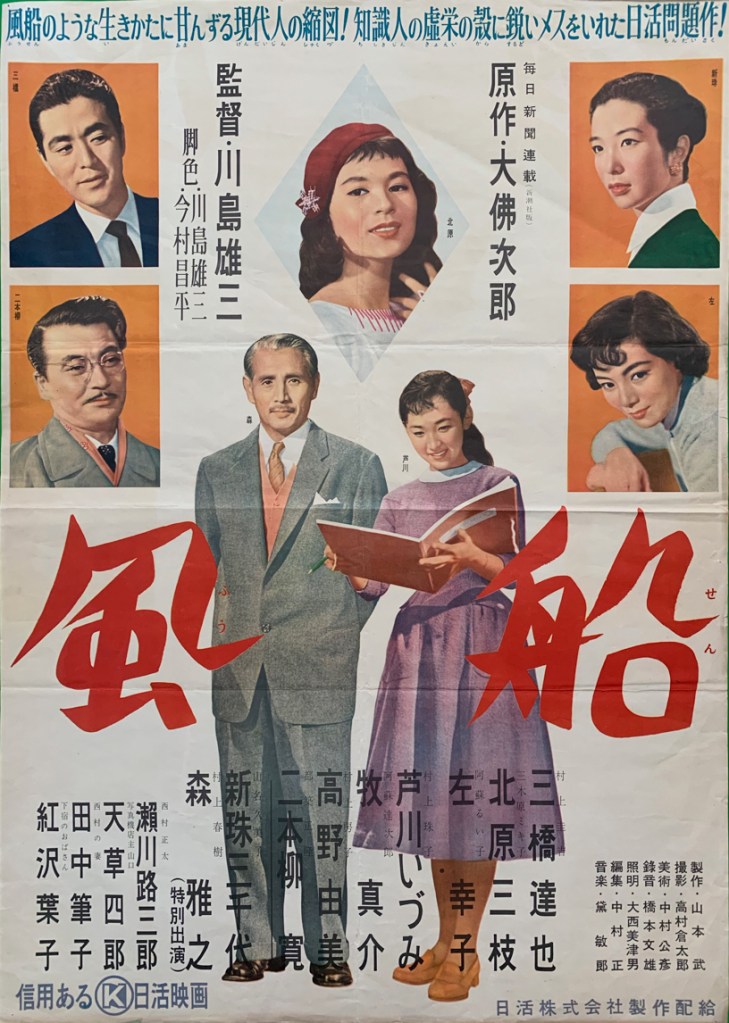
The Balloon (風船, Yuzo Kawashima, 1956)

The uncertainties of the post-war world are often conveyed through the familiar “cloud” metaphor, but in characteristic fashion Yuzo Kawashima opts for something earthier in the manmade “Balloon” (風船, Fusen). Less representative of its troubled humanists than the amoral villain Tsuzuki (Hiroshi Nihonyanagi) who likes to know which way the wind is blowing so he can go that way too, these balloons are up in the air because they’re afraid to land fearing the inevitable pop if they pick the wrong spot.

Our hero, former painter Murakami (Masayuki Mori), has become the head of a successful camera firm. His son, Keikichi (Tatsuya Mihashi), works with him, while his 20-year-old daughter Tamako (Izumi Ashikawa) is a reluctant student still living in the family home. Out of step with his times, he’s known as a decent and compassionate boss, offering his staff a significant wage increase in excess of that recommended by the union just because he thinks it’s the right thing to do. Unfortunately, Keikichi is much more like his conservative mother and does not quite share his father’s egalitarian principles. He’s currently engaged in a “relationship” with widowed bar hostess Kumiko (Michiyo Aratama) but treats her extremely badly, throwing money on the side table as he leaves her apartment to make it clear that he views himself as a customer and not as a lover. When Murakami re-encounters a family friend, Tsuzuki, at his father’s funeral it sets off a chain of events that will change his life completely. Now a shady nightclub entrepreneur, Tsuzuki is dead set on making his singer, Mikiko (Mie Kitahara), a star and thinks a good way to help make that happen might be to get her married to someone with money, like, for instance, Keikichi. 

Raised in Shanghai, singing in French, and forever wearing berets, Mikiko may indeed be the face of avaricious post-war youth, apparently having floated along with Tsuzuki halfway across the world in search of a place in the sun. Urged on by her manager, she goes to war against Kumiko who, in contrast to the “bar girl” image, is earnest and naive. Working as a hostess places her on the fringes of the sex trade, but does not necessarily imply that she makes a living by sleeping with her customers, and she certainly seems less than grateful to receive money from Keikichi whom she believes to be her boyfriend. Mikiko willingly weaponises her sex appeal and seemingly endures no consequences for doing so, while Kumiko is roundly rejected as a “fallen woman” and deemed an unsuitable match by Keikichi’s snooty mother. 

Tamako, by contrast, actively reaches out to Kumiko and attempts to make her a member of the family, never for a second considering that she might not be welcome because she can see that Kumiko is a “nice” person. Much more like her kindly father, she finds herself uncomfortable at home and mostly holes up in the attic painting. After suffering childhood polio, she’s been left with muscle weakness in her left arm and is treated like a child by her mother and brother who openly tell people that the illness has also made her “simple”. Despite all that, however, she sees only the best in people and desperately wants those around her to be happy. 

The difference in her own family is brought home to her when her father takes her with him on a business trip to the much quieter, more traditional Kyoto where he has reunited with a pair of youngsters whose late parents once rented him a room when he was temporarily displaced by post-war confusion. Like Kumiko, Rui (Sachiko Hidari) is a kind person in difficult circumstances. She too is working in a bar and has done some work as a photo model, even glamour shots to earn money to pay her brother’s university fees. Rui doesn’t want to go on doing that in the future, but doesn’t feel too bad about it either because she only exposed the outside of herself, and really who cares about that. 

Beginning to regret some of his life choices, Murakami wonders if he mightn’t be better to move back into the attic room in Kyoto and pray at the temple everyday like before instead of trying to make money he feels has slowly corrupted his family. Confronted with Keikichi’s near sociopathic self-involvement over his relationships with Kumiko and Mikiko, he comes to the conclusion that all he can do is cut him loose and hope he learns some humility through being forced to stand on his own two feet. Given a talking to by his father Keikichi doubles down with his misogynistic world view, insisting that “all women are whores” and all relationships are essentially transactions while claiming that he, himself, as well as men in general, is the real victim because he’s being forced to carry the can for the way the world works. Murakami isn’t having any of it, calmly asking him if he’d say the same thing to his mother, which he sheepishly admits he couldn’t. 

Mikiko likens Tsuzuki to one off his metaphorical balloons, pointing out that he was an imperialist in Shanghai and now seems to have it in for the bourgeoisie, but for all his cynicism he seems to have a kind of admiration for a woman like Kumiko who carried on loving one man no matter how poorly he treated her. If only he had a woman like that, he might have found a place to land and his life would have been very different, he muses. Murakami, meanwhile, has rejected the modern city, certain that his son is the way he is because his life has been too easy and access to wealth has given him a superiority complex that’s put him out of touch with ordinary people. Disappointed with his own family, he decides to make a new one with the two cheerful youngsters in Kyoto, hoping that he will at least be able to save his daughter from the ravages of a rapidly declining society which seems primed to swallow the sensitive whole.


Currently available to stream on Mubi in the US.

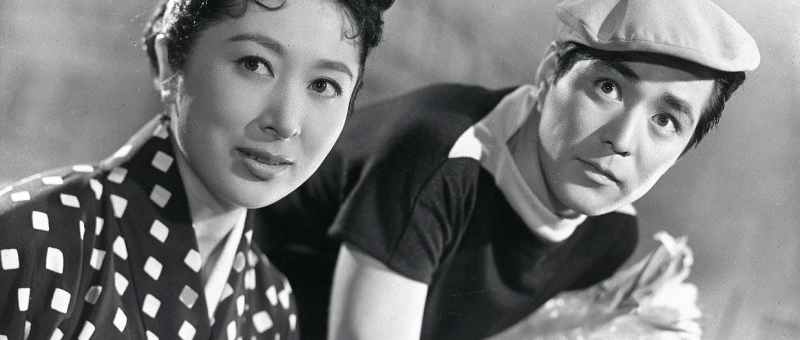
Till We Meet Again (あした来る人, Yuzo Kawashima, 1955)

(C) Nikkatsu 1955

“Men only want to treat women as pets” according to a disaffected housewife in Yuzo Kawashima’s Till We Meet Again (あした来る人, Ashita Kuru Hito). Given the well-meaning paternalism of her melancholy father, she may indeed be right. Her struggle, along with that of her husband, and of the lonely manageress of a dress shop, is in part to break free of paternalism, rejecting the “traditional” and breaking with the natural order of things to claim her own happiness. That, however, requires not only courage and conviction, but time and a willingness to endure hurtful failures. 

The hero, patriarch Kaji (So Yamamura), is a successful businessman. He’s married off his daughter, Yachiyo (Yumeji Tsukioka), to a promising young man, Kappei (Tatsuya Mihashi), but the marriage is unhappy. Kappei, a mountaineering enthusiast, rarely goes home – either out drinking with buddies in a bar with an Alpine theme, or away rock climbing in the mountains. Feeling neglected, Yachiyo resents her husband’s lack of interest and finds it increasingly difficult to get on with him, but her father proves unsympathetic, simply telling her she must put up with it and work harder at her marriage. A chance encounter on a train, however, kickstarts a change in Yachiyo’s outlook, while Kappei also finds himself drawn to a melancholy young woman who actively takes an interest in his mountain climbing career. 

Unfortunately, the young woman, Kyoko (Michiyo Aratama), is also in a strange “relationship” with Kaji who met her while she was a bar hostess in Ginza. Bonding with her for one reason or another, he funded her dress shop which has allowed her to escape the red light district, despite his oft repeated claim not to make frivolous investments. There is however, on his side at least, no “romantic” interest, his intentions are purely paternal. As Yachiyo said to her mother about Kappei, he is in a sense treating her as a kind of “pet”, to be loved and fussed over as an exercise in itself. He claims what he wants from her is his “lost youth”, presumably sacrificed for his business success, but she begins to believe herself painfully in love with him because, paradoxically, of his beneficence. Meanwhile, she meets Kappei by chance, never knowing his connection to Kaji, but bonding with him after taking in the little dog he brought home but was forced to give up by Yachiyo who claims to hate them (or, more accurately, living things). 

That ought to be as good a clue as any that Yachiyo and Kappei simply aren’t suited. Their marriage is already a failure which is making them both miserable, but they’re obliged to put on a show of being a happy couple for appearance’s sake. Yachiyo turns to her mother, Shigeno (Fukuko Sayo), for guidance, suddenly noticing that she looks much older than she’d remembered. Shigeno tells her that you age faster when you’ve nothing to do, busying herself by fussing over the cat (another living thing Yachiyo can’t abide). Yachiyo asks if she was ever happy with Kaji, but gets only the reply that she was “happy” to the extent that she knew she’d never have to worry about being hungry. Looking at her mother’s life, Yachiyo knows that she doesn’t want to end up in the same position, bored and aimless with no “dreams” to speak of. She doesn’t see why she has to stay in a loveless marriage and is convinced that only with another man could she ever truly be “herself”. 

The idea of divorce is still taboo, which is perhaps why her father insists she reconsider, aside of course from his business entanglements with Kappei. Talking it over the couple come to a mutual conclusion, that they only make each other unhappy and separating is the best decision for them both. Pretty much everyone, however, tries to talk them out of it – Kaji still wedded to the idea of marriage as an unbreakable sacrament, while new friend Sone (Rentaro Mikuni) is convinced he’s contributed to their marital discord.

Sone, a bumbling professor obsessed with his research into a rare type of fish and its possible ability to adapt to its environment, becomes friends with Yachiyo after a mix up with dinner bills on a train. She offers to introduce him to her father to see if he can help find financing, and thereafter generates a friendship which, in her mind at least, turns romantic. Sone, however, is a widower now only interested in his fish. Yachiyo falls for him because he’s a much softer, kinder presence than her husband and despite his dedication to his work, is keenly aware of the feelings of others even if he’s awkward in a charming sort of way when it comes to dealing with them. There is something, however, a little perverse in her immediate attraction to another emotionally distant man. She couldn’t stand Kappei’s obsession with the mountains, but could potentially become interested in Sone’s fish. Then again, that’s just as likely to be because Sone made a point of including her in his passion, where Kappei keeps his to himself, eventually sharing it with the more receptive Kyoko. 

Kaji, returning to the paternal, advises Kyoko that “romance is mutual deception”, or at least a kind of transaction and if she really wants to do this, she’d best be sure she’d be OK with regretting it at some point in the future. Previously, he’d told her that “marriage is pointless”, and she’d decided never to do it partly because she thought she was in love with him and he was married already. Her realisation that she’s just a kind of pet to him, a plaything he uses to feel useful while reclaiming his youth, pushes her towards an acceptance of her growing love for Kappei, an irony Kaji struggles with but eventually comes to understand. He really does want the best for her and will support her love story even though it’s also extremely inconvenient in providing an unwelcome link between the different branches of his life. Once Kyoko discovers the truth, however, her determination to fight for love begins to weaken as she reflects on an image of herself as a wicked and selfish woman betraying a man who’d been good to her, when in reality quite the reverse is true. 

Yachiyo, meanwhile, begins to understand that Sone does not necessarily return her feelings, perhaps still attached to the memory of his late wife, too preoccupied with his research, feeling awkward about her position as a married woman, or just not interested. So alarmed is he that he temporarily rushes off from his research to have a word with Kappei and is once again upset by his calm explanations that this is a decision they’ve come to mutually. It’s not because of his love for Kyoko, that only provided an excuse, but because they simply weren’t suited and made each other unhappy. Sone declares himself “sick of seeing beautiful things getting hurt”, but prepares to absent himself from the entire situation by returning to his research. Faced with the potential failure of their new romances, neither Yachiyo or Kappei reconsider their decision to divorce. Kappei retreats to his beloved mountains, while Yachiyo refuses an offer from her father to return home with him, electing to remain in Tokyo and live her own life.  

Now an old man, Kaji struggles to understand the young but somehow admires them for being what he couldn’t be. He describes them as having something pure that he did not have in his youth, but wonders if that purity hasn’t in a sense allowed them to be “damaged” in a way he never has been. Still, he thinks that’s probably a good a thing, because it allows them to become more themselves. Things might not work out right now, and it might hurt, but there’s always tomorrow. He admires the young people because they’re in the process of becoming whole and will be able to continue on their own journeys as complete people while he can only proceed down this corridor, unable to access the post-war future by actively rejecting the rigidity of the traditionalist past.


Currently available to stream on Mubi in the US.

Original trailer (no subtitles)

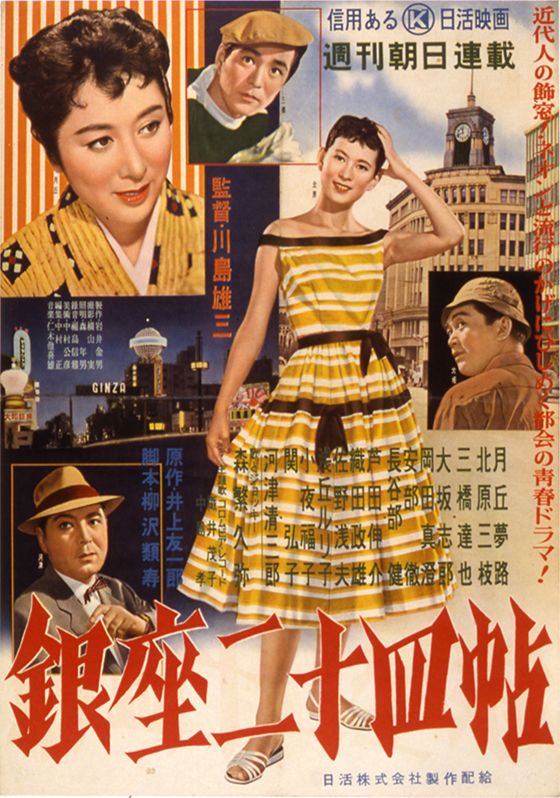
Tales of Ginza (銀座二十四帖, Yuzo Kawashima, 1955)

“If we all work together we can make Ginza’s night, no the whole world, bright and at peace” insists the hero of Yuzo Kawashima’s chronicle of changing times Tales of Ginza (銀座二十四帖, Ginza 24 Chou), trying to sell a brighter post-war future to a jaded reactionary. By 1955, the consumerist revolution was already on the horizon, and nowhere did it beckon as invitingly as in the upscale Ginza with its elegant department stores and swanky nightlife, but as Hiroshi Shimizu’s Tokyo Profile had shown two years earlier, it wasn’t all glitz and glamour. The world looked very different to the people who lived and worked in the city within a city than it did to those who just dropped in to have a good time. 

Our hero, the incongruously named Mr. Coney (Tatsuya Mihashi), is an earnest florist doing his best to brighten up the city. He’s taken three orphaned teenage girls into his shop, allowing them to support themselves honestly while he teaches them valuable skills, and has also employed the rather less earnest Jeep (Asao Sano). Jeep has had trouble with drug dependency in the past and, Coney fears, is drawn to the easy pleasures of the post-war underworld. The main drama kicks into gear when the upper middle-class Wakako (Yumeji Tsukioka) wanders past the shop and fancies a few roses, asking one of the girls to deliver them to her home later in the day. 

Wakako is currently in the middle of arranging some paintings which belonged to her late father for an exhibition in a gallery where she hopes to sell them. As we discover, she’s in need of money fast because she’s become estranged from her husband, Kyogoku (Seizaburo Kawazu), who has been seduced by post-war criminality. Wakako wants a divorce, but the situation is complicated by the fact her mother-in-law has taken custody of her daughter. In the course of sorting through paintings, the gallery owner spots one Wakako didn’t really want to part with – a portrait of herself as a teenager painted by one of her father’s apprentices when they lived in Manchuria during the war. The painting is signed “G.M”, and the only concrete thing Wakako can remember is that the boy was called “Goro” and was a beautiful, kind soul whom she’d dearly like to see again. 

The “G.M” mystery begins to whip up a small storm in the already volatile Ginza. Coney comes to believe that his older brother, whom he’d long believed to be dead, may be the man Wakako’s looking for but he doesn’t really want to say so until he’s 100% certain. Meanwhile, there are a surprising number of GMs in the city, including a rather sleazy, womanising “doctor” (Toru Abe) who goes to the papers and tells them he painted the picture though Wakako is not convinced and would be a little disappointed to think the man she wondered about all those years turned out to be a cheesy lounge lizard. Other contenders include a melancholy baseball scout (Shinsuke Ashida) who turns out to have connections to the underworld, and, unbeknownst to Coney, the drugs kingpin of post-war Japan known as the “G.M. of Ginza”. 

Drugs are something that Coney is particularly worried about. He’s seen the effect they’re having on his city, and resents that their influence is making Ginza “dark”. The orphaned girls he has working at the shop all lost their parents to drug abuse, and Coney has made getting Jeep off the stuff a primary goal. Jeep, however, is unconvinced. He thinks Coney is a sucker, and that floristry isn’t a profession for a grown man. In part, he’s kicking back against Coney’s well-meaning paternalism, but is also attracted by the flashing neon signs and easy pleasures of the modern Ginza of which the drugs trade is an increasingly big part. For Jeep, the post-war future is one of amoral and thoughtless hedonism, getting rich quick though low level, “innocent” crime, like peddling drugs and porn. 

Wakako too is tempted by that future, though mostly through lack of other options. She’s planning to open a bar with the money from the paintings, but eventually decides to go into business with Coney, working for his brighter future in the florist’s. The pair perhaps fall in love, but the future is still too uncertain for romance. Wakako refuses to see her husband, insisting only on obtaining a divorce and with it her freedom. Coney volunteers to talk to him on her behalf, essentially arguing that his wife will he happier with him because the kind of future they desire is essentially the same. Kyogoku cannot really argue with him. He is a sad and broken man who realises that his choices have robbed him of the future he desired, forced onto the run unable to see his wife and daughter. He justifies himself with the rationale that if he didn’t run drugs in Ginza, “foreigners” would take over and crime would be rampant. He claims that life is survival of the fittest, and that he has no need of love. Kyogoku never felt loved by the aristocratic mother who raised him only as an heir to their name. The only time he felt loved was by his best friend who was, he says, murdered because he lacked power and because his good heart made him weak. 

There maybe something a little reactionary in Coney’s moral absolutism. He condemns his brother for getting involved with student politics which made him “hate Japan”, though he later signs a student petition himself, and has only contempt for Ginza’s famous nightlife while willingly wandering through it selling flowers to romantically-minded guys in bars, but does his best to avoid judgment as he tries to coax those he feels have strayed back onto a better path. Coney believes in a brighter future where good people work together peacefully, while the Kyogokus of the world are content to plunge us all into darkness in a nihilistic pursuit of empty pleasures. No one really “wins” in the end. Coney gets some answers, but remains too diffident to fight for love, while Wakako is perhaps prevented from doing so in feeling called towards another kind of future, which is in effect the past, because of her maternity. Ginza is changing, and you can’t change it back, but you can do your best to be your best, saying it with flowers if with nothing else.


Currently available to stream on Mubi in the US.

Opening titles (no subtitles)

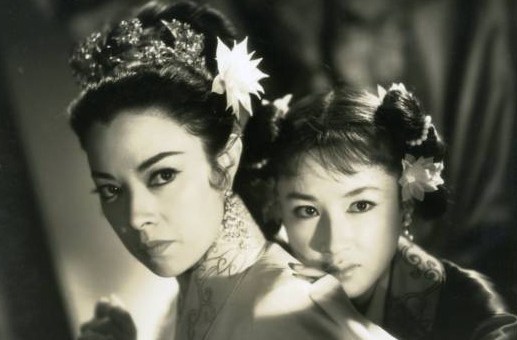
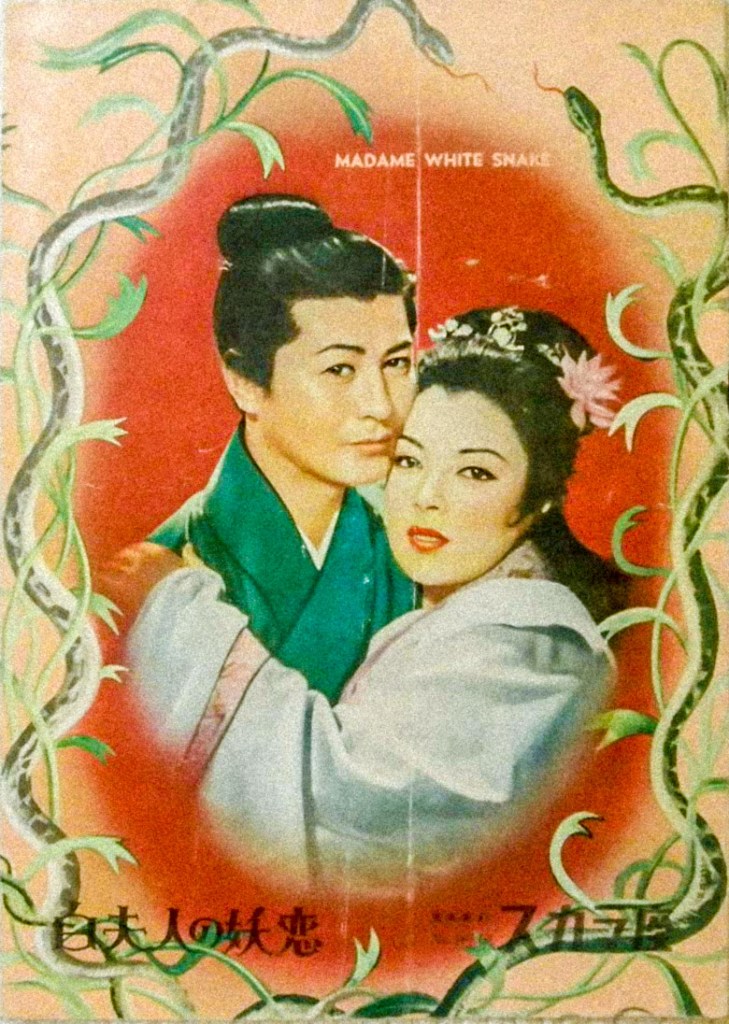
Madame White Snake (白夫人の妖恋, Shiro Toyoda, 1956)

A studio director at Toho, Shiro Toyoda was most closely associated with adaptations of well respected works of literature, often with an earthy, humanist touch. He might then be an odd fit for a tale of high romance co-produced with Hong Kong’s Shaw Brothers and inspired by a classic Chinese legend. Madame White Snake (白夫人の妖恋, Byaku Fujin no Yoren) effectively drops some of Toho’s top talent, including “pan-Asian” star Shirley (Yoshiko) Yamaguchi (AKA Li Xianglan / Ri Koran), into a contemporary Hong Kong ghost movie with Toyoda doing his best to mimic the house style. 

As in the classic legend, fate is set in motion when herbalist Xu-xian (Ryo Ikebe) allows “noblewoman” Bai-niang (Shirley Yamaguchi) and her maid Xiao-qing (Kaoru Yachigusa) to board a boat he is riding to escape a storm. The pair bond because they are both orphans out in the rain to pay their filial respects to their late parents on tomb sweeping day. Disembarking, Xu-xian lends the ladies his umbrella, vowing to visit their house the next day after his rounds to reclaim it. When he arrives, Xu-xian is greeted by a near hysterical and extremely romantic Bai-niang who has apparently fallen deeply in love with him because of his pure heart. She proposes marriage, but Xu-xian is wary. He is after all just a poor boy, a herbalist living with his older sister and her husband. He has no money to get married and Bai-niang is a noble woman from a good family, society simply wouldn’t allow it. Xu-xian tries to escape, but his gentle words of refusal only wound Bia-niang’s heart. 

Hoping to smooth the situation, Xiao-qing decides to give Xu-xian a small fortune in silver taels so the money issue will be solved. Strangely, the plan appears to work. Xu-xian quickly gets over his reluctance to accept money from a wealthy woman who wants to marry him and returns to being in love and excited, selling his newfound hope for the future to his sister by showing her the taels. It is, however, not quite that simple. The silver turns out to be stolen as evidenced by a mark of fire on its surface. Xu-xian falls under suspicion as a thief and comes to resent Bai-niang for placing him in such a difficult and embarrassing position. 

Nevertheless, despite all the strange goings on such as the suddenly “abandoned” house, the green smoke, and vanishing women, Xu-xian does not seem to suspect that Bai-niang is not fully human, and is only angry with her for misusing him. In a motif which will be repeated, however, he is eventually won over. After taking a job in his sleazy uncle’s inn, he re-encounters Bai-niang and realises she really is the one for him. But as they begin to build their life together, launched with an unwise loan from the sleazy uncle who can’t seem to keep his eyes (and occasionally hands) off Bai-niang, doubt begins to creep in. Those small cracks are deepened when Xu-xian is accosted by a man who announces himself as a Taoist from Mount Ji and tells him that he has an evil aura over his head, encouraging him to believe that an evil spirit is slowly capturing his heart which why he’s a little bit afraid to go home. The priest gives him some useful talismans, which are of course quite bad news for Bai-niang who now knows that her husband secretly doubts her. 

Meanwhile, prepared to do “anything” to make the man she loves happy, Bai-niang has come to the strange conclusion that Xu-xian’s moodiness is down to the fact that their medicine shop isn’t doing so well. Unfortunately, her big idea is poisoning the local well to make everyone think there’s a plague so they’ll have to buy more of her potions. It’s a fairly nefarious plan, but apparently all for love. As in the original tale, however, the real crisis once again comes with the randy uncle who uses the pretext of a local festival to try and get Bai-niang drunk on special wine that is known to unmask spirits. Realising that his wife is a little bit otherworldly sends Xu-xian into a coma, while Bai-niang goes to ask the gods for help, only to be undercut by the annoying Taoist priest who wakes Xu-xian up by convincing him his wife’s “evil”. 

If you don’t want people to think you’re “evil”, trying to drown the entire town might not be the best move. Bai-niang’s refusal to give up on Xu-xian even when he constantly tries to reject her places her at odds with loyal servant Xiao-qing who is equal parts enraged on her behalf and exasperated that she can’t see sense. Bai-niang tells the gods that the only witchcraft she used was the witchcraft of love even if that love caused her to try and poison the entire town, but now regards herself as nothing more than Xu-xian’s wife and is willing to renounce her powers in order to save him. Once again, Xu-xian has a sudden change of heart, avowing that there are human women with the heart of a snake, and Bai-niang is a woman to him even if she’s a snake spirit which is, apparently, the only thing that matters. Still, theirs is a love this world doesn’t understand, and so only in a better one can they ever be together.


Original trailer (no subtitles)