The Fossil (化石, Masaki Kobayashi, 1975)

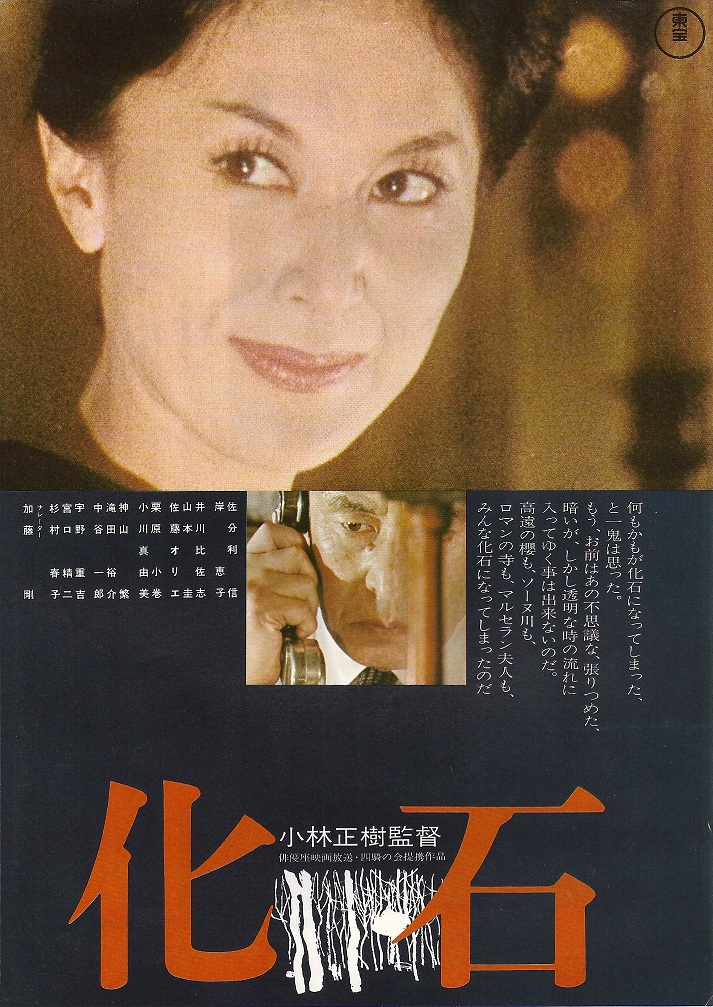
fossilThroughout Masaki Kobayashi’s relatively short career, his overriding concern was the place of the conscientious individual within a corrupt society. Perhaps most clearly seen in his magnum opus, The Human Condition, Kobayashi’s humanist ethos was one of rigid integrity in which society’s faults must be spoken and addressed in service of creating a better, fairer world. As might be expected, his often raw, angry social critiques were not always what studios were looking for, especially heading into the “difficult” 1970s which saw mainstream production houses turning on the sleaze to increase potential box office. Reluctantly, Kobayashi headed to TV on the condition he could retain some of his footage for a feature film. Adapted from the 1965 novel by Yasushi Inoue, The Fossil (化石, Kaseki) revisits many of Kobayashi’s recurrent themes only in a quieter, more contemplative way as an apparently successful man prepares to enter the final stages of his life, wondering if this is all there really is.
Itsuki (Shin Saburi), a selfmade man who hit it big in Japan’s post-war boom town by founding his own construction firm which currently employs over 1000 people, is about to catch a plane to Europe for a trip that’s pleasure disguised as business. As he leaves, his younger daughter informs him he may be about to become a grandfather for the second time after the birth of her niece, though she is worried and is not sure she wanted a child at this precise moment. Brushing aside her nervousness with an odd kind of fatherly warmth, Itsuki seems pleased and states that he hopes it’s a boy this time. Nevertheless he leaves abruptly to catch his plane. During the flight he begins to become depressed, reflecting that since his wife has died and both of his daughters have married and have (or are about to have) children of their own he is now totally alone. Never before has he faced a sensation of such complete existential loneliness, and his arrival in Paris proves far less invigorating than he had originally hoped.

Wandering around with his secretary, Funazu (Hisashi Igawa), who has accompanied him on this “business” trip, Itsuki catches sight of an elegant Japanese woman in a local park and is instantly captivated. Improbably spotting the same woman several times during his stay, Itsuki later discovers that she is the wife of a local dignitary though not universally liked in the Japanese ex-pat community. At this same work dinner where he discusses the merits of Madame Marcelin (Keiko Kishi), Itsuki experiences a severe pain in his abdomen which makes it difficult for him to stand. Feeling no better back at the hotel, Funazu arranges a doctor’s visit for him. The doctors seem to think he should head straight home which Itsuki is not prepared to do but when he masquerades as Funazu on the phone to get the full verdict, he finds out it’s most likely inoperable intestinal cancer and he may only have a year or so to live.

This unexpected – or, perhaps half sensed, news sends him into a numbing cycle of panic and confusion. At this point Itsuki begins his ongoing dialogue with the mysterious woman, arriving in the guise of Madame Marcelin only dressed in the traditional black kimono of mourning. Telling no one, Itsuki embarks on a contemplative journey in preparation for a union with his dark lady in waiting which takes him from the Romanesque churches of the picturesque French countryside back to Japan and the emptiness, or otherwise, of his settled, professionally successful life.

Like the hero of Kurosawa’s similarly themed Ikiru, Itsuki’s profound discovery is that his overwhelming need for personal validation through work has led him to neglect human relationships and may ultimately have been misplaced. On his return to Japan, Itsuki makes the extremely unusual decision to take a day off only to receive a phone call regarding an old friend and former colleague who, coincidentally, has aggressive cancer and has been asking to see him. Not wanting to mention his own illness, Itsuki parts with his friend feeling it may be for the last time but eventually returns for a deeper conversation in which he probes him for his views about his life so far and what he would do if he had, say, another year to live. His friend has come to the same conclusion, that his working life has largely been a waste of time. What he’d do differently he couldn’t rightly say, things are as they are, but if he had more time he’d want to do “good” in the world, make a positive change and live for something greater than himself.

Itsuki isn’t quite as taken with the idea of “goodness” as a life principle, though he does begin to re-examine himself and the way he has treated the people in his life from apologising to the stepmother he failed to bond with as a child to reconnecting with an old army buddy who maybe the closest thing he’s ever had to a “true friendship” – something which the mysterious woman reminded him he’d been missing for a very long time. Meeting Teppei again, Itsuki is introduced to his walls of fossilised coral and all of their millions of years of history frozen into one indivisible moment. Feeling both infinite and infinitesimal, Itsuki is reminded of his immediate post-war moment of survivor’s guilt in which he and his friend agreed that they’ve each been living on borrowed time ever since.

Given a sudden and unexpected chance of reprieve, Itsuki is even more confounded than before. Having made a friend of death, he may now have to learn to live again, even if his mysterious lady reminds him that she will always be with him, even if he can no longer see her. Though he’d wanted nothing more than to live to see the cherry blossoms in the company of the living Madame Marcelin whose vision it was that so captivated him, his old life is one he cannot return to and must be preserved in amber, frozen and perfect like Teppei’s fossilised coral.

Tonally European, perhaps taking inspiration from Death in Venice, and bringing in a Christianising moral viewpoint pitting the values of honest hard work against genuine human feeling, The Fossil is the story of a man realising he has been sentenced to death, as we all have, and makes his peace with it only to learn that perhaps his sentence will be suspended. Yet for a time death was his friend and her absence is a void which cannot be filled. This life, this new life so unexpectedly delivered, must be lived and lived to the full. Itsuki, who had prepared himself to die must now learn to live and to do so in a way which fulfils his own soul. Originally filmed as a 13 part TV series now reduced to three hours and twenty minutes, The Fossil’s only consolation to its medium is in its 4:3 frame which Kobayashi’s unobtrusive style fully embraces with its ominous distance shots, slow zooms and eerie pans backed up by Toru Takemitsu’s sombre score. Kobayashi, who’d given us a career dedicated to railing against the injustices of the system, suddenly gives us the ultimate rebellion – against death itself as a man who’d prepared himself to die must judge the way he’s lived on his own terms, and, finding himself wanting, learn to live in a way which better fits his personal integrity.


Lullaby of the Earth (大地の子守歌, Yasuzo Masumura, 1976)

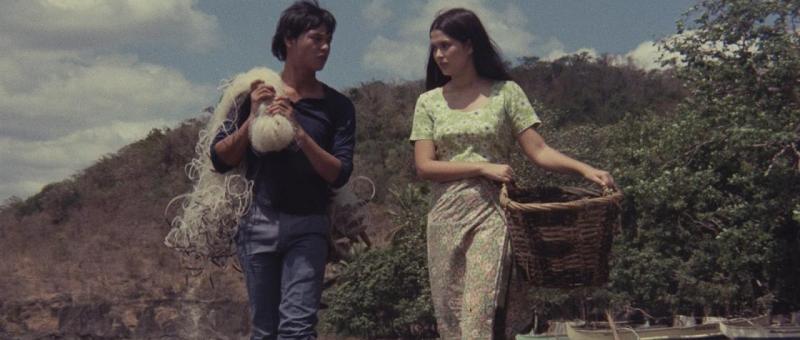
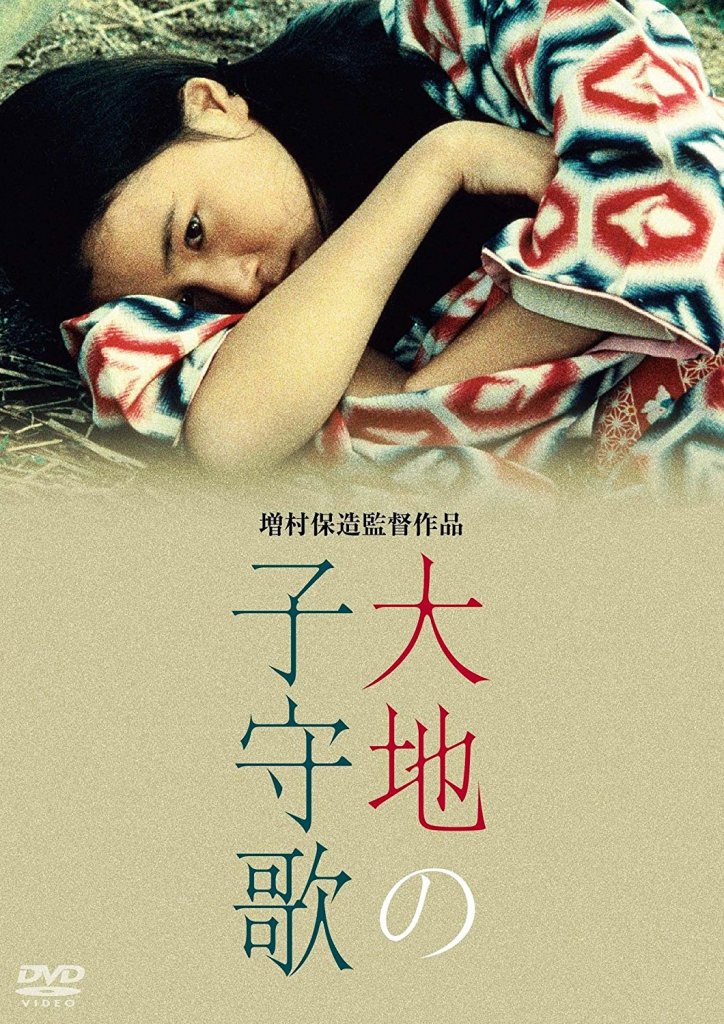
lullaby-of-the-earthYasuzo Masumura is best remembered for his deliberately transgressive, often shockingly grotesque critiques of Japanese society and its conformist overtones. Lullaby of the Earth (大地の子守歌, Daichi no Komoriuta) is one of his few completely independent features, filmed after the bankruptcy of Daiei where Masumura had spent the bulk of his early years. As such, it is quite an exception in terms of his wider career both in terms of its production and in its earthy, spiritual themes. Adapted from the 1974 novel by Kukiko Moto, Lullaby of the Earth is the story of an abandoned and betrayed woman but one who also draws her strength from the Earth itself.
13 year old Rin (Mieko Harada) has been living with her adopted grandmother in a remote mountain community. Returning home one day triumphantly carrying a rabbit for dinner, Rin discovers that her grandmother has passed away. Being just a child and now alone and frightened, Rin does not know what to do and later receives harsh treatment from the villagers from whom she temporarily conceals her grandmother’s death. With no one to look after her, Rin is approached by a kind seeming man in Western dress who offers her a good job on a nearby island which, he says, pays well and offers a much better quality of life than Rin’s current survivalist setup in the mountains. Rin has heard tales of men like him before and is not taken in by his arguments, even when he suggests she could use the money to buy a proper grave for her grandmother. She is, however, caught when he mentions taking her to see the sea – something she has been longing for for most of her life.

However, Rin’s pure joy at the waves and endless horizons of the shoreline is short lived when reality hits home and she realises she has been sold to a brothel. The brothel owners are not a bad sort, considering, and intend on using her as a servant until she comes of age but Rin is not having any of it. Refusing to eat, work, or wear her new clothes, Rin is proving to be a very bad investment but changes her tune when she strikes up a friendship with a girl who works at a local store who convinces her that her rebellion is misplaced. Work hard and pay off your debt, she says, and they’ll let you go home. Rin decides to do just that, and with her characteristic energy, but her journey home is not to be such a straight forward experience.

Lullaby of the Earth maybe unusual in Masumura’s filmography due its period setting and gentler, more spiritually orientated progression but Rin is, in many ways, a typical Masumura heroine. A true child of nature, Rin is athletic, at home in the forests and woods trapping rabbits and building fires. Her downfall is brought about precisely because of her desire for total freedom. Longing to see the sea with all of the freedom and possibilities that it suggests, Rin allows herself to be taken in by the false promises of a procurer (presumably alerted by a less than helpful villager), little knowing that she’s damned herself for a period of at least three years.

Made to suffer numerous degradations from the humiliation of her servitude, to a beating that leaves her half dead and her final forced prostitution, Rin maintains her resistance in whichever way she can. Striving for control, Rin takes on a masculine quality defined by strength and agility rather than elegance and beauty. Once again longing for the sea, Rin begs to be allowed to row the boat that takes the girls out to find business from passing ships. “If you take my oar you’ll be in trouble” she later exclaims, clinging to her source of male power even whilst being forced into the gaudy brothel kimono. Displaying her own ability for active choice even within her controlled environment, Rin takes the scissors to her own hair, cutting it short like a man’s.

Given the chance to escape the brothel for a comfortable life as the mistress of a wealthy man, Rin refuses. A decision which seems bizarre to many of the other girls, but Rin will have her freedom back in its entirety – she will not swap one cage for another as the prized possession of a some other authority. Meeting a man who claims he may be able to help her, Rin starts working overtime to save the money to escape with the consequence that her health suffers, leading to almost total blindness followed by listless depression. Only at this point does her inner fire start to waver, but it is never extinguished allowing her to finally make a break for it even if she literally cannot see where she is headed.

Rin’s guiding voices come from the Earth itself as mediated by the kindly internal presence of her grandmother. The soil is sacred, as her grandmother told her. Rub soil into your wounds and you’ll soon be healed. In times of trouble, lie against the Earth’s surface and you will know what to do. Rin wants to find the way back to her mountain, but it may no longer exist for her. Nevertheless, the Earth itself is singing and will tell her where to go, so long as she can find the strength to listen.

Masumura begins the film with Rin at prayer, dressed in the white clothes of a pilgrim and dutifully following the temple paths around the island of Shikoku. Suffering a final PTSD flashback of all she’s suffered since her grandmother’s passing, Rin is once again comforted by the sounds of the Earth, beginning with her grandmother’s voice to which more are slowly added, cheering her on with chorus of support as she walks towards the end of her journey. A wonderful, early leading performance for Mieko Harada, Lullaby of the Earth is a far more new age exercise than Masumura’s generally cynical approach to human spirituality would usually allow but neatly tallies with his primary concerns in its heroine’s eternal quest for her own autonomy, body and soul, as she traverses a cold and unforgiving world.


Blue Christmas (ブルークリスマス , Kihachi Okamoto, 1978)

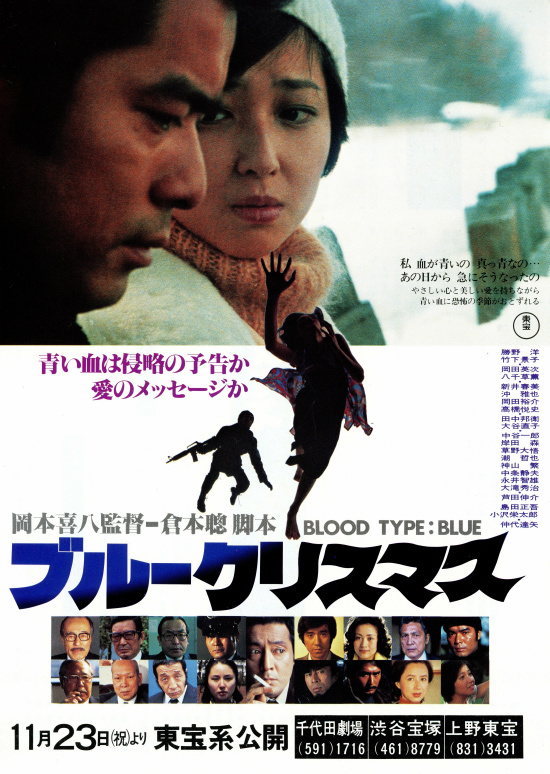
blue-christmasThe Christmas movie has fallen out of fashion of late as genial seasonally themed romantic comedies have given way to sci-fi or fantasy blockbusters. Perhaps surprisingly seeing as Christmas in Japan is more akin to Valentine’s Day, the phenomenon has never really taken hold meaning there are a shortage of date worthy movies designed for the festive season. If you were hoping Blue Christmas (ブルークリスマス) might plug this gap with some romantic melodrama, be prepared to find your heart breaking in an entirely different way because this Kichachi Okamoto adaptation of a So Kuramoto novel is a bleak ‘70s conspiracy thriller guaranteed to kill that festive spirit stone dead.

A Japanese scientist disgraces himself and his country at an international conference by affirming his belief in aliens only to mysteriously “disappear” on the way back to his hotel. Intrepid reporter Minami (Tatsuya Nakadai) gets onto the case after meeting with a friend to cover the upcoming release of the next big hit – Blue Christmas by The Humanoids. His friend has been having an affair with the network’s big star but something strange happened recently – she cut her finger and her blood was blue. Apparently, hers is not an isolated case and some are linking the appearance of these “Blue Bloods” to the recent spate of UFO sightings. Though there is nothing to suggest there is anything particularly dangerous about the blue blood phenomenon, international tensions are rising and “solutions” are being sought.

A second strand emerges in the person of government agent, Oki (Hiroshi Katsuno), who has fallen in love with the assistant at his local barbers, Saeko (Keiko Takeshita). Responsible for carrying out assassinations and other nefarious deeds for the bad guys, Oki’s loyalty is shaken when a fellow officer and later the woman he loves are also discovered to be carriers of the dreaded blue blood.

Okamoto lays the parallels on a little thick at times with stock footage of the rise of Nazism and its desire to rid the world of “bad blood”. Sadly, times have not changed all that much and the Blue Bloods incite nothing but fear within political circles, some believing they’re sleeper agents for an alien invasion or somehow intended to overthrow the global world order. Before long special measures have been enforced requiring all citizens to submit to mandatory blood testing. The general population is kept in the dark regarding the extent of the “threat” as well as what “procedures” are in place to counter it, but anti Blue Blood sentiment is on the rise even if the students are on hand to launch the counter protest in protection of their blue blooded brethren, unfairly demonised by the state.

The “procedures” involve mass deportations to concentration camps in Siberia in which those with blue blood are interrogated, tortured, experimented on and finally lobotomised. This is an international operation with people from all over the world delivered by their own governments in full cognisance of the treatment they will be receiving and all with no concrete evidence of any kind of threat posed by the simple colouring of their blood (not that “genuine threat” would ever be enough to excuse such vile and inhuman treatment). In the end, the facts do not matter. The government has a big plan in motion for the holiday season in which they will stage and defeat a coup laid at the feet of the Blue Blood “resistance”, ending public opposition to their anti-Blue Blood agenda once and for all.

Aside from the peaceful protest against the mandatory blood testing and subsequent discrimination, the main opposition to the anti-Blue Blood rhetoric comes from the ironically titled The Humanoids with the ever present Blue Christmas theme song, and the best efforts of Minami as he attempts to track down the missing scientist and uncover the conspiracy. This takes him around the world – firstly to America where he employs the somewhat inefficient technique of simply asking random people in the street if they’ve seen him. Laughed out of government buildings after trying to make serious enquires, Minami’s last hope lies in a dodgy part of town where no one would even try to look, but he does at least get some answers. Unfortunately, the information he receives is inconvenient to everyone, gets him fired from the investigation, and eventually earns him a transfer to Paris.

In keeping with many a ‘70s political thriller, Blue Christmas is bleaker than bleak, displaying little of Okamoto’s trademark wit in its sorry tale of irrational fear manipulated by the unscrupulous. In the end, blue blood mingles with red in the Christmas snow as the bad guys win and the world looks set to continue on a course of hate and violence with a large fleet of UFOs apparently also on the way bearing uncertain intentions. Legend has it Okamoto was reluctant to take on Blue Christmas with its excessive dialogue and multiple locations. He had a point, the heavy exposition and less successful foreign excursions overshadow the major themes but even so Blue Christmas has, unfortunately, become topical once again. Imperfect and cynical if gleefully ironic in its frequent juxtapositions of Jingle Bells and genocide, Blue Christmas’ time has come as its central message is no less needed than it was in 1978 – those bleak political conspiracy thrillers you like are about to come back in style.


Original trailer (No subtitles)

Inn of Evil (いのちぼうにふろう, Masaki Kobayashi, 1971)

inn-of-evil“Sometimes it feels good to risk your life for something other people think is stupid”, says one of the leading players of Masaki Kobayashi’s strangely retitled Inn of Evil (いのちぼうにふろう, Inochi Bonifuro), neatly summing up the director’s key philosophy in a few simple words. The original Japanese title “Inochi Bonifuro” means something more like “To Throw One’s Life Away”, which more directly signals the tragic character drama that’s about to unfold. Though it most obviously relates to the decision that this gang of hardened criminals is about to make, the criticism is a wider one as the film stops to ask why it is this group of unusual characters have found themselves living under the roof of the Easy Tavern engaged in benign acts of smuggling during Japan’s isolationist period.

Led by the innkeeper Ikuzo (Kan’emon Nakamura), the Easy Tavern is, effectively, the hideout of a smuggling gang conveniently located on a small island in the middle of a river where they can unload goods from the Dutch boats before shipping them on to Edo. Everything had been running smoothly, but the friendly policeman has been moved on and the new guy seems very straight laced. The gang’s routine existence changes one night when they receive two unexpected visitors – a young man they save from a beating in the street, and a drunk who wanders in looking for sake. The younger man, Tomijiro (Kei Yamamoto), brings a sad story with him in that all of his troubles have been caused by trying to save the woman he loves from being sold to a brothel. Moved by Tomijiro’s innocent ardour, even the most hardhearted residents of the Easy Tavern become determined to help him. Accepting a job everyone had a bad feeling about in order to get the money for Tomijiro to buy back his lady love before it’s too late, the gang’s unusual decision to risk their lives for someone else’s happiness may be the first and last time they ever do so.

The residents of the Easy Tavern have various different backstories, but the thing they all have in common is having been rejected by mainstream society at some point in their lives. The most high profile, Sadashichi (Tatsuya Nakadai), is known as “The Indifferent” which is both apt and slightly ironic. Sullen and cynical, he puts on a show about caring for nothing and no one but, as inn keeper’s daughter Omitsu (Komaki Kurihara) has figured out, it’s more that the opposite it true – he cares too much about everything. Abandoned as a child, Sadashichi’s sad story is that he once thought his saw his mother long after they were separated but killed her because she’d fallen into prostitution. Then again, perhaps it was just a woman who looked like her, or perhaps he made he whole thing up. Coming across a lost baby bird shortly after killing a man, Sadashichi is determined to look after it but is later distressed by the words of the drunk who reminds him that the bird’s mother is probably going crazy with worry. Sadashichi may identify with this lost little bird, but his empathy also extends to Tomijiro’s plight as his plaintive looks and gloomy face prompt him into action, if only to make them go away.

Similarly, the other members including “The Living Buddha” – a rabidly bisexual former monk thrown out of his temple for his lascivious ways, an effeminate homeless man, a stutterer, and an invalid all have reasons for living outside the law. As the sympathetic inn keeper later tries to explain to a policeman, most of these men are people who’ve faced rejection in one way or another. Craving sympathy, they’ve turned violent and suspicious, pushed away from the very things they wanted most. Far from an Inn of Evil, the Easy Tavern is the only place where these people have been able to find acceptance, building a community of lost souls from those cast out from society at large.

The decision to try and help Tomijiro to rescue his childhood sweetheart, cruelly sold by her selfish and uncaring father, is, in once sense, a selfless one but perhaps also reminds them of all the times they were also betrayed or abandoned and no one came to help. Even knowing the plan is unlikely to end well, the inn keeper is proud of his men’s decision, if they didn’t try to help the girl no one else would. They may be throwing their lives away in a pointless endeavour, but if they don’t at least try then what’s the point in living at all. This more than anything expresses Kobayashi’s constant preoccupation throughout his career in pointing to the essential goodness of those who refuse to simply accept acts of injustice as normal and stand up to oppose them, even if their resistance will produce little or no actual change.

Filming in a crisp black and white, Kobayashi creates an eerie atmosphere aided by Toru Takemitsu’s strangely ethereal score. The world of the The Easy Tavern is a dark one in which cruelty and betrayal lie at every turn and men ruin themselves through thoughtless and reckless decisions, but the best of humanity is to be found among this gang of outlaws who collectively decide it’s world risking their lives for someone else’s love story. Filled with impressive visual imagery including the strange sight of the looming bright white police lanterns and the impressively staged last stand as Sadashichi holds off the troops for Tomijiro to escape, Inn of Evil is a tightly controlled, minutely detailed character drama in which men who’d throw their lives away for nothing find that their sacrifice has not been in vain.


Lone Wolf and Cub: White Heaven in Hell (子連れ狼 地獄へ行くぞ!大五郎, Yoshiyuki Kuroda, 1974)

lone-wolf-and-cub-white-heaven-in-hell-japanese Ogami (Tomisaburo Wakayama) and his son Daigoro (Akihiro Tomikawa) have been following the Demon Way for five films, chasing the elusive Lord Retsudo (Minoru Oki) of the villainous Yagyu clan who was responsible for the murder of Ogami’s wife and his subsequent framing for treason. The Demon Way is never easy, and Ogami has committed himself to following it to its conclusion, but recent encounters have broadened a conflict in his heart as innocents and seekers of justice have died alongside guilty men and cowards. Lone Wolf and Cub: White Heaven in Hell (子連れ狼 地獄へ行くぞ!大五郎, Kozure Okami: Jigoku e Ikuzo! Daigoro) moves him closer to his target but also further deepens his descent into the underworld as he’s forced to confront the wake of his ongoing quest for vengeance.

Ogami and Daigoro have made it to Snow Country, meanwhile Lord Retsudo is receiving a dressing down from a superior over his total failure to eliminate the Lone Wolf or his Cub. It seems Ogami has already despatched all three of Retsudo’s sons, and so now Retsudo pledges his daughter, Kaori (Junko Hitomi), skilled in the use of daggers and every bit as fine a warrior as her defeated brothers, in the mission to end the Ogami threat.

Things do not go to plan and Retsudo is forced to approach his one remaining son. An illegitimate child born to a concubine, disavowed, and hidden away in the mountains, Hyoe (Isao Kimura) is not well disposed to his estranged father’s request to save the Yagyu clan to which he feels only rage and resentment. Sending his father away, Hyoe nevertheless decides to take on Ogami in the hope of embarrassing the Yagyu by taking him out first. Possibly having spent too much time alone, Hyoe’s plan involves a number of strange rituals beginning with resurrecting three of his men as emotionless (yet intelligent) zombies meant to terrify Ogami and his son into submission.

Throughout the series, we’ve seen Ogami’s world darken as the straightforward missions of eliminating corrupt lords eventually gave way to more morally dubious assignments with the tragic story of Oyuki and later the assassination of an entire family in order to preserve the legitimate arm of a historical clan. Along the way, Ogami has met “true samurai” and villainous cowards, but his encounters with honest men and women have only served to shake his heart as he guides his young son onwards bound for hell by way of death or violence.

The pair have never been afraid before, but Hyoe’s plan hinges on pushing Ogami’s mind into those dark places, preventing him from fighting back against his supernatural soldiers. Death has always surrounded them, but the price of Ogami’s vengeance is brought home to him when Hyoe’s forces unceremoniously wipe out the entire population of an inn where Ogami and Daigoro are staying whilst hovering in some nearby trees to remind them that this is all really their fault and the longer they keep on down this path, the more the innocent will suffer. The zombie trio threaten to destroy Ogami’s human emotions – joy, sorrow, pleasure, and anger, leaving him only with fear. Unbowed, Ogami faces Hyoe but the pair have more in common than they thought and so round one ends in a stalemate.

White Heaven in Hell, though not intended as a conclusion to the series, neatly brings things full circle as Ogami visits his wife’s grave, recalling his familial tragedy and reinforcing his bond with Daigoro. All of the films have, in some way, dealt with functional and dysfunctional family, each commenting on the unusual relationship between Ogami and his son. Finally meeting face to face, Retsudo takes Ogami to task for the loss of his children which Ogami throws right back at him – after all, all he did was defend himself against a threat Retsudo himself instigated. Ogami eventually tells him that he hopes Retsudo becomes so lonely that he goes completely mad. Retsudo’s pointless manoeuvring has cost him dearly in the loss of each of his legitimate children, eventually forcing the acknowledgement of his illegitimate son and daughter whose hatred of him also leads to their undoing. So great is Hyoe’s loathing of the Yagyu, that his last ditch attempt at revenge is in trying to convince his own sister, Azuma, to bear his child and create a new line to finish them off once and for all.

Kenji Misumi declined to return for this instalment, claiming the series had become too much like a Western which is a little ironic as White Heaven in Hell leaves the arid deserts behind for the frozen ice plains of the north. Yoshiyuki Kuroda, making his first and only contribution to the series, had a strong background in horror cinema which might explain the sudden appearance of the supernatural elements in what has been, up to now, a fairly grounded exercise even if somewhat outlandish. This is also the only script with which original creator Kazuo Koike was not not involved and bears the least relation to the then ongoing manga. Still, the action is undoubtedly innovative as the baby cart’s wheels are swapped for skis and Ogami faces off against an entire army of enemies on a snow covered hillside. Kuroda sticks more closely to Misumi’s aesthetic than Saito had done though steers away from the painterly cinematics in favour of showcasing the snow covered terrain, driving Ogami deeper into hell as his heart freezes over but denying him the vengeance that has become his life’s work. White Heaven in Hell is the last outing for Ogami yet refuses to close the circle, his quest may be a never ending one, plunging both himself and his son into an inescapable cycle of violence and regret as the Demon’s Way stretches on endlessly towards an uncertain destination.


Original trailer (subtitles in German for captions only)

Lone Wolf and Cub: Baby Cart in the Land of Demons (子連れ狼 冥府魔道, Kenji Misumi, 1973)

baby-cart-land-demonsOgami (Tomisaburo Wakayama), former Shogun executioner now a fugitive in search of justice after being framed for treason by the villainous Yagyu clan who are also responsible for the death of his wife, is still on the Demon’s Way with his young son Daigoro (Akihiro Tomikawa). Five films into this six film cycle, the pair are edging closer to their goal as the evil Lord Retsudo continues to make shadowy appearances at the corners of their world. However, the Demon’s Way carries a heavy toll, littered with corpses of unlucky challengers, the road has, of late, begun to claim the lives of the virtuous along with the venal. Conflicted as he was in his execution of a contract to assassinate the tragic Oyuki in the previous instalment, Baby Cart in Peril, whose story was perhaps even sadder than his own, Ogami is about to descend further still as a commission to kill a living Buddha proves even more sordid than expected.

Baby Cart in the Land of Demons (子連れ狼 冥府魔道,  Kozure Okami: Meifumado) starts as it means to go on as Ogami finds yet another coded way of touting for business when he notices the strange demonic drawing on the face mask of a resting man and correctly reads it as a message for the Lone Wolf and Cub. The Kuroda clan have despatched five of their best men wearing just such masks in order to test his skills and find out if he’s worthy of their job. Each time he defeats one, he’ll receive 100 ryou (a fifth of his fee) and part of the reasons and explanations he requires in deciding whether to take the job.

This time the assignment is to do with a mislaid yet incriminating letter from the Kuroda lord, Naritaka (Shingo Yamashiro), who has unwisely been deceiving the Shogun as to the identity of his children. Very much in love with his mistress, Naritaka has been passing off their daughter, Hamachiyo (Sumida Kazuyo), as his son Matsumaru. Meanwhile the real Matsumaru, his legitimate heir through his legal wife, has been imprisoned in the compound and kept away from prying eyes. A particularly stupid and pointless ruse, yet the lord has created even more problems for himself by allowing a letter outlining all of this to fall into the hands of a treacherous priest, Jikei (Hideji Otaki), who turns out to be the head of a ninja spy network. Ogami’s job is to kill Jikei and get the letter back but it comes with some additional spice – Jikei plans to hand the letter to Lord Retsudo, Ogami’s arch nemesis.

Ogami’s world is a feudal one where allegiance to one’s lord trumps almost everything. The lords are, however, often dishonest, selfish, and cruel. The hypocrisy of the samurai world is a phenomenon well known to all, and most particularly to Ogami who has found himself at the mercy of the ambitious Yagyu clan. Whatever else he may have become, Ogami is a man of honour to whom the way of samurai maintains a deep spiritual importance. Jikei’s attempt to unsettle Ogami by asking him what he thinks he’s going to achieve on the Demon’s Way and if killing a living Buddha is a fitting use of his talents, further pushes Ogami into a spiritual crisis regarding his quest for vengeance and ongoing career as a sword for hire.

Naritaka has, indeed, broken his code in lying to the Shogun but also in rejecting his position and creating an alternative family of his choosing by favouring the female child of his mistress over his legitimate male heir. In addition to his contract to kill Jikei and retake the letter, Ogami also receives a request to assassinate the lord himself alongside his concubine and even their daughter. This illegitimate line cannot be allowed to continue, the illicit family born of personal choice must be cut off before it begins to corrupt the future of the Kuroda clan. Actively plotting the death of one’s lord is an unthinkable concept, yet a retainer also has a responsibility to guard the honour of their house and so the lord must go, even if the retainer is bound to follow him.

The decision to execute the entire family recalls the series’ origins in which Ogami was seen to act as a second in the “harakiri” of a toddler shortly before seeing his own family fall under the sword of a Yagyu plot. Daigoro is growing older at an unnatural rate but shows a little more willingness to engage in acts of altruistic heroism than his father, such as in an episode where he decides to refuse to identify a local pickpocket even if it means he himself will be flogged in her place. Ogami looks on in inaction, yet there is the faintest flicker of pride in his otherwise impassive face as his fearless son opts to undergo a harsh punishment rather than allow someone else to suffer even as she tries to save him in turn. Daigoro also has an awkward moment of connection with the similarly aged unlucky princess but remains apparently unmoved by her fate at the end of their mission. The legitimate prince may have been liberated and the official line restored, but there has been a heavy price for all concerned and the Kuroda clan is far from saved.

Baby Cart in the Land of Demons marks the return, albeit for the last time, of the series’ original director Kenji Misumi who gets rid of the heavily exploitation leaning approach brought by Buichi Saito in the previous film, Baby Cart in Peril. No voiceovers, no musical sequences, and an overall return to quiet contemplation mixed with impressively balletic fight sequences rather than the frenetic action and sudden trickery which defined Baby Cart in Peril send the series back to its spiritual roots after a brief foray into the contemporary jidaigeki. Baby Cart in the Land of Demons is also the first in the series which contains no female nudity though it does make room for another skilled female warrior and also repeats the motif of Ogami leaving a melancholy woman behind him as he sets off into the sunset, yet this time it’s a woman who has chosen her own path in keeping with her own code and earned Ogami’s respect, and perhaps sorrow, in the process. Ogami is drawing closer to Retsudo, though his path leads him through a land of demons each more villainous than the last and justice seems like an unrealistic ideal where only men like Ogami stand at the gates of man and beast.


Original trailer (subtitles in German for captions only)

Lone Wolf and Cub: Baby Cart in Peril (子連れ狼 親の心子の心, Buichi Saito, 1972)

baby-cart-in-perilNow four instalments into the Lone Wolf and Cub series, Ogami (Tomisaburo Wakayama) and Daigoro (Akihiro Tomikawa) have been on the road for quite some time, seeking vengeance against the Yagyu clan who framed Ogami for treason, murdered his wife, and stole his prized position as the official Shogun executioner. Lone Wolf and Cub: Baby Cart in Peril (子連れ狼 親の心子の心, Kozure Okami: Oya no Kokoro Ko no Kokoro) is the first in the series not to be directed by Kenji Misumi (though he would return for the following chapter) and the change in approach is very much in evidence as veteran Nikkatsu director Buichi Saito picks up the reins and takes things in a much more active, full on ‘70s exploitation direction. Where Baby Cart to Hades was content to take a break for contemplation of Ogami’s quest, Baby Cart in Peril is a post-thought spring into action. It is, however, among the most melancholic episodes in the series as it continues to explore the often precarious position of women and the disenfranchised poor in Ogami’s often cruel world.

Opening with a thrilling action sequence in which a topless and heavily tattooed female warrior elegantly despatches a series of enemies, Saito makes the most of the genre’s tendency for economy to jump straight to a scene of Ogami receiving the request to assassinate her. As they travel onward, father and son become accidentally separated after Daigoro wanders off to follow a pair of street performers. Looking for his dad in all the familiar places he can think of, Daigoro unwittingly comes into contact with an old foe, Gunbei (Yoichi Hayashi) – son of Ogami’s arch enemy, Lord Retsudo, who is immediately alarmed by the steely look in Daigoro’s eyes which he claims is only born of mass killing. Daigoro gets himself into trouble when he’s accidentally caught in a field of long grass which the local peasants are set to clear by burning, but gets himself out of it by cleverly digging himself into the mud. Gunbei, impressed, is poised to execute Daigoro on the spot but luckily Ogami turns up to save the day.

Once Ogami has accepted a contract he will see it through but this one brings him no pleasure as his target, Oyuki (Michi Azuma), has a sad story to rival his own. A skilled swordswoman, she finds employment with a local clan but is deceived and then raped by one of their retainers leading her to escape and seek her vengeance. Oyuki’s origins lie in an underclass of street performers, loosely grouped into a clan of their own but with communities spanning the entire country. On meeting Oyuki’s father, Ogami’s sorrow in his task deepens as he finds him to be an honest, decent and kind man who accepts his forthcoming suffering with a weary resignation. Further torn between his contract and his personal judgement, Ogami steps back to allow his target to avenge her honour but then must obey his own.

Baby Cart in Peril, even more so than the other chapters, dives into the parent and bond between Ogami and Daigoro as Ogami is once again forced to consider if he made the right choice for his son in bringing him into the “Demon’s Way” of death dealing vengeance. Oyuki, thoroughly and heartbreakingly alone, is distressed to learn that her own father also consents to her death but in Ogami’s view, it’s sometimes lucky to have a parent who wishes for the death of their child. This uncomfortable idea leads him back into that first fateful decision when he allowed Daigoro to choose the sword or the ball and then consented to his choice of the sword. Oyuki also chose the sword as a child and has paid heavily for it, yet more so than Daigoro will ever be she is a victim of her class and gender, subject to a second set of rules of which Daigoro and his father live on the opposing side.

Betrayed, scarred and in the view of the world she lives in defiled, Oyuki has every right as much to seek her vengeance as Ogami has, yet Ogami has already agreed to carry out her sentence for breaking the rules of that same world. He does, however sympathise and feel sorry her plight which is not so different from his own though hers is a heavier burden. Treating Oyuki with far more respect than his previous targets which have all been in some way guilty of crimes against samurai honour, Ogami also tries to help her father whose adherence to that same code (with a sincerity absent from the countless “true samurai” he’s encountered so far despite being a member of an underclass) has sparked his admiration but Ogami is unable to salvage anything at all from the rapacious hands of the uncaring lords.

Baby Cart in Peril marks the return of evil antagonist Lord Retsudo (Tatsuo Endo), not seen since the first instalment, which hints at Ogami finally getting closer to his goal even as Retsudo and his (disgraced) son Gunbei amp up their plotting. This climaxes during one of the large scale brawl scenes the films are famous for as Ogami faces off against hordes of grey clad ninja and basket heads in white. Though badly injured, Ogami makes his way onward even whilst Gunbei celebrates his survival in order that he might face him on equal footing and end his own cycle of vengeance in person.

From the exciting action packed opening, the fight scenes are once again innovative in design including a surprising sequence in which Ogami is attacked by ninjas masquerading as statues in a temple. Saito’s approach is much more contemporary than Misumi’s artful aesthetic, prioritising speed over beauty though that’s not to say the film lacks for impressive visuals. Baby Cart in Peril breaks from the series pattern in adding in other narrative devices from film cycles of the time as in the narrative voice over and greater use of non-diegetic music most obviously when Daigoro’s forlorn wandering turns into a kind of sad music video. Nevertheless, even if Baby Cart in Peril sinks a little from the artistic highs of the first three instalments, it does at least embrace some of its more outlandish elements with a degree of self aware witticism that plays to its exploitation roots. The baby cart and its master have escaped the peril for now, but Ogami and his son are still bound on the Demon Way leaving the sad story of Oyuki behind them. Lord Retsudo may be coming into vision but the road stretches on promising nothing other than death and suffering for all who travel it.


Original trailer (subtitles in German for captions only, NSFW)

Lone Wolf and Cub: Baby Cart to Hades (子連れ狼 死に風に向う乳母車, Kenji Misumi, 1972)

lone-wolf-and-cub-baby-cart-to-hadesOgami Itto (Tomisaburo Wakayama) and his (slightly less) young son Daigoro (Akihiro Tomikawa) are going to hell in a baby cart in this third instalment of the six film series, Lone Wolf and Cub: Baby Cart to Hades (子連れ狼 死に風に向う乳母車, Kozure Okami: Shinikazeni Mukau Ubaguruma). The former shogun executioner, framed for treason by the villainous Yagyu clan intent on assuming his position, is still on the “Demon’s Way”, seeking vengeance and the restoration of his clan’s honour with his toddler son safely ensconced within a bamboo cart which also holds its fair share of secrets. In the previous chapter, Baby Cart at the River Styx, Ogami’s stoic personality came to the fore as he showed that sometimes there is more strategic value to be found in avoiding a fight rather than charging into one where it isn’t necessary. Baby Cart to Hades will further test this element of his life philosophy as he finds himself bound onwards, seeking his redemption.

Neatly attaching Daigoro’s cart for towing, Ogami boards a boat which appears to be being followed by underwater ninjas, if the reeds he notices whilst using his sword as a mirror are anything to go by. Also on the boat is a distressed young woman, apparently on her way to be sold to a brothel. Diagoro takes pity on the girl and catches her tiny bundle of belongings when the loquacious middle man knocks them overboard. Later they all end up at the same inn where the unfortunate woman kills her procurer when he attempts to rape her (bad business decision as that would be). Daigoro takes pity on the woman once again and Ogami decides to help her, especially after he notices the wooden memorial tablet among her belongings. Rather than fight off the brothel running samurai who come to find her, Ogami agrees to undergo the torture which is the alternative to entering a brothel on the girl’s behalf.

In addition to saving a life from fear and suffering, Ogami’s forbearance also earns him the respect of the madam in question, Torizo (Yuko Hama), who has another job for him. Her older sister was raped at the court of their lord and subsequently committed suicide, she and her father would like him dead and are willing to pay for it. Amusingly enough, the corrupt lord in question also tries to hire Ogami for another assassination for which he will pay double, but Ogami is an honest man. This latest mission brings him closer to his fated battle with the Yagyu but the Demon’s Way is long and Ogami is not yet approaching its end.

Directed once again by Kenji Misumi, this third instalment is much less psychedelic and action packed than the preceding film but seems keener to explore more of Ogami’s world which is often cruel and unforgiving. An early scene in the film features a discussion between four mercenaries, one a fine samurai who refuses to associate too much with the other three who are of a much more earthy character. Caring only for women and sake, the three men live a life of banditry by another name, fleeting from one clan to another participating in parades to bulk out an otherwise lacking show of force. Kanbei (Go Kato), by contrast, at least has a consciousness of the “true samurai” and a conflicted heart when it comes to his way of life. Having been a loyal retainer and later betrayed by the very lord he was seeking to protect over a matter of protocol, he has lost sight of his place in the world but knows himself to be superior to these venal, dishonest, empty scabbards for hire.

These same three men then attempt to have some sport with a well to do mother and daughter unwisely travelling with a single attendant. After despatching their escort, the three rape the two women before turning to Kanbei for help to clear up the giant mess they’ve just made. Kanbei does indeed clear it up by killing the two women in the gentlest and most elegant way he can before instructing the three culprits to draw lots – one of them will have to die and take the blame for everything to avoid getting entangled with the local police. Neither Kanbei or Ogami arrive in time to save the two women, whose deaths are both a solution to their “defilement” and the means to coverup a crime, leaving two thirds of the perpetrators free to commit the same crime again further along the road. Female life is both cheap and worth a lot of money to the right people, though there are precious few willing to defend it as a matter of honour – even Ogami’s decision to help the young woman about to be sold against her will has more to do with the cosmic coincidence of her memorial tablet than a desire to defend a vulnerable girl in trouble.

Where the dying monologue in Baby Cart at the River Styx was about the elegance and nobility of killing, Baby Cart to Hades focuses on the nature of the “true samurai” as the similarly disenfranchised Kanbei and Ogami discuss the “proper” way of life and death. Kanbei, like Ogami, is a brave man who served his lord in his own way, only to accomplish his mission and be cast out by those who disagreed with his methods. Is it really wrong to fight to live, rather than prepare to die? Both men say no, but the conclusion that is reached is that a samurai can only live by death. Meeting for the first time, Kanbei requests a dual from Ogami, promising to care for his son if only he survives. Ogami agrees but later sheaths his sword and declares the fight a draw. He would rather not fight a man who appears to be his equal in every way and has no quarrel with him, though the two will meet again for an unavoidable showdown.

Misumi is more straightforward his direction save for a few expressionist scenes of the bright sunset and a dramatic switch to POV as a head is severed from its body and rolls away. Nevertheless the ninja antics become ever more impressive, as do Ogami’s methods of detecting them. Once again Ogami attracts the attention of a grateful woman in the person of Torizo who, in keeping with the previous two chapters, watches him push his baby cart away with tears in her eyes (all accompanied by the first appearance of a closing ballad in the series). There are a lot more bodies behind him now as Ogami strides away from a battlefield littered with corpses, yet he’s seemingly no closer to achieving his goal despite his brush with the Yagyu. The price of vengeance is increasing, but the Demon Way is long, and Ogami must follow it to its end, no matter where it leads.


Original trailer (German subtitles for captions only, NSFW)

Lone Wolf and Cub: Baby Cart at the River Styx (子連れ狼 三途の川の乳母車, Kenji Misumi, 1972)

baby-cart-at-river-styxThe first instalment of the Lone Wolf and Cub series saw the former Shogun executioner framed for treason and cast down from his elite samurai world onto the “Demon’s Way” on a quest to clear his name and avenge the murder of his wife whilst caring for his young son, nominally also on the path of vengeance alongside his father. As far as progress goes, Ogami (Tomisaburo Wakayama) has made little other than dispatching a few of his enemy Yagyu foot soldiers and earning himself 500 ryou by ridding a spring town of some pesky gangsters. Well trained genre fans will correctly have guessed that chapter two in this six part series, Lone Wolf and Cub: Baby Cart at the River Styx (子連れ狼 三途の川の乳母車, Kozure Okami: Sanzu no Kawa no Ubaguruma), contains more of the same as Ogami trudges onward pushing his son Daigoro (Akihiro Tomikawa) in a bamboo cart earning a living by way of the sword with his sights set on the Yagyu stronghold.

After swiftly despatching a series of Yagyu agressors, Ogami and Daigoro procede along the Demon’s Way, jointly earning their living as hitmen for hire. The procedures for hiring the Lone Wolf and his Cub are complicated – talismans are positioned on the road calling for their services, and if the pair are interested, they’ll build a trail of rocks to indicate a meeting. Their mission this time is in the name of a put-upon clan whose income stems from a unique dyeing technique, only they’ve been “underestimating” their takings to avoid unfair taxation by the Shogun. Another clan found out about their practices and sent in undercover agents to agitate among the workforce who were already feeling oppressed and misused. The elite samurai took out most of the ringleaders, but their foreman has run off and taken refuge with a neighbouring clan who claim to know nothing about him. Ogami’s job is to kill the manager before he reaches the Shogun and blows the whistle on everything and everyone.

In addition to the Hidari brothers – a trio of skilled ronin acting as bodyguards to Ogami’s target, Ogami also has to contend with the Yagyu currently still angry over the foot soldiers he dispatched in the first film. Now that they know Ogami is not a man to be taken lightly, they’ve handed over the assignment to their crack troop of female ninja led by the expert swordswoman, Sayaka (Kayo Matsuo).

As in the first film the action scenes are impressively choreographed if filmed with a degree of absurd whimsy. Sayaka attempts to ambush Ogami by having her women hanging out in the country performing normal tasks such as washing daikon at the riverside, only the daikon are filled with knives and these are no ordinary housewives. Ogami is not fooled and quickly despatches the full complement of female warriors with ease (and a little help from Daigoro and his well equipped cart), leaving him to face Sayaka one-to-one. Their battle ends in a stalemate in which Sayaka effects a daring ninja escape (from her kimono no less) to retreat to fight another day.

As much as Ogami is on the road to hell, he maintains his honour – as do his opponents, the Hidaris, who take the time even whilst trapped on a burning boat to explain to him that they have no particular grudge towards Ogami and mean him no ill will. They will though respond without mercy if attacked. Unfortunately, Ogami will have to do battle with them as they stand between himself and his target but his philosophy is broadly the same. He will be ruthless in the execution of his mission but is not a ruthless man and will attempt to leave bystanders out of his quarrels.

This oddly stoical quality of his threatens to turn Ogami into something of a wandering heartbreaker as once again he attracts the admiration of a woman, this time his closely matched rival Sayaka, just as he had the prostitute in the first film. Though determined to gain revenge for her fallen clan members, Sayaka is uncomfortable with her clansmen’s plan to kidnap Daigoro and use him as bait to trap Ogami. As the plan offends her honour, she frustrates it at a crucial moment, allowing Ogami to escape with Daigoro in hand. Later following him and trying again to assassinate Ogami during his flight from the aforementioned burning boat, Sayaka finds herself rescued by the very man she was trying to kill. Though misunderstanding Ogami’s rough tearing off of her wet clothes – ever uncommunicative, Ogami is simply trying to prevent her dying of hypothermia and borrow some of her body heat to help himself and Daigoro do the same, Sayaka eventually finds herself literally and figuratively “disarmed” by her target.

Heading back into the world of the spaghetti western, the final fight takes place in the desert with enemies buried in the sand itself. Misumi’s approach is even more psychedelic this time round in which he has Ogami fighting shadows and even more elaborate blood sprays striking the camera as heads, limbs, ears and fingers are severed with glee abandon. The mood shifts slightly as one fallen warrior is allowed a long dying monologue about the sad wail emanating from his fatal wound and his lingering feelings of jealously that he was never able to inflict the kind of elegant kill which Ogami so effortlessly effected on him. Still, the road is long. Ogami remains on the Demon’s Way seemingly no closer to achieving his goal and with a trail of fallen enemies and broken hearts stretching out behind him, but continue he must, pushing his baby cart onwards towards hell in search of both redemption and revenge but with no guarantee of finding either.


Original trailer (intermittent German subtitles only)

Lone Wolf and Cub: Sword of Vengeance (子連れ狼 子を貸し腕貸しつかまつる, Kenji Misumi, 1972)

lone-wolf-and-cub-sword-of-vengeanceWhen it comes to period exploitation films of the 1970s, one name looms large – Kazuo Koike. A prolific mangaka, Koike also moved into writing screenplays for the various adaptations of his manga including the much loved Lady Snowblood and an original series in the form of Hanzo the Razor. Lone Wolf and Cub was one of his earliest successes, published between 1970 and 1976 the series spanned 28 volumes and was quickly turned into a movie franchise following the usual pattern of the time which saw six instalments released from 1972 to 1974. Martial arts specialist Tomisaburo Wakayama starred as the ill fated “Lone Wolf”, Ogami, in each of the theatrical movies as the former shogun executioner fights to clear his name and get revenge on the people who framed him for treason and murdered his wife, all with his adorable little son ensconced in a bamboo cart.

The first instalment in the series, Sword of Vengeance (子連れ狼 子を貸し腕貸しつかまつる, Kozure Okami: Kowokashi Udekashi Tsukamatsuru), begins with Itto Ogami’s fall from grace when he’s framed by a rival clan, Yagyu, who have their eyes on his family’s historical position as the Shogun’s official “executioner”. In fact, when we first meet Ogami he’s in the middle of an unusual job – he’s to be the “second” in the seppuku of a noble lord, only this noble lord is a toddler whom Ogami must behead (the child will obviously be spared the horror of cutting his own stomach, but not excused the execution). Returning home after completing his grim task with seemingly no reaction at all, Ogami embraces his own young son, not so different in age from the boy whose head he just removed, and talks warmly with his wife who describes to him an ominous nightmare she’s been having in which some of the lords Ogami has been the second for come back for revenge.

Though Ogami decries his wife’s fears as ridiculous, his house is indeed raided, his wife killed and a tablet bearing the Shogun’s crest placed on his memorial altar neatly incriminating him for plotting against his master. Ogami manages to defeat the Yagyu clan members who’ve been sent to arrest him and sets off on a quest for vengeance, wandering the land as a swordsman for hire with his little son, Daigoro, also apparently for rent too.

Despite his cool exterior and lack of outward expression, Ogami is clearly attached to his son both as the head of his clan and as a father. In deciding what to do with the child, he gives Daigoro a simple test in which he positions a sword and a ball on the floor and instructs his infant son to choose one, even knowing that he can’t understand well enough to make anything other than an instinctual choice. Had he chosen the ball, Ogami would have sent him to meet his mother but Daigoro chooses the way of the sword and so the pair are forced onto the “Demon Way”, a path filled with blood and violence as they journey onward to avenge the death of a wife and mother, and restore the good name of their clan unfairly tarnished by a dark plot.

Though his quest is for bloody vengeance, Ogami is not a cruel man as evidenced by the first job the pair receive which is for little Daigoro who finds himself seized by a woman driven mad by grief following the death of her own infant son but seems to calm down a little after being allowed to breastfeed Ogami’s boy. Though the woman’s mother apologises and offers to pay for “borrowing” Daigoro as it says on the large sign attached to his cart, Ogami refuses to take the money seeing as Daigoro needed feeding anyway. Similarly, when the pair find themselves swordless and trapped among vicious bandits, Ogami saves the life of a prostitute who just attempted to stick up for him by giving in to the bandits’ demands and publicly sleeping with her.

This earns him the woman’s eternal admiration, not only for “degrading” himself by sleeping with such a lowly woman as herself and in such a public way, but apparently making quite a success of it for someone supposedly terrified into silence. No one, she says, could be so considerate and bring such satisfaction to a woman in a state of fear. Indeed, Ogami has been playing the long game, pretending to be just another terrified hostage of this tiny hot spring town but when the bandits suddenly declare it’s time to get rid of anyone who’s seen their faces, Ogami leaps into action with a series of cleverly hidden tools secreted about Daigoro’s cart.

That is to say, he’s there on a job, saving the townspeople is more of a happy byproduct than his ultimate intention. On his entrance into the town, Ogami comes across the scene of a local woman failing to escape the bandits’ clutches before being stripped, molested, raped and murdered in front of the father who has come to try and save her and is also murdered for his pains. Ogami, end game in mind, does nothing. The bandits eventually find their comeuppance on the edge of Ogami’s sword, but it’s too late for a poor young woman and her elderly father.

Inhabiting a similar cinematic world to the also Koike scripted Lady Snowblood, Sword of Vengeance is a Leone-esque, western-tinged tale of a mysterious wandering assassin, albeit one pushing a baby cart. Complete with the more expressionist aesthetics of the Japanese ‘70s exploitation film from the colourful ice and fire opening to the exaggerated blood spray in the genre’s characteristically thick, too bright red, Sword of Vengeance is a worthy start to the cycle which casts Ogami downwards from his elite samurai roots and onto the “Demon Way”, bound for hell by way of vengeance, and all with a smiley faced toddler peeking out from a constantly moving cart.


Original trailer (English subtitles)