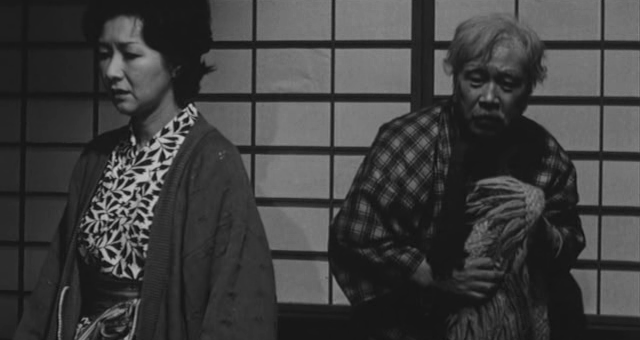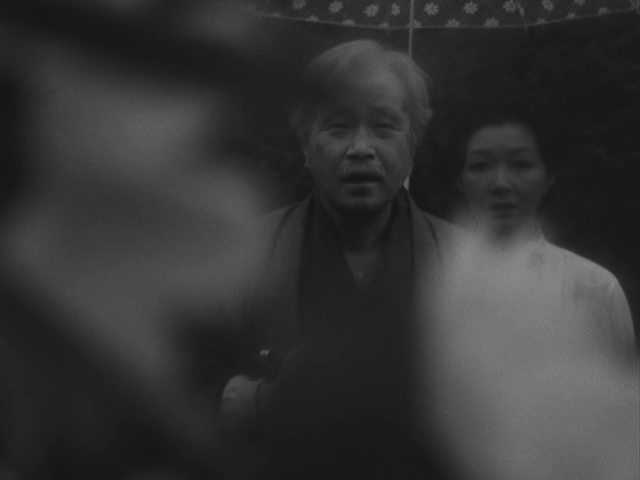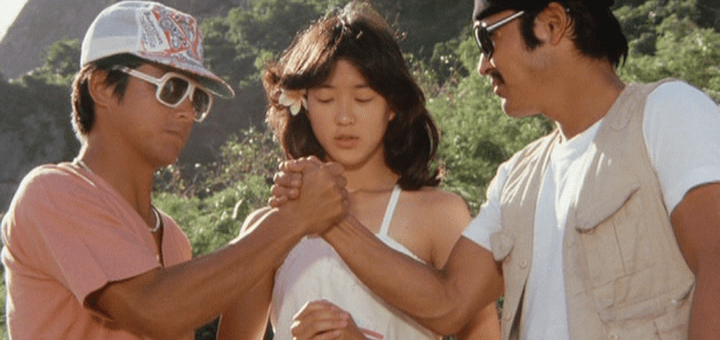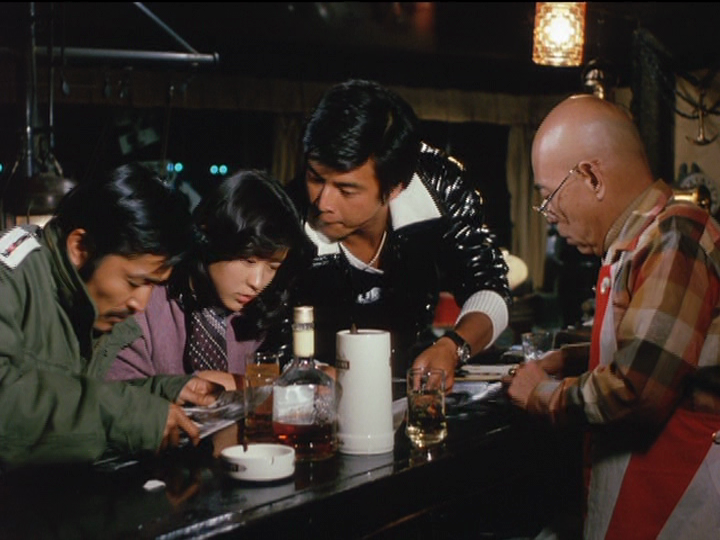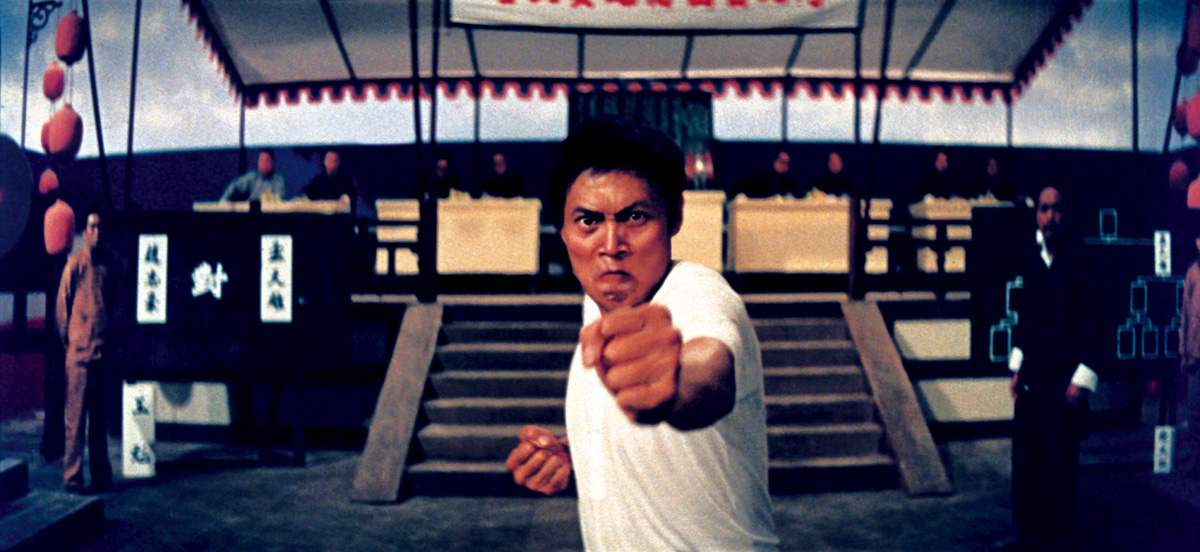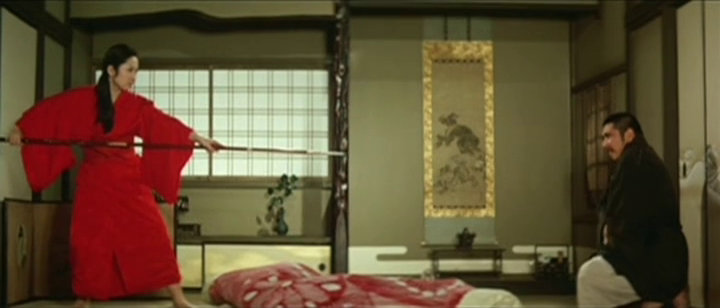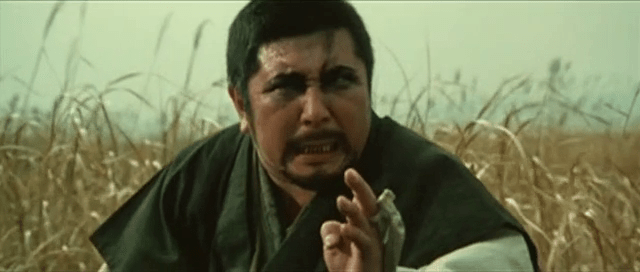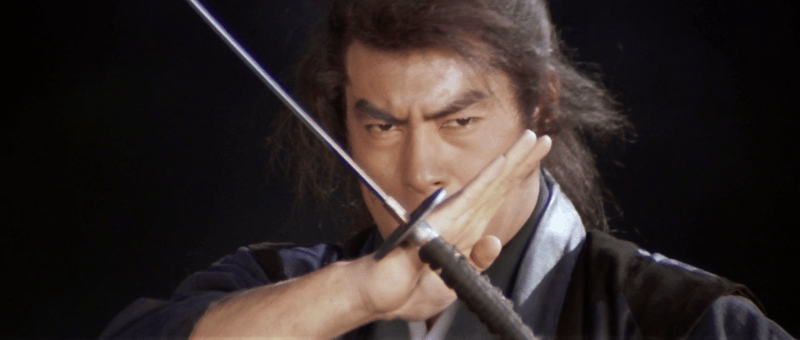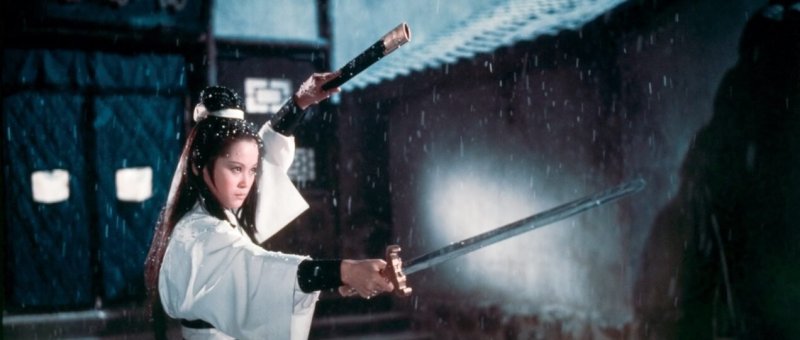
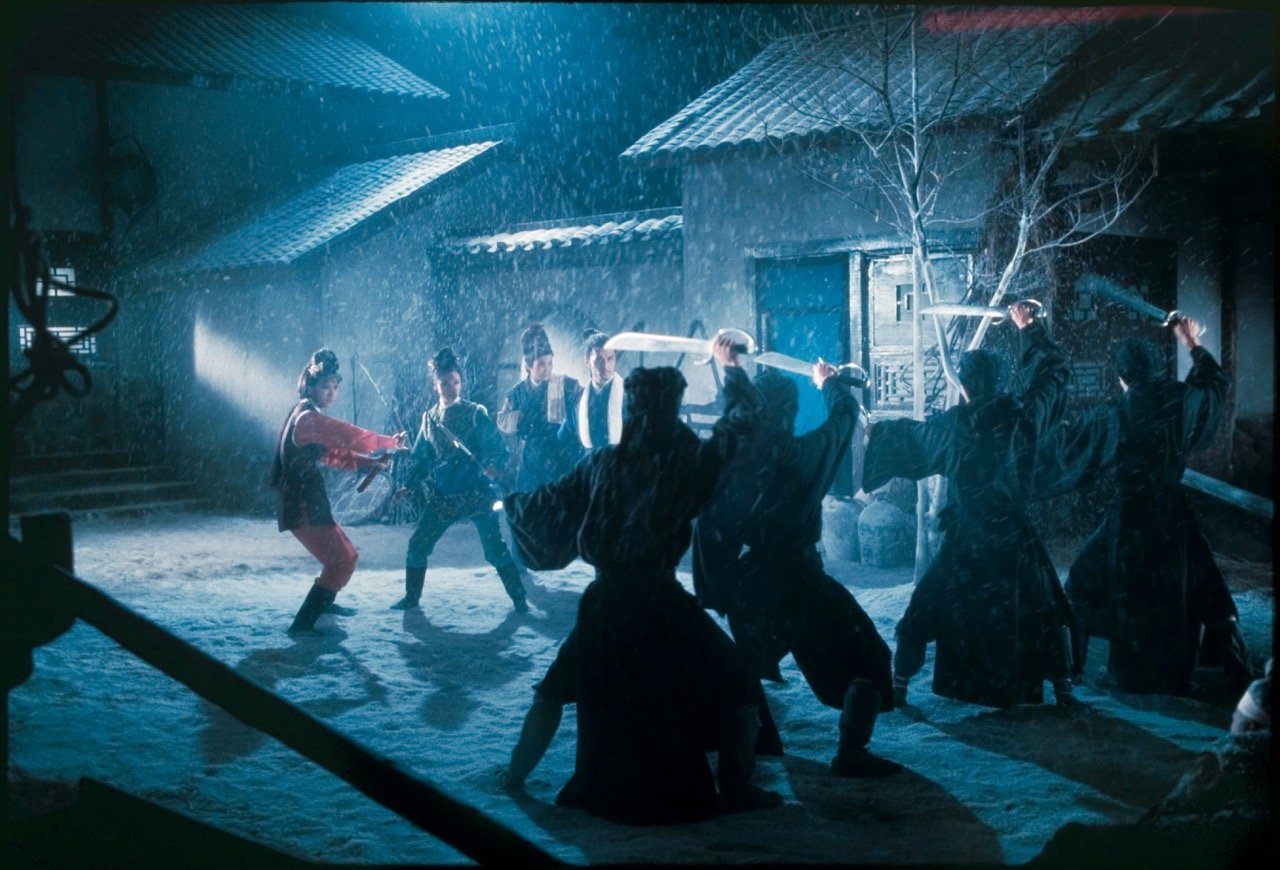
Wicked Priest 4: The Killer Priest Comes Back (極悪坊主 念仏三段斬り, Takashi Harada, 1970)

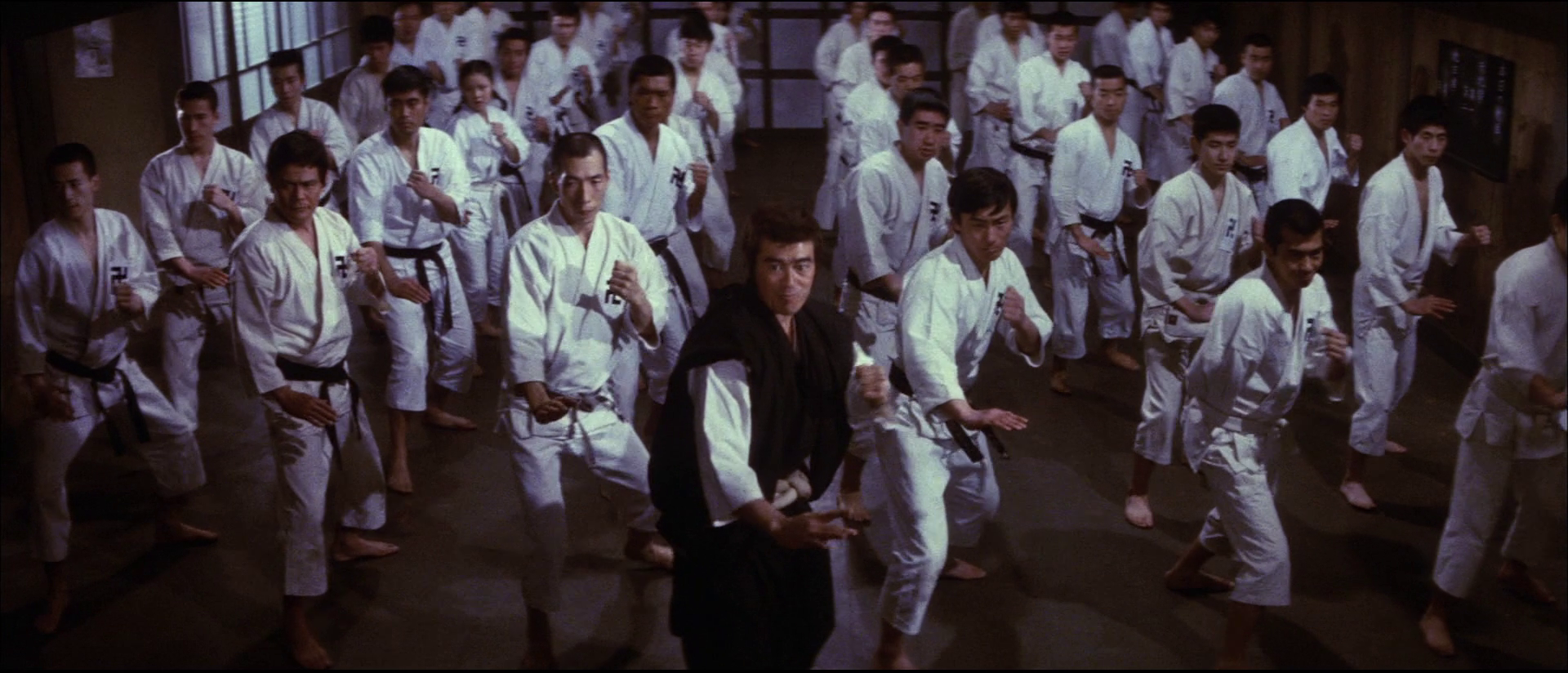
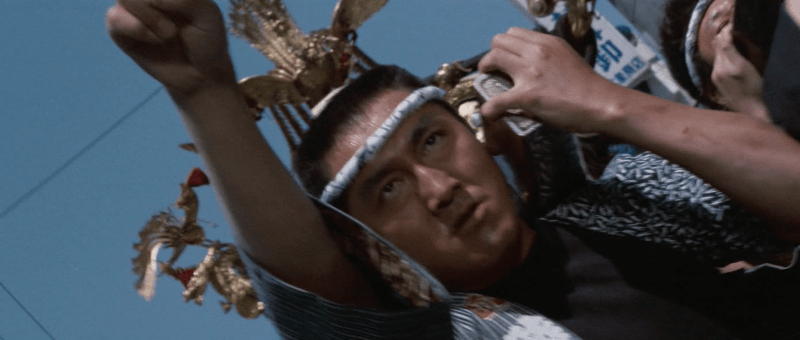
At the heart of the Wicked Priest series is an idea of rootlessness, the wandering monk Shinkai (Tomisaburo Wakayama), an orphan, often finding himself dragged into familial disputes between fathers and sons for one reason or another often estranged from each other. The aptly named Wicked Priest 4: The Killer Priest Comes Back (極悪坊主 念仏三段斬り, Gokuaku Bozu: Nenbutsu Sandangiri) finds Shinkai returning to his hometown after reencountering a childhood friend who’s found himself on the wrong side of a historical divide.

When Shinkai and Takegoro (Ichiro Nakatani) left their childhood village, they swore to become the best priest and mountain owner in Japan respectively but that obviously hasn’t worked too well for either of them. Takegoro evidently joined the wrong side during Bakumatsu chaos, a fact rammed home when his attempt to use currency issued by a feudal lord is rebuffed in a gambling den whose owner reminds him that it is now worthless. Only official currency issued by the central government is considered legal tender. On top of all that, it seems Takegoro might also have been cheating which signals just how far he has fallen. Running into him by chance, Shinkai ends up saving the day while accidentally humiliating a chastened Takegoro who is given a further dressing down by the old school lady yakuza boss Kuroda (Chieko Naniwa), also known as “the Thunder Woman”, who appears to be in charge, shooting off his little finger as an attempt to save face. 

In any case, the encounter has Shinkai feeling nostalgic and he decides to return to his hometown to hold a proper memorial service for his late mother. Only once there he ends up being drawn into another cycle of local corruption on discovering that the river workers are being exploited by rival yakuza groups who are working them to exhaustion and paying almost nothing. The leader of the Gondawara is quite obviously up to no good as he wears a western suit and has a handlebar moustache, quite clearly an amoral capitalist while his rival Ryuo (Eizo Kitamura) is a violent thug in ominous sunshades. In actuality, however, they are both branches of the yakuza syndicate led by Kuroda who is of the old school and doesn’t approve of their exploitative mindset. Just as she had Takegoro, she gives both men a good telling off reminding them that the river workers are essential for providing a steady supply of coal without which the new industrial economy will flounder. 

It’s also true that this same industry is fuelling militarisation and an eventual eye towards expanding imperialism, but Kuroda does seem to be mainly mindful of the workers welfare immediately insisting they should be paid a fair wage which is five times more than they’re currently getting. Ryuo and Godawara superficially agree but intend on simply exploiting their workers differently by demanding five times as much work for five times as much pay in a fifth of the time. Shinkai does his best to defend the rights of the local people, but is faced with a dilemma on realising that Takegoro is member of Godawara and hellbent on killing him having become cynical and desperate, willing to sell out a childhood friend for a few pennies. 

Part of Shinkai’s mission is winning Takegoro back over the side of right while reuniting him with his mother whom he’d been too ashamed to visit. On the other hand, this is perhaps the first time Shinkai shows a darker side to himself on threatening to rape a lascivious nun who tricked him into a martial arts contest while rebuffing his amorous intentions. He’s also still being pursued by Ryotatsu (Bunta Sugawara) and ironically ends up temporarily losing his sight himself but just as always Ryotatsu decides to come to his rescue mostly because it would be very annoying if someone else killed him first before he’s got his revenge. He also agrees to wait for Shinkai to finish his mother’s memorial service before scheduling their death match, the most patient revenger in jidaigeki history. In any case, it all ends with another massive showdown as a wounded Shinkai purifies the town of corrupt yakuza and liberates the river workers while finally getting to honour his late mother’s memory leaving Ryotatsu to make his exit deciding that vengeance can wait until the mourning’s over.


Haunted Samurai (土忍記 風の天狗, Keiichi Ozawa, 1970)

An exiled spy is confronted by the cruel inequalities of the feudal era in Keiichi Ozawa’s possibly mistitled ninja drama Haunted Samurai (土忍記 風の天狗, Doninki Kaze no Tengu). There is a kind of fatalism that follows him, and he is in some senses haunted not only by men like himself charged with the neutralisation of a deserter but by the ills of a corrupt society, though the only ghost here may be himself. Based on a manga by Goseki Kojima who illustrated Lone Wolf and Cub, the film ultimately suggests that to be a good man necessarily means to walk alone as a melancholy exile from a society founded on greed and power.

Indeed, Rokuheita’s (Hideki Takahashi) sole desire is to live a “simple and decent” life as an ordinary farmer. The film opens with him squaring off against a childhood friend, who is also his sister’s love interest, having been ordered to execute him for deserting from their ninja clan. His friend no longer wants to live “like a beast”, and so there’s nothing more either of them can really do in this situation. Rokuheita carries out his duty, and his sister takes her own life in despair. When he’s given another similar mission, he questions it but again resolves that he has no real choice. Only he discovers that his target, Ushizo (Yuji Odaka), has chosen to desert after marrying and having a child. When his family suddenly show up just as he’s contemplating delivering the final blow, Rokuheita decides to let him go warning Ushizo that the Yagyu will never give up and he’ll be haunted all his life so he should try to live it well for as long as it lasts. 

But this also makes Rokuheita an exile too, himself now a target and on the run from the Yagyu and his clan. On his travels, he runs into a small family who’ve been attacked by bandits while returning from town to buy wheat seeds because their harvest has failed in the drought and they’re facing onerous taxes from an unforgiving lord. Rokuheita decides to stay in the village hoping to become an ordinary farmer but is regarded with suspicion by some because of his samurai status, while there is also another samurai exile in town, Tarao (Seiichiro Kameishi) who first worked hard to be a part of the community but has since become lazy and aloof.

Tarao is also suspicious of Rokuheita but mostly fearing that either he’s come to make trouble for him or is a fugitive who will lead trouble their way. Unlike Rokuheita, Tarao was kicked out of his clan for stealing and now lives a slightly disreputable life made all the more so by his attempts to pan gold from the local river. Rokuheita fears that if the villagers find out about Tarao and the gold it will only cause chaos and the obsession with easy riches will in the end be much worse for them than the famine. Even Tarao’s wife Oryo (Utako Shibusawa) insists they’ve already got plenty to live on and should simply go somewhere else to lead a quiet life but Tarao wants more, his hand reaching out for his purse even while attacked by corrupt retainers themselves intent on discovering the gold and keeping it a secret from their lecherous lord. 

The retainers have been taking one life for every bale of “hidden” rice, carting off young women from the village to place into sexual slavery. Rokuheita tries to teach the villagers how to skirt the feudal order by secretly farming on rough terrain to evade taxes and ensure their own food supply, but this simply incurs harsher penalties even as one of the young men points out hungry farmers can produce nothing at all. Yet there’s nothing Rokuheita can really do for the villagers because it is the feudal order which is most at fault, an order which his ninja clan supports through their spy activities. The man who tracks him, Matahei (Isao Natsuyagi), says he does so as a means of appeasing the Yagyu and protecting his home territory from them but to do he must choose a lesser evil in killing those who have chosen to try to live “simple and decent” lives outside of this system.

Ozawa brings them together in a supernaturally charged conclusion which takes place during a solar eclipse marked by the eerie winds of the Japanese title but finds them both defeated, left with only the melancholy acceptance of their rootlessness as men who will always be pursued by the invisible hands of the feudal order. Utilising wuxia-esque jump cuts to recreate the ninja magic of Rokuheita’s spy craft along with a degree of surrealism in the underwater sequence in which he is attacked by a band of topless female ninjas the film seems to edge towards a more contemporary reading of jidaigeki and not least in the unexpected violence of its final scenes.


The Homeless (無宿 やどなし, Koichi Saito, 1974)

Two men are released from prison on the same day. One, dressed in a 1920s-style white suit and straw hat, tries to befriend the other, in black kimono and geta, but he ignores him. Soon, they arrive at a fork in the road. The man in the kimono walks down a well worn grass path cut between the fields while the man in white, looking back and a little disappointed, continues along the modern roadway making his way towards civilisation.

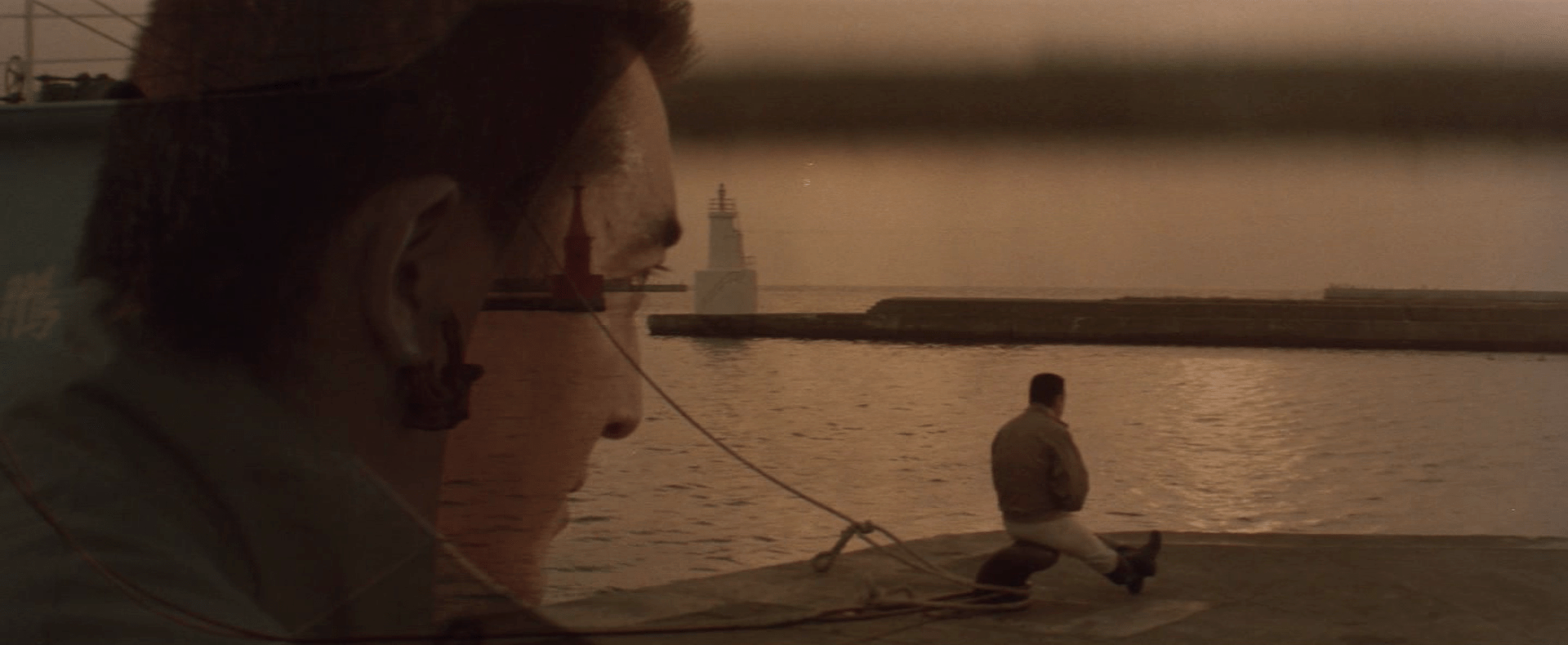
In some ways, the heroes of Koichi Saito’s The Homeless (無宿 やどなし, Yadonashi) are embodiments of past and future. Jokichi (Ken Takakura), the kimonoed man in black, chooses the path of vengeance. On his release from prison, he learns that his gang leader older brother has been killed while his sister was sold to a brothel. He goes there to find her, but is told that she is already dead. The madam says she died of a chronic illness and that she did for her what she could but treating such a cruel disease is only throwing good money after bad. Sakie (Meiko Kaji), a sex worker who appears to have a childlike quality and possibly impaired mental state, tells a different story claiming the madam had Jokichi’s sister killed for reasons she doesn’t explain but may have more to do with the drama going on with Jokichi’s gang than a desire to cut costs and her losses. 

Gen (Shintaro Katsu), meanwhile, seemingly chooses the path of prosperity. He returns to his wife, Ume (Murasaki Fujima), who is a member of a moribund theatrical troupe, and asks her to return to him what he believes is a treasure map marking the location where his father saw a ship sink during the Russo-Japanese war that may be filled with gold. On finding out Jokichi used to be a diver, Gen becomes determined to bring him onto his mission but Jokichi is set on revenge firstly on a man called Senzo (Noboru Ando) he thinks killed his sister and then on whoever ordered the hit on his brother. This bad news for Gen who realises that if he achieves his vengeance, Jokichi won’t be available to help retrieve the gold because he’ll be in prison so he starts by warning Senzo that his past’s about to catch up with him. 

But it’s also Gen that helps Jokichi escape from the rival gang by suggesting he help rescue Sakie from her indentured servitude as sex worker. Childlike and ethereal, Sakie claims not to remember where she was from and has a simple desire to see the sea which represents to her a kind of freedom while for each of the men it may in fact form a kind of border they will eventually be backed up against and unable to escape. Though Sakie develops a fondness for Jokichi, and then begins to love Gen after he ends up taking care of her along the road, the three form a relationship that seems more fraternal or perhaps even forged on the homoerotic tension between the two men who light their cigarettes one from the other and finally find a home on an idyllic beach where they devote themselves to the search for buried treasure.

Sakie may say that the real treasure is her new life of freedom and warmth, but the hint of riches the two men find is itself rooted in warfare and imperialism which are the same forces by which they were each displaced amid the rising militarism of the 1930s. The three of them remain homeless in this environment, unable to fit into the changing society and by degrees exiled from it. An early title of the film was apparently Jingi no Okite (仁義の掟) which means “the law of honour and humanity” and that is in a way what Jokichi is bound by in his desire for vengeance, while Gen is clearly an anarchistic force unable to submit himself to authority and lusting after a more prosperous modernity. Sakie meanwhile is powerless as a woman with few rights, sold into sex work and technically a fugitive from the gang-backed brothel that owned her contract.

As beautiful as the beach is, we have the feeling that in some senses the three of them are already dead and living in their temporary paradise. Indeed, the past eventually catches up with them as if these three homeless fugitives cannot be allowed to survive in resistance to an authoritarian culture. Their existence is elegised by the beautifully composed cinematography along with the childlike rapport between the two men and the sense of domesticity which arises between the trio before reality bites and even their beachside idyll is invaded by the forces of darkness.


Original trailer (no subtitles)

The Inferno (地獄, Tatsumi Kumashiro, 1979)

No one can escape from their sins according to the ominous voiceover that opens Tatsumi Kumashiro’s loose reimagining of Nobuo Nakagawa’s Jigoku, The Inferno (地獄, Jigoku). Then again, some of these “sins” seem worse than others, so why is it that a woman must bear a heavy burden for adulterous transgression while the man who killed her seemingly suffers far less? Perhaps hell, in this case, is born of conservative social attitudes more than anything else besides the darker elements of the human heart such as jealousy and romantic humiliation. 

Those negative emotions are however as old as time as reflected in the folk song which opens the film about a young couple, though not the young couple currently onscreen, who are eloping because their incestuous desire is not accepted by the world around them. The connection between the couple onscreen might also be deemed semi-incestuous for Ryuzo (Ken Nishida) has run off with the wife of his brother, Miho (Mieko Harada), who is carrying (what she claims to be) Ryuzo’s child. Unpei (Kunie Tanaka), the brother, finally catches up with them and shoots Ryuzo with a shot gun. Miho tries to escape, but her foot is caught in a bear trap and Unpei decides to leave here there to die, while Ryuzo’s jealous wife Shima (Kyoko Kishida) later does the same. The body is found by local hunters, and in a strange miracle the baby is born from Miho’s dead body while Miho is dragged to hell for her “sins” where she learns that her baby has been born in hell but remains above. Not knowing what to do, the locals give the baby, Aki, to Shima but she obviously doesn’t want it and so swaps it with a foundling thanks to a weird old man, Yamachi, coming to love this other child, Kumi, as a daughter. 

This is quite literally a tale of the sins of the parents being visited on the child, the 20-year old Aki (Mieko Harada) later lamenting that she has no identity of her own and is solely a vehicle for her mother’s revenge. Though she apparently ends up in the same rural town “by chance” knowing nothing of her past, she resembles her mother physically and discovers she has some of her talents such as an innate ability to play the shamisen. What she also has is a trance-like lust that bewitches the men around her, though this is in a sense complicated by the fact it does not seem to be of her own volition so much so as a manifestation of her mother’s curse. Thus she ends up sleeping with the vulgar younger brother of the man she actually likes, Suchio, who in truly ironic fashion is actually her half-brother. She describes herself as having her mother’s “tainted blood”, while Shima later adds in a degree of class and social snobbery revealing that Miho had been a geisha Unpei unwisely fell for and was unworthy even of being a maid in their upper-middle class household let alone the wife of the second son. 

For all of her resentment, Shima is otherwise a loving mother to her sons and even to Kumi whom she is able to accept as a daughter in a way she would never have accepted Aki who was after all an embodiment of her husband’s betrayal. Colder and more austere than Aki or Miho would seem to be, she clings to the mummified body of her husband kept in a secret vault as a secret triumph over her humiliation laughingly remarking that now he’s hers forever and will never cheat on her again. Even if she left Miho to die, Shima does not particularly resist her fate well aware that her son has fallen for his half-sister (which probably wouldn’t have happened if she hadn’t swapped babies) and merely hoping Aki can be convinced to leave town alone rather than plotting any more drastic action. 

But the inferno of hell envelopes them all, crying out for retribution as the cycles of repressed or inappropriate attractions repeat themselves. Kumi realises that her love for her brother, Suchio, is actually not inappropriate because they are not related after all but is then consumed by her own hell in realising that he does in fact love his biological half-sister but is uncertain if he accept damnation in order to pursue it. What she, Miho, and Aki are punished for is female sexual desire aside the arguably taboo qualities of its direction though in hell it seems men are punished for this too, or more accurately for giving in to it, in a way they often aren’t in the mortal realm. “They cut their own flesh and blood for the vision of a woman in the future,” the guide explains as the brothers and Unpei literally climb over each other reaching for an illusionary representation of Aki/Miho at the top of the tree. In the mortal world they do something similar, grappling with each other, mired in competitions of masculinity as mediated through sexual dominance, conquest, or humiliation. 

Yet Aki’s path to hell is also a confrontation with her femininity and her search for an identity as a woman by reuniting with the birth mother who died before she was born. Kumashiro’s visions of hell are terrifying and outlandish, a giant land in which the dead are thrown into a huge meat grinder they then have to push themselves. For the sin of eating meat, others are condemned to spend eternity eating human flesh. Miho has lost all sense of reason and is incapable of recognising her daughter seeing her only as another source of food but there is a kind of rebirth that takes place even if it’s only once again to be born in the underworld. Surreal and harrowing, Kumashiro’s eerie land of giant demons and shuffling corpses does indeed suggest that as the opening titles put it we all live our lives alongside hell.


Original trailer (no subtitles)

Curse of the Dog God (犬神の悪霊, Shunya Ito, 1977)

By the late 1970s, Japan was a very prosperous place and the cutting edge of modernity yet old beliefs die hard and those who run afoul of a natural order they assumed had long been forgotten will pay a heavy price for their arrogance. After a four-year hiatus following the third of the Female Prisoner Scorpion films, Shunya Ito returned with a strange slice of folk horror The Curse of the Dog God (犬神の悪霊, Inugami no Tatari) in which it is indeed the city invaders who have transgressed these ancient boundaries in their wilful indifference to the natural world.

The conflict between these two Japans is clear in the opening sequence in which three men pass through a tunnel in a truck bearing the logo of a nuclear power company and emerge into a village where a group of boys jump out from behind a row of tiny haystacks wearing masks made of leaves. The boys crowd around the van asking the strangers why they’re here and they jokingly tell them that they’ve come to look for “treasure,” which turns out to be a quest to find uranium in the local mountains. Otherwise uninterested in the village or the landscape, the men back their truck into a dilapidated roadside shrine which then collapses, and subsequently run over a little boy’s dog which had attempted to stop their car by barking fiercely at them. Rather than stop to apologise or comfort the boy who is cradling his dead dog in his arms, the men sheepishly drive off as if embarrassed. 

Of course, the shrine turns out to belong to the Dog God who is guardian deity of these mountains and now incredibly annoyed not just by the destruction of the shrine and killing of the dog, but by the men’s intention to tear the natural world apart looking for something which could prove very destructive even if they claim they want to use it responsibly to fuel the economic rocket which is Japan in the 70s. The Kenmochi family, the head of which, Kozo, is the local mayor are very receptive to the firm’s entreaties and immediately grant them access to their land while arranging a marriage which at least in part dynastic between Kozo’s daughter, Reiko (Jun Izumi), and the head of the expeditionary group Ryuji (Shinya Owada). But once they return to the city, the other two men die in mysterious circumstances, one entering a kind of trance and walking off the roof of the hotel after the couple’s formal wedding reception and the other attacked by a pack of wild German Shepherds in the middle of Tokyo. 

Reiko is quick to exclaim that it’s all the fault of the Dog God, though it’s never quite clear whether or not she is aware that her family is the subject of an ancestral curse because they themselves offended the deities by getting their hands on the land cheaply when it was used as collateral for a loan. In contrast to the Tarumis, the family of Reiko’s best friend Kaori (Emiko Yamauchi) and her little brother Isamu (Junya Kato) who is the boy whose dog they killed, the Kenmochis put on heirs and graces and as if they were the ancestral aristocracy of this area rather than having made a speedy class transition thanks to someone else’s misfortune and the vagaries of the post-war era. The Tarumis, meanwhile, live in a much more humble home and dress in a much more traditional mountain village manner. Patriarch Kosaku (Hideo Murota) point-blank refuses to sell his land and will have little truck with Ryuji or the mine once it opens, leaving the family regarded as outcasts within the village. 

But then there is a definite and literal pollution signalled by the arrival of the prospectors. At a meeting, it’s suggested that the sulphuric acid they’re using to flush out the uranium in inaccessible areas of the mine could contaminate the local groundwater which is a problem when many families are still taking their water from wells but they all laugh it off. Sometime later Ryuji is horrified to see dead fish floating in the river, while his own in-laws, the older generation of the Kenmochi family, are also killed by ingesting contaminated water. A rumour arises that the culprit is the Tarumis who have poisoned the wells out of spite, and when Ryuji tries to raise the alarm after getting a positive result for sulphuric acid in the water supply the company tell him to pin it on them instead. 

The intrusion of modernity has interrupted the careful, if woefully feudal, balance of the village with terrifying and tragic consequences. Yet Kosaku is also surprised, asking how a city man like Ryuji could really believe in something like a “curse”. The shamans they bring in to do a ritual also blame everything on the Terumis, adding the suggestion that the ill will is motivated by Kaori’s sexual jealousy over Ryuji giving rise to yet another interpretation of the curse’s origin besides the Kenmochi’s class transgression and the unintentional offence caused by the destruction of the shrine. Then again, perhaps it really is all because of the Dog God in a great confluence of coincidences that have led to this incredibly strange and unfortunate situation. In the end, even the film’s purest character, the Kenmochi’s small daughter Mako (Masami Hasegawa), is possessed by the evil spirit and made to take her revenge with a remorseful Ryuji desperately trying to repair what he himself broke in the acceptance that he should not have come here and was the catalyst for this confrontation with fate. Weird and haunting even in its bizarre obscurity the film nevertheless makes a case for the protection of the dark heart beating at the centre of the contemporary society which speaks of something older that cannot be crossed and most specially by those hellbent on a hubristic path to prosperity that has little respect for the land.


School of the Holy Beast (聖獣学園, Norifumi Suzuki, 1974)

“Why is sex wrong?” a rebel nun enquires, hinting at the hypocritical atmosphere of the convent which comes to stand in for the patriarchal superstructure of the contemporary society. That it does so might in a way be surprising given that Christianity has relatively little cultural relevance in Japan save its stance as a persecuted religion during the feudal era. Director Norifumi Suzuki jumps on the nunsploitation bandwagon but does so with a baroque romanticism mixed with punkish youthfulness as two young women find themselves rebels in the house of God.

They are both there for reasons largely unconnected to religion. 18-year-old Maya (Yumi Takigawa) is searching for the truth behind her birth and her mother’s death, while Sister Ishida (Emiko Yamauchi) claims she’s been sent there by a wicked stepmother. Ishida also kicks up a stink during a class by questioning the truth of immaculate conception which is quite odd for someone who wanted to become a nun, while otherwise punished for drinking whisky in the middle of the night. Punishment does seem to be the main thrust of their religious practice with the transgressions of “adultery”, which includes all impure thoughts, murder (!), and theft taken the most seriously. On her first night at the convent Maya is woken by the sound of another nun furiously whipping herself though in fairness there just isn’t much else to do. 

Suzuki rams home the erotisicm of ritual in the baptism Maya undergoes during her initiation as a nun in which she is totally nude and instructed to stand with her arms out as if on the cross in front of the altar. She must then bend to kiss the crucifix before receiving her veil as a bride of Christ. The nuns talk of lives of eternal virginity while burying themselves in asceticism in an effort to deny their natural desires but have to a degree sublimated their lust in violence. The most common form of punishment is whipping, while Maya is later tortured with thorns and artfully battered by roses. When one nun steals money in guilt for having abandoned her impoverished family to begin her spiritual journey to Christ, she confesses herself to a priest who offers her the same amount so that she can help her family and ease her conscience by returning it. But in reality the priest has tricked her. He resents that she feels as if her sin has been forgiven and she may forget her guilt, cruelly telling her that she will never hear the voice of God before going on to violate her. 

The act of betrayal, of himself breaking the code to which he should subscribe, is only a echo of an societal corruption which allows men to abuse their power often with the complicity of the women around them such as the abess who has long been in love with him. Kakinuma (Fumio Watanabe) is a man whose faith has been shaken. He bears the scars from exposure to the atomic bomb in Nagasaki which is centre of Christianity in Japan. After telling Hisako (Yayoi Watanabe) that God will not see her, he asks if anyone has actually seen him and why he does nothing when his people suffer. 

Both he and the abbess are trapped in a hell of their own making, though as the girls both say the convent is akin to a prison. When Hisako’s sister visits her they talk to each other through glass as if she were a prisoner, though in many ways she is oppressed by her own repressed desires while those of the other nuns have begun to drive them quietly out of their minds and into sadomasochistic fury. This peculiar madness is only deepened by the arrival of a new Mother Superior who returns from Europe insistent on rooting out “witches” in league with the devil. Suzuki signals the absurdity by playing a chorus of elation when a tortured nun wets herself over a tablet featuring a crucifix in the inversion of a bizarre Edo-era ritual designed to identify secret Christians who were at that point illegal. 

To break free of the covent and return to her liberated life in contemporary Japan as seen in the cheerful opening sequences of her date with Kenta (Hayato Tani), Maya must also free her mother’s ghost and the souls of her sisters by forcing Kakinuma to reckon with his crimes if in the most ironic of ways. Suzuki shoots with febrile romanticism, the pastel colours of the church lending it a hellish glow even before the resurrection of a ghost enacts karmic revenge in a feverish atmosphere of romantic jealously and masochistic repression.


Original trailer (no subtitles)

*Norifumi Suzuki’s name is actually “Noribumi” but he has become known as “Norifumi” to English-speaking audiences.

Zero Woman: Red Handcuffs (0課の女 赤い手錠, Yukio Noda, 1974)

“Your sense of duty is too strong! The world isn’t a pretty place,” barks an irate policeman, scolding a female officer with a tendency to take things, in his view at least, too far. Yukio Noda’s kidnap drama Zero Woman: Red Handcuffs (0課の女 赤い手錠, Zeroka no onna: Akai Tejo) is on the extreme end of pinky violence and soaked in the political concerns of the 1970s along with all their concurrent paranoia but nevertheless positions its fearless avenger as a lone arbiter of justice in an incredibly unjust world. 

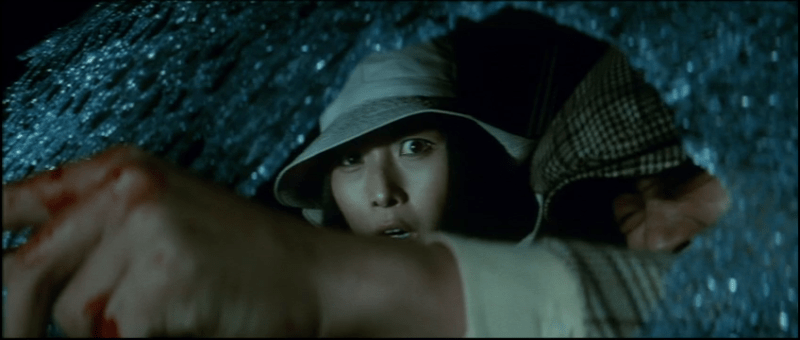
We know this from the start as we see Zero (Miki Sugimoto) almost date raped by an apparent serial killer who has his own torture suitcase and apparently killed her friend. Knowing that he is a diplomat and therefore has diplomatic immunity, she simply shoots him in the balls in the film’s extraordinary opening sequence. But even though it could be argued what she did was self-defence, Zero is kicked off the force and thrown into a woman’s prison for an indefinite period of detention to keep the lid on any possible scandal. Zero is only reprieved when the daughter of a politician is kidnapped by thugs and, wanting to keep things quiet, they need someone to rescue her and also wipe out all of the kidnappers to ensure no one ever finds out.

Kyoko (Hiromi Kishi), the politician’s daughter, claims that her father will do “anything” to ingratiate himself with the prime minister and has in fact already arranged her marriage to his son. Kyoko, however, already has a boyfriend who, inconveniently, is quite obviously a student protestor given his yellow construction hat and other paraphernalia. The pair are accosted while sitting in a car near an old American base, and as Kyoko is gang raped, firstly by the gang leader Nakahara (Eiji Go) who is wearing a hoodie with the words US Navy printed on the back, US planes fly over her as if she were being raped by America in an obvious metaphor for the legacy of the occupation. 

Indeed, the flashbacks later experienced by Nakahara are of his mother whom he describes as a sex worker who worked at the base suggesting a very literal allusion to the corrupting influence of American servicemen. The gang operate out of a bar called “Manhattan” which is surrounded by other similar bars with Western names in a neon-lit area, while they constantly run across various signs written in English in fact peeing directly on a no peeing sign outside a largely disused residential area on the edge of the base where they later take hostage some kind of amateur dramatics / English-language class currently in the middle of a production of Romeo and Juliet. 

Yet the big bad turns out to be essentially homegrown in the form of the corrupt lackey policeman Osaka, and the politician Nagumo (Tetsuro Tanba), who is more concerned with his political capital than his daughter’s safety keen that the police keep everything out of the papers otherwise the wedding will be called off and he’ll have a problem with the prime minister. Seeing a very pale Kyoko, her clothes torn, barely conscious having been drugged by the gang, he says he no longer cares to think of her as his daughter and perhaps it would be better if she simply passed away in an “accident”, instructing Osaka to care of loose ends like Zero too. 

It’s very clear that women’s lives have little currency in this very patriarchal world, something Zero seems to know all too well even if at the beginning of the film she was content to work for the oppressive organisation of the police force though she later tears up her warrant card in disgust. The fact that division zero, operating like a secret police force on the behalf of an authoritarian government, exists at all is a clear indication that this is already a police state though one subverted by Zero who uses her red handcuffs to deliver ironic justice to all those who deserve it. Then again, unlike other pinky violence films there’s precious little solidarity that arises between herself and Kyoko whom she later describes as nothing more her mission objective seemingly caring little for her as a fellow human being. Noda cuts back between the Diet building and police HQ as if actively critiquing the latent authoritarianism of the early 70s society but even if Nagumo gets a kind of comeuppance it’s abundantly clear that nothing really will change and Zero stands alone wilfully freeing herself of the handcuffs of a controlling society. 


Female Yakuza Tale (やさぐれ姐御伝 総括リンチ, Teruo Ishii, 1973)

Having completed her quest for revenge, Ocho (Reiko Ike) returns in Female Yakuza Tale (やさぐれ姐御伝 総括リンチ, Yasagure anego den: Sokatsu Lynch) once again swept up in intrigue after being framed for a bizarre series of murders. With Teruo Ishii taking up the reins from Norifumi Suzuki, the film has a slightly more realistic aesthetic making frequent use of handheld particularly in the narrow backstreets of the late Meiji Society while eventually taking a bizarre detour into the cruel world of an early 20th century mental health institution. 

In any case, Ocho’s troubles start when she’s met at Kobe harbour by a woman who says she’s come to fetch her. On arrival at her destination, Ocho is chloroformed and sexually assaulted by three men who evidently think she’s think she’s someone else and decide to get rid of her after realising their mistake. She wakes up next to the dead body of another woman and is in danger of becoming the prime suspect in a series of murders the subtitles don the “crotch-gauge” killings. After managing to escape, she sets about trying to find out who set her up and what’s going on while getting involved in a succession crisis in the Ogi in which the old boss who was once good to her has been killed. 

Though with much less political subtext, the film nevertheless indulges in the Sinophobia common in many similarly themed dramas in revealing a Mr Lee of Yokohama to be a major player in a drug trafficking scam in which women are forced to smuggle drugs in their vaginas after the gang gets them hooked to manipulate them. Besides Ocho, another woman dressed eerily like Sasori in a black wide brimmed hat and loose dress known as “Yoshimi of Christ” is also on their tail and seeking revenge while echoing some of the religious themes of the first film. She later teams up with recently released yakuza Jyoji who is looking for the daughter of the old boss who has gone mysteriously missing while he is also convinced that present boss Gondo had something to do with it along with the old man’s death. 

This is however mainly a tale of female revenge, Ocho’s being on the yakuza who cut off the Old Boss’ finger after he stood up for her as a teeanger whens she was caught cheating at a gambling den. Nevertheless, what eventually emerges is a sense of female socildairy as Ocho, Yoshimi, and the other women abused by the gang come together to free themselves from its grasp in a strange orgy of violence utilising eerie green lighting to lend it an almost supernatural dimension even if in the end the final blow is struck by a man and not without a little irony. 

This sense of unreality otherwise out of keeping with the immediacy of Ishii’s handheld camera is also seen in the mental institution to which the film eventually travels, a foggy gothic building echoing the Western mansion in the first film but similarly filed with oppressed and abused women sent mad by a patriarchal society or perhaps merely sent there to become so by men who wanted them out of the way. Gondo himself seems to be a regular visitor bringing along his own electroshock machine but finally resorting to using his bare hands in order to tie up a loose end and preserve his own position as head of the clan. 

Ocho is not above using her sexuality to manipulate him, while Ishii maintains the naked sword fights from the first film both from the balletic opening of Ocho and her parasol to the chaos of the final sequence as the women come together to take their revenge as one. Perhaps strangely there isn’t an awful lot of gambling in the film, but Ocho nevertheless makes good use of her trademark hanafuda cards while in a moment of symmetry it’s the wife of her target who eventually settles the matter in a more diplomatic fashion by subjecting herself to the same humiliation to which Ocho had been subjected to bring the circle to a close. Having once again stood up against corrupt crooks and greedy men, Ocho later takes her sisters with her as she walks off this time into the sunset rather than the dark. 


Original trailer (no subtitles)

Sex and Fury (不良姐御伝 猪の鹿お蝶, Norifumi Suzuki,1973)

An orphaned daughter takes revenge against the corruptions of the late Meiji society in Norifumi Suzuki’s pinky violence classic Sex and Fury (不良姐御伝 猪の鹿お蝶, Furyo anego den: Inoshika Ocho). As the opening voiceover explains, the Japan of the early 1900s is already stoking imperial ambitions closely linked with the ideas of “modernisation” and “civility” it is seeking though in reality it is very much a gangster society as the three villains the heroine searches for have come to dominate the new Japan. 

This moment of schism is depicted in the opening sequence set in 1886 in which the little girl who will later take the name Ocho witnesses the murder of her policeman father by three unseen assassins who steal from him evidence of a scandal they then use for their own gain. The murder takes place in a shrine, the young Ocho rolling her paper ball onto a discarded charm that reads “misfortune”, while the film then jumps on to 1905 through a series of historical images prominently featuring the emperor Meiji along with a host of patriotic symbols that seem to signal the wrong path that is being taken. 

As for Ocho (Reiko Ike), she has survived by living on her wits as an excellent pickpocket and gambler but is otherwise uncorrupted continuing to dress in kimono and giving off an air of refined elegance that belies her toughness. In the course of her revenge, she is met by her opposite number, Shunosuke (Masataka Naruse), whose father was also killed by the same three duplicitous yakuza and is dragged into geopolitical intrigue by means of plot by the British to turn Japan into the site of the second opium wars using a spy disguised as a dancer played by Swedish starlet Christina Lindberg who is really in Japan for Shunosuke with whom she fell in love abroad only to be cruelly abandoned. 

Somewhat contradictorily, it’s these Western intrusions that are being resisted with Ocho the representative of an older Japan, and the gangsters that of a newer, largely amoral society of burgeoning militarism. Arch villain Kurokawa (Seizaburo Kawazu) lives in a huge Western-style mansion and is preparing to transition into national politics in the post-feudal society insisting that he and his organisation will soon control “everything”. His underling Iwakura (Hiroshi Nawa), who travels by motorcar, will also be handling the construction of Tokyo Harbour. When the girls from Ocho’s adopted family are kidnapped, they are taken to dance hall Panorama which is bedecked both with Christmassy tinsel and signs celebrating the victory in the Russo-Japanese conflict, while in an anachronistic touch scenes of the war are projected inside. Just to ram the point home, the man who throws a knife at Ocho is wearing stereotypical Chinese dress, while Kurokawa is later seen to have at his disposal a secret attack squad of nuns armed with switchblades and has Ocho whipped, by British spy Christina, in front of a large mural of Christ in some kind of underground chapel. 

In taking her revenge, Ocho is also in a sense attempting to right a historical wrong in removing these usurping men and their accomplice from power while fighting their perversion with her sexuality over which only she is master going so far as to kill one with poison rubbed on her own skin. In accidentally having exposed the equally duplicitous practices in a gambling hall, she is attacked while in the bath but instantly leaps into action entirely in the nude in a strangely beautiful sequence of elegant violence and poetic bloodletting that echoes the film’s conclusion in finally moving out into the snow. Eventually captured, she is bound tightly with rope and tortured but manages to cut herself free using only one of her trademark hanafuda cards which also symbolise her skill as a gambler even if her climactic game with Christina is played with Western cards for casino chips over a dining table. 

Suzuki signals the chaotic nature of this early 20th century world in his riotous use of colour and frequent anachronisms along with canted angles and a spinning top shot that seems to echo the world spinning out of control as Iwakura breaks a sacred promise between gamblers and rapes a young woman he had agreed to spare if Ocho was victorious in her bout with Christina. He saves his most expressionistic technique for the film’s closing moments in which Ocho singlehandedly puts a stop to Kurokawa’s corruption, another picture of Emperor Meiji looking down at her as she launches her final attack, and then stops to purify herself in the snow before wandering off into a storm of hanafuda cards with only darkness ahead of her.


Original trailer (English subtitles)

*Norifumi Suzuki’s name is actually “Noribumi” but he has become known as “Norifumi” to English-speaking audiences.

The Tattooed Hitman (山口組外伝 九州進攻作戦, Kosaku Yamashita, 1974)

The close brotherhood between two men is disrupted by changing times in a more contemporary gangster drama from Kosaku Yamashita, Tattooed Hitman (山口組外伝 九州進攻作戦, Yamaguchi-gumi gaiden: Kyushu shinko-sakusen). As many are fond of saying, times have changed and the yakuza must try to change with them or else meet a melancholy end. But as the hero admits, change is something he has no intention of doing even as his old school gangsterism leaves him increasingly at odds with the corporatising ways of the contemporary yakuza. 

The change in the times is obvious from the film’s opening sequence set in 1957 in which an attempt is made on the life of petty boss Ishino (Tatsuo Umemiya) by a gunman who shouts “die, for the good of the world” before firing a pistol and running away. Ishino has been targeted in a dispute over construction rights connected with the regeneration of hot springs resort, Beppu. The hit seems to have been ordered by rival gang, Sakaguchi (Eizo Kitamura), the leader of which is also a prominent local politician who is content to abuse his power for his own financial gain. So confident is he in his safety, that Sakaguchi even gets the police involved rather than deal with it himself. 

Ginji (Bunta Sugawara) has been Ishino’s sworn brother since their teenage delinquent days and determines to get revenge by raiding the Sakaguchi offices and killing one of their high ranking officers. Seeing as he’s already wanted by the police for a previous murder, Ishino sends Ginji to Osaka to lay low while working for an associate, Daito, mainly as a debt collector. It’s this act of separation which introduces a rift between the two men. While Ginji waits patiently to be recalled, Ishino climbs the ranks of corporatised gangsterism by learning to play by the new rules. 

To fill the void, Ginji takes on a new “brother” or perhaps surrogate son in the wayward Ken (Tsunehiko Watase) whom he first meets cheating at pachinko at a parlour where his pregnant wife Fusako (Mayumi Nagisa) is working. It’s Ken who first drags him into a brewing turf war as Korean gang Soryu threaten to disrupt the local equilibrium not least by selling drugs of which Ginji does not approve. Ginji “saves” Ken from joining Soryu by essentially making him his one of his guys though he doesn’t really have much of a position in Daito’s gang, offering him a sense of grown-up responsibility by handing him a pistol with the only the instruction to make sure he shoots with two hands. Unfortunately, Ken will follow his advice but otherwise ends up almost causing an incident with another gang by shooting a man who disrespected him in the street. Ginji marches straight down there to sort things out, but on arrival discovers an arrangement has already been made with his boss which further strains his sense of pride and confidence in his position as a yakuza.

Ginji feels something similar on being invited to a party to celebrate Ishino’s promotion only to be seated with the lowly footsoldiers and ignored by Ishino all night. Ishino rejects him still further in agreeing to plan to send him back to Kyushu out of the way hoping that his old school hotheadedness can finally be tempered. Others meanwhile voice concern that Ginji may have forged a relationship with rival Kobe gangs during the 18 months he abruptly disappeared from Osaka and has only come back to cause trouble. Ginji perhaps knows that he has no more future in the contemporary society, others remarking that seems like someone who is in a sense already dead for having accepted that he will die and most likely in Hakata, the town he had wanted to conquer with Ishino who had crushed his dreams in his newfound pragmatism by calmly explaining that they would never have the power to take it. 

Koji Takada’s screenplay positions Ginji’s gradual decline as an allegory for the yakuza himself while citing the new legislation that this particular series of incidents made necessary creating the new offence of assembly with dangerous weapons as a decisive moment in weakening the yakuza as an institution. Ginji remains a man displaced by his times unable to move forward into a new society in the way that Ishino has but stuck in a permanently post-war mentality despite the constant reminders that “times have changed”. Yamashita adopts the trappings of the jisturoku drama with frequent references to real life events and narrative voiceover but otherwise maintains his classicist formalism while ending on a note of ambivalence that tells us a certain kind of justice may have been served but the cycle of violence may not yet be completed.


Original trailer (no subtitles)