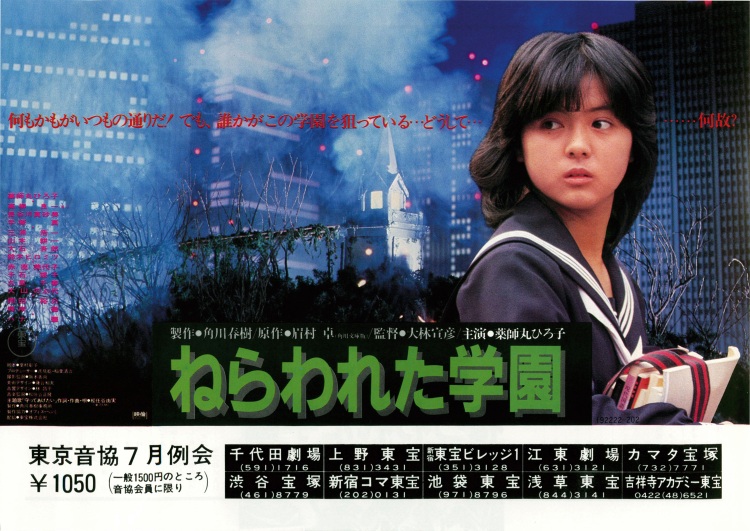
School in The Crosshairs (ねらわれた学園, Nobuhiko Obayashi, 1981)

Still most closely associated with his debut feature Hausu – a psychedelic haunted house musical, Nobuhiko Obayashi’s affinity for youthful subjects made him a great fit for the burgeoning Kadokawa idol phenomenon. Maintaining his idiosyncratic style, Obayashi worked extensively in the idol arena eventually producing such well known films as The Little Girl Who Conquered Time (starring Kadokawa idol Tomoyo Harada) and the comparatively less well known Miss Lonely and His Motorbike Her Island (starring a very young and extremely skinny Riki Takeuchi). 1981’s School in the Crosshairs (ねらわれた学園, Nerawareta Gakuen) marks his first foray into into the world of idol cinema but it also stars one of Kadokawa’s most prominent idols in Hiroko Yakushimaru appearing just a few months before her star making role in Shinji Somai’s Sailor Suit and Machine Gun.
Set once again in a high school, School in the Crosshairs is the ultimate teen movie for any student who’s ever suspected their place of education has been infiltrated by fascists but no one else has noticed. Top student Yuka (Hiroko Yakushimaru) is the archetypal Obayashi/idol movie heroine in that she’s not only bright and plucky but essentially good hearted and keen to help out both her friends and anyone else in trouble. Her life changes when walking home from school one day with her kendo obsessed friend Koji (Ryoichi Takayanagi) as the pair notice a little kid about to ride his tricycle into the path of a great big truck. Yuka, horrified but not quite knowing what to do, shouts for the little boy to go back only it’s time itself which rewinds and moves the boy out of harm’s way. Very confused and thinking she’s had some kind of episode, Yuka tests her new psychic powers out by using them to help Koji finally win a kendo match but when a strange looking man who claims to be “a friend”  (Toru Minegishi) arrives along with icy transfer student Takamizawa (Masami Hasegawa), Yuka finds herself at the centre of an intergalactic invasion plot.

Many things have changed since 1981, sadly “examination hell” is not one of them. Yuka and Koji still have a few years of high school left meaning that it’s not all that serious just yet but still, their parents and teachers have their eyes firmly on the final grades. Yuka is the top student in her class, much to the chagrin of her rival, Arikawa (Macoto Tezuka), who surpasses her in maths and English but has lost the top spot thanks to his lack of sporting ability. Koji is among the mass of students in the middle with poor academic grades but showing athletic promise even if his kendo career is not going as well as hoped.

Given everyone’s obsession with academic success, the aliens have hit on a sure thing by infiltrating a chain of cram schools promising impressive results. Grades aside, parents are largely laissez-faire or absent, content to let their kids do as they please as long as their academic life proceeds along the desired route. Koji’s parents eventually hire Yuka as a private teacher to help him improve only for her to help him skip out to kendo practice. Her parents, by contrast, are proud of their daughter and attentive enough to notice something’s not right but attribute her recent preoccupation to a very ordinary adolescent problem – they think she’s fallen in love and they should probably leave her alone to figure things out her own way. A strange present of an empty picture frame may suggest they intend to give her “blank canvas” and allow her to decide the course of her own life, but she has, in a sense, earned this privilege through proving her responsible nature and excelling in the all important academic arena.

School is a battlefield in more ways than one. Intent on brainwashing the teenagers of Japan, “mysterious transfer student” Takamizawa has her sights firmly set on taking over the student council only she needs to get past Yuka to do it. Takamizawa has her own set of abilities including an icy stare which seems to make it impossible to refuse her orders and so she’s quickly instigated a kind of “morality” patrol for the campus to enforce all those hated school rules like skirt lengths, smoking, and running in the halls. Before long her mini militia has its own uniforms and creepy face paint but her bid for world domination hits a serious snag when Yuka refuses to cross over to the dark side and join the coming revolution. Asking god to grant her strength Yuka stands up to the aliens all on her own, avowing that she likes the world as it and is willing to sacrifice her own life for that of her friends. Accused of “wasting” her powers, Yuka asks how saving people could ever be “wasteful” and berates the invaders for their lack of human feeling. Faced with the cold atmosphere of exam stress and about to be railroaded into adulthood, Yuka dreams of a better, kinder world founded on friendship and basic human goodness.

Beginning with a lengthy psychedelic sequence giving way to a classic science fiction on screen text introduction Obayashi signals his free floating intentions with Yuka’s desaturated bedroom floating over the snowcapped mountains. Pushing his distinctive analogue effects to the limit, Obayashi creates a world which is at once real and surreal as Yuka finds herself at a very ordinary crossroads whilst faced with extraordinary events. Courted by the universe, Yuka is unmoved. Unlike many a teenage heroine, she realises that she’s pretty happy with the way things are. She likes her life (exam stress and all), she loves her friends, she’ll be OK. Standing up for the rights of the individual, but also for collective responsibility, Yuka claims her right to self determination but is determined not to leave any of her friends behind.


Original trailer (no subtitles)

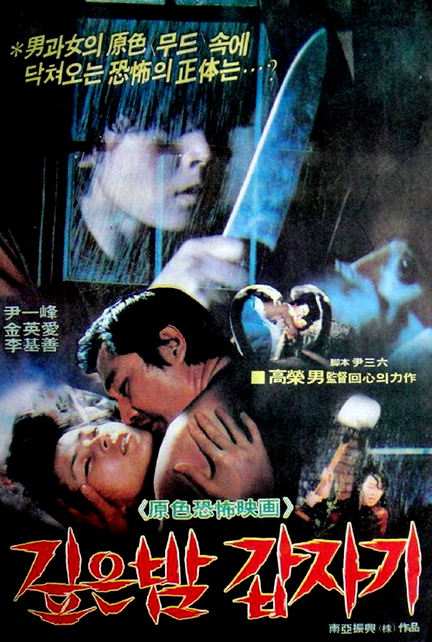
Suddenly in the Dark (깊은밤 갑자기, Go Yeong-nam, 1981)

suddenly-in-the-darkEverybody ought to have a maid, goes the old adage, but finding one you can trust can be a tall order. Kim Ki-young’s The Housemaid clearly sounds a warning call to husbands everywhere not to be tempted by the enticements of pretty young girls or conniving social climbers with designs on upending the domestic order by supplanting the legitimate wife from within her own home. The Housemaid is melodrama rewritten as horror in which a parasitical force colonises the domestic environment hell bent on taking it over through a subversion of its binding yet taboo foundation – sexual desire. Twenty years later, Suddenly in the Dark (깊은밤 갑자기, Gipeun Bam, Gapjagi) returns to the same theme but from a different angle. A once harmonious household is suddenly turned upside down following the introduction of a second female, provoking a series of crises within the already strained mind of its wife and mother.
Lepidopterist Kang Yu-jin (Yoon Il-bong) returns home after three weeks away chasing butterflies and is warmly greeted by his faithful wife, Seon-hee (Kim Young-ae), and their loving daughter. Seon-hee looks on while her husband shows off some slides of his latest finds to his colleagues but is disturbed by the incongruous presence of a shamanic statue, somehow mixed in with the shots of rare butterflies. The creepy doll-like figure continues to haunt Seon-hee who finds herself in a state of agitation regarding her husband’s frequent absences.

She is then, fairly non-plussed when Yu-jin returns from another trip with a strange young girl in tow. Essentially kind but also absent minded and a little insensitive, Yu-jin has picked up a waif and stray, recently orphaned and alone, with the idea of killing two birds with one stone by taking her into his house as a maid. On hearing Yu-jin’s explanation, Seon-hee reconsiders and is excited to get both some much needed domestic help and a degree of companionship in her otherwise lonely life. The girl, Mi-ok (Lee Ki-seon), is a little strange but seems grateful to have found a place to belong. Seon-hee, however, gradually becomes alarmed firstly by Mi-ok’s youth and beauty, and later by the presence of the same shamanic statue that’s been haunting her all this time among Mi-ok’s few belongings. Increasingly unhinged and paranoid, Seon-hee becomes convinced that her new maid has seduced her husband and means to kill her by any means possible.

Like The Housemaid, Suddenly in the Dark turns on the parasitical threat of an outsider within the family unit. Focussing on the women rather than the temptation and fall of the man of the house, the narrative shifts away from a crisis of male desire and responsibility to the fear and insecurity of the neglected, lonely housewife intentionally isolated from society at large yet under appreciated and often bored at home. By all appearances, the Kangs have made a fairly nice life for themselves with a spacious, if remote, country villa filled with nicknacks and elegant furniture, and seem to have a happy and fulfilled marriage. However, Yu-jin is often away for long stretches of time and even when home is often too occupied with work to appreciate his wife and daughter.

Seon-hee appears to have only one real “friend” who seems to be the sort of woman who likes to talk people down and undermine the happiness of others to make herself feel better. Consequently, she’s filled Seon-hee’s mind with lots of imagined troubles. Women over thirty might as well be sixty when it comes to male attention, she says. Suddenly throwing Seon-hee into a morass of uncertainty regarding her husband’s growing indifference towards her as he retreats to the spare room to finish writing his book, Eun-yeong is then quick to disregard Seon-hee’s distress over the threat posed by her new maid, refusing her help at the very time it’s most needed.

Mi-ok moves between an innocent young girl clutching the talisman left to her by her mother like a child her doll, and a predatory sex fiend corrupting and possessing Seon-hee’s husband aiming to displace her from her rightful position in this ordinary middle-class world. Aside from Seon-hee’s subjective perception, Yu-jin seems mostly indifferent or genially paternal in his dealings with Mi-ok, and even her caustic friend Eun-young remarks that she doesn’t think Mi-ok is all that pretty after all. In fact, the only person to be struck by Mi-ok’s physical beauty is Seon-hee who finds herself personally bathing her new maid, caressing her lithe and youthful body and remarking on the beauty of her skin. Insecure of her own ageing appearance, Seon-hee is, in one way or another, desirous of Mi-ok’s youthful figure, either jealously wishing to possess and wear it for herself, or possess it in a more obvious, externalised way.

Even if Seon-hee describes Mi-ok’s beauty as striking enough to attract even a woman, any latent desire on her own part is left on the level of psycho-sexual subtext rather than directly addressed even if each of the lingering shots of Mi-ok’s naked body are from Seon-hee’s POV and her (perhaps fantastical) observations of Mi-ok and her husband making love are entirely focussed on the younger woman.

Where Suddenly in the Dark diverges from its closer genre relatives is in its shamanistic themes as Seon-hee finds herself haunted by the creepy talisman and its later personification as Mi-ok before finally perhaps becoming the image herself. Shamanism had been aggressively suppressed in recent history, often viewed distastefully as a remnant of a backwards, superstitious age. Though Yu-jin insists that the doll is just a doll and holds no power, forcing Seon-hee to stay in the same room with it to overcome her irrational fear of a bit of old wood, the ancient ways work their magic on her, adding to her madness and ultimately provoking the final, psychedelic rampage.

Through the disorientating, kaleidoscopic butterfly vision which fractures Seon-hee’s fragile world view, Go creates a strange and eerie atmosphere of uncertainty as perception and reality diverge into opposing poles. Taking advantage of the recently relaxed censorship codes to further enhance the film’s erotic quality, Suddenly in the Dark is a psychedelic tour de force with its glass bottom view, green tinted shamanistic visions, taxidermy filled creepy mansion, and constantly shifting uncertainty born of spiritual and mental battling inside its heroine’s soul. A fantastic example of esoteric Korean horror, Suddenly in the Dark is an important rediscovery for the genre’s history but also a fascinating zeitgeisty character study which refuses definitive interpretation.


Recently released on blu-ray by Mondo Macabro with English subtitles (currently sold out, second pressing released 2017)

Mondo Macabro trailer (dialogue free, NSFW, quite creepy)

At This Late Date, the Charleston (近頃なぜかチャールストン, Kihachi Okamoto, 1981)

At this late date, the charlestonKihachi Okamoto first made his name with his samurai movies but his output was in fact far more varied in tone than the work most often screened outside of Japan might suggest. Marked by heavy irony and close to the bone social commentary, Okamoto’s movies are nothing if not playful even in the bleakest of circumstances. He first teamed up with Japan’s indie power the Art Theatre Guild for The Human Bullet in 1968 which recounted the absurd final days of the war in true Okamoto fashion and then bounced back to the Edo era for Battle Cry before deciding on the very contemporary satire At This Late Date, the Charleston (近頃なぜかチャールストン, Chikagoro Nazeka Charleston) in 1981.
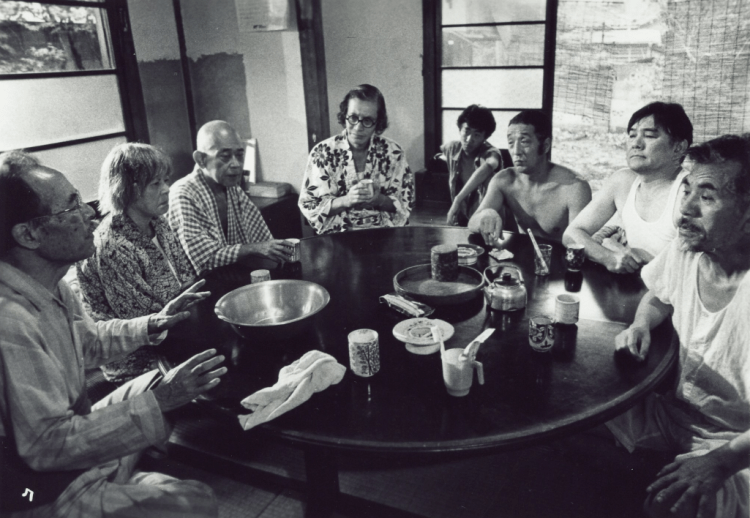
Shot in 4:3 and a stately looking black and white, At This Late Date, the Charleston begins when Jiro – a slightly strange younger son of a wealthy family, punches out a girl’s boyfriend whilst the pair are sitting on a bench and subsequently chases her through the park util he eventually gets himself arrested on a charge of “attempted rape”. He then gets thrown into a cell with a gang of crazy old guys who took the decision sometime ago to secede from the state of Japan and create their own independent nation known as the land of Yamatai. Consequently, they all refer to each other by their “cabinet titles” such as Foreign Minister and Army Minister etc each inspired by their former lives which is why they have a minister for mail (he used to be a postman). They’re in jail because they tried to make a “state visit” to the Diet building and whilst there enjoyed some of the canteen food but as this was an official event they didn’t see why they should pay for any of it (and their Finance Minister was busy at the races).

Soon enough everyone gets released – the old guys when the Finance Minister turns up to pay their bill and Jiro when he’s bailed out by his older brother and the family housemaid (who quickly realises the “victims” aren’t quite what they seem). However, in a fantastically weird coincidence it turns out that the government of Yamatai have commandeered a house on the estate of Jiro’s father for their sovereign territory. Jiro’s brother is desperate to evict them but there’s also the problem that their multimillionaire dad has been missing for months and no one’s quite sure what might have happened to him…

Crazy old guys (and gal) who’ve become so disillusioned with their nation that they’ve started a new one on their own, missing industrialists, a Lupin III-like policeman who’s so obsessed with looking cool that the suspects always run away while he’s left striking a pose – Okamoto really knows how to pile on the strangeness, but somehow it all seems to make perfect sense. Madcap doesn’t even begin to do justice to crazy cartoon world Okamoto has created but it’s all so effortlessly funny that it hardly matters what you’d call it.

After initially being captured and branded a spy when he marches on over to Yamatai to ask them about his father, Jiro finds himself defecting to become “Minister of Labour” (this seems to involve doing all of the old guys’ menial tasks). As the youngest member of the group, he becomes the repository for their stories which mostly date back to the days of their youth from the fun loving Charleston era to the rise of militarism and eventually the war itself. This comes to the fore even more as the events take place in August, meaning that there’s both the anniversary of the atomic bomb and of the end of the war raising painful memories for this group of older folks, even if not quite so relevant to the younger contingent. The gang are planning a special trip to a hot spring on the 15th, but first they have to defend their micro-country against the onslaught of gangsters and bailiffs who are trying to “invade” their sovereign territory.

The old folks are pacifists, more or less (they didn’t really want an “Army Minister” but it was argued that no one would take them seriously without means of defence) but are still determined to protect their ideal state of Yamatai all the while clamouring for a silent kind of diplomatic immunity. They have some very unusual ideas but they know what’s what and having made an unlikely ally in the form of an unhappily married and soon to be retired policeman, have even managed to expose a little corruption and evil corporate shenanigans in the process of defending their own freedom. A vote for dancing cheerfully over a military march, At This Late Date, The Charleston is a warm and funny tale of eccentric oldsters who’ve seen it all before and finally decided it’s all kind of ridiculous anyway which can’t help but get your own toes tapping, whatever age you are.


Several unsubtitled trailers for the price of one:

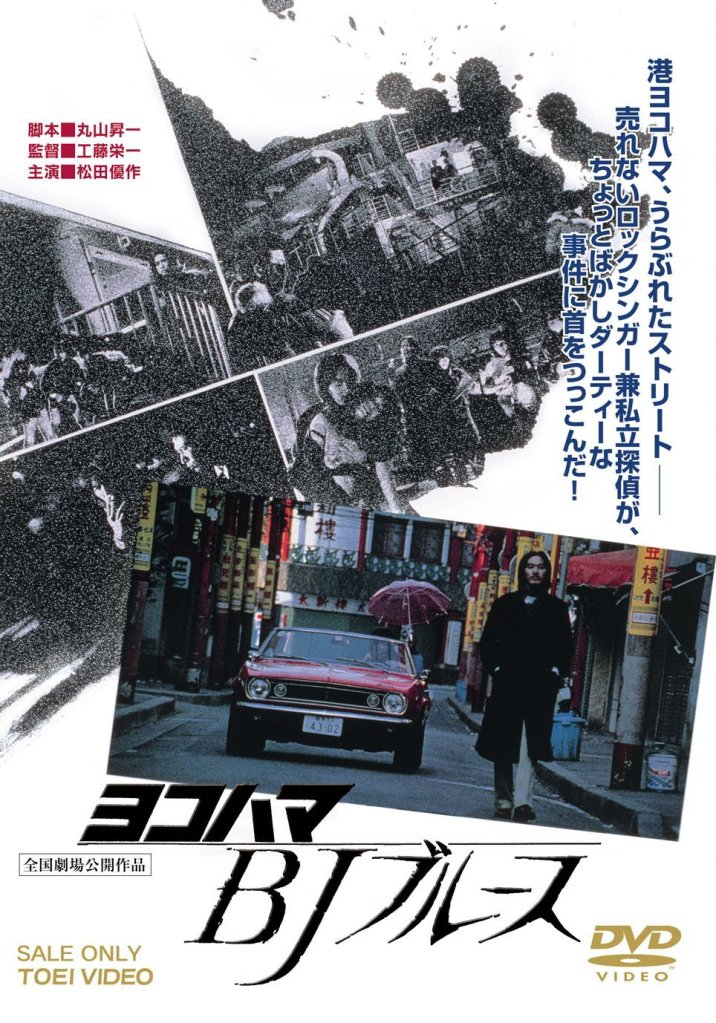
Yokohama BJ Blues (ヨコハマBJブルース, Eiichi Kudo, 1981)

Yokohama bj bluesYusaku Matsuda may have been the coolest action star of the ‘70s but by the end of the decade he was getting bored with his tough guy persona and looked to diversify his range a little further than his recent vehicles had allowed him. Matsuda had already embarked on a singing career some years before but in Eiichi Kudo’s Yokohama BJ Blues (ヨコハマBJブルース), he was finally allowed to display some of his musical talents on screen as a blues singer and ex-cop who makes ends meet through his work as a detective for hire.

After his set at a rundown jazz bar, BJ’s first job is tracking down a missing son. When he finds the guy, Akira, he seems to have become the employee (and possible sex slave?) of a gay gangster. Akira says he’s fine with his new life and wants his mother to leave him alone so BJ gets the hell out of there to give her the message but the unpleasantness of the situation lingers with him a little.

Shortly after, BJ receives a telephone call from an old police buddy, Ryo, who needs his help. Ryo got in too deep with the same gang BJ just came up against and is thinking of quitting the force in a bid to make the “Family” lose interest in him. However, Ryo is gunned down in broad daylight leaving his partner, Beniya, convinced that BJ is somehow responsible. BJ now doubly has it in for Family and starts working on his own behalf to try and find some answers and possibly a little vengeance too.

You see, back when Ryo and BJ were partners, they both liked the same girl, Tamiko, who eventually married Ryo. Beniya thinks BJ killed his friend to steal his wife and is much more interested in giving BJ a good kicking rather than investigating this very strange gang set up which seems to have some kind of drug smuggling gig going with the triads in Hong Kong.

BJ forms an odd sort of friendship with Akira in the hopes of tracking down the four gay, leather clad punk henchmen of Ali who probably gunned down his friend. However, the conspiracy only deepens and BJ finds himself suspecting even his closest of friends.

With its jazz soundtrack and melancholy tone, Yokohama BJ Blues is channelling hard boiled in a big way though does so in a distinctly modern fashion. BJ sings the blues whilst walking around this strange noir world which seems to endlessly disappoint him. Unfortunately for him, BJ is quite a good detective and quickly gets himself in way over his head only to end up finding out a few things it might be better not to know.

One of the film’s most notable components is its use of homoerotic themes with its gangs of gay gangsters, rent boys and punks. Indeed, though the wife of his former partner is floated as a possible motive, the love interest angle is never fully explored and all of BJ’s significant interactions in the film are with other men. Firstly his relationship with his former police partner Ryo which kick starts the entire adventure and then his strange almost date-like experience with Akira about half way through. BJ remains otherwise alone, a solo voice seeking justice for his fallen friends.

Of course, the film’s selling point is Matsuda’s singing so he’s allowed to play his own chorus in a sense by narrating the events from the stage in the form of the blues. Not quite “The Singing Detective”, but almost – BJ tries to bring some kind of order to his world by turning it into a song. In addition to adding to the noir tone, the bluesy soundtrack even allows for a New Orleans-esque musical funeral which oddly fits right in with the film’s weird, macabre atmosphere.

A surreal, noir inspired crime drama with musical elements, Yokohama BJ Blues is quite a hard film to categorise. Unusual for its homosexual milieu and overt homoerotic plotting the film occupies something of a unique place given its obvious marketing potential and star’s profile coupled with its decidedly murky noir tone. Difficult, yet interesting, Yokohama BJ Blues ultimately succeeds both as an intriguing crime drama and as a star vehicle for its versatile leading man.


This is a really, deeply, strange film.

Unsubtitled trailer:

http://www.youtube.com/watch?v=oYzkD-YJbjo

I actually quite like Matsuda’s foray into the world of jazz, the title song from Yokohama BJ Blues which is heard in the trailer is called Brother’s Song and is included on Matsuda’s 1981 album Hardest Day. Here he is on a talk show singing Yokohama Honky Tonk Blues:

http://www.youtube.com/watch?v=5Yr4fW2zoFk

Kagero-za 陽炎座 (Heat Haze Theatre – Seijun Suzuki 1981)

SuzukiKageroza1Zigeunerweisen was an unexpected commercial and critical hit in Japan netting both an improbably good box office return and more than a few awards. The next instalment in what would become Suzuki’s Taisho Roman Trilogy (though it would be another ten years before the final part, Yumeji, would arrive) therefore benefitted from a slighter bigger budget, bigger stars and even greater ambition. Like the others in the trilogy and as implied by its title, Kagero-za is once again based on a book set in the Taisho era though this time by Kyoka Izumi. Izumi was a novelist and kabuki playwright most closely associated with supernatural tales influenced by Edo era traditions and Kagero-za even features a playwright as its protagonist. With even less clarity than Zigeunerweisen, Kagero-za is not altogether as successful but nevertheless boasts Suzuki’s bizarre imagery and surreal world view.

Like Zigeunerweisen Kagero-za also throws dreams and reality into a giant melting pot with a non-linear narrative that floats and wefts like a strange nightmare. It begins with the central character, Matsuzaki (played by Yusaku Matsuda), meeting a lone woman near a shrine who asks him to accompany her to visit a friend in the hospital. She doesn’t want to go alone because she’s afraid of the old woman who sells charms and medicines there including bladder cherries which are said to contain the souls of women. Originally reluctant Matsuzaki agrees only to have her change her mind shortly after. Matsuzaki is pre-occupied over having dropped a love letter and worrying it’s been found by an ‘evil’ person – something which upsets his new friend as she’s convinced the letter was from a married woman.

This mysterious woman, it turns out, may be (or have been?) the wife of Matsuzaki’s wealthy patron Tamawaki. To make matters even more confusing, Tamawaki may have had two wives – the first a German woman he married while abroad and brought back with him to Japan who died her hair black and wore contact lenses to look more Japanese but regained her original blonde & blue eyed foreignness in the bright moonlight. The second is, apparently, dying in hospital – not that Tamawaki is terribly upset about it. Matsuzaki becomes increasingly obsessed with the mysterious woman, following her across the country only to discover Tamawaki waiting for him – apparently intent on witnessing a double suicide.

The film takes an even more surrealist dive towards the end as Matsuzaki finds himself the only adult audience member at a kabuki show entirely performed and witnessed by children. Not only that, this bizarre kabuki play appears to re-enact the exact same events from the first half of the film. A fitting trap for a playwright, this last, nightmarish section echoes the film’s ghost story origins complete with the creepy bladder cherry seller from the beginning as some kind of villainous demoness and Tamawaki as a tempting devil. Who talks of realism here? Says Tamawaki making an exit through an alleyway with a rifle on his shoulder. Who indeed? Not us, that’s for sure.

Even less coherent than Zigeunerweisen, Kagero-za is a veritable fever dream of a film. There’s barely any linear plot, Matsuzaki’s perceptions are recounted in fractured dream narrative where the true nature of events is always unclear. We can’t trust Matsuzaki to guide us here, nor can we trust Suzuki who employs fewer absurdist tricks than with the previous film but injects a heavy dose of kabuki inspired theatrics. Everything feels inevitable, like the action in a play it’s all been scripted and performed many times before. Yet for all that we don’t ever come to feel very much for Matsuzaki and his presumably tragic fate even though we realise fairly early on what sort of story this is. It’s hellish, and gruelling and honestly tries the patience at times but never achieves that sense of over arching dread that characterised Zigeunerweisen.

That said, if Kagero-za’s largest weakness is playing second fiddle to Zigeunerweisen that’s not so much of a problem. Once again filled with bizarre and trippy imagery, Kagero-za has many startling moments but fails to marry its visual virtuosity with the more individualistic focus of its script. Undeniably without the power of Zigeunerweisen, Kagero-za ultimately feels a little too clever (and perhaps too cold) for its own good but nevertheless does offer Suzuki’s visual flair and an entertaining (if baffling) narrative.