A New Love in Tokyo (愛の新世界, Banmei Takahashi, 1994)

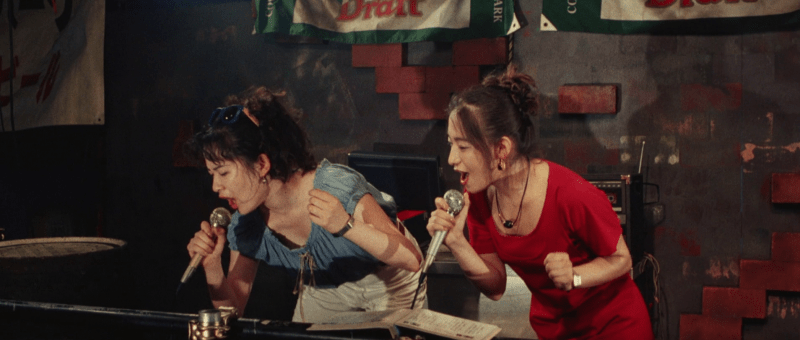
Life is theatre in Banmei Takahashi’s A New Love in Tokyo (愛の新世界, Ai no Shinsekai). Strangely marketed in some quarters as a kind of sequel to Ryu Murakami’s Tokyo Decadence though it is entirely unconnected to it, Banmei Takahashi’s after hours drama is a breezy riot that runs in direct contrast to other post-Bubble era movies which saw only despair and disillusionment in economic stagnation. For Rei (Sawa Suzuki) and Ayumi (Reiko Kataoka), however, life is one long party that they live on their own terms hoping to ride the wave all the way to the sea.

That said, it’s true that Rei, at least, is doing her dominatrix job because it’s impossible to support oneself as an artist in this economy. She is, in fact, basically subsidising her whole theatre troupe through sex work as a means of keeping it going. Her relationship to the men in the group is almost like Snow White and the Seven Dwarves while, for unexplained reasons, she sleeps with each of her dopey castmates on a rota system. It’s not until crunch time that they realise they should probably get jobs too, while the only other woman in the group (Yoko Nakajima) takes a job as a receptionist answering the phone at the call girl agency where Ayumi works.

Rei often runs into Ayumi leaving hotels and the pair soon become fast friends, though unlike Rei, Ayumi is a regular sex worker who sleeps with her clients. Nevertheless, Rei seems to like her precisely because, as she puts it, she’s a good liar, which is perhaps what you need to be to be successful at this business. She manipulates her clients by pretending to be a shy virgin so they pay her more for basic services, while lying to her boyfriend that she’s an office lady. The fact he takes it at face value suggests he might not be all that bright, which is why he’s struggling to finish his exams to become a doctor. Later, she’s thrown him over for a lad training to be a lawyer but just with as much success. Both the men she ends up with seem to be feckless and dim, though she fluffs their egos by pretending to be stupid. She says that her end goal is to become the wife of a professional lawyer or doctor, which is to say she’s looking for class status and respectability, though she’s probably earning more than they are by herself already. Ayumi has a host of savings pots and sometimes transfers large sums of money into one telling her boyfriend it’s from her father to help pay for a wedding.

Which is to say, everyone here is playing a kind of role. Both Rei and Ayumi seem to be using their real names for their work, but as Rei says the dominatrix gig is good for her acting career in allowing her to take on multiple personas. She too writes frequent letters home to her mother which bear little relation to reality in which she claims to be a therapist’s receptionist. But the clients are acting too, because this is, after all, all about role play. One of Rei’s most devoted customers is a yakuza who bosses his men around all day then comes to her to be punished. He is scrupulously polite and really rather sweet, buying up all the tickets to Rei’s play to make sure she’s not embarrassed on the opening night. Generally speaking, the streams shouldn’t cross between Rei the actress and Rei the dominatrix, so the yakuza is crossing a line by intruding on her personal life at the play, though he does so in an otherwise respectful way, apologising for his presence and making it clear that he doesn’t mean to expose her to those who might not know nor does he intend to encroach any further on her personal life.

Another of the women’s clients seems to be a fed up salaryman ranting about his boss and company lay-offs, hinting at the stressfulness of the economic situation for those working outside of the sex industry as well as the emasculating nature of corporate life in which the salaryman can only vent his frustrations through BDSM role-play rather than by actually taking it up with his boss. Rei and Ayumi are, by contrast, free from any such concerns. That is not to say, however, that their lives are easy or without danger. When a sex worker is found dead in a love hotel bathroom, a gloom falls over the industry. Rei asks Ayumi if she’s feeling alright, but as it turns out her agency has spotted a business opportunity seeing as most of the others will have decided to close for the sake for safety and as a gesture of respect. Ayumi too is threatened by a customer with a knife and is only saved by the arrival of a yakuza, in an unexpected cameo from ice cool V-Cinema star Show Aikawa, who intimidates the customer into backing off by eating his own sunglasses. Nevertheless, Ayumi goes straight back to work to meet the next customer, unwilling to let herself be cowed by male violence.

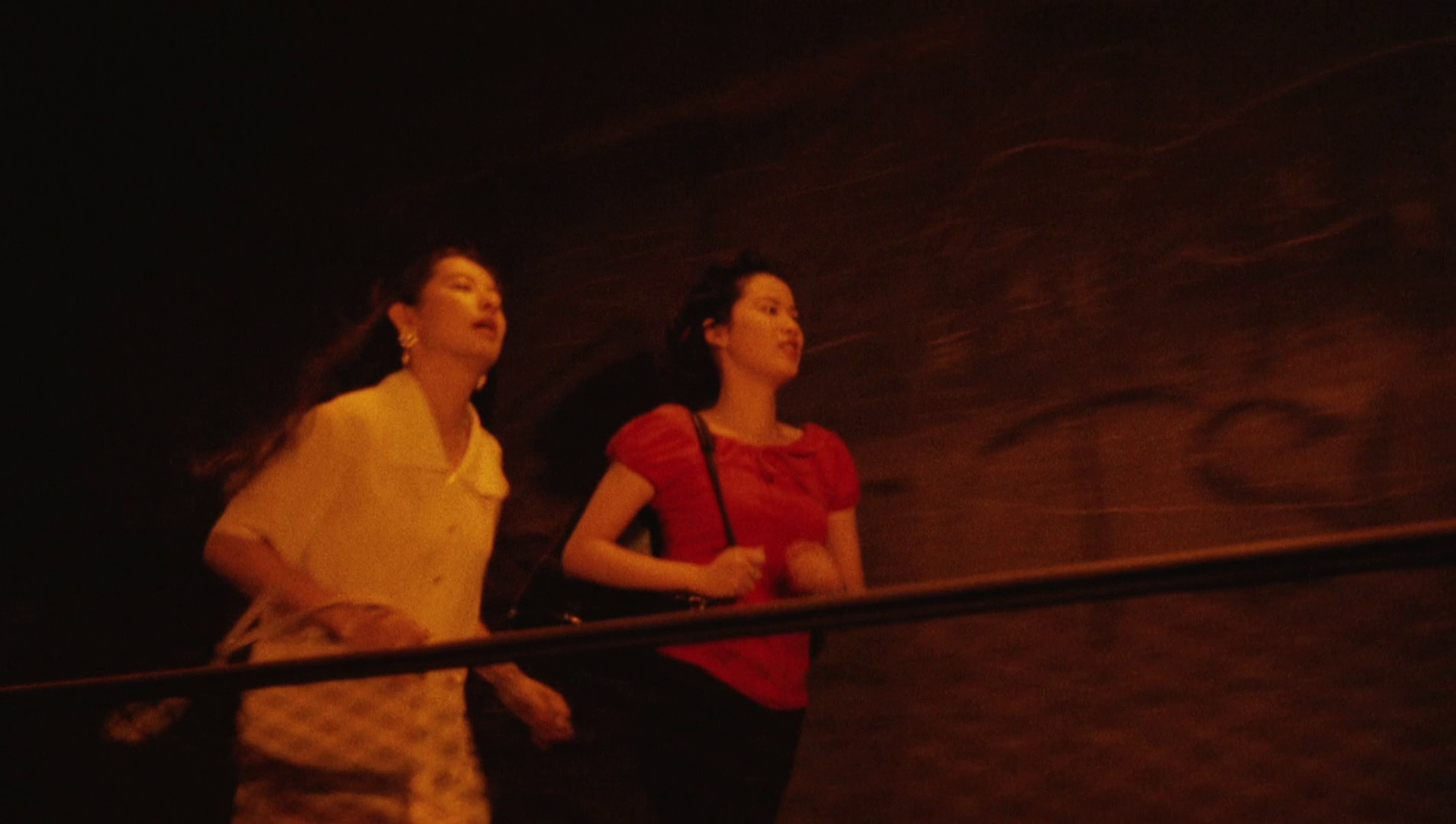
That’s something she has in common with Rei who similarly treats the attempts of men to ruin her night with similar disdain. When one customer proves rebellious, she keeps him waiting for hours while tied up and bound in the dark. She and Ayumi try turning the tables by visiting a host club, but are instantly put off by their poor quality patter. They go on a kind of date with two guys who tried to pick them up, but dump them when they’ve had enough. Rei, in particular, has several boyfriends who think they have some sort of claim on her body and her time, but she only ever does as she pleases. There’s something unexpectedly joyful about the two women running hand in hand through the midnight city, as if this were only ever their playground. The juxtaposition of the erotic photographs taken of actress Sawa Suzuki by Nobuyoshi Araki and those of her childhood hint at this quality of playfulness, as if her life were one of fun games in which she’s never quite grown up. They also remind us, however, of her ordinariness. She had a childhood too, and is, in fact, just like everyone else. Her job is just a job, no different from those of the guys at her theatre troupe who work in restaurants and video stores. She and Ayumi even exchange business cards. This festival might be over now, but that only means it’s time to start preparing for the next in the company of her friends as she and Ayumi enjoy their lives in the permanent dawn of a city that seems to exist only for them.


Trailer (English subtitles)
Proof of the Man (人間の証明, Junya Sato, 1977)

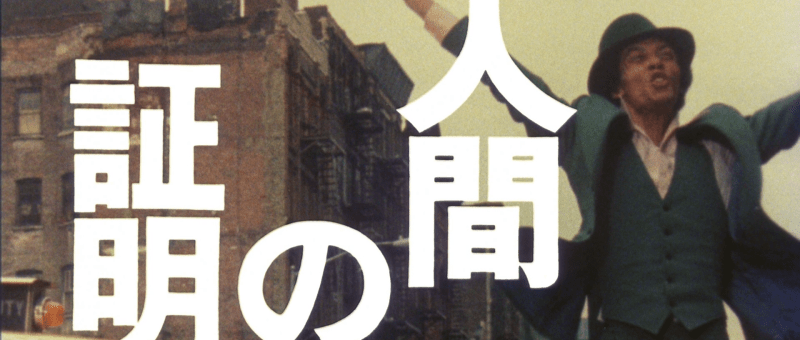
proof of the man posterOne could argue that Japanese cinema had been an intensely Japanese affair throughout the golden age even as the old school student system experienced its slow decline. During the ‘70s, something appears to shift – the canvases widen and mainstream blockbusters looking for a little something extra quite frequently ventured abroad to find it. Pioneering producer Haruki Kadokawa was particularly forward looking in this regard and made several attempts to crack the American market in the late ‘70s and early ‘80s before settling on creating his own mini industry to place a stranglehold around Japanese pop culture. Sadly, his efforts mostly failed and faced the same sorry fate of being entirely recut and dubbed into English with new Amero-centric scenes inserted into the narrative. Proof of the Man (人間の証明, Ningen no Shomei) is one of Kadokawa’s earliest attempts at a Japanese/American co-production and, under the steady hands of Junya Sato, is a mostly successful one even if it did not succeed in terms of overseas impact.

Based on the hugely popular novel by Seiichi Morimura, Proof of the Man stars the then up and coming Yusaku Matsuda as an ace detective, Munesue, investigating the death by stabbing of a young American man in Japan. The body was discovered in a hotel lift on the same night as a high profile fashion event took place with top designer Kyoko Yasugi (Mariko Okada) in attendance. After the show, an adulterous couple give evidence to the police about finding the body, but the woman, Naomi (Bunjaku Han), insists on getting out of the taxi that’s taking them home a little early in case they’re seen together. On a night pouring with rain, she’s knocked down and killed by a young boy racer and his girlfriend who decide to dispose of the body to cover up the crime rather than face the consequences. Kyohei (Koichi Iwaki), the driver of the car, is none other than the son of the fashion designer at whose show the central murder has taken place.

Like many Japanese mysteries of the time, Proof of the Man touches on hot-button issues of the immediate post-war period from the mixed race children fathered by American GIs and their precarious position in Japanese society, to the brutality of occupation forces, and the desperation and cruelty which dominated lives in an era of chaos and confusion. The only clues the police have are that the victim, Johnny Hayward (Joe Yamanaka), said something which sounded like “straw hat” just before he died, and that he was carrying a book of poetry by Yaso Saiji published in 1947. Discovering that Hayward was a working-class man of African-American heritage from Harlem whose father took a significant risk in getting the money together for his son to go to Japan (hardly a headline holiday destination in 1977), the police are even more baffled and enlist the assistance of some regular New York cops to help them figure out just why he might have made such an unlikely journey.

The New York cops have their own wartime histories to battle and are not completely sympathetic towards the idea of helping the Japanese police. Munesue, of a younger generation, is also harbouring a degree of prejudice and resentment against Americans which stems back to a traumatic incident in a market square in which he witnessed the attempted gang rape of a young woman by a rabid group of GIs. Munesue’s father tried to intervene (the only person to do so) but was brutally beaten himself, passing away a short time later leaving Munesue an orphaned street kid. In an effort to appeal to US audiences, Proof of the Man was eventually recut with additional action scenes and greater emphasis placed on the stateside story. Doubtless, the ongoing scenes of brutality instigated by the American troops would not be particularly palatable to American audiences but they are central to the essential revelations which ultimately call for a kind of healing between the two nations as they each consider the ugliness of the immediate post-war era the burying of which is the true reason behind the original murder and a secondary cause of the events which led to the death of Naomi.

Naomi’s death speaks more towards a kind of growing ugliness in Japan’s ongoing economic recovery and rising international profile. Kyohei is the son not only of high profile fashion designer Kyoko, but can also count a high profile politician (Toshiro Mifune) as his father. Spoiled and useless, Kyohei is the very worst in entitled, privileged youth driving around in flashy cars and going to parties, living frivolously on inherited wealth whilst condemning the source of his funds as morally corrupt citing his mother’s acquiescence to his father’s frequent affairs. Yet aside from anything else, Kyohei is completely ill-equipped for independent living and is essentially still a child who cannot get by without the physical and moral support of his adoring mother. 

Johnny Hayward, by contrast, retains a kind of innocent purity and is apparently in Japan in the hope of restoring a long severed connection as echoed in Saiji’s poem about a straw hat lost by a small boy on a beautiful summer’s day. The words of the poem are later repeated in the title song by musician Joe Yamanaka who plays Johnny in the film and is of mixed race himself. As in most Japanese mystery stories, the root of all evil is a secret – in this case those of the immediate post-war period and things people did to survive it which they now regret and fear the “shame” of should they ever be revealed. Some of these secrets are not surmountable and cannot be forgiven or overcome, some atonements (poetic or otherwise) are necessary but the tone which Sato seems to strike encourages a kind of peacemaking, a laying to rest of the past which is only born of acceptance and openness. Despite the bleakness of its premiss on both sides of the ocean, Proof of the Man does manage to find a degree of hopefulness for the future in assuming this task of mutual forgiveness and understanding can be accomplished without further bloodshed.


Original trailer (no subtitles) – includes major plot spoilers!

School in The Crosshairs (ねらわれた学園, Nobuhiko Obayashi, 1981)

Still most closely associated with his debut feature Hausu – a psychedelic haunted house musical, Nobuhiko Obayashi’s affinity for youthful subjects made him a great fit for the burgeoning Kadokawa idol phenomenon. Maintaining his idiosyncratic style, Obayashi worked extensively in the idol arena eventually producing such well known films as The Little Girl Who Conquered Time (starring Kadokawa idol Tomoyo Harada) and the comparatively less well known Miss Lonely and His Motorbike Her Island (starring a very young and extremely skinny Riki Takeuchi). 1981’s School in the Crosshairs (ねらわれた学園, Nerawareta Gakuen) marks his first foray into into the world of idol cinema but it also stars one of Kadokawa’s most prominent idols in Hiroko Yakushimaru appearing just a few months before her star making role in Shinji Somai’s Sailor Suit and Machine Gun.

Set once again in a high school, School in the Crosshairs is the ultimate teen movie for any student who’s ever suspected their place of education has been infiltrated by fascists but no one else has noticed. Top student Yuka (Hiroko Yakushimaru) is the archetypal Obayashi/idol movie heroine in that she’s not only bright and plucky but essentially good hearted and keen to help out both her friends and anyone else in trouble. Her life changes when walking home from school one day with her kendo obsessed friend Koji (Ryoichi Takayanagi) as the pair notice a little kid about to ride his tricycle into the path of a great big truck. Yuka, horrified but not quite knowing what to do, shouts for the little boy to go back only it’s time itself which rewinds and moves the boy out of harm’s way. Very confused and thinking she’s had some kind of episode, Yuka tests her new psychic powers out by using them to help Koji finally win a kendo match but when a strange looking man who claims to be “a friend”  (Toru Minegishi) arrives along with icy transfer student Takamizawa (Masami Hasegawa), Yuka finds herself at the centre of an intergalactic invasion plot.

Many things have changed since 1981, sadly “examination hell” is not one of them. Yuka and Koji still have a few years of high school left meaning that it’s not all that serious just yet but still, their parents and teachers have their eyes firmly on the final grades. Yuka is the top student in her class, much to the chagrin of her rival, Arikawa (Macoto Tezuka), who surpasses her in maths and English but has lost the top spot thanks to his lack of sporting ability. Koji is among the mass of students in the middle with poor academic grades but showing athletic promise even if his kendo career is not going as well as hoped.

Given everyone’s obsession with academic success, the aliens have hit on a sure thing by infiltrating a chain of cram schools promising impressive results. Grades aside, parents are largely laissez-faire or absent, content to let their kids do as they please as long as their academic life proceeds along the desired route. Koji’s parents eventually hire Yuka as a private teacher to help him improve only for her to help him skip out to kendo practice. Her parents, by contrast, are proud of their daughter and attentive enough to notice something’s not right but attribute her recent preoccupation to a very ordinary adolescent problem – they think she’s fallen in love and they should probably leave her alone to figure things out her own way. A strange present of an empty picture frame may suggest they intend to give her “blank canvas” and allow her to decide the course of her own life, but she has, in a sense, earned this privilege through proving her responsible nature and excelling in the all important academic arena.

School is a battlefield in more ways than one. Intent on brainwashing the teenagers of Japan, “mysterious transfer student” Takamizawa has her sights firmly set on taking over the student council only she needs to get past Yuka to do it. Takamizawa has her own set of abilities including an icy stare which seems to make it impossible to refuse her orders and so she’s quickly instigated a kind of “morality” patrol for the campus to enforce all those hated school rules like skirt lengths, smoking, and running in the halls. Before long her mini militia has its own uniforms and creepy face paint but her bid for world domination hits a serious snag when Yuka refuses to cross over to the dark side and join the coming revolution. Asking god to grant her strength Yuka stands up to the aliens all on her own, avowing that she likes the world as it and is willing to sacrifice her own life for that of her friends. Accused of “wasting” her powers, Yuka asks how saving people could ever be “wasteful” and berates the invaders for their lack of human feeling. Faced with the cold atmosphere of exam stress and about to be railroaded into adulthood, Yuka dreams of a better, kinder world founded on friendship and basic human goodness.

Beginning with a lengthy psychedelic sequence giving way to a classic science fiction on screen text introduction Obayashi signals his free floating intentions with Yuka’s desaturated bedroom floating over the snowcapped mountains. Pushing his distinctive analogue effects to the limit, Obayashi creates a world which is at once real and surreal as Yuka finds herself at a very ordinary crossroads whilst faced with extraordinary events. Courted by the universe, Yuka is unmoved. Unlike many a teenage heroine, she realises that she’s pretty happy with the way things are. She likes her life (exam stress and all), she loves her friends, she’ll be OK. Standing up for the rights of the individual, but also for collective responsibility, Yuka claims her right to self determination but is determined not to leave any of her friends behind.


Original trailer (no subtitles)