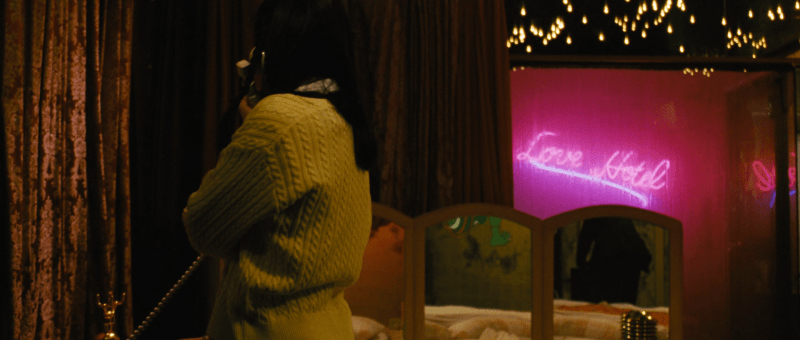

Love Hotel (ラブホテル, Shinji Somai, 1985)

love-hotel

Shinji Somai is not particularly well known outside of Japan but where his work is celebrated it’s mostly for his youth films of teen alienation and pop culture cool. Released in the same year as his iconic Typhoon Club, Love Hotel (ラブホテル) seems like something of an aberration in Somai’s career which leans towards the melancholic rather than the passionate. Somai had begun his working life apprenticing with Nikkatsu during their Roman Porno years and Love Hotel is, in someways, a return to this genre but is only accidentally a “pink film”, produced with Director’s Company and later acquired by the pink film giant. As such it contains a number of explicit sex scenes but maintains Somai’s characteristic long takes and contemplative approach rather than adhering to the often formulaic nature of the Roman Porno.

Failed businessman Muraki (Minori Terada) returns one day to find his office full of gangsters in the middle of raping his wife. Distraught, his first thought is suicide but then he decides on a little roundabout revenge before he goes. Dressed in a dark suit and sunglasses like some ‘60s Nikkatsu bad guy, Muraki holes up in a love hotel and calls down for a girl. “Yumi” (Noriko Hayami) arrives not long after. Handing the girl a vast sum of money, Muraki then instructs her to close her eyes because he’s also brought “a present”. He handcuffs her and reveals his true purpose by tearing off her clothes, tying her up and fitting her with a vibrator. He’s going to kill himself tonight, but he doesn’t want to go alone. In the end, he can’t go through with it, something in Yumi’s face changes his mind and he leaves her there, tied up and handcuffed.

Two years later, Muraki has divorced his wife (apparently to keep her safe from the yakuza who are still after him for his debts) and is now living an intentionally dull life as a taxi driver. One fateful day he runs into Yumi again, only she’s no longer “Yumi” but “Nami”, an office lady at a top company. Eventually recognising each other, the pair are each forced to face the circumstances surrounding the traumatic night of two years previously but doing so means risking everything they have now.

Love Hotel is a film of seeing and not seeing, of looking and refusal to look. The film opens with a semi-explicit sexual scene in which Muraki’s wife is raped by a loanshark in which we watch both Muraki’s horrified expression and the act itself by means of a well positioned mirror. Somai repeats the mirroring motif throughout the film both by showing us Nami repeatedly caught in mirrors and by the obvious tripartite glass arrangement of the love hotel’s headboard. Both Muraki and Nami have elements of themselves at which they’d rather not look but the ever present mirrors constantly prompt them into areas of self-reflection, ironically possible only by looking at the other.

Where Muraki has chosen a life of austerity, separating from his wife who nevertheless continues stopping by to look after him in all of the wifely ways, Nami has tried and failed to put her traumatic past behind her by hopping into the consumerist revolution. Having supported herself through prostitution as a student, she’s managed to swing a pretty good job at top company only to find herself “prostituted” again through an ill-advised affair with her married boss. After his wife finds out and Nami loses her job and the entire life she’d begun to build for herself, she tries to call her former lover for consolation only to have him cruelly hang up on her. Nami continues her lamentations to the alarming trill of the dial tone in a heartbreaking moment of true loneliness.

Left with nothing else, the pair decide to revisit their unfinished love hotel business but their much more normal encounter changes each of them in different ways. It’s clear something has passed between the two, but Muraki’s final glance into the mirror perhaps shows him something he’d rather not have seen. Nami’s face, like Yumi’s face, may well have been “angelic” but cannot “save” Muraki in the same way twice – or at least, not in the way the restored Nami would have liked to save him. Dark, melancholy and fatalistic, Somai’s stab at Roman Porno is a sad tale of frustrated love, destroyed by the use and misuse of bodies speaking against each other and becoming a barrier to true connection. The Love Hotel is a place romance goes to die, and what the pair of damaged lovers at the centre of his noir-tinged tale of despair find there is only emptiness and pain devoid of any sign of hope.


Opening scene (no subtitles)

Masterfully constructed one take final scene (dialogue free)
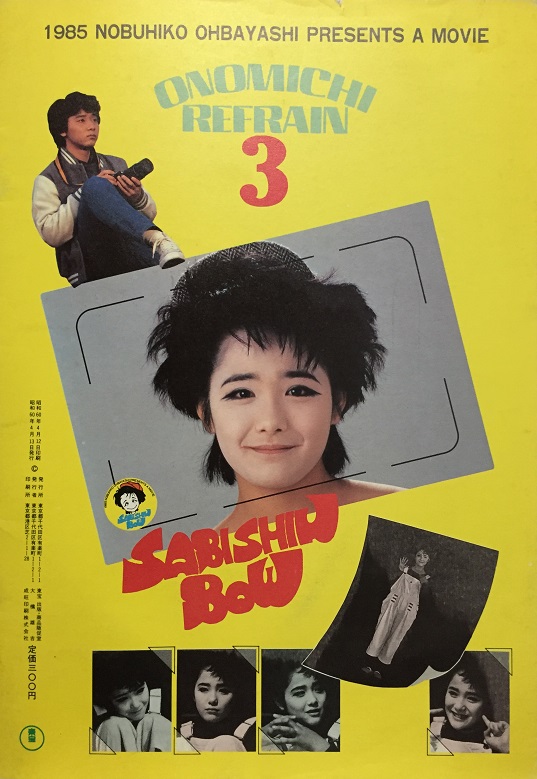
Miss Lonely (さびしんぼう, Nobuhiko Obayashi, 1985)

Miss LonelyMiss Lonely (さびしんぼう, Sabishinbou, AKA Lonelyheart) is the final film in Obayashi’s Onomichi Trilogy all of which are set in his own hometown of Onomichi. This time Obayashi casts up and coming idol of the time, Yasuko Tomita, in a dual role of a reserved high school student and a mysterious spirit known as Miss Lonely. In typical idol film fashion, Tomita also sings the theme tune though this is a much more male lead effort than many an idol themed teen movie.
Obayashi begins with an intertitle-like tribute to a “brusied, brilliant boyhood” before giving way to a wistful voiceover from the film’s protagonist Hiroki Inoue (played by frequent Obayashi collaborator, Toshinori Omi). His life is a fairly ordinary one of high school days spent with his two good friends, getting up to energetic mischief as teenage boys are want to do. The only thing that’s a little different about Hiroki is that his father is a Buddhist priest so he lives in the temple with his feisty mother who is always urging him to study more, and he’ll one day be expected to start training to take over the temple from his father (he has no particular aversion to this idea).

Hiroki’s big hobby is photography and he’s recently splashed out on a zoom lens but rarely has money for film to put in the camera so he’s mostly just playing around, accidentally spying on people. The main object of his interest is a sad looking high school girl who spends her days playing the piano. Hiroki, as an observer of human nature, has decided that she must be just as lonely as he is and has given her the name of “Miss Lonely”. It comes as a shock to him then that a very similar looking sprite appears, also called “Miss Lonely” and proceeds to cause havoc in his very ordinary life.

Although the film is filled with Obayashi’s trademark melancholy nostalgia, there is also ample room for quirky teen comedy as the central trio of boys amuse them selves with practical jokes. The best of these involves a lengthly sequence with the headmaster’s prized parrot which he has painstakingly taught to recite poetry. On being sent to clean up the headmaster’s office after misbehaving in class, the boys quickly set about teaching it a bawdy song instead causing the poor bird to hopelessly mangle both speeches into one very strange recitation. This comes to light when the headmaster attempts to show off his prowess with the parrot to an important visitor but when the mothers of the three boys are called in to account for their sons’ behaviour, they cannot control their laughter. That’s in addition to a repeated motif of the boys’ teacher’s loose skirt always falling off at impromptu moments, and a tendency to head off into surreal set pieces such as the anarchic musical number which erupts at the stall where one of the boys works part time.

Miss Lonely herself appears in a classic mime inspired clown outfit, dressed as if she’d just walked out of an audition for a Fellini film. To begin with, Hiroki can only see Miss Lonely through his camera lens, but she quickly incarnates and eventually even becomes visible to others as well as Hiroki himself. Past and present overlap as Miss Lonely takes on a ghostly quality, perhaps reliving a former romance of memory which may be easily destroyed by water and is sure to be short lived. Love makes you lonely, Hiroki tells us, revelling in the failure to launch of his first love story. Though, if the epilogue he offers us is to be believed, perhaps he is over romanticising his teenage heartbreak and is heading for a happy ending after all.

Chopin also becomes a repeated motif in the film, bringing our trio of lovesick teens together with his music and adding to their romantic malaise with his own history of a difficult yet intense relationship with French novelist George Sand. There’s a necessarily sad quality to Hiroki’s tale, an acceptance of lost love and lost opportunities leaving their scars across otherwise not unhappy lifetimes. Set in Obayashi’s own hometown Miss Lonely takes on a very heartfelt quality, marking a final farewell to youth whilst also acknowledging the traces of sadness left behind when it’s time to say goodbye.


Original trailer (no subtitles)

And here’s idol star Yasuko Tomita singing the title song on a variety show from way back in 1985

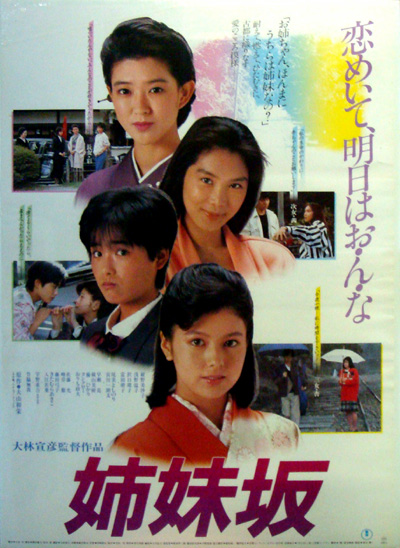
Four Sisters (姉妹坂, Nobuhiko Obayashi, 1985)

Four SistersNobuhiko Obayashi takes another trip into the idol movie world only this time for Toho with an adaptation of a popular shojo manga. That is to say, he employs a number of idols within the film led by Toho’s own Yasuko Sawaguchi, though the film does not fit the usual idol movie mould in that neither Sawaguchi or the other girls is linked with the title song. Following something of a sisterly trope which is not uncommon in Japanese film or literature, Four Sisters (姉妹坂, Shimaizaka) centres around four orphaned children who discover their pasts, and indeed futures, are not necessarily those they would have assumed them to be.
Yasuko Sawaguchi plays the third oldest sister and more or less protagonist of the story, Anzu, who is facing a very common teenage dilemma in that there are two boys (best friends) both interested in her and she can’t decide if she likes both, one, or either of them. Eventually, Yuzuki (Ichirota Miyakawa) wins out leaving his friend Oba (Toshinori Omi) depressed and on the sidelines. However, Yuzuki is from a wealthy family and it was intended he marry a cousin so his mother does some digging and discovers more about Anzu than Anzu knew about herself.

As it turns out, the four sisters are not actually related by blood as only one was the biological child of the goodhearted couple who raised them. Unfortunately, the children’s adoptive parents died in a car accident leaving their birth daughter, Aya (Misako Konno), as a kind of maternal figure to Akane (Atsuko Asano), Anzu, and Ai (Yasuko Tomita) though Akane was the only one old enough to remember their lives before coming to live with Aya and her family. The rediscovery of the truth knocks both younger girls for six, especially as Anzu’s birth mother has reappeared and presents an existential threat to their insular family of four.

Set once again set in a peaceful, countryside town, Four Sisters revisits many of Obayashi’s constant concerns in its evocation of memory, mislaid truth, and the need to come to terms with the past in order to go on living in the present. The four young women are each very different, but bound tightly together by their shared experience, including the recent loss of their parents. Anzu’s discovery threatens to destroy the family firstly through the exposure of a lie (or, what is really an omission of truth), and secondly to speed up the inevitable fracturing as she begins to seek a new life and eventually family of her own. Though Akane has been able to forge a career for herself (less pleasant part-time work aside), she rightly points out that in becoming their maternal figure, Aya has in a sense lost or rejected the opportunity to pursue her own happiness. The sisters’ bond is tight and near unbreakable, but it’s also, in a sense, constraining.

Obayashi begins the picture with in a polaroid-like frame in which the two boys declare their intentions to duel for Anzu’s affections. As the film moves on, Obayshi returns to these intertitle-like captions particularly in bookending the various seasons throughout which the film turns. Though not as radically as in some of his other work, Obayashi once again uses colour filtering as a highlighting tool which is most obvious towards the end as the edges of the screen start to blur, greying out everything other than our central heroines. However, other sequences take place in a noticeably expressionist environment with extreme colour contrasted backgrounds and unreal, star filled skies and Obayashi also allows the real world weather with its storms and raging rivers to dictate the mood.

Four Sisters is, at heart, a family drama though one seen through a slightly distorted mirror. The four girls are indeed a unit which would inevitably have to split or stagnate in the normal order of things but the bonds are strong enough to withstand the unusual amount of pressure placed on them, enabling the sisters to move on with their individual lives whilst remaining close. Obayashi keeps things relatively low key (by his own standards) but gently builds a melancholy, nostalgic tone filled with loss and regret yet also with hope for the future. Beautifully shot, with Obayashi’s characteristically unusual use of imagery and wistful, ethereal atmosphere Four Sisters may not be among the director’s most experimental efforts but does provide a warm tale of love lost and gained in the lives of four ordinary women.


Ran (乱, Akira Kurosawa, 1985)

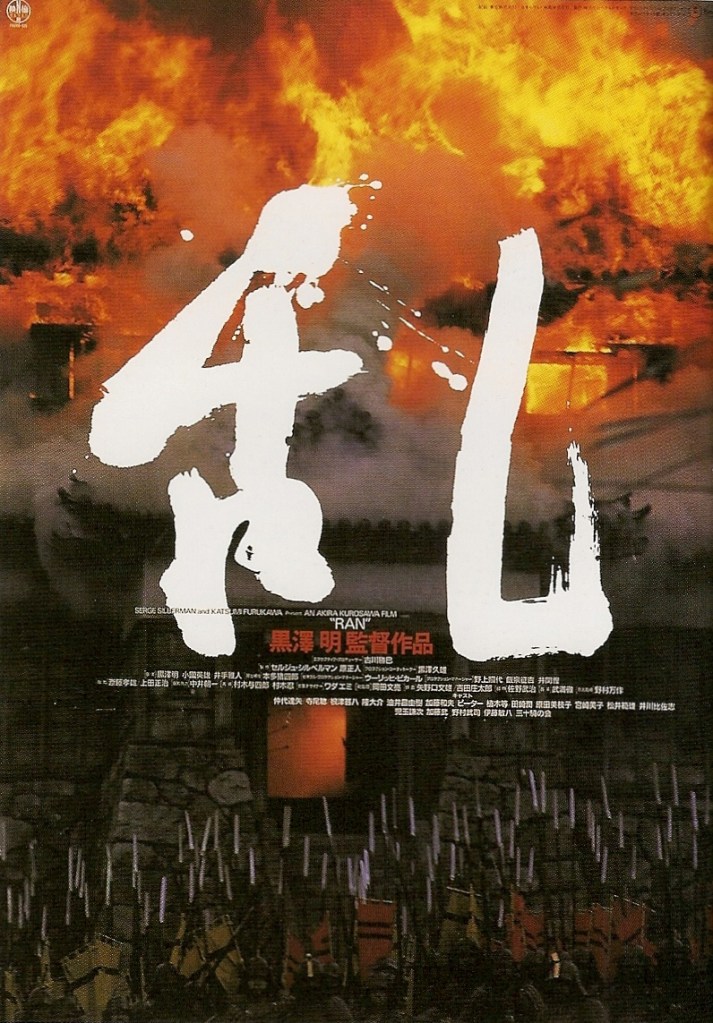
ran posterAkira Kurosawa is arguably the most internationally well known Japanese director – after all, Seven Samurai is the one “foreign film” everyone who “doesn’t do subtitles” has seen. Though he’s often thought of as being quintessentially Japanese, his fellow countryman often regarded him as too Western in terms of his filming style. They may have a point when you consider that he made three different movies inspired by the works of Shakespeare (The Bad Sleep Well – Hamlet, Throne of Blood – Macbeth, and Ran – King Lear) though in each case it’s clear that “inspired” is very much the right word for these very liberal treatments.
In the case of Ran (乱) – a loose adaptation of King Lear, Kurosawa moves the story to feudal Japan and an ageing king who this time has three sons rather than three daughters. This leaves Hidetora (Tatsuya Nakadai) with a smaller problem than Lear’s though in his original idea of making his eldest son his heir with the other two inheriting smaller roles it’s clear things aren’t going to end well. Just as in the original play, the oldest two sons Taro and Jiro sing their father’s praises with cynical glee but the youngest and most sincere, Saburo, refuses to play this game as his respect for his father is genuine. Unfortunately, Saburo’s honesty sees him banished from his father’s kingdom and his share of responsibility given over to his treacherous brothers. Predictably, neither is satisfied with what they’ve been given and it’s not long before a familial conflict has sparked into a bloody civil war.

How sharper than a serpent’s tooth it is to have a thankless child….Hidetora is not quite as far gone as Lear in Shakespeare’s original text at the beginning of the film yet he is still unable to see that his oldest two sons have placed personal ambition ahead of filial piety. Hidetora was once a fearsome, if cruel, warrior, famous for burning enemy villages and creating peace only through destruction. He’s old now, and tired and so he proposes to hand over the running of the kingdom to his eldest son, yet – he wants to remain the de facto leader until the very end. Of course, that doesn’t sit well with Taro, or more to the point his ambitious wife Lady Kaede. Hidetora is thrown out of Taro’s castle and then also from Jiro’s before all out war erupts between the two leaving him totally isolated – a king without a kingdom.

Hidetora’s true madness begins when he realises not only how little regard his eldest two sons hold for him, but also that his failure to recognise the true nature of the situation has lead to the deaths of the people in his care that have remained loyal to him to the very end. As the enemy begin to engulf the castle, concubines begin helping each other to commit suicide in order to avoid ravishment while others try to escape but are cut down by arrow fire. This is all his own fault – his ruthless cruelty has been filtered down to his two oldest sons who, as he did, will stop at nothing in the pursuit of power. What is a king if not the father of a nation, and as a father he has failed. Neither Taro or Jiro are worthy of the offices afforded to them and lack both basic humanity and the princely power one needs to become the unifying force of a people.

Only too late does Hidetora see the wisdom in Saburo’s words and finally understand that he has alienated the only one of his children that truly loved him. From this point on his madness increases and Nakaidai’s performance becomes increasingly mannered and theatrical as if Hidetora himself is acting in another play which only he can see. Wandering and lonely, the once great king is reduced to the estate of a beggar led only by his fool and sheltered by the ruins of a castle which he himself burned down.

However, as great as Nakadai is (and he always is), he’s very nearly upstaged by the young Mieko Harada as one of the all time great screen villainesses with the Lady Macbeth a-like Lady Kaede. Filled with a vengeful fury, Kaede is unafraid to use every weapon at her disposal to achieve her goal. No sooner is she brought the news of her first plan’s failure in the death of her husband than she’s embarking on a plot to seduce his brother which includes getting him to execute his wife. Vile as Kaede’s actions often are, her desire for revenge is an understandable one when you consider that Hidetora was responsible for the deaths of her family leaving her to become a trophy bride for the son of the man that killed them. Viewed from another angle, it would be easy to sympathise with Kaede’s desire to rid the world of these cruel and tyrannical lords were it not for her insistence on the death of Lady Sue – a woman in exactly the same position as herself whose death would not actually advance her cause very much at all.

Kurosawa films all of this from a distance. We, the audience, almost become the gods he speaks of – the ones who weep for us, watching silent and helpless, unable to save us from ourselves. We see the world for what it is – chaos, horses and men and blood. The battles aren’t glorious, they are frenetic, frightening and ultimately pointless. Though for all that there is a beauty to it too and the sheer scale of the production with its colour coded princes and immense armies is one the like of which we will never see again.

Ran presents us with a prognosis which is even more pessimistic than that of Lear. At the end of Shakespeare’s play, as profoundly tragic as it is, there is at least the glimmer of hope. There is a new, rightful king and the idea that something has been restored. Here there is no such resolution, we are the blind man casting a stick around the edge of a precipice, entirely alone and unable to see the gaping chasm which extends before us into which we may plunge headlong driven only by the chaos in our own hearts. In the end, Kurosawa’s message is not so different from Shakespeare’s – all the weight of this sad time we must obey, speak what we feel, not what we ought to say. Fathers and sons must strive to understand each other, and themselves, lest we fall into the eternal chaos which leads us to build our very own hell here on Earth.


Ran is currently playing in UK cinemas in a brand new 4K restoration courtesy of StudioCanal!


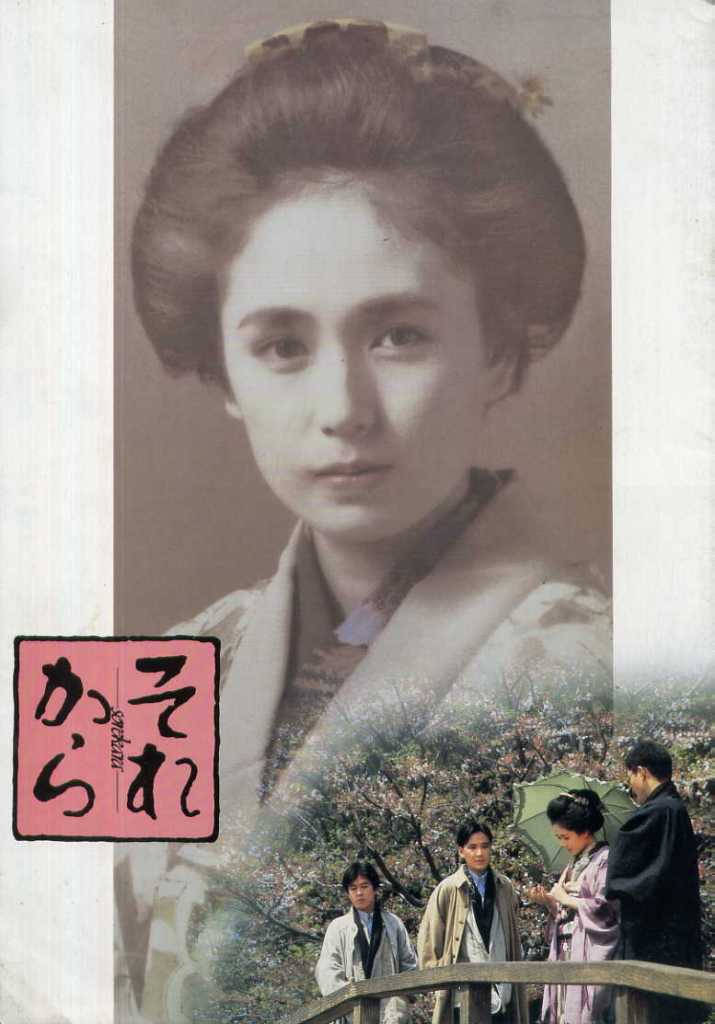
Sorekara (それから, AKA And Then, Yoshimitsu Morita, 1985)

Sorekara PosterYoshimitsu Morita had a long and varied career (even if it was packed into a relatively short time) which encompassed throwaway teen idol dramas and award winning art house movies but even so tackling one of the great novels by one of Japan’s most highly regarded authors might be thought an unusual move. Like a lot of his work, Natsume Soseki’s Sorekara (And Then…) deals with the massive culture clash which reverberated through Japan during the late Meiji era and, once again, he uses the idea of frustrated romance to explore the way in which the past and future often work against each other.

Daisuke (Yusaku Matsuda) is a youngish man approaching early middle age. Thirty years old and a “gentleman” of leisure, he lives in a world of perpetual ennui where he even has to hold his hand to his chest to check that his heart is indeed still beating. His days might have gone on aimlessly had it not been for the unexpected return of an old friend from university, Hiraoka (Kaoru Kobayashi), who has been dismissed from his job following a series of problems with his superiors which has also landed him with a considerable debt to repay and no prospects of further employment. Adding to his sorrows, Hiraoka and his wife, Michiyo (Miwako Fujitani), have recently lost their infant child and have been told that due to Michiyo’s poor health they may not be able to have any more. Daisuke wants to help them, but he’s also facing a lot of pressure from his family to accept an arranged marriage which will further his father and brother’s prospects and is becoming conscious of the relative lack of freedom his life of dependent idleness entails.

Men of Daisuke’s era have perhaps had it hardest coming of age during a period of massive social change which is incomprehensible to the older generation. He’s a well educated man, an intellectual, who can speak several languages and is given to introspective contemplation, but he’s also inherited the worst of European classism as he’s come to believe that working for money is beneath his dignity as a gentleman. He’s completely unable to identify with his friend who needs to work to eat and enjoys none of the various safety nets which are provided by his own wealth and privilege. Nevertheless, he does want to try and help Hiraoka and is dismayed to discover just how little power he has do anything for him.

Hiraoka and Daisuke were part of a group of friends at university which also included another boy who, sadly, died of an illness and his sister – Michiyo, who eventually married Hiraoka. At the time, Daisuke himself had fallen in love with Michiyo but out of a misconceived idea of “chivalry” – another unnecessary adoption of European romanticism, he stepped aside in favour of his friend. This has proved to be a disaster all round and Michiyo and Hiraoka are trapped in an unhappy union which has made Michiyo physically weak and caused Hiraoka to spend the money he should be using to pay back his massive debts on drink and geisha so he can avoid going home. Daisuke’s adherence to a code of morality which is more affectation than anything else is shown up to be cowardice, another way of avoiding adulthood, as he uses his intellectual ideas to mask what is really a fear of rejection.

Daisuke later comes to believe what he did in not acknowledging his own feelings towards Michiyo was “a crime against nature”. He now finds himself at another crossroads as he faces the choice between conforming to the rigidity of his upperclass life in marrying the woman his father has chosen for him and continuing to be financially dependent, or embracing his individuality and striking out on his own to finally claim the woman he’s always loved (and, tragically, has always loved him). In choosing to make a life with Michiyo, Daisuke would be taking several transgressive actions – firstly acting against his own self image by entering the world of working men and secondly by stealing a married woman away from her husband which is no simple matter in the still relatively conservative Meiji era society.

Ultimately, the film is much more a story of Daisuke’s journey of self realisation than it is a melodrama with a love triangle at its centre though Sorekora certainly embraces these aspects too. Morita opts for a more classical tone here with a number of long, unbroken takes and static camera shots yet he also affects a strange, dreamlike tone in which the present and the past seem to co-exist, each drifting one into the other. He intercuts scenes which echo the film’s ending into the main body of the action as well as showing us the early days of Daisuke and Michiyo’s unresolved romantic connection which is poignantly brought out by an experimental technique in which the foreground appears almost like a freeze frame while the rain carries on falling behind them. At certain points there are also some surreal sequences in which Daisuke is travelling on a train but is surrounded by fellow passengers who suddenly each pull out a large sparkler or another where a gaggle of men all dressed just like him are crowded into the the other end of the train and looking at the moon through the open roof of the carriage.

A prestige picture, but one with a healthy dose of strangeness, Sorekara is an inexpressibly sad film full of the tragedy of wasted time and the regret that comes with not having acted in way which satisfies your authentic self. In order to live a life that’s true to himself Daisuke must finally learn to risk losing everything but the film’s ambiguous ending may ask whether the cost of following your heart may not be too heavy a one to pay.


Unsubtitled trailer:


Capone Cries a Lot (カポネおおいになく, Seijun Suzuki, 1985)

1040003_lNever one to be accused of clarity, Seijun Suzuki’s Capone Cries a Lot (カポネおおいになく, Capone Ooni Naku) is one of his most cheerfully bizarre movies coming fairly late in his career yet and neatly slotting itself in right after Suzuki’s first two Taisho era movies, Zigeunerweisen and Kageroza. Though not part of the so called “Taisho trilogy” (this would be completed with Yumeji in 1991), Capone Cries a Lot begins its tale in the short lived period between the ages of Meiji and Showa when the world seemed open and foreign influence flooded into this once isolated nation. Could that influence also travel upstream? Naniwa-bushi, for example, could could a Naniwa-bushi singer on the run make something of himself in the New World?

Like most of Suzuki’s movies, plot is a secondary concern. However, loosely speaking, our protagonist is Jun – a man who wanted to learn the art of Naniwa-bushi from its accepted master but ultimately ran off with another man’s wife and ended up in 1920s America. Once there he hooks up the Japanese gangster Gun-tetsu who makes use of Jun’s sake making experience to assist in his bootlegging business during prohibition. This brings them in contact with the Capones, firstly with Frank and eventually with Al (who Jun amusingly mistakes for the president of the United States). Meanwhile, Jun’s girl, Kozome, has left him (to an extent) and become a prostitute. However well things seem to be going for Jun, he’s still a foreigner in a strange, and sometimes unkind, land. Is this the sort of place where dreams can survive?

Suzuki films the whole thing in Japan at an abandoned theme park which is 100% Americana – the Old West tricked out with cowboys, saloons and guns. Now it’s strange kind of new city populated by runaway Japanese criminals gambling and whoring their way through life. Jun wants to sing Naniwa-bushi in this odd place even if no one understands him. Originally he’s annoyed by the foreigners laying a hand on his shamisen or making attempts to join in with their jazz inflected modern music, but eventually he’s singing new Naniwa-bushi songs about the plight of the Native Americans and finally joining the jazz band for a full on musical fusion number. Suzuki does not shy away from the racial politics and problems inherent in his critique of American imperialism even up to an including the KKK and the Japanese internment camps.

In contrast to the previous two Taisho set films, Capone is much lighter in tone and obviously more playful even if it includes a similar level of oblique surrealism. Chaplin references and slapstick humour mix with absurdist dialogue and cosmic silliness to create a popcorn candy world that’s still somehow sad and strange. It’s a vision of America filtered through ‘20s gangster pics and B-movie westerns, equal parts bubblegum and tommy guns. It doesn’t make a great deal of literal sense but offers plenty of Suzuki’s psychedelic eye for colour, surprising editing choices and all round idiosyncratic approach to storytelling.

There may be ample reasons why Capone Cries a Lot has never found an overseas audience, it’s a little overlong for one and its comments on race are perhaps a little uncomfortable from several different angles. Nevertheless, it’s another characteristically zany effort from Suzuki and full of colourful pop aesthetics that are much more playful than the rather heavier Zigeunerweisen and Kageroza. Well worth the long strange ride, Capone Cries a Lot is a trip to 1920s candy land that few of the directors devotees will be able to resist.


(Unsubtitled) Scene from midway through the film

http://www.youtube.com/watch?v=r_ILc3zQ7nE