Sumo Do, Sumo Don’t (シコふんじゃった, Masayuki Suo, 1992)

sumo do sumo don'tConsidering how well known sumo wrestling is around the world, it’s surprising that it doesn’t make its way onto cinema screens more often. That said, Masayuki Suo’s Sumo Do, Sumo Don’t (シコふんじゃった, Shiko Funjatta) displays an ambivalent attitude to this ancient sport in that it’s definitely uncool, ridiculous, and prone to the obsessive fan effect, yet it’s also noble – not only a game of size and brute force but of strategy and comradeship. Not unlike Suo’s later film for which he remains most well known, Shall We Dance, Sumo Do, Sumo Don’t uses the presumed unpopularity of its central activity as a magnet which draws in and then binds together a disparate, originally reluctant collection of central characters.
We begin with a lecture given by Professor Anayama (Akira Emoto) in which he recounts the brief mention of sumo in the work of Jean Cocteau. It seems that Anayama is something of a sumo fanatic and had previously been a champion wrestler in his student days. Shuhei Yamamoto (Masahiro Motoki) is currently registered for Anayama’s class but he’s here on a party mandate and never attends classes – he even has someone raise their hand for him at registration. Shuhei already has a job offer for when he leaves so he needs to graduate – Anayama makes him a proposition, join the currently moribund sumo club and he’ll forget about the lack of attendance problem and fill his credits up too.

Actually, the sumo club has only one member – fanatical sumo fan and mature student, Aoki (Naoto Takenaka). Aoki takes tradition very seriously and it’s not long before he’s got Shuhei in a traditional “mawashi” sash (don’t call it a fundoshi!) and parading about the campus trying to find others they might be able to coerce into the club so they can compete in the next competition. Luckily they run into shy student Hosaku (Hiromasa Taguchi) who’s quickly convinced to help them keep the sumo club open, before also recruiting Shuhei’s younger brother Haruno (a refugee from the regular wrestling team), and even a foreign student, George Smiley, who only joins up to save on his rent. Together, they face an uphill battle but can they really conquer this demanding game with so little experience between them?

At heart, Sumo Do, Sumo Don’t is a standard sports comedy in which a rag tag collection of amateurs attempt to triumph over adversity whilst finding out more about themselves and each other.  No one, other than Aoki, really wanted to be in the sumo club with its embarrassing attire and total lack of social kudos. Shuhei is only there because he needs the grades, but after seeing how much Aoki cares about his sport he becomes determined to support his new found friend. Similarly, Hosaku had been leading quite a lonely life but enjoys being part of a team where his friends enthusiastically cheer him on.

By bringing in the foreign student (supposedly an English rugby player but played by an American with an unusually gung-ho attitude) Suo attempts to define sumo and, in a roundabout way, other aspects of Japanese culture from a more detached view point. “You Japanese never think things through” he’s fond of saying after asking a perfectly logical question that no one seems able to answer such as why they have a shrine to a household god in their clubhouse when this is a Christian university or why it’s frowned upon for him to wear shorts underneath his mawashi. Later, the group get a hanger on in the form of Masako (Ritsuko Umemoto) who has taken a liking to sumo, and more particularly to Haruno. Women aren’t allowed in the sumo ring but this is one aspect of tradition that it seems even the sumo diehards are prepared to let go. Far from the serious and rarified sumo world, the sumo club is a strictly equal opportunities enterprise built on mutual trust and acceptance. No one who loves the beautiful art of sumo is getting turned away.

Perhaps with less serious intent that some of Suo’s later works, Sumo Do, Sumo Don’t is a prime example of the ensemble comedy drama. The essence of the humour is physical leaning mainly on slapstick but with a side serving of wit and irony. Suo keeps things simple and straightforward, allowing the gentle comedy to emerge organically underpinned by strong characterisation and performances. Unashamedly feel good yet never tipping over into the mawkishly sentimental, Sumo Do, Sumo Don’t is the best kind of sports comedy where the outcome itself is almost irrelevant in light of the greater game that’s been in play right the way through.


Unsubbed trailer:

Keiko Desu Kedo (桂子ですけど, Sion Sono, 1997)

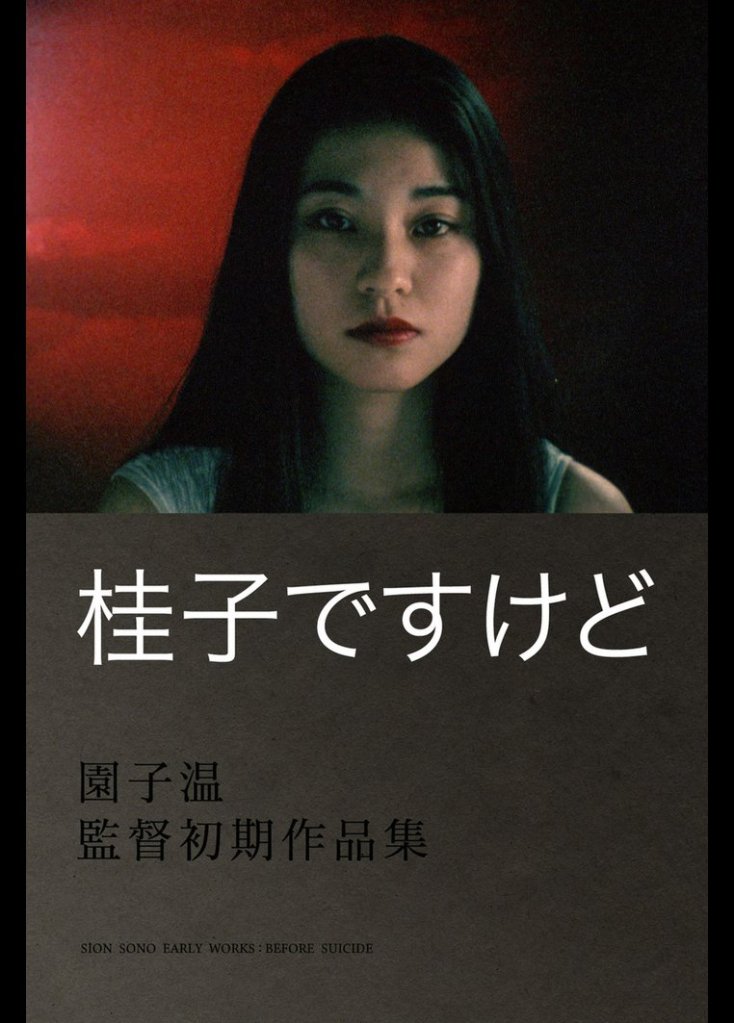
Keiko desu kedoI was 21 years when I wrote this song, I’m 22 now but I won’t be for long…the leaves that are green are turning to brown for the heroine of Keiko Desu Kedo (桂子ですけど, “I am Keiko”). Approaching her 22nd birthday and with the recent death of her father ever present in her mind, she’s begun to feel the passage of time even more keenly. She doesn’t want to miss out on or forget anything so she’s going to share with us the last three weeks of her 21st year on Earth.
The first image we see of Keiko has her looking directly at us, holding our gaze while a Rothko-esque backdrop and ambient sounds of children arguing and birds singing provide our only context. After a few minutes she looks away, shyly, before resuming contact with a sad smile. Eventually a single tear courses down her cheek and she looks away again. We become her audience as she narrates her existence to us, filled with moments of everyday tedium – cleaning, sitting in silence and gazing out of windows. As the time begins to run out, she moves on to more direct forms of communication including a daily news broadcast where she relates the fact that once again it has been a slow news day in the land of Keiko. The time passes, Keiko grows older, as we all do, nothing changes, nothing stays the same.

This relatively early effort from Sono has a very definite French new wave influence with a little Fassbinder thrown in to boot. Much of the film takes the form of still frames accompanied by Keiko’s voice over which often consists of her counting out loops of 60s to aurally honour each passing second. Keiko lives in an oddly colourful, childlike world in her bright red apartment which has bright yellow furniture though the rest of her existence is fairly empty. As she tells us at the beginning, the only things in this apartment are herself and the bones of her father. As if to bear witness to the French new wave theme, she even shows us some other relics of the life she’s lost in the form of a packet of her father’s Gauloises cigarettes inside their unopened and equally colourful light blue box.

In a touch of Godardian mischief, Sono breaks the film into mini chapters with the help of frequent colour cards bearing the names of the days of the week (notably Keiko skips a day here and there or elides two days into one with another colour card simply stating the hour). It seems as if Keiko is eager to pass the time, she will be “reborn” the moment she crosses over into year 22 – leaving this grief filled coda behind her. Yet the time passes slowly, tediously spent in inconsequential pursuits. Actress Keiko Suzuki excels in the difficult task of playing the identically named Keiko, imbuing her depression filled voice overs with a degree of melancholy warmth. She seems to want to connect with us, staring up at us after scribbling out the words “I am” written on an otherwise blank piece of of paper with her father’s fountain pen. She reaches out to us, but we are powerless to respond, all we can do for her is to listen and bear witness to these final three weeks of her soon to be former life.

In the light of Sono’s later career, Keiko Desu Kedo may seem like a strange entry in his back catalogue. Tightly focusing on one young woman as she comes to terms with grief and the passage of time, Keiko Desu Kedo is an exercise in minimalism from a man later known for his cinematic excesses. Yet, there is excess here too in the stylisation of Keiko’s world, her brightly coloured living environment and various “disguises” she adopts in her news reader persona. Tellingly, in her final broadcast Keiko appears as herself but has nothing to say to us, once again looking directly into the camera with moistened eyes, full of loneliness. Presumably at the end of the film as she skips off away from her apartment trash bag in hand and counting down the seconds, she no longer needs us and all that remains is for her to read the credits of her confessional video diary, thereby bidding adieu to her old self via this strange obituary pausing only to thank us as the lights go out.


Unsubbed trailer:

Welcome Back, Mr. McDonald (ラヂオの時間, Koki Mitani, 1997)

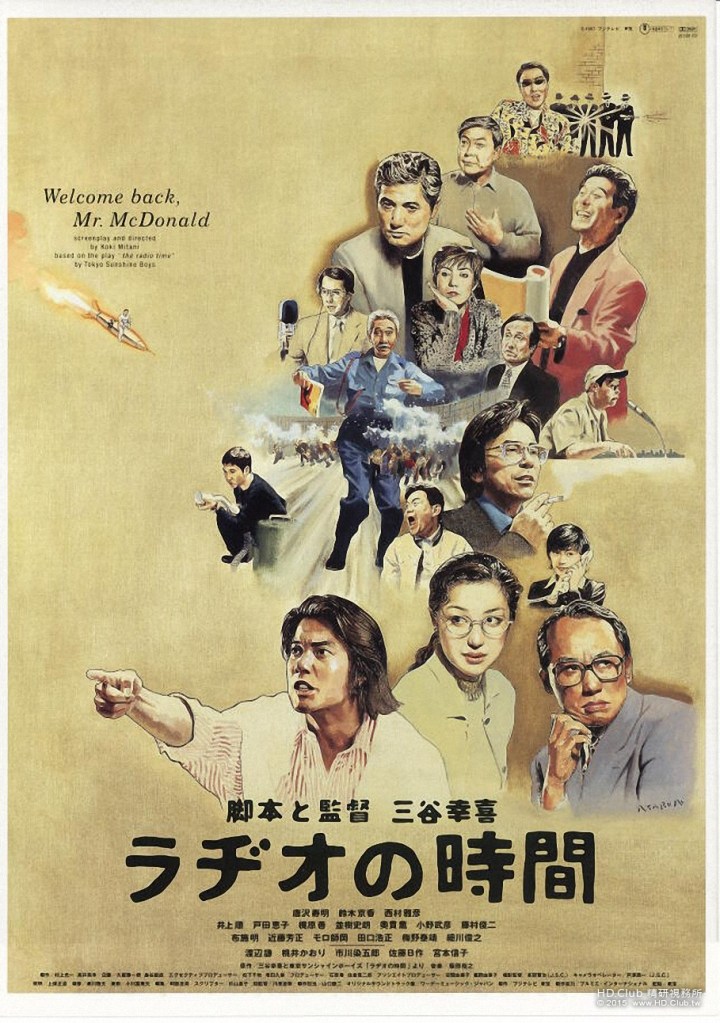
Welcome Back Mr. McDonaldKoki Mitani is one of the most bankable mainstream directors in Japan though his work has rarely travelled outside of his native land. Beginning his career in the theatre, Mitani is the master of modern comedic farce and has the rare talent of being able to ground often absurd scenarios in the  humour that is very much a part of everyday life. Welcome Back, Mr. McDonald (ラヂオの時間, Radio no Jikan) is Mitani’s debut feature in the director’s chair though he previously adapted his own stage plays as screenplays for other directors. This time he sets his scene in the high pressure environment of the production booth of a live radio drama broadcast as the debut script of a shy competition winner is about to get torn to bits by egotistical actors and marred by technical hitches.
Mild-mannered housewife Miyako Suzuki (Kyoka Suzuki ) has won a competition to get her radio play, titled “Woman of Destiny”, on air. A romantic tale of a bored housewife unexpectedly finding love at the pachinko parlour, her story may have a thin layer of autobiography or at least wish fulfilment but at any rate she is very close to her material. Unfortunately, “difficult” actress Nokko (Keiko Toda) has been foisted on the production crew due to entertainment world politics and objects to her character’s name because she once dated a married guy whose wife shared it. Eventually Nokko demands to be called something more interesting like “Mary Jane” (the irony!). At this point, all the other actors start wanting changes too and before you know it Miyako’s gentle tale of forbidden romance has become a gangster crime thriller set in Chicago filled with mobsters and tommy guns!

The writer is god, in one sense. Only, god has been locked out of the room leading to total chaos. Each small change necessitates a series of other changes and seeing as this is all being done live and on the hoof, no one is quite thinking through the implications of each decision. When the actor playing “Mary Jane’s” love interest suddenly goes off book and declares his name is “Donald McDonald” (inspired by left over fast food cartons) and he’s a pilot not a fisherman as agreed (though why would a fisherman be in the mountains of Chicago anyway?), everything goes completely haywire eventually ending up in an outer space based love crisis!

If all this wasn’t enough, someone has also wandered off with the key to the sound effects machine which would be fine if they hadn’t added all the gangster shenanigans in the first place. The show’s producer, Ushijima (Masahiko Nishimura), explains to Miyako at one point that radio has a very important advantage over visual media as you really can do anything even on no budget because your biggest resource is your audience’s imaginations. He has a very real point, though the completely bizarre saga of “sexy female lawyer” Mary Jane, her “Nasa Pilot” (a quick save after “Donald’s” plane is reported missing and someone remembers this slot is sponsored by an airline) true love, and her husband who for some reason is a random German named Heinrich is going to require a significant suspension of disbelief from the confused listeners at home.

As a theatre practitioner Mitani is an expert at creating ensemble comedy and even though he is playing with a large cast and a fast moving environment each of his characters is extremely well drawn. We see the shy writer beginning to lose heart after her story is shredded by the unforgiving production environment whilst also trying to persuade her husband who has turned up unexpectedly to go home before he figures out her script is suspiciously close to their real lives. We also see the production team frantically trying to fulfil their obligations so they can avoid getting into trouble with the higher ups and finally go home for the day. Ushijima is caught in the middle, surrounded by nonchalant yes men and lazy bosses, he’s desperately trying to compromise to keep everything on schedule whereas the jaded director just wants to do his job as written. However, it’s the director who is ultimately most moved by Miyako’s script and eventually decides it does deserve the happy ending that Miyako has been longing for.

By the end of the recording, something of the old magic has returned to the otherwise work-a-day world of the radio studio. They’ve even brought back old fashioned foley effects and retrieved the old school sound guy who’d been relegated to playing his gameboy in the security booth because no one needed his expertise anymore. Nothing went as planned, but everything worked out in the end and it’s happy endings all round both in the real world and in the completely surreal radio play. They might even do a sequel!

Mitani breaks the action every now and then to take us outside of the studio environment and into the cab of a petrol tanker being driven by a strangely dressed trucker (in a brief cameo from Ken Watanabe, no less!) who keeps trying to change the channel for more country influenced Enka but finds himself enthralled by the strange tale of the true love between Mary Jane and Donald mcDonald. We might not be quite as moved as he is, having been party to all the backstage goings on, but we have perhaps laughed more than cried through the almost screwball comedy and farcical set up of Mitani’s spot on depiction of the less than glamorous workings of the fast paced live production environment.


English subtitled trailer:

The Black House (黒い家, Yoshimitsu Morita, 1999)

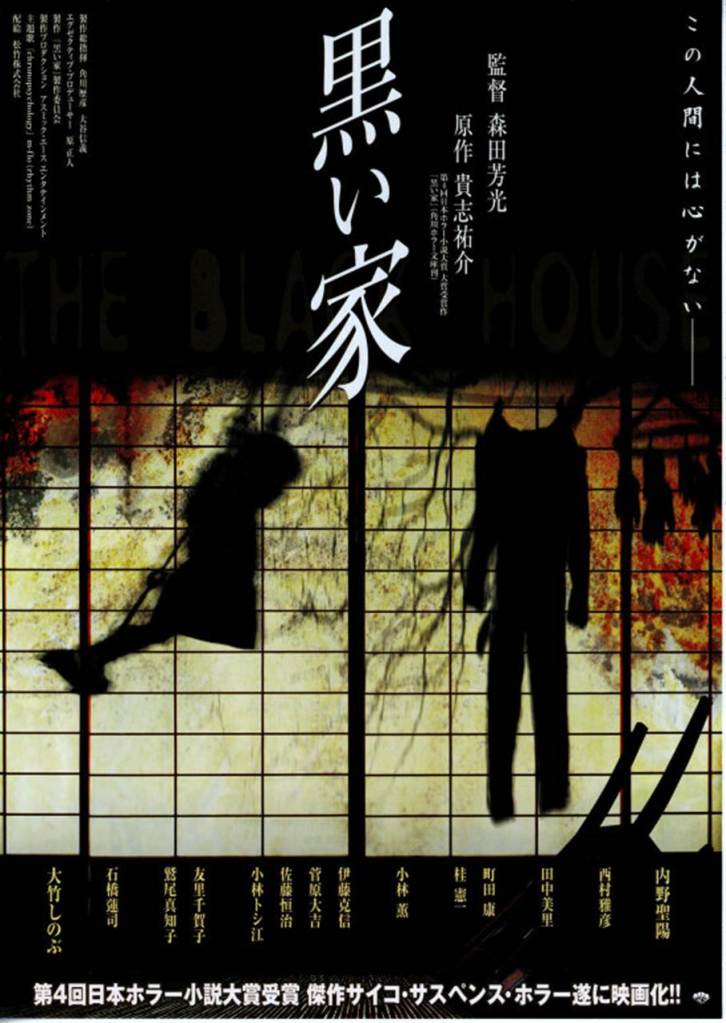
black house posterYoshimitsu Morita, though committed to commercial filmmaking, also enjoyed trying on different kinds of directorial hats from from purveyor of smart social satires to teen idol movies, high art literary adaptations and just about everything else in-between. It’s no surprise then that at the height of the J-horror boom, he too got in on the action with an adaptation of Yusuke Kishi’s novel of the same name, The Black House (黒い家, Kuroi Ie). Though tagged as “J-horror” you’ll find no long haired ghosts here and, in fact, barely anything supernatural as the true horror on show is the slow descent into madness taking place inside the protagonist’s mind.

Wakatsuki (Masaaki Uchino) is a nice young man with a good job investigating claims at an insurance office. Unfortunately, this gives him a slightly dim view of humanity as he comes into contact with scamsters and even people willing to maim themselves just so that they can claim on their policies. One day, he receives a strange phone call from a woman who wants to know if her insurance policy will pay out in case of suicide. Wakatsuki, slightly panicked, tells her that it really depends on the circumstances and, jumping to the conclusion she plans to kill herself, urges her to get help and talk things over with someone before doing anything rash.

The next thing he knows, Wakatsuki is despatched to her house to sort things out whereupon he makes an extremely gruesome discovery – the woman’s son, though only a child, has hanged himself in the back room. Obviously extremely shocked and distressed, Wakatsuki heads home with the nagging suspicion that Sachiko (Shinobu Ootake) and her husband Komoda (Masahiko Nishimura) have done something truly dreadful. The couple take turns coming into the office to find out what’s taking so long with their claim and gradually the situation begins to spiral desperately out of control.

Always one for irony,  Morita’s tone varies widely here. There’s an oddly Twin Peaks-like vibe with the jolly jazz score giving way to synths at moments of high tension, not to mention the run down industrial town setting. If that weren’t enough Lynchery, there’s even a moment where a severed hand is found in a patch of grass, crawling with ants just like the ear found by Jeffrey at the beginning of Blue Velvet. Morita seems to be telling us not to take any of this too seriously yet his subjects include parents harming or even murdering their children to claim on an insurance policy as well as bloody violence and dismemberment of corpses.

In fact, the insurance guys don’t spend too long trying to figure out if the boy actually killed himself but Wakatsuki becomes preoccupied by the idea the husband, Komoda, is behind the whole thing (the boy was only his step-son after all) and will now try and kill his wife to claim her insurance too. The couple are certainly both very strange people and the insurance company also have a problem as the policy was signed off on during a campaign drive in which a now dismissed employee made use of a personal connection to try and meet her unrealistic quota. Wakatsuki eventually engages an equally eccentric psychology professor who takes him out on a weird nighttime odyssey to a seedy strip club where he expounds on a epidemic of psychopathy among the younger generation. Even Wakatsuki’s girlfriend, Megumi, has some off the wall ideas based on an essay Sachiko wrote in elementary school (though actually Megumi’s view has some merit).

Things hit a more conventional note from this point on landing us with a familiar slasher villain who begins stalking Wakatsuki, even trashing his apartment before kidnapping his girlfriend and keeping her prisoner in the “Black House”. Wakatsuki heads to the den of evil by himself in the dark (in true horror movie fashion) where he finds a whole bunch of other dismembered corpses (and a few other surprises). He might think he can put his troubles behind him after this extremely traumatic incident, but this is still a horror movie so the killer gets away to strike again by throwing a bright yellow bowling ball at his head through the office toilet window.

Morita is not being serious at all, even for a second, but somehow he still manages to create an oddly threatening atmosphere of suspense despite the extremely weird things which are going on. He creates a complex set of visual cues from the recurring sunflower motif repeated on Sachiko’s shirt to the glistening yellow bowling ball, goldfish (in a toilet bowl if not a percolator), repeated sounds of cockroaches and old fashioned reel printers, and even the green glow from both old fashioned computer systems and the company’s insurance documents. Undoubtedly bizarre, The Black House is mind bending psychological-horror-movie-cum-Freudian-slasher that is primed for both head scratching puzzlement and confused chuckling as Morita has a lot of fun messing with our senses.


Shower (洗澡, Zhang Yang, 1999)

Shower posterChina is changing. Transforming faster than any other society at any other point in history. This brave new future, flooding in as it has across an ancient nation, has nevertheless left a few islands of dry land untouched by modern progress. Old Liu’s bathhouse is just one of these oases, far away from the big city with its frantic pace and high technology. In the city, you can step into a tiny cubicle and “undergo” a shower inside a contraption that’s just like a carwash, only for people. In Liu’s bathhouse you can relax for as long as you like, laughing and joking with old friends or just hiding out from the world.

Prodigal son Da Ming returns to this untouched relic from his past on a brief reprieve from his busy businessman life, attempting to reconnect with his distant father and younger brother, Er Ming, who has some learning difficulties. Da Ming left here for something better, he looks down on his father’s profession and its old fashioned insistence on taking one’s time, but gradually as he returns to the rhythms of his childhood the warmth of the bathhouse atmosphere begins to soak into his heart.

Most of Liu’s customers are older men who grew up in an era when going to the bathhouse was normal rather than bathing at home as younger people do. They use the bathhouse as some would use a teahouse or a bar, they spend all day there getting various treatments, racing crickets and bickering about the past. If it weren’t for the bathhouse many of these older men would have nowhere to get together. However, times have changed and even if the bathhouse were more popular with the young folk, it seems the entire block has been bought up by property developers intent on throwing up an array of tall buildings replacing the cosy, traditional atmosphere of the small town shops, restaurants and amenities which currently occupy it.

Da Ming keeps meaning to go home, he even books a return flight, but keeps putting it off. Eventually he begins to bond with his father again, going so far as climbing up to the roof to help him secure a tarpaulin during a heavy thunderstorm. He enjoys hanging out with his brother but after being away for so long has perhaps forgotten how much looking after he really needs with the consequence that Er Ming actually wanders off somewhere for the first time in his life. However, Er Ming is much more resourceful than his father had assumed and returns with a broad grin and pockets full of apples as if nothing out of the ordinary had happened.

In its final stretch, Shower makes a tonal shift to the arid deserts of Northern China and a story which happens to reflect the early life of Da Ming’s parents. In this dry land, water is worth more than all the gold in the world. There is an ancient custom that on the night before her wedding, each bride enjoys a hot bath – a true luxury in a place where death from thirst is a real possibility. The extreme measures her family have to go to to allow their daughter to perform this important ritual emphasise its importance as do the tears shed by the girl in question as she sinks into what is possibly the first and last time she will ever enjoy the simple pleasure of a hot bath. Water unites all things, as a TV broadcast watched by Er Ming reminds us, the elephant and the dung beetle have exactly the same dependency on water and their access to it is entirely in the hands of fate.

Liu’s bathhouse is a place of solace where men can come and talk through their troubles together. One local man has a series of marital problems with his rather feisty wife whereas another enjoys loudly singing O Sole Mio whilst having a shower but freezes up when he tries to sing on stage, and then there’s the old guys with their crickets and decades old arguments. Liu listens to them all, allowing their tensions to run away with the bathwater. The “human wash” shower cubicle might be efficient and undoubtedly useful in the quickening pace of modern life, but you go in there alone with all your thoughts and no one to gently lead you to the truths you always knew were there but were unwilling to see.

Shower is another China at the cross roads movie as older brother Da Ming represents the forward marching younger generation who’ve abandoned their old hometowns for the bright lights of the cities only to feel cheated out of something more essential. Returning home is a journey filled with ambivalence – being hit both by the backwardness of the place but also by its wholesome goodness and the warmth of community spirit. It may be too late to save the bathhouse, but that doesn’t mean all that it represents has to go with it. The future is uncertain for Da Ming and Er Ming, as it is for China itself, but if anything can hold back the erasure of centuries of culture it has to start here, with two brothers and a bathhouse, or doesn’t start anywhere at all.


Shower (洗澡, Xǐzǎo) is available on DVD in the UK from Momentum and in the US from Sony Pictures Classic.

US release trailer:

Dr. Akagi (カンゾー先生, Shohei Imamura, 1998)

Dr AkagiA late career entry from socially minded director Shohei Imamura, Dr. Akagi (カンゾー先生, Kanzo Sensei) takes him back to the war years but perhaps to a slightly more bourgeois milieu than his previous work had hitherto focussed on. Based on the book by Ango Sakaguchi, Dr. Akagi is the story of one ordinary “family doctor” in the dying days of World War II.

As Dr. Akagi (Akira Emoto) puts it, much of the the life of a family doctor involves running. If he breaks one leg, he’ll run on the other, if he breaks both legs, he’ll run on his hands, but he’ll do whatever it takes to get to his patients. Some of the villagers have branded him as a quack and nicknamed him “Doctor Liver” because his most frequent diagnosis is for hepatitis. Doctor Akagi is convinced that there really is an epidemic of contagious hepatitis plaguing the population and even has the evidence to back his theory up but with the war in crisis and so much else going on he’s having trouble getting anyone to listen to him. Nevertheless, Akagi fearlessly tries to find out what it is that’s causing this deadly disease to spread and hopefully put an end to it for good.

Imamura strikes an oddly comic tone here. Though the above synopsis may sound overly serious, for the vast majority of its running time Dr. Akagi is the story of a small fishing village going about its everyday life with the war just simply background. The town narrowly escapes being bombed by an American raid because it’s known that there’s prisoner of war camp nearby filled with allied soldiers and red cross personnel and there are certainly a lot of troops on the ground more or less running the show. However, despite the obvious hardships – lack of food being the biggest one, the townspeople are getting on with things in a fairly cheerful way.

Following a spot of pastoral care, Dr. Akagi ends up taking in a local girl as his assistant and housekeeper after her father has died leaving her to support her two younger siblings. Though a married woman with a husband away at the front, Sonoko (Kumiko Aso) has been making ends meet through prostitution with the rather unwelcome result that one of her regular customers wants to marry her (she does not reciprocate and after all already has a husband). Akagi doesn’t necessarily disapprove of the idea of prostitution or of openly expressed sexuality, but accepts that society does object to these ideas and takes Sonoko in so that she won’t have to sell herself (though she actually didn’t really mind very much and still finds herself called upon to provide her “services” even after she’s officially given up).

Akagi’s other supporters include a fellow doctor, Tomomi, who has become addicted to morphine after his wartime service and a drunken and lecherous buddhist monk who proves an essential ally when it comes to body snatching a recently buried corpse. Akagi gets himself into even more trouble when he takes in and treats an escaped Dutch POW who bears the scars of extreme torture by Japanese forces who are paranoid about possible spy action. Imamura is never afraid of raising the spectre of wartime brutality as his soldiers flit between righteous zealots committed to the letter of the law and bumbling idiots who can’t see that each of their actions is entirely counterproductive to their cause.

The most surprising moment comes when Akagi has a dream about his son who is an army doctor serving in Manchuria. After Akagi and his friend have conducted an autopsy to gain a fresh liver sample, Tomomi starts talking about his time in the army and a rumour about a group of doctors doing live dissections and possibly researching chemical weapons. Akagi is aghast and horrified but recounts his dream in which he stood before his son whose bloodied hands are extended towards him with a living patient writhing below. Akagi reminds him that he is a doctor and urges him to stop this barbaric practice but the nightmarish vision of this gloomy, blood-soaked room persists.

At the end of the film Sonoko and Akagi unwittingly end up viewing the giant mushroom cloud which arises after the atomic bomb blast in Hiroshima. Not knowing what it is, Akagi predictably sees it as a giant infected liver and wonders if the donor for his liver sample is angry with him but then thinks again and says the cloud is a representation of everybody’s anger towards this war. Akagi loses himself a little in the quest to solve the hepatitis question and after it leads him to neglect a patient he begins to question himself over his true motives and whether there’s really any point to what he’s trying to do. However, Dr. Akagi is a good and a kind man and eventually remembers what his true calling is – as a family doctor, running from one emergency to the next but always making sure his patients are well looked after. War or no war, life goes on – people get sick and they need to know there are men like Akagi out there that can always be relied upon to do the very best they can.


Dr. Akagi was originally released in the US by Kino Lorber but seems to be out of print. The good news is that the region free Korean disc comes with English subtitles.

Unsubbed trailer:

The Sting of Death (死の棘, Kohei Oguri, 1990)

Sting of Death

Kohei Oguri’s The Sting of Death (死の棘, Shi no Toge) won the prestigious jury prize at the Cannes film festival in 1990 but has since passed into obscurity. Adapted from the “I Novel” by Toshio Shimao, Sting of Death is an absurdist, caustic look at a collapsing marriage beset by difficulties on all sides as the pair try to navigate the confusing post-war society.

Toshio and Miho are a married couple with two young children. Miho has recently discovered that her husband has been carrying on with a neighbour for quite some time and is uncertain how to deal with this unexpected revelation. The film opens with a serious marital argument which is almost chilling in its calmness. Toshio is sorry, he doesn’t intend to leave his marital home and pledges to stop seeing this other woman – he’ll stay in 24/7 and not even go out without his wife and children if it means he can defend his family. Miho is definitely not happy with this compromise but accepts it and the couple attempt to get back to a kind of normality. However, the peace does not last long as Miho becomes increasingly depressed and paranoid before hurtling headlong into a nervous breakdown.

The “I Novel” is an integral part of Japanese literature and has often provided the basis for many of the country’s prestige films even though its specific style is a necessarily literary one which is hard to dramatise on screen. The genre is centred around the ideas of naturalism and the main tenet is that the writer is recounting real events from the world he sees around him, though perhaps through a thin veil of fictionalisation. That said, it’s never quite “autobiography” and it may sometimes be better to think of them as “hyperreal” rather than just naturalistic.

Oguri attempts to evoke this strange sense of uncanniness by opting for an ethereal, dreamlike tone akin to avant-garde or absurdist theatre. The couple speak to each other in a slightly heightened, deliberate manner, often posed unnaturally facing away from each other literally divided by the film’s framing. Toshio is also haunted by visions from his wartime service somewhere in the pacific where he seems to have received some kind of stomach injury. Emerging from a cave he suddenly sees saluting soldiers, or remembers a passing religious ceremony as if the past is always with him like a Fury tormenting his mind.

The Sting of Death is very close to the experiences of the author who uses his own name for that of the protagonist and that of his own wife for the central female character, Miho. Shimao’s own wife became seriously mentally ill during their marriage eventually having to be admitted to a hospital where Shimao took the unusual step of living with her. Though this uncommon gesture is widely praised as displaying his deep love for his wife, it was in part born of guilt as he believed he had caused her distress through his frequent infidelities, just as Toshio does in the film.

The couple live together in a perpetual nightmare world. Though Miho exclaims at one point that they both need to do their best now for their children they both consider suicide more than once, alternately saving or frustrating one another. They both suffer, they both try to go on but Miho’s position becomes increasingly difficult leading to a period of mental decline which climaxes in a strangely humorous yet violent episode in which she tries to exact revenge on her husband’s mistress only to be offered a lesson in civility – “I don’t know what’s going on here but none of us have the right to act like savages”, says the perfectly genial other woman (the silent casualty in all of this).

Oguri shoots the majority of the film in near darkness, as if the couple are enveloped in a night without end. They haunt each other like living ghosts, emerging from shadows moving slowly like those without hope or purpose. Oguri adds to the surreal, dreamlike atmosphere by sticking to static camera shots filled with strange tableaux and little discernible action. The film paints a bleak picture of marriage and the family unit as the central couple remain locked in an odd game-like battle of suffering while their two innocent children look on helplessly. A strange and beguiling film, The Sting of Death pulls no punches when it comes to describing the way in which adults wound each other with childish games but is also filled with quite beautiful, if sometimes unsettling, iconography.


The Sting of Death is available with English subtitles on R3 Hong Kong DVD as part of Panorama’s Century of Japanese cinema collection.

Opening scene of the film (unsubtitled)

East Meets West (イースト・ミーツ・ウエスト, Kihachi Okamoto, 1995)

East_Meets_WestEast has been meeting West in the movies from time immemorial and though it’s often assumed that the traffic is only running in one direction, in reality the river runs both ways. Kihachi Okamoto was always fairly open about his love of Hollywood westerns, particularly those of John Ford, and even mixed a fair amount of wild west style action to his 1959 Manchurian war movie, Desperado Outpost. Returning to the theme almost 40 years later in East Meets West (イースト・ミーツ・ウエスト), Okamoto retains his wry, ironic eye but adopts a tone much more in keeping with the slightly silly exploitation cowboy movies of the ‘70s.

The tale begins with an American voiceover explaining the intricacies of the time period. It’s 1860 and America has been putting pressure on the recently opened Japan to agree to a trade deal. A delegation of two ships is shortly to arrive in San Fransisco which has also undergone many changes in the last few years after the influx of hopefuls during the 1848 goldrush transformed it from a peaceful fishing town to a dangerous prospector’s paradise. The situation in Japan is also turbulent and those who object to the recent foreign influences have a number of plots in motion. Once the boats leave a band of former samurai will assassinate the remaining official. The men on the boat will not hear of this until they return and the revolutionaries have also placed an assassin amongst those who will travel to America with the ultimate aim of assassinating the diplomat in charge of the delegation who was also responsible for the deaths of a number of “resistance” members in Japan.

However, everything gets derailed when a gang of bandits rob the bank just as the Japanese are about to deposit the money they’ve brought to seal the trade agreement. The group’s interpreter, Kamijo (Hiroyuki Sanada), takes advantage of his samurai training to cut down some of the bandits saving his own life but is unable to prevent them making off with the money. Taking to the road in the company of the young son of one of the bystanders who was killed, Kamijo becomes every inch the cowboy, standing apart ready to take his revenge. However, his mission is at times aided or hindered by an ace ninja working as a servant to the delegation, Tamejiro (Naoto Takenaka), who has accidentally ended up with a Native American wife.

East Meets West is a very silly film, it has very little in the way of serious intent but offers a fair amount of zany fun as its fish out of water samurai try to adapt to the ways of the Wild West. In many ways, it’s the classic cowboy movie as a bunch of strangers arrive and proceed to clean up the area which has become threatened by out of control bandit gangs. You have your mainstays like the lazy sheriff, meek vicar, and drunken doctor-cum-undertaker, the only difference is that the strangers are Japanese adventurers who fight with samurai swords and out of ideals of honour and justice rather than of survival or frontier values.

Indeed, it’s a little strange that East Meets West turned up in 1995 just a few years after Hollywood itself began to re-examine the western, re-injecting it with a little more realism and the grittiness and cruelty which filled frontier life but had been all but erased from the sanitised, romantic vision of the movie cowboy duelling pistols world. East Meets West references the classic western with its associated myths and tropes of clearly defined good guys taking down clearly defined bad guys to save the townspeople from moral and physical ruin. There are plenty of horse stunts and gunfights all offered with a kind of good natured (if sometimes black) humour that’s much more John Wayne than it is Clint Eastwood.

That said, there is a degree of cross cultural critique as the guys try to get used to their New World lives. Because English speakers have a problem with foreign names, Kamijo quickly becomes “Joe” and Tamejiro “Tommy” with Kamijo ending up with a little blond surrogate son and Tamejiro an enterprising Native American wife with whom he seems to develop quite a bond despite sharing no common language. Kamijo may have come to America with one singular mission in mind but once under the wide open skies he finds a kind of individual freedom that he hadn’t previously experienced and gradually loses his adherence to the rigid social codes of the samurai, exchanging them for the seemingly endless vistas of the ever expanding frontier.

Okamoto mines the dualities for all their worth – the chaos of the Meiji era contrasted with the organised lawlessness of the Wild West, yet East Meets West never quite transcends its western pastiche origins. With plenty of inventive and keenly observed comedy plus some nicely choreographed action scenes and excellent performances from the committed cast from both the English speaking American side and the Japanese actors, East Meets West proves an often entertaining experience but perhaps fails to offer the same level of social critique found in Okamoto’s previous work.


Farewell My Concubine (霸王别姬, Chen Kaige, 1993)

farewell-my-concubine-1993
French DVD cover

Review of Chen Kaige’s 1993 masterpiece Farewell My Concubine (霸王别姬, Bàwáng Bié Jī) first published by UK Anime Network.


“Why does the concubine have to die?” Spanning 53 years of turbulent, mid twentieth century history, Farewell My Concubine is often regarded as the masterpiece of fifth generation director Chen Kaige and one of the films which finally brought Chinese cinema to global attention in the early 1990s. Neatly framing the famous Peking Opera as a symbol of its nation’s soul, the film centres on two young actors who find themselves at the mercy of forces far beyond their control.

Beginning in 1924, Douzi (later Cheng Dieyi) is sold to an acting troupe by his prostitute mother who can no longer care for him. The life in the theatre company is hard – the boys are taught the difficult skills necessary for performing the traditional art form through “physical reinforcement” where beatings and torturous treatment are the norm. Douzi is shunned by the other boys because of his haughty attitude and place of birth but eventually finds a friend in Shitou (later Duan Xiaolou) who would finally become the king to his concubine and a lifelong companion, for good or ill.

Time moves on and the pair become two of the foremost performers of their roles in their generation much in demand by fans of the Opera. However, personal and political events eventually intervene as Xiaolou decides to take a wife, Juxian – formerly a prostitute, and shortly after the Japanese reach the city. Coerced by various forces, Dieyi makes the decision to perform for the Japanese but Xiaolou refuses. After the Japanese have been defeated Dieyi is tried as a traitor though both Xiaolou and Juxian come to his rescue. The pair run in to trouble again during the civil war, but worse is to come during the “Cultural Revolution” in which the ancient art of Peking Opera itself is denounced as a bourgeois distraction and its practitioners forced into a very public self criticism conducted in full costume with their precious props burned in front of them. It’s not just artifice which goes up in smoke either as the two are browbeaten into betraying each other’s deepest, darkest secrets.

Farewell My Concubine is a story of tragic betrayal. Dieyi, placed in the role of the concubine without very much say in the matter, is betrayed by everyone at every turn. Abandoned by his mother, more or less prostituted by the theatre company who knowingly send him to an important man who molests him after a performance and then expect him to undergo the same thing again as a grown man when an important patron of the arts comes to visit, rejected by Xiaolou when he decides to marry a prostitute and periodically retires from the opera, and finally betrayed by having his “scandalous” secret revealed in the middle of a public square. He’s a diva and a narcissist, selfish in the extreme, but he lives only for his art, naively ignorant of all political concerns.

Dieyi doesn’t just perform Peking Opera, he lives it. His world is one of grand emotions and an unreal romanticism. Xiaolou by contrast is much more pragmatic, he just wants to do his job and live quietly. On the other hand, Xiaolou refuses to perform for the Japanese (the correct decision in the long run), and has a fierce temper and ironic personality which often get him into just as much trouble as Dieyi’s affected persona. The two are as bound and as powerless as the King and the Concubine, each doomed and unable to save each other from the inevitable suffering dealt them by the historical circumstances of their era.

The climax of the opera Farewell My Concubine comes as the once powerful king is finally defeated and forced to flee with only his noble steed left beside him. He begs his beloved concubine to run to sanctuary but such is her love for him that she refuses and eventually commits suicide so that the king can escape unburdened by worry for her safety. Dieyi’s tragedy is that he lives the role of the concubine in real life. Unlike Xiaolou, his romanticism (and a not insignificant amount of opium) cloud his view of the world as it really is.

It’s not difficult to read Dieyi as a cipher for his nation which has also placed an ideal above the practical demands of real living people with individual emotions of their own. Farewell My Concubine ran into several problems with the Chinese censors who objected not only to the (actually quite subtle) homosexual themes, but also to the way China’s recent history was depicted. Later scenes including one involving a suicide in 1977, not to mention the sheer absurd horror of the Cultural Revolution are all things the censors would rather not acknowledge as events which took place after the birth of the glorious communist utopia but Farewell My Concubine is one of the first attempts to examine such a traumatic history with a detached eye.

Casting Peking Opera as the soul of China, Farewell My Concubine is the story of a nation betraying itself. Close to the end when Dieyi is asked about the new communist operas he says he finds them unconvincing and hollow in comparison to the opulence and grand emotions of the classical works. Something has been shed in this abnegation of self that sees the modern state attempting to erase its true nature by corrupting its very heart. Full of tragic inevitability and residual anger over the unacknowledged past, Farewell My Concubine is both a romantic melodrama of unrequited love and also a lament for an ancient culture seemingly intent on destroying itself from the ground up.


Farewell My Concubine is released on blu-ray in the UK by BFI on 21st March 2016.

Original US trailer (with annoying voice over):

Keiho (39 刑法第三十九条, Yoshimitsu Morita, 1999)

keihoArticle 39 of Japan’s Penal Code states that a person cannot be held responsible for a crime if they are found to be “insane” though a person who commits a crime during a period of “diminished responsibility” can be held accountable and will receive a reduced sentence. Yoshimitsu Morita’s 1999 courtroom drama/psychological thriller Keiho (39 刑法第三十九条, 39 Keiho Dai Sanjukyu Jo) puts this very aspect of the law on trial. During this period (and still in 2016) Japan does nominally have the death penalty (though rarely practiced) and it is only right in a fair and humane society that those people whom the state deems as incapable of understanding the law should receive its protection and, if necessary, assistance. However, the law itself is also open to abuse and as it’s largely left to the discretion of the psychologists and lawyers, the judgement of sane or insane might be a matter of interpretation.

The case at the centre of the film centres around a young actor, Masaki Shibata, who has confessed to the murder of a pregnant woman and her husband after he argued with the woman at her place of work. Shibata acts strangely and makes a point of asking for the death penalty before spouting off about angels and demons and later displays evidence of a split personality. Everyone seems convinced he’s suffering from MPD and committed the murders during a dissociative episode but the assistant psychologist is convinced he’s faking. At the same time, one of the lead policemen on the case also thinks there’s more to this. On investigating further, he discovers the strange irony that the murdered man himself escaped prosecution by reason of insanity after committing a horrifying crime that lead to the death of a six year old girl.

The film may be about a murder but what’s really on trial here is the law itself. The murdered man, Hatada, committed a heinous crime but was a child himself at the time so received only a brief sentence served in a hospital. He was released, went to university, got a good job and got married – a normal life. The family of the little girl he killed, by contrast, will never be able to return to normality and will continue to live in torment for the rest of their lives knowing the man who so brutally took their child from them is still out there living just like one of us. The film does not go into why Hatada committed the original crime or the reasons he was later declared fit to return to society, but the film wants to question the idea of releasing back into the world someone who has done something as horrifying as the rape, murder and dismemberment of a child.

The case at hand is a complicated one which has so many layers coupled with twists and turns that it becomes unavoidably confusing. Playing with several literary allusions from the frequent quotations from the “mad prince” Hamlet to naming the assistant psychologist “Kafuka”, Keiho also wants to delve deep into human psychology with its questions of identity and self realisation. Both the accused and the psychologist have deeply buried memories of trauma the suppression of which has cast a shadow through the rest of their lives. Both of them are, in a sense (even if not quite in the way it originally appears), haunted by a shadow of themselves.

When it comes to the procedural aspects, the final “twist” is a step too far and perhaps undermines the groundwork which has gone before it. Something which is presented as an elaborate revenge plot against both the state and the original instigator of a crime also appears to originate with a clumsy motion of self preservation. The state’s failure to properly deal with the criminal in the first case has resulted the death of another innocent bystander, all of which might have been avoided if Article 39 had not come into play.

Kafka-esque is, in fact, a good way to describe the circularity of the narrative as the notion of an insanity plea becomes a recurrent plot device. Backstories are constructed and discarded, identities are shed and adopted at will and the past becomes a thorn in the side of the future that has to be removed so everyone can comfortably move on. Morita relies heavily on dissolves to create a floating, dreamlike atmosphere as memories (imaginary or otherwise) segue in and out like tides but he also shows us images reflected in other surfaces such as the Strangers on a Train inspired sequence which literally shows us events through someone else’s eyes as we’re watching them reflected doubly on the lenses of a pair of sunglasses.

Difficult, complicated and ultimately flawed Keiho proves an elusive and intriguing piece that is put together with some truly beautiful cinematography and interesting editing choices. Fascinating and frustrating in equal points Keiho is another characteristically probing effort from the wry pen of Morita which continues to echo in the mind long after the credits have rolled.


Keiho is available with English subtitles via HK R3 DVD as part of Panorama’s 100 Years of Japanese Cinema Collection.