The Laughing Frog (笑う蛙, Hideyuki Hirayama, 2002)

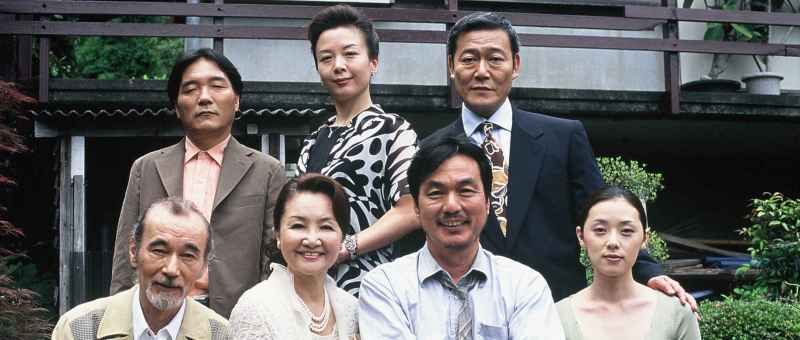
laughing frog posterEver have a day (or perhaps a lifetime) where you feel so stupid that even the frogs are laughing at you? That’s pretty much how it is for disgraced former bank manager Ippei when he turns up one day at a family holiday home he assumed would be empty but turns out not to be. In Laughing Frog (笑う蛙, Warau Kaeru) director Hideyuki Hirayama deftly dissects the modern family, the gradual redundancy of the middle-aged man, and the way society seems to have of anointing the lucky and the unlucky, in a darkly humorous satire in which even mother nature seems to be mocking our petty human concerns.

33 year old Ryoko (Nene Otsuka) is attending the third memorial service for her late father at which her greedy sister-in-law (Kumija Kim) asks for various things in an attempt to get some of the inheritance in advance while Ryoko’s brother (Shuzo Mitamura) wanders off to chat about silkworms in Chinese on his mobile phone. The event ends with Ryoko’s sprightly mother (Izumi Yukimura) and the sister-in-law urging her to sort out some kind of marital difficulties in order to ease the awkwardness surrounding her lack of external connections.

Meanwhile, Ryoko’s missing husband, Ippei (Kyozo Nagatsuka), rocks up at a rural station and climbs into a familiar house through an open window. Wandering around in his pants, he hears a noise and realises someone lives there after all. Ryoko has moved into her father’s old house in the country and started a whole new life for herself. After a brief discussion, Ryoko agrees to let him stay for a while on the condition that he finally sign the divorce papers but Ippei soon finds himself confined to an especial kind of irrelevance as he starts his new life in the hall cupboard observing his wife’s new freedoms by means of a tiny hole in the wall.

No one seems to have much of a good word to say about Ippei, which is fair enough seeing as he apparently became obsessed with a bar hostess and embezzled money from his bank to pay for a lavish affair before running away and leaving his wife to deal with the fallout. He is, however, paying for it now as his own irrelevance is once and truly brought home to him as he lives out his days like an impotent ghost trapped in a storage cupboard undergoing his wife’s strange mix of kindness and revenge.

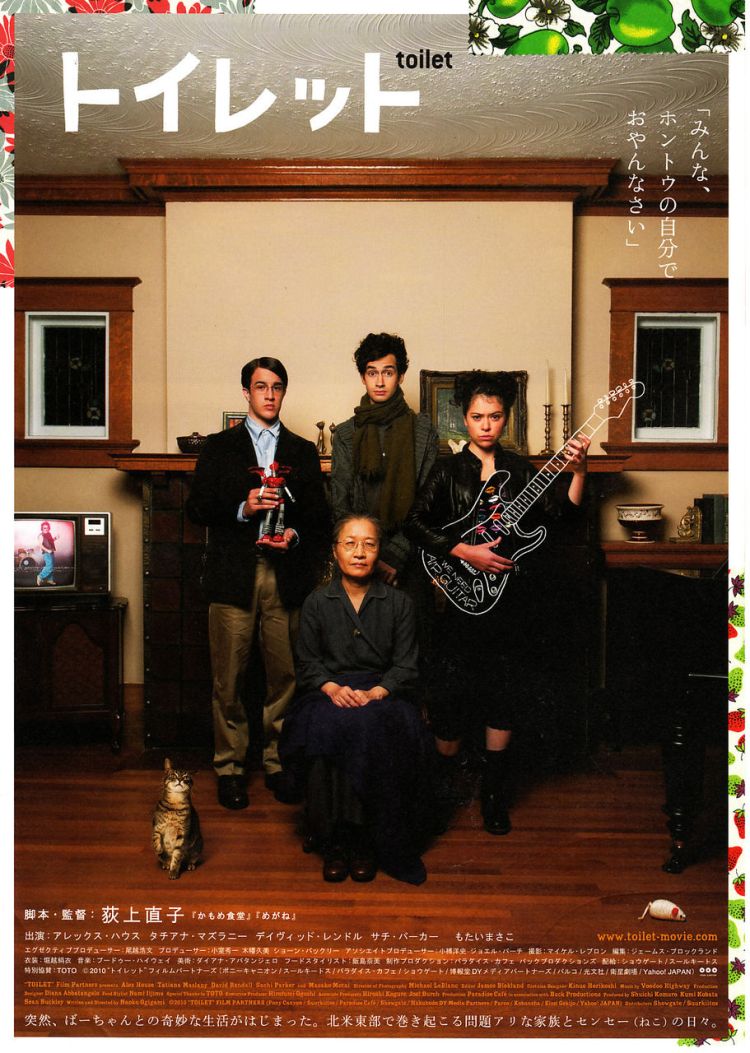
Ryoko, the goodly wife, is not quite all she seems. Ippei’s mistress makes a surprise appearance to try a spot of extortion on the wealthy wife but she’s no match for Ryoko’s perfectly practiced poise. One of the oddly cruel accusations the mistress has to offer is that Ippei once referred to a kind of boredom with his wife’s properness, branding her a “fancy pet cat” whilst apparently avowing the mistress’ bedroom superiority. If Ippei’s sheepish behind the wall expression is anything to go by he is guilty as charged but then perhaps the uncomfortable statement leads right back to his uncomfortable place within Ryoko’s upperclass family who seem to look down on a mere bank manager, affecting politeness while secretly bemoaning the fact that their daughter has married beneath herself.

The model upperclass family is a simulacrum. Feigning politeness, elegance and dignity they attempt to disguise their otherwise distasteful affectations. Ryoko’s sister-in-law is at least honest in her constant harping on about the inheritance, plan to steal grandma’s house out from under her to knock it down and build a new one, and constant asides to her apparently hopeless (and unseen) son away at a (not great) university. Meanwhile her husband, Ryoko’s brother, pretends to chat silkworms in Chinese on his phone but is really talking to a Chinese mistress and Ryoko’s mum is planning to get married again to a (possibly dodgy) antiques dealer (Mickey Curtis) who is so deeply in debt there won’t even be any inheritance anyway.

Ryoko too has moved on. Ippei is forced to watch as she entertains her new boyfriend (Jun Kunimura), a stonemason whose main line is headstones, while the frogs outside work themselves into some kind of frenzy. Little by little all his manly affectations are worn away – he’s forced to realise how foolish he’s been, how irrelevant he is in Ryoko’s life, and how perfectly pointless his fugitive existence really is. Ryoko meanwhile remains calm and calculating. She “lies” and she wins in a bloodless victory, allowing her opponents to sentence themselves to the punishments they feel themselves to deserve. Ippei, it seems, is just a weak, unlucky man doomed to ruin himself through a series of poetic failures and petty self involved mistakes. Meanwhile the frogs look on and laugh at our human follies. Makes you feel small doesn’t it….


Kilimanjaro (킬리만자로, Oh Seung-uk, 2001)

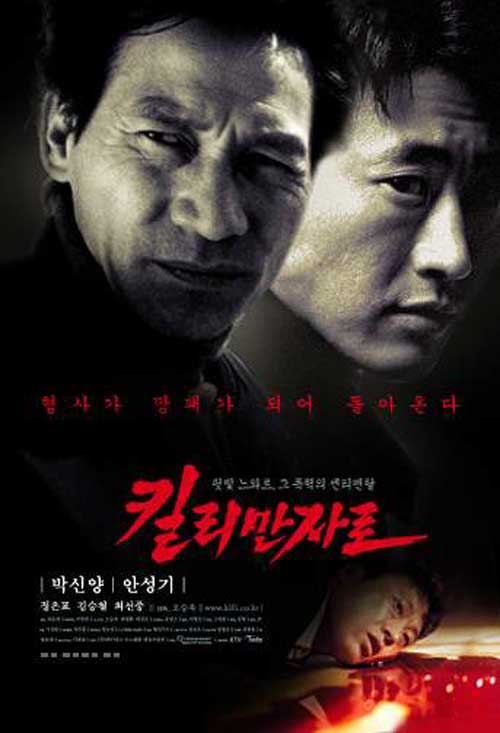
Kilimanjaro posterMt. Kilimanjaro is the world’s tallest free-standing mountain. Oh Seung-ok’s debut, Kilimanjaro (킬리만자로), is not a climbing story, at least not in that sense, but a story of a man trying to conquer his own mountain without really knowing why. Twin brothers Hae-shik and Hae-chul are mirrors of each other, a perfect mix of light and dark, but when one makes a choice to choose the darkness, it throws the other into despair and confusion. A noir-ish tale of fragmented identities and fatalistic retribution, Oh’s world of tired gangsters and impossible dreams is as icy and unforgiving as the summit of its titular mountain, offering little more than lonely deaths and eternal regrets.

Policeman Hae-shik (Park Shin-Yang) drifts in and out of consciousness, tied up in a room by his twin brother, Hae-chul, with Hae-chul’s children looking on. Hae-chul murders his family and then shoots himself all while his brother is tied up and helpless, a policeman without recourse to the law. Taken to task by his colleagues who want to know how he could have allowed any of this to happen, if not as a brother than as a cop, Hae-shik has little to offer them by way of explanation. To add insult to injury, he is also under fire for unethical/incompetent investigation, and is taken off the case. Suspended pending an inquiry, Hae-shik goes back to his hometown but is immediately mistaken for Hae-chul and attacked by gangsters Hae-chul had pissed off before he left town and killed himself. Saved by local petty gangster Thunder (Ahn Sung-Ki), Hae-shik assumes Hae-chul’s identity and slips into the life of hopeless scheming which ultimately led to his brother’s ugly, violent death.

The film’s title is, apparently, slightly ironic in referring to the film’s setting of a small fishing village in the mountainous Gangwon-do Providence, known to some as “Korea’s Kilimanjaro”. Each of the men in this small town is trapped by its ongoing inertia and continual impossibility. They want to make something of themselves but have few outlets to do so – their dream is small, owning a family restaurant, but still it eludes them and they soon turn to desperate measures in opposing a local gangster in the hope of finally improving their circumstances.

Despite the seemingly tight bond of the men in Thunder’s mini gang – a mentally scarred ex-soldier known as “The Sergeant” (Jung Eun-pyo) and nerdy religious enthusiast knows as “The Evangelical” (Choi Seon-jung) rounding out Hae-chul’s goodhearted chancer, none of them has any clue that Hae-shik is not Hae-chul, or that Hae-chul and his family are dead. No one, except perhaps Thunder, is very happy to see him but even so Hae-shik quickly “reassumes” his place at Thunder’s side and takes over Hae-chul’s role in the gang’s scheming.

Hae-shik and Hae-chul had formed a perfect whole of contradictory qualities, each with their own degrees of light and darkness. Hae-chul had been the “good” brother who worked hard at home taking care of his parents while Hae-shik headed to university and a career in the city, never having visited his hometown since (in fact, no one seems to know or has already forgotten that Hae-chul even had a twin brother). Hae-shik’s “goodness” might be observed in his career as a law enforcer, but he’s clearly not among the list of model officers, and his home life also seems to be a failure. Hae-chul’s family might also have failed, and his shift to a life of petty crime provides its own darkness but living in this claustrophobic, impossible environment his crime is one of wanting something more than that his world ever had to offer him.

As might be expected, Thunder’s plans do not unfold as smoothly as hoped. Ineptitude and finally a mental implosion result in a near massacre costing innocent lives taken in a fury of misdirected vengeance. Despite wishing for a quiet life spent with friends on the beach, heroes die all alone, like mountain climbers lost on a snowy slope unsure whether to go up or down. Attempting to integrate his contradictions, become his brother as well as himself, Hae-shik reaches an impasse that is pure noir, finally meeting his end through a case of “mistaken identity”.


Screened at London Korean Film Festival 2017.

Christmas on July 24th Avenue (7月24日通りのクリスマス, Shosuke Murakami, 2006)

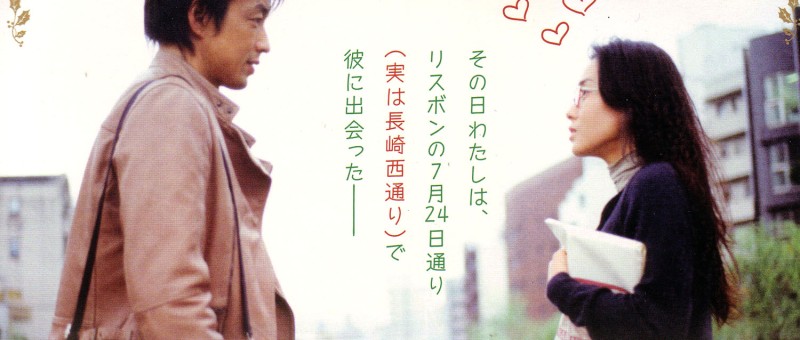
Christmas July 24th AvenueThey do Christmas a little differently in Japan. Rather than a celebration of family and commercial excess, Christmas is an occasion for romance much like the Western Valentine’s Day. Strangely, Japanese cinema has been slow to warm to the idea of the Christmas date movie though Christmas on July 24th Avenue (7月24日通りのクリスマス, 7 gatsu 24 ka dori no Kurisumasu) tries its best to plug the gap. Starring the ever reliable Miki Nakatani, Christmas on July 24 Avenue is a grown-up romance filtered through the innocence of the shojo manga its heroine has come to love.

Sayuri Honda (Miki Nakatani) is a 24 year old office lady who dreams of romance but has come to believe that she just isn’t destined for a great love of her own. Obsessed with a manga she’s loved since childhood which is set in Lisbon, Sayuri has begun to notice the various similarities between her hometown of Nagasaki and the Portuguese capital, living part-time in a kind of sunbaked European fantasyland. When her long lost high school crush, Satoshi (Takao Osawa), resurfaces as a famous architect with a bestselling book out, Sayuri’s dreams of romantic fulfilment are suddenly reawakened.

Constructed with obvious projected wish fulfilment, Sayuri’s arc is the rom-com classic of shy girl gets handsome boy after a series of coincidences and misunderstandings. Bespectacled and reserved, Sayuri’s major selling point is her propensity to suddenly fall over and make a spectacle of herself which she does in spectacular fashion during one of the amateur dramatic plays she helps out with. Embracing an unwelcome genre norm, Sayuri’s journey towards true love begins with prettying herself up – swapping her glasses for contacts, getting a more sophisticated haircut, and dressing in more typically elegant girlish outfits over her practical, dowdy tastes.

Rather than allow Sayuri to realise she’s fine as she is and doesn’t need to change herself for a man, the arc is Sayuri abandoning her anxieties to become the kind of person she thinks Satoshi would like. While all of this is going on there’s another potential suitor hanging around in the form of Yoshio (Ryuta Sato) – a geeky guy who works in a bookstore and has been nursing a crush on the oblivious Sayuri for years. Several times Yoshio confesses his love, and several times Sayuri fails to understand him. His being a pure love, Yoshio decides to help Sayuri find happiness no matter who with.

Sayuri sees her own situation mirrored in that of her brother. Where Sayuri sees herself as plain and undesirable, her brother is handsome and popular with the ladies – the kind of “prince” she herself dreams of. Despite having a long history of dating remarkable girls, Koji’s new girlfriend (Juri Ueno) is a virtual clone of Sayuri – mousy with glasses and a talent for mumbling. Oddly, Sayuri is not worried by this development in the way that might be expected, but only outraged at her brother’s breaking of romantic protocol in taking up with someone who is nowhere near his league. Resenting that a girl just like her has improbably managed to bag a prince, Sayuri treats her potential new sister-in-law with scorn and contempt whilst continuing to blame her own failure to do the same on her plainness and reserve.

Truth be told, Satoshi is a predictably dull love interest – a cardboard cutout prince of the kind familiar to shojo romance. Additional spice is added in an extra-marital affair between Satoshi and an old flame with whom he apparently has some unfinished business but even this hint of impropriety does not seem to put Sayuri off. Her final revelations tend towards realising that there’s nothing wrong with plain dowdy girls hooking handsome guys, even though she is no longer a plain and dowdy girl herself and her prince is also responsible for a crisis in the marriage of a friend. She has this revelation through a lengthy speech at someone else’s wedding which she has nearly derailed by provoking a crisis of confidence in the bride.

Based on a short story by Shuichi Yoshida – best known for socially conscious crime thrillers such as Villain, Rage, and Parade, Christmas on July 24th Avenue is a consciously cute affair filled with quirky details which attempt to recreate the world of shojo manga but cannot make up for the soulless quality of its romance. A lack of chemistry between Nakatani and Ozawa prevents the love story from taking off while the second lead is kept hovering the background but more sweet joke than credible option. Reaching an improbably neat conclusion in which everything is forgiven and everyone lives happily ever after, Christmas on July 24th Avenue fulfils its promise of magical romance filled with cheerful Christmas carols and twinkling lights but proves disappointing after all the fancy wrapping.


30 second trailer (no subtitles)

Wild Berries (蛇イチゴ, Miwa Nishikawa, 2003)

wild berries poster

The family drama was once the representative genre of Japanese cinema. In the turbulent post-war world, the one unchanging, unbreakable touchstone was the bonds between parents and their children even if it must also be realised that those bonds will necessarily change over time. Tiny cracks might have been visible even in Ozu’s Tokyo Story in the growing disconnection between the old folks in the country and their city kids, but it wasn’t until the ‘80s when Japan’s economic recovery had fully taken hold that the family itself began to come under fire. Yoshimitu Morita’s The Family Game kickstarted a trend of family implosion movies which implied that familial bonds were more social affectation than genuine connection, but post-bubble the tables turned again. These days, Hirokazu Koreeda has picked up the family drama mantle, depicting broadly positive pictures of normal family life. It is then all the stranger that his protege, Miwa Nishikawa, should be the one to ask again if family really is all it’s cracked up to be.

An ordinary breakfast in the Akechi household. Grandpa (Matsunosuke Shofukutei ) is dipping his toast in the coffee again while salaryman dad Yoshiro (Sei Hiraizumi) reads his paper. Schoolteacher Tomoko (Miho Tsumiki) barely has time to look at her breakfast before her mother, Akiko (Naoko Otani), reminds her that today is “Wednesday” – not only does she need her PE kit, but it’s also the day that her fiancé, Kamata (Toru Tezuka), is coming round to tea to meet the folks. The atmosphere is pleasant, genial, but why has Yoshiro had his mobile phone cut off and is the bald spot Akiko has just discovered on the top of her head really anything to worry about?

The Akechis are the archetype of a modern middle-class family, living a comfortable life in a nice home while dad goes out to work and mum does everything else. It is not, however, quite as it seems. Yoshiro’s phone has been cut off because he hasn’t paid the bill. He hasn’t paid the bill because he’s lost his job. He hasn’t told his wife he’s lost his job because he’s too ashamed, so he’s taken out vast loans from gangsters rather than trying to find a more honest solution. Mum Akiko plays the dutiful housewife, cooking, cleaning, putting up with Yoshiro’s imperious behaviour and looking after grandpa who has advanced dementia and thinks he’s still at war. In reality she’s bored and resentful, tired of the burden of looking after her husband’s ungrateful father and longing to have some time for herself. The only uncorrupted member of the family is schoolteacher Tomoko who finds herself giving a strange lesson on the evils of lying to her class of small children. Tomoko is perhaps too uncorrupted, prim as a schoolmarm but dull with it.

When grandpa meets an unfortunate end, the longstanding family secret is revealed – Tomoko is not an only child, she had an older brother, Shuji (Hiroyuki Miyasako), who had been expelled from the family for his immoral ways – i.e, lying, cheating, and stealing. In fact, Shuji’s return was an accident – his main job is stealing the condolence money from funerals and he just happened to be at the one next door. Shuji’s conman credentials might be just what the family needs, but could they and should they let him save them and is “saving” the family that rejected him really a part of Shuji’s grand plan?

Japan’s rapid economic recovery is usually blamed for the collapse of the family, sending sons away from the villages and prizing the commercial over the spiritual. Tomoko’s fiance, Kamata, has a slightly different take on the problem. After his first meal with the Akechis he’s touched by the warm and friendly family atmosphere, comparing them favourably with his own upperclass family which he feels to be cold and austere. The class difference and Kamata’s obvious discomfort surrounding it is one problem as is his problematic characterisation of Tomoko’s family as earnest and hardworking as, perhaps, he thinks people without inherited wealth ought to be is another, but the real irony is reserved for Kamata’s eventual reaction to discovering the truth. Yoshiro didn’t take to Kamata because he thought him “unconventional” with his unkempt hair and pretentious tastes, but Kamata proves himself the most conventional of all in his cruel rejection of his fiancée over what he sees as a betrayal by her family.

Wild berries, once they take root, quickly take over, leaving a trail of destruction in their wake. Secrets, and the need to keep them, have eaten away at the foundations of the Akechi family but which is the best way to repair them – starting all over again and working hard to put things right, as Tomoko would have it, or opting for Shuji’s dishonest quick fix? The youngsters battle it out amongst themselves for the soul of the family unit while mum and dad are just too world weary to even care anymore. Faith in the family may be running at an all time low, but Nishikawa at least manages to mine the situation for all of its bleak irony, laughing along knowingly with each dark revelation or small tragedy.


Screened as part of Archipelago: Exploring the Landscape of Contemporary Japanese Women Filmmakers.

Original trailer (no subtitles)

Bare Essence of Life (ウルトラミラクルラブストーリー , Satoko Yokohama, 2009)

©Little More Co.

bare essence of life posterThere might be a pun involved in the title of Bare Essence of Life – another example of a Japanese film with a katakana English title, Ultra Miracle Love Story (ウルトラミラクルラブストーリー), given a completely different English language title for overseas distribution, but that would be telling. Following her feature debut German + Rain, Satoko Yokohama once again tells a tale of small town misfits only this time of an Aomori farm boy whose brain is wired a little differently to everyone else’s – “not broken, just different”. Though everyone in the village knows Yojin (Kenichi Matsuyama) and is familiar with his sometimes unusual behaviour, a young visitor taking a temporary job in a quaint rural backwater may need a little more time to acclimatise.

Yojin is, as he says, a little different from the others. Neatly signalling a problem with executive functioning, he lives his life to the tune of several different alarm clocks with deliberately different sound cues to help him remember what he’s supposed to be doing. Grandma also helps with that too through use of a giant whiteboard which has Yojin’s daily itinerary on it so he can keep track of where he is and record his thoughts about the day. Yojin’s grandfather has passed away but has left him some valuable horticulture tips on a cassette tape which Yojin listens to diligently every day whilst tending to his cabbages, trying to work out a good way of keeping them safe from creepy crawlies seeing as grandma doesn’t really trust him with insecticide (later events will prove this to be wise).

Everything changes when brokenhearted school teacher Machiko (Kumiko Aso) arrives all the way from Tokyo as temporary cover for maternity leave at the local nursery. Oddly, seeing as there are so few young people around, the school seems pretty busy with youngsters but then again perhaps they’ve come from neighbouring villages which would explain why the parents are sometimes so late coming to pick their kids up. In any case, Machiko instantly captures Yojin’s heart and he becomes fixated on the idea of making her his one and only. Machiko, however, is battling her own romantic woes and is originally quite taken aback by Yojin’s odd combination of directness and innocence.

Yojin is, undoubtedly, a lot to take in, but the villagers are all very used to his ways and mostly just shrug his various antics off even when they entail inconveniences like office paperwork suddenly scattered to the wind, or getting pelted with vegetables after taking issue with Yojin’s sales patter. Grandma bears the brunt of his rudeness not to mention self-centred attitude and otherwise difficult behaviour but she also worries how he’s going to look after himself when she’s gone. Hence the vegetable patch – a literal testing ground. Machiko makes Yojin wish he were different, and a half-baked experiment in which he buries himself up to the neck in his cabbage patch (perhaps to better understand cabbages so that he can figure out how to grow them) and a neighbourhood boy sprinkles him with pesticide shows him a way he can make it happen.

So begins Yojin’s long, strange path towards “evolution” as he discovers that exposure to various chemicals helps him slow everything down so he can be a little more like everyone else. Moving into the centre ground makes his presence more palatable to Machiko, giving them time to bond during nighttime walks as Machiko outlines her curious theories on the forward motion of the human race. Machiko wonders if humanity’s need to control the unpredictable, smooth out rough edges and tame nature is limiting its ability to change and grow, yet even as she says so Yojin is attempting to temper his own wildness expressly for Machiko. Nevertheless, getting to know him Machiko comes to the conclusion that maybe what Yojin needs is to become more Yojin, rather than dousing himself in dangerous chemicals which seem to have provoked some kind of strange metamorphosis as yet unknown to medical science.

Chemicals aside, Yojin’s world takes a turn a definite turn for the surreal as he chats with headless ghosts and then temporarily joins the ranks of the undead himself. Yokohama has a point or two to make about the use of pesticides – a neighbourhood woman warns Machiko to head indoors when she first arrives because it’s crop spraying day, but then refuses to buy Yojin’s “organic” vegetables because she’s not convinced anything grown without chemical assistance could really be “safe” or “clean” enough for consumption. This need to control nature may eventually ruin it, and us too – much as Machiko’s hypothesis posited. Maybe Yojin is the most evolved us all, defiantly in touch with his essential nature and, perhaps, finally allowing his soul to find its true home if in the strangest of ways.


Screened as part of Archipelago: Exploring the Landscape of Contemporary Japanese Women Filmmakers.

Original trailer (English subtitles)

PTU (Johnnie To, 2003)

PTU_PosterMissing gun thrillers have become a mainstay of Asian cinema from Kurosawa’s Stray Dog right up to the Jiang Wen starring The Missing Gun. Less than a year after Lu Chuan’s existential drama, Johnnie To takes a typically ironic look at the same problem as an arrogant yet incompetent officer gets into a disagreement with a gang of thugs and loses his gun just as a particular moment of chaos is about to strike the local gang scene. Set over the course of a single night, To’s film has an ambiguous attitude to its central collection of street cops and detectives as they attempt to recover the missing firearm before it causes more harm than they are able to contain.

A gang of petty thugs led by local bigwig “Ponytail” marches into small restaurant and commandeers the best table, forcing the young man already sitting at it eating his dinner to move further back. A short time later, Officer Lo (Lam Suet) gets into an altercation with a young man outside and then marches in and commandeers Ponytail’s table, forcing the group onto the table behind, and the young man from before onto a tiny perch near the kitchen. Only a few minutes later, Lo gets a call and leaves but is followed by some of Ponytail’s guys while Ponytail stays behind is knifed in a shock execution attempt which threatens to permanently unbalance the precariously held equilibrium of the local underworld scene.

When Lo the leaves the restaurant, he discovers that the first guy who he arrogantly disrespected has thrown yellow paint all over his car but his real problem occurs when Ponytail’s guys start chasing him and he decides to play along, only to slip on a banana skin halfway through his big moment. When he wakes up surrounded by cops, he realises he’s missing his gun and that he has a big problem. Sympathetic nighttime beat cop Mike (Simon Yam) agrees to help him find it out of a sense of solidarity, managing to get his by the book colleague to agree to give them until dawn to sort it all out.

To opens the film with a news report of an event earlier in the evening in which a police officer was killed during a robbery. Some of the PTU guys react with gallows humour only to be shot down by the fairly humourless Mike who reminds them that one of their own died today and they ought to have some respect. That is perhaps why he decides to help Lo, whom all of the other police officers regard as something of a ridiculous embarrassment. A rare leading role for To favourite Lam Suet, Lo is a genial figure of fun whose ongoing self aggrandisement mixed with pure panic at the thought of all his dodgy dealings coming out if he has to report his gun stolen makes for entertaining viewing, especially as his incompetencies are usually of the amusing rather than dangerous kind.

Yet “good guy” Mike is not exactly the beacon of fairness that he first seems. His resentment at being shouldered with a straight laced rookie from HQ, tonight of all nights, is more than just irritation with playing babysitter. Concerned that HQ may have sent a spy to look in on his very own night watch, Mike keeps the rookie in the back away from the less palatable parts of his evening which include getting information out of suspects through torturing their friends, and nearly kicking a guy to death in an alleyway. King of the night, Mike knows each and every dodgy spot and is perfectly primed to track down Lo’s gun through his thorough knowledge of the local gang scene.

Taking the tripartite structure common to many of To’s films, PTU makes full use of the director’s familiar world view in which all outcomes are the result of random acts of fate and unforeseeable coincidence. Thus, Lo slips on a banana skin, an insignificant young man turns out to be of pivotal importance, and everyone keeps thinking their phone is ringing but it turns out to be someone else’s. The gun, the great Mcguffin in all this, is revealed to be an irrelevance, resolving itself in due course just as the real chaos – the all out gang war between two rival Triad clans, brings the evening to a close. At the end of this extremely long night, Lo, Mike, a female police detective investigating Ponytail’s murder, and just about everyone else has their own version of what really happened, but, as to be expected, none of them quite tally with the events we have just witnessed.


Screened at Creative Visions: Hong Kong Cinema 1997 – 2017

Original trailer (Cantonese with English subtitles)

A Dirty Carnival (비열한 거리, Yoo Ha, 2006)

dirty carnival poster“Down these mean streets a man must go who is not himself mean” said Raymond Chandler talking about a detective, a hero who would, eventually in some sense, triumph. The inverted version of the same story casts a noble man in the role of the villain, a man who must play at being mean but will ultimately fail, unable to cast off his innocence to embrace the darkness of the world around him. There hero of Yoo Ha’s gangster odyssey, A Dirty Carnival (비열한 거리, Biyeolhan geori), is just such a man. The world which he inhabits is cruel, but his intentions are pure and his various missteps born only of a sense of injustice mixed with mild ambition. His goodness is his fatal flaw.

Petty gangster Byung-doo (Jo In-sung) has a pretty good life. At 29 he’s a mid-range foot soldier about to become the manager of a small arcade and has managed to provide for his mother, brother, and sister. The problems start when the positioning of the arcade provokes a turf war with another local gang and Byung-doo’s useless boss, Sang-chul (Yoon Je-moon), turns up late to a rumble and then knifes a guy in the wrong place after getting hit on the head. Gangster fights are bloody and visceral, but no one’s supposed to die and so now the gang has a problem. Sang-chul should fall on his sword but he doesn’t, he gets an underling to promise he’ll go to jail for him in return for handing over the new arcade. Byung-doo’s boss has betrayed and humiliated him whilst also taking the money he needs to support his family right out of their mouths.

The big boss, Hwang (Chun Ho-jin), is having trouble with a lawyer whom he wants Sang-chul to take care of, but he won’t – lawyers are too much trouble. Byung-doo, desperate to impress, decides it’s worth the risk and undercuts Sang-chul to curry favour with the boss by offing the offending official. Meanwhile, an old school friend, Min-ho (Namkoong Min), has become a film director and wants to spend some time with real gangsters as research. Through Min-ho, Byung-doo is pulled back to a more innocent time and allows himself to dream of reuniting with childhood sweetheart, Hyun-joo (Lee Bo-young).

Byung-doo is not your typical gangster. He’s a softhearted innocent who only ended up in the underworld because his father died and his mother was ill, meaning he had to leave school to take care of his family and had no other options for earning enough to support them all. Despite this, he is still not earning his dues – Sang-chul is snaffling all the dough and not paying his guys. Though Byung-doo’s innocence extends to a belief in the gangster code of brotherhood, the long years of slumming it as a foot soldier have worn him down and destroyed his faith in his boss. Betraying him to cosy up to Hwang, Byung-doo makes the first of his three serious mistakes.

The second would be his friendship with aspiring film director Min-ho. Reconnecting with his childhood friends reactivates Byung-doo’s problematic goodness as he’s given another look at what gangster life looks like from the outside. Invited to a reunion, Byung-doo’s gangsterism is tolerated though also mildly fetishised but when confronted with its reality, everyone is suddenly afraid. Having forgotten how normal people live, Byung-doo allows his violent impulses to overwhelm him – viciously attacking a man who mistreated Hyun-joo, showing off his real life fighting skills on Min-ho’s film set, Byung-doo no longer knows where the gangster ends and he begins.

Following his transgressive action, Byung-doo reassess what it is to be a gangster but makes a crucial mistake in indulging in too much intimacy with Min-ho who turns out not to be quite so innocent as he seemed and is just as untrustworthy as any of his colleagues. Byung-doo’s final mistake is an inability to move past his innocent notions of friendship and loyalty to recognise that such things do not exist in the world in which he lives. His tragedy is that he dares to dream of something better – the unity of his gangster family, providing for his mother, and a normal romance with the love of his life. To gain these things he will compromise himself, and in compromising himself he seals his own fate.

Yoo’s gangster epic follows a familiar pattern but it does so with style and with real weight behind its tragic fatalism as Byung-doo sinks ever deeper in to the gangster mire. Byung-doo looks for family in the gangster brotherhood, but eventually betrays it, never realising it may also betray him. Filled with gritty, realistic action coupled with a meta commentary on the movies’ love of cinematic violence, A Dirty Carnival lives up to its name as Byung-doo waltzes on the precipice, surviving only on melancholy romanticism.


Screened at London Korean Film Festival 2017.

Original trailer (English subtitles)

Die Bad (죽거나 혹은 나쁘거나, Ryoo Seung-wan, 2000)

die bad posterRyoo Seung-wan is now one of Korea’s top directors with such high profile box office hits as Berlin File, Veteran, and Battleship Island to his name. Back in 2000, he was just a young punk trying to make his mark in the film industry. Die Bad (죽거나 혹은 나쁘거나, Jukgeona Hokeun Nabbeugeona), Ryoo’s feature debut is, in reality, a series of four connected shorts (some of which were screened individually) telling an all too familiar story of a life ruined in adolescence giving way to a gangland nightmare and a nihilistic struggle for survival. Shot on grainy, low budget 16mm, Ryoo’s aesthetic is clearly influenced by the cinema of Sogo Ishii and perhaps Shinya Tsukamoto in its intensely kinetic, punk rock rhythms but he brings to it a youthful, angry fatalism so often seen in Korean youth drama.

Told in four chapters each of which is filmed with a different conceit, Die Bad is the story of Sung-bin (Park Sung-bin), a young man whose future is derailed after he kills a boy by accident in a pool room scuffle. When he gets out of jail, his father doesn’t want to know him and his friends have moved on but his brother gets him a job in a garage and it seems as if he’s finding his feet. When he comes across a guy getting beaten up in the street, he’s hesitant to get involved – literally seeing the ghost of the boy he killed in amongst the aggressors. Eventually he intercedes and rescues the guy who turns out to be a well connected mobster.

Meanwhile, while Sung-bin was inside, his friend who started the fight that fateful night, Seok-hwan (Ryoo Seung-wan), has become a policeman. Seok-hwan’s little brother, Sang-hwan, is getting involved in the same typically teenage punk violence which defined the adolescence of Sung-bin and Seok-hwan. A police round up engineers a fateful reunion between Seok-hwan and Sung-bin who discovers a way of getting back at the “friend” he feels destroyed his life though targeting the impressionable little brother with big time gangster dreams.

Given the unusual production circumstances behind Die Bad – the decision to incorporate two existing short films and combine them with two new ones to create a single feature, it’s no surprise that it can feel disjointed. The first segment, The Rumble, is pure punk spectacle. Set to a ferocious beat, the camera becomes a protagonist as Ryoo mixes frequent POV shots careering down narrow streets with more abstract sequences of the boys fighting the camera, extreme close-ups and artful contemplations of the awful beauty of violence.

Nightmare continues in more or less the same vein but “grows up” along with Sung-bin, dropping the frenetic, testosterone fuelled pace for a slower kind of melancholy as Sung-bin tries to find his feet as an ex-con in an unforgiving society. The Rumble was an indictment on the hopeless situation of young men without prospects – unlikely to escape through academic success, Sung-bin and Seok-hwan exorcised their feelings of impotence and impossibility through violence, but The Nightmare is its inescapable aftermath in which Sung-bin, having paid for his crimes, is unable to come to terms with his guilt and is haunted by the face of the boy he killed by accident. Given no real hope for a positive future, Sung-bin gives in to the lure of violence and eventually pursues gangland success rather than a life on the straight and narrow.

The ironically titled Modern Men rams this point home in its deliberate contrasting of Sung-bin and Seok-hwan – the gangster and the cop. Ryu moves away from the naturalism of the earlier scenes for a docudrama conceit as both Seok-hwan and Sung-bin’s mentor Tae-hoon give direct to camera interviews talking about their respective careers. Tae-hoon wound up a gangster for similar reasons to Sung-bin, he was a regular punk teen with no prospects who was handy with his fists so he joined a gang where his talents could be of the most use. Seok-hwan joined the police but his job involves a lot of tussling with thugs and there are times he’s not even sure if he’s a policeman or state sponsored gangster. He no longer has hopes or dreams and his only desire is to work hard without encountering any hassle. Both men define themselves through violence, they dress for the fight and chart their success through defeats and conquests. Yet both also claim that their violence is in the name of “maintaining order” even as they create chaos in facing each other.

For the final segment, Die Bad, Ryoo shifts to black and white as the stories of Seok-hwan and Sung-bin reunite. Times have changed, but not all that much. Sang-hwan, Seok-hwan’s little brother, hangs around in arcades with his buddies but Streetfighter soon gives way to Streefighting as the boys determine to work out their youthful frustrations through violence. Sang-hwan, brought up on an image of violence as masculinity is eager to prove himself, and dreams of the glamorous gangster life. Sung-bin, the jaded, reluctant veteran, makes cynical use of Sang-hwan’s desperation to get revenge on his brother for ruining his life by engineering the fight that cost both Sung-bin and his victim their lives. Cop or thug, there are no winners in Ryoo’s violent world in which the disenfranchised masses are encouraged to scrap to the death for the mere crumbs thrown to them. Fiercely kinetic and filled with the fire of youth Ryoo’s debut is an extraordinary meditation on the fatalism of violence as the most intimate, or perhaps the only, means of communication between men.


Screened at London Korean Film Festival 2017.

Big Man Japan (大日本人, Hitoshi Matsumoto, 2007)

big man Japan posterBeing a superhero is not all it’s cracked up to be. After all, with great power comes great responsibility and responsibility, well, it’s kind of a drag. The debut feature from comedian Hitoshi Matsumoto, Big Man Japan (大日本人, Dai Nipponjin) is the story of a modern day gladiator – a slave and a prisoner, forced into an arena to fight “monsters” intent on causing widespread destruction, but usually being the cause of that destruction himself. Poor old Daisato (Hitoshi Matsumoto) is not much of anything at all, but bears all of his respective burdens with stoic resignation.

Shot in mock-documentary style, the film keys us in to Daisato’s predicament slowly as he lovingly looks at an umbrella or a packet of dried seaweed before adding that he likes them because they “only get big when you want them to”. The fact is, Daisato is the sixth in a line of superheroes known as Big Man Japan. Every time disaster strikes and there’s a scary looking monster about to pound Tokyo, Daisato has to hightail it to the nearest power station, undergo a lengthy, bizarre, and completely pointless ritual before jumping into a giant pair of purple pants and being pumped full of electricity which eventually causes him to grow to colossal size.

Yet unlike Batman, or even the obvious point of inspiration, Ultraman, Daisato is not particularly public minded and submits himself to this unpleasant treatment out of a sense of duty and tradition. Daisato’s grandfather, the Fourth, was the kind of superhero everybody loves – strong, clever, dependable, but more than that he was a fun guy to be around. Under the Fourth, superheroing was a laugh and a mini industry all at once. Asked why they bother with the strange ritual before Daisato transforms (given that they’re pushed for time), the old timer looks wistful and remarks that everything was much better when Four ran the show.

These days Four (Taichi Yazaki) is a doddery old man with dementia whom Daisato leaves in an old people’s home whilst feeling guilty about not being able to look after him. Occasionally Four goes rogue and causes havoc by beating up innocent buildings and generally destroying things that don’t need to be destroyed. Daisato maybe a monster fighting superhero but he’s no match for Japan’s ageing population and the increasing demands of elderly care.

Daisato bears his responsibilities with resignation rather enthusiasm. His father, unlike Four, had a lust for fame, repeatedly zapping himself to try and be bigger and stronger but eventually just zapping himself to death. Yet even whilst unhappy about being forced into his life of mercenary monster hunting, Daisato still wanted his kid to take over the Big Man Japan name – only his kid’s a girl who doesn’t actually like her dad very much and gets picked on at school for being the daughter of Japan’s most rubbish reality TV star. Daisato’s superpowers have led to the breakdown of his marriage as his wife has left him, unwilling to allow her child to be zapped with electricity and sucked into Daisato’s abnormal world. She’s moving on, going with the mainstream and looking to hook up with a decent, reliable sort of guy.

Even the documentary maker occasionally seems exasperated at Daisato’s passivity and general malaise. The monster hunting battles are not just in service of protecting the people of Japan but also a major TV event, though it has to be said that Daisato is not very popular and the few people who like him do so precisely because of his perseverance in the face of constant failure. Daisato has a manager of sorts, who drives expensive looking cars, has two expensive looking dogs named “simplicity” and “delicacy”, and is intent on selling each and every spot in Daisato’s giant torso to advertising sponsors landing him with tattoos advertising fresh goods right on his chest and back. Eventually Daisato ends up angering the public still further when he kills an incredibly cute, apparently harmless monster in a moment of panic.

Daisato is, in many ways, a victim of his culture as he feels compelled to put up with constant mistreatment in service of duty and tradition, seeing himself as the last in a long chain of ancestors he’s never been able to live up to and whose powers he will probably not be able to pass down to a successor of his own. In one particularly worrying episode, the mysterious forces which control Daisato do not even bother to contact him but break into his house for a spot of non-consensual zapping which destroys Daisato’s entire home leaving him with nothing. Being big in Japan is actually being very, very small. Poor old Daisato can’t seem to catch a break, but maybe there is one just waiting to catch him.


Original trailer (English subtitles)

Symbol (しんぼる, Hitoshi Matsumoto, 2009)

kinopoisk.ruSymbol (しんぼる) – one thing which stands for another, sacrificing its own nature in service of something else. Hitoshi Matsumoto waxes philosophical in his follow up to Big Man Japan. Life, the universe, and everything converge in the seemingly unrelated tales of an unsuccessful Mexican luchador, and a confused Japanese man trapped in a surrealist nightmare. As expected, these two strands eventually meet, though not quite as one might expect.

The Mexican desert, a chain-smoking nun drives erratically towards a small house in which there lives a lucha libre wrestler by the name of Escargot Man (David Quintero) who has a big fight coming up but is worried because his opponent is much younger and stronger than he is.

Meanwhile, at an undisclosed location, a Japanese man wakes up in a pair of colourful polka dotted pyjamas inside an entirely white room. The man screams and rails but gets no reply. Eventually he notices a strangely shaped protrusion on the wall and taps it, at which point a host of tiny cherubs swarms around him before returning to the wall leaving only their tiny penises poking through. The man taps more penises and a host of objects begins to flood the room, each more useless than the last until the man begins to concoct a plan of escape.

Matsumoto lets his Mexican opening drift on indefinitely before abruptly cutting to the bright white walls of the mysterious room. The Mexican vistas are warm, wide, and open as the three generation family fret over the masked father’s destiny as a luchador with grandpa comforting the youngest who finds himself bullied over his dad’s profession while the mother is concerned by her husband’s nervous mood.

The mysterious room, by contrast, contains only a lone Japanese man even if just as strangely dressed. Matsumoto does not skimp on the surrealism as the man is bombarded with a series of totally useless accessories each time he presses one of the penis switches attached to the wall. Beginning with a toothbrush, the man is gifted a bonsai tree, hundreds of chopsticks, a sun lounger, toaster, and so on, each lacking any concrete purpose for his new life in the room save making him both more comfortable and also more frustrated. Irony rules as he receives a sushi lunch with no soy sauce only for a bottle to appear as soon as he’s finished, or he’s presented with the next-but-one volume of a manga he’s been reading but remains eternally unable to acquire the missing book. Eventually he finds a method of possible escape, conducts various trial and error attempts to make it work and then discovers it only leads to a second round gamesmanship with his invisible tormentor.

Unbeknownst to the man, his actions have consequences which begin with the improbable story of the Mexican wrestler and then flood around the world as he keeps tapping switches before literally ascending to a higher plane of existence. Random events are, perhaps, the result of a random button pusher in a far off land, trying and failing to escape his own captivity. Or then again, maybe he is us, endlessly tormented by unseen forces, desperately looking for a way out but left with no other mechanism than trial and error. We follow him through “learning” to “practice” and eventually to “future”, though what he learns through his strange evolution in an Escher-like world of inescapable repetition is debatable.

Strange, absurdist and defying interpretation, Symbol is a surreal escape game played on a universal scale. Matsumoto’s message is permanently unclear and possibly a long form joke, but its playfulness and somehow goodnatured attempt at cosmological exegesis is one which evokes a puzzled smile or exasperated laughter more than irritation at its appropriately obilque coda.


Currently streaming on Mubi.

Original trailer (dialogue free)