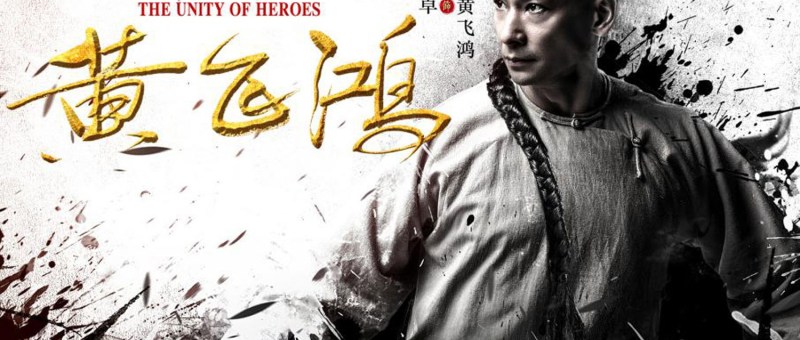
The Unity of Heroes (黄飞鸿之南北英雄, Lin Zhenzhao, 2018)

“All Chinese martial artists must stick together” affirms Wong Fei-hung, justifying himself to a dejected disciple for supposedly having appeased a local rival in Lin Zhenzhao’s The Unity of Heroes (黄飞鸿之南北英雄, Huáng Fēihóng zhī Nánběi Yīngxióng). Returning to the role he first took over from Jet Li closing out Tsui Hark’s Once Upon a Time in China series, Vincent Zhao stars in and produces this VOD outing for the legendary folk hero in which he once again valiantly defends the values of traditionalism while contending with an ever changing society. 

Twin arrivals, one expected the other not, spell change for Fei-hung and his trio of assistants, the first being the return of 13th Aunt Shaojun (Wei Na) who had been studying abroad, and the other being a crazed, zombie-like figure who wanders into the temple after escaping from a fire at the docks. If that weren’t enough to contend with, a new master, Wu (Michael Tong Man-Lung), has also arrived in town to teach his brand of martial arts with the Northern Fist Club, immediately entering a conflict with Fei-hung’s guys when Kuan (Li Lu-Bing) comes to the rescue of a mysterious woman who started a fight with them. Meanwhile, Fei-hung is suspicious of a new Western-style hospital which has been set up in order to treat victims of the opium crisis which he feels is ironic as he holds the Westerners responsible for getting the Chinese hooked on opium and then forcing them to pay to be cured of it. Of course, it turns out that the hospital, apparently backed by the British East India Company, is very definitely up to no good, led by the rather vampirically named “Vlad”. 

Finding himself faced with the threat of a superpowered opium which turns those who use it into rage-fulled killing machines, Fei-hung remains preoccupied with the erosion of Chinese traditions in the face of increasing Westernisation. Indeed, Shaojun who has been studying Western medicine in Europe has apparently even forgotten how to use chopsticks and asks for a knife and fork instead which it seems Fei-hung would not have denied her only well-meaning underling Qi decides to bring her something not quite as suitable for the dinner table. Likewise, seeing Fei-hung running a needle over a flame, Shaojun immediately runs for her alcohol bottle only for him to protest that he’s always been taught fire is enough. Nevertheless, he’s not totally against Western learning, eventually conceding that he could not have cured his patient on his own, it took one of Shaojun’s injections to clear his acupuncture points so he could eliminate the “poison” though moxibustion. 

Even so, Fei-hung is at the mercy of the evil Vlad who, as he feared, uses the rivalry between the martial arts masters to divide and conquer, seducing the apparently equally anti-Western henchmen of Wu by hopping them up on his new wonder drug as a means to take out Fei-hung and become the town number one. Allegories abound, but the lines drawn between covert capitalist colonialism and the drugs trade are anything but subtle as Vlad sells his super soldier drugs plan as a remedy to the supposed weakness of the Chinese physique that will allow them to escape subjugation, something which is of particular interest to his conflicted underling Xiaoyue (Wei Xiao-Huan) whose mother was apparently worked to death in a labour camp. “Your lives are worthless” Vlad reveals as the mask slips, “nothing is cheaper than you” justifying his decision to test his drugs on Chinese subjects with vaguely eugenicist overtones. 

All of that aside, however, first time feature director Lin Zhenzhao makes sure to include all the Wong Fei-hung staples from the training montage which opens the film to an innovative set piece involving Fei-hung’s trademark umbrella coupled with his obvious confusion with Shaojun’s “upgraded” European model, its steel spokes, and “improved” opening and closing mechanism. Given the film’s destination for the online streaming market as opposed to cinema screens, production values are surprisingly high with well populated crowd scenes, convincing production design, and nicely choreographed fight sequences including that all important shadowless kick. While not perhaps a return to the Once Upon a Time in China highs, Unity of Heroes nevertheless holds its own as another entertaining entry in the Wong Fei-hung saga.


The Unity of Heroes streams in the US Feb. 12 to 18 as part of Asian Pop-Up Cinema’s “Happy Lunar New Year!”

Original trailer (English subtitles)
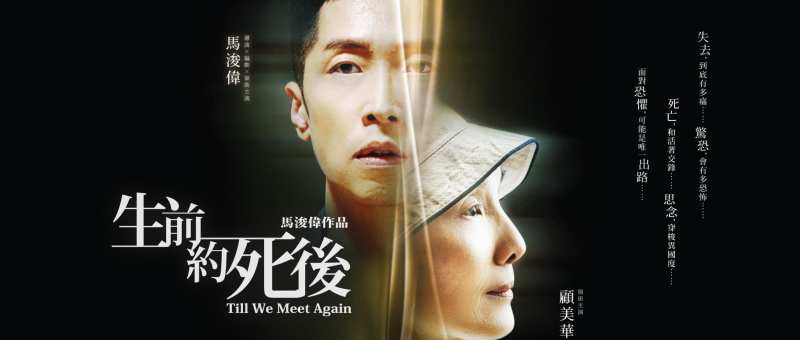
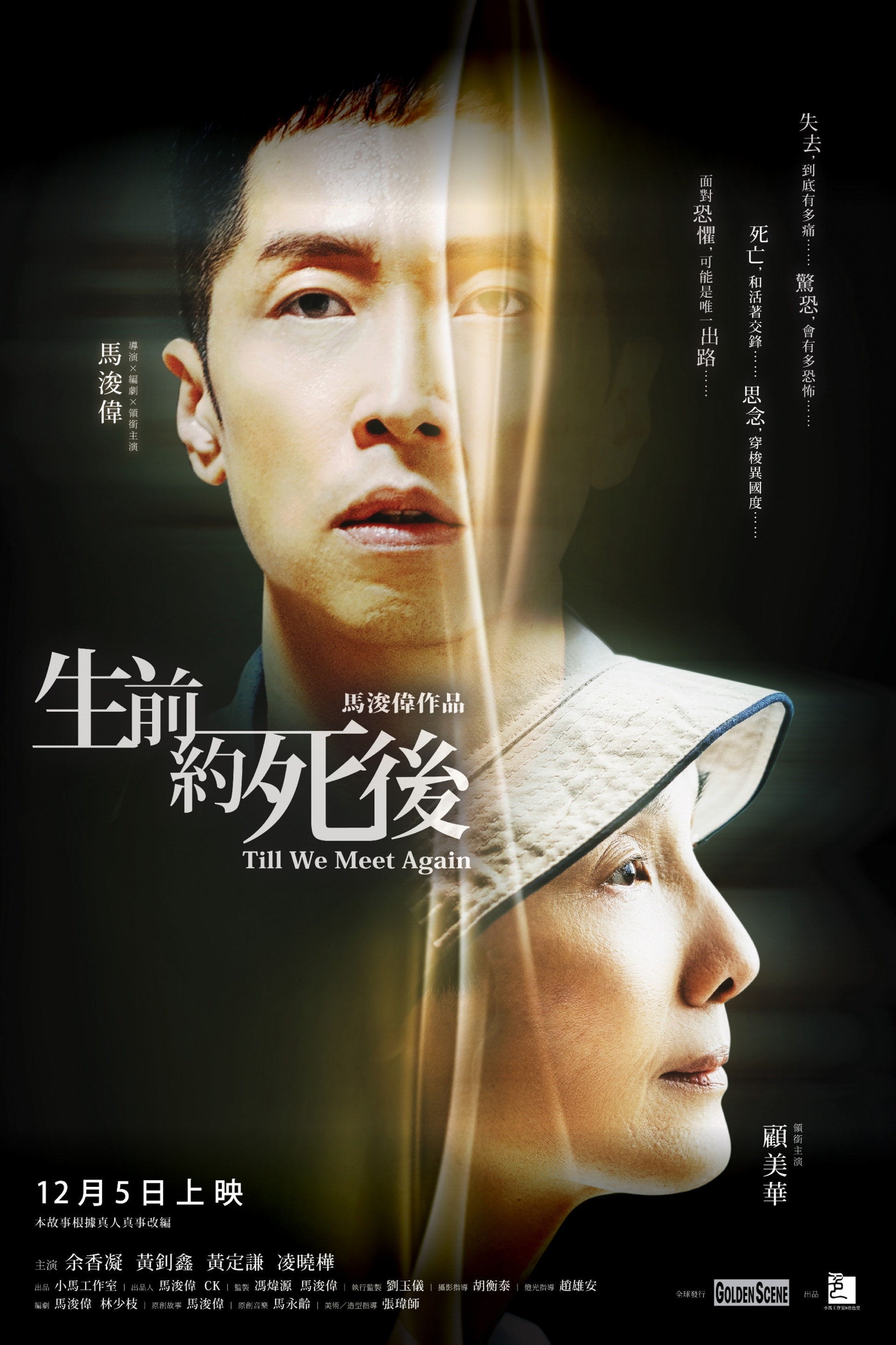
Till We Meet Again (生前约死后, Steven Ma, 2019)

“What if you let go of my hand and I get lost?” an over anxious little boy asks his mother. “Then you should stay where you are,” she tells him, “Mum will definitely come back for you.” It’s an instruction the now adult Wai (Steven Ma Chun-Wai) has perhaps taken too literally, struggling under the weight of grief and filial guilt while standing still waiting for his mother to find him again in the hope of earning her forgiveness for a sin he does not quite want to remember. Semi-autobiographical, Steven Ma’s Till We Meet (生前约死后) again is at once a dark psychodrama of man undone by loss but also a deeply touching evocation of an unbreakable mother son bond. 

Now a solitary salesman, 30-something Wai has only one wish – to reunite with his mother whom he hasn’t seen in over 10 years fearing that she bears some kind of grudge against him. We in fact see Mui (Josephine Koo Mei-Wah), his mother, angrily telling another woman, Lai (Bee Wong Chiu-Yam), that she refuses to see her son though the scene is not quite as it first seems. After abruptly quitting his job, Wai wanders out into the street and endures some kind of mental breakdown after which he visits his psychiatrist who reminds him that his mother is dead and has been for some time. 

Wai avows that he doesn’t like taking his medication because it makes him feel “sluggish” but increasingly finds his mental universe fracturing, shifting between sepia-tinted memories of his early childhood during which his mother first became ill and his life as a young man during which she suffered a relapse and later passed away. We begin to doubt Wai’s perception, uncertain if people and events he encounters are “real” or a product of his psychosis. His mother, ghost or merely spectre of memory, hovers on the sidelines apparently unwilling to see him though perhaps for his own good in hoping he will finally be able to move on and learn to be happy in acceptance of his loss. 

Tracey (Jennifer Yu Heung-Ying), his perhaps unrealistically invested psychiatrist, reminds Wai that he isn’t the only person who’s ever been bereaved or felt abandoned, left behind by those who have gone far away. She herself lost her mother young and was then abandoned by her father who left her in the care of an uncle who too abandoned her and ran off with all her father’s money. Another ghostly, perhaps imagined, conversation with Mui reveals that again Tracey may not have the full story and may never get it but unlike Wai may still have the chance to achieve a kind of closure with the traumatic past. He meanwhile carries the burden of his repressed guilt as it slowly works its way to the surface, cutting through his fragile psyche like a knife. 

While Mui’s conversations with third parties presumably taking place entirely within Wai’s mind may hint at a deeper psychological crisis they are essentially attempts to work out his guilt and shame, one-sided dialogues that eventually guide him back towards an acceptance of the truth he was intent on forgetting beginning with the traumatic fact of his mother’s death. Perhaps to some Wai’s maternal attachment may seem extreme, as the psychiatrist echoes in reminding him he’s not the only son to suffer such catastrophic loss, but it’s underpinned by a sense of filial guilt that lies at the heart of their bond in his worry that his own distress pushed Mui into pursuing a path she may otherwise have rejected on the grounds it would only cause her more pain for an additional few weeks of life. 

Trapped in his grief and guilt, Wai staggers through a nightmarish existence elegantly manifested in Ma’s abrupt tonal shifts as Wai finds himself staggering along a darkened corridor complete with faulty lighting and a single exit, while the sky itself seems to brighten to more romantic tones as he embraces a fantasy of a happier time drawing closer either to a kind of closure or the victory of his delusion whichever way you wish to read it. A painful journey through guilt and grieving, Ma’s unsparing drama provides few easy answers for living with loss but does perhaps allow its hero a degree of escape if only in unreality. 


Till We Meet Again streams in the UK until 15th February as part of Focus Hong Kong

Original trailer (English / Traditional Chinese subtitles)

The Empty Hands (空手道, Chapman To, 2017)

“You have to remember. You’ll always meet someone stronger than you. They might beat you down, but no matter what you need to have the courage to face it.” the defeated heroine of Chapman To’s second feature The Empty Hands (空手道) is reminded by her rediscovered mentor pushing her towards a literal reclaiming of her space in accepting her father’s legacy. The title, a literal translation of the characters which form the word “karate”, is perhaps also an allusion to the heroine’s sense of powerlessness and displacement even as she learns to rediscover a source of strength in that which she had previously dismissed as a worthless burden. 

30-something Mari Hirakawa (Stephy Tang Lai-Yan) is the daughter of a Japanese émigré, Akira (Yasuaki Kurata), who came to Hong Kong in 1972 on a work transfer and later married a local woman. Teaching karate as a hobby in his spare time, he eventually discovered that in the Hong Kong of the late 70s and 80s, martial arts was a valuable commodity and so he sunk all his savings into buying a sizeable flat in Causeway Bay, converting the living area into a Dojo with the family relegated to neighbouring rooms. The business did well but the family floundered and when Mari’s mother asked Akira to mortgage the dojo to help out her brother who ran into financial trouble during the 89 crisis his refusal and the uncle’s subsequent suicide led her to leave the family. A lonely child, Mari complains that her overly strict father forced her to practice karate against her will, something which she gave up as a brown belt after an unexpected tournament defeat swearing off the practice ever since.

When Akira dies suddenly, however, Mari is forced into a reconsideration of her life choices on discovering that he has left only 49% of the apartment/dojo to her with the controlling share entrusted to a former pupil, Chan Keung (Chapman To Man-Chat). Prior to this discovery, she had been cynically planning to subdivide the apartment into seven units, renting out six and living in the seventh solely on her proceeds from exploiting Hong Kong’s notoriously difficult housing market. Mari is, it has to be said, often difficult to like, defiantly aloof and with a healthy contempt for other people even throwing back a racial slur, albeit with a pinch of irony, at a little boy who’s been frequenting the dojo expressly in order to fight back against the discrimination he faces in everyday life as a member of the Indian community. This might be something you’d expect Mari to show a little more empathy for but she seems ambivalent in her sense of identity immediately introducing herself as Japanese on giving her name to man who works at the radio station where she gets a job as a security guard and with whom she drifts into a doomed affair. 

Mari’s affair with a married man is another thing of which she believes her father disapproved, but it’s also a reflection of her low self-esteem and awkward relationship with paternal authority in that she continues to seek but is afraid to ask for approval from emotionally distant men. She claims to have only one friend, Peggy (Dada Chan Ching), whom she somewhat cruelly dismisses as “all boobs and no brain”, explaining to her that what she likes about Ka Chun (Ryan Lau Chun-Kong) is his “loyalty” ironically admiring his refusal to leave his childhood sweetheart wife but also confident that he will one day choose her. Beaten down by life, Mari has perhaps backed away from the fight passively retreating while refusing to deal with her conflicted sense of identity and desire. She resents the implication that she petulantly jacked in karate after a single defeat destroyed her sense of confidence, but as we discover it is indeed her fear of failure which has been holding her back. Chan Keung’s bet that he will sign over his share of the apartment if she can remain standing, even if she loses, after three rounds in an upcoming competition is then a subtle way of getting her stand up again and rediscover a sense of confidence to fight for herself in the arena of life. 

Ironically enough, Chan Keung had been kicked out of the dojo for doing just that, told off for using karate to prove himself when its true purpose should be in the defence of others in need of help. He rediscovers the true spirit of karate after rescuing a little girl from a predatory triad, but Akira’s mission is also one of redemption for Chan Keung as he patiently mentors the originally reluctant Mari back towards an acceptance both of her father and of her relationship with karate along with the confidence that counters defeat. A meditative mood piece from the hitherto comedian To anchored by a stand out performance from Tang (who apparently spent six months training for the role) pushing back against glossy rom-com typecasting, The Empty Hands is less martial arts movie than gentle life lesson as its beaten-down heroine learns to fight her way out of existential malaise towards a more forgiving future. 


The Empty Hands streams in the UK 9th to 15th February as part of Focus Hong Kong

Original trailer (English subtitles)
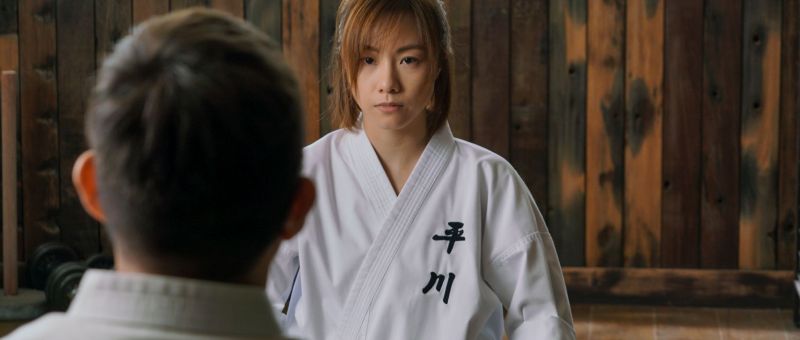
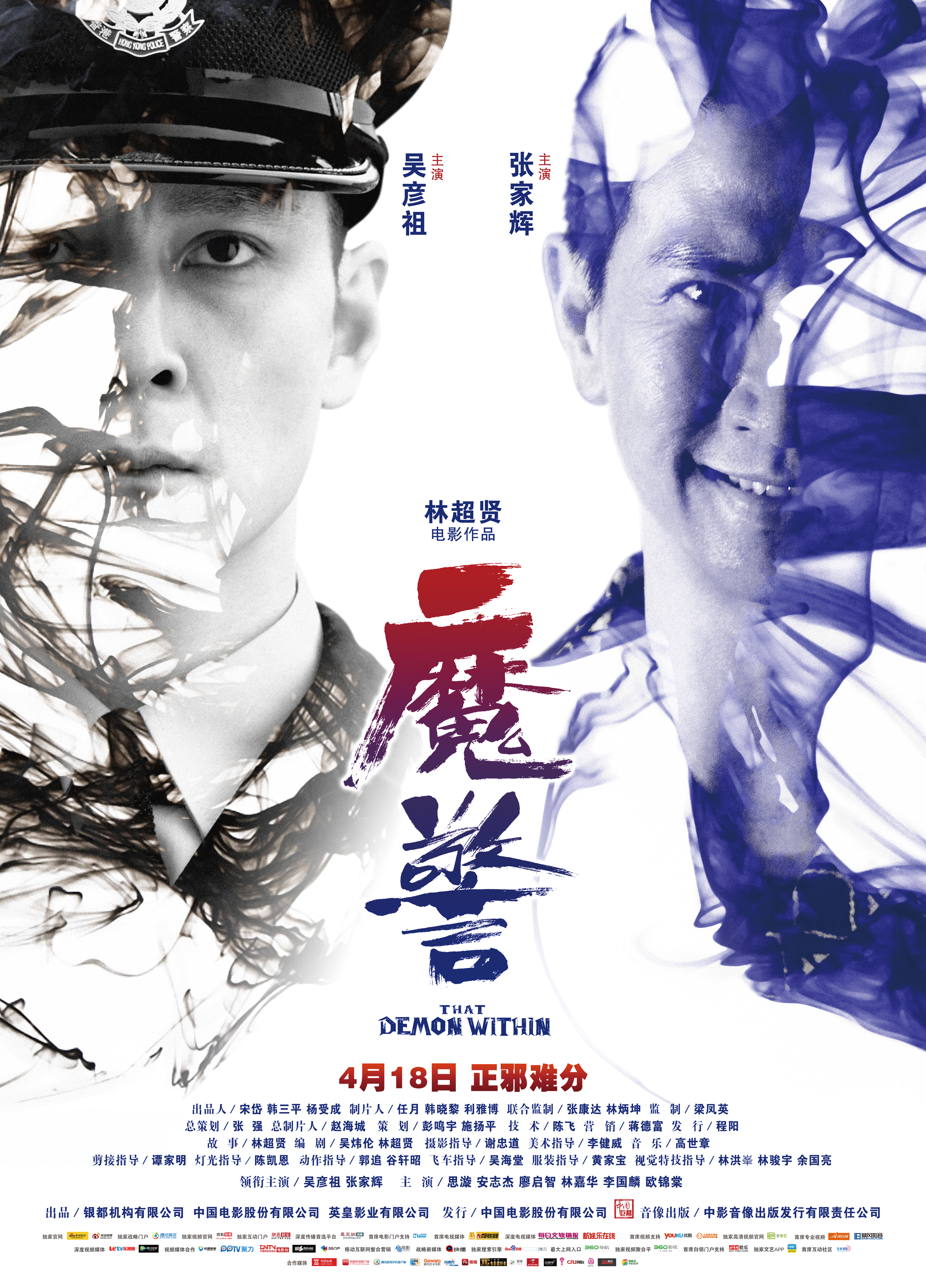
That Demon Within (魔警, Dante Lam, 2014)

“Every man has his own fear, and different ways of hiding it. But fear will never go away” according to the hero of Dante Lam’s That Demon Within (魔警), a twisty, metaphysical take on the futility of violence and inevitability of karmic justice. Hong Kong cinema has often held that cop and criminal are merely two sides of the same coin, but rarely has it taken its mistrust of authority and nihilistic cynicism to such great heights as in Lam’s B-movie-inflected psychological thriller.

The hero, Officer Wong (Daniel Wu Neh-Tsu), is a fearful man. Now 35 and a 17-year veteran of the Hong Kong police he’s still a lowly beat cop currently occupying the police box in the reception area of a less than busy hospital. He tells us, paradoxically, that he puts on the uniform because it makes him feel safe. His life begins to change, however, when he makes the selfless offer to give some of his own blood to a man who staggers in badly injured after a bike accident. What Wong didn’t know is that the man is Hon (Nick Cheung Ka-fai), a notorious local gangster known as the Demon King responsible for the deaths of two fellow officers during the escape which led to his accident. Wong gets a dressing down from the Inspector in charge, Pops (Dominic Lam Ka-wah), and is thereafter haunted by his ironic action of being a policeman who saved the life of a cop killer.

Of course, others might say Wong did the right thing so that Hon can face justice and in any case it would be wrong to deny someone lifesaving treatment because of a moral judgement, but Wong can’t see it that way and continues to punish himself (quite literally) for his “mistake”, remembering the authoritarian father who taught him that mistakes are a sin. It turns out that Wong’s career has floundered because of “personality issues”, those being that he’s a bit of a prig, overly serious and by the book when most his fellow officers are anything but. His new commanding officer is, as it turns out, an old academy classmate who perhaps remembers what those issues might be but doesn’t see why they should have disrupted his career to the extent that they have and actively wants to help him get over them with the aid of a hypnotherapy psychologist.

Wong, however, is like everyone else dealing with his own demons but his decision to face them by chasing down Hon who has escaped to presumably do even more crime proves increasingly problematic as his sense of reality begins to unravel. There is something quite ironic in the fact that Hon’s “gang” (well, bunch of guys he hired for the job) is based in a funeral home and mostly involved with the rituals of death which, whichever way you look at it, is particularly convenient for their side business. Lam’s Hong Kong is a grimy, film noir land of dread and violence, a shadowy hellscape where no one is safe from the fire of karmic retribution. Wong has been in hell all along, waiting for the flames to consume him, but is only just starting to notice that it’s beginning to get warm.

Overcome with rage, Wong’s world literally glows red around the edges while Lam shifts to a steady cam closeup on his final mental break in the face not only of tremendous grief but the sudden impossibility of redemption and the manifestation of his guilt. Becoming a policeman was to Wong a way to protect himself from himself, an ironic form of atonement for past transgression. The source of all his trauma is echoed in the present plague of low level thuggery that sees “repo men” splash grease and paint on the homes of mostly elderly poor people presumably to pressure them to move while a single act of (accidental) police brutality at a protest against forced eviction changed not only his life but those of several others forevermore, kickstarting a chain of karmic retribution that leads us right back into the flames. If Wong is “mad” it’s because the world made him that way. Treading firmly within the realms of the B-movie with its comicbook-style aesthetic, incongruous score, and pop psychology take on the legacy of trauma, Lam’s nihilistic psycho-supernatural thriller leaves no doubt that cop or criminal there’s a demon within us all looking for an excuse to raise hell in a land of fear and violence.


Currently available to stream on Netflix in the UK and possibly elsewhere.

Original trailer (English subtitles)

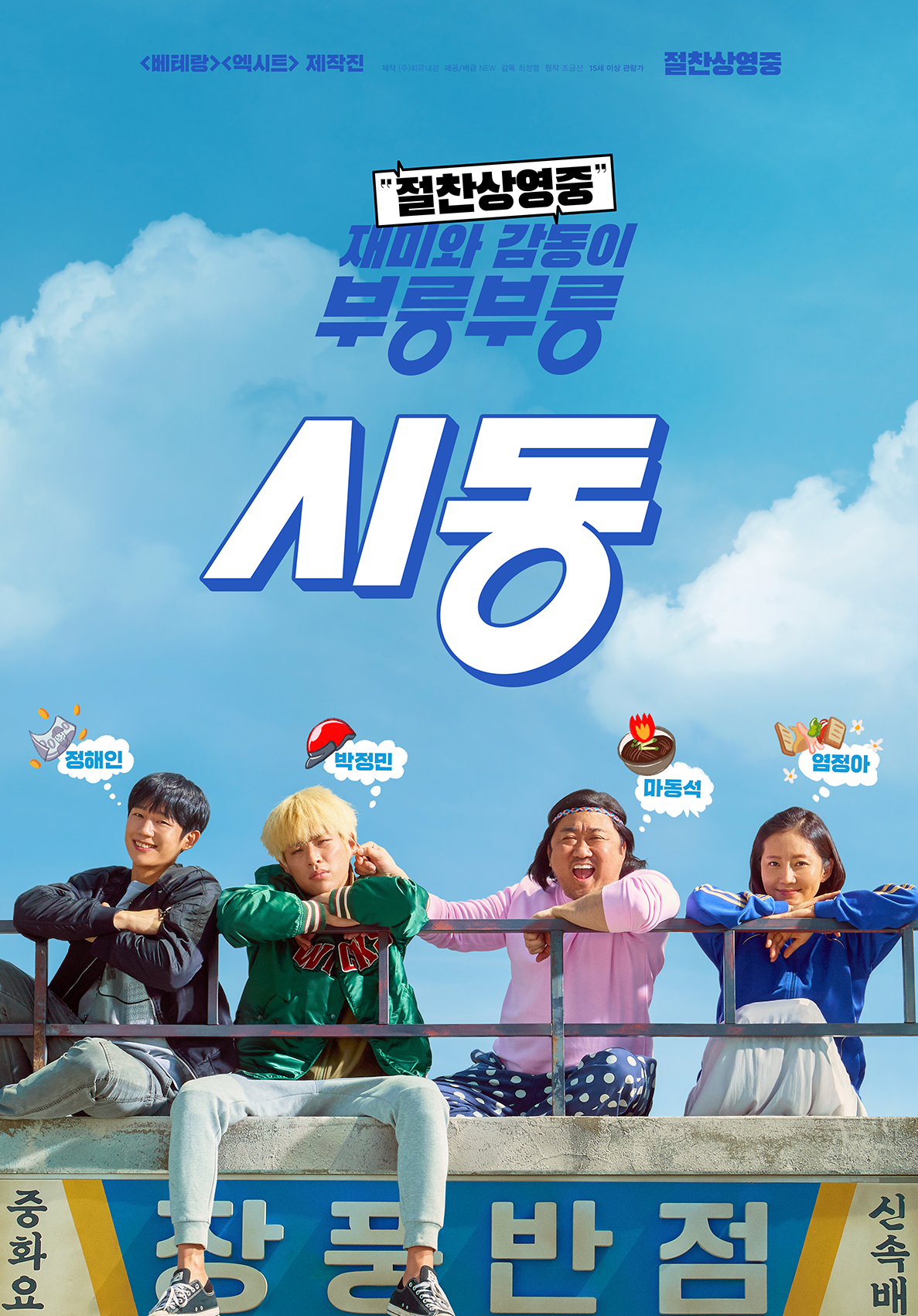
Start-Up (시동, Choi Jung-yol, 2019)

Two young men experience a failure to launch in Choi Jung-yol’s Start-Up (시동, Sidong), a much gentler coming of age tale than his 2016 feature debut One Way Trip. Like the earlier film, however, Start-Up finds its two heroes pulled in different directions while experiencing the same dilemmas, these being in the main a kind of toxic masculinity that sees them in part reject their respective maternal figures in internalised shame as sons who feel they should be but are fundamentally incapable of taking of care of them and perhaps concluding that their only familial connection must be disappointed and resentful.

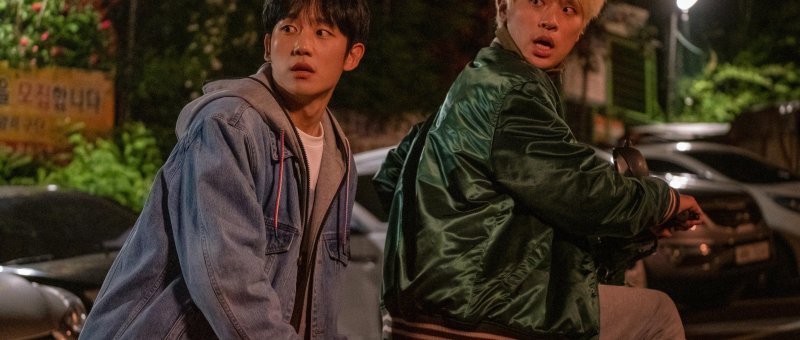
We can see the boys’ sense of futility in the opening sequence in which they literally fail to kickstart a scooter that 18-year-old Taek-il (Park Jung-min), the hero, has somehow managed to buy on the internet but seems to be a dud. Eventually they wind up having an accident and being taken to the police station where Taek-il’s mother Jeong-hye (Yum Jung-ah) has to bail them out leaving even the desk officers looking quite embarrassed as she takes Taek-il to task for his irresponsibility, disappointed to learn he spent money intended for lessons to help him (belatedly) get his high school diploma on the useless scooter. He tells her he’s dropped out of school and has no interest uni, fiercely resenting her refusal to accept his decision while unwisely cutting in that she doesn’t have the money to send him anyway which earns him one of her trademark volleyball slaps. 

Taek-il’s unwise words perhaps hint at part of the reason he’s rejecting the life his mother wants for him in that he knows how much she’s suffered and sacrificed on his behalf and doesn’t want to add to her burden by encouraging her to overwork herself to pay for college when he doesn’t think he’s worth it anyway. Of course, he can’t say any of this to her, and she can’t tell him she only wants the best for him, so they alternate between silence and blazing rows with Taek-il retreating into peaceful visions of life on a desert island when everything gets too hard. Wanting to prove himself independent, he ends up running away but doesn’t have money to get very far so ends up working in a Chinese noodle restaurant in provincial Gun-san. 

His friend Sang-pil (Jung Hae-in), meanwhile, is an orphan living with his elderly grandmother (Go Doo-shim) who appears to be suffering from dementia and has been supporting the pair of them by peeling chestnuts. Like Taek-il, Sang-Pil desperately wants to be able to take care of his grandmother and make her life as easy as possible but is largely out of options which might be why he lets a shady friend, Dong-hwa (Yoon Kyung-ho), introduce him to his “company” which turns out to be a local loansharking gang for which Dong-hwa is an enforcer and debt collector. Sang-pil tells Taek-il that he’s got a job “in finance”, and though he’s conflicted enjoys the sense of self worth he gains as a working man earning money to look after grandma. He is too naive to realise that the first family they visit is aggressively nice to Dong-hwa because he’s probably been less than nice to them in the past, coming away with the mistaken idea that the job’s not so bad and people are grateful for the “service” they’re providing. 

A repeated gag sees both boys getting repeatedly beaten up, literally struck down every time they attempt to move forward. Taek-il finds himself punched in the stomach by an amateur boxer with problems of her own and thereafter knocked around by the eccentric chef at the Chinese restaurant (Ma Dong-seok), while Sang-pil is finally awakened to the dark side of his new job when he’s thrown through a glass doorway by a drunken client very clearly at the end of his tether. The answer is less fighting back than it is standing together and up for oneself as the boys begin to make mutual decisions about the future directions of their lives and the kind of men they’d like to be even if they still don’t quite know where they’re going. 

Start-Up’s genesis as an online webmanga might help to explain its myriad unresolved plot strands including the backstory of the mysterious boxing high school girl (Choi Sung-eun) who appears to have lost or become estranged from her family but ends up becoming the surrogate daughter of the kindly man who owns the Chinese restaurant (Kim Jong-Soo) which seems to be a haven for lost people of all ages looking for a place to call home, while Jeong-hye’s past success as a volleyball star is resolved as little more than an awkward punchline and her desire to start her own business which she is then swindled out of presented as something done solely for her son rather than for herself. The difficult economic circumstances of contemporary South Korea are certainly a factor in the boys’ malaise and general sense of hopelessness but it’s less Hell Joseon that’s trapping them than a complex web of familial love and resentment coupled with their desire as a young men to feel in control of their own lives rather than being constrained by parental expectation. “You should decide where to go first” Taek-il is repeatedly told, but when it comes right down to it the most important thing is figuring out how to start the engine, everything else you can figure out later.


International trailer (English subtitles)

The Queen of Black Magic (Ratu Ilmu Hitam, Kimo Stamboel, 2019)

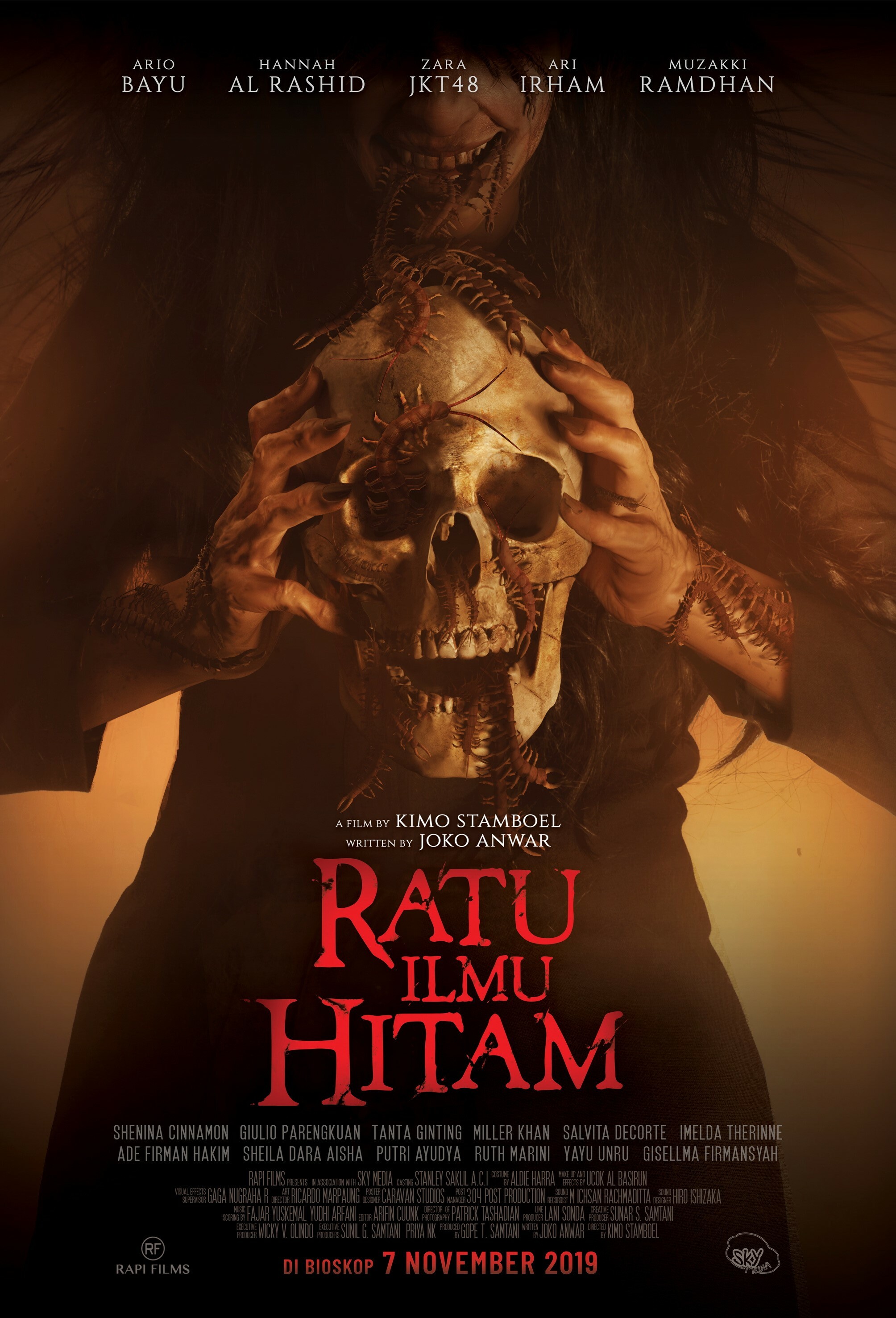
“I’m not here just to punish you, I’m here to create hell” the vengeful tormentor at the centre of Kimo Stamboel’s contemporary remake of the 1981 classic The Queen of Black Magic (Ratu Ilmu Hitam) cooly intones. Reminding her victims that not to know is also a sin, the shadowy villainess has come she says to create hell on Earth because she is uncertain that mortal transgressions will be suitably punished after death and means to ensure those who have sinned suffer accordingly. Quite literally trapped in the space of their trauma, the heroes attempt to find a way out of their guilt and shame but are perhaps confronted as much by themselves as by a witch hellbent on justice as they try to find escape from the traumatic past. 

Hanif (Ario Bayu) and his wife Nadya (Hannah Al Rashid) have foregone their planned holiday to Bali to visit the man who ran the orphanage where Hanif spent much of his childhood who is now apparently close to death. This comes as a surprise to their three children who hadn’t realised their father was adopted or really ever thought about kids who don’t have parents, and though they are perhaps annoyed to have missed out on their holiday they are also a little excited to be going somewhere so unusual. Unfortunately however, the family’s cheerful mood is broken when they hit what they assume is a deer on their way to the orphanage casting an air of foreboding over their journey. 

Though it appears Hanif has been “open” with his wife about his past, the same is not necessarily true for his “brothers” Anton (Tanta Ginting) and Jefri (Miller Khan) who have also brought their partners to meet Mr. Bandi (Yayu A.W. Unru), Jefri’s wife Lina (Salvita Decorte) complaining that she knew nothing about any of this until they were already in the car on their way over. Far from a happy reunion, however, the brief sojourn at the orphanage begins to highlight the strain on each of the familial relationships, Lina apparently experiencing a kind of body dysmorphia and preoccupied with her weight while Anton’s wife Eva (Imelda Therinne) is constantly applying moisturiser to guard against a mysterious rash she was convinced was down to flesh eating bacteria but others feel is simply “dry skin”. These will however be the least of their worries as the men vaguely hint on voicing their anxiety that Mr. Bandi’s biological children may sell the estate to developers unsure of “what they’ll uncover”.

This perhaps implies that the now grown up men know more than they’re willing to admit about the dark secrets the orphanage hides, something which Hanif has in any case not shared with his wife who has only a rosy picture of his childhood with Mr. Bandi who eyes her with nervous suspicion even on his death bed. Nevertheless, the men have each been drawn back to the source of their trauma and now find themselves unable to escape without a reckoning, recalling a similar occasion that they tried to run only to find themselves mysteriously brought back as if by some supernatural force. There are indeed dark, other worldly forces in play but also a healthy dose of patriarchal violence, entrenched misogyny, abuse of power, and as the villainess had hinted a wilful tendency not to see especially when it comes protecting the most vulnerable members of society, children without parents who are easily manipulated in the knowledge that, as Hanif originally puts it, they would otherwise die abandoned. 

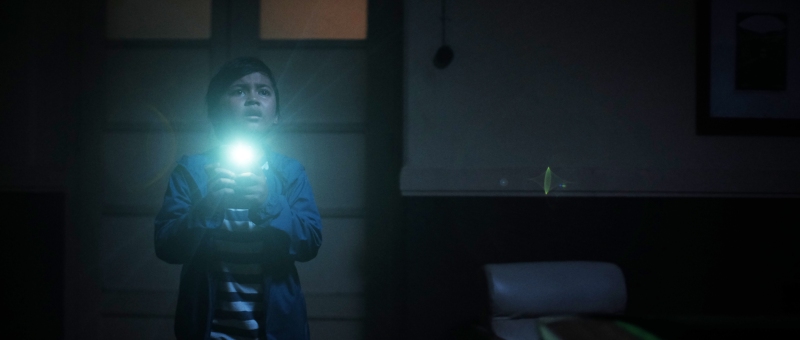
Justifying a particularly ironic part of her revenge plan, the witch reveals that the orphans may in fact be better off dead than raised by a man like Bandi, something which Hanif himself echoes if not quite with the same intent. Creating her hell, she forces her prey to harm themselves and each other with a variety of weapons ranging from kitchen knives, scythes, and comparatively more modern projectile weapons to insects literally choking the guilty from the inside. The orphanage itself is a place out of time, frozen as it was during Hanif’s childhood, one of the two orphans to have remained behind as mystified by Hanif’s inquisitive son Haqi’s (Muzakki Ramdhan) references to such things as “the internet”, “wi-fi” and “streaming” as he is by the “scary” VHS tape she shows him featuring actual footage of his father and a mysterious figure of legend. Yet even in realising they have allowed themselves to serve poor masters, deceived by a man they trusted, there is a sense the men at least, absent from the final frames, may never be able to free themselves from their guilt, forever haunted by the spectre of those they have unwittingly harmed. An eerie, gory, dread-propelled voyage through human cruelty to supernatural retribution, Queen of Black Magic positions the evil that men do ahead of that performed by vengeful witches looking for spiritual justice as its misused heroes attempt to find accommodation at least with the traumatic past.  


The Queen of Black Magic is available to stream via Shudder in the US, Canada, UK, Ireland, Australia, and New Zealand from 28th January.

Trailer (English subtitles)

The Burning Buddha Man (燃える仏像人間, Ujicha, 2013)

“There are many strange things happening in this world” according to the mysterious young woman who appears in the brief live action sequences bookending Ujicha’s debut feature, The Burning Buddha Man (燃える仏像人間, Moeru Butsuzo Ningen). Who is she? One of the “space people” mentioned in the accompanying voice over which also points out that humans are hard to trust seeing as they don’t even trust each other, or merely a stand in for the omnipotent artist sitting down as she does and looking over her creation her butler dutifully waiting at her side? Who can say, it’s just one of many mysteries at the heart of Ujicha’s beguiling retro sci-fi/horror Buddhist conspiracy thriller animated in his now trademark and equally retro “gekimation” style. 

Taking place in the director’s native Kyoto, the action opens with a strange, alien-like creature breaking into a temple and firing some kind of laser from a phallic device on his belt directly into the head of a colossal Buddha statue. The couple who look after the family-run temple, mindful of their duty to protect their ancestral legacy, are perturbed and politely ask the creature to stop but are later caught in the crossfire when the statue suddenly disappears leaving only their bottom halves behind. Cue the arrival of teenage daughter Beniko (Yuka Iguchi) in her school uniform who is quickly taken in by weird old monk Enju (Minori Terada) who explains that he’s an old friend of her parents and that the theft of the statue is part of a spate of similar heists across the Kyoto area perpetrated by a crazed cult who are apparently intent on “rescuing” neglected Buddha statues from “disrespectful” modern people. Staying with him in his temple, however, Beniko starts to have doubts especially after encountering the strange-looking children who run wild in the grounds Enju claims are “disadvantaged” kids he’s taken in after they were abandoned by their parents because of their odd appearances, not to mention an encounter with Enju’s sculptor grandson Enji (Ryuki Kitaoka) who suddenly frees a small dog apparently trapped inside the uchiguri cavity of an Buddhist statue after being caught in the range of the “Matter Transference Device” used by the thieves to teleport the neglected icons to “safety”. 

A weird tale of spiritual fusion, The Burning Buddha Man’s villains have apparently forgotten all their Buddhist teachings and become “addicted” to melding with statues in order to harness their power and become all powerful beings. Beniko, however, is still pure of heart and is not after revenge for what happened to her parents but to save the wrongdoers by making them “reform”. To do so, however, she’ll have to undergo an apparently reversible transformation herself as well as journeying to another world where, she discovers, her elderly catatonic grandmother (Chisako Hara) has apparently been in training for just such an eventuality for the last couple of decades. “It’s easy just to kill them” Beniko later explains, “but no one can get out from their suffering that way” apparently hoping to undo some of the pain in the world caused by this strange new technology through an act of healing. 

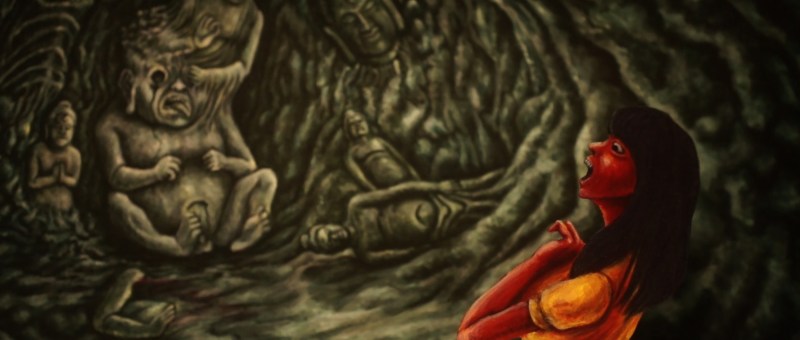
As showcased in the live action intro/extro sequences in which the young woman painstakingly assembles and then disassembles her world, pausing briefly to look admiringly at a figure perhaps representing herself before handing it back to her gloved butler for safekeeping, Burning Buddha Man’s aesthetics consist of a series of beautifully painted backdrops and paper cut out puppets of its strange cast of characters which include a gang of Giger-esque biomechanical former Buddhist monks rendered monstrous by their experiments in spiritual enhancement. Amping up the body horror quotient, real liquid often oozes from their mouths made sickening in its viscosity while blood later fills the screen. Yet for all that there’s a strangely childlike glee in the macabre grimness as the wholesome heroine and her pure-hearted friends push back against the corruptions of hyper-religiosity and spiritual madness hoping to restore rather than destroy but ultimately finding themselves forging a purifying hellscape that ends only in fire (and a peculiar kind of sludge making its way towards the drain of all humanity). Deeply strange yet strangely charming Ujicha’s Buddhist body horror conspiracy thriller is undeniably dark but also imbued with a sense of ironic playfulness in its truly bizarre cosmology.


The Burning Buddha Man is available on blu-ray in the UK courtesy of Third Window Films in a set which also includes Ujicha’s second feature Violence Voyager as well as a selection of shorts.

Original trailer (English subtitles)
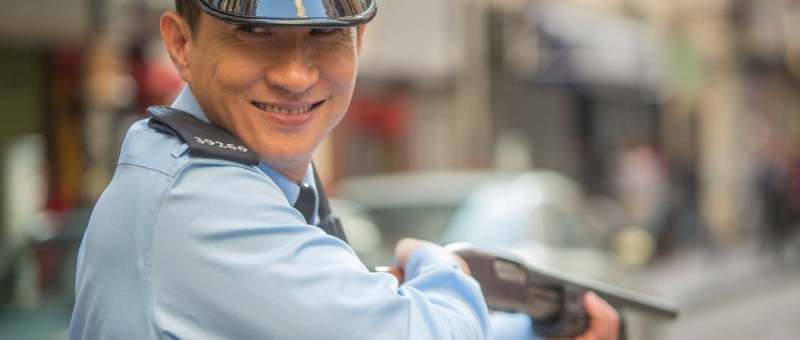
Talking the Pictures (カツベン!, Masayuki Suo, 2019)

Famously, silent cinema was never really “silent” in Japan. As the quote from director Hiroshi Inagaki which appears after the end credits of Masayuki Suo’s ode to the early days of the movies Talking the Pictures (カツベン!, Katsuben!) reminds us, audiences always had the benshi to guide them. These narrators of film were often more of a draw than the pictures themselves, cinemagoers keener to see their favourite storyteller perform than the story up on screen. A relic of a bygone age, the benshi has often been blamed for holding Japanese cinema back as studios continued to craft their films around audience appetites for live performance, but as we’ll see even the benshi themselves could sense their obsolescence lingering on the horizon. 

Beginning in 1915, the film opens with a retro mockup of a Toei logo from the silent era though the studio was only founded in 1938 and therefore produced only sound movies. Shot as a silent picture the opening sequence follows a gang of kids as they make their way towards an active film set where a classic jidaigeki is in production, confused on passing what appears to be a woman peeing standing up against a tree, a reminder that early cinema was largely inspired by kabuki and therefore featured male actors playing female roles. This is a disappointment to young Umeko, the daughter of an itinerant sex worker, who dreams of becoming an actress. Shuntaro, a little boy obsessed with the movies and dreaming of becoming a benshi like his idol the marquee draw Shusei Yamaoka (Masatoshi Nagase), reassures her that plenty of films from other countries feature female actors as the pair bond sneaking into the local picture house together but as in any good melodrama they are separated by time and circumstance only to be reunited 10 years later when neither of them is quite living their best life. 

While Umeko (Yuina Kuroshima) is a struggling actress trying to make it in motion pictures, Shuntaro (Ryo Narita) is living as a “fake benshi” impersonating Yamaoka and others for clueless provincial audiences while the gang he’s running with rob local houses using the movies as a cover. Escaping with some of the loot, he rebrands himself as “Kunisada” after a favourite character from the silver screen and fetches up in his old stomping ground, getting a backstage job at the troubled picture house which finds itself at the mercy of the new outfit in town, a purpose built modern cinema run by local yakuza Tachibana (Fumiyo Kohinata) and his movie-loving modern gal daughter Kotoe (Mao Inoue). Like the film itself, the town is at the nexus of changing times. The Aoki cinema is housed in a former kabuki theatre with the staff dressing in kimono even if Shuntaro and his divaish rival Mogi (Kengo Kora) don suits to talk the pictures. The palatial Tachibana meanwhile boasts modern seating and has the habit of poaching the Aoki’s staff partly because they pay more and partly because no one wants to work with Mogi who is, in his own way, an exemplification of the ways the benshi can interfere with cinematic development in that he forces the projectionist to undercrank the movies to ensure they follow the rhythm of his narration and not vice versa. 

The handsome Mogi is still pulling in the crowds, but the ageing Yamaoka has become a melancholy drunk now convinced that his own art is an act of destruction, actively unhelpful in becoming a barrier between the audience and the movies rather than a bridge. After all, cinema is a visual medium, it shouldn’t need “explaining” in words. He’s actively standing in the way, imposing his own narrative over someone else’s vision just as Shuntaro is a “fake” benshi in that he merely copies the routines of others, adopting a “fake” persona while hiding out in the movie house from the gang he ran away from and the movie-loving cop (Yutaka Takenouchi) who’s chasing them. Yamaoka may have a point, the days of the benshi are numbered though there were those who argued the advent of the talkies was also a regression, the advances of the silent era squandered on the spectacle of sound. Nevertheless, filled as it is with silent-era slapstick, silly farce, melodrama, and romance, Talking the Pictures is a warm and nostalgic tribute to a bygone age of cinema and the men and women who guided us through it. 


Original trailer (no subtitles)

My Little Monster (となりの怪物くん, Sho Tsukikawa, 2018)

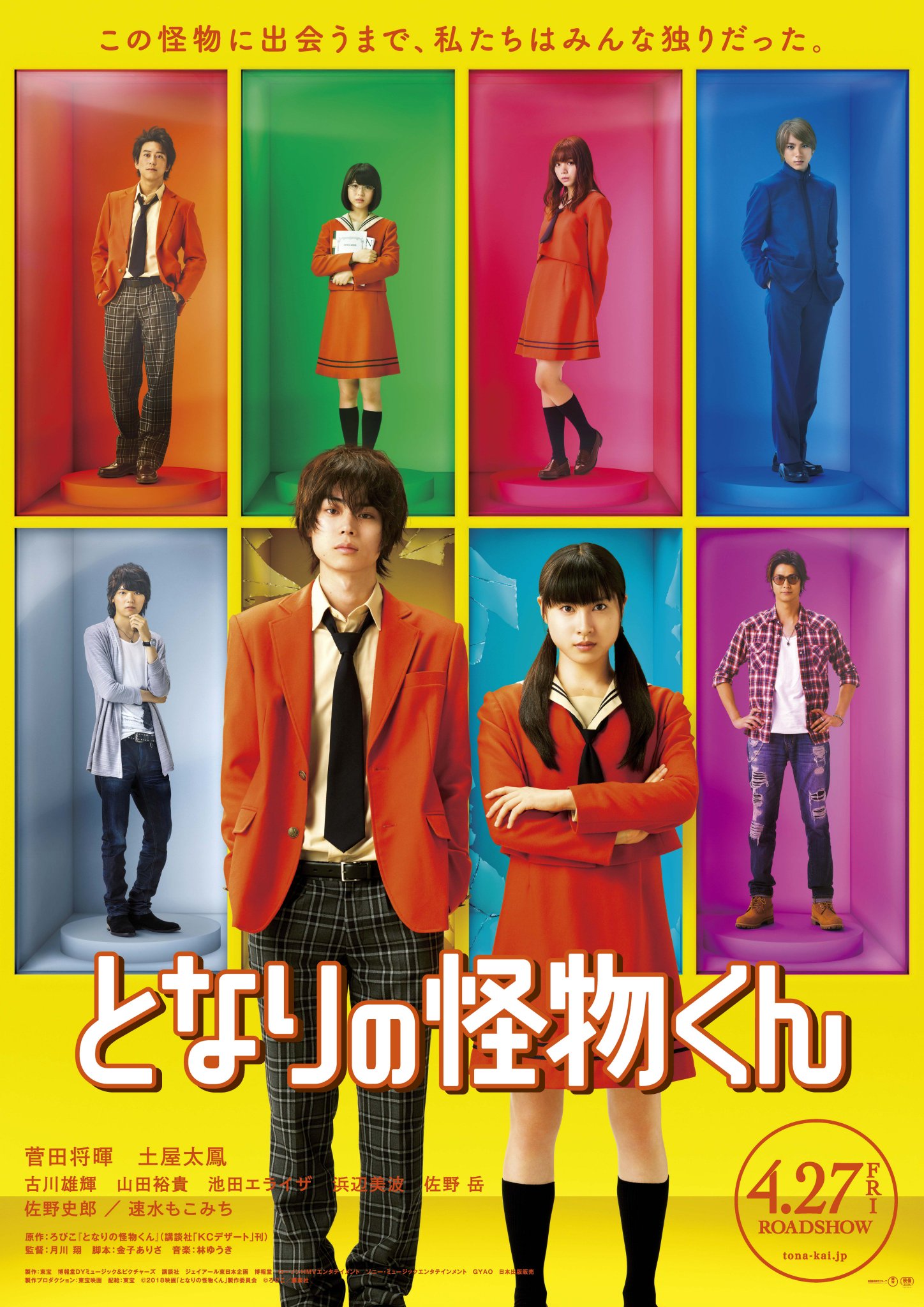
A wilfully self-contained high school girl falls for a big-hearted classmate, but struggles to understand that they are in essence fighting different battles in their parallel quests for acceptance. Adapted from the hit shojo manga by Robico, Sho Tsukikawa’s My Little Monster (となりの怪物くん, Tonari no Kaibutsu-kun) is in many ways a typical high school rom-com in which a repressed young woman begins to deal with her abandonment issues essentially by mothering a displaced young man whose “problematic” big-heartedness sees him regarded as a “monster” by a still conservative society. 

Opening with a flashback presumably set in the present day, an older Shizuku (Tao Tsuchiya) now wearing a lawyer’s pin listens wistfully to Kana Nishino’s 2010 hit Best Friend and reflects on a time when all she cared about was studying, rejecting all human connection. Until that is she met the titular “monster” Haru (Masaki Suda) and suddenly found herself surrounded by people. Haru, as we discover, got into a fight on the first day of school and never actually showed up for classes. Because Shizuku should have been his desk neighbour, the panicked teacher asks her to take the handouts etc to his home in the hope he’ll one day return. Shizuku has no interest in doing as the teacher has tasked her but fulfils her duty, only to unexpectedly encounter Haru who then decides they must be “friends” based on a primary school understanding that friends take each other notes and homework when one of them is sick. 

It turns out that Haru hasn’t been coming to school because it bothers him that everyone finds him scary because of his lack of impulse control. He desperately wants to make friends and thinks he has some in a trio of local boys but Shizuku can see right away that they are essentially bullying him for money and tries to explain that “real” friends don’t sponge off each other. Perhaps because of his innate kindness, Haru is completely guileless and sees the best in everyone unable to understand when he’s being taken advantage of. Despite herself, Shizuku begins to feel protective assuring Haru that he will one day be surrounded by people who understand him unwittingly echoing the words of his late aunt who was the only other person who’d ever rooted for him. Straightforward as ever, Haru immediately confesses his love and so their awkward high school romance begins. 

Shizuku, however, is still largely uninterested in love. She has devoted herself to studying and only cares about coming top in the school exams. As we discover this is less because of academic ambition than practical application. She studies hard and immediately sees results. It’s the sure thing, something which is completely within her own control, unlike other people’s feelings which are necessarily messy and unpredictable. There is however an uncomfortable conservatism in the centring of Shizuku’s trauma solely in the fact that her mother works outside the home and is therefore not present in her life in the way that mothers are expected to be in a patriarchal society while her family set up is regarded as unusual in that her father, having failed several times in business, is a househusband. 

Meanwhile, she remains fairly blinkered to Haru’s parallel familial disconnection in that he has apparently been disowned by his authoritarian father for his free-spirited ways. Taken to a birthday party held for Haru’s older brother Yuzan (Yuki Furukawa), Shizuku begins to realise there is a large class difference between them but reacts badly, confused that he is rejecting the very things she’s striving for in refusing to reconnect with his father, ignoring the fact that he has separated from him because he is essentially abusive. He refuses to let Haru be Haru, trying to straight-jacket him into conventionality by forcing him to clamp down on his noisy impulsivity, something which he seems unable to do even if he wanted to. Shizuku fails to realise the hurt she deals him in refusing to understand his reluctance, unable to see that it amounts to a rejection from the one person he assumed had completely accepted him. 

What she discovers is that you won’t always be forgiven for momentary thoughtlessness and in the end you have to let people be what they are, which throws into light the problematic “monster” of the title which is how Haru is often seen by others, a quality brought to vivid life in Suda’s manic performance. A rival suitor, Yamaken (Yuki Yamada), selling himself as the slow and steady candidate perhaps more suited to Shizuku in being more like herself, describes their relationship as a “make-believe friendship” rather than a real romance, something she has to accept may have a grain of truth in it in her inability to fully understand the person she claims to love, but nevertheless comes to the conclusion that while Yamaken may make her feel at ease in herself it’s the stressful stimulation with the intense yet passionate Haru that she truly craves. That aside, their romance is a fairly cool affair and its resolution too contrived to have any kind of impact which is perhaps why Tsukikawa resorts to anime-style imagery including a flying leap of love accompanied by bright sunshine flooding in from behind. Nevertheless, in true shojo fashion My Little Monster celebrates not only its heroine’s gradual path towards an embrace of the chaos of being alive, but also the power of friendship and acceptance as the gang find a place to belong in each other and with it a more concrete sense of self.


Singapore release trailer (English/Simplified Chinese subtitles)

Kana Nishino – Best Friend

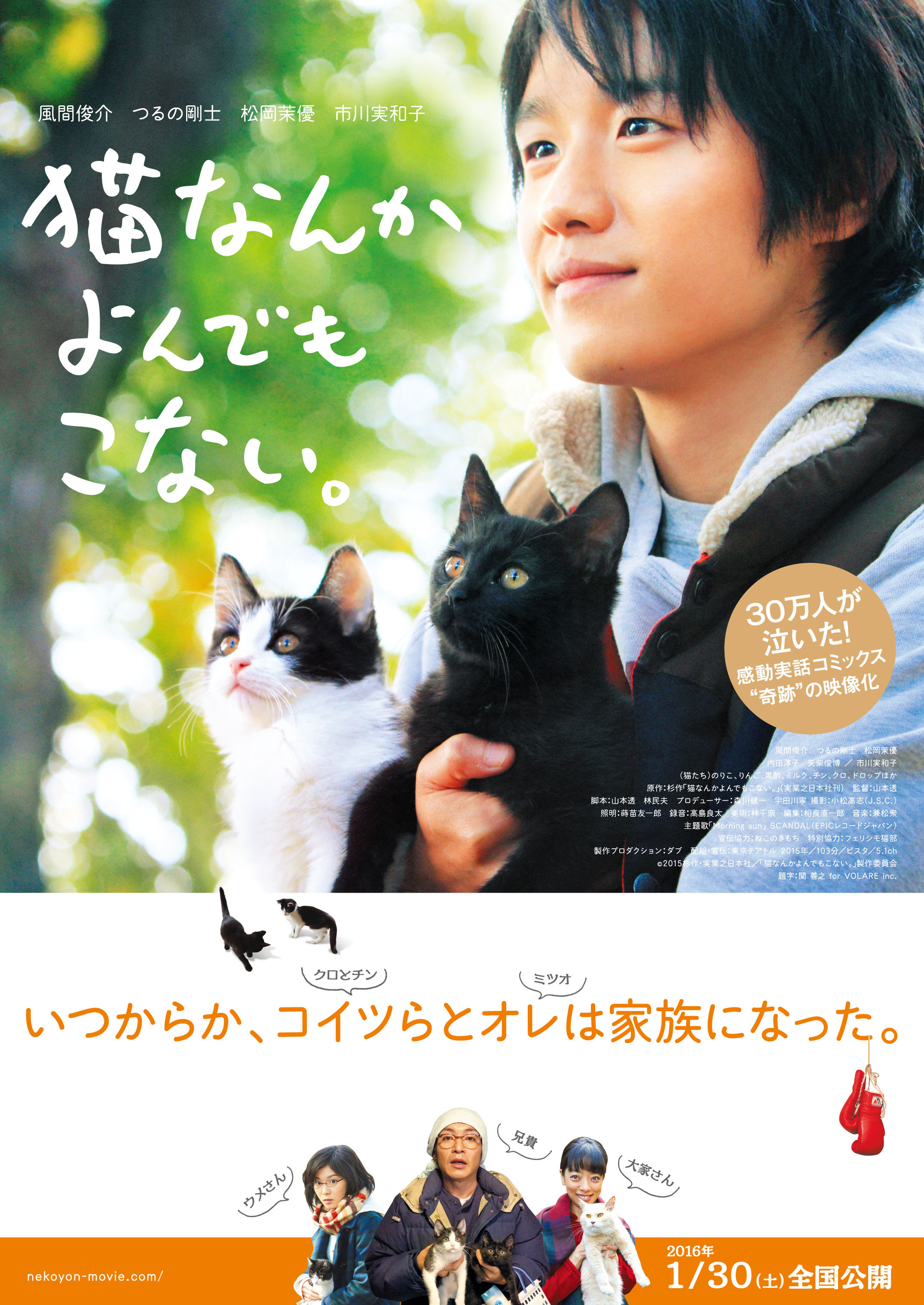
Cats Don’t Come When You Call (猫なんかよんでもこない。, Toru Yamamoto, 2016)

How do you keep going after all your dreams have died? For the hero of manga adaptation Cats Don’t Come When You Call (猫なんかよんでもこない。, Neko Nanka Yondemo Konai.), a pair of adorable kittens eventually point the way towards a more positive future. After all, it’s easier to convince yourself to look after something else than it is to look after yourself. As the title suggests, however, cats like the future can be elusive and confusing, both needy and indifferent. In caring for them you’ll inevitably make mistakes, but those mistakes will perhaps teach you something about the business of being alive. 

The hero, Mitsuo (Shunsuke Kazama), is a dog person, which is why he walks on by when he sees a cardboard box with two abandoned kittens inside by the railway line. An aspiring boxer, he’s moved in with his mangaka brother (Takeshi Tsuruno) and given up all his part-time jobs in the hope of winning enough fights to achieve A-rank status and get a license to turn pro. He’s quite annoyed, therefore, to discover that his brother decided to adopt the cats, naming them Tiny and Blackie, and is expecting him to look after them seeing as he’s not contributing in any other way. 

Despite his original animosity (he claims to hate cats because of their “malicious, warped personalities”), Mitsuo ends up taking to the kittens who quickly take to him, though mostly because he is providing them food and warmth. He even starts to think that these must be “special”, “genius” cats, especially after he wins his big fight and is all set to turn pro believing that the cats are his good luck charm. But all at once his dreams crumble. He receives an eye injury that requires surgery and is advised not to box again in case he goes blind. Feeling sorry for him, his brother keeps giving him money to get out of the house, something which makes Mitsuo feel loved and appreciated. Only later does he realise that he had an ulterior motive when his brother announces he’s decided to get married and will be moving back to the country. “You’re good at taking care of others” he tells him, dropping the bombshell he’s leaving the cats behind too. 

It’s tempting to believe that Mitsuo’s brother picked the cats up with just this purpose in mind, to give Mitsuo another outlet outside of boxing that encouraged him to nurture a more caring side that wasn’t all about solitary, singleminded athletic pursuit. For a man in his early 20s who’s thrown everything at his boxing dream, Mitsuo has few life skills and is perhaps not particularly used to taking care of himself even if he lived alone before surviving on part-time jobs alongside training. He quickly realises that the money his brother left won’t last long, and not only that he can’t really afford to be a cat dad on his meagre savings. An attempt to cut costs by buying cheaper cat food (which he at some points shares) backfires when the offended felines decide to stage a protest by temporarily leaving home. Cats don’t come when you call after all, and Mitsuo wonders if there’s anything more in their decision to stay with him than the fact he feeds them. 

For all that, however, they exemplify the contradictory qualities of his personality. The male cat, Blackie, is timid and shy, while his sister Tiny is outgoing and adventurous, quickly joining a local cat gang and taking up with its boss. Fuelled by a vicarious toxic masculinity, Mitsuo becomes preoccupied with Blackie’s lack of manly energy, obsessed with him becoming the boss of the local cats. A young woman in the park who found the pair after they ran away advises Mitsuo to get the cats spayed and neutered, something he probably should have thought about earlier but doesn’t really have the money for. Worried about Tiny’s “promiscuity”, he eventually decides she should have the surgery but later worries he did the wrong thing when the neighbourhood cats shun her and she becomes a depressed shut-in. Conversely he decides against Blackie getting the snip, glad to discover him going out on the prowl and challenging the local toms even when he is seriously injured in a fight. Projecting his own boxing struggles and the desire to be a champion onto his cat, Mitsuo decides his responsibility as a cat dad is to support from the sidelines as Blackie assumes his masculinity by becoming top cat. 

Because of his underdog boxer past, Mitsuo doesn’t stop to worry that it’s not good his cat keeps getting hurt, believing all these scars are badges of manliness especially after Ume (Mayu Matsuoka), the woman from the park, explains that the male cats fight over the females which is why he should have had him neutered. She also explains that Blackie’s delivering him dead lizards probably isn’t a thank you for not giving him the snip, but a minor insult in implying he thinks he’s a bit helpless and doesn’t know how to hunt. Spurred on by Blackie’s contempt he decides to forge ahead in the new frontier of manga, no longer content with his steady life working part-time in a school kitchen, to prove that he too is a “champion” even if not in the ring. Only too late does he realise he may have let Blackie down in not properly protecting him in projecting his own toxic masculinity onto his cat, and that he may have let himself down too with his all encompassing need to be the champion when maybe it’s better to just enjoy life while doing your best. Nevertheless as Ume points out, cats choose their carers and if they aren’t happy they leave. It’s better to look back on all the happy times you’ve spent together and take note of everything they’ve taught you. Cats don’t come when you call, but they come when you need them, and, as Mitsuo discovers, being needed by them when everything else seems to have rejected you might just be the push you need to finally start taking care of yourself.


Hong Kong release trailer (English / Traditional Chinese subtitles)