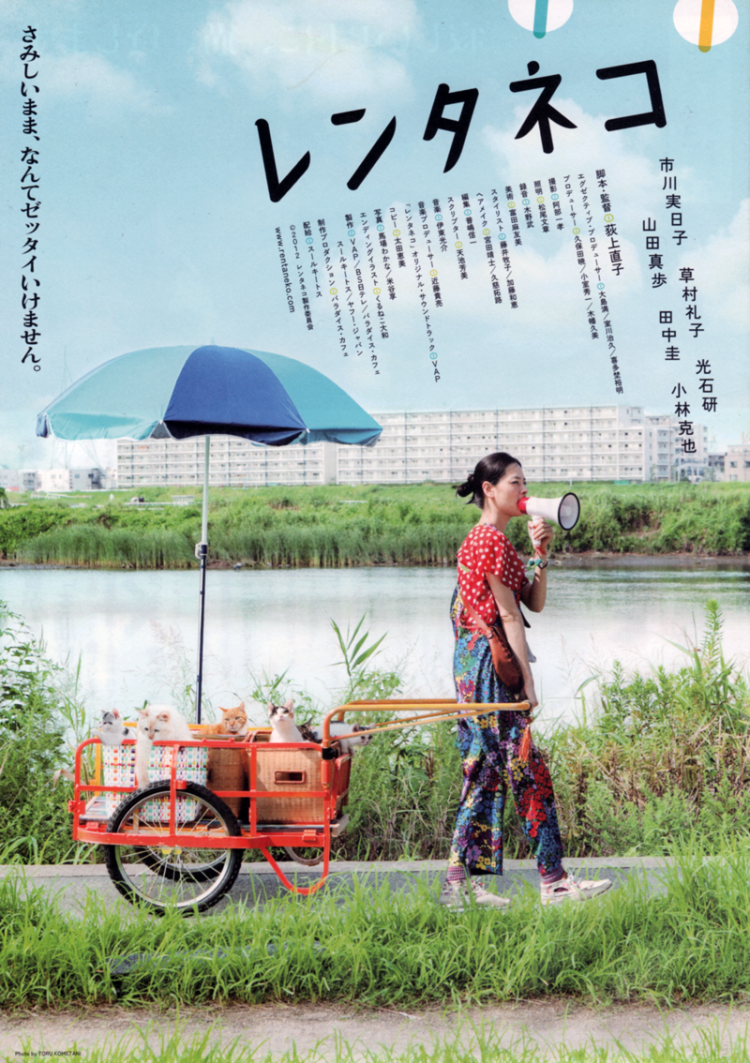
Rent-a-Cat (レンタネコ, Naoko Ogigami, 2012)

©2012レンタネコ製作委員会

rent-a-cat posterPreviously, Ogigami’s heroines (and hero, when one thinks about it) have had to go great distances in order to figure out what it was they were looking for and then finally find it. In Kamome Diner, Sachie went all the way to Helsinki to open up a Japanese cafe only to find herself accidentally attracting a collective of other runaway Japanese people whilst building a community of friendly Finns in her new home. Taeko, in Megane, went on a random holiday that turned out to be much more random than she ever would have expected but she did end up learning to slow down and enjoy the simple pleasures of life which is, presumably, why she ended up on holiday in the first place. Rent-a-Cat’s (レンタネコ, Rent-a-Neko) Sayoko (Mikako Ichikawa), by contrast, stubbornly stays put. In fact, she is the pillar around which all else turns as a fixed point for her various “stray cats” each in need of temporary support.

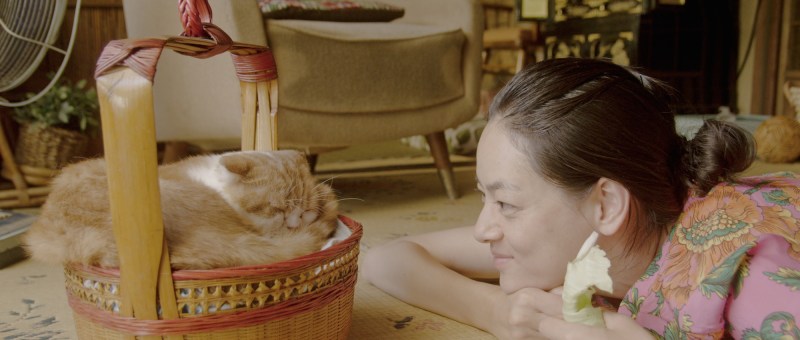
Since her grandmother died a few years ago, Sayoko’s life has been in free fall. A 30-something single woman with no “regular” employment, Sayoko lives in a spacious Japanese-style house with a small garden which is home to the various stray kitties which seem to seek her out when looking for a good place to crash. Sayoko has taken to writing out large banners declaring her immediate goals – getting married being the main one, and pasting them on the walls to encourage herself to keep going. The truth is, though Sayoko is not exactly unhappy she is unfulfilled. Since childhood she’s had the strange talent of attracting friendly cats but secretly longs to attract people too. Combining her strength and her weakness, Sayoko operates an unusual enterprise – cat rental! Walking along with a loud speaker and a trailer full of cats, she looks for lonely people who might want to borrow a fluffy friend for a while to help them out while they’re feeling low.

Of course, Sayoko’s quest to heal the hearts of others is also one to heal her own. Eccentric since childhood during which she was nicknamed “Jamiko” after a strange monster and mostly spent her time snoozing in the nurse’s office along with a kleptomaniac fellow student, Sayoko has never found her feet when it comes to building lasting relationships with people. Her voiceovers all refer back to her grandmother whom she misses deeply and seems slightly lost without. Appearing to have no real friends and spending a lot of time at home looking after her collection of needy cats, Sayoko’s main source of daily interaction comes from the horrible old woman who lives next door and turns up at random intervals to play Greek chorus in neatly reciting Sayoko’s various neuroses back to her over the garden fence.

Sayoko’s neighbour probably has a hole in her heart she fills by being deliberately insensitive to obviously sensitive people, but Sayoko offers her clients another solution in the form of a fluffy little cat who needs someone to look after it. Before lending one of her charges, Sayoko makes sure to vet the prospective cat guardian – after all, not everyone is nice and some people like to project their own suffering onto harmless little creatures. Through the house visits Sayoko gets to find out exactly what kind of hole it is that needs filling from dimples in jellies to holes in socks and even those in donuts, and being the sensitive soul she is, Sayoko usually knows what kind of help her customers need.

Structured around four different clients and bridged with Sayoko’s own neurotic journeys, Rent-a-Cat takes on a charming, fairytale quality in its repeated formulas. Each time someone asks to rent a cat they get the same speech about the inspection and then when it comes to talking money they each express surprise at the extremely good value, making sure to ask if Sayoko will be OK financially when she operates on these oddly beneficial terms. Don’t worry, she tells them – she has other income, a different one each time from stockbroking to fortune telling. The problems run from late life isolation as in a little old lady who loves making jellies for the son she never sees, to dejected fathers forced to work away from home and missing their kids grow up, and young women who feel trapped in a conservative society and would like nothing more than to jet off somewhere to follow their own path, if only they had the courage.

Social conservatism does seem to be something which particularly annoys Sayoko, if perhaps subconsciously. A strange dream sends her off to a Rent-a-Cat corporate clone where clients can rent cats of three different classes priced according to desirability. Sayoko is particularly anxious about the “Class C” cats whom the lady behind the counter disdainfully describes as “crossbreeds”. Sayoko is not having any of that and takes the woman to task for her need to “rank” things before insisting on renting a Class C cat at the Class A price to fully ram home the unpleasantness and absurdity of such a prejudiced world view.

Branded a “crazy cat lady” by the neighbourhood kids, Sayoko’s humanitarian mission of spreading love and kindness eventually does start to reel in a few humans even if they are mostly lonely souls in need of temporary support. Towards the end, when a promising reappearance provokes only disappointment, Sayoko wonders if perhaps there are holes cats cannot fill or sadnesses too great to be borne, but nevertheless she persists. A falling banner a suggests Sayoko may have already found the material to fill her own hole in helping other people fill theirs whilst surrounded by the by warm indifference of her feline brood.


You can catch Rent-a-Cat at the Japanese Embassy in London on 22nd November as the first in a series of events, Archipelago: Exploring the Landscape of Contemporary Japanese Women Filmmakers, which also includes screenings of Bare Essence of Life, Death of a Japanese Salesman, and Wild Berries from 30th November to 2nd December.

 Original trailer (no subtitles)

The Brink (狂獸, Jonathan Li, 2017)

the brink posterDesire makes beasts of us all. Longtime assistant director Jonathan Li makes his feature debut with a waterborne pulp noir which takes on more than a hint of gloomy sea shanty in its musings on sailors, their eternal brotherhoods, and ocean owned souls. The Brink (狂獸) mixes metaphysical drama with the more usual procedural tropes as a wounded, maverick cop chases his prey through hell and high water, refusing to acknowledge that his own “recklessness” is the single cause of the chaos he currently finds himself embroiled in.

The exhilarating opening sequence tracks around a ruined building before finding ruthless cop Sai Gau (Zhang Jin) engaged in a brutal fight with a suspect who later lands right on his police car after careering out of a top floor window. In addition to the death of the suspect, Sai Gau’s recklessness also causes the death of a fellow officer and sees him suspended from the police force after being charged with possible manslaughter. Six months later he’s absolved of guilt, released, and reinstated but clearly not forgiven by his colleagues and superiors who continue to regard him as a liability.

Hair dyed blond, Sai Gau sets about investigating a notorious gold smuggling operation operating under the cover of the local fishing trade. Meanwhile, smuggling underling Gui Cheng (Shawn Yue) has learned he’s about to be sidelined by his adopted father figure in favour of a feckless biological son and suspects his boss is about to have him offed. Gui Cheng preempts the situation by taking out the son’s guys and replacing them with his own before turning his would-be-assassin’s knife (or more accurately harpoon gun) back on him only for Sai Gau to arrive and ruin everything, unwittingly kicking off a series of unfortunate events for all concerned.

Li sets up Sai Gau and Gui Cheng as inverted mirrors of each other – hence Sai Gau’s ridiculous blond hair which sets him apart from the darkness of the long haired Gui Cheng. Where Sai Gau is all impulsive, instinctual action, Gui Cheng is calm and distance personified. Gui Cheng rarely speaks and when he does he’s concise and to the point, whereas Sai Gau, while not especially loquacious, is a classic wisecracker who speaks without thinking and is unafraid of the consequences of his words. Yet both men are also playing against themselves – Sai Gau has adopted the teenage daughter of the man he killed but refuses to allow himself to care for her, whereas the otherwise heartless Gui Cheng seems to have an intense yet platonic relationship with his female sidekick.

Twin betrayals set Sai Gau and Gui Cheng on an inevitable collision course leading towards a tussle over the gold which becomes more symbol than pure financial gain. Gui Cheng, once so calm and calculating, becomes fixated on harvesting what’s his, turning the buried treasure into his personal white whale while for Sai Gau it becomes the symbol of a long buried evil, a cursed charm designed to lure men to their doom by sending them into the centre of a storm it knows they cannot survive. Gui Cheng believes himself blessed by the goddess of the sea and that the gold is his for the taking, but it is ultimately the sea which claims him as he attempts to defy the elements to stake his claim on the cursed treasure which it has already swallowed. Sai Gau claims no particular spiritual affiliation but the gold, and its corrupting influence, reawakens his sense of morality as he becomes as convinced that the gold is evil as Gui Cheng is that it is his salvation.

The gold turns men into the “wild beasts” of the Chinese title though the English one seems to place them on the “brink” of losing themselves at any given time. Highly stylised, Li’s Hong Kong is one of neon lit darkness in which it is always raining and the air hangs heavy with despair and impossibility. The action scenes are impressively choreographed sequences of balletic beauty captured with Li’s gift for unusual composition and an urgent energy which acts as a harbinger for the coming storm. Pure pulp noir, The Brink has an almost Lynchian sense of lurking darkness creeping in from another, more mythical world the kind of which sailors sing about in their shanties and only talk about by candlelight.


Screened at Creative Visions: Hong Kong Cinema 1997 – 2017

Original trailer (dialogue free, English captions)

Mad World (一念无名, Wong Chun, 2016)

Mad World_posterThroughout the aptly titled Mad World (一念無明), the central character frequently asks if he is really the one who is “abnormal” or if everyone else is merely operating under some misguided notion of “normality”, either deluding themselves that they meet it or actively masking the fact that they don’t. The first feature from Wong Chun, Mad World is not only the story of a man attempting to live with mental illness in a society which is unwilling to confront it, but also a discourse on the various ills of modern life from the ageing population and breakdown of the “traditional” family to the high pressure nature of “successful” living. Carefully nuanced yet pointed, Wong Chun’s vision is at once bleak and hopeful, finding victory in the courage to move on in self acceptance rather than in a less ambiguous discovery of a more positive future.

Tung (Shawn Yue) has spent the last year institutionalised after being arrested in connection with the death of his mother (Elaine Jin). The doctors and courts have both absolved him of any blame, but Tung has also been diagnosed with bipolar disorder and is being released into the care of his estranged father, Wong (Eric Tsang), rather than simply released. When Wong picks Tung up at the hospital, the disconnect and anxiety between them is palpable, as is Wong’s embarrassment when he takes Tung back to the tiny room he inhabits in a low rent lodging house sharing a kitchen and a bathroom. Father and son will be sleeping on bunk beds with any idea of privacy or personal space firmly rejected.

Wong, a man in his 60s who’d all but abandoned his family for a career as a long-distance truck driver crossing the border into China, is ill-equipped to cope with caring for his son on several different levels. Perhaps a man of his times, he’s as ignorant and afraid of mental illness as anyone else, quickly getting fed up with Tung’s frequent crying fits and even stooping so low as to simply ask him why he can’t just be normal like everyone else. However, after getting more used to Tung’s new way of life, Wong does his best to get to grips with it, buying a number of books about depression and joining a support group for people who are caring for those with mental health needs.

Tung continues to struggle, finding it difficult to reintegrate into to society when society actively excludes those who don’t quite fit in. Attending a friend’s wedding shortly after having been discharged, Tung spots a few unpleasant social media posts referring to him under the nickname “Mr. Psychosis” while guests in the room mutter about the “nutjob” who must have just escaped the “loony bin”. Tung doesn’t do himself any favours when he grabs the mic and interrupts the groom’s speech to take the audience to task for their indifference, but the hostility he faces is entirely unwarranted. Later, experiencing another setback, Tung finds himself the subject of a viral video when he stops into a convenience store and guzzles Snickers bars in an attempt to improve his mood. It’s not long before someone has correctly identified him as the guy who was accused of killing his mother and put in a mental hospital, literally sending him right back to square one in terms of his recovery. To make matters worse, Tung can’t get any of his old contacts to look at his CV because they all have him branded as a dangerous madman and interviewing for new jobs never gets very far after they ask why there’s a one year gap in his employment history. 

Employment does seem to be a particular source of anxiety with frequent mentions of mass layoffs and even managerial suicides in the high pressure financial industries. Even before the events which led to his hospitalisation, Tung was undoubtedly under a lot of stress – planning a life with his fiancée, Jenny (Charmaine Fong), which adds the financial pressures of mortgages and saving to start a family. The sole carer for his elderly mother, Tung is also on the front line for her cruel, sometimes violent mood swings which, according to Wong, are a lifelong phenomenon rather than a symptom of the dementia she is also afflicted with. Tung lashes at out Jenny when she suggests putting his mother in a home where she can be better cared for, exhibiting a streak of unpredictable, frustrated violence of his own which also deeply worries him.

Tung may have inherited this impulsive volatility from his mother, in one sense or another, but his longstanding feelings of low self worth are as much to do with his parents’ seeming disregard for him as they are to do with anything else. His mother, unhappy in her marriage, blames her eldest son for trapping her in dead end existence while continuing to worship the younger one, Chun, who went to an Ivy League US university and has since left them all far behind. Constant, unfavourable comparisons to the golden boy only raise Tung’s levels of stress and resentment at being obliged to care for the woman who constantly rejects and belittles him after the “good” son and the “bad” husband both abandoned her. Wong “left” his wife because he couldn’t cope with her difficult personality and complicated emotional landscape, but now faces a similar dilemma with the son he had also left behind.

Hong Kong is, indeed, a maddening world as Tung and Wong find themselves crammed into a claustrophobic share house filled with similarly stressed and anxious people predisposed to see danger where there is none. Tung’s condition finds him semi-infantilised as the wiser than his years little boy from next-door becomes his only friend until his mother finds out about Tung’s condition and orders her son not to see him. Wong Chun’s central premise seems to be that the world will drive you crazy, but if there were more kindness and less hostility perhaps we could all stave off the madness for a little longer. Anchored by strong performances from Yue and Tsang, each playing somewhat against type, Mad World is a remarkably controlled debut feature which subtly underlines its core humanitarian message whilst taking care never to sugarcoat its less pleasant dimensions.


Screened at Creative Visions: Hong Kong Cinema 1997 – 2017

Original trailer (English subtitles)

Paradox (殺破狼・貪狼, Wilson Yip, 2017)

paradox posterLouis Koo, possibly the hardest working actor in Hong Kong, has played his fair share of heroic (and not so heroic) cops but you’d be hard pushed to describe him as an action star. Proving nothing if not his dedication, Koo gives it his all as the lead in Paradox (殺破狼・貪狼), the latest in the SPL franchise directed by Ip Man’s Wilson Yip. Yip also directed the first in the series but stepped away for the second, though there is no narrative continuity with any of the films and, confusingly enough, the SPL tag seems to have been dropped from the international title altogether. In any case, what Paradox shares with instalments one and two is a series of intensely kinetic action scenes built around a storm of three incompatible personality types coupled with a quest narrative as Koo searches for clues in the disappearance of his 16 year old daughter.

Yip begins the film inside the memories of Hong Kong cop Lee Chung-Chi (Louis Koo) as he remembers the golden time when his daughter was young and worshipped her dad, crawling into his bed in the morning with a video camera ready for a whole day of birthday fun. Lee buys a cute a silver bracelet with a teddy bear charm but it’s the 16 year old Wing-Chi (Hanna Chan) he gives it to. Lee and his daughter are in a restaurant, not at home, and the air between them is tense. A boy turns up and Wing-Chi introduces him as her boyfriend but if Lee is annoyed things are about to get worse. The pair want to get married because Wing-Chi wants “to keep the baby”. Lee barely reacts save for abruptly stepping away from the table. When he returns he seems as if he’s composed himself, but in reality he has already made a catastrophic error of judgement which will force his daughter away from him.

Wing-Chi goes to Thailand to visit a friend and disappears. Lee goes to look for her, breaking out his best investigator skills and teaming up with local cop Chui Kit (Wu Yue) who is soon to be a father himself, but what he finds there leads him onto a dark path of paternal guilt, regret, and suffering whilst wading through the corruption and cruelty of the Thai underworld.

Though the narrative is, in a sense, unimportant, Yip homes in on the nature of fatherhood and the sometimes difficult or conflicted position a father finds himself in when trying to protect his child. Lee may think he’s “doing the right thing” when he clamps down on his teenage daughter’s plans to start a family of her own way ahead of schedule, but then again perhaps this was not his decision to make and ruining three lives to suit himself is nothing more than selfishness masquerading as love. It is his own actions which send his daughter into the path of danger, and then later decide her fate on a split second decision.

Later, Kit’s father-in-law (Vithaya Pansringarm) faces a similar dilemma when he’s threatened by government big wigs and fears his own daughter (and unborn grandchild) may be in danger if he does not play along. Lee’s quest to find Wing-Chi runs in parallel with that of the local mayor to win re-election, only the mayor has a bad heart which causes him to collapse before an important rally. Shady fixer Cheng (Gordon Lam) decides the mayor needs a heart transplant (seemingly unaware of the complexity of the operation and the time needed for recovery) which all links back to a dodgy American ex-pat (Chris Collins) who operates a large scale meat factory as a front for illegal organ trafficking.

The stories of Kit and Lee are linked by the curious use of the classic Chinese pop song The Moon Represents My Heart made famous by Teresa Teng. The song with its constant references to the “heart” which is also visually represented by the cheerful cards around the mayor’s bed perhaps over does things in the metaphor stakes but does its best to tug at the heartstrings in its insistence on a fathomless love in this case of fathers for their children. Koo’s rage only intensifies the more desperate he becomes as his quest hits continual dead ends punctuated by the discovery of various unpleasant characters lurking not just in the backstreets but in the police stations and political institutions of Pattaya.

The action scenes are visceral and kinetic though Koo makes the most impact when acting with stone cold efficiency, leaving the most memorable sequences to rising star Wu and Tony Jaa whose extremely brief appearance as a psychic / extremely buddhist cop may disappoint those deceived by his top billing into expecting his role to be more than a cameo. Nevertheless, Paradox delivers what it promised in Koo’s unexpected metamorphosis into an ultra cool action star whilst sending his moody cop on a dark journey of the soul as he confronts the depths of his own complicity in the corruption which is consuming him.


Screened as the opening film of Creative Visions: Hong Kong Cinema 1997 – 2017

Original trailer (English subtitles)

Co-stars Louis Koo and Wu Yue recorded a new version of The Moon Represents My Heart especially for the film

Teresa Teng’s The Moon Represents My Heart

A Bittersweet Life (달콤한 인생, Kim Jee-woon, 2005)

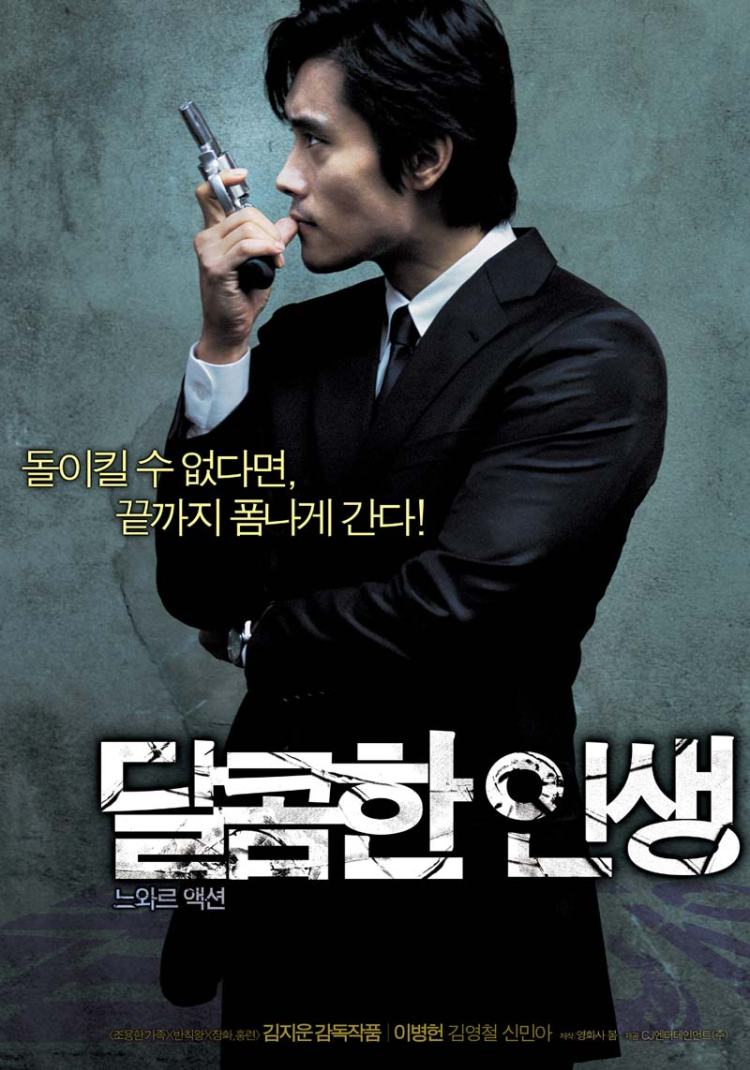
bitterweet life posterAs Boss Kang (Kim Young-chul) tells the hero of Kim Jee-woon’s A Bittersweet Life (달콤한 인생, Dalkomhan Insaeng), no matter how well things are going, it only takes one mistake to make it all float away. Like any good film noir, the forces which conspire to ruin the quiet, orderly life of cooler than thou gangster Sun-woo (Lee Byung-hun) are those of desire as they come in conflict with codes of loyalty and decency. Sun-woo, like many a lonely hitman before him, finally wakes up to the emptiness of his life only to find no point of escape except the one he has often provided for others in precisely the same situation.

Smartly suited, Sun-woo is the trusted manager of the casino bar, Dolce Vita. Taken away from his elegant dessert in the upstairs restaurant, Sun-woo deals with a group of rowdy customers in true gangster fashion by launching in with a series of jump kicks and quickly thrown punches that reveal just why it is Sun-woo rules the roost. Sun-woo’s boss, Kang, has a special mission for his most trusted minion – keep an eye on his much younger girlfriend, Hee-soo (Shin Min-a), while he travels to Shanghai for three days. Kang thinks Hee-soo is having an affair. If she is, Sun-woo’s options are either to call Kang right away or take affirmative action on his own initiative.

Sun-woo investigates, but much to his surprise finds himself taken with Hee-soo. She is indeed having an affair, something which Sun-woo tries to ignore but finally has to be dealt with. A sudden pang of sympathy stops him from contacting Kang or pulling the trigger. Instead he decides to let the pair go on the condition they never see each other again. Thinking it’s all behind him, Sun-woo tries to go back to his regular job but he’s still dealing with the fallout from playing whistleblower on a high ranking gangster’s son.

Kim opens with an arty black and white sequence of tree branches swaying. In the story offered in voice over a disciple asks whether it is the trees or the wind which are moving, but the master replies that is is neither – it is the heart and mind which move. Like the branches, Sun-woo’s heart has begun to stir. Not love exactly, or lust, but movement. Sun-woo gazes at the way Hee-soo’s hair brushes her shoulder, at the way she walks and smiles at him. Listening to her cello rehearsal, his own emotional symphony begins, dangerously unbalancing his previously one-note existence with its identical suits and minimalist apartments.

Yet if Sun-woo’s downfall is Hee-soo and her alluring vitality, it was Kang’s first. An ageing gangster, Kang feels foolish taking up with a young girl but just can’t help himself. He loves the way Hee-soo couldn’t care less about what other people think, but that also worries him because she’ll never care what he thinks. Kang’s childishly romantic gift of a kitschy lamp with two owls huddling together on the base is the perfect symbol of his misplaced hopes – oddly innocent yet ultimately redundant. Notably, the lamp is one of many things shattered when Sun-woo takes Hee-soo’s lover to task.

Realising he has been betrayed, though not quite for the reasons he thinks, Sun-woo vows revenge. Everything has gone wrong, and he no longer believes in any kind of future which has him in it. Pausing only to send a more mature romantic gift to Hee-soo, an elegant lamp she’d admired on one of their shopping trips, he marches off towards certain death no longer caring for own life in his quest for vengeance and retribution. Repeating Kang’s questions back to him, asking for the real reason any of this happened, doesn’t get him very far but even if these two men have shared the same folly, they fail to understand each other even in death.

Returning to the master and his pupil, the closing coda recounts another story in which the pupil wakes up from a dream, weeping. The master asks him if he’s had a nightmare but the pupil says no, he’s had the sweetest of dreams. He’s crying because he’s awake and knows his dream can never come true. Sun-woo too has woken up, he knows there’s nothing for him now except to accept his fate. He has but been asleep, dreaming a sweet dream, and now he must wake and taste life’s bitterness just as he prepares to leave it.


Screened at London Korean Film Festival 2017.

Original trailer (English subtitles)

Franky and Friends: A Tree of Life (극장판 프랭키와 친구들: 생명의 나무, Park Jung-oh, 2016)

Franky and Friends tree of life posterChildren’s films are full of messages and advice about how to grow up into a fine, upstanding person. Franky and Friends began life as a TV series in which the titular polar bear, Franky, and his friends live in a world of self sufficiency in which everything they consume they must grow for themselves in their kitchen garden. The problem is Franky is essentially still a child which means he wants everything all at once and doesn’t know the reasoning behind his way of life. In other words, he’s just like the target audience and is about to learn what every parent wants to teach their child – to eat what they’re given and be grateful.

Franky, Kwon, and Pong live in a small cottage with the more mature Doo who cooks all their meals and tends to the house and garden. The boys, however (is it interesting that they’re so obviously male and Doo so obviously female even though they’re all fantasy creatures?), don’t want her sensible, wholesome food. They want everything else but *especially* fried sweet potatoes. Doo gives in and agrees to make some if the boys promise to eat everything all up. Of course, they do, but they’re full long before the pot of potatoes is even half empty. While Doo gets up to answer the door, Franky and Kwon scrape the food into a basket and take it outside to bury in the woods. They keep this up for a few days but weird mushrooms start growing everywhere and when the local insects eat them they grow to giant size and become ravenous, destroying the market garden!

As it turns out there is black magic at play in the strange land in which Franky lives. The only way to save everyone is to safeguard the Tree of Life from the clutches of an evil witch. The Fairytale Kingdom is home to a strange selection of creatures from abstract creations like Kwon, Pong, and Doo to guest appearances from Pinocchio, Santa, and The Monkey King. Later, Franky teams up with another friend, Misa, who seems to be something between the classic Snow Queen (only nice) and Elsa from Frozen but she doesn’t really do very much other than freeze things. Kids film this maybe but the references are retro beginning with a visit from a Godzilla-like creature to a large scale battle with skeletons resembling Harryhausen’s from Jason and the Argonauts.

The jokes, however, are considerably less highbrow with genuinely childish toilet humour providing the bulk of the comedy. Franky and his friends set off on their quest recklessly – not a good message for children, despite the positive reinforcement of Franky acknowledging his responsibility and pledging to correct his mistake, and appear not to have learned very much at the end of their quest. Still, the target audience probably won’t be thinking too hard about all of this and are most likely to pick up on the intended messages of the evils of wastefulness and lying to your mum about eating your vegetables. Hopefully they won’t remember the bit about magic mushrooms and life sucking aphids, but will remember that the Earth is everyone’s responsibility and if we don’t all agree to look after it together the tree will die and the witch will win.


Screened at London Korean Film Festival 2017.

Trailer (no subtitles)

Coin Locker Girl (차이나타운, Han Jun-hee, 2015)

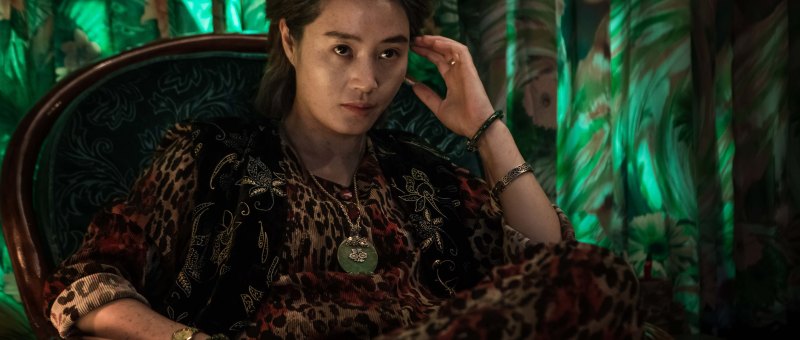
coin locker girl posterFamily in Korean films, unlike those say of Japan, has always been something of a double edged sword. Coin Locker Girl (차이나타운, AKA Chinatown) takes the idea of “family” and twists it around, bites into it to test its veracity, and offers a wry smirk as the metal begins to bend. Set in Incheon’s Chinatown, Han Jun-hee’s noirish thriller sends its heroine down a series of dark alleyways as she both fights and fights to retain her humanity whilst inhabiting an extremely inhuman world.

Il-young (Kim Go-eun) was found, covered in blood, hidden away in a coin locker, an abandoned child with no clue as to her identity or that of the woman who gave birth to her. Named and taken in by a collection of beggars at the station, she began her life as a street rat though not, perhaps, entirely unloved or friendless. As a young child she was then taken by gangsters working for a fearless female gang boss known as “Mom” (Kim Hye-soo). Mom is not one to suffer fools and feels no compunction in getting rid of those no longer useful to her. She soon puts Il-young to work, pamphleteering, begging, and eventually debt collecting as she grows older under Mom’s watchful eyes. By the time Il-young is almost come of age, she has an older brother and a sister as well as a younger brother with learning difficulties whom Mom still looks after despite her otherwise unsentimental approach to life.

The trouble starts when Mom sends Il-young to collect a debt from the young son of a man who’s skipped the country. Seok-hyeon (Park Bo-gum) is not like the typical clients she’s met before. He opens his door, invites her in, even offers to feed her before she leaves. Il-young finds all of this very strange. She’s never met anyone “nice” before and wonders what his angle is. Seok-hyeon, however, does not appear to have much of an angle aside from perhaps the usual one. Spending a bit of time with him, Il-young begins to develop certain feelings which see her swapping her Mom-style slacks and jackets for pretty summer dresses. Despite his son’s faith in him, Seok-hyeon’s father has not kept his end of the bargain and so Mom decides it’s time to call in the debt by offing Seok-hyeon and harvesting his organs. Il-young has a choice – between the woman she calls “Mom”, and a naive young man she has come to like though he has no place in her kill or be killed world.

One of the most attractive qualities about the young Il-young was that she didn’t exist. No birth certificate and no identity meant that she could be Mom’s to do with as she pleased. Consequently, adolescent Il-young has a more complicated relationship with her “Mom” than most young women but is also acutely aware of the debt of gratitude which is owed, the precariousness of her position, and the reality that she has nowhere else to go should she decide to try and break away from the world in which she has been raised. Never quite sure what her relationship to Mom is, Il-young has come to think of the other children in the same situations as siblings, but again cannot be sure that they feel the same.

Like many a good film noir, the tragedy lies in not completely closing off one’s heart as the harshness of the world dictates. Mom rejects those who are not useful and terminates those who have betrayed her with extreme prejudice, but despite herself she cannot destroy Il-young. Stepping back from her code, her orders are to let Il-young live, condemning her to a fate perhaps worse than death but alive all the same. Mom is betrayed by another child figure enacting a petty act of revenge, but her decision to let Il-young live is the one which threatens to condemn her. Having believed herself an unloved, unwanted child, Il-young is left with two terrible legacies of abandonment and the feeling that she will never leave that coin locker in which she has been trapped since birth. The cycle of maternal sacrifice continues, though Il-young has the opportunity to change her fate by taking charge of it, picking up where Mom left off but with greater compassion even within the confines of her still cruel world.


Screened at London Korean Film Festival 2017. Also screening at Manchester (11 Nov) and Glasgow (16 Nov).

Original trailer (English subtitles)

The First Lap (초행, Kim Dae-hwan, 2017)

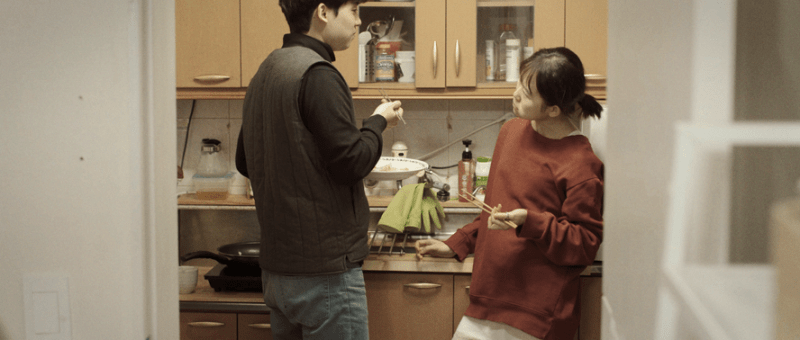
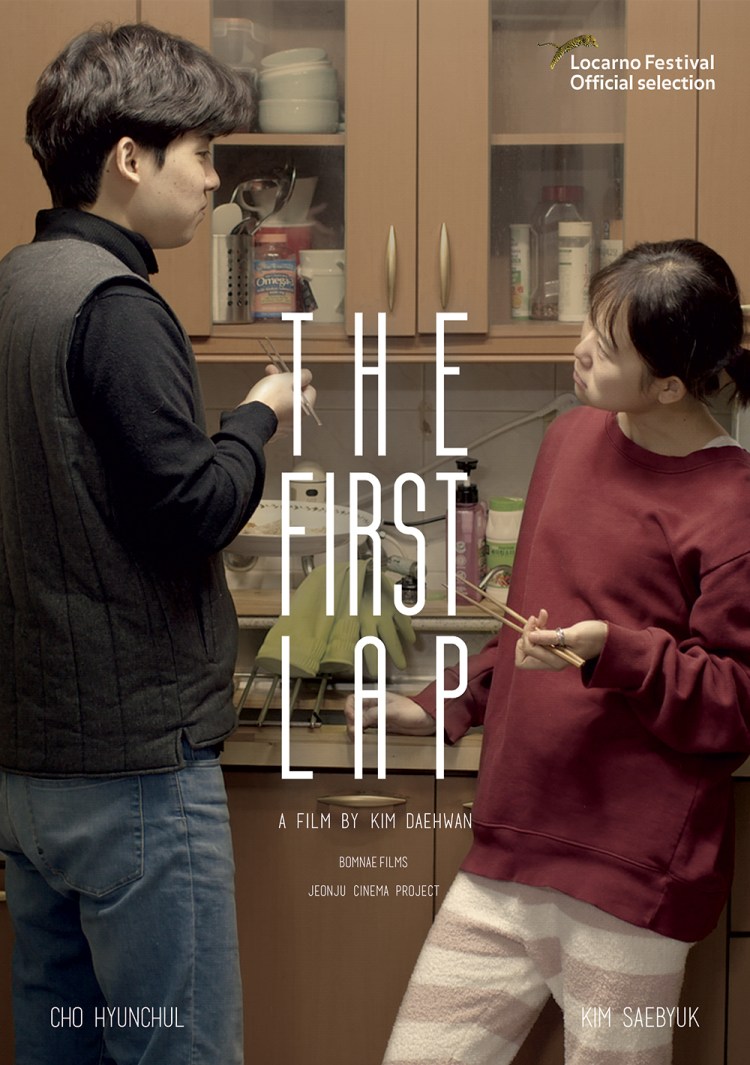
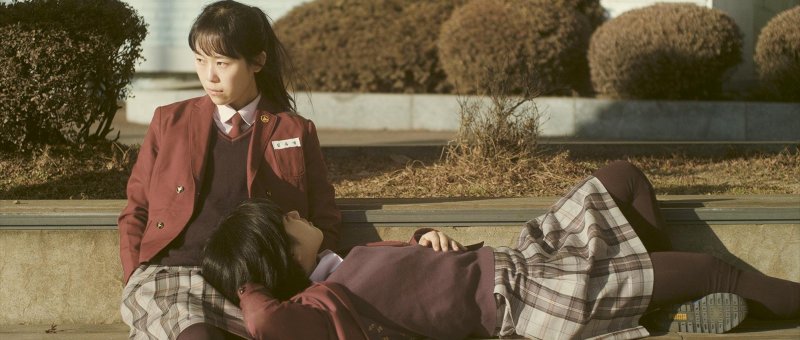
The First Lap posterFor some, life is a series of stages. Education, work, marriage, parenthood, death. For others, life is more like a continuous stream, a series of minor movements in an ongoing symphony. The couple at the centre of Kim Dae-hwan’s second film, The First Lap (초행, Cho-haeng), are contentedly (for the most part) trapped in a permanent adolescence living chaotic lives aside from what most would consider the mainstream. Together for seven years but still unmarried, Ji-young (Kim Saebyuk) and Su-hyeon (Cho Hyun-chul) are forced to confront their liminal status when the twin pressures of a pregnancy scare and obligatory family visits place a strain on their otherwise settled relationship.

Their two year rental contract up for renewal, Ji-young and Su-hyeon are packing up to move somewhere cheaper when Su-hyeon gets an awkward phone call from his brother inviting him home for his father’s 60th birthday party. Su-hyeon obviously does not want to go and makes a series of excuses despite Ji-young’s urging that he should probably attend. Ji-young also drops the bombshell that she’s worried she might be pregnant which raises several problems for the couple both financial and emotional. The next day they set off on a trip, but it’s to visit Ji-young’s well-to-do parents in their new high-rise Incheon apartment.

Kim structures the film around the two very distinct family environments, subtly suggesting the various reasons neither Ji-young or Su-hyeon are in favour of moving onto the next stage stems back to their own problematic upbringings. Though Ji-young’s family are financially secure and occupy a traditionally middle-class social stratum with her father working for the government and mother in real estate, the home is a cold one and Ji-young’s mother a harsh and direct woman who is unafraid to speak her mind regarding what she sees as her daughter’s poor life choices. In what will become a recurrent motif, Ji-young’s mother wants to know why the couple aren’t married, pointing out Ji-young’s advancing age and the unseemliness of an unmarried woman over thirty. After pointedly telling Ji-young she is not proud of her and in fact thinks of her as a disappointing embarrassment, Ji-young’s mother goes off the deep end on discovering the pregnancy test in Ji-young’s bag, driven into a fury of conservative discombobulation at the thought of being grandmother to a child born out of wedlock.

Ji-young is afraid to become a mother in case she becomes hers and does to her child what her mother has done to her. Su-hyeon has a similar problem, though his is one of intense discomfort with his familial environment in growing up in an unhappy home. Travelling back to the tiny fishing village where Su-hyeon’s parents used to own a sashimi restaurant but now apparently work for a factory which has all but destroyed the area’s previously lucrative tourist industry, Ji-young could not be more out of place. Unlike the ordered coldness of Ji-young’s parents’ swanky apartment, Su-hyeon’s family home is one of repressed heat in which longstanding arguments seem permanently primed to spark. Su-hyeon, depressingly used to this kind of scene, ushers Ji-young out the door just as it looks about to kick off, only for her to urge him back to “do something’ – something he’s long given up the idea of doing. Su-hyeon does not want to live in this kind of family or make his wife as miserable as his mother has been married to a man she can’t stand who holds only contempt for his more sensitive son.

Thus Ji-young and Su-hyeon find themselves at an impasse facing both economic anxiety and long-standing emotional fears for the future. All around them, society seems to be in flux, Su-hyeon travels through a subway as protestors from the “Candlelight Revolution” make their way home after another long day spent peacefully protesting the administration of Park Geun-hye. Even young couples like Ji-young and Su-hyeon not usually interested in politics are drawn to the movement, suddenly finding themselves free to consider a better future, not the one they’re supposed to have but the one they actually want (if they can figure out what that actually is). A visit to the protest proves a surprisingly romantic outing. Sharing hot soup in the midst of candle light and gentle music, the pair wander around, still directionless and unsure where exactly it is that they’re going but happy to be together wherever it is they might end up.


Screened at London Korean Film Festival 2017. Screening again in Manchester in 11th November, 1.30pm.

Original trailer (English subtitles)

Jamsil (누에치던 방, Lee Wanmin, 2016)

jamsil still 1Have you ever met someone for the first time but felt as if you’ve been friends all your lives? Maybe you’ve been depressed and lonely enough to knock on a stranger’s door wishing you had that kind of friendship because there’s very little else in your life, but you probably didn’t find anyone quite as willing to play along as the increasingly fragile Mihee (Lee Sanghee) does when she marches up to Sungsook’s (Hong Seungyi) home and announces herself as a long lost childhood friend. From that description alone Jamsil (누에치던 방, Nuechideon Bang) sounds as if it could be a dark tale of stolen identity and mental disturbance, but first time feature director Lee Wanmin’s intentions are not so severe. Defying rational explanation and looping back through past traumas and regrets, Jamsil is a tale of female friendship in all of its complexity but also of its immediacy and warmth.

30-something Mihee has taken the bar exam several times, unsuccessfully. Wondering if now is the time to give up on a legal career but afraid she’s left it too late to get any other kind of job, Mihee wanders aimlessly, not really doing much of anything at all. Growing tired of having no money and of having the moping, listless Mihee to contend with, Mihee’s graduate student boyfriend throws her out and ends the relationship. Faced with her lack of money, Mihee can only afford a run down apartment in a dodgy part of town with a strange and invasive landlady. Mihee, going quietly mad through loneliness and feelings of failure, makes the strange decision to knock on a stranger’s door, stating that she and the woman on the other side were once best friends at high school.

This seems improbable as the woman, Sungsook, seems to be around ten year’s older than Mihee, but even so Sungsook lets her in and tries to comfort the obviously distressed woman as best she can. Sungsook’s live-in partner, her childhood sweetheart Ikju (Lim Hyongkook), does not like Sungsook’s habit of letting strangers into their home and sets out to investigate Mihee only to begin having an affair with her whilst keeping his relationship to Sungsook secret. Meanwhile, Sungsook develops an attraction for a younger reporter who wrote something nice about an avant-garde theatre show in which she performed.

Though Mihee and Sungsook have obviously never met before they seem to share an immediate connection and soon become firm friends. Both women are thrown back to the trials and traumas of their teenage years, confronting choices they did and didn’t make or which were made for them. A ghost from Sungsook’s past has literally followed her all the way into the future as the spectre of absent friends continues to mar her relationship with Ikju. Mihee was guided to Sungsook by a teenage girl with the same name as Sungsook’s real teenage best friend, who for some reason reminded her of her younger self, but Mihee’s decision to track down her own high school confidant does not go well as she leaves repeated messages on her voicemail which are never returned before making a final, drastic bid for recognition.

Both Mihee and Sungsook are in some way, stalled, unable to reconcile what it is they want with what they’re supposed to be. Perhaps they, like the silkworms which give their name to this particular part of town, must leave something of themselves behind in order to move forward, but then perhaps those memories can be spun into something finer and softer to the touch than the jagged scars they currently seem to be. Lee’s shooting style leans towards indie naturalism, but mixes in a little avant-garde theatricality with her “actors” and their discussions of political terminology or brief snippets of philosophical musings on the wider nature of existence. Never quite earning its two hour plus running time, Jamsil is nevertheless a deep and fascinating exploration of romanticised pasts and depressed futures in which female friendship is both salvation and destruction but always a strong and abiding connection spun in the larval stage.


Screened at London Korean Film Festival 2017.

Subtitled clip

Interview with director Lee Wanmin conducted at Busan International Film Festival 2016.

Merry Christmas Mr. Mo (메리크리스마스 미스터 모, Lim Dae-hyeong, 2016)

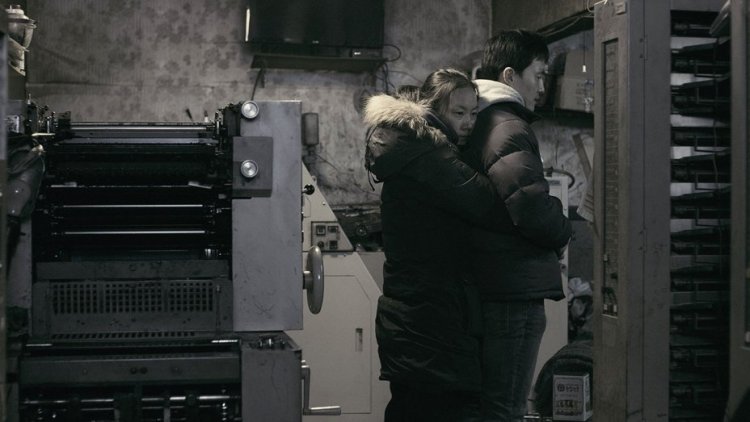
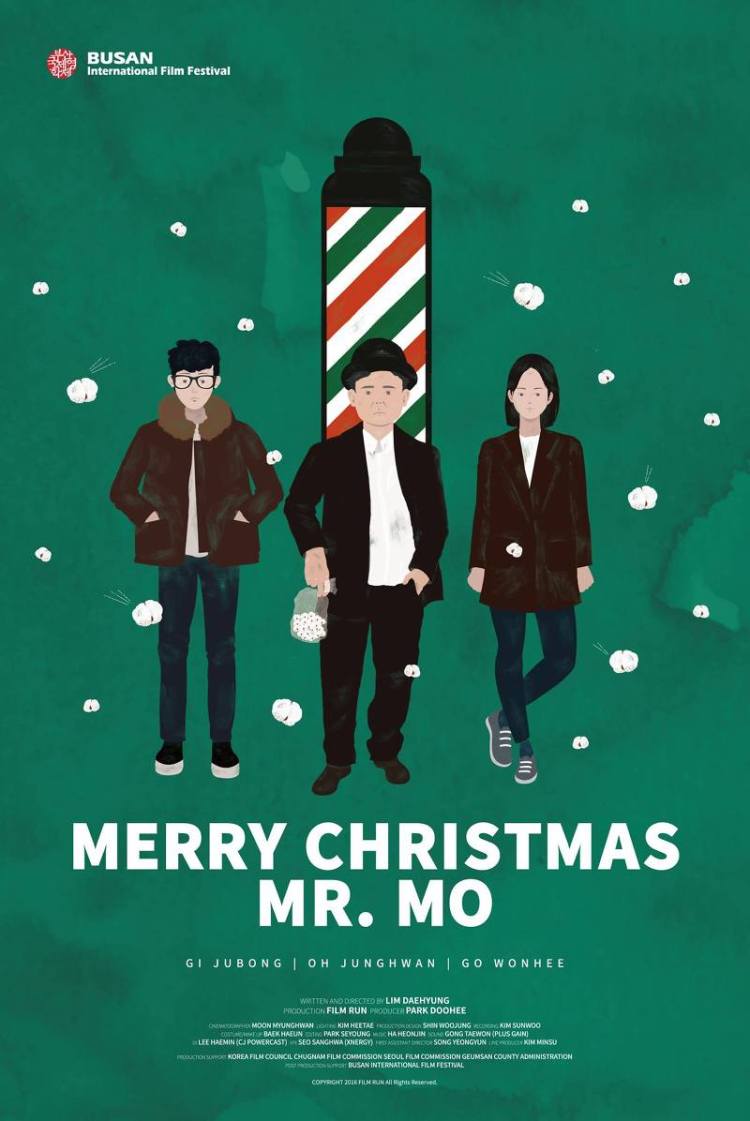
Merry Christmas Mr Mo posterMr. Mo does not at first seem the Christmassy type. He’s gloomy, sullen, and monosyllabic – about as far from festive as it’s possible to get, yet over the course of Lim Dae-hyung’s charming feature debut, he becomes an irresistible hero bravely fighting back against his loneliness and disappointment while there is still time. Shot in black and white with a deadpan, Jarmushian sense of humour, Mr. Mo’s journey of reconnection is one of quiet melancholy yet filled with its own strange warmth for its cast of disconnected characters each finding a point of recognition in the silent world of Mr. Mo.

The local barber, Mr. Mo (Gi Ju-bong) is known around town but does not encourage friendliness outside of his studio. His life begins to diverge from its usual routine when a visit to the doctor, who urges him to quit smoking, causes him to worry about his health. Despite his normally aloof nature, Mr. Mo engages in some slapstick humour in the pool where he swims everyday before asking a young woman, Ja-young (Jeon Yeo-bin), to go for a drink with him on the way home. Ja-young is somewhat taken aback and perhaps worried about an old man asking her to drink with him, replying that she’s quite tired and just wants to go home. Mr. Mo’s intentions are 100% honourable and he just really wanted some company on this quite depressing day. Ja-young decides to go anyway and regales him with horticulture tips and theories on physiognomy, her loquaciousness a perfect match for Mr. Mo’s laconic demeanour.

When he receives even worse news than he feared from the Doctor, Mr. Mo decides it’s time to put his house in order – clearing out a 15 year old Christmas tree but leaving the December 1999 calendar hanging on the door. It’s clear from Mr. Mo’s apartment that he once had a family and now lives alone, though he mostly spends his off time munching popcorn in front of the TV and writing in his diary. His nights are repetitions of insomnia in which he repeatedly thumps his pillow in frustration, sitting up reluctantly in the morning and tearing his eye mask off his face.

Having dreamed of being an actor in his youth, Mr. Mo’s final wish is to make a film with his distant, aspiring filmmaker son. Stephen (Oh Jung-hwan) lives in the city with his girlfriend, Ye-won (Go Won-hee), but he seems to be just as sullen and depressed as his dad though perhaps without so much of the reason. Mr. Mo is a big fan of Ye-won, though he can’t quite understand what she’s doing with his son. She puts up Stephen’s nonsense, his loss of drive and occasional fits of pique and the couple’s relationship seems solid, even if a little strained and sometimes difficult.

Making the movie, a Chaplin-esque slapstick piece, is partly an excuse to reconnect with Stephen but it also affords him an opportunity to revisit and reconsider the past, revealing hitherto hidden details of his son’s early life. Gi Ju-bong excels in the leading role of the vacant Mr. Mo who eventually becomes a hilarious silent movie comedian complete with silly walk and repeated sight gags which also take on and added degree of melancholy given Mr. Mo’s condition and his desire to push his own self-destruct button.

Despite his aloofness, Mr. Mo is a keen observer of people as revealed in the final voiceover of his diary for December (written in the form of letters to his late wife) in which he notes down his various meetings from the overly polite young man who says hello to too many people to picking up on Ja-young’s loneliness, and regretting his hostile reaction to his sister-in-law’s kindness. Getting everyone together at the end to reveal the solution to the enigma which is Mr. Mo, Lim’s debut is a whimsical journey through the loneliness and resignation of late middle age filled with a strange affection for its cast of eccentrics and enlivened by the quirky, acoustic guitar score which considerably adds to the air of mild surreality in strangely framed vistas of emptiness which perfectly capture Mr. Mo’s charming black and white world.


Screened at London Korean Film Festival 2017.

Original trailer (English subtitles)