Love’s Whirlpool (愛の渦, Daisuke Miura, 2014)

Love's WhirpoolNo names, no strings. That’s the idea at the centre of Daisuke Miura’s adaptation of his own stage play, Love’s Whirlpool (愛の渦, Koi no Uzu). Love is an odd word here as it’s the one thing that isn’t allowed to exist in this purpose built safe space where like minded people can come together to experience the one thing they all crave – anonymous sex. From midnight to 5am this group of four guys and four girls have total freedom to indulge themselves with total discretion guaranteed.

The four couples are a disparate group which includes a primary school teacher, office lady, shy college student, and a brusque regular who apparently comes to the club five times a week. The male side consists of a slick salaryman, a freeter, a factory worker and an anxious NEET who’s cleaned out his bank account just to be here in this extremely expensive, upscale sex club. After receiving the instructions from the owner (shower first, after sex, after going to the toilet, always use a condom, and respect the women’s right to say no), the group sit awkwardly wearing only their towels waiting for someone else to kick things off.

Everyone is being extremely polite to one another, the women beginning to talk amongst themselves whilst the men do the same. Everyone has come here for the same reason but it’s not as quite as straightforward as they thought it would be. Soon enough, people start to pair up an head downstairs but after the initial ice is broken the edges sharpen, relationships change, and a kind of Bacchanalian harshness begins to take over.

Once inside the split level, trendy club style environment, the guests spend the entirety of the evening naked save for their white bath towels but this is about as far from intimacy as it’s possible to get. They may have all come for one reason, but they each had various different motives for doing so. The office lady and the school teacher are both attractive young women, confident in what they do and don’t want, and would prove a hit in any club or bar (though this is a safer option). The freeter and the salaryman could say the same though the salaryman spends half the evening phoning his wife to explain that he’s been kept out drinking with a boring colleague. College girl and Neet are both too shy to get it on independently, leaving the cynical regular and the overweight factory worker as the odd ones out. It’s not long before they’ve begun to dissect each other, ticking off the check list like remembering to buy washing powder and then discussing the merits of “Ariel” vs “Persil” with your fellow “shoppers” in the checkout line. Utilitarian as it is, as the night goes on the barriers fall away leaving both wild abandon and cruelty lying behind them.

Things are reinvigorated half way through when another couple join, a husband and wife duo who each claim to be 100% OK with how this is going to work but, as it turns out, one of them was more serious than the other. By this point, relationships have begun to solidify themselves and shy Neet has grown attached to the unexpectedly raucous, repressed college girl. Such attachments are unwise in an environment like this, and can become dangerous if everyone does not remain on the same page as to what’s going on. At the end of the evening, the guys are asked to wait so the girls can leave first – to help prevent stalking. This is no strings, remember. No names, no phone numbers, none of this ever happened.

This intense need for secrecy is understandable yet speaks something to the oddly specific conflict between repression and the open expression of erotic desire that is permitted inside the club but only if you follow its rather strict (if very sensible) rules, not to mention the arcane, underground directions needed to find it at all. For some the reason for coming here was loneliness but what they’ll find is only likely to exacerbate the aching lack of connection they already feel. The case of the college student becomes the most interesting as she fights both her own shyness and the intense shame she feels in regards to her own sexual desires. After the fact, she feels as if she’s betrayed herself, as if the “other self” that emerged during the previous night’s proceedings is a shameful doppleganger that must now go back into hiding. She wants to forget this happened, go back to being a lonely college girl but for the NEET, it’s the opposite, he feels unreal now – as if he left his “real” self behind in that unreal space.

A sophisticated take on modern human relationships, Love’s Whirlpool occasionally pulls its punches in opting for a satirical tone and only really skims the surface of why places such as these still need to exist. Stylishly shot and explicit without becoming exploitative or sleazy, Miura’s film proves a refreshingly nuanced, mature take on modern sexual behaviour even if it stops short of probing into some of the darker aspects that flicker around its edges. If Love is a whirlpool, desire is a tornado, but where a whirlpool may drag you under you’ll eventually float to the surface gasping for air. After a tornado burns through, all you’re left with is ashes and emptiness. Modern love, indeed.


English subtitled trailer (NSFW)

The Catcher on the Shore (やぎの冒険, Ryugo Nakamura, 2011)

catcherMaking a coming of age film when you’re only 14 is, in many ways, quite a strange idea but this debut feature from Ryugo Nakamura was indeed directed by a 14 year old boy. Focussing on a protagonist not much younger than himself and set in his native Okinawa, Catcher on the Shore (やぎの冒険, Yagi no Boken) is the familiar tale of a city boy at odds with his rural roots and the somewhat cosy, romantic relationship people from the town often have with matters of the countryside.
Hiroto is a young boy living with his single mother in the city. He’s supposed to spend the winter holidays with his grandparents in his mother’s home town and feels very grown up making the trip all by himself. He’s obviously spent quite a lot of time with his grandparents on earlier occasions and is eager to visit their two “pet” goats who live in “goathouses” (dog kennels) in the garden. However, it’s traditional in Okinawa to make goat soup at times of celebration and Hiroto’s family are raising the goats for their meat, much as they may seem like pets. Unfortunately, Hiroto wasn’t aware of this and is very distressed when he realises what’s happened to one of his “friends”. From this point on he becomes despondent and withdrawn though also committed to the idea of saving the other goat from the fate that befell its mate.

The divides between town and country prove stark here as Hiroto views the goats as domestic pets, never equating the living animal with the life sustaining meat on the dinner table. Though the other children might be able to tuck into goat soup one minute and marvel at the animal’s cuteness the next, Hiroto’s family have not fully considered that a boy from the city will have significantly different ways of looking at things. Seeing as no one thought it necessary to explain something so commonplace to him, Hiroto is shocked and left feeling as if he’s lodging with a gang of heartless murderers. Not only that, he’s now forced to consider his own place in this – his complicity in the death of other creatures as they become the means which sustains his life in the sacrifice of their own.

To begin with it’s all idyllic country scenes of children playing in lakes though perhaps it’s just different kinds of exploitation as Hiroto has also bought a tank along which is soon enough occupied by a shrimp freshly plucked from the river. It might not be a dinner plate, but even Hiroto’s well meaning desire to look after his new shrimp friend is quite a selfish one – especially as he ends up not being the best guardian, abandoning shrimpy to run off after a goat in danger.

This is a place where the old things are still important and there’s a very specific meaning to being a man. Men kill things. Women and cry babies run away. After Hiroto runs from an unexpectedly violent scene, his former friend brands him a “little girl” for lacking the courage to do something as vital as taking the life of an animal. Leaving aside the obvious sexism inherent in both his statement and the rural world (who do you think is going to deal with all those goat carcasses anyway), Hiroto and the local boy challenge each other’s manliness in the traditional way – with a fight! Which neither of them really win, though they do go on to have more of an in depth dialogue whilst marooned for a long dark night of the soul during their very differently motivated goat related quests.

Nakamura’s achievement shows remarkable assuredness for someone his age. That said, this is hardly a back bedroom affair and he’s had quite a lot of help from more experienced professionals to give him a slick, polished finish that eludes many older or even more established indie directors. Any lack of finesse can be excused by his youth but even so Nakamura’s grasp of quite complex themes is especially nuanced from someone who is still technically coming of age himself. Performances are also strong across the board but particularly from the younger members of cast and Nakamura doesn’t even shy away from Okinawa’s chief political concern as a local parliamentary candidate becomes a brief figure of fun whilst calling out for a military base to be built in the area in the hope of creating jobs and boosting the population. Imperfect, yet impressive, Catcher on the Shore is an interesting and undoubtedly well crafted debut which marks the young Nakamura as an intriguing voice that will hopefully have much to offer in years to come.


English subtitled trailer:

Beautiful World (任侠ヘルパー, Hiroshi Nishitani, 2012)

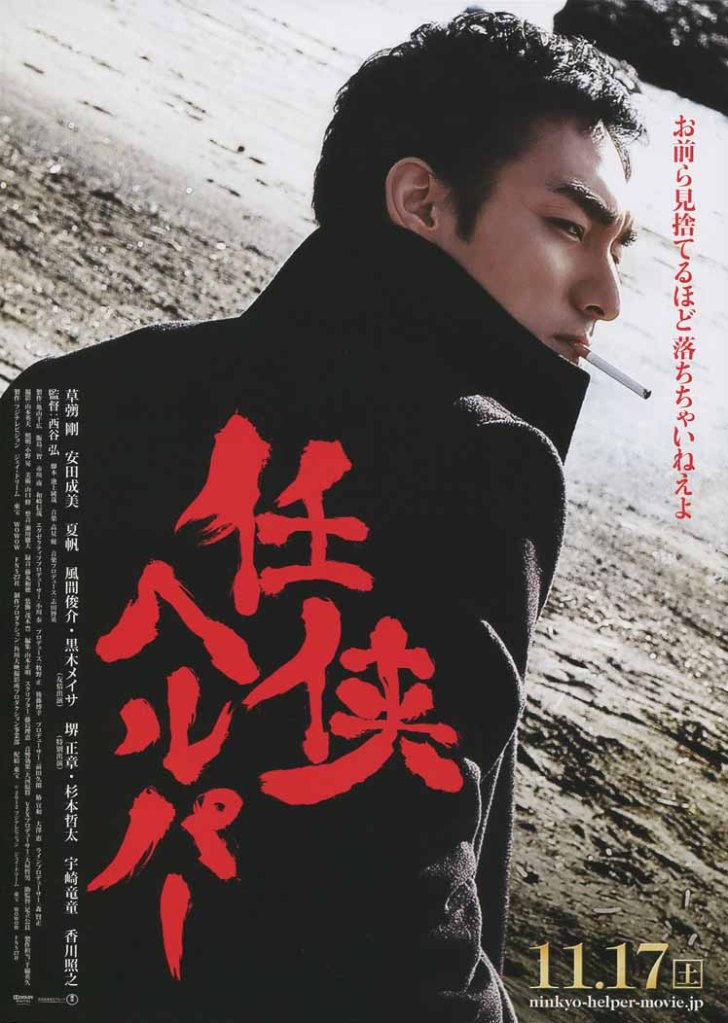
ninkyo helperIn old yakuza lore, the “ninkyo” way, the outlaw stands as guardian to the people. Defend the weak, crush the strong. Of course, these are just words and in truth most yakuza’s aims are focussed in quite a different direction and no longer extend to protecting the peasantry from bandits or overbearing feudal lords (quite the reverse, in fact). However, some idealistic young men nevertheless end up joining the yakuza ranks in the mistaken belief that they’re somehow going to be able to help people, however wrongheaded and naive that might be.
The hero of Hiroshi Nishitani’s Beautiful World (任侠ヘルパー, Ninkyo Helper) is just one of these world weary idealists turned cynics. We find him working a low rent convenience store job where he fills the shop with the kind of intensity that only a disappointed former yakuza can generate. Hikoichi (Tsuyoshi Kusanagi) was trying to make a go of things in the regular world, but when a sad little old man comes in with armed robbery on his to do list, Hikoichi shows his yakuza stripes by easily beating him down in front of his stunned colleague.

This might have earned him some brownie points at work, but overcome by pity for this pathetic old man reduced to robbing corner shops for petty change, he gives him the cash and tells him to run. The police soon turn up and arrest them both – during the robbery Hikochi’s colourful tattoos were caught on security camera and no one wants a yakuza working here, even if he did volunteer to pay back the tiny sum of money the old guy got from his own wages.

Meeting up in prison, Hikoichi and the armed robber eventually become friends and after his release, Hikoichi ends up in the old guy’s home town where he joins his former clan as an enforcer. Extremely bitter by this point, Hikoichi has decided to play the modern yakuza game to the max so when he finds out his assignment is running a dodgy “care” home which gets its residents by extorting old people through outrageous loans which send them bankrupt, he only briefly pauses.

The idea of a yakuza running a care home is a strange one. The Uminoneko residential care facility is far from what one would want from a old people’s home – there are no doctors, or even carers, the entire home is run by one nurse, herself an elderly woman who got her nurse’s certification and eldercare qualifications back in 1943!

With a rapidly ageing population, eldercare is a big topic in Japan as the birth rate has progressively fallen while lifespans have increased leaving many older people without family to look after them. With the nature of the family unit also changing, it’s become much harder to care for elderly relatives at home especially if they need around the clock attention. There are simply not enough facilities available to cope with the increasing needs of the older generation leaving families struggling to cope and social services overwhelmed. It’s not surprising that the yakuza have picked up on this as a growth area.

When Hikoichi arrives at the Uminoneko facility, which is just really a prefab shed with some futons in it, he finds a hellish place filled with unstimulated old people left on their beds to die. The place is filthy, and about the only attention the guests receive is the occasional offering of food to keep them alive so that the clan can keep claiming their pensions and welfare payments. Though Hikoichi goes along with this to begin with, it’s not long before his idealism rears its ugly head and he hits on the idea of reforming Uminoneko by turning it into a kind of old person’s commune in which the residents themselves will help out with the running of the place. What was a sad and gloomy prison of exploitation suddenly transforms as the older generation rediscover a place that they can belong, working together to build their own community. However, this of course means less money for the clan and more trouble for Hikoichi.

The clan aren’t his only problems as the town also has a progressive mayor who made a commitment to wipe out organised crime and turn the area into a tourist hotspot with a special focus on caring for the older generation. Teruo (Teruyuki Kagawa) has is own stuff going on which again causes a problem for Hikioichi as he also has a long standing crush on the older yakuza’s daughter, now a single mother with two young children and a mother of her own with senile dementia who needs expensive medical care. Yoko (Narumi Yasuda) has a grudge against yakuza after enduring decades of stigma and eventual abandonment by her father but is willing to deal with them if it will enable her to help her mother. Predictably she begins to develop a better understanding of her father as she bonds with Hikochi and warms to his noble tough guy ways.

Directed by Hiroshi Nishitani and inspired by a TV show (though functioning as a standalone movie), Beautiful World is a finely plotted drama which explores both the roles of the ageing population and eldercare explosion in Japan, and the conflicting role of the yakuza who seek to exploit those who are arguably the weakest in society. Hikoichi makes for a very Takakura-like, brooding presence as his innate idealism and desire to help those around him conflict with his experiences as a yakuza which teach him to distrust everyone and expect betrayal and exploitation at every turn. Resolving in an unconventional and unexpected way, this otherwise mainstream, if  beautifully photographed, drama develops into one of the more interesting character driven pieces of recent times.


Unsubbed trailer:

Shinjuku Swan (新宿スワン, Sion Sono, 2015)

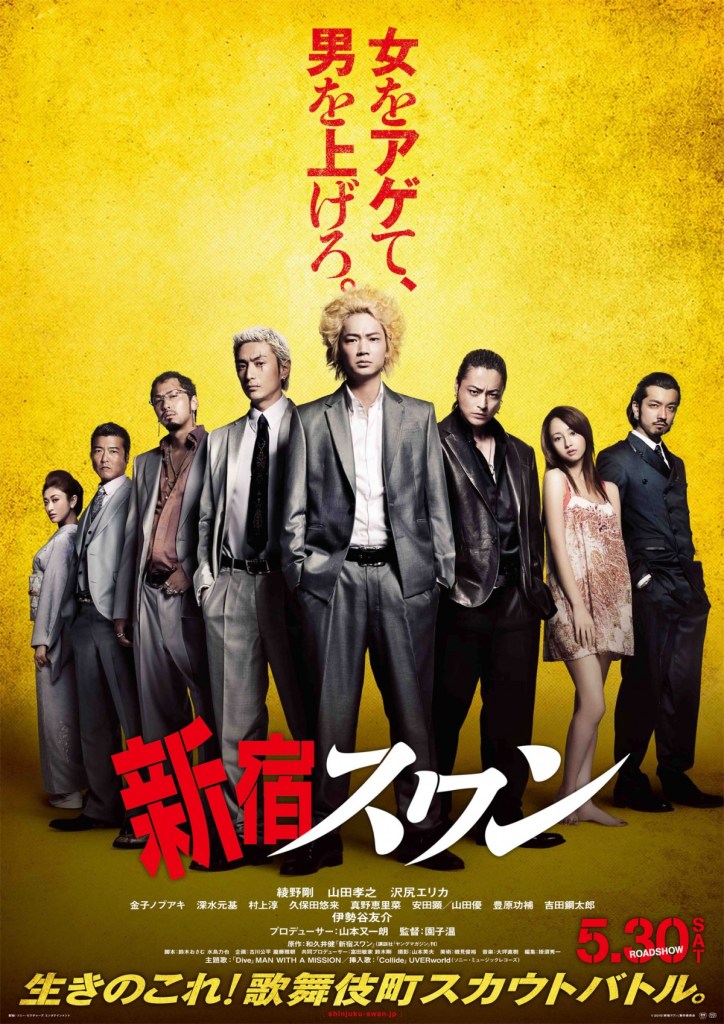
Shinjuku SwanEnfant terrible of the Japanese film industry Sion Sono has always been prolific but recent times have seen him pushing the limits of the possible and giving even Takashi Miike a run for his money in the release stakes. Indeed, Takashi Miike is a handy reference point for Sono’s take on Shinjuku Swan (新宿スワン) – an adaptation of a manga which has previously been brought to the small screen and is also scripted by an independent screenwriter rather than self penned in keeping with the majority of Sono’s directing credits. Oddly, the film shares several cast members with Miike’s Crows Zero movies and even lifts a key aesthetic directly from them. In fact, there are times when Shinjuku Swan feels like an unofficial spin-off to the Crows Zero world with its macho high school era tussling relocated to the seedy underbelly of Kabukicho. Unfortunately, this is somewhat  symptomatic of Sono’s failure, or lack of will, to add anything particularly original to this, it has to be said, unpleasant tale.

Our “hero” is down on his luck loser Tatsuhiko (Go Ayano) who’s come to Shinjuku to make it big. He’s here because it’s the sort of place you can make it happen with no plan and no resources. “Luckily” for him, he runs into low-level gangster Mako (Yusuke Iseya) who spots some kind of potential in him and recruits him as a “scout” for his organisation, Burst. Now dressed in a fancy suit, Tatsuhiko’s new job is stopping pretty girls in the street and trying to talk them into working in the sex industry….

Tatsuhiko is not the brightest and doesn’t quite understand what the implications of his work are. When he finally gets it, he feels conflicted but Mako convinces him that’s it’s OK really with a set of flimsy moral justifications. Before long, Tatsuhiko comes into conflict with a lieutenant, Hideyoshi (Takayuki Yamada), from the rival gang in town, Harlem, and a yakuza style territorial dispute begins to unfold destabilising the entire area.

Sono has often been criticised for latent misogyny and an exploitative approach to his material and Shinjuku Swan is yet more evidence for those who find his output “problematic”. Though based on a manga and scripted by a third party, Shinjuku Swan has an extremely ill-defined take on the sex industry and the people involved with it. After figuring out what happens to the girls he takes to Mako, Tatsuhiko has second thoughts but Mako tells him that the girls are happy and are in this line of work because they enjoy it (leaving out all the stuff about debts, drugs, and violence). So Tatsuhiko vows to make even more girls live happy lives inside the “massage parlours” of Kabukicho.

Noble heart or not, Tatsuhiko is a pimp. Not even that, he’s a middle man pimp. He’s earning his money from the suffering of the women that’s he conned, coerced, and finally exploited. Leaving aside the idea that, yes, some of these women may be perfectly happy with the arrangement, at least one of Tatsuhiko’s recruits displays evidence of previous self harm and is unable to cope with the demands of her new way of life. Another woman, Ageha (Erika Sawajiri), who becomes Tatsuhiko’s primary damsel in distress, escapes into a children’s fairytale picture book in which a prince with crazy hair just like Tatsuhiko’s comes to rescue the heroine from her life of slavery and takes her to a place of love and safety. Tatsuhiko “rescues” her by taking her to a “nicer” brothel…

Tatsuhiko may have convinced himself that he’s somehow a force for good, “helping” these women into employment and providing “protection” for them unlike the other guys from rival gangs who use drugs and violence to keep their girls in line, but his continued belief in his own goodness becomes increasingly hard to swallow as he learns more about how this industry really works. It’s difficult to believe in a “hero” who is so deluded about his own place in the grand scheme of things – he’s not stupid enough to be this oblivious, but not clever enough to be continually unseeing all of the darkness that surrounds the way he makes his living.

All of this is merely background to the central yakuza gang war which later ensues. Tatsuhiko ends up as a pawn in the tussle for territory between Burst and Harlem as double crosses become triple crosses and no one is to be trusted. Predictably, Tatsuhiko and Hideyoshi turn out to have a long standing connection though this revelation never achieves the dramatic weight it’s looking for and the gang war itself is, at best, underwhelming. Notable scenes including a classic battle in the rain could have been spliced in from Crows Zero and no one would have noticed. The main dramatic thread remains Tatsuhiko’s journey as he travels from clueless loser to, admittedly still clueless, assured petty gangster and smooth talking lady killer.

If there’s an overall feeling which imbues Shinjuku Swan, it’s lack of commitment. Though often beautifully photographed and featuring some interestingly composed sequences (including a few Carax-esque musical set pieces) the final effect is one of workman-like competence. Not bad by any means, but this feels like the work of a director for hire and lacks the sense of the personal that a would-be-auteur would usually seek to provide. Moral ambiguity can often be a film’s strong point, inviting comment and debate rather than pushing a pre-defined agenda but Shinjuku Swan takes too many incompatible approaches to the already unpalatable series of questions that it stops short of asking. Distinctly uneven, Shinjuku Swan ends on a note of anti-climax and though a perfectly serviceable, mainstream, commercial effort proves something of a disappointment from a director who has often managed to bring out a sense of mischievous irony in similarly themed work to date.


Unsubtitled trailer:

Journey to the Shore (岸辺の旅, Kiyoshi Kurosawa, 2015)

journey to the shoreTime is an ocean, but it ends at the shore. Kiyoshi Kurosawa neatly reverses Dylan’s poetic phrasing as his shoreline is less a place of endings but of beginnings or at least a representation of the idea that every beginning is born from the death of that which preceded it. Adapted from a novel by Kazumi Yumoto, Journey to the Shore (岸辺の旅, Kishibe no Tabi) takes its grief stricken, walking dead heroine on a long journey of the soul until she can finally put to rest a series of wandering ghosts and begin to live once again, albeit at her own tempo.
The film begins with three years widowed Mizuki (Eri Fukatsu) giving a piano lesson to a little girl whose mother goes on to enquire about her daughter’s progress. Wouldn’t it be better if she could learn something a little more cheerful once in a while? Reconsidering, the mother reflects that uptempo doesn’t quite suit Mizuki, and she’s right – it doesn’t. After impulse buying some flour and baking a few Japanese sweets at home, Mizuki receives an unexpected visit from her deceased husband, Yusuke (Tadanobu Asano), who drowned himself at sea.

Somehow unsurprised and pausing only to remind him to remove his shoes, Mizuki gives Yusuke some of the dumplings then retires to bed, only to wake up the next morning and wonder if she dreamt the strange events of the night before but, sure enough, Yusuke is still very much present. Promising to show her some of the beautiful places he discovered on his long odyssey home to her, Yusuke takes Mizuki on a reverse honeymoon in celebration and in mourning of all they once were to each other.

In each place they travel to, Mizuki and Yusuke help the people there deal with their own walking ghosts. Yusuke is not the only returnee as they discover with a lonely old newspaper seller who doesn’t appear to be aware that he died a long time ago. Walking dead in a realer sense than Mizuki or some of the other depressives they meet along the way who are still living but not exactly alive, Mr Shimakage is a spirit held in place by an inability to reconcile himself with the actions of his past and has brought his feelings of self loathing and regret with him into the afterlife.

Sometimes it’s the living that pin the dead, holding them close with guilt, regret, love or loneliness. If the film has a central tenet, it’s that the past has its place, and it’s not among the living. At one point Mizuki says that perhaps it’s better to leave some things unresolved. Yusuke asks her if she’s really OK with that, and she seems to reconsider but in the end that’s the way it has to be. There are no final solutions, the answers are not at the back of the book. In the end, the best you can do is try to understand and learn to be OK with everything you do and do not know about yourself and about those who are no longer here to tell their stories. Mizuki also says that she hated to practice piano as a child, but her teacher always told her to pay attention to her own rhythm. The music will always be lifeless, until you learn to hear your own song.

Kurosawa creates a beautifully ethereal world, held in a tension between the spirit realm and the everyday. Playing with lighting levels in extremely interesting ways, he allows the supernatural and natural to flow into each other, jostling and merging like waves and shore. Travelling from the grey, ordered and utilitarian city to the unruly nature of the countryside with its ancient, crashing waterfalls and beautiful, if lonely, coastlines we move from static and lifeless existence to a place of perpetual potential as we let go of one thing so that we might grasp another.

As much as Journey to the Shore is bound up with death, it necessarily speaks of life, too. During one of his strange lessons for the village folk, Yusuke delivers some meditations on science and philosophy to the effect that the world is built of nothingness but that nothingness does not lack meaning. He tells us that we are all dying, the universe was born billions of years ago and will end one day just as our species may end when the planet’s temperature exceeds that which we can endure or galaxies collide and take us down with them. For all of that, the universe is young, still growing, still expanding, and we are so lucky to have been born now when there is still so much ahead of us. This is a time of infinite beginnings. Starting again means letting go, but sooner or later you have to step off the shore of this self imposed purgatory and return to the great ocean which is life.


Journey to the Shore is availble on dual format DVD and blu-ray in the UK courtesty of Eureka Masters of Cinema.

Lowlife Love (下衆の愛, Eiji Uchida, 2016)

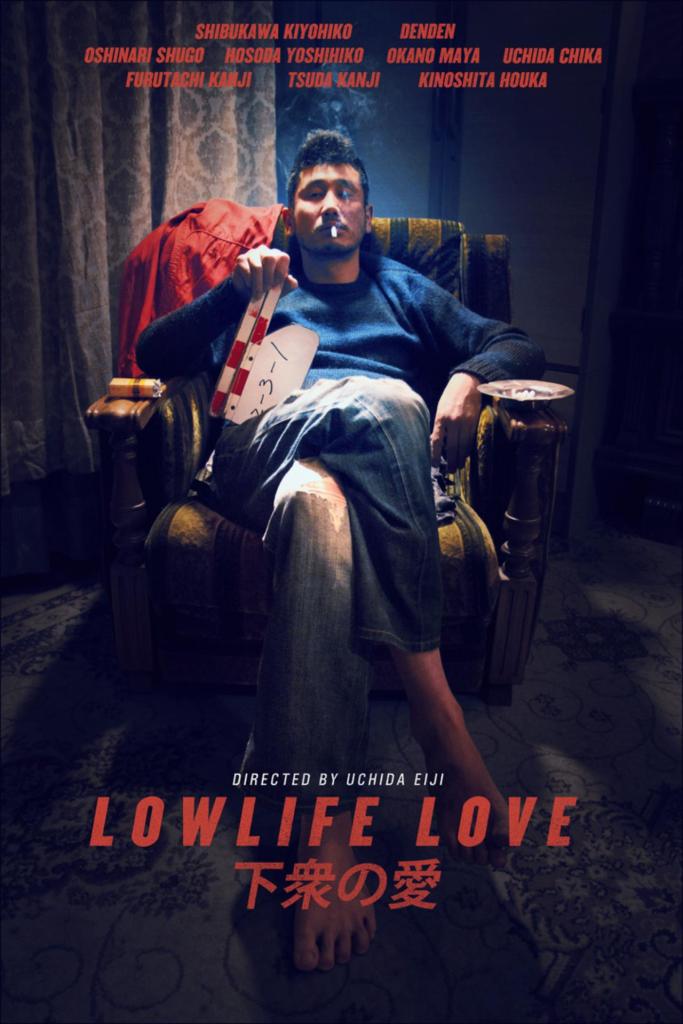
Lowlife Love“What would John do?” is a question Cassavetes loving indie filmmaker Tetsuo (Kiyohiko Shibukawa) often asks himself, lovingly taking the framed late career photo of the godfather of independent filmmaking in America down from the wall. Unfortunately, if Cassavetes has any advice to offer Tetsuo, Tetsuo is not really paying attention. An example of the lowlife scum who appear to have taken over the Japanese indie movie scene, Tetsuo hasn’t made anything approaching art since an early short success some years ago and mainly earns his living through teaching “acting classes” for young, desperate, and this is the key – gullible,  people hoping to break into the industry.
Despite ripping off the next generation, Tetsuo’s financial situation is not exactly rock solid as he still lives at home with his parents and younger sister and even resorts to stealing his elderly mother’s pension money all in the name of art. A low level sociopath, he bangs on about movies and artistic integrity whilst using his directorial authority to pull young and naive would be actresses onto the casting couch with promises to make them a star through the massively successful movie he’s supposedly about to make (but probably never will).

His world is about to change when he encounters two still hopeful entrants into the movie industry in the form of aspiring actress Minami (Maya Okano) and shy screenwriter Ken (Shugo Oshinari ). Ken’s script is good, and Minami shows promise as an actress but also a backbone as she’s unwilling to give in to Tetsuo’s clumsy pass at her through what actually amounts to an attempted rape in the (unisex) toilet of a seedy bar. And they say romance is dead!

Soon enough a rival appears on the scene in the form of a more successful director who abandoned the indie world long ago in favour of the golden cage of the studio system. Tetsuo calls him a sell out, but as his own world crumbles Tetsuo finally gets a much needed reality check that leaves him wondering how much “integrity” there is in his current life which is based entirely on exploitation yet produces nothing but cheap, instant gratification.

This is a film about a sociopathic, pretentious, and above all lazy “film director” who is being cast as a representation of a certain type of guy found the lowest edges of the indie film scene. Lowlife Love seeks to illuminate the inherent misogyny in the cinema industry and more particularly at the bottom of the ladder where the desperate masses congregate, each waiting for someone to extend a hand down to those below that will help them onto the higher rungs, but this is less about the subjugation of women and the way their lack of status is consistently used against them than it is about Tetsuo’s own fecklessness. Tetsuo probably could make a movie, but he doesn’t. He just talks about making movies. The system isn’t the problem here, Tetsuo is just a useless person with almost no redeeming features.

The successful director, Kano, and the ones that follow him are barely any better. Minami says at one point that directors are all crafty, filthy, bitter, and annoying – on the basis of these examples she is not wrong. Kano replies that filmmaking is like a drug, once you’re in there’s no out and you’ll do anything just to be allowed to stay. These guys are all hollow, desperate creatures, craving validation through “artistic success” but finding it through easy, loveless sex with “obliging” actresses equally eager to play this unpleasant game solely to avoid being thrown out of it or worse onto a lower stratum altogether.

Minami’s path is either one of growth or corruption depending on your point of view but the extremely shy, naive and innocent girl dreaming of becoming, not a star, but a successful actress, is gradually replaced by a manipulative dominatrix well versed in the rules of the game and unafraid to play it to the max. Whether her success is a fall or a victory is likewise a matter for debate but it contrasts strongly with the similar struggles of the veteran actress Kyoko (Chika Uchida) who even has a friend doing research on her targets so she can assess their usefulness before going all the way.

Unfortunately for her, even when she hits on a useful contact promises are easily broken, especially when you’ve already played your only bargaining chip and another, prettier player steps onto the field. A deleted scene features an embittered actress attempting to take her own life and uttering the final words that she never cared about stardom, she just wanted to keep on acting. This is an all too real response to an age old problem but one that Tetsuo and his like are much more willing to perpetuate than ease, even whilst mourning the loss of a friend to the unreasonable demands of their own industry.

Famously funded by a Kickstarter campaign and personal sacrifices of its producer, Lowlife Love features unusually high production values for an indie film and a fairly high profile cast including its leading actor, Kiyohiko Shibukawa, who has become something close to modern Japanese indie cinema’s most recognisable star. Performances are excellent across the board though the picture the film paints of the no budget indie world is extremely bleak and mean spirited. Porn, gangsters, exploitation, prostitution, and a lot of rubbish about creating art makes one wonder why anyone bothers in the first place but then we’re back to Kano’s conundrum and taking down our pictures of Cassavetes to ask what John would do. Sleazy, unpleasant and cynical, Lowlife Love’s cast of dreadful people in difficult situations yet, apparently, dreaming of the stars, is all too plausible if a little hard to watch.


Lowlife Love (下衆の愛, Gesu no Ai) was financed through a Kickstarter campaign run by Third Window Films and is currently shipping to backers with a regular retail release scheduled for a later date.

Lowlife Love will also be shown as part of the Edinburgh International Film Festival on 22nd and 23rd June 2016.

Her Granddaughter (娚の一生, Ryuichi Hiroki, 2015)

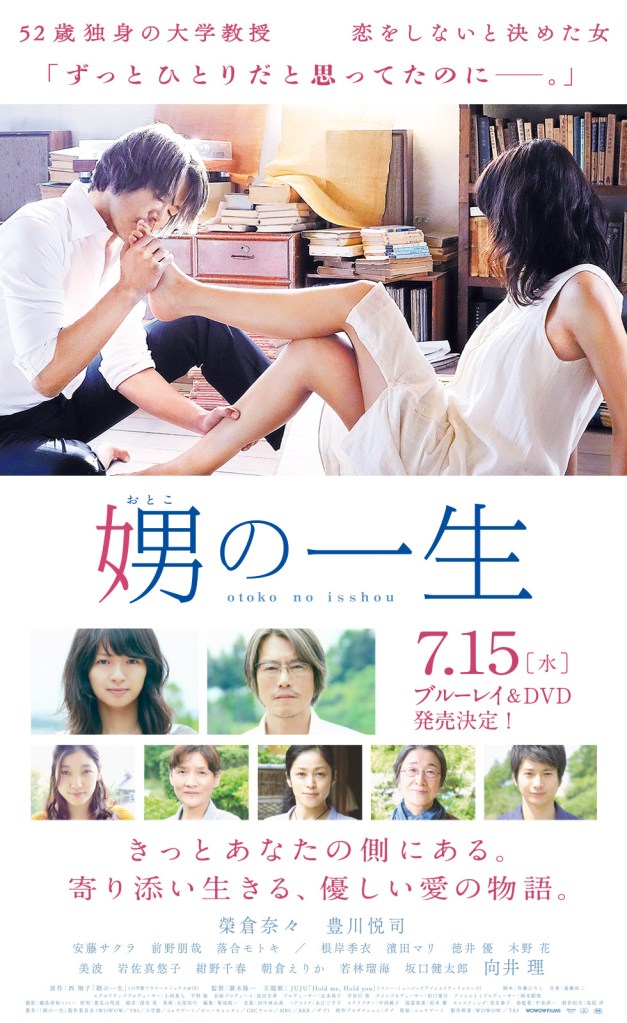
Her GranddaughterRyuichi Hiroki has one of the most varied back catalogues of any Japanese director currently working. After getting his start in pink films and then moving into V-Cinema, Hiroki came to prominence with 2003’s Vibrator – an erotically charged exploration of modern alienation, but recent years have also proved him adept at gentle character drama. Her Granddaughter (娚の一生, Otoko no Isshou), though coming with its own degree of strangeness, is another venture into the world of peaceful, if complicated, adult romance.

Tsugumi, a still youngish woman with a good job in IT in Tokyo returns to her rural hometown to look after her ailing grandmother. When her grandmother unfortunately passes on, Tsugumi inherits her house and begins to consider not going back to her old life but staying and taking over her grandmother’s hand dyed fabric business.

Feeling a little alone after the funeral, she’s shocked to encounter a slightly abrasive older man who apparently has a key to the annex given to him by the grandmother. Confused, Tsugumi can’t exactly throw him out (much as she’d like to), but gradually the two start to form a tentative relationship.

Her Granddaughter is indeed based on a best selling manga by Keiko Nishi, which might go some distance to explaining some of its more unusual plot elements. Though in essence it’s a fairly innocent tale of May to September love between a lonely, unfulfilled young woman looking for a simpler way of life, and a sensitive if difficult older man with a complicated past, there’s more to it than that. Specifically, the grandma problem. The question whether or not to pursue a man who may have previously dated your grandmother, is not one that many young women will be faced with.

Tsugumi herself is obviously grief stricken after her grandmother’s death and has also left a messy situation behind her in Tokyo. The lack of desire to return may be partly to do with this same unresolved question, though the idea of a slower, more traditional way of life obviously appeals to her. Even when the possibly ex-boyfriend of her grandmother, Kaieda, abruptly moves in, she reverts to classic gender roles by doing his washing and cooking for him, expecting him to perform the more “manly” tasks like chopping wood and making sure the fire is in for the bath. According to her friend visiting from Tokyo, this is something Tsugumi tends to do which marks her as a little out of step with her more progressive city friends.

Kaieda is an outwardly abrasive, chain smoking philosophy professor who appears to be nursing a life long broken heart. He aims for a classically cool persona with his affected ennui yet, despite his gruffness, he is a pretty good judge of character able to nudge people in the direction they should be heading but might be about to miss such as when a gauche local politician with a longstanding crush on Tsugumi might be about to accidentally rebuff the attentions of a shy but pretty girl from the municipal office who is clearly interested in him.

A later scene sees Kaieda and Tsugumi becoming a temporary family with a little boy mysteriously dropped on their doorstep. Kaieda often harshly indicates to the boy that his mother has abandoned him and won’t be coming back. Lonely childhoods of rejected children become something of a running theme as the resultant certainly of abandonment leaves each of our now adult protagonists looking for a premature exit from any potentially serious relationship. For all his aloof exterior, Kaieda is sensitive soul, though one easily read after discovering the key to all his insecurities.

One of Hiroki’s softer efforts, Her Granddaughter is nevertheless a warm and gentle character driven romantic tale. Full of beautiful country landscapes and refreshing summer breezes, the circularity of all things comes to the fore as Tsugumi in some senses becomes her grandmother and sees herself in the sad little boy as he climbs on a stool to wind a clock just as she had done in her own childhood. An interesting, resolutely old fashioned tale of modern romance which, though shrouded in several taboos neatly side steps them and encourages us to do the same, Her Granddaughter is a gentle gem from Hiroki which proves rich both in terms of theme and of emotion.


English subtitled trailer:

Ghost in the Shell: The New Movie (攻殻機動隊 新劇場版, Kazuya Nomura, 2015)

Ghost in the Sell new movieMasamune Shirow’s cyberpunk manga Ghost in the Shell burst onto the scene in 1989 and instantly became a genre classic. Mamoru Oshii then adapted the manga into a much lauded anime movie in 1995 which almost came to define cyberpunk animation even if it emerged towards the end of the genre’s heyday. A sequel, Ghost in the Shell: Innocence followed in 2004 as well as a TV anime spin-off Ghost in the Shell: Stand Alone Complex. Now with the 20th anniversary of the original animated movie, the series has yet again been adapted into a series of entirely new anime OVAs under the name of Ghost in the Shell: Arise. Ghost in the Shell: The New Movie (攻殻機動隊 新劇場版, Kokaku Kidotai – Shin Gekijoban) is the big screen outing of this latest incarnation scripted by Tow Ubukata who also produced the very GITS influenced Mardock Scramble.
Following on from the Arise OVAs, we find Major Motoko Kusanagi at the head of her gang of cybernetically enhanced former soldiers operating as security consultants with a special focus on cyber crime. Still outside the government aegis, Kusanagi has managed to wangle herself some extra funding and official patronage when she’s brought in to handle a sensitive hostage situation as seven disgruntled soldiers take a number of hostages inside a financial institution.

Though Kusanagi & co have the situation well in hand, they are about to have the rug pulled from under them firstly by the reappearance of the Firestarter virus which corrupts the memories stored on an infected cyberbrain wreaking havoc with their new captives, and then secondly as the hostage situation itself turns out to be a high level diversionary tactic designed to provide cover for the assassination of the prime minister. Kusanagi and her team quickly discover there’s far more going on here than they could ever have imagined and soon enough Kusanagi herself becomes the centre of a hi-tec conspiracy.

Like the Arise OVAs which preceded it, The New Movie maintains a much heavier focus on action set pieces than the philosophical contemplations that made Ghost in the Shell such an important entry in the cyberpunk catalogue. Though the ideas are not entirely absent, they are presented as background much more than an essential component of the series.

That said, the film does touch on some quite prescient issues firstly with the role of the soldiers which highlights the pressures ordinary rank and file officers are under when they see their service has not been valued and they’re about to be sold out by the country they risked their lives to protect. They are also, apparently, not well cared for by military authorities who kit them out with second grade equipment which they then also fail to maintain leaving many of their number literarily falling apart as their components become “obsolete”.

Ironically enough, Kusanagi also thinks of her team as component “parts” in a well functioning machine. She congratulates herself by praising them as a prime selection which she has been lucky to find – they need to look after themselves because a replacement component would be a hard thing to come by. However, if they begin to malfunction in some way, she will “purge” them rather than allow them to corrupt the rest of her system. This way of thinking seems cold to some members of the team, particularly to Togusa who’s the least “enhanced” among them. Raised by the military, Kusanagi is a born leader but not one to whom warm words come easily so this, actually rather apt, metaphor is as close as she will allow herself to get in letting the guys know that they each have their specific place within her grand plan. Though she needs them to perform as expected, they are important to her on both a personal and professional level.

This is where we’ve been heading with Arise – the origin story of Section 9 as it comes to be in the original movie, and of Kusanagi herself. Unsurprisingly the conspiracy turns out to have a lot to do with the Major’s own past and a few buried “ghosts” which must be exorcised in order to move forward. This extended metaphor is played out in the somewhat contrived final fight which sees Kusanagi facing off against a villain using an identical cyberbody which means she is fighting “herself” in a way, but nevertheless, it is a victory of the reclaimed self (even if that same “self” is about to undergo yet more existential battles in adventures to come).

The new character design and animation style have begun to seem more familiar by this point, though despite the stellar work of Production I.G the New Movie never quite reaches the aesthetic heights of the iconic original. This is only further brought out by the frequent homages to 1995’s Ghost in the Shell including the final scene which is almost a carbon copy of the original film’s opening (thematically fitting as it is). The action scenes, however, are extremely impressive and display innovative animation techniques which make fantastic use of the latest animation technology. Another exciting, action packed outing for Major Kusanagi and her guys, the New Movie doesn’t quite live up to the legacy of its namesake but nevertheless proves a thrilling cyberpunk infused adventure and a fitting bridge between the Arise series and the landmark 1995 movie.


Reviewed as part of the “biennial” Anime Weekend at BFI Southbank. Ghost in the Shell: The New Movie is also available in the UK from Manga Entertainment (and Funimation in the US).

Unsubtitled trailer (why is it so hard to find a trailer for the Japanese language track with English subtitles for these?)

Empire of Corpses (屍者の帝国, Ryoutarou Makihara, 2015)

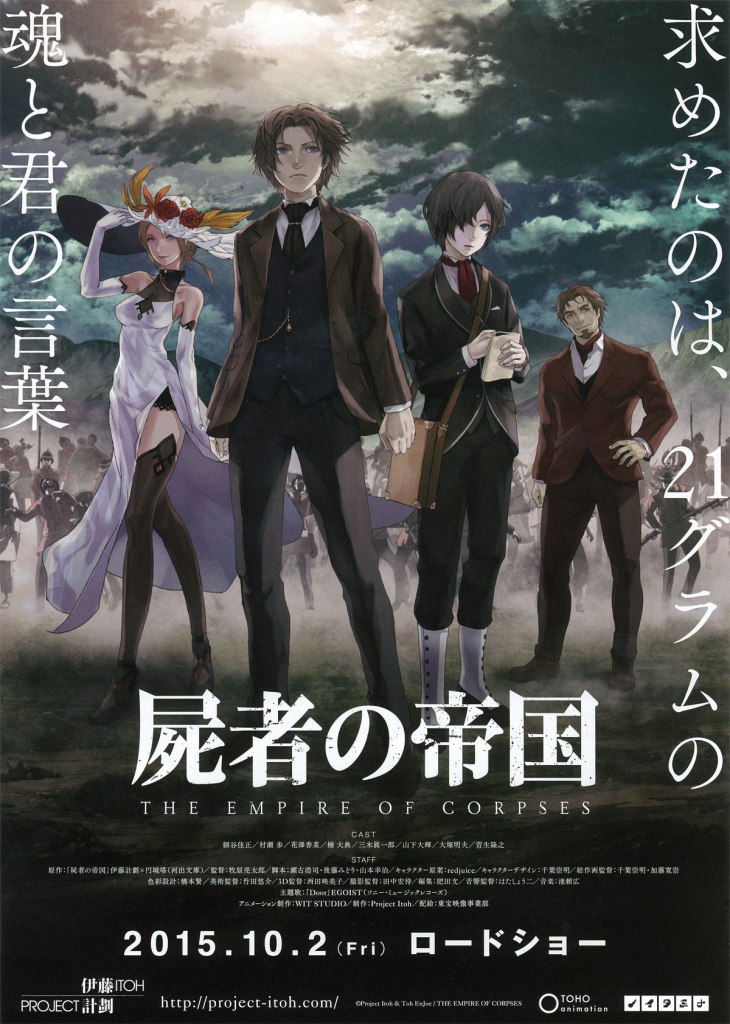
empire of corpses posterEmpire of Corpses (屍者の帝国, Shisha no Teikoku) is what would happen if someone’s vast library of Victorian literature was destroyed in a fire and then someone tried to put all the not too singed pages back together based on their knowledge of international pop culture. Inspired by Project Itoh’s novel of the same name and the first of three planned adaptations of his works, Empire of Corpses is a very specific kind of absurd, boys own action adventure based around the idea of empire supported by a zombified proletariat.
Beginning in London in 1878, this is steampunk paradise only steam power is quickly becoming old hat as the greatest discovery of the age turns out to be the city’s largest untapped resource – its dead. Reanimated corpses can be trained to fight wars, wait tables, or work as servants but they’re tools now – not people, they may be able to follow an order but they have no mind to act with. Corpse Engineer John Watson has unwisely reanimated his friend Friday, but is distressed not to be able to restore his friend’s soul along with his body.

Watson ends up being dispatched on a secret mission by Her Majesty’s government to reclaim the notes made by the famous Dr. Frankenstein who has succeeded in creating a sentient creature known as The One. The notes are apparently in the possession of Russian scientist Karamazov. Watson travels to India with Burnaby, a mercenary bodyguard, and Friday where he also teams up with a mysterious flame thrower wielding busty blonde, Hadaly.

Empire of Corpses touches on some interesting philosophical questions such as the nature of the soul, the border lines between death and life, and the repurposing of a body as a fleshy tool. Though it stops short of delving into what the British Empire was really based on, the idea is very much that using reanimated corpses to fight your wars remotely is an absurd solution to an unnecessary problem.

That said, these “zombies” are a well trained and docile bunch. Until of course, they aren’t. Certain forces have planned to harness the zombie hordes for their own ends to create mass panic and wholesale destruction across the world. This might be the first mission the later famous John Watson will tackle, but he’s about to realise that there’s a lot more going on here than a set of secret documents no one wants to fall into the “wrong” hands.

Empire of Corpses remained unfinished when Project Itoh unfortunately died at a relatively young age. The concept is filled with extremely interesting ideas which are only ever dealt with in a superficial sense, though one wonders if the novel he might eventually have completed would have progressed so far down the ridiculous fantasy historical epic route. Very clearly channelling ‘30s style, post-penny dreadful tales of derring do starring familiar names, Empire of Corpses steals a host of famous literary characters from across the international canon as well as a number of historical personages, though only really borrows their names or perhaps a few other minor details. After raising such interesting ideas, the film quickly reverts to riduclous B-movie genre tropes as the gang get caught up in a zombie apocalypse with flashing mystical lights and the transmigration of souls thrown in for good measure.

No, it doesn’t make any sense though it isn’t really supposed to. Patient viewers will be rewarded with a post credits sequence shining a little more light but just as much bafflement onto the characters and their possible futures, though the intention is clearly just to raise a knowing wink from the well read members of the audience. By the time it all turns into The Wizard of Oz, some will undoubtedly have followed the yellow brick road out of the cinema but it is worth sticking around to see the final coda.

What Empire of Corpses has going for it is the extremely impressive visuals. Backgrounds in particular are gorgeously drawn making for an always interesting spectacle even if other aspects of direction can seem a little uninspired. Clumsily plotted and often incoherent, Empire of Corpses has its fair share of problems even aside from the inherent absurdity of its original premise, yet it isn’t completely unsalvageable and those who come expecting a B-movie style slice of incomprehensible hokum might well find much to enjoy.


Reviewed as part of the “biennial” Anime Weekend at BFI Southbank. Empire of Corpses has also been licensed for UK distribution by All the Anime (and Funimation in the US).

Unsubtitled trailer:

Hospitalité (歓待, Koji Fukada, 2010)

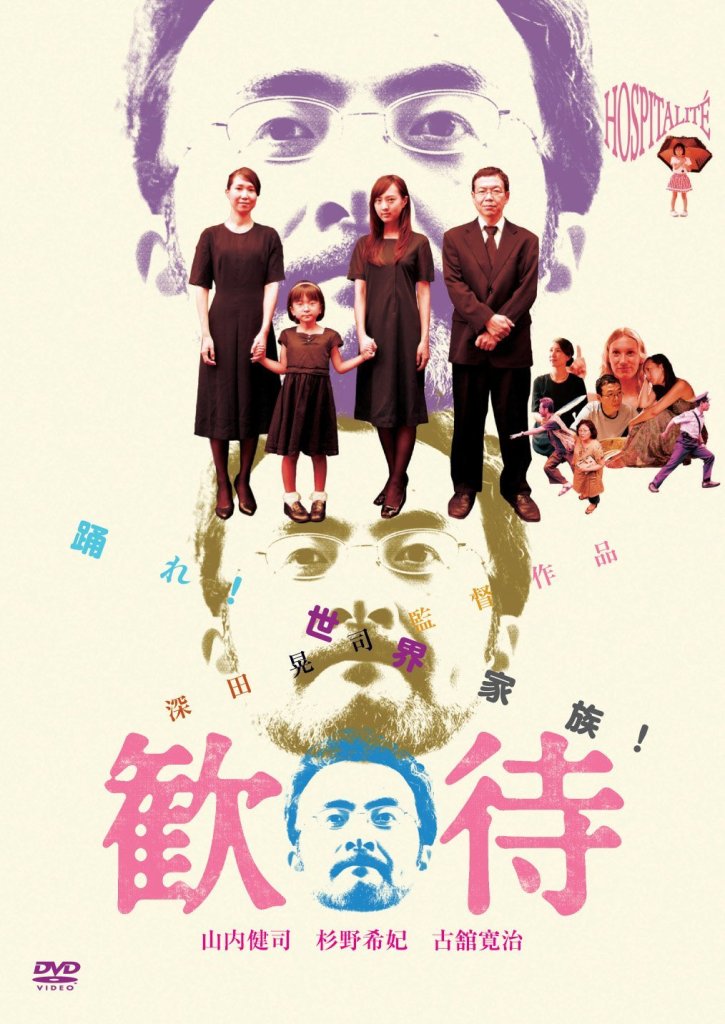
hospitaliteFrom the Ozu-esque, classic calligraphy of its elegant title sequence, you might expecting a rather different kind of family drama than the one you find in Koji Fukada’s Hospitalité (歓待, Kantai). Though his compositions lean more towards the conventional, Fukada aims somewhere between a more restrained The Family Game and a much less explosive Theorem as he uses the family as a microcosmic analogy for his country’s attitudes towards “outside intrusion”. An absurdist tale of dysfunctional families and hypocritical social standards, Hospitalité takes a long hard look at whom exactly you regard as “guest” and how much you’re really prepared to take care of them.

The Kobayashis run a small printers shop in a rundown suburban backwater. Son Mikio has inherited the business and lives above it with his second wife, Natsuki, and his daughter from a previous marriage, Eriko. Older sister Seiko has recently moved back in following a divorce though she also has a vague idea of wanting to study abroad. Things start to go haywire when little Eriko’s pet parakeet absconds from the family home. Heartbroken, she designs a special flyer to try and find it which brings them to the attention of “old friend” Kagawa who claims to have seen the bird somewhere near the station.

Kagawa hangs round a little longer than necessary chatting to the couple when their assistant suddenly keels over. This allows a convenient opening for Kagawa to volunteer his services at the print shop – luckily he knows how to handle the machines. He quickly moves into their spare upstairs room before also moving in his “foreign wife”, Annabelle, and a bunch of other non-Japanese people by which time he’s well and truly wrested control of the mini printshop empire away from the mild mannered Mikio and caused a degree of local panic in the process.

The Kobayashis are “hospitable” people. To begin with they don’t mind having this “old friend” hanging around and helping him out by letting him stay and work in the shop. When he suddenly introduces his wife without warning they may feel he’s taking advantage but anyway they go along with it. Annabelle, from “Brazil”, or was it “Bosnia”, gives the impression of someone who is always pretending their language skills aren’t as good as they really are so people let their guard down around her. She teaches “salsa”, apparently, and starts to get on Natsuki’s nerves by usurping her position as resident English speaker.

The town itself is not quite as charitable as the Kobayashis as evidenced by the older lady who keeps dropping by with petitions for the neighbourhood watch to which she’d also like to recruit the ladies of the house. She’s worried about the increasing number of “foreigners” in the area which she now feels is becoming “dangerous” as a consequence. That’s not to mention the proposed “beautification” plan for the park (which really means getting rid of all those people who sleep there in cardboard boxes). That said, though neither of the women is particularly interested in joining the neighbourhood watch or against the idea of non-Japanese people coming to live in their town, they go along with the woman and her plans not to rock the boat. They run a business here after all so they have an interest in keeping the town stable and in maintaining good social relations with their neighbours, so it makes sense to just put up with whatever bigoted nonsense they’re spouting, right?

For all their “lascivious dancing”, topless sunbathing, and “promiscuous immorality”…the foreigners are quite clearly not as much of a problem as the underlying hypocrisy which runs through the Kobayashis’ world. When Kagawa asks about Mikio’s previous wife, he says “she got sick” leading him to think Mikio is a widower which isn’t quite true but is a less embarrassing for explanation for Mikio to offer than what really happened. There’s an obvious tension between Mikio and Natsuki as well as with the recently returned older sister. As soon as Kagawa begins to work his magic, driving a pneumatic drill right into all of those tiny cracks and fractures which exist between a husband and a wife, everything begins to fall apart though in an equally quiet and subtle fashion. However, people have need of their fantasies and even after Kagawa has exposed the holes in their marriage, Mikio and Natsuki seem content to simply paper over their differences and go back to pretending everything’s fine just like before.

A surrealist’s meditation on xenophobia, social mores, and what happens when a caged bird decides to be free, Hospitalité is a suitably nuanced, not to mention frequently amusing, look at contemporary small town mentality. Everyone is so invested in maintaining a particular quality of personal truth, be it in a hospitable place which thinks the answer to people cluttering up the park with their cardboard boxes is to “beautify” the area by throwing them out, or a neighbourhood watch group that’s all egos with a local place for local people mentality, that maintaining the lies is much more important than solving the underlying problem. Koji Fukada’s farcical approach to the absurdity of everyday life is a good natured and humorous one, but the problems at its core are all too real.


Hospitalité was released on DVD in the US by Filmmovement and still appears to be in print though the distributor’s website is constant 403.

English subtitled trailer: