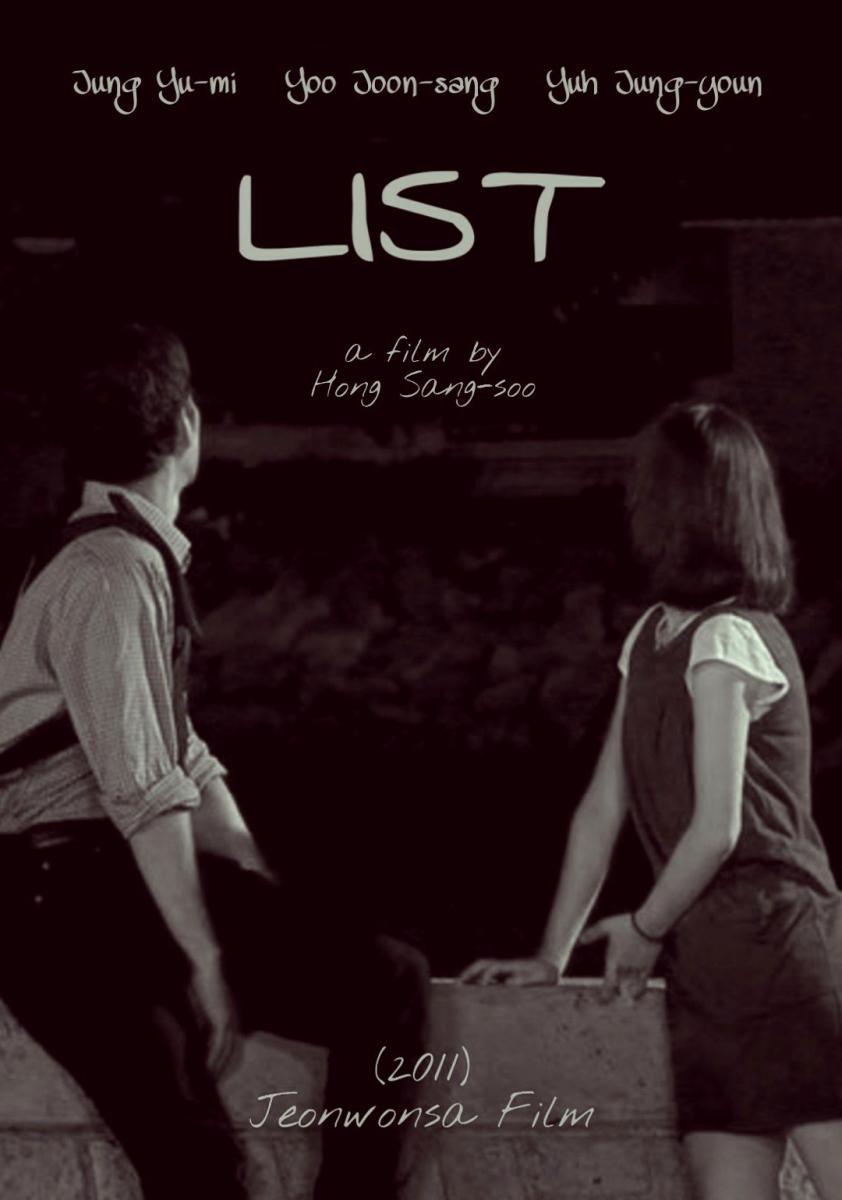
List (리스트, Hong Sang-soo, 2011)

Hong Sang-soo finds himself in a positive, if characteristically melancholy, mood for his hard to see 2011 short, List (리스트). Short as a companion piece to In Another Country, the film opens with the exact same scene as a mother and daughter bicker about the sorry circumstances which have forced them to retreat to the seaside where they’ll be living in peaceful seclusion. This time however, young(ish) Mihye (Jung Yu-mi) sits down to write not a screenplay but a list, a kind of itinerary in order to make the most of this deliberately boring “vacation” taken all alone with her nice but “concerned” mother (Youn Yuh-jung).

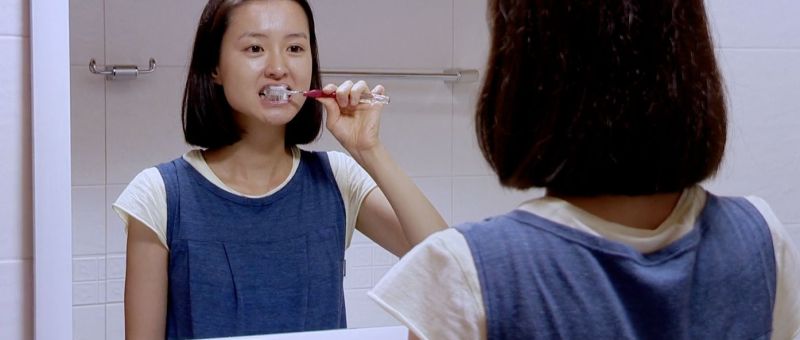
Mihye’s List runs right through the day and includes normal holiday activities like having a meal in a famous restaurant, checking out the mudflats, and buying souvenirs, as well as reminders to giver her mum a massage and let her know she’s loved, and a few idiosyncratic suggestions too. Perhaps what she’s really the most excited about is trying out her new tooth brushing technique! At night she plans to dream of “prince charming” which is also something her mother later brings up in pushing a little on why the near 30-year-old Mihye has no boyfriend and is not yet married. Mihye’s mother worries that she has no desires before dialling back and suggesting that Mihye has desires but not the courage to act on them. 

This will, perhaps, prove to be true when Mihye and her mother meet a nice man just sitting on the beach as if waiting for them. Unsurprisingly, the man turns out to be a film director but he’s a far cry from Hong’s general leads. Sanjun (Yu Jun-sang) is a nice, wounded young man who might be slightly awkward but in an affable way. Though Mihye’s mother is taken with him, Mihye isn’t so sure. He seems kind of like a prince charming, but then again he’s just a random man they met on a beach who turns out to be famous and successful. Claiming that her daughter is “shy”, Mihye’s mother agrees to Sanjun’s invitation to a date on Mihye’s behalf (which was bizarrely directed to her anyway) and then offers to come along despite Mihye’s double protests. 

Tellingly, Hong departs from his usual aesthetic with key scenes shot on obvious sets and a strange absence of energy even in those taking place on location. Mihye muses and her fantasies appear to come to life. She completes her list for the day almost by accident while in the company of the prince charming she requested. Still, she isn’t sure. She asks him why he likes her but his answers are vague and perhaps worrying. He likes her “purity” and thinks she’s cute. She’s “special” in a way no one can see. All things Mihye’s wants to hear but doesn’t quite believe. Later she tells Sanjun she’s frightened of what her life will become, that she’s trapped by her mother and feels, in some way, damaged by her though she fails to elaborate further. In true fairytale style the romance escalates improbably, culminating in lifelong declarations of love and a promise of mutual salvation. 

Mihye wonders why people can’t see the good right in front of them. Sanjun replies it’s because they’re too focused on indulging themselves in the now. Yet what Mihye learns is perhaps that occasional fantasies are OK, that vague lists are useful because they leave you open to possibilities while lessening the fear of disappointment, and that even if your mother thinks your plans are “too ambitious”, it doesn’t really matter, you can just see where they go. Mihye might not have cured any of those anxieties. Perhaps she still feels trapped, resentful, even hopeless, but the sun rises anew and there’s another day to explore. It’s as cheerful an ending as Hong can muster, hope mixed with melancholy resignation and a stoic determination to put a brave face on existential despair.

Laddaland (ลัดดาแลนด์, Sophon Sakdaphisit, 2011)

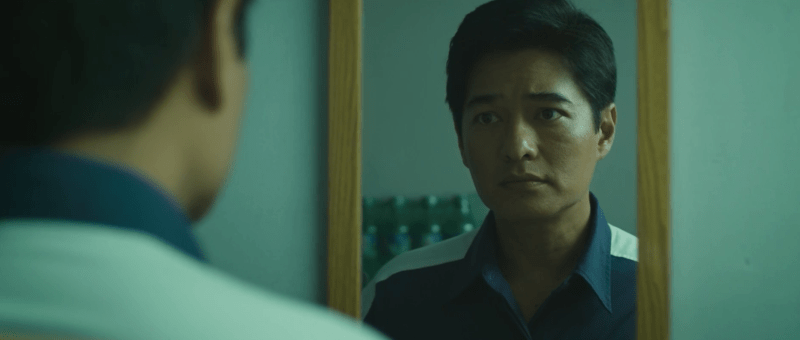
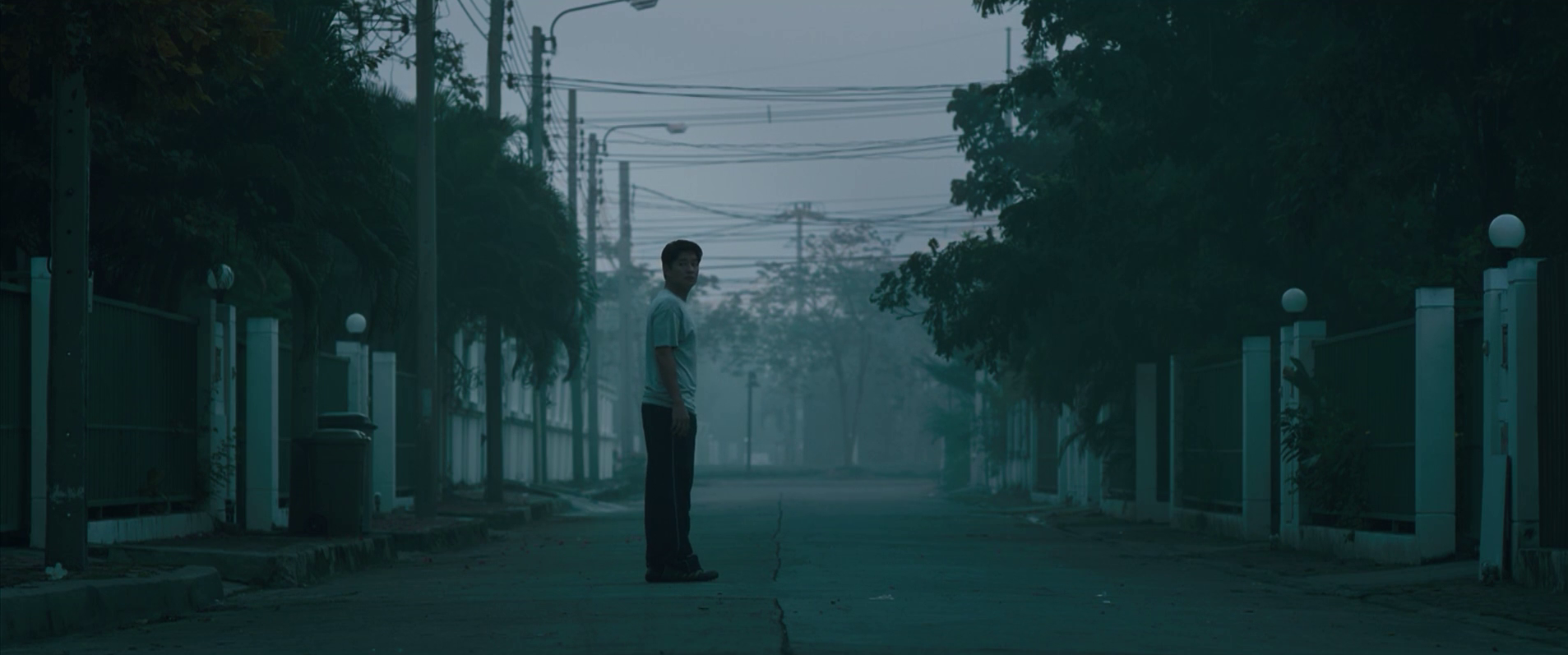
Laddaland (ลัดดาแลนด์) is a strangely haunted place. The people who live there are mainly ghosts, but also haunted by the spirits of financial anxiety and toxic masculinity amid the continual impossibility of an aspirational suburban existence and happy family life. In the opening scenes, a man patiently sets up the new home he’s bought for his family, painting a cherry blossom tree on his daughter’s wall and throwing a Ben 10 quit over his son’s bed. “I’m glad all four of us are finally together,” he sighs to an empty room while sitting alone at his dining table. 

But there are already cracks in the foundations of this family which probably can’t be repaired by simply moving into another life. They had already been separated by financial anxiety with eldest daughter Nan (Sutatta Udomsilp) living largely with her grandmother who seems to come from a much wealthier, class-conscious background. Her father Thee’s (Saharat Sangkapreecha) desire to reunite his family breaks that Nan had formed with her grandmother, to whom she is constantly on the phone, and it is unsurprising that she isn’t happy about being forced to leave her friends in Bangkok to live in this suburban paradise. Yet her attitude towards her father is in part motivated by his failure to give her this life, repeatedly reminding him that he essentially abandoned her and is incapable of doing what is expected of a man in providing for his family.

It’s this sense of toxic masculinity that may have prompted Thee to embark on this grand venture. The house he’s bought on an aspirational housing estate in a recently gentrified area is a large family home and as his wife Parn (Piyathida Woramusik) reminds him, the mortgage is bit of a stretch. But Thee is so focused on his dream that he can’t think of anything else. He’s given up his steady job and gone in with a friend on what is very obviously a dodgy pyramid scheme. The foundations of his new middle-class life are built on shaky ground, while every attempt at rapprochement with Nan seems destined to fail as he becomes an increasingly authoritarian father and she a resentful and contemptuous teen. 

But times are hard for everyone. The woman next door already lives like a ghost because her husband is violent and abusive. Parn tries to help her, but there isn’t much that can be done. We learn that the man is also, like Thee, under increasing strain from financial anxiety as his factory business flounders amid the turbulent Thai economy. He too is subject to the same sense of humiliation and insecurity as a man who is failing to live up to the codes of masculinity in being unable to provide his family with a comfortable life. Thee doesn’t exactly become violent, but he does later buy a gun after being burgled and fantasise about using it to free himself of his responsibility and the burden of this aspirational life that he can’t really afford.

In an odd way, the ultimate transgression may have been his attempt to hire a maid. A local Burmese woman, she is soon found dead in a house owned by a foreigner and thereafter becomes a more literal ghost haunting the local area and his family in particular due to their attempt to exploit her for cheap labour, perhaps hinting at Thailand’s relationship with Myanmar. Yet it’s also Thee who seems to have been possessed by a vengeful spirit, becoming increasingly cruel and irrational in his attempts to hold on to his home while simultaneously alienating Nan by refusing to listen to her or let her hang out with her new friends. Even Parn begins to turn against him, fed up with his financial fecklessness and pondering swallowing her pride and going back to her mother who loathes Thee for ruining Parn’s life by getting her pregnant in college. Parn suggests going back to work, but that doesn’t fit Thee’s old-fashioned vision of a patriarchal family while he also accuses her of having had an affair with her admittedly sleazy former boss and needles her about leaving him for someone with better financial means. Perhaps this the curse of Laddaland, a liminal space inhabited by hungry ghosts obsessed with fulfilling aspirational, if outdated, ideas of suburban bliss only to end up destroying the very house they were trying to build.


International trailer (English subtitles)

Young Black Jack (ヤング ブラック・ジャック, Kentaro Otani, 2011)

The Black Jack of Osamu Tezuka’s classic manga is a morally ambiguous figure who cultivates an image of callousness through asking for exorbitant sums to cure often desperate people, but in reality will usually treat seriously ill patients if touched by their plight or is content to collect the money from another source ensuring a kind of social justice is done. A spin-off manga written by Yoshiaki Tabata and illustrated by Yugo Okuma, Young Black Jack (ヤング ブラック・ジャック), was published from 2011 to 2019 and was set in the 1960s when Black Jack was gifted young medical student living through a politically turbulent era. 

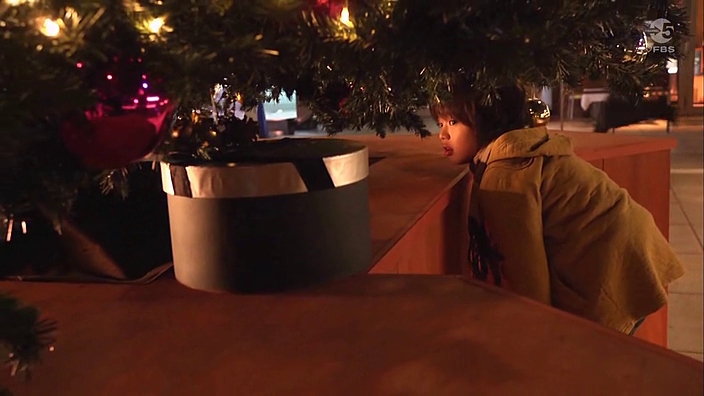
Broadcast in 2011, this television special meanwhile updates the action to the present day while acting as a kind of double origin story if one set in a more realistic world. As a nine-year-old boy, Black Jack asks his mother to meet him by the Christmas display in a local shopping mall. Not having had enough money to buy his mother a red rose, he patiently sits and draws one under the tree while otherwise oblivious to the news being broadcast on a large screen explaining that there has been a series of bombings in the city and the next target is this very mall. Black Jack’s mother has become mute after a traumatic incident but tries to call out to him only for the pair to be caught in the blast. Touched by their story, the genius doctor Honma (Masachika Ichimura) manages to save Black Jack by transplanting his organs and giving him a skin graft while his mother remains in a coma.

The story then jumps to the present day with Black Jack (Masaki Okada) a medical student with an underground lair where he keeps his comatose mother (who hasn’t aged at all in 15 years) and operates as a backstreet doctor treating undocumented migrants and yakuza. Aside from emphasising his contradictory nature as someone who both treats anyone who requires treatment no matter of their social status yet simultaneously demands incredible sums of money for doing so, associating with these kinds of people also places Black Jack among the lower ranks of society which is something that niggles at snooty doctor Naoki (Yukiyoshi Ozawa). Naoki is sort of betrothed to Yuna (Riisa Naka), the daughter of the chief doctor at a prestigious university hospital who is herself in the middle of taking her final exams to become a doctor. 

Familiar to fans of the manga, Naoki is Black Jack’s opposite number. As he tells Yuna, there are two kinds of doctors. Those who save lives and those who kill. In the manga, Naoki was a doctor traumatised by his wartime experiences who often wants to euthanise the patients that Black Jack is trying to save believing that there is no way to save them. Having encountered Black Jack cooly saving a patient who collapsed in the street, Yuna asks Naoki what he thinks makes a good doctor and he tells her it’s the belief that medical science has no limits and the doctor is omnipotent. Yet he later says just the opposite, telling Yuna that she is being childish and of course there are limits to what medical science can achieve so in effect he’s giving up. Black Jack meanwhile does believe in his own omnipotence, even if that’s not always such a good thing, and is confident he can save any patient even if in the end he cannot save the one most close to him (perhaps because she wanted him to stop trying). 

The film does not however go into very much detail and only gives brief snippets of backstory such as Black Jack’s mother going mute after a shadowy man enters and leaves their home while hinting at potential future stories in his opposition to Naoki who objects to him partly out of snobbishness, and a potential romance with Yuna who has now shifted away from the elitism that coloured her family towards a more altruistic kind of medicine represented by Black Jack even in his aloofness. Nevertheless, the film makes no real attempt to transcend its origins as a television movie, not that it has to, and is hampered by an uninspired script and low production values which contribute to its relatively more naturalistic setting yet sit awkwardly with the more outlandish parts of the narrative such as Black Jack’s keeping his mother in cryogenic status for 15 years or being able to transplant all of someone’s organs at once and in under 10 minutes. Still, as a minor outing for the iconic character it’s entertaining enough for fans of the franchise. 


Stateless Things (줄탁동시, Kim Kyung-Mook, 2011)

“We looked everywhere for a place for us to stay, but we could not find it anywhere” one of the twin heroes of Kim Kyung-mook’s indie drama Stateless Things (줄탁동시, Jooltak Dongshi) confesses. As the title suggests, Kim’s eventually surrealist drama follows those who no longer have a home and are instead condemned to wander the margins of an unforgiving city. Finding only loneliness and exploitation they long for an escape and perhaps find one if only in a moment of eclipse. 

Shooting in a more naturalistic, documentary style, Kim first focusses on the figure of Jun (Paul Lee), a young North Korean refugee who lost his mother in the crossing and his father to another woman in Busan. He works in a petrol station but is treated with disdain by his boss who has his eye on his female colleague, Soon-hee (Kim Sae-Byuk), who is a member of the Korean minority in China where most of her family reside. Though originally hostile towards each other, each wary of their mutual isolation and concurrent vulnerability, the pair later bond in a shared resentment of their boss who exploits Jun physically for his labour and seeks to exploit Soon-hee sexually. After each saving the other from the nefarious boss, the pair have no choice but to go on the run taking in a series of tourist spots while looking for another place to settle. 

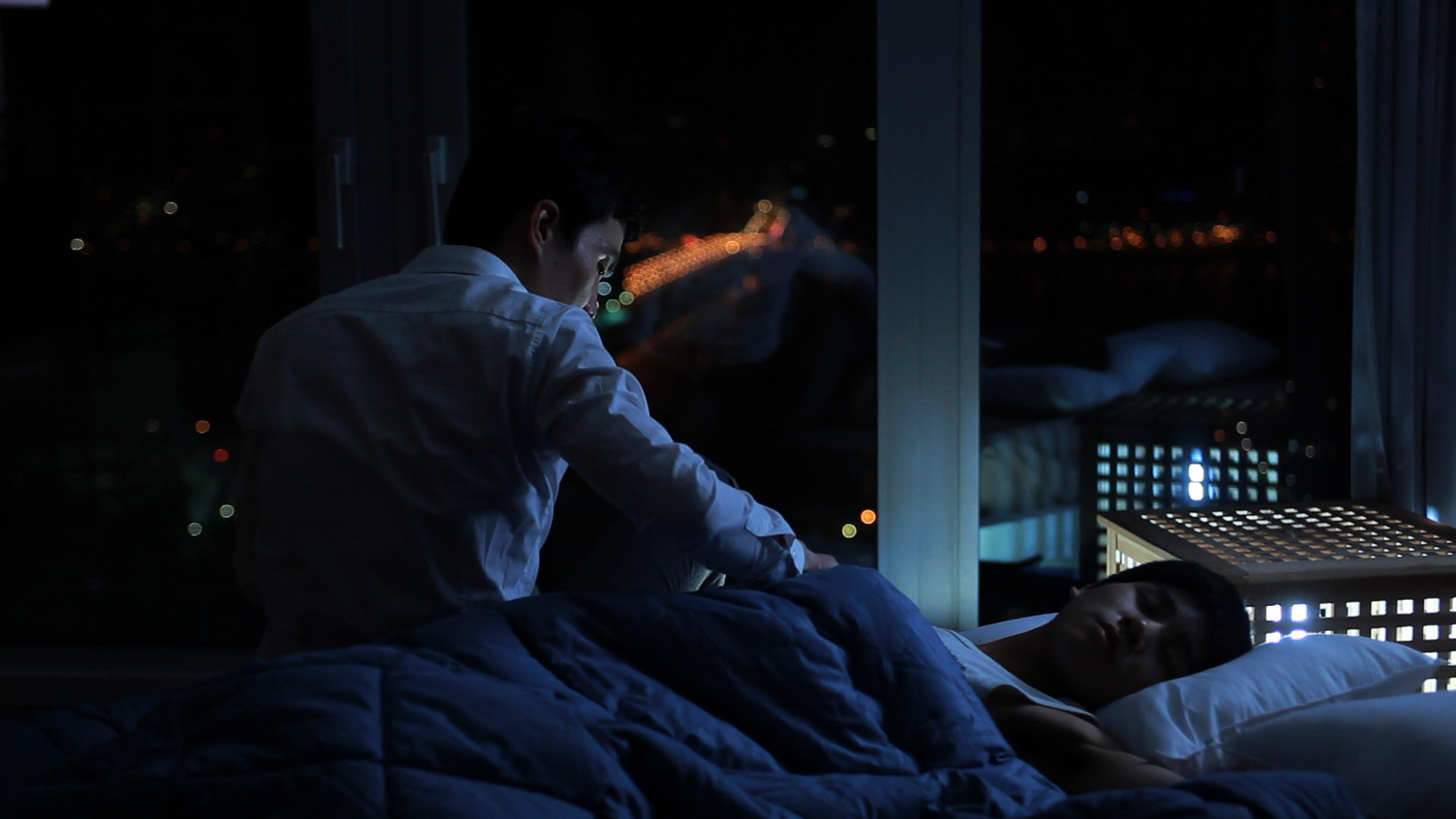
Meanwhile, across town, a young gay man, Hyun (Yeom Hyun-Joon), is a virtual prisoner in the home of his wealthy, married and closeted lover. He looks out across the midnight city and dances sadly alone in a luxury apartment in the sky while occasionally venturing out to meet other men, mostly older, who similarly only intend to exploit his body. “You have nowhere to go.” the exasperated Sung-woo/Sung-hoon (Lim Hyung-Guk) insists, thrown into jealous anxiety on visiting the flat and finding Hyun absent, yet he cannot really offer him a “home” and is all too aware of the transactional nature of their relationship. Though Hyun is also in a sense “stateless”, he has a power over Sung-woo and is able to wield his youth and beauty like a weapon if one he may not fully be able to control. In any case, he too is excluded from the mainstream society by virtue of his sexuality and socio-economic background. 

When Soon-hee and Jun visit a temple, he remarks on the incongruity of seeing a painting that features both a sun and a moon. She explains a folktale to him in which sun and moon are embodiments of siblings who climbed a rope into the sky to escape a hungry tiger. In his diary, Hyun also envisages a pair of twins one opening a door with his right hand as the other closes it with his left. In the surrealist sequence which closes the film, after a title card that appears 90 minutes in, the two men blur into one another as if they shared the same soul in an almost literal eclipse of the self. Kim nevertheless characterises them as sun and moon who cannot ordinarily share the same space. Jun occupies a world of street level sunniness until the light finally begins to dim leaving him alone in a dusky, rain-soaked city. Hyun meanwhile lives by night in his high rise apartment, a prisoner of luxury who flirts with danger for a sense of escape. 

Then again we might ask if Jun and Hyun are two sides of one whole, a sun and moon protecting the king who finds himself an exile. Kim shifts to scenes of emptiness, rooms without presence and streets without life as if the two men were ghosts of themselves hovering above a rootless Seoul, the sense of eeriness only deepened by Kim’s lengthy takes as he follows Jun walking a lonely path towards nowhere in particular because in the end he too has nowhere to go. Departing from the realism with which the film opened, the final sequence gives way to a kind of rebirth if only one of wandering that leaves its heroes at the mercy of a society continually unwilling to recognise their personhood. 


Stateless Things screened as part of this year’s Queer East .

Trailer (English subtitles)

Life Without Principle (奪命金, Johnnie To, 2011)

A financial earthquake destabilises the ordinary lives of a series of Hong Kongers in Johnnie To’s circular thriller, Life Without Principle (奪命金). As one character puts it, greed is human and everyone always seems to want more but even a little is out of the reach of many and so perhaps their desire is understandable in a world in which a loan shark can lord it over the bank who are in essence little better than he is in exploiting their customers by charging them extortionate fees yet failing to protect their investments. 

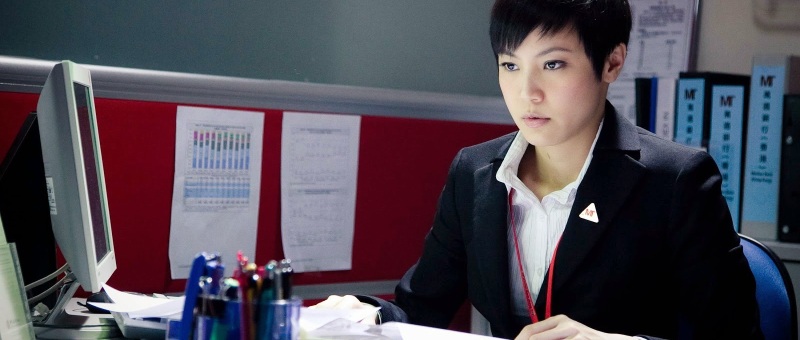
Just before the financial crisis of 2008, bank clerk Teresa (Denise Ho Wan-see) is beginning to fear for her job because she’s stuck at the bottom of the staff sales leader board and her boss doesn’t even bother to tell her off anymore. Under pressure she finds herself misselling a high risk BRIC loan to an older woman seemingly fearful of her declining economic power and hoping to make her savings pay a little more rather than just sitting in the bank doing nothing. Meanwhile Teresa is at the constant beck and call of boorish loanshark Yuen (Lo Hoi-pang) who won’t take out a loan with her because banks just rip you off. “Business is about profit but you have to play fair” he unironically explains handing over a card in case Teresa ever needs a “fair” loan pointing out you’ll pay 35% interest on a credit card but he’ll give you 15% even with bad credit. In any case, he leaves with only half of the 10 million he took out, asking Teresa to deposit the rest and sort the forms out later because he’s in a hurry, only he ends up getting offed in the car park meaning that second five million is in paper limbo. 

Teresa can’t really argue that the bank is morally any better than the loanshark, only that what they’re doing is legally regulated even if she has just broken a series of regulations in talking the old woman into the risky loan because she herself fears a financial crisis in losing her job. Meanwhile in another part of the city, one old man ends up killing another in a property dispute amid the city’s notoriously difficult housing market. The policeman investigating, Cheung (Richie Jen), is ironically called away because his wife, Connie (Myolie Wu Hang-yee), is nagging him about buying a new apartment requiring a one million deposit on a 30-year mortgage. She complains that he’s stubborn and overcautious, but he is at least pretty much the only person showing any kind of prudence in the cutthroat investment world even as he hesitates on learning that his estranged father is at death’s door leaving behind an illegitimate little girl it falls on he and his wife to adopt. 

If Cheung’s caution seems cold, it’s ironically mirrored in the film’s only pure hearted hero, ironic triad parody Panther (Sean Lau Ching-wan) who only cares about old-fashioned ideals like gangster loyalty even if those ideals are often expressed through money. Complimented by a boss for not trying to steal from a wedding collection he nevertheless games the restauranteur but only desires money in order to bail out his gangster friend Wah (Cheung Siu-fai) who is immediately deserted by all his minions who obviously don’t have the same ideas of loyalty as old school Panther. “Loyalty matters most” he insists to an old friend who left the triads to work as a junk collector because you can make more money recycling cardboard than in the contemporary underworld. Even his former sworn brother Lung (Philip Keung Ho-man) has managed to do very well for himself as a legitimate businessman hosting online gambling platforms and playing the stock market. 

Yet as Panther pores over data it becomes obvious that they are all betting on the market remaining the same, blindsided by the advent of the Greek Debt crisis and its devastating destabilisation. They thought they had control, that the decisions they made based on the data they received would remain correct only to realise that they are almost entirely powerless. Teresa fiddles with the jammed lock on her cabinet as she vacillates over whether or not to cash out of the corporate life with the “invisible” money, while Connie reckons with potentially losing her deposit when the already risky mortgage application is turned down, and the old lady is left to face potential financial ruin all alone in the twilight of her life. Then again, fate is fickle. The crisis passes as quickly as it arrived allowing a kind of normality to return but finding the desperate protagonists largely unchanged if perhaps emboldened by the feeling of relief resulting from their accidental lucky escapes from certain ruin. A slick and intricately plotted elliptical thriller, Life Without Principle revels in cosmic ironies but nevertheless holds only scorn for the dubious promises of spiralling consumerism in an increasingly jaded society.


Life Without Principle screens at London’s Prince Charles Cinema on 7th July as part of The Heroic Mission: Johnnie To Retrospective.

Original trailer (English subtitles)

The Warped Forest (あさっての森, Shunichiro Miki, 2011)

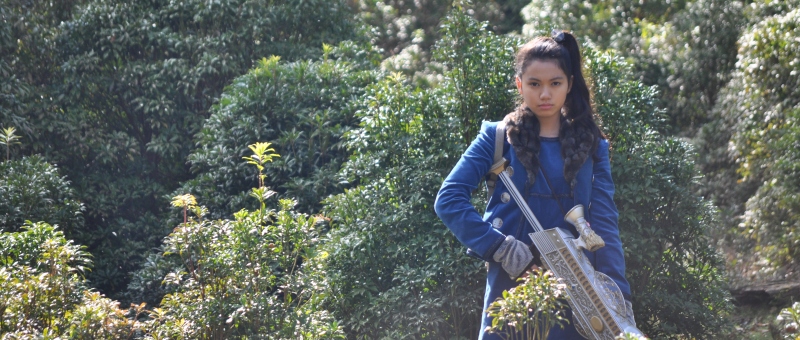
“Life is about making the most of what you get” according to a former blackmailer seeing the error of his ways when his attempt to use his ill-gotten gains to woo a lover abruptly fails, but you can always dream in the wild and wacky world of Shunichiro Miki’s The Warped Forest (あさっての森, Asatte no Mori). A quasi-sequel to Funky Forest: The First Contact which Miki also co-directed, Warped Forest is in someways more conventional lending a loose overarching narrative to its otherwise disconnected scenes set in a bizarre village where the residents can spend acorns and pinecones to tinker with their dreams assuming they don’t mind the possibility of emerging with a curse. 

Like Funky Forest, the film revolves around three trios in the black and white sequence which opens the film two staying at the same inn but adopting vastly different personas in the full colour alternate universe to which we are soon transported. The older male trio are informed they’ve been “missing” for two days though they don’t remember going anywhere and are very confused by the apparent forward motion of time. One does remember, however, that some of his students with whom he’d been on a camping trip turned up at his door and explained they’d been mysteriously beamed to a forest and had to hike their way back. 

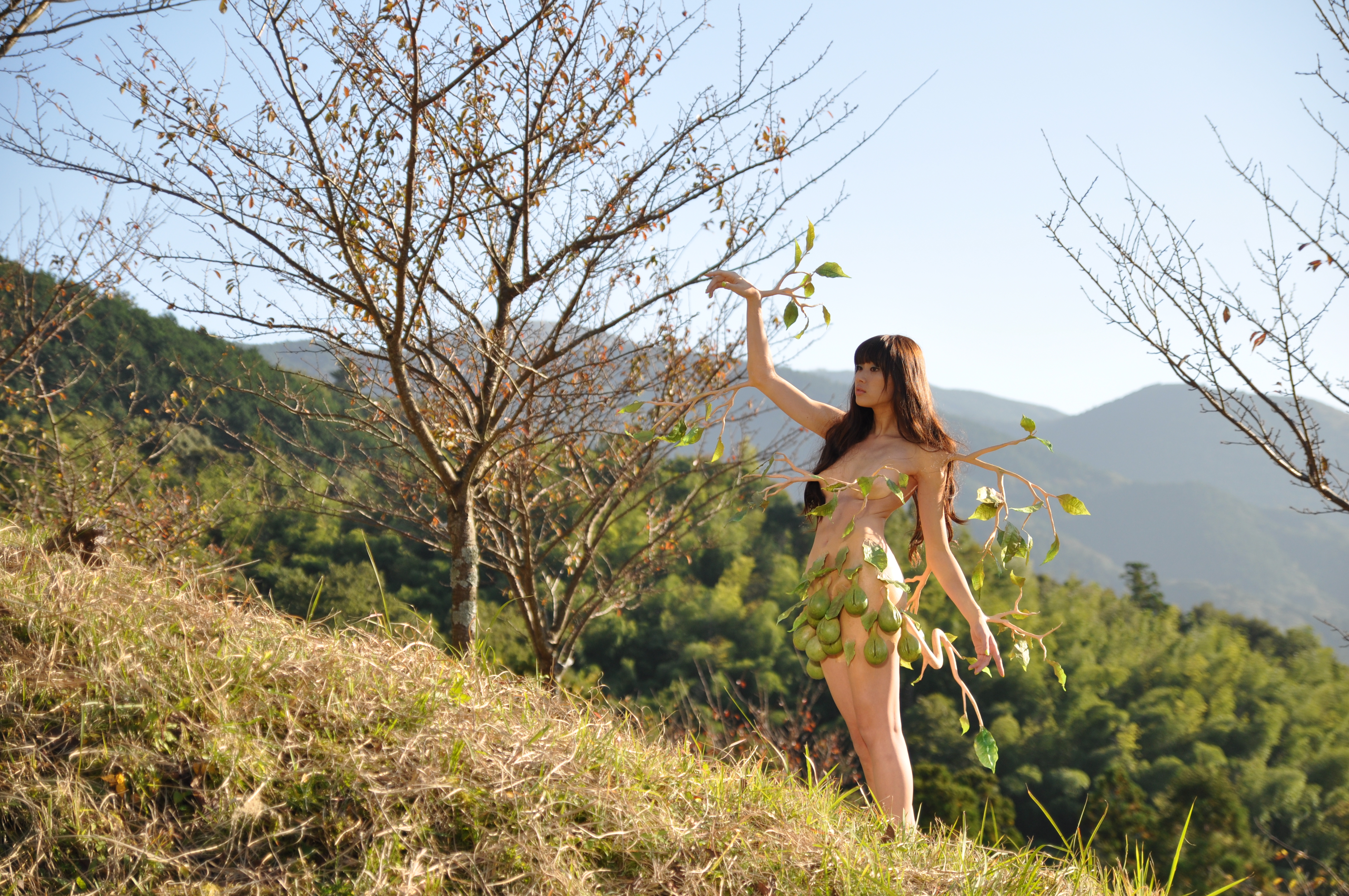
The Japanese title simply means the forest of two days from now, but warped might be a good way to describe it if it weren’t for its judgemental implications seeing as it is indeed somehow out of shape seemingly inhabited by giants and tiny people who co-exist in the same space with tinys prioritised, the giants squashing themselves into tiny chairs and drinking tiny coffees while appearing to also occupy spaces of their own (in which tiny people are not really seen). In any case, this is also a place where everyone is obsessed with the very suggestive Kattka fruit which pulses and gyrates, oozing a sweet liquid and growing from trees in the form of human women which Miss Au Lait, one of the sisters from the inn but here in kimono and walking with a cane, waters by drinking from her flask and passing liquid via her mouth. 

Even here, everyone is lovelorn and unhappy. “If only we could have fun in our dreams” one young man laments after trying out a positive thinking training hall where they’re told to repeat the phrase “I am happy” only to discover their instructor is far from happy himself. They know they can’t have real happiness, so all they can do is dream of it which is why some of them are intent on “dream-tinkering” despite the rumours of negative consequences and vast costs required. Each of the inn trio, all romantically frustrated store owners in this reality, eventually decide to give it a go after one of them gets hold of a special guide that apparently allows them to bypass the curse by promising to sacrifice two days. Appli (Fumi Nikaido) meanwhile is wracked with guilt after having asked to see her whole family happy in her dreams only for her sister to encounter an accident which is why she roams the forest with a gun which shoots white liquid from its penis-shaped tip to trap a “pinky panky” monster and get hold of a weird bug to get the worms out of Miss Au Lait’s leg. 

As for Miss Au Lait, “dreams are just dreams. I have to accept reality” she sadly remarks on turning down a invitation, “I’ll leave my beautiful dream untouched” too fearful and insecure to chase happiness while her suitor later echoes her words unwilling to run away in flights of fancy. Even so we might wonder which is the dream world and which the real, the hotel guests later finding each other and experiencing a kind of true happiness in togetherness unknown in the forest where everything seems to be not quite right. Continuing the slightly vulgar aesthetic of Funky Forest with his fleshy fruits and frequent innuendo, Miki conjures a bizarre world which nevertheless possesses an internal normality in which people are distanced from one another, not least by their respective size differentials, but each longing for something more which they fear cannot be found not even in dreams. 


The Warped Forest is released on blu-ray in the UK on 21st March courtesy of Third Window Films alongside Funky Forest: The First Contact in a set which also includes a feature length commentary, director interview, and introduction.

Original trailer (English subtitles)

.

Monsters Club (モンスターズクラブ, Toshiaki Toyoda, 2011)

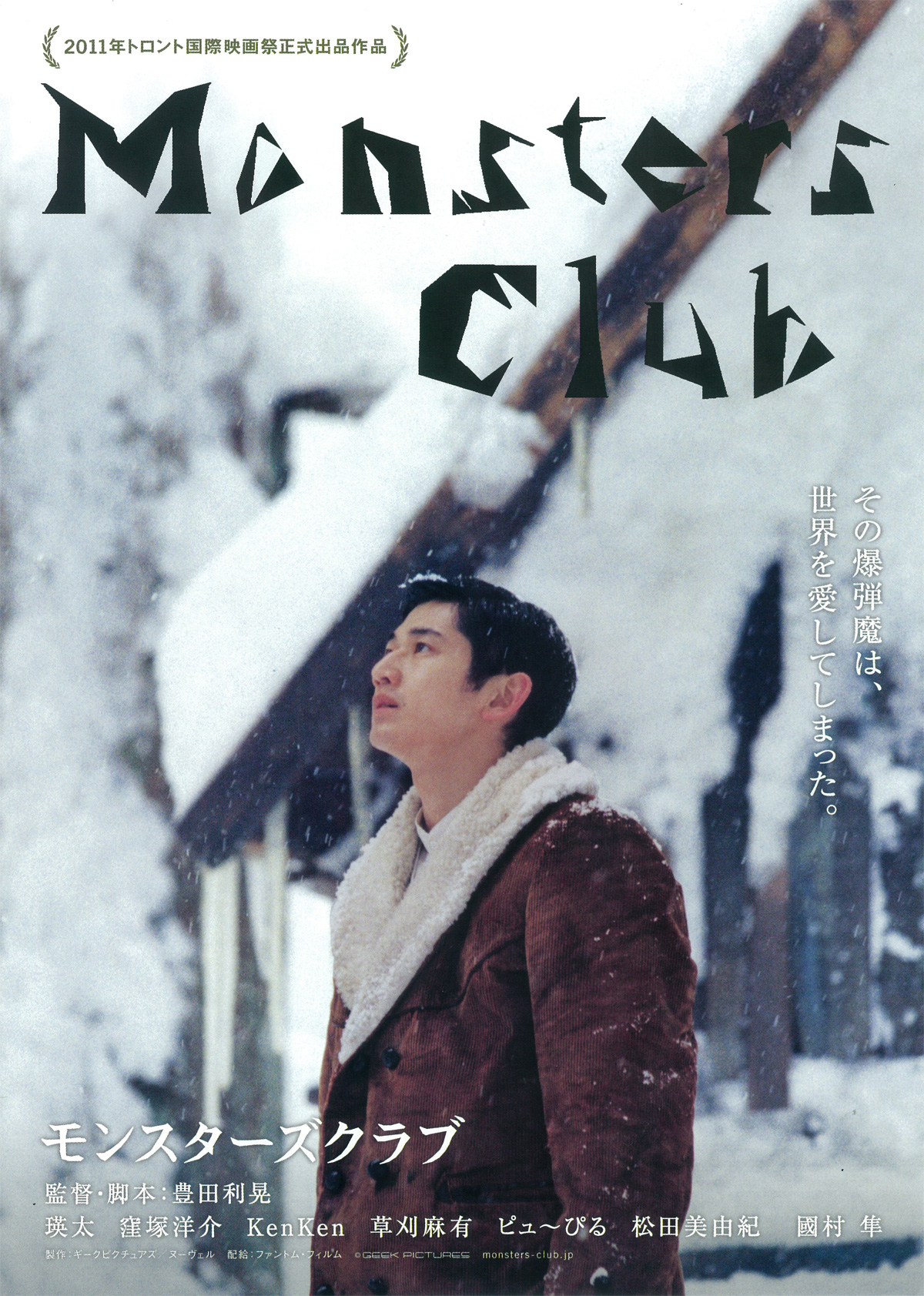
“I’m disappointed in you. Very disappointed. You’re still in love with the world” a young man is told in a dream or perhaps delusion by a man he respected but by whom he may also in a sense have been betrayed. Partly inspired by the life and writings of the Unabomber, Toshiaki Toyoda’s Monsters Club (モンスターズクラブ) is less a treatise on post-millennial Japan than it is a profoundly moving character study in trauma and isolation in which an orphaned young man struggles to find meaning in world in which he feels he has no control over his existence. 

The second son of a noble family, Ryoichi Kakiuchi (Eita Nagayama) has retreated from “this stench-filled society” to live alone in a small cabin in the woods. In an opening voiceover he reads from a manifesto railing against the “industrial society” which he believes railroads those born into it towards a life of wage slavery from the day they are born. Yet his existence is more 19th century than it is a primitive return to the land, his appearance meticulously well maintained in an incongruous clash with his rejection of social conformity, and he must necessarily in some sense still be connected with the outside world given that he will need to obtain batteries and gunpowder used for constructing the bombs he’s been mailing to CEOs of advertising and entertainment companies, not to mention the cigars he is often seen smoking after repurposing their packaging. 

Though he is aware people have died because of his bombs, Ryoichi regards them not as murder but as a “message”, later penning a letter to the prime minister which he ultimately discards in favour of sending him the poems of Kenji Miyazawa instead. Ryoichi’s dilemma is that, as one of the ghosts who visits him suggests, he still wants to save a world he believes is beyond salvation. The bombs are therefore a wake up call, but an awkward one which fails to deliver the message he intended in urging a corrective course away from empty capitalism towards a less regimented social order in which he is master of his own destiny. “Freedom is power” he later writes, resentful of a society he feels infantilises him by removing his “right to self-determination” while his life “depends on the decisions of others” whom he doesn’t even know. 

It might be easy to sympathise with his philosophy in the Japan of 2011 entering another decade of a stagnant economy in a rigid and conformist social culture in which the rewards of playing by the rules have all but disappeared. But Ryoichi’s nihilism is born as much of his successive traumas as it is by dissatisfaction with a world devoid of meaningful opportunity. Formerly the son of a wealthy man with no need to worry about the future, uncertainty enters his consciousness with the death of his father, followed soon after by his mother’s from illness, his younger brother’s in an accident, and his older’s by suicide leaving only he and his younger sister (whom he has also abandoned) as the last of his line. Literally orphaned he finds himself unanchored, forced into retreat and choosing self-isolation. Yet if retreat was all he wanted he could have achieved it, living quietly alone in the woods with no need for bombs or indeed any kind of communication at all. Taunted by the ghost of his brother Yuki (Yosuke Kubozuka), he at once takes aim at the “system” which drives those who cannot accommodate themselves with it to suicide, while flirting with the nihilism that suggests suicide is the only true expression of freedom in an oppressive society. 

Nevertheless, Ryoichi eventually loses faith in his brother’s philosophy rationalising that if he had managed to find the pathway to the ideal world he spoke of he would not have needed to take his own life and could have lived in “relative happiness” even if in “a forest of monsters”. He claims to have found this happiness himself and urges his sister to do the same, ignoring the ghosts of their brothers should they visit. Haunted both by familial trauma and a maddening demon, Ryoichi makes a monster of himself but is ironically later chased out of the forest and back towards civilisation, gradually removing his mask as he goes. In an ending he would later repeat in the similarly themed anti-Olympic treatise Day of Destruction, Toyoda leaves his hero screaming in the centre of the city left with no other outlet for his rage and grief, but uncertain if this represents defeat or victory, defiance or surrender. Elegiac and in its own way profoundly sad, Monster’s Club is the story of a man haunted by himself, unable to break free from the legacy of trauma and embracing his loneliness all alone surrounded by snow but ultimately still in love with an imperfect world and finally learning to play “that pipe organ made of light that fills the sky”. 


Monsters Club is released on bluray in the UK on 18th October as part of the Toshiaki Toyoda: 2005 to 2021 box set courtesy of Third Window Films and is accompanied by a richly detailed audio commentary by film scholar Jasper Sharp.

Original trailer (English subtitles)

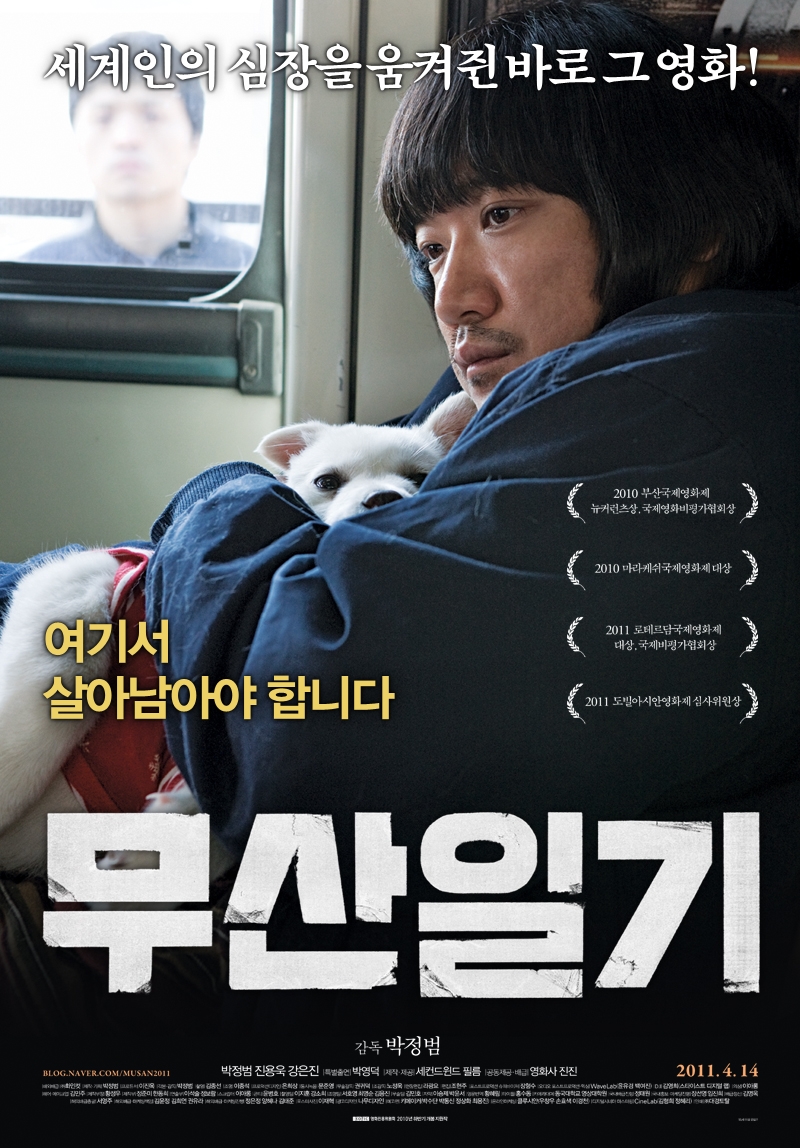
The Journals of Musan (무산일기, Park Jung-bum, 2011)

Journals of Musan posterIf you’ve made it out of North Korea, travelled all the way through China, and finally arrived in the promised land of the South, you might expect to find yourself in a kind of paradise free of violence, fear, and oppression, where opportunity and freedom rule. The reality, however, is rarely so pleasant. Those arriving from the North do so with little support, face constant stigma and the threat of exploitation, and may end up just as hungry and alone as before. The hero of Park Jung-bum’s Journals of Musan (무산일기, Musanilgi) is one such lonely soul who finds himself tested and betrayed until cheated even out of his own innocence.

After months in a resettlement centre, Seung-chul (Park Jung-bum) is living with a friend in a rundown flat next to a village knocked down to pave the way for yet another batch of swanky middle-class homes on the periphery of an ever expanding city. Assisted by a friendly policeman who urges him not to tell his prospective employers that he’s come from the North, only that he’ll work hard, Seung-chul looks for honest work but finds it difficult to come by, not only thanks to the mild stigma attached to being a defector but his relative lack of equivalent qualifications, and restrictions on his movements. Meanwhile his roommate, Kyung-chul (Jin Yong-ok), has decided the best buck’s a fast buck and started an individual enterprise “assisting” his fellow North Koreans sending money home via his uncle in China for a “small fee”. The only job Seung-chul can get is pasting up fliers for clubs and bars often over those for other establishments at the behest of an exploitative gang leader who rarely pays him and threatens to take the work away altogether if Seung-chul continues to refuse the less legal jobs he’s often “offered”.

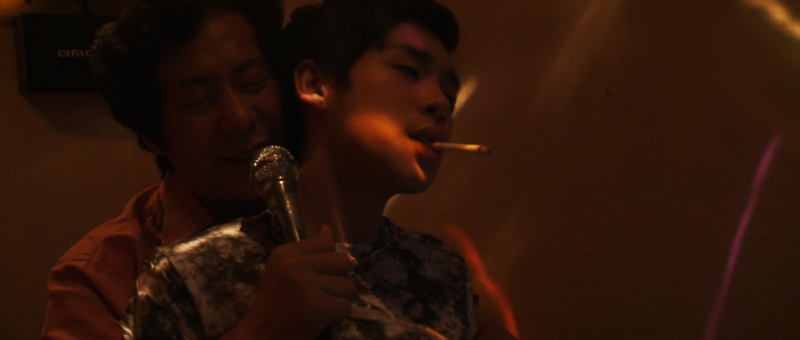
Seung-chul is an innocent, godly soul who truly believes it should be possible to live honestly and with kindness in a land of freedom. His only refuge is the local church of which he is a devout member, but even here he is an invisible outsider who sits and eats alone only just brave enough to venture in in the first place. Developing a fondness for a pretty woman in the choir gives Seung-chul another reason to attend, and eventually a hope of a job too when he silently follows her to the karaoke bar she works in where they happen to be in need of another pair of hands.

The church, however, is just one of the many institutions to renege on their promises, offering relatively little in terms of real support to suffering men like Seung-chul who are granted only superficial welcome. Sook-young (Kang Eun-jin), the young woman Seung-chul idolises, is ashamed of her job in the karaoke bar which she feels to be immoral and in conflict with her otherwise intense religiosity, taking against Seung-chul on spotting him at church in fear that he will spill the beans and out her as an impure woman among her flock. Seung-chul would never do such a thing, though as he points out he doesn’t have any friends there to spill the beans to anyway.

In any case he continues to admire her from afar while she remains oblivious though slightly irritated to think he may have formed an attachment to a “helper” girl after he gets into a fight with a drunken patron who was touching her inappropriately. “Why do you care about people like that?” she asks him, tellingly, exposing her religiosity as the puritanical kind all about rules and oppression and not at all about compassion or kindness. Sook-young looks down on the helper girls as fallen women, advising Seung-chul that a godly man like himself has no business falling for “that sort of girl” before firing him when she catches him singing hymns in the karaoke booth, convinced that his excuse of not knowing any other songs must be a lie.

Sook-young seems to have no idea Seung-chul is from the North. True enough he speaks little but no one picks up on his accent and he’s been trained not to volunteer the information for fear of rejection. Once she finds out, Sook-young is full of remorse, actively inducting Seung-chul into the church and making him her good deed for the day. It’s not only the social stigma that plagues Seung-chul, but a kind of exoticisation. Kyung-chul’s other sideline is earning money through lectures to anti-communist organisations to whom he parrots the accepted line on North Korea – the violence, the oppression, the famine, though stopping short of the full horror. Seung-chul, unwillingly dragged to a church support group, reveals the full extent of what it cost him to survive and discovers no one quite wanted that level of honesty or is willing to help him in the depths of his despair. All anyone wants of a defector is to say what it is they want to hear, any deviation from the accepted line will not be tolerated in an eerie echo of all they’ve escaped.

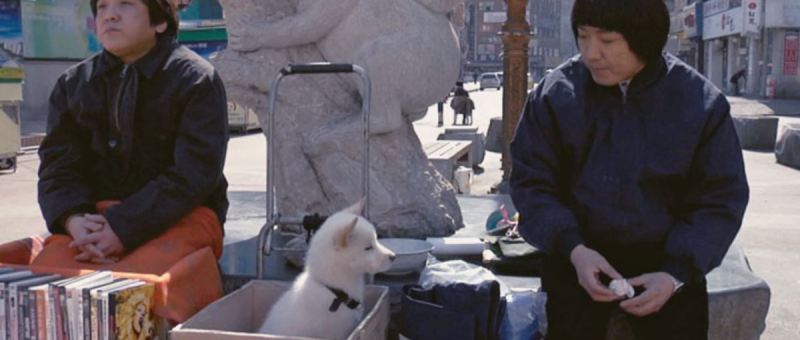
Gazing at an expensive tailored suit, Seung-chul chases dreams of success but finds only exploitation and abandonment. His only real attachment is to a little dog brought in off the street to whom he shows the tenderness no one has yet shown him but even this small comfort is not enough to sustain him in the fiercely capitalist environment of modern day Seoul. Seung-chul is presented with a choice, one which strains the fragile innocence he’d been careful to preserve for his new life, and finds himself no better than the world which surrounds him. North or South, survival has a price but you can damn yourself by paying it even in the knowledge that those around you sold out long ago.


The Journals of Musan was screened as part of the 2018 London Korean Film Festival.

International trailer (English subtitles)

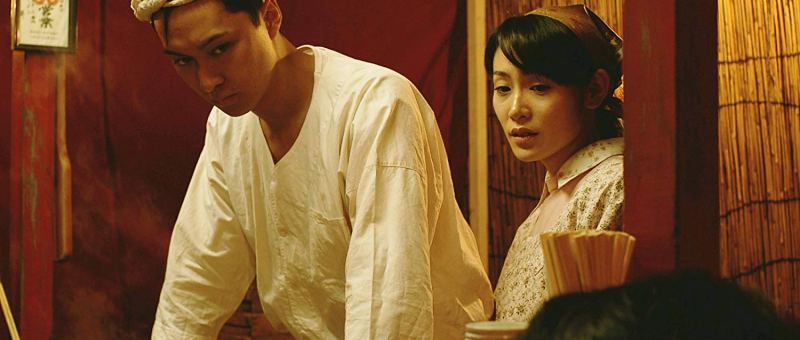
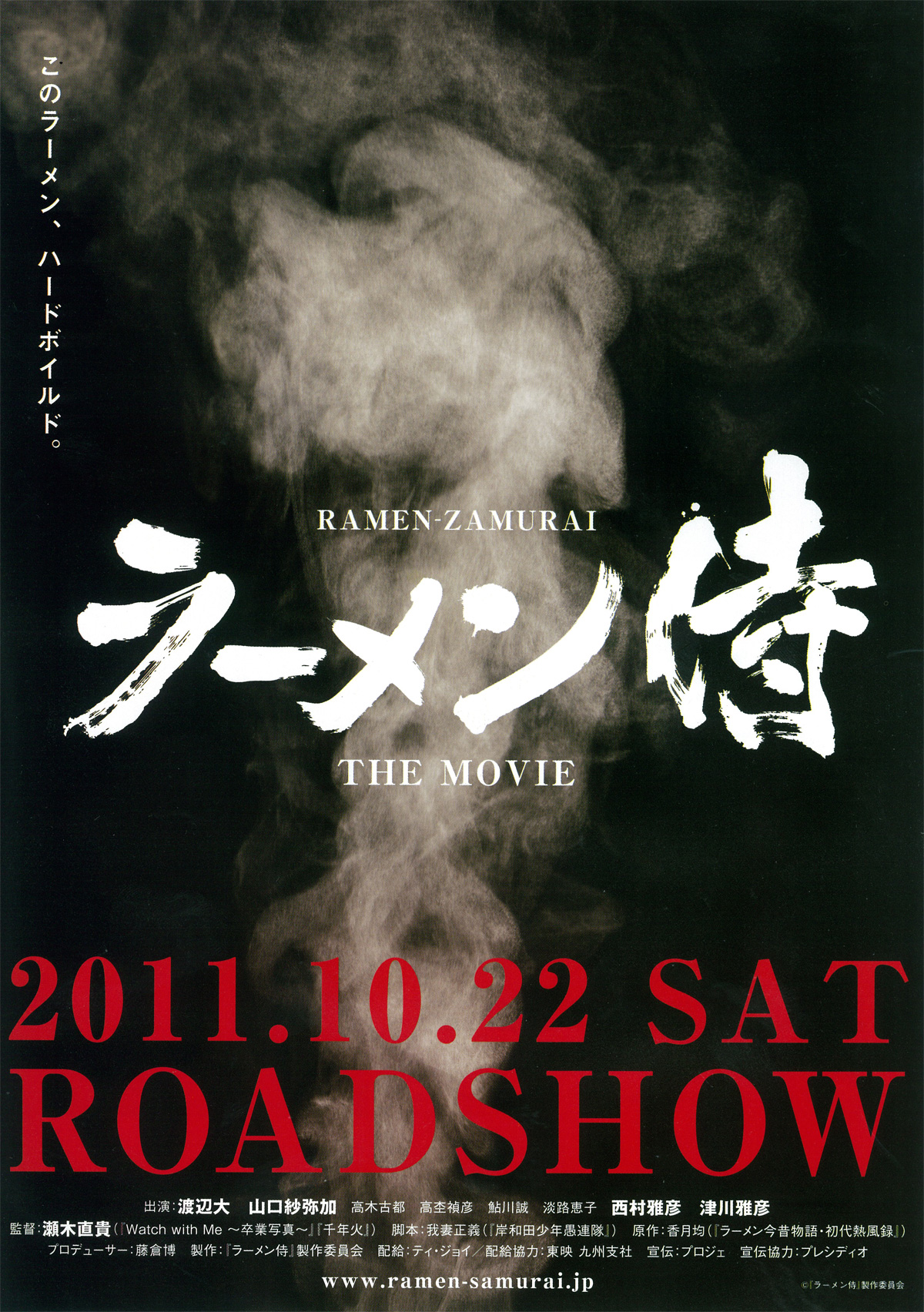
Ramen Samurai (ラーメン侍, Naoki Segi, 2011)

Ramen Samurai posterSet in the ‘90s, Ramen Samurai (ラーメン侍) is in many ways a post-Showa story or a tale of one man’s reaction to bubble era disillusionment. It’s also in the fine tradition of legacy movies in which a troubled child reflects on a complicated relationship with a late parent and struggles to accept their role as an inheritor of skills and knowledge they’d spent much of their youth attempting to reject. Yet the hero of Ramen Samurai, though he maybe reluctant, is more willing than most to pick up his father’s burden, walking back through family history with his long-suffering mother and rediscovering the heroism which lay behind his sometimes difficult father’s tough guy exterior. Hikaru (Dai Watanabe) does not see himself as a man like his father – he’s no “hero” and bears no natural inclination towards rebellion, but only through addressing his father’s life can he learn to define his own. This is all, of course, a roundabout way to discovering the soul of ramen lies in the confidence of the chef.

In 1990 Hikaru, a graphic designer, gets a call at work from his mum to let him know his father has had a stroke. Hikaru left town in a hurry some years earlier, rejecting the idea of taking over the ramen restaurant for a life in bubble era Tokyo. On his father’s death he assumes his natural responsibility and comes home but customers say his ramen’s not as good as his dad’s, and he has trouble keeping his staff in line because they simply don’t accept him. Try as he might, Hikaru just can’t seem to find a way to replicate his father’s recipe, in the store or in life.

Yet there’s a nostalgia in him that sees him want to try. Kurume, a small town in Kyushu, is defined by its ramen – a local delicacy that once brought tourists and general prosperity to the area, but during bubble era “modernisation”, the “backward” yatai ramen stands with their colourful tarpaulins were deemed too reminiscent of post-war privation to survive. The carts were shunted away from the new sophisticated city centre while the police started restricting licenses to run them, eventually prohibiting their sale and limiting their inheritance to direct family members. Hikaru is at least his father’s son and so has a natural right to take over the business even if he has hitherto rejected it.

Rather than a cooking tale, Ramen Samurai steps back to tell the story of its vicarious protagonist – the problematic figure of Hikaru’s dad who is, in many ways, the idealised figure of the Showa era “hero”. That’s not to say he was perfect – he drank to the point of financial ruin and frequently caused problems for his family, but his heart was always in the right place and so he was mostly forgiven. A salt of the Earth type and cool with it, Hikaru’s dad was the big man around town and the defacto leader of the yatai owner community. He brooked no injustice, stood up to the yakuza (who only had the profoundest respect for him), and sought to protect those who were unable to protect themselves. Seeing a sleazy yakuza molesting a young girl, Hikaru’s dad kicked him out and later offered the girl, who is mute, a job and a place to stay, almost adopting her into his family until another act of random kindness accidentally reunites her with her own long-lost father.

Faced with such an intense legacy, it’s no wonder Hikaru struggled. A sensitive, artistic soul he tried his luck in bubble era Tokyo working in an advertising agency where he found the coolness of his colleagues puzzling and difficult to bear. Hikaru’s boss loudly discusses pub lunches and evenings spent in hostess bars, often throwing away the lovingly made bento provided by his wife. Returning home with an empty lunchbox is, he says, his way of showing love though his refusal to eat it perhaps a reaction against a salaryman’s lack of freedom. Nevertheless, even if they clashed in terms of personal morality, Hikaru’s boss compliments him on his commitment to hard work and growth as an artist even whilst admitting that the work itself is often frivolous and ultimately thankless.

Hikaru eventually learns to channel his artistic inclinations into his ramen, seeing himself as a “ramen artist” incorporating his father’s legacy into a dish which is entirely his own. In a sense, Hikaru retreats into the safety of the Showa era past, or that is the cosy 1970s in which he lived a comfortable, if eventful, childhood under a yatai’s awning while dad made trouble but only for the best of reasons. A samurai’s duty is, after all, to protect and Hikaru has decided to do exactly that in “restoring” his hometown to its former glory, dragging retro yatai culture into the rapidly disintegrating post-bubble world and bringing warmth and community back with it.


Original trailer (no subtitles)

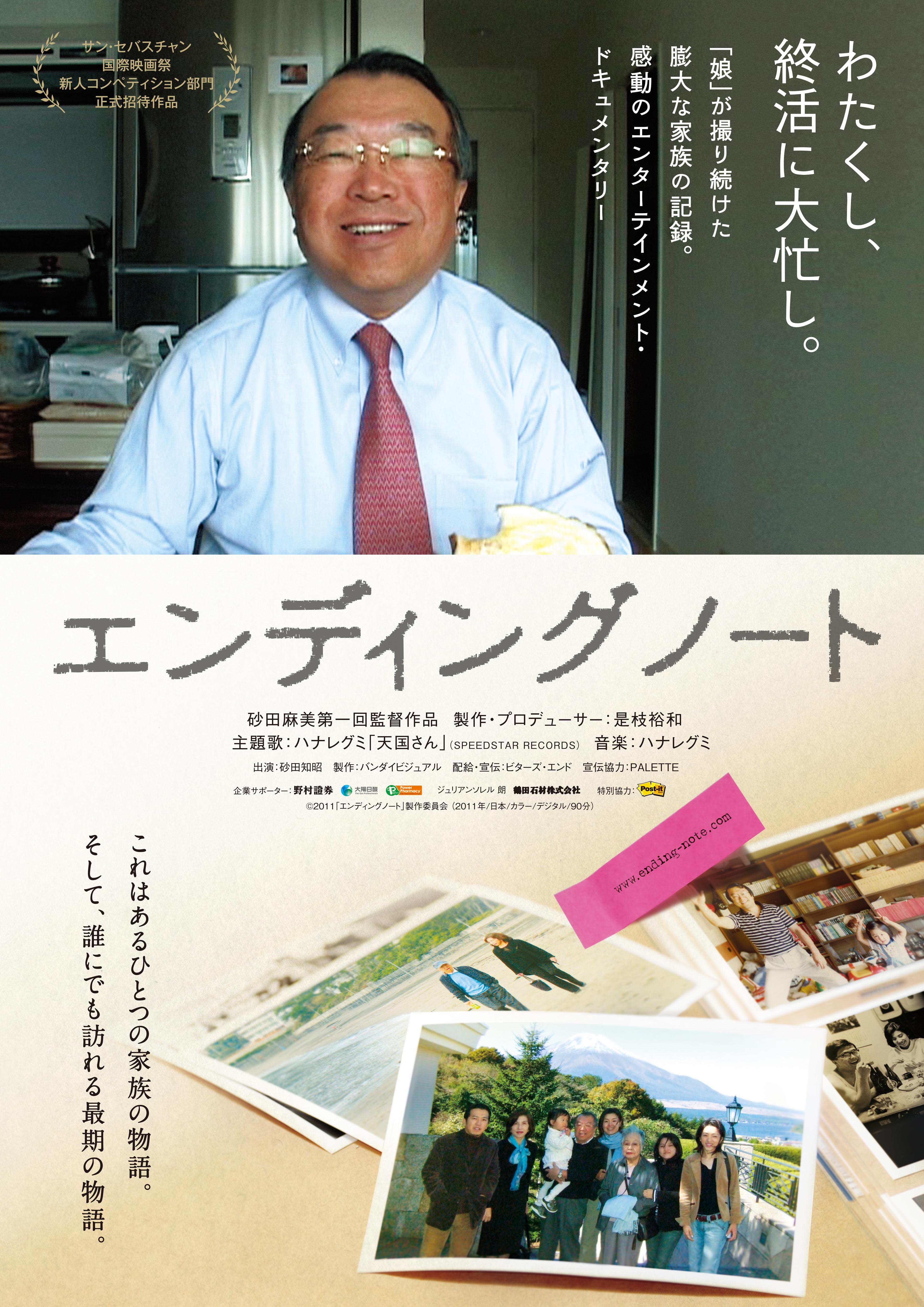
Ending Note: Death of a Japanese Salesman (エンディングノート, Mami Sunada, 2011)

emi_3For various reasons, external commentators on Japanese culture have long held the view that the idea of “death” takes on a much more central position in the lives of ordinary people than it might elsewhere. Death is, however, as much of a taboo in Japan as it is elsewhere – few want to talk about the process of death and dying, of illness and of caring for the sick. Perhaps as a way to evade this particular paradox, there is another tradition in which those aware of their own impending death write a kind of letter for those they will leave behind. Like a testament which accompanies a will, the “isho” can include biographical details, confessions, advice and apologies by way of a final word of parting and a demonstration of having accepted one’s death.

This concept is what inspires the subject of Mami Sunada’s documentary, Death of a Japanese Salesman (エンディングノート, Ending Note), in his desire to create an “Ending Note” when diagnosed with terminal stomach cancer shortly after retiring from a lifetime spent as a regular salaryman. Tomoaki Sunada’s “Ending Note” is intended to be something warmer than an isho and completely divorced from any legal concept but nevertheless a kind of letter saying the things it was too hard to say out loud.

Sunada captures her father’s last days with equal parts affection and detachment. Tomoaki is a humorous man whose wide grin and dry wit help to alleviate what is an unavoidably heavy subject as he comes to terms with the aggressive nature of his illness. The thing is, Tomoaki never gets round to writing that “Ending Note” because he’s just too busy living to think about dying. What he writes is a kind of bucket list which runs from typically practical concerns such as looking at venues in which his funeral might be held and talking over converting to Christianity, to definitively patching things up with his wife and getting to see his three grandchildren again who live abroad in America because of his son’s job.

Living in America Tomoaki’s son perhaps has things a little easier than his father did (even if he’s inherited Tomoaki’s notorious attention to detail and meticulous planning). As Tomoaki puts it in one of Sunada’s flashback moments, middle-aged men like him built the modern Japan. Exclaiming “The company is life!”, albeit with an ironic smile on his face he leaves for work just as he did every morning for over forty years at the same company and for most of it in marketing and sales. The traditional Japanese family demanded a strict division of labour with men pouring their efforts and emotions into their careers and women, supposedly, subsuming their hopes and desires into creating a happy family home. During their working lives, therefore, men like Tomoaki rarely got to see the families they were working to support, placing undue burdens on their wives and appearing as little more than absent disciplinarians to their children. Retirement offers an opportunity to finally become a part of family life, enjoying the days out and long lunches often so impossible for a company man, but Tomoaki has been robbed of the right to enjoy his old age by a cancer diagnosis received almost immediately after the end of his career.

Sunada in effect writes her father’s Ending Note for him, both through the film and the voice over narration she herself delivers written in her father’s playfully ironic authorial voice. Taking cheeky potshots at herself as the “accidental” youngest child whose still unmarried state apparently weighs on her dying father’s mind, Sunada adds both bite and warmth to her “father’s” final words as he waxes philosophical on death and the afterlife while trying to plan pragmatically for his own eventual end. The whimsical indie score also lends to the lightness of the exercise but Sunada does not shy away from the rapidity of her father’s decline or cruelty of his illness, taking her camera away only at the moment of death. Raw and painful, Sunada’s fearsome exploration of the process of dying is one of ordinary tragedy but also becomes a glorious celebration of life from all of its sadness and difficulties to shared laughter and the joy of new arrivals.


Screened as part of Archipelago: Exploring the Landscape of Contemporary Japanese Women Filmmakers.

Original trailer (no subtitles)