Dual City (デュアル・シティ, Yokna Hasegawa, 2015)

dual cityCyberpunk and Japan are a match made in heaven though, it has to be said, it’s often been much more an inherited influence in international pop culture than something which has originated directly in Japan. Yokna Hasegawa’s Dual City (デュアル・シティ) puts this to rights a little with a politically infused tale of Japan in 2034 – a nation divided and engaged in a wider information war with the little guy at the mercy of evil corporate giants.

The year is 2034, following a civil war Japan has been divided in two with a north/south border located at the feet of Mount Fuji. Our protagonist, Yoriko, is a nurse and mother working in the North sector which is definitely thought of as the least advantageous place to be. When her hospital is raided by guerrilla soldiers, Yoriko finds herself in the relatively lucky position of last survivor but is then charged with assisting this “resistance movement” by taking over from the soon to be dead insurgent, Gou, and completing his mission of carting a mysterious suitcase across the border.

Once in the south, we’re introduced to the rest of the band including the dynamic Ayumi who can’t seem to forgive Yoriko for the loss of Gou. The gang’s ultimate goal is to expose the shady Nephe corporation who, aside from their business interests of arms dealing and android production, have begun building a virtual world known as “information life” which is constructed through harvesting the memories of Northern corpses. Yoriko lost her daughter to terrorist aggression and the idea that she might be able to see her again, albeit in virtual form, is one which she is unable to pass up.

Adding to the intrigue is the love story between a resistance member and an android which may or may not come to be a liability and the hacker group’s involvement with the steady stream of illegal migrants somehow making the dangerous cross border journey into the relative safe haven of the South. Many of these people have injuries or ailments that would be best served by a doctor, but having no proper papers they can’t risk a hospital and so the care that Yoriko can provide becomes another useful asset for the group.

Drawing parallels with other “divided” nations, Dual City looks at a multitude of contemporary social and philosophical problems from dealing with refugees fleeing an oppressive regime to the power of multinational corporations and the eternal quality of a mother’s love. Nephe (represented in a futuristic ad campaign starring Third Window Films’ Adam Torel as its heinous CEO) commits the very worst kind of identity theft as it steals and repurposes the very soul of those that it has killed by sucking out their memories and using them to create artificial counterparts in their online world. Are these ghosts in the machine any less “real” than their flesh counterparts were? A standard question of the cyberpunk world and one which still has no clear answer, but Dual City continues to explore it in a mature and nuanced manner.

Though an undoubtedly low budget, indie movie Dual City makes a decent job of creating its realistically grimy cyberpunk world with its interactive video screens and invisible techno warfare. Special effects, though sparse, are effectively achieved and never call attention to themselves. Dual City is actually the second part of a projected trilogy with the overarching title of Japan Year Zero (following the 2014 short Illuminations) but is perfectly intelligible even without knowledge of the previous film and manages to create a sense of a bleak, oppressive society which travels along with Yoriko from the totalitarian North to the supposedly freer South. Eventually Yoriko’s love for her daughter transforms and becomes something larger, an eternal and infinite love for all mankind that represents our last, best hope for peace. It only remains to be seen if the troubled society of 2034 can can learn to follow a similar road.


Reviewed as part of the SCI-FI London Film Festival 2016.

On a side note, Illuminations seems to be the film Hoshi Ishida was talking about when I interviewed him (for UK Anime Network) a couple of years ago. Small world! I would like to see the movie but it doesn’t seem to be available anywhere, maybe one day. Here is a trailer for Illuminations:

You can also keep up with director Yonka Hasegawa’s work via her website and twitter feed!
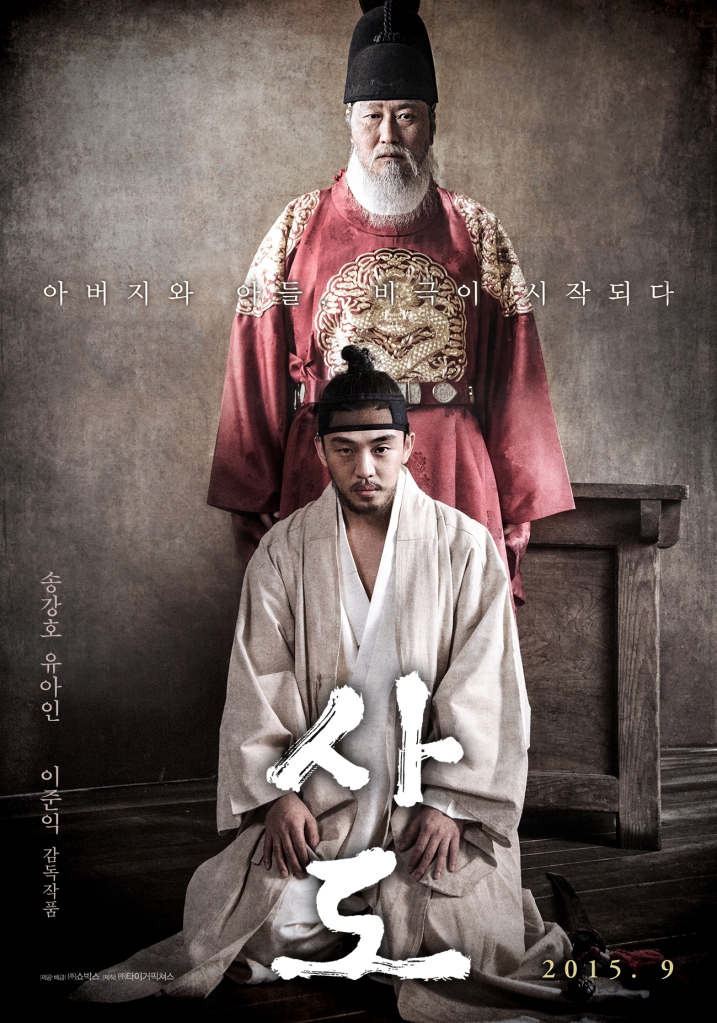
The Throne (사도, Lee Joon-Ik, 2015)

the throneWhich one is worse, the son who tries to kill his tyrannical father, or the tyrannical father who executes his own son and heir? A collection of sad stories all round, Lee Joon-ik’s The Throne (사도, Sado) is a historically inspired tale of familial conflict played out on a national stage. Where another nation might have entered into a bloody civil war, this very private tragedy keeps its bloodshed within the palace walls but still does not lack for cruelty.

Told in a non-linear fashion, The Throne takes inspiration from the 1762 incident in which the ageing King Yeongjo has the Crown Prince, his son later named Sado, executed in the most brutal of ways – confinement inside a heavy wooden rice chest placed inside the castle courtyard where he will be denied food and water until events take their natural course. In flashbacks we see that the king did love his son once but as the boy grew older and became something other than what his father desired of him, his love turned to disappointment and then to fear and disgust. The legends say that Sado was a madman – a murderer or deviant who needed to be eliminated, or just the victim of a conspiracy, but his anger with his father is easily understandable even if it hadn’t been for a seemingly crucial episode where he was forced to endure a feat of painful endurance which almost cost him his life and, perhaps, provoked something akin to madness.

Yeongjo is an austere man, devoted to scholarship. He began Sado’s kingly tutelage at just two years old but even if he was a bright little boy he eventually grew bored with his father’s educational regime of dull rote learning and constant tests preferring the relative freedom of outdoor life with swords and arrows and far less judgement. Sado likes to paint too, but this also falls under his father’s definition of pointless frivolity and so is just another thing which earns him nothing but disdain from the man who would make him king.

Things come to a head when Yeongjo suddenly declares he wants to retire as a ruler and abdicate in favour of his son who is anything but ready. Settling on a regency agreement sounds like the ideal compromise but turns out to be quite the reverse as Sado is merely a stooge for his father who only uses the situation to perpetually humiliate him in front of his courtiers. Sado himself has different ideas to his father about how things should be done in that his father’s emphasis on keeping peace at court had largely resulted in deferring to the more powerful lords at the expense of the poor which is one way to rule country, but perhaps also the most selfish.

When Sado has a son who seems to be everything his father isn’t, tension only rises as Yeongjo first rejects the boy as an infant only to later seek deposing his son in favour of his grandson. Simply put, Sado is now surplus to requirements and despised by his father who also happens to be the king so things are not looking good for him even if he hadn’t descended into a kind of madness which, like Hamlet, briefly cleared and allowed him to stay his hand rather than kill a king where compassion proved his weakness.

Added to the historical intrigue and the tragic misunderstandings between fathers and sons, The Throne adds in a comment on the vagaries of rigid social systems which set out correct and incorrect ways of living, even down to the the ties on the hem of a pair of trousers. Sado wasn’t cut out for his father’s life of dry book learning and calculated appeasement. He was an artist and an athlete – a man of action who might have made a fine king at any other time but could never have been what his father wanted him to be (which was essentially just another version of himself). Yet no deviation can be permitted in this extremely regimented kingly court where a single misspoken word or misplaced action can be enough to seal your fate.

When prompted for a kind of explanation at the end of the film, Sado repeats one of the teachings from his father’s books – that in the end laws and decorum are less important than the men that stand in front of them. He placed the man before the idea but was not rewarded with the same degree of feeling – only a cold and dispassionate application of the law. In part an exploration of a historical event which is both personal and national tragedy, Sado is the time old story of a father and son who are unable to understand each other, snatching only a few brief moments of connection before the inevitable separation. A partial posthumous pardon only serves to deepen the tragedy of a son driven mad by his father’s unpredictable cruelty and even if the film ends on a note of melancholy reconciliation with the past, the central message of fathers attempting to force their own world on their unwilling sons is one that rewrites itself with each passing generation.


Reviewed at a “teaser” screening for the London Korean Film Festival.

https://www.youtube.com/watch?v=SR89DcvmAtY

They Call Me Jeeg (Lo Chiamavano Jeeg Robot, Gabriele Mainetti, 2015)

JEEGItalian cinema once had a hearty appetite for genre fare, but has long since abandoned the weird and wacky in favour of the arty or the populist. You wait years for an Italian superhero movie and then two come along at once. Following on from Gabriele Salvatores’ much younger skewing The Invisible Boy which perhaps owed more to Spy Kids than anything else, first time director Gabriele Mainetti brings us a bloody, R-rated yet humour filled look at the superhero genre filtered through Japanese manga and anime rather than US comic books.

The film begins with an aerial shot of Rome accompanied by loud panting which turns out to belong to petty criminal Enzo (Claudio Santamaria) who is currently running hell for leather away from the various policemen who are chasing him. Eventually he dives into the Tiber where he accidentally puts his foot through the lid of some barrels which have been dumped in the river and gets covered in some kind of gunk. After finally getting home he’s violently sick and shaky but probably thinks it’s just from being cold and wet or some other random thing picked up in the water.

At this point, he decides to sell his genuine rolex watch through a fence he knows, Sergio (Stefano Ambrogi), who currently works for a gangster named “Gypsy” (Luca Marinelli). Sergio ends up taking him on a job which is supposed to involve extracting drugs from inside a pair of dope mules but one of them is in a fairly bad way and Sergio’s refusal to take him to a hospital sees the other one grab his gun and shoot him. Enzo is caught in the shoulder and falls nine floors down to the street below but actually is pretty much OK. Later he realises his gunshot wound is healing surprisingly quickly and he’s apparently super strong too. With great power comes great responsibility? When you’re as isolated as Enzo, maybe not so much.

Enzo is 100% not a match for The Chosen One. He is totally disinterested in his fellow human beings and just wants to be left alone. In fact, the first thing he does when he figures out he has superpowers is steal an entire ATM (he didn’t know about the anti-theft dye) and use the cash to buy a fridge full of yoghurt and some more porn to add to his collection. He isn’t even really very bothered about his friend’s death except that he’d rather not attract the attention of Gypsy and his henchmen.

However, Sergio had a grown-up daughter, Alessia (Ilenia Pastorelli), with some kind of psychological condition which has her in an infantilised state where she’s obsessed with the 1970s Go Nagai mecha anime series, Steel Jeeg. After Enzo, against his better judgement, jumps in to save her from Gypsy she becomes convinced that he’s the real Steel Jeeg and tries to persuade him to use his powers for the good of all humanity.

The de facto antagonist of the story, Gypsy (real name “Fabio”), is a petty gangster and former wannabe reality TV star with grand ambitions. The deal that Sergio was working on was part of a larger collaboration with the Neapolitan mafia who are starting to wonder where all their drugs have got to and are just about ready to come looking for them themselves. Gypsy’s yearning for fame is further irritated by the presence of the so called “Super Criminal” who is already a star on YouTube and immortalised in graffiti all over the city. A violent psychopath with a taste for flamboyant outfits and cheesy music, these twin pressures are fit to send Gypsy way over the edge.

Mainetti ties in current social concerns with the constant TV news reports about large scale protests against austerity and a series of terrorist incidents which are later said to be a mass conspiracy perpetrated by the mafia to try and influence government policy (seemingly successfully). Conversely, he satirises modern society’s dependence on social media with everyone whipping out their phones to try and capture Enzo’s superhuman capabilities and Gypsy’s attempt to make himself a YouTube star with some superhero stuff of his own as well as frequently mocking his former attempt to become a big name celebrity through taking part in a TV reality show.

Ironically, the actress playing the difficult role of Alessia was herself a star of Italy’s version of Big Brother and this is her first acting role. It has to be said that her performance is nothing short of extraordinary as she perfectly captures the strange innocence of this wounded child woman who seems to have experienced a number of traumatic incidents in her past which have pushed her further and further into her anime themed delusional world. In many ways she is the heart of the film using her own superpowers of love and innocence to try and reawaken Enzo’s humanity and push him towards becoming a functional human being who is able to recognise the potential for good his new found powers may have.

Though filmed for an extremely modest budget, They Call Me Jeeg displays extremely high production values mostly concentrating on in camera effects backed up with inventive cinematography. Refreshingly opting for a more grown-up approach, the film doesn’t stint on blood or violence either but is careful to avoid becoming exploitative and is also frank in dealing with its difficult romantic subplot. An impressive debut feature from Mainetti, They Call Me Jeeg succeeds not only in providing action packed entertainment but also manages to mix in a fair amount of humour to its subtly melancholic atmosphere eventually climaxing in an unexpectedly moving finale.


Reviewed as part of the Cinema Made in Italy festival at London’s Ciné Lumière in March 2016 where it screened under the title They Call Me Jeeg Robot.

There doesn’t seem to be an English subtitled trailer around yet but this film is so much fun I can’t even tell you!

Being Good (きみはいい子, Mipo O, 2015)

Being Goog J poster“Being good”. What does that mean? Is it as simple as “not being bad” (whatever that means) or perhaps it’s just abiding by the moral conventions of your society though those may be, no – are, questionable ideas in themselves. Mipo O follows up her hard hitting modern romance The Light Shines Only There by attempting to answer this question through looking at the stories of three ordinary people whose lives are touched by human cruelty.
The film begins with newbie teacher Okano (Kengo Kora) who is still trying to adjust to the extremely stressful life of a primary school teacher in charge of 38 little guys and girls. As he’s young and he’s only just started he’s filled with enthusiasm and is intent on doing his best to make a difference. On the other hand, he’s a young man with a private life of his own to think about and sometimes he’s just too tired to want to be bothered with a bunch of kids intentionally trying to push his buttons. When he notices one of the pupils hanging around the schoolyard everyday long after he should have gone home, he begins to worry about the boy’s life outside of school.

Strand two also features the life of an abused child as stressed out mother Masami (Machiko Ono) struggles to cope with her three year old daughter Ayane while her husband is frequently abroad on business. Having been an abused child herself, Masami enters a vicious cycle of hating herself for treating her daughter the way she does and resenting Ayane even more for making her feel this way. After becoming friends with a cheerful woman who seems completely at ease with her two rowdy kids, there may be a better way out on offer for Masami and Ayane.

The third tale is a little different than the other two as it encompasses themes of lonely older people in Japan’s rapidly ageing society and the position of those who are different from the norm. Akiko lost her entire family during the war and never had children of her own so she’s all alone now. Every evening while she’s sweeping the steps a young boy says “hello, goodbye” to her as he walks past. One day the boy is in a terrible panic because he’s somehow lost his house key but Akiko calms him down and takes him inside until his mother can come and fetch him.

Okano is full of good intentions. He wants to think himself a “good” person and genuinely wants to look after the young lives placed in his care. However, he is still young, inexperienced and a little bit vain so that the slightest bit of criticism niggles at him. Simply put, he just doesn’t really know what to do and several of his ideas backfire quite spectacularly or appear extremely ill-conceived. Some of this is still about him and his own idea of his being a “good person” rather than an altruistic desire to help the children under his care.

The same, however, cannot be said of the elderly lady who still takes such delight in the falling cherry blossoms which waft down from the school to her small suburban house. Akiko might be lonely, but there’s nothing selfish in the warmth she extends to others. When Hyato’s mother, Kazumi, arrives to fetch him, she’s immediately mortified, convinced that her son must have caused immense levels of trouble for this little old lady. Akiko claims not even to have noticed Hyato’s differences but remarks on how polite he is greeting her every evening and that he’s been the perfect houseguest – in fact she was enjoying herself so much she’s a little sorry Kazumi has turned up so quickly. Kazumi is completely overwhelmed by Akiko’s kindness – it’s the first time she’s ever heard anyone say something nice about her son rather than having people criticise him for being different. In fact, sometimes even she begins to forget how “good” he can be.

In the case of Masami and her daughter Ayane, it’s not that Masami is “bad” person but is responding to a cycle of violence that she finds impossible to escape. Masami doesn’t cope well with stressful situations, dislikes noise and disorder and has impossibly high (and arbitrary) standards for her daughter which result in “discipline” through physical violence. Nevertheless, Ayane loves her mother and, even if Masami recoils when Ayane tries to hug her, reacts with horror to cheerful friend Yoko’s joke of adopting her into their family. Ayane wants to be like her mum, taking delight in wearing a matching pair of shoes even if that means she can’t play with the other kids. As Masami was abused, so she abuses – will the cycle continue with Ayane? Luckily, the pair may have found a more gentle solution in the form of the kindly Yoko who proves far wiser than one would suspect.

As Okano’s sister tells him, when you’re nice to children, they’re nice to others. If everyone could be nicer to their children perhaps we could have a nicer world. The young boy whom Okano is trying to save has come to believe that he’s a “bad kid” – proven by the fact that Santa never comes to their house. He can’t bring himself to talk about his step father to his teachers and Okano’s interventions only make things worse for the boy. He needs someone to show him that he’s not at fault and that the world is not a bad place but it will take more than just “good will” to solve the problem. Sometimes, all you can do is knock on the door.


Reviewed as part of the Japan Foundation Touring Film Programme 2016.

This is the original trailer for the film but in my opinion it contains a few spoilers so bear that in mind if you plan on watching in the near future:

The Emperor in August (日本のいちばん長い日, Masato Harada, 2015)

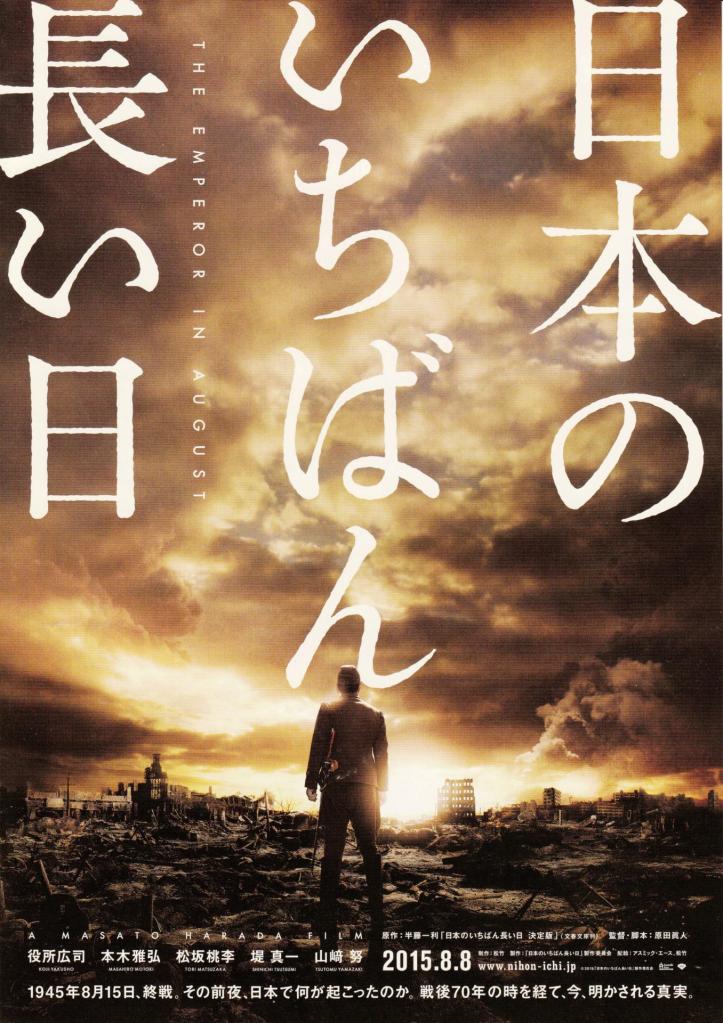
bbc56b4fff657dfc4fcc0499f8be9741How exactly do you lose a war? It’s not as if you can simply telephone your opponents and say “so sorry, I’m a little busy today so perhaps we could agree not to kill each other for bit? Talk later, tata.” The Emperor in August examines the last few days in the summer of 1945 as Japan attempts to convince itself to end the conflict. Previously recounted by Kihachi Okamoto in 1967 under the title Japan’s Longest Day, The Emperor in August (日本のいちばん長い日, Nihon no Ichiban Nagai Hi) proves that stately events are not always as gracefully carried off as they may appear on the surface.
By the summer of 1945, it’s clear that the situation as deteriorated significantly and Japan can no longer cling to any kind of hope of victory in the wider scale. Tokyo has been firebombed almost out of existence leaving only the Imperial Palace untouched – even the Emperor and his wife have been reduced to eating gruel. Everyone knows it’s time for a solution, but no one is quite ready to say it. In the wake of the atomic bomb, the situation becomes ever more desperate and even if the Emperor himself advocates a surrender, he needs the approval of his advisors. The Prime Minister, Navy and other officials are in favour but the Army, represented by General Anami, is committed to fighting on to the last man. Eventually, Anami comes around to the Emperor’s point of view but some of his men prove much harder to convince…

It might seem like a strange time to make a film about grace in the face of defeat given the recent political troubles stemming back to Japan’s wartime activities, but director Masato Harada is not lamenting the course of the war or trying to advocate for any rightwing agenda so much as trying to make plain the final absurdity of recognising when the battle is over. The civilians and even the Navy might be in favour of accepting the terms of the Potsdam Declaration and ending the war as quickly as possible but a soldier is a soldier and the Army wants to go down fighting. They aren’t alone, of course, there are ordinary people who feel this way too but the writing is well and truly on the wall here.

The bulk of the film takes place within the palace, debating halls or army buildings all of which have escaped major damaged but every time we venture outside we’re shown a scene of utter desolation. A great, gaping hole where once there was a city. Anami’s wife undertakes a four hour walk to try and get in contact with a man who knew their son and can tell them how it was that he fell somewhere in Manchuria. She sees people fleeing, some thinking the enemy are about to descend any minute or that Tokyo will be the next target for an atomic bomb, and walks on through a barren, eerie landscape emerging soot covered and, finally, too late.

Closer to home, the situation among the soldiers is reaching boiling point. Originally committed to rejecting the terms of the treaty, Anami is now in favour of a surrender (with a few caveats) and is desperately working against the threat of an internal coup. Though the top brass have seen enough of warfare to know when it’s time to put down your weapons, the young hotheads have not yet learned the value of pragmatism. Seeing themselves as a second incarnation of the February 26th rebels, a cadre of young officers breaks ranks to try and stop the Emperor’s message of surrender from hitting the airwaves, hoping instead to spread the false message that the Russians have invaded and it’s all hands on deck. Needless to say, they don’t fare any better than the young officers of 1936 and if anything their bullheaded refusal to see sense becomes a microcosmic allegory for the years of militarism as a whole.

In the midst of all this chaos, the real heart of the film is Koji Yakusho’s conflicted general who feels his era passing right in front of him. Grieving for his fallen son yet also clinging to his military duty which dictates no surrender, no retreat he finally sees each of his ideals crumbling and comes to the realisation that the only way to save Japan is to abandon the military. Making a sacrifice of himself, he ensures the safe passage of his nation along a road on which he cannot travel.

The Emperor is a sympathetic figure here, gentle, soft, wanting the suffering to end for everyone but being more or less powerless to effect it despite his title. All he can do is advocate and try to convince his council that surrender is the right course of action as his country burns all around him.

Harada manages to keep the tension high even though a lot of the film comes down to a group of men discussing the proper wording for a treaty. A timely and beautifully photographed exploration of the last days of a war, The Emperor in August is another much needed reminder that decisions which will affect millions of lives are made by handfuls of men in tiny, closed up rooms that most people will never get to see.


The Japanese blu-ray/DVD release of The Emperor in August includes English subtitles.

Unsubtitled trailer:

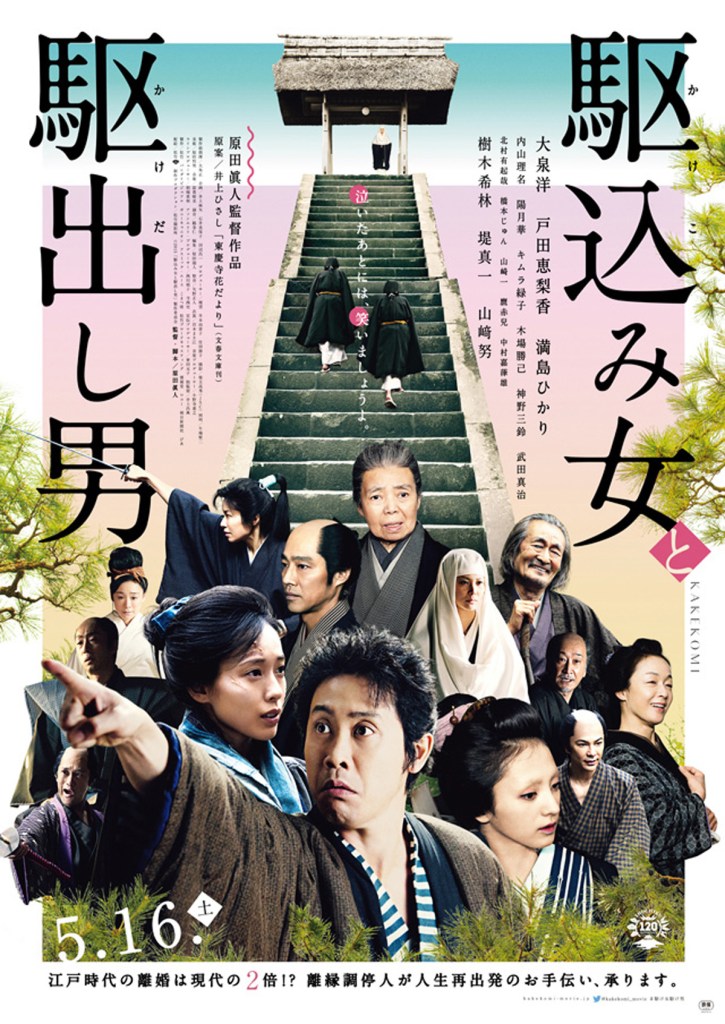
Kakekomi (駆込み女と駆出し男, Masato Harada, 2015)

166028_02The world of the classical “jidaigeki” or period film often paints an idealised portrait of Japan’s historical Edo era with its brave samurai who live for nothing outside of their lord and their code. Even when examining something as traumatic as forbidden love and double suicide, the jidaigeki generally presents them in terms of theatrical tragedy rather than naturalistic drama. Whatever the cinematic case may be, life in Edo era Japan could be harsh – especially if you’re a woman. Enjoying relatively few individual rights, a woman was legally the property of her husband or his clan and could not petition for divorce on her own behalf (though a man could simply divorce his wife with little more than words). The Tokeiji Temple exists for just this reason, as a refuge for women who need to escape a dangerous situation and have nowhere else to go.
Kakekomi (駆込み女と駆出し男, Kakekomi Onna to Kakedashi Otoko) places this important institution at its centre as it focuses on the stories of a number of women who’ve each ended up at the temple after a series of difficult circumstances. Jogo (Erika Toda) is married to a womanising drunkard who forces her to run his iron smelting business from the front lines (hence the painful looking blisters on her face) while he enjoys his life of debauchery. When the staff complains about his attitude and their subsequent fears for their jobs and Jogo raises their concerns with him he simply beats her before returning to his mistress. She then faces a decision – Tokeiji, death, or endurance. During her flight, she runs into O-Gin (Hikari Mitsushima), a mysterious wealthy woman who’s sprained her ankle after fighting off bandits in the woods. The pair bond on their quest to reach Tokeiji where they hope to find refuge from their turbulent home lives.

Before you can enter Tokeiji you’re held at one of the receiving inns where they hear your story, assess the possibility of being able to reconcile with a husband and, if deemed necessary, allowed to travel to the temple where you’ll live as a Buddhist nun for two years at which time your husband must legally sign the divorce papers. The inn adheres to strict Buddhist principles – no men are allowed near the temple (even the outside helpers wear bells so the ladies can hear them coming), you eat only temple cuisine (no meat or stimulants like garlic and onions), and have to abide by the word of the head nun. There are also three different classes of resident starting with the most expensive court lady lifestyle, then one of sewing and making repairs, and finally the lowest class which does all the day to day cooking, cleaning and other menial tasks.

The other pivot around which the film turns is the one time medical student Shinjiro (Yo Oizumi) who has literary dreams but has had to beat a quick retreat from Edo after defiantly breaking its ridiculous “no singing in the streets” law (amongst other things). At this period Edo and the surrounding area is undergoing its own mini cultural revolution as the current authorities advocate a period of austerity which sees things like literature, music and even sushi outlawed. Perceiving threats everywhere, the powers at be are also looking for a way to close down Tokeiji by any underhanded means necessary.

Shinjiro is a fast talking wise guy who can generally talk his way out of anything though he is also a keen student and a promising young doctor. As a relative of the Tokeiji inn owners, he’s seeking refuge too but also hoping to make use of their extensive archives for his writing career. As a doctor he’s immediately fascinated by the burns on Jogo’s face which he believes he can treat though in her frightened state she’s alarmed by his direct manner and refuses. After hearing his more reasoned arguments she finally submits and in turn becomes interested in his medical knowledge assisting him to gather herbs in the forest before starting her own herb garden in the temple.

Of course, the two develop a growing romantic attachment though frustrated by Jogo’s position as a married woman and the temple’s prohibition against male contact. Their romance is never played for melodrama, more as a simple and natural course of events though it’s well played by both Toda and Oizumi. At heart, Kakekomi is an ensemble drama which encompasses the often sad stories of its female cast who are each at the mercy of the cruel and rigid Edo era social system. O-Gin’s reasons for fleeing to Tokeiji turn out to be a little different from everyone else’s though she too is still suffering for love.

A humorous look at this untold story, Kakekomi proves an engaging ensemble drama anchored by the committed performances of its cast. Toda takes Jogo from a frightened and abused woman to a confident and learned scholar who is perfectly capable of taking charge of things on her own and her transformation is the true heart of the film. Apparently, director Masato Harada shot nearly four hours of footage before cutting the film down to the more manageable two and a half which may explain why it sometimes feels a little abrupt but nevertheless Kakekomi proves one of the most enjoyable mainstream Japanese movies of recent times.


The Japanese blu-ray/DVD of Kakekomi includes English subtitles.

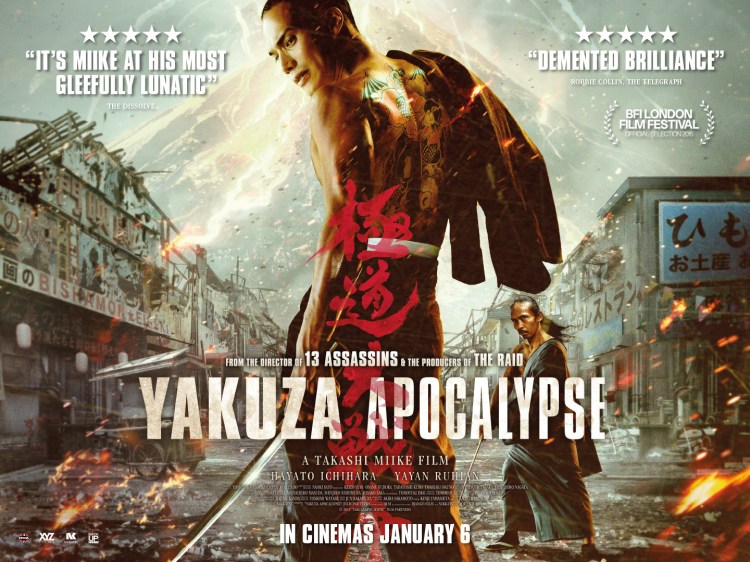
Yakuza Apocalypse (極道大戦争, Takashi Miike, 2015)

Yakuza-Apocalypse-Quad-HalfSize-NEWBelated review from the 2015 London Film Festival – Yakuza Apocalypse is released in UK cinemas for one day only on 6th January 2016 courtesy of Manga who will also be releasing on home video at a later date.


Takashi Miike shuffles back towards the yakuza plains in the western inspired horror comedy Yakuza Apocalypse (極道大戦争, Gokudo Daisenso) trailing ever more zany humour behind him. Yakuza gungslingers, bloodsucking, high school girls running away from things and, finally, a guy with a magic belly button wearing a frog suit who just happens to be “The World’s Toughest Terrorist”.

We open in media res as vampire yakuza boss Kamiura (Lily Franky) cuts up a storm in settling some local disputes. There’s a handy voice over from our soon to be protagonist, Kageyama (Hayato Ichihara), lamenting the old yakuza world of tough guys and honour codes but things don’t really take off until a very geeky looking guy and a Van Helsing type in 17th century attire suddenly turn up hoping to re-recruit the boss to “The Syndicate”. When he refuses, they fight and the geek twists Kamiura’s head right off. Using his last ounce of strength and in a touch right out of Hausu, Kamiura clamps onto Kageyama’s neck turning him into a vampire. However, in his just turned state, the honourable Kageyama turns a few more vampires of his own – and not only vampires, the bite also transmits yakuzaism too. This increase in bloodsucking gangsters is a bit of a problem for the regular guys as it does mean their pool of victims is being steadily depleted…

Not making much sense is not generally much of a problem in a Miike film. In fact, it’s a pretty much a given at this stage of the prolific director’s career. However, in the case of Yakuza Apocalypse it’s even more pointless than usual to pay any attention at all to any kind of narrative. Looking over Kageyama’s shoulder, we move from set to piece to set piece as, first of all, the non-vampire yakuza guys struggle for power between themselves and then with the vampire variety before the giant frog turns up to ruin everything.

There are some rules, Miike takes a while explaining to us how this yakuza business works with Kamiura as the “good” kind of yakuza committed to protecting his townspeople above all else – essentially, he’s the sherriff around these parts. He’s a vampire, yes, but he only feeds on yakuza who he’s “reforming” by means of an underground knitting circle held prisoner in his basement. Apparently yakuza blood tastes bad and isn’t very good for you but eating civilians is dishonourable and anyway, limited in supply, because when you turn someone they also become a foul mouthed yakuza fighting machine.

The world building is shaky at best, none of this really hangs together making for a fairly disappointing series of one note jokes. There is an attempt at a bit of more sophisticated satire with the regular gangsters suddenly lamenting that there will be no one left for them to prey on if everyone turns yakuza vampire but otherwise it’s crazy piled on crazy. Not a bad thing in itself but somewhat lacking in substance.

Despite that, the film offers some quality performances notably from its lead, Kageyama, played by Hayato Ichihara, as the yakuza who’s so sensitive his delicate skin won’t allow him to get a proper yakuza tattoo. That is, until he becomes a brooding, conflicted vampire mourning the loss of his boss and of those long held tough guy ideals. Lily Franky also offers a high impact though short lived appearance as the honourable vampire boss with a hinted at backstory, though the much publicised cameo of The Raid’s Yayan Ruhian feels a little wasted as he’s just generally hanging around for a handful of fight scenes. That said, the action scenes themselves are extremely impressive, both exciting and often funny too.

Yakuza Apocalypse is not one of Miike’s most well thought out efforts. Its collection of crazy ideas feels thrown together and there’s disappointingly little depth to its world building. Even its media res conclusion looks more like running out of ideas than a deliberate decision. However, that’s not to say it isn’t heaps of fun, which it often is. A crazy frog riding a bicycle who somehow wakes up the giant king of the crazy frog people after some kind of emergency plaster is ripped off his belly button – really, what could be more fun than that? That really is all there is though and those who prefer their absurdist action thrills with a little more substance had best look elsewhere.


Yakuza Apocalypse is in released in UK cinemas for one night only on 6th January 2016. Luckily the film is playing across the UK even if it’s only the one night and you can see if it’s on anywhere near you by checking out this handy link! If it’s not, don’t despair! It’ll also be available in all the normal ways from Manga later in the year.

Reviewed at the 2015 BFI London Film Festival.


La La La at Rock Bottom (AKA Misono Universe, 味園ユニバース, Nobuhiro Yamashita, 2015)

プリントNobuhiro Yamashita has made something of a career out of championing the underdog and La La La at Rock Bottom (味園ユニバース, Misono Universe) provides yet another foray into the lives of the disposed and degraded. With a lighter touch than some of his previous work, the once again musically inflected film is another testament to the power of redemption and that you can still turn your life around if you only have the courage to take the chance.
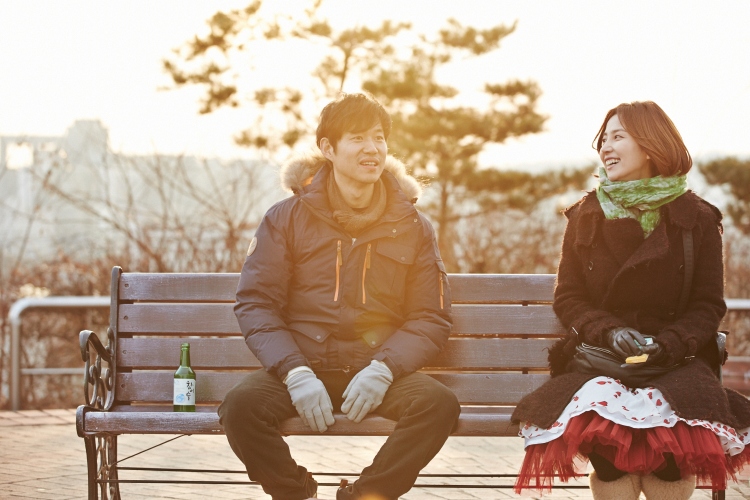
The film begins with a young man being released from prison. The guard apologises about the smell of mothballs emanating from the man’s jacket, usually the family bring clean clothes. No family has come for this inmate though – just a couple of cool seeming characters who profess their gratitude for “what you’ve done for us” but the reunion is anything but warm. A little while later the man is unceremoniously bundled into a car and taken off to a quiet place where he is beaten half to death by thugs using baseball bats. After waking up, he stumbles around and eventually chances on a summer festival with a band playing on the mainstage. Zombified, the man grabs the mic and starts singing before promptly collapsing again.

The band’s manager, a young girl, takes the man home whereupon she discovers he’s lost his memory. Giving him the ironic nickname of “Pooch” (Kasumi also has a habit of picking up stray dogs), the band and local villagers quickly “adopt” the confused stranger and let him work at their karaoke rooms and studio whilst coaching him to become their new lead singer. However, as Pooch’s memories start to return it seems that his former life may not have been as tranquil as his laid-back amnesiac persona might suggest.

Like much of Yamashita’s previous work, music plays a central role with the one thing that Pooch remembers from his former life being the lyrics to a particular song and his innate singing talent. The leading role of Pooch himself is played by real life singing star Subaru Shibutani of Kansai based idol band Kanjani Eight who proves himself more than capable of belting out these hard rock/enka tracks as well as being able to imbue Pooch’s amnesiac blankness with his own specific character. He is ably supported by the popular young actress Fumi Nikaido who turns in yet another impressively nuanced performance as the older than her years Kasumi.

The beginning of the film gives us quite an idea of the man Pooch may have been and the kind of life he’s led. As the revelations pile on and Pooch’s memories inevitably return threatening the new life and personality he’s begun to build with the band and the possibility of fulfilling a long abandoned dream of being a singer, his dark side begins to break through and we’re shown a man lost in rage and violence left with nowhere to turn. At the end of the day, “Pooch” has been given a valuable opportunity to start all over again but it requires him to make the choice to do so. Go back to being “Shigeo”, a self hating thug who’s alienated absolutely everyone in his life or choose to become Pooch and earn a second chance to be the man he always wanted to be.

Like Yamshita’s previous film, Tamako in Moratorium, with which it also shares a lot in terms of style, La La La offers no great revelations or technical bells and whistles but revels in the simple pleasure of a tale told well. Like much of his other work, the central message is that it’s never too late to begin again (even if there are bridges which have been burned beyond repair) only that it requires you to make the sometimes scary choice to take a chance on something new. That choice rests with one person but is greatly aided by the support of others and the unusual bond between the two central characters (which stops short of romance) plus the uncompromising faith which Kasumi places in Pooch are some of the greatest joys of the film.

Perhaps not a career best from this still vastly underrated director, La La La at Rock Bottom is nevertheless another beautifully constructed addition to his filmography. Offering an extreme depth of performance from each of its ensemble cast, the film is rich with detail whilst also reflecting Yamashita’s trademark cinematic naturalism. Once again a musical feast for the ears, La La La at Rock Bottom is destined to become one of the director’s best loved films even in a career which has already offered so many as yet undiscovered gems.


Twenty (스물, Lee Byeong-heon, 2015)

Twenty Movie PosterReview of Lee Byeong-heon’s Twenty (스물, Seumool) up at UK Anime Network. I really felt so old watching this film.


The age at which you become “an adult” varies according to your culture but in Korea, as in Japan, at 20 you become fully grown up with all the rights and responsibilities that carries. The three guys at the centre of the Korean film Twenty are just walking through this magic doorway which marks the end of their childhoods and the beginning of their adult lives. The road has forked for them and they have to decide which path to take. However, they’ll have to take their minds off the opposite sex long enough to make a decision.

To state the obvious, Twenty is aimed at a very specific audience and is likely to please a certain group of people very well whilst leaving others a little lost and bemused. It stars a collection of popular and very good looking younger Korean actors and actresses and is largely about what it’s like to be on the cusp of adulthood in contemporary Korea. What it’s not is a hard hitting drama. The target audience for this movie is people who are in their teens or early twenties, so they know what it is to be young, now. They just want to laugh along or sympathise with others in a similar position.

We meet the three guys, Chi-ho (popular rich kid), Dong-woo (put upon poor boy), and Gyung-Jae (doing OK middle class guy) towards the end of their high school years. The boys became friends after falling for the same girl who eventually picked Chi-ho but being boys they had a fist fight about it and are now bonded for their rest of their lives. In many ways they’re quite different, Chi-ho is rich, good looking and only interested in girls whereas Dong-woo comes from quite an impoverished background which means he’ll find it difficult to pursue his studies past high school because he needs to be supporting his mother and siblings. Gyung-Jae is almost the protagonist and is a typical middle class boy who’ll go to college and probably do alright for himself. He’s also a typical “nice guy” with a selection of fairly ordinary romantic issues (bar one interesting aspect which is raised but never followed up on) but being pretty level headed he’ll almost certainly get over it.

At twenty they have the whole of their lives ahead of them – or they kind of do given the fairly restrictive nature of Korean society. Chi-ho just thinks about sex. His parents are rich so he just lives in a perpetual adolescence where he hasn’t applied for university but hasn’t decided on a job either. He watches lots of movies and mopes but honestly he’s just a bit lost and afraid to admit it. Dong-woo wants to be a manga artist and decides to repeat the last year of high school whilst continuing to work all the other hours to support his family all the while feeling guilty about trying to pursue his dream rather than accepting the offer of a steady office job at his uncle’s company. Gyung-Jae actually has it pretty easy as his problems are just the normal sort of romantic growing pains everybody goes through and realising that makes them a little easier for him.

The film is not really a serious examination of the problems young people face. Even the eventual looming of military service is treated in quite a matter of fact way. Twenty is more of a celebration of being young and that it’s OK to be a bit lost and stupid when you’ve just left school. It gets surprisingly crude given that it’s aimed at a comparatively conservative Korean audience but generally gets away with it thanks to its cheeky tone. Undoubtedly hilarious in places (the “fist fight” finale in a Chinese restaurant being a late highlight) Twenty is a film that will play best to those around the same age as its protagonists in real terms and truthfully doesn’t offer so much for those who are already little older but it is nevertheless very funny and likely to entertain Korean idol fans of any age.


Reviewed at the London Korean Film Festival 2015.


A Matter of Interpretation (꿈보다 해몽, Lee Kwang-kuk, 2015)

matterofinterpretation_keyartFirst published on UK Anime Network – review of Lee Kwang-kuk’s A Matter of Interpretation (꿈보다 해몽, Ggumboda Haemong).


Romance Joe director Lee Kwung-kuk returns to the director’s chair with a another meta take on modern Korean life only this time he’s interested in the nature of dreams vs reality. A Matter of Interpretation is, ironically, a little closer to Lee’s mentor Hong Sang-soo thanks to its repeated dream motifs but always stands at a slightly more abstracted angle than the comparatively more realistic Hong. Building on the promise of Romance Joe, A Matter of Interpretation further marks Lee out as a talent to watch in modern Korean cinema.

The film begins with a group of performers nervously waiting in a rather circus-like theatre before eventually deciding to cancel the performance because no tickets have been sold. Yeon-shin, the star actress, storms out and goes for a smoke in a nearby park. Her boyfriend eventually finds her and they talk about the film project Yeon-shin has just been bumped from in favour of a young pop idol. They break up and we time jump to the same bench some point later as Yeon-shin talks to a policeman who, it turns out, can also interpret dreams. Yeon-Shin has had a dream about attempting to commit suicide in an abandoned car only to find a man (who now has the face of Seo, the policeman) tied up in the car’s boot.

The car itself ends up becoming a recurrent theme in the film, appearing in the dreams of multiple people and eventually in reality (maybe?). The policeman (who frequently pulls out a pocket watch and seems to be late for a very important date) interprets Yeon-shin’s dream as being about regret over rashly ending her relationship with her boyfriend and a mixture of guilt and worry that he quit his theatre job soon after and she hasn’t heard from him since. There are other repeated motifs such as the date 7th February circled on a calendar and, like Romance Joe, a pre-occupation with suicide but A Matter of Interpretation proves an apt title for a film that’s so bound up with playful symbolism.

Also like Romance Joe, A Matter of Interpretation owes a lot to Lee’s mentor Hong Sang-soo. Like Hong, Lee has opted for a concentration of static camera shots with his subjects centrally framed like a conventional landscape photograph albeit with the occasional creeping zoom. However, where Hong can be deliberately repetitious, Lee’s repeated motifs take on a different kind of playfulness – deliberately disorientating us with his mix of dream and reality to the point where we can’t really be sure which of the two is the “real” world. He’s also ported over his love of Alice in Wonderland (or this time Through the Looking Glass) which adds another surrealistic layer of whimsy to the film.

Ultimately, A Matter of Interpretation builds on the promise of Romance Joe to create something that feels much more well thought out as well as much more affecting than Joe’s rather distant atmosphere. Much of this is thanks to Shin Dong-mi’s engaging performance (even more so than her winning turn as the “coffee waitress” prostitute in Romance Joe) as the aging actress Yeon-shin who’s coming to regret some of her previous life choices and wondering how things might have been different. Whimsical is probably the best way to describe the film. It isn’t trying to be deep or profound so much as playfully thoughtful though its complex, interconnecting narrative symbolism is certainly likely to spur post viewing debate. Less contrived and undoubtedly more fun than Romance Joe, A Matter of Interpretation marks a definite step up for director Lee Kwang-kuk and hints at even more meta tales of playful absurdity to come from this promising director.


Reviewed at the London Korean Film Festival 2015.