Dream (드림, Lee Byeong-heon, 2023)

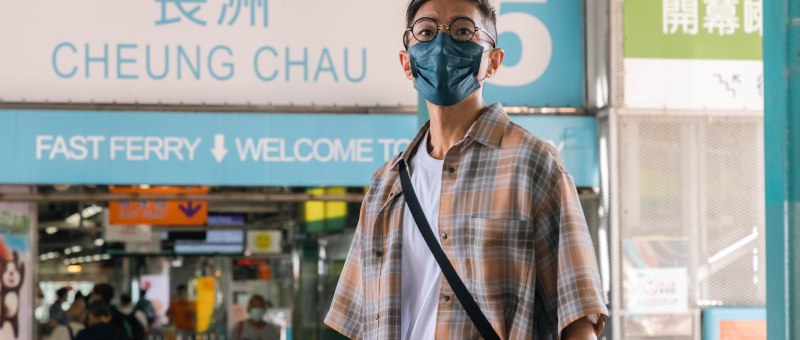
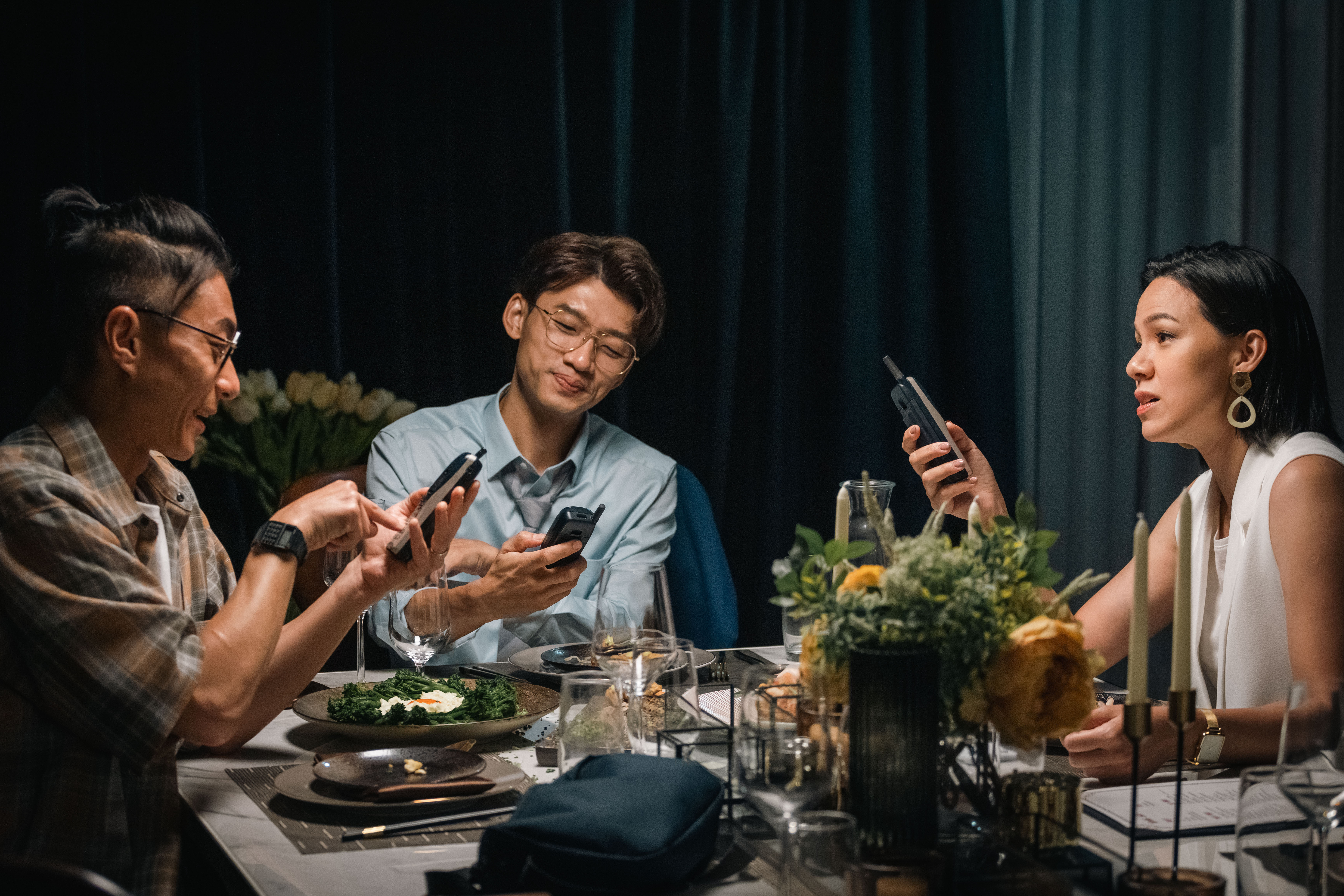
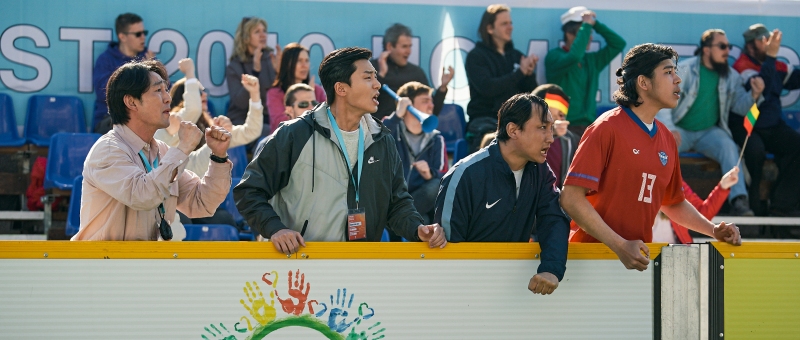
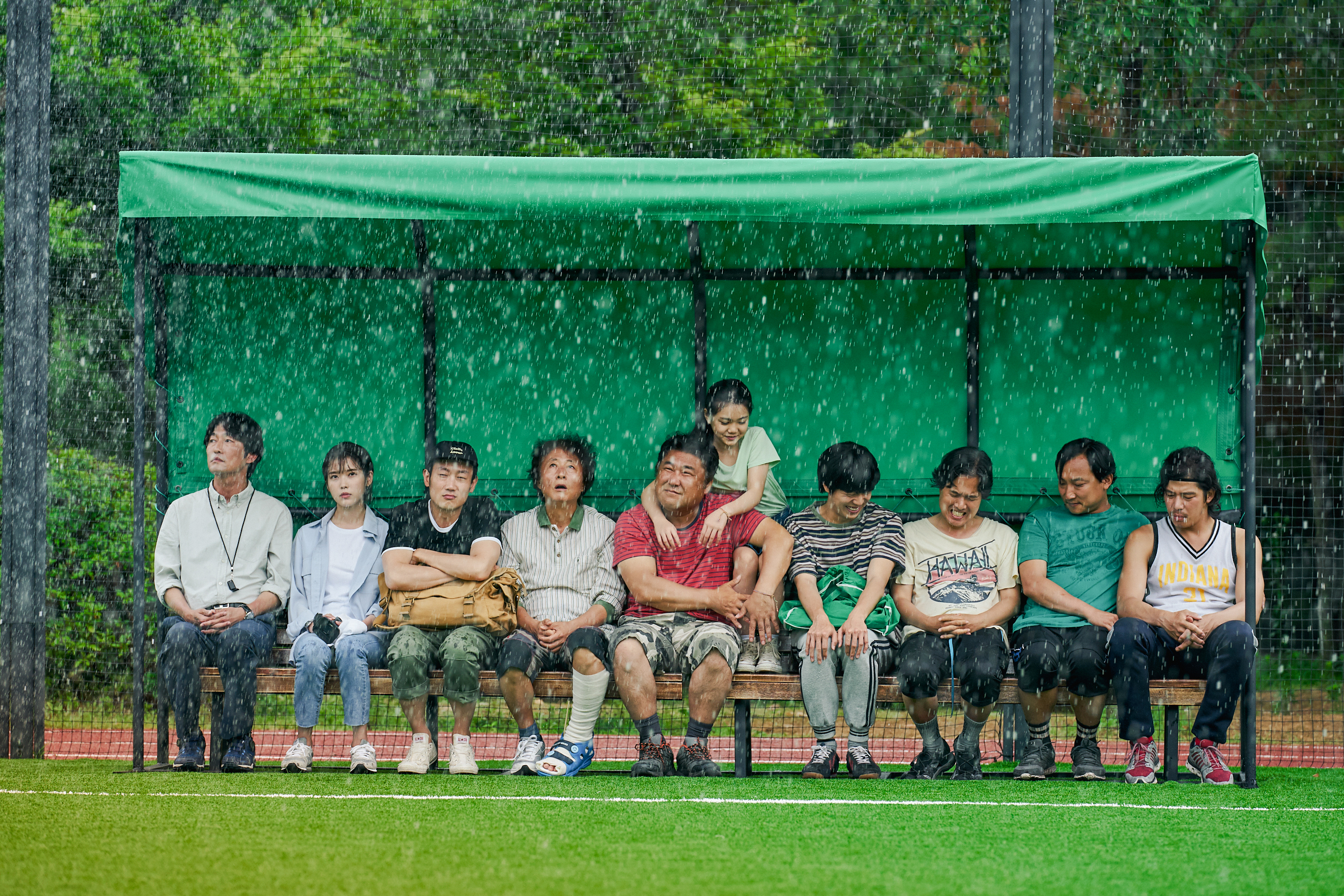
A disgraced football player gets a shot at redemption after agreeing to coach a team hoping to take part in the Homeless Olympics in Lee Byeong-heon’s sporting drama, Dream (드림). The Homeless Olympics was founded in order to advocate for the end of homelessness while combatting discrimination and stigma and takes place annually with teams of homeless people from all over the world taking part. Set in 2010 and inspired by the first Korean delegation to participate, the film is essentially an underdog sports drama in which the act of scoring a single goal is the same as an overall victory.

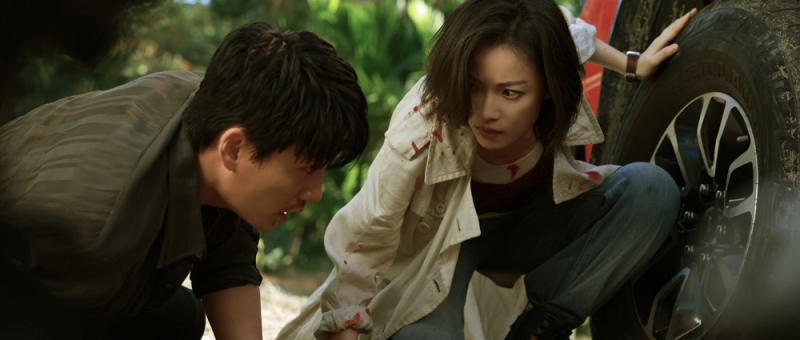
It is also, meanwhile, heavily critical of celebrity and sensationalist media each of which have a habit of latching onto popular causes in order to further their own careers. Hong-dae (Park Seo-jun) was a popular footballer insecure in his talents, but gained notoriety after poking an obnoxious reporter in the eyes when he repeatedly brought up the topic of his mother who happens to be a fugitive from justice. Deciding to retire from the game, Hong-dae is picked up by a talent agency who want to make him a star and is convinced to become the coach of the homeless football team in order to improve his personal brand while documentarian So-min (Lee Ji-eun) hopes to do something much the same by producing a semi-scripted reality show following the team’s fortunes.

Accordingly, So-min instructs Hong-dae to let her “cast” the key players on the basis of their touching backstories rather than their sporting ability. She comes up with a selection of people who have each for various reasons ended up on the streets but are looking for a way to turn their lives around and repair fractured relationships with family members. One man turned to booze and women while riding high but found himself out of luck when the Asian Financial Crisis ruined his business, while another claims that he’s not really homeless just lying low for a while, and a third was scammed by a friend and saddened by the impending exit of his ex-wife and daughter who will shortly be moving to Australia with her new husband. The film strays into more interesting territory in exploring the story of 44-year-old Beom-su (Jung Seung-gil) who ended up on the streets after a workplace accident left him with a chronic illness he did not have the money to treat, but otherwise falls into the same trap as So-min’s documentary in taking a fairly superficial view of homelessness. By the end of the film many of the players have thankfully moved into stable accommodation but do so largely without explanation aside from having apparently managed to save up for a deposit. 

Positioning their battle for sporting success as a means of reclaiming their self-esteem might also uncomfortably suggest that the reason they’re on the streets is a matter of mental attitude while ignoring other systemic issues that led them there or prevented them from moving on (assuming that they wish to do so). Aligning their struggles with Hong-dae’s and to a lesser extent So-min’s might do something similar while they too are also battling cynicism and self-esteem issues, Hong-dae continuing to blame his mother for his problems complaining that he was born to be second place because she never put him first. As Hong-dae later points out, So-min is also to an extent exploiting the homeless in trying to create an inspirational narrative for her TV show before she like everyone else realises there are other ways to win besides the literal. 

The final message is more one of never giving up as the team finally travel to the Olympics and find themselves out of their depth before deciding to give it everything they have even if it’s very unlikely they will win. There had indeed been discrimination in Korea, a sponsor pulling out describing the homeless as “smelly and disgusting” and expressing a degree of squeamishness about involving them with their brand, but at the Olympics they become the most popular team despite their lack of skill purely because of their charismatic perseverance. One player’s late in the game announcement that he is gay but has now come to accept himself in the knowledge that the problem lies with the world that will not accept him also makes the case for a greater equality if perhaps clumsily conflating two different issues. Nevertheless, IU’s lively performance and the film’s warmhearted tone help to overcome any mild sense of discomfort in its otherwise genial tale of never giving up and regaining your self-esteem even if you feel as if the world has already abandoned you. 


Dream screens July 17 as part of this year’s New York Asian Film Festival.

International trailer (English subtitles)

Images: © 2023 PLUS M ENTERTAINMENT & OCTOBER CINEMA INC. ALL RIGHTS RESERVED.

Lost in the Stars (消失的她, Cui Rui & Liu Xiang, 2023)

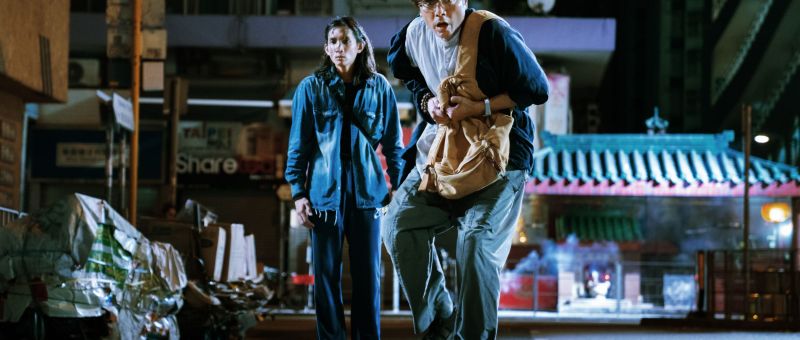
A desperate husband with five days left on his visa finds himself at the mercy of a foreign police department when his wife suddenly disappears into thin air during their honeymoon in a fictional South East Asian nation in Liu Xiang & Cui Rui’s hugely entertaining mystery thriller Lost in the Stars (消失的她, xiāoshī de tā). Produced and co-scripted and produced by Detective Chinatown’s Chen Sicheng, the film draws inspiration from the 1990 Russian drama Trap for a Lonely Man which was itself adapted from a 1960 French play, Piège pour un homme seul, which Alfred Hitchcock had once been interested in adapting. 

It’s not difficult to see why seeing as the film revolves around a classic “wrong man” in frantic husband He Fei (Zhu Yilong) who like so many Hitchcock heroes is left feeling like the only sane man in an insane world when he wakes up next to a woman who claims to be his missing wife only he’s never seen her before and is adamant that something untoward must be going on though all the evidence points to the contrary and no one really believes him. The film never really entertains the possibility that the “fake” wife (Janice Man) is indeed telling the truth and Fei is undergoing some kind of psychotic break but does leave a question mark over his mental state and credibility on revealing that he is suffering from a neurological condition caused by his work as a diving instructor for which he is on serious medication. 

In any case, the film opens with him bursting into a local police station exasperated with their lack of interest in his wife’s disappearance. In something of a trope in recent Mainland cinema, the action takes place in a fictional South East Asian nation which has shades of Thailand and Indonesia where the implication is the authorities don’t really care very much about a missing tourist. A Chinese policeman, Zheng (Du Jiang), eventually admits as much confessing that the police department is massively understaffed and only investigates “criminal” cases which they don’t believe his wife’s to be, rather that she most likely got fed up with Fei and has gone off of her own accord. Their lack of concern echoes a persistent theme in mainstream Mainland movies that the safest place for Chinese citizens is at home, an idea only reinforced by the film’s melancholy conclusion and the implications of Chen Mai (Ni Ni), a top international lawyer Fei meets by chance, who suggests that his wife may have been taken by an international trafficking ring. 

Nevertheless, in its various twists and turns the film also has a few things to say about class disparities in contemporary China in which as someone later says money may even buy the Devil’s soul. With his visa running out, Fei insists that he won’t leave without finding out what’s happened to his “real” wife and what’s going on with the “imposter” who soon drops any pretence and openly admits that she’s out to get Fei for reasons he finds unclear though assumes to be financial. Then again, we start to realise that perhaps he hasn’t been a hundred percent honest even with the information he’s giving Mai who is the only person interested in helping him find his wife who may or may not be at the mercy of vicious international gang backed by important people against whom an ordinary tourist like Fei or even an international figure like Mai has little power. 

While the film noticeably carries a strong anti-gambling message perfectly in tune with the censors’ sensibilities, it also has a surprising queer subtext in the quite obviously coded persona of super lawyer Mai who makes a dramatic motorbike entrance and then more or less steals the film as she tries to ascertain the whereabouts of Fei’s missing wife. Nothing is quite as it first seems, subterfuge piles on on subterfuge along with altered realities and personal myth making though the film’s title takes on a poignant note in the closing moments in which another starry image is presented in an attempt to evoke an emotional reaction from an otherwise heartless villain. Boasting excellent production values and elegant production design, the film is careful never to lose itself in its various twists and reversals before quite literally dropping the curtain on its extremely satisfying conclusion in which we discover just how far some are willing to go in pursuit of the stars.


Lost in the Stars is in UK cinemas now courtesy of CineAsia.

Trailer (Simplified Chinese / English subtitles)

Maelstrom (マエルストロム, Mizuko Yamaoka, 2023)

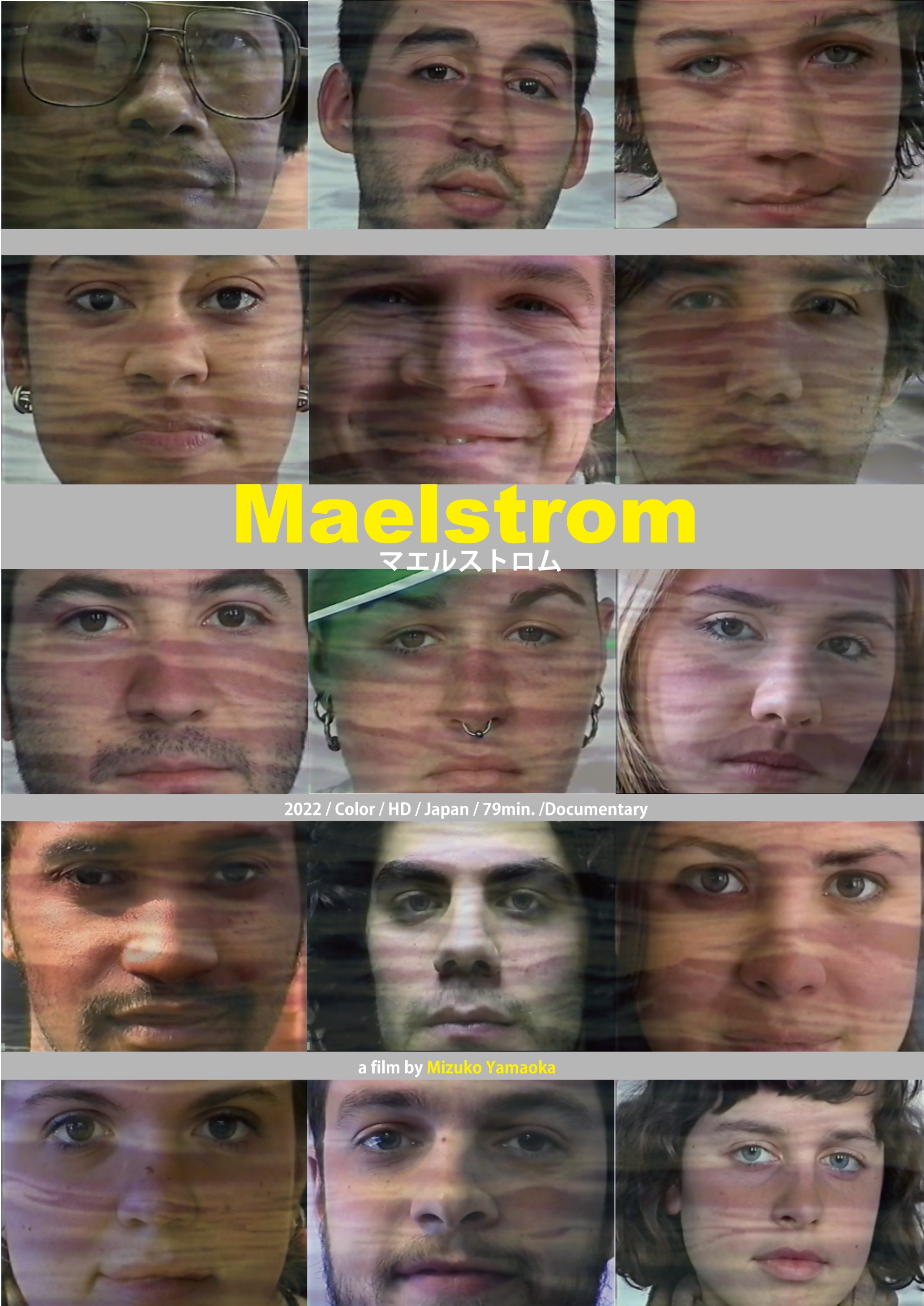
In her personal essay film Maelstrom (マエルストロム), Mizuko Yamaoka meditates on disability and the quest for fulfilment in a society that can be oppressive and unwelcoming. Accompanied by her continuous voiceover, she presents a series of slides and snapshots along with a handful of video captures and interviews to illustrate her life’s journey while simultaneously searching for direction and wondering where it is she is supposed to be or go to fully become herself.

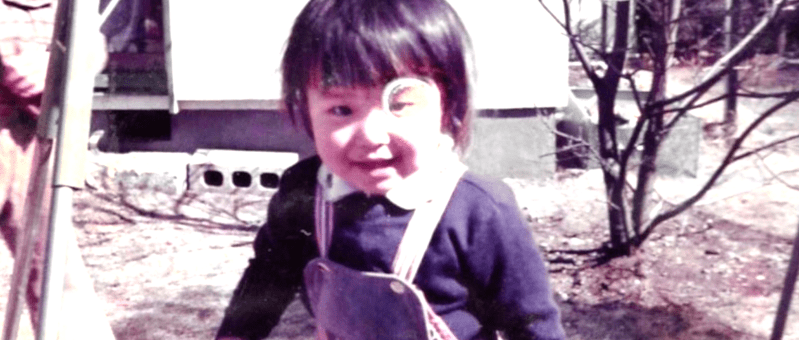
Several times she asks herself if she’ll ever become nostalgic for what was otherwise a time of struggle, and does in fact find that she has a fondness for the childhood home from which she longed to escape and most particularly its flowering dogwood tree so cruelly cut down when the house was demolished in 2013. The destruction of the house at once leaves her painfully rootless but perhaps also free as it seems to have done for her parents. She observes her mother whom she otherwise describes as controlling and lacking in empathy finding a new lease on life living together with the husband with whom she still seems to be very much in love all these years later. 

Paradoxically it’s this kind of relationship that Mizuko describes herself as seeking, lamenting the end of a relationship with a German boyfriend she met while studying abroad which frittered out when he returned home and she stayed in New York. Though Mizuko had longed go to abroad as a way of escaping her family which also in its way represents the conservatism of Japanese society, she had not wanted to go to New York and had ambivalent emotions about accepting her mother’s offer to study there not least in the feeling that she was once again suppressing her own desires to follow her mother’s commands. It was while studying there that she was involved in a traffic accident which broke her neck. Now a wheelchair user she felt she had no option but to return to Japan for longterm treatment and to the home she’d been so desperate to escape. 

Even so, the wheelchair is for her a means of seizing her freedom and she determines to reclaim her independence. The middle section of the film centres on the difficulties of living with disability in the contemporary society. Her parents had had their house adapted for accessibility and provided a separate entrance to give her some privacy, but when her father’s business closes and they have to sell she finds it difficult to find accessible living spaces and has to make a few alterations including a new bathroom in the flat she moves into. Attending a residential programme in Denmark had given her new insights into accessibility which she hoped to bring to Japan while making her own accommodations where she can such as fitting a crane to her accessible car to help her lift her powered wheelchair into the back independently.

Later she remarks on how easy it seemed to be for an able-bodied man to carry the wheelchair she struggled to move for her while insisting that she didn’t want to let stairs become a barrier to her travel. Wanting to visit somewhere new, she goes to a hairdresser’s owned by someone she’d met at a bookshop but has to ask staff to physically carry her down the narrow stairs to the basement salon. She finds that though it requires thorough research and planning, she is able to enjoy international travel arriving safely in Venice by water taxi further boosting her sense of freedom and independence. A temporary sense of equality emerges during the coronavirus pandemic as events go online and accessibility issues decrease even if it doesn’t seem to have much longterm benefits in changing the way society thinks about disability and inclusion. 

There’s no denying that Mizuko’s voiceover is often bleak and rigorously honest in expressing her feelings especially those relating to her complicated family relationships, but is in it’s own way hopeful as she continues to strive to find fulfilment in her life even as she observes others move on and leave her behind. She reflects that the internal issues she’s trying to overcome were present long before her accident and rediscovers release in her art of which this documentary is only a part while beginning to reassess her relationships and realising that independence doesn’t necessarily mean doing everything alone. A poignant meditation on past, future, the floating nature of connection, and an ableist society Yamaoka assembles a kaleidoscopic vision of her life while musing on ambivalent nostalgia and the necessity of moving forward in the midst of the maelstrom of life.


Maelstrom screened as part of this year’s Nippon Connection

Original trailer (English subtitles)

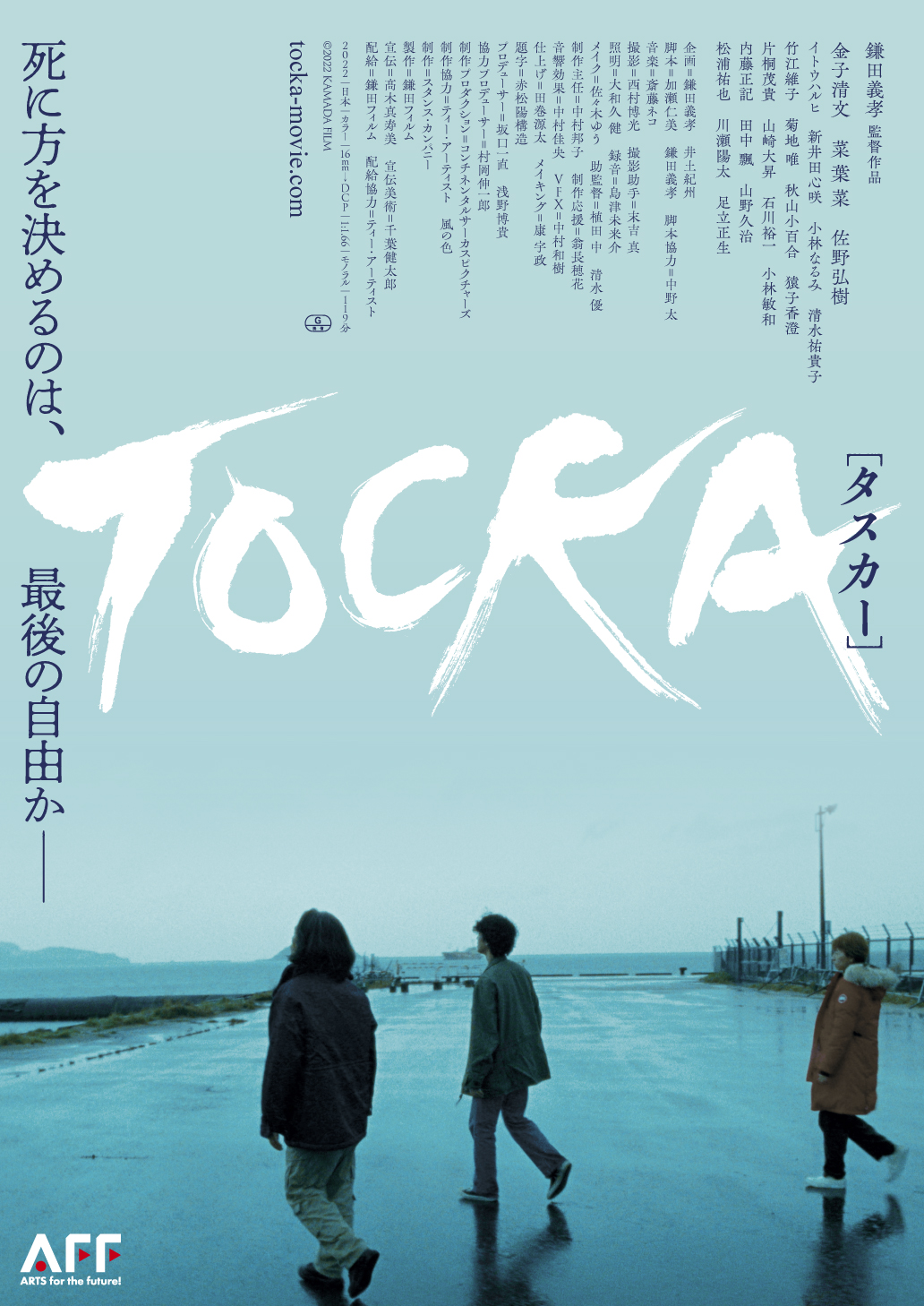
TOCKA (タスカー, Yoshitaka Kamada, 2023)

The man at the centre of Yoshitaka Kamada’s bleak social drama Tocka (タスカー) claims that he no longer knows why he’s alive, but as the woman he’s just asked to kill him replies no one else really knows either but even so they continue to live. Set in the northernmost reaches of Hokkaido where you can pick up Russian-language radio and it’s not unusual to spot signage in Cyrillic, the film’s title is taken from a Russian word that describes a quality of spiritual agony that manifests as listless ennui while its sensibility seems to be very much in tune with that of 19th century Russian literature. 

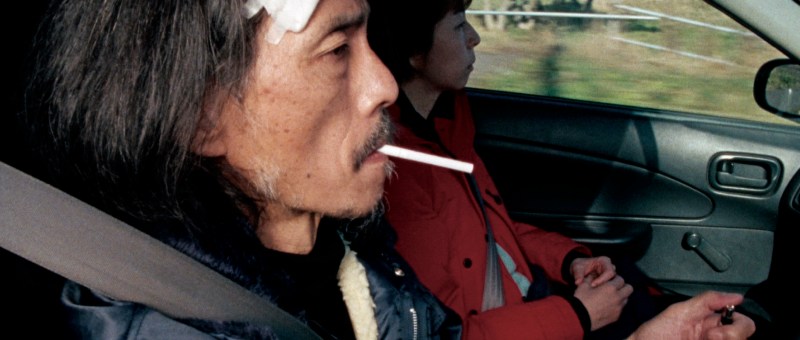
This indeed a cold a barren place almost devoid of signs of life. The heroine, Saki (Nahana), has returned in flight from the implosion of her life in Tokyo but has not told her parents who presumably live not too far away that she’s lost her job or broken up with her fiancé. Instead, she’s living a difficult and dissatisfying life with a part-time job in a local supermarket while contending with massive debts. Unable to see a way forward, she begins to consider taking her own life which is how she ends up meeting Shoji (Kiyobumi Kaneko), a man who wants to die but is unable to kill himself so is looking for someone to help him. 

Perhaps it says something of Saki’s own desperation that she considers his proposal or at least does not necessarily see anything odd about it aside from Shoji’s general vagueness about the reasons he wants to die. Like her, he is living a dissatisfying life but mostly precipitated by the loss of his family and his subsequent descent into alcohol dependency. He used to run a junk shop selling second hand appliances, but his business has also gone bust leaving him with nothing. His only goal is to make sure his daughter receives the payout from his life insurance policy which would be void if it was ruled that his death was a suicide. 

Yukito (Hiroki Sano) also works as a junk man, but scams his clients by pressing them to pay despite advertising a free removals service for unwanted appliances. He also steals petrol to sell illegally on the side and has nothing much going for him in his life while feeling guilty that he has failed to repay the sacrifices his mother made to raise him. Meanwhile, his sister is pregnant and the baby’s father has abandoned them leaving her in much the same position as her own mother but worried she doesn’t have the strength to manage on her own. 

It’s not difficult to understand the reasons why they want to end their lives even if as they sometimes suggest it’s more that they lack reasons to live while those in favour of dying are readily apparent. There doesn’t appear to be much going on in Northern Hokkaido when the businesses seem to be those dedicated to moving around obsolete items, buying junk or selling junk or maybe even stealing junk to sell to people who can’t afford anything better or else for scrap. All three feels themselves already on the scrap heap with nothing more than broken dreams to their names. Saki once wanted to be a singer in Tokyo, but now can’t seem to see a reason to be much of anything at all.

The way she later sees it, it’s alright to want to die and it’s alright to do it too even if you’ll hurt the people you’ll leave behind. None of them are fully able to escape their sense of despair or hopelessness despite the bonds that arise between them as they try to fulfil Shoji’s dying wish. In the end, the firmest expression of friendship is that they will help one another die if and when it’s what they really want though they may never meet again in more pleasant circumstances. In any case, Kamada captures a sense of bleakness in the beauty of the snowbound landscape which remains otherwise barren and defined by emptiness even as those trapped inside it try to find reasons either to live or to die but more often than not find nothing much of anything at all. 


TOCKA screened as part of this year’s Nippon Connection

Original trailer (English subtitles)

Images: ©2022 KAMADA FILM

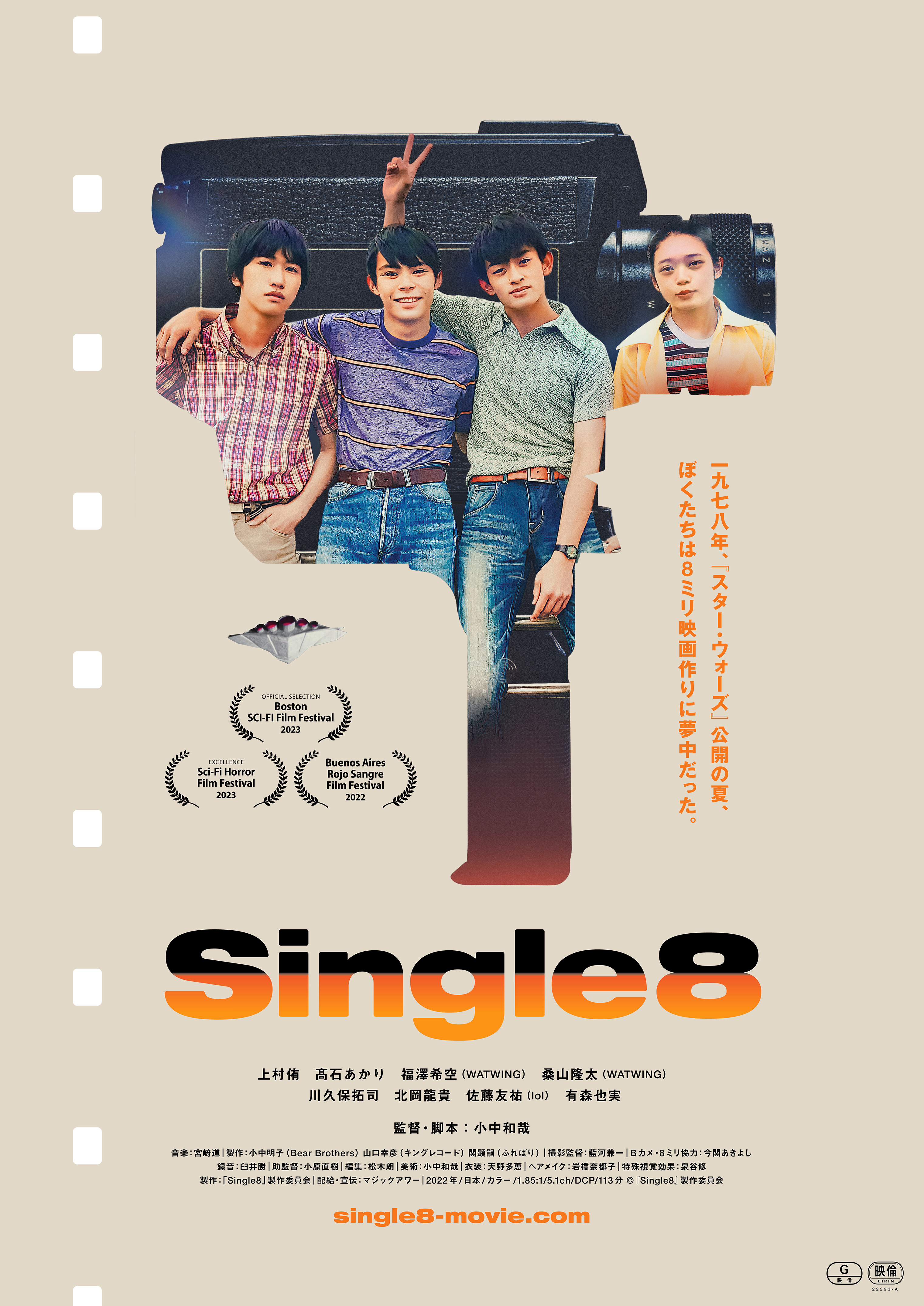
Single8 (Kazuya Konaka, 2023)

In a lot of ways, it’s never been easier to make a movie. You can capture sound and image with your phone, edit and add special effects on an ordinary laptop with no particular need for professional grade software or equipment. But on the other hand, perhaps there’s something that’s been lost now that you don’t need to work so hard to overcome technical limitations. Kazuya Konaka’s auto-biographically inspired high school drama Single8 follows hot in the heels of It’s a Summer Film! in pairing the classic summer adventure movie with filmmaking nostalgia while looking back to a now forgotten era of analogue creativity. 

Set in the summer of 1978, the film opens with an homage to Star Wars which has captured the imagination of diffident high school boy Hiroshi (Yu Uemura). Hiroshi is not so much a film buff as special effects enthusiast and is particularly obsessed with figuring out how Lucas achieved the overwhelming sense of scale in his spaceship model shots. Aimed only with a regular, consumer-level 8mm camera, he teams up with a friend, Yoshio (Noa Fukuzawa), to experiment and thanks to the advice of the guy at the camera shop (Yusuke Sato) eventually manages to recreate the scene with a surprising level of dexterity. His new found confidence leads him to suggest they continue with the film as the class project for the upcoming school festival which will be the last of their high school lives. 

The snag is that Hiroshi hadn’t thought much beyond recreating the shot. His previous short film had been called “Claws” and was basically Jaws only with a bear. When people ask him what the film will be about, he looks at them quizzically as if it hadn’t really occurred to him that the plot would be important or something anyone would be interested in. It’s only by teaming up with another student, Sasaki (Ryuta Kuwayama), who actually is a film buff that they begin to come up with their own ideas even if they’re also often influenced by other science fiction films and tokusatsu television series. In a meta touch, the students openly discuss scriptwriting theory remarking that the most important aspect is how the protagonist evolves between the first scene and the last. The film itself and the film with in a film attack this in a similar way, with Hiroshi eventually deciding to end on a note of ambivalence in which it is clear that something has changed if perhaps not obviously. Now no longer quite so diffident, he steps into the role of a director and proudly declares that his next film will be even better than this one. 

Similarly, Konaka avoids falling into the trap of an overly neat conclusion in allowing events to play out in a more natural way than we would usually expect them to in a movie even if Hiroshi is eventually able to win over even the most obnoxious of his classmates, Yoshida. Through making the film together, each of team members including Hiroshi’s crush Natsumi (Akari Takaishi) who plays the film’s heroine grow in confidence and come to understand something of themselves while otherwise having fun and making friends across the last summer break of their teenage lives. The film is a collaborative effort and made with a true sense of generosity with a university student friend of the camera shop guy helping out with special effects by literally carving them directly into the film itself and the high school band Natsumi manages also agreeing to provide the score. 

A true tribute to the charming world of DIY filmmaking in the pre-digital era the film has has a charming nostalgic quality which is only enhanced by the fact that the film within the film, which is eventually shown in its entirety, is actually very good and quite touching in its earnestness. Konaka includes clips of the few of his own 8mm films over the closing credits which adds a meta note to the film’s message that “people should fix their own mistakes” even if there is also an irony in the insistence that they should look to the future rather than obsessing over the past. Using frequent screenwipes as a visual homage to Star Wars but also of course to The Hidden Fortress which inspired them, Konaka’s retro teen drama ends on a similarly ambiguous though less melancholy note than the film within a film filled with a sense of possibility for a new world of creativity which is only just beginning. 


Single8 screened as part of this year’s Nippon Connection. It will also be screening in New York on 30th July as part of this year’s JAPAN CUTS.

Original trailer (no subtitles)

Images: ©Single8 Film Partners

Spring In Between (はざまに生きる、春, Rika Katsu, 2023)

A struggling editor at a magazine gains a new perspective while falling in love with an autistic artist in Rika Katsu’s romantic drama Spring In Between (はざまに生きる、春, Hazama ni ikiru, haru). Spring is coming in the lives of artist and reporter alike, yet as Haru’s (Sakurako Konishi) professional life begins to come into focus she finds herself romantically confused and ever more obsessed with the mysterious painter while largely unable to ascertain what the extent of his feelings for her may be assuming that he has any at all. 

Haru’s obsession begins when she becomes immersed in one of Tohru’s (Hio Miyazawa) paintings which like much of his work depicts a vast blue sea. Three years on the job, she’s still making rookie mistakes and is constantly berated by her boss who offers little in the way guidance. Nevertheless, she catches a break when he brings her on to assist with an interview of a top artist who is known to be “eccentric”. Never having much exposure to neurodiversity, Haru finds herself captivated but also somehow on the same wavelength while drawn to what she sees as Tohru’s profundity and poeticism. 

The film does at times fall into the trap of fetishising Tohru’s “unique” way of seeing of the world while otherwise keen to lay bare the extent to which neurodiversity continues to be stigmatised. Haru’s partner on the magazine article repeatedly describes Tohru as “odd” in a slightly mocking way, while the journalists assigned to interview him have little patience and do not even bother to hide their exasperation when he flies off on tangents about plastic bottles or tree bark. The magazine is interested in him precisely because of his neurodiversity and learning disability hoping to sell an inspirational story of someone overcoming the odds to find success but in private continue to laugh at him.

Even Haru struggles to comprehend some of the unhelpful information she looks up while researching Asperger’s Syndrome which talks of an inability to empathise leaving her wondering if Tohru has the capacity for romance despite his directly telling her that he has fallen in love before because he is after all human though he never said anything because he did not want to get hurt. A more experienced colleague noticing Haru’s increasingly erratic behaviour tries to give her some advice, but it isn’t to the effect that it might be unethical and irresponsible to fall in love with your subject for a piece but only that she’ll wind up getting hurt because Tohru is autistic and therefore unable to return her feelings, implying that in any case she views a relationship between them as as inappropriate given what she sees as Tohru’s disability. 

In revealing Haru’s own potentially autistic traits, such as her preference to have someone stand on her left and never her right, the film strays into a potentially uncomfortable implication that everyone is a little bit autistic while otherwise trying to eliminate the line has that been placed between Tohru and everyone else. Introducing a romantic rival in the form of an equally eccentric, larger than life photographer who also does not fit into “conventional” society, also implies that neurodiverse people can only date each other while Haru struggles to define her feelings both for Tohru and for uni boyfriend Nao who appears to be both possessive and disinterested telling her that she should get over her left side only thing in the same way some talk about a “cure” for Tohru’s neurodiversity. 

Haru can’t state her feelings any more directly than Tohru can while simultaneously unable to find a way through to him to find out if he likes her at all or is just being friendly and considerate, unlike Nao making a map to figure out the acceptable dimensions of her personal space and promising to always stay at a comfortable angle. Yet in the end it’s curiosity that builds connection, the simple desire to know more about another person and to see the world from another perspective. Promises are kept, and a message delivered if in a roundabout way. As they say, spring will always get there in the end even if summer is right around the corner. A sweet and innocent romance, Spring in Between is as much about self-revelation as it is about mutual understanding and the still currents of a deep blue sea.


Spring in Between screened as part of this year’s Nippon Connection

Original trailer (no subtitles)

Thorns Of Beauty (恋のいばら, Hideo Jojo, 2023)

“Can two women who like the same guy become best friends?” A loose remake of Pang Ho-Cheung’s 2004 Hong Kong comedy Beyond our Ken, Hideo Jojo’s Thorns of Beauty (恋のいばら, Koi no Ibara) finds a jilted ex teaming up with the current squeeze against a no good guy who has compromising photos of each of them he could potentially expose online anytime he feels like it. Not quite everything is as it first appears, yet as they plot revenge against the caddish Kentaro (Keisuke Watanabe) the pair begin to discover a bond that runs deeper than their shared quest for validation.

Momo (Honoka Matsumoto), a mousy librarian, first accosts Riko (Tina Tamashiro), an aspiring dancer who works at a nightclub, on a bus, staring at her intensely until she finally removes her earphones. In truth, Momo never quite shakes an edge of possibly dangerous eccentricity and there is always an underlying doubt that she is telling the truth when she explains to Riko that she and Kentaro were previously an item and he has private photographs of her she fears he may intend to post online. For whatever reason, Riko decides to hear her out and though insisting that Kentaro’s not that sort of guy seems to think there may be something in it. A photographer by trade, Kentaro has in the past photographed her without her consent claiming that he spends all day photographing things other people find beautiful and wanted capture something for himself in his free time. 

Much of the story is filtered through a version of Sleeping Beauty that Momo finds at the library where she works. As the two women bond in their shared quest for revenge, Jojo often plays with the image of them as “witches” lighting them in an eerie green while they dress in black with hats that cast shadows over their faces. Yet we also find ourselves wondering who the sleeping beauty is in this scenario, an unexpected candidate turning out to be Kentaro’s elderly grandmother who has dementia and spends her days collecting shiny things to build a vast fairytale castle. Momo comes to see herself as hoping to wake Riko from a moment of romantic fantasy with a man who in the end doesn’t really care for her which she likely knows but has allowed the relationship to continue mainly out of a sense of inertia. 

But in teaming up with Riko, Momo also begins to awaken from her own low self-esteem in believing herself to be inferior to someone like her. There are times when we wonder if this is going to turn into a Single White Female-style bid at identity theft as Momo seems to idolise her new friend possibly planning to eliminate her and reclaim her place in Kentaro’s life. In the end, however, both women are throughly awakened from their romantic illusions in realising that Kentaro is indeed that sort of person with a hard disk full of pictures of other women just like them while their friendship also begins to take on a distinctly homoerotic quality that clearly runs beyond simple friendship or female solidarity. 

As Momo reflects, Sleeping Beauty is a passive heroine who is asleep for the entirety of her own story. When she’s born, the fairies give her various gifts that turn her into a stereotypical figure of idealised femininity and leave her with nothing to want or strive for. Momo wonders if that doesn’t make her a little boring and if Sleeping Beauty actually wanted any of those things or in the end they were just burden to her. Momo would only be grateful for things she actually wanted like the ability to totally become herself, while Riko reflects on a “past life” as a woman living happily with her two sons by a lake in Switzerland. Cutting through the thorns of their illusions, they awaken each other to a sense of possibility each of them may long have forgotten. Strangely poignant in the touching quality of its central romance along with fairytale allusions, the film in the end allows both women to reclaim an image of themselves from a man who tried to take it from them without ever really bothering to look at it. 


Thorns Of Beauty screened as part of this year’s Nippon Connection.

International trailer (English subtitles)

Okiku and the World (せかいのおきく, Junji Sakamoto, 2023)

“Where does Edo’s poop go?” it’s a question a child might ask but the rest of us somehow gloss over. In the modern world, if we were suddenly confronted with a lot of problematic poop, we’d have to pay someone to come and take it away and that person might then get paid twice for selling it on. In old Edo, however, manure merchants had to buy their raw materials (well, aside from those they could produce themselves) in the hope of selling them on to peasant farmers desperate for fertiliser. Junji Sakamoto’s Okiku and the World (せかいのおきく, Sekai no Okiku) takes a wry look at this circular economy in the dying days of the feudal era and in the end asks us if a samurai’s shit is really any better than anyone else’s.

In a sense it might be, given that historically samurai are better fed but even they are beginning to feel the pinch these days. Sakamoto opens in 1858 which is the year the Treaty of Amity and Commerce between Japan and the United States was signed opening the door to trade with other nations after two centuries of isolation. It is also 10 years before the Meiji Restoration and the eventual abolition of the samurai. Okiku (Haru Kuroki) is just one woman struggling with this moment of social change. Her samurai father Genbei (Koichi Sato) has been kicked out of his clan for challenging corrupt authority, so now she supports him teaching calligraphy at a local temple while the pair live in a rundown tenement in a forgotten corner of the city. 

Fittingly enough, Okiku’s name and the film’s title with it is written in hiragana, but the character usually used to write it is that for chrysanthemum which is also of course a stand in for Japan itself. Genbei muses on what the world is, defining it as an expanse of skies and lamenting that those who have only just realised that the world is vast are ironically unable to look past their small corner of it amid the chaos of the bakumatsu era and what he describes as continual “unrest”. But then politics have little relevance to those living in this particular corner of the world or for those who quite literally shovel the shit day in day out just to be able to shit themselves. 

Chuji (Kanichiro) and Yusuke (Sosuke Ikematsu) are manure men who purchase excrement from local communities and fine samurai houses to sell on to provincial farmers, transporting it by boat to a silo out in the country they occasionally bulk out with mud seeing as they’re paid by weight. Yusuke rails against his subjugation, revealing that at one particularly low point he was asked to wipe a samurai’s bum while otherwise constantly humiliated by their doorman who really does seem to think his shit’s better than anyone else’s. But as Yusuke points out, samurai or common man everyone eats and shits even if he describes himself as a literal bottom feeder who is nevertheless essential to the Edo-era economy. Without men like him, the samurai wouldn’t eat either because they’d have no crops to buy. Chuji may berate him for being all mouth and no trousers, but times are changing. Even he later mounts resistance by flinging his produce at a now powerless samurai. 

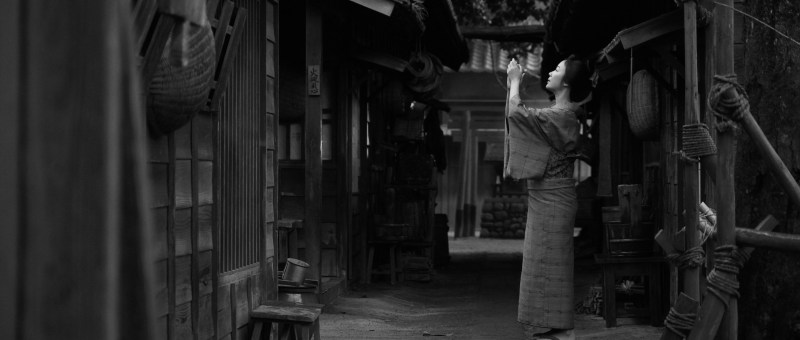
Okiku meanwhile has been rendered mute, her voice silenced by the cruelties of the feudal order leaving her struggling to rediscover her place. She has fallen in love with Chuji, but they think they come from worlds even as they witness them merging and realise there is only one vast expanse under an unending sky. In a decade’s time, it won’t mean anything that Okiku is a samurai’s daughter and Chuji an illiterate peasant but for the moment every step towards each other is transgressive and requires courage in breaking an unthinkable taboo. Sakamoto homes in on the muddiness of this “hopeless shitty world”, the unending drudgery and nihilistic futility of feudalistic life but finally offers his shit-shovelling heroes a new sense of possibility amid the ever expanding vistas of a new society. Presented as a series of black and white vignettes each except the last ending in a moment of vibrant colour, the film finally discovers a sense of serenity as Okiku prepares to reenter the world having finally come to understand her place within it.


Okiku and the World screened as part of this year’s Nippon Connection.

International trailer (English subtitles)

Hoarder On The Border (断捨離パラダイス, Takayuki Kayano, 2023)

A former concert pianist begins to see the world from a different angle after taking a job cleaning houses in Takayuki Kayano’s humanistic dramedy, Hoader on the Border (断捨離パラダイス, Danshari Paradaisu). Ritsuki (Ryo Shinoda) describes the path that took him to his new line of work as mere coincidence, but there is something satisfying to him in helping people get rid of all the rubbish in their lives both literal and metaphorical and doing so in a broadly sympathetic way that encourages the customer to think hard about what it really is they want and don’t want cluttering their existences. 

Ritsuki doesn’t seem to have that much literal clutter, only it also appears that he is more than a little conflicted with his way of life. Seemingly coming from a rather upper middle class family, Ritsuki had trained since childhood to become a concert pianist only to give up a promising future due to a hand tremor which may be psychosomatic. It may be no coincidence that in contrast to the upbeat dance music his boss plays while cleaning, Ritsuki prefers jazz rather than classical and may be looking for something with a little more freedom than the life of a concert pianist. 

Even so he quickly discovers how many of his relationships were based on his status as classical musician. His girlfriend of 11 years abruptly breaks up with him apparently no longer interested now that he is a mere piano teacher with a sideline as a house cleaner. His experiences place him well to empathise with some of his clients who are each in someway overwhelmed to the extent that it has prevented them getting rid of literal rubbish from their lives which continues to clog up their homes only further deepening their sense of internalised shame. Then again, one of his first clients, Asuka (Yumiko Nakamura), is in her own way “shameless”, unembarrassed when Rituski discovers a box of DVDs she describes as “precious” featuring herself in her previous career as a porn star. 

The film doesn’t go into what led to her home becoming a “trash house”, but perhaps does suggest there is a degree of shame involved in the proposed solution of welcoming more visitors to encourage her to keep the place presentable. The reason she needed it cleaned is that her son’s teacher has become fed up with her attempts to dodge a home visit while his usual behaviour has them thinking there may be something wrong in his family circumstances. As is later revealed, the teacher, Mariko (Tomu Muto), also lives in a trash home for unclear reasons but that seem to reflect her generalised anxiety in her inability to make decisions or take care of the rubbish in her life. She’s recently become engaged to a man who seems a little domineering but is also becoming suspicious of her reluctance to let him into her flat worried that it’s because she lives with another man while also hurt and confused by her rejection of intimacy.

Similarly, a care worker preparing to move back to the Philippines (Mac Sekioka) found himself living in a trash home after falling into depression following the death of his mother. The thing he didn’t want to get rid of was a Tupperware container containing a stew his mother had made for him he’d been keeping in the freezer for the last eight years and eventually shares with Ritsuki as a final ritual before moving on. Another old man meanwhile needs a little more persuading with the situation complicated seeing as the main reason his son wants them to intervene is that he suspects there may be valuable antiques trapped under all that trash. What led to Shigeo becoming a local pariah remains obscure save that he too seems to be suffering with guilt and grief, haunted by the figure of a tiny woman who claims he threw her away. In some cases, it seems like at some point it all became too much and what each of the clients needed was a helping hand to get them started, Ritsuki and his eccentric boss gradually freeing them of the burdens of their lives while restoring both peace and order as he too learns to move forward bonding with his new work family no longer quite so constrained but living in the freedom and happiness of an uncluttered existence.


Hoarder On The Border screened as part of this year’s Nippon Connection.

Original trailer (no subtitles)

The Roundup: No Way Out (범죄도시 3, Lee Sang-yong, 2023)

Ma Dong-seok has been cultivating an image of himself as an action star for quite some time. The kind of marquee name who generally plays the hero, Ma looks back to the genre’s heyday presenting an uncomplicated vision of righteous masculinity, a bruiser with a heart of gold. The Roundup: No Way Out (범죄도시 3, Beomjoedosi 3) is the third in a series of films that began with The Outlaws and is projected to total at least eight instalments each starring Ma as the maverick detective his superiors hate to love. 

It’s true enough that you can’t get away from the more problematic elements of his unreconstructed good bad cop persona. We often see Seok-do (Ma Dong-seok) beat information out of suspects which the film treats as a cheeky joke in an otherwise tacit endorsement of police brutality that suggests red tape is the reason the guilty often evade justice. Meanwhile, in a step back from other Ma vehicles there are almost no women in the film and none in the police force. The heart of the case is the death of a 28-year-old woman who “fell” from a hotel room window and is later discovered to have died of a heart attack after being drugged in a club and dragged off by a random man who then literally threw her away to distance himself from the crime. The murder which Seok-do is supposed to be investigating is totally forgotten in his all encompassing drive to find out where the drugs are coming from which eventually descends into a battle of wits with a corrupt police officer who’s teamed up with a Korean-Japanese yakuza to skim his boss’ supply of new designer drug Hiper. 

There is a distinctly uncomfortable thread of xenophobia that runs through the series even if in this case the villainy is discovered closer to home in the form of police corruption. This time around, the threat is once again Japan which is apparently where Hiper originated though petty yakuza Tomo (An Se-ho) now manufactures it in Korea where he’s cut a freelance deal with dodgy cop Joo (Lee Joon-hyuk) to distribute it in the local night life scene without the knowledge of his boss back in Japan, Ichijo (Jun Kunimura). Joo has also cut a deal to sell the drugs to a Chinese gang, so it’s quite bad news for him when Ichijo gets wind of the situation and Tomo takes off with a suitcase full of pills for his own protection. Unluckily for him, Ichijo has already sent his most intimidating assassin, Riki (Munetaka Aoki), to find out what’s been going on behind his back. 

Problematic as it may be, Ma’s retro take on the action star is undeniably entertaining with his frequent hero moments and penchant for one liners. The first time he appears, we see him break up a street fight but mostly interested in finding out if the guy on the ground started it the implication being that perhaps if he did it’s none of his business but otherwise he’s going to have to intervene. Then again as he tells his exasperated boss, his personal motto is “punish and serve” and he’s here to get the job done even if that means wading in all fists blazing without much thought for regulations or procedure. At one point Seok-do and his guys stumble on a crime scene and walk around it touching everything in sight without bothering to even put on so much as gloves. 

In any case, Lee makes every punch land and quite literally as the screen seems to vibrate on contact almost as if the camera itself were taking a blow. Ma’s thunderous fists clash with the sound of justice as he all too easily disables hardened gangsters with one well placed slap. At times, his invincibility borders on the ridiculous but he does eventually allow himself be “defeated” if only temporarily as in his miraculous recovery from being run over by a gangster’s car. In many ways, Joo is Seok-do’s mirror, a bad bad cop with crazy eyes who kills without a second thought and behaves with narcissistic recklessness, overconfident in his abilities to sort his problems through his status as a law enforcement officer. Bruiser he may be, but Seok-do likes arresting people and never uses lethal force even when the opportunity is presented to him, symbolically snapping Riki’s katana and then proceeding to slap him seven ways to Sunday leaving the ice cool assassin collapsed amid a display of Japanese parasols. An end credits scene set three years later in 2018 sets up a fourth instalment and the return of a familiar face besides that of Seok-do himself who continues to charm as the world weary bruiser slapping down crime wherever it rears its ugly head. 


The Roundup: No Way Out is in UK cinemas now.

International trailer (English subtitles)