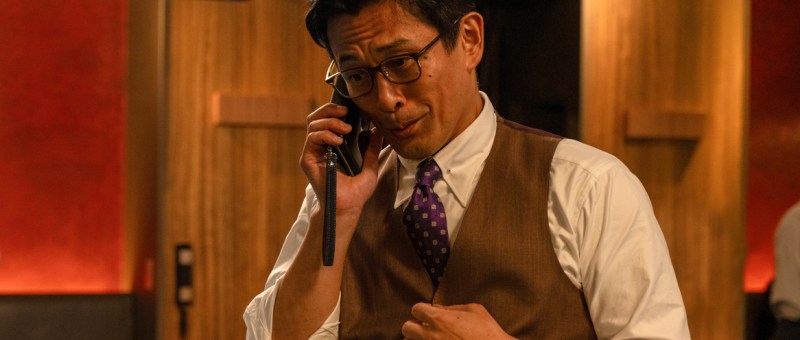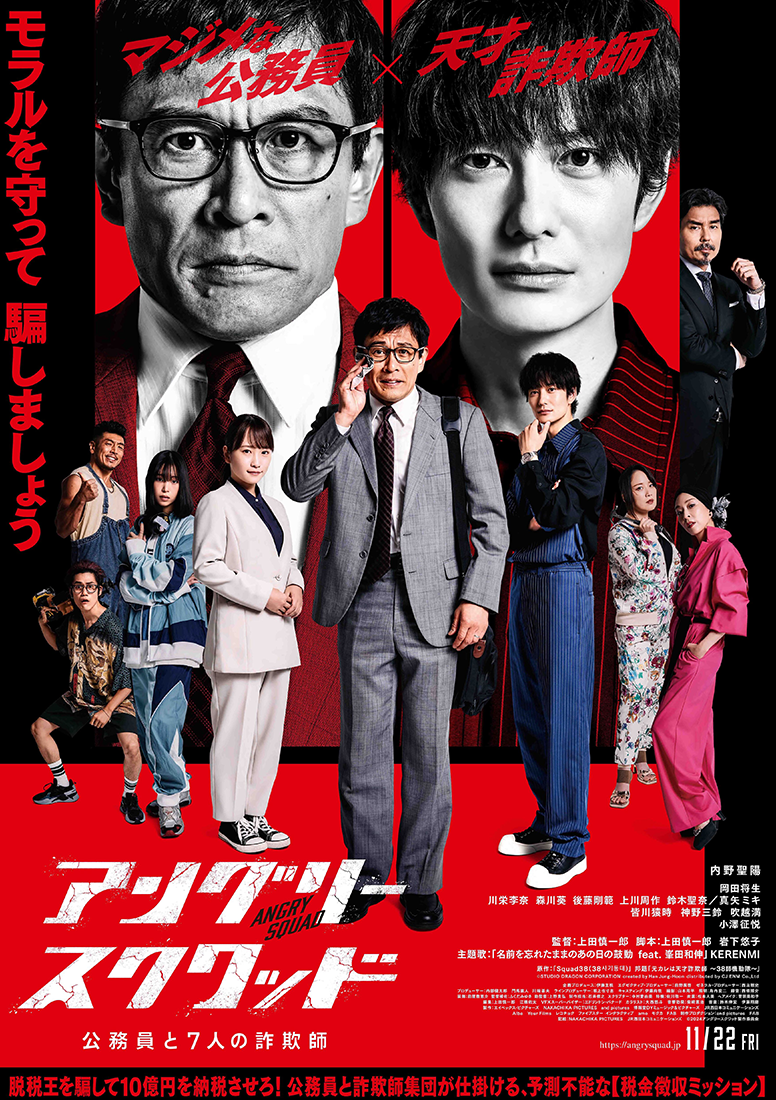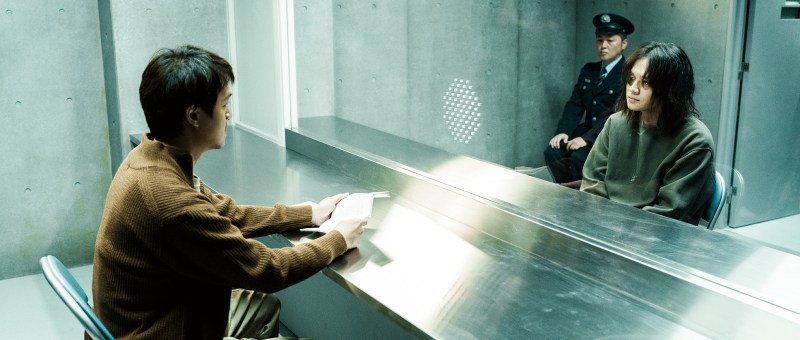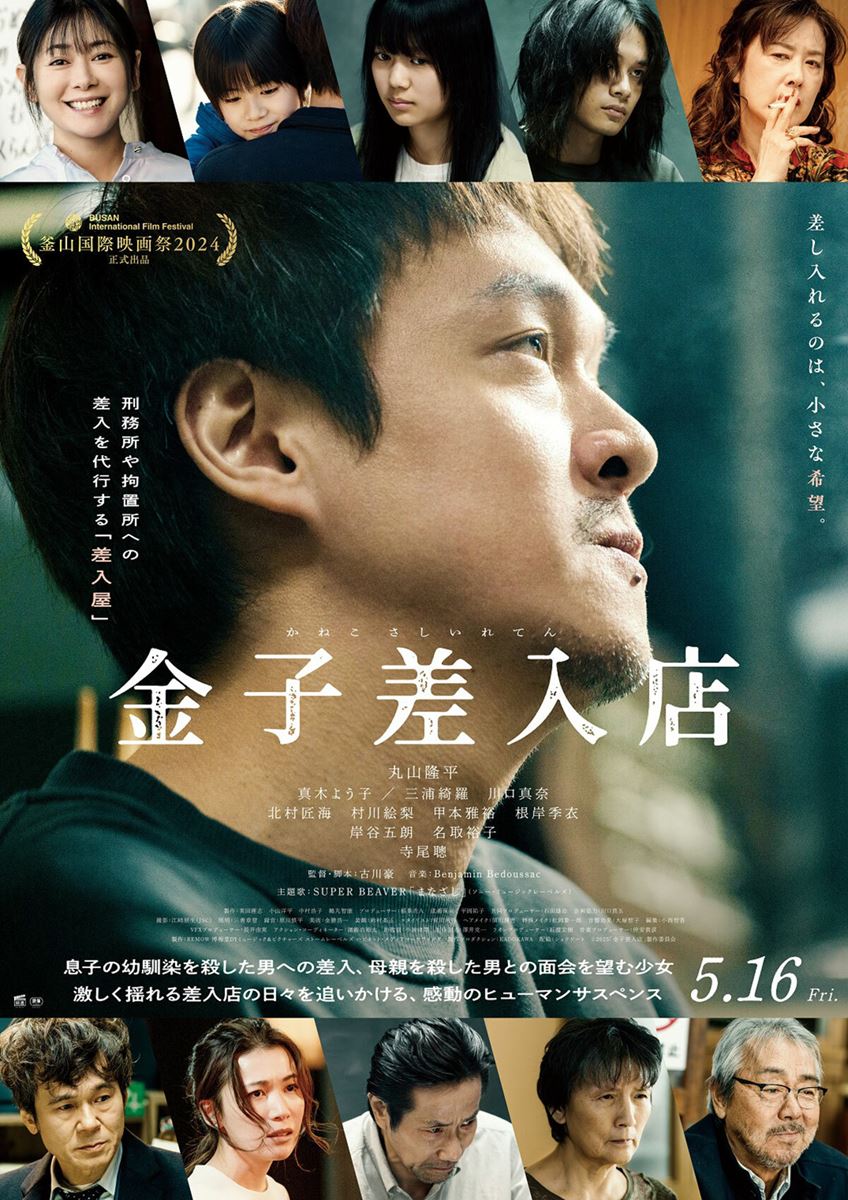
The Unrighteous (원정빌라, Kim Seon-kuk, 2024)

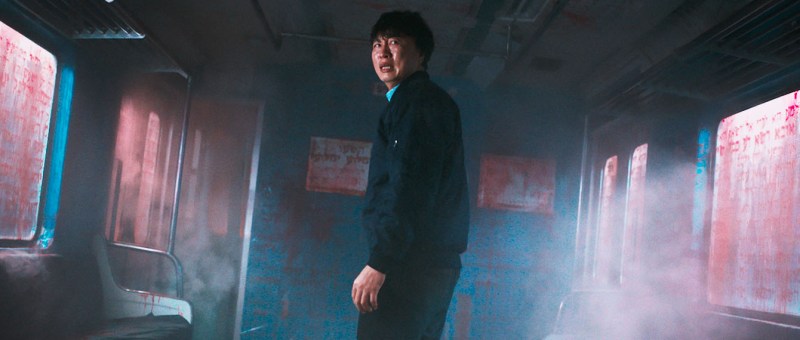
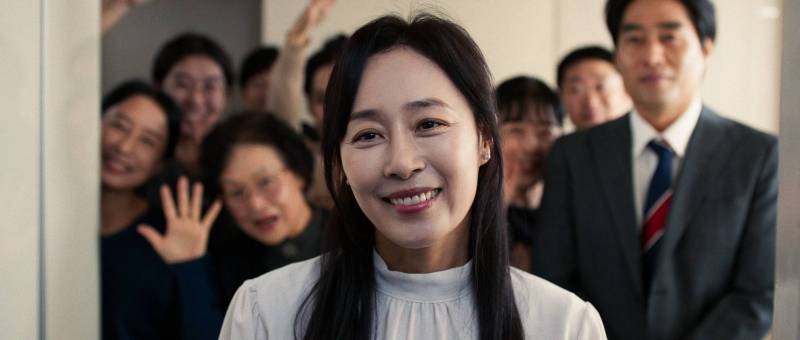
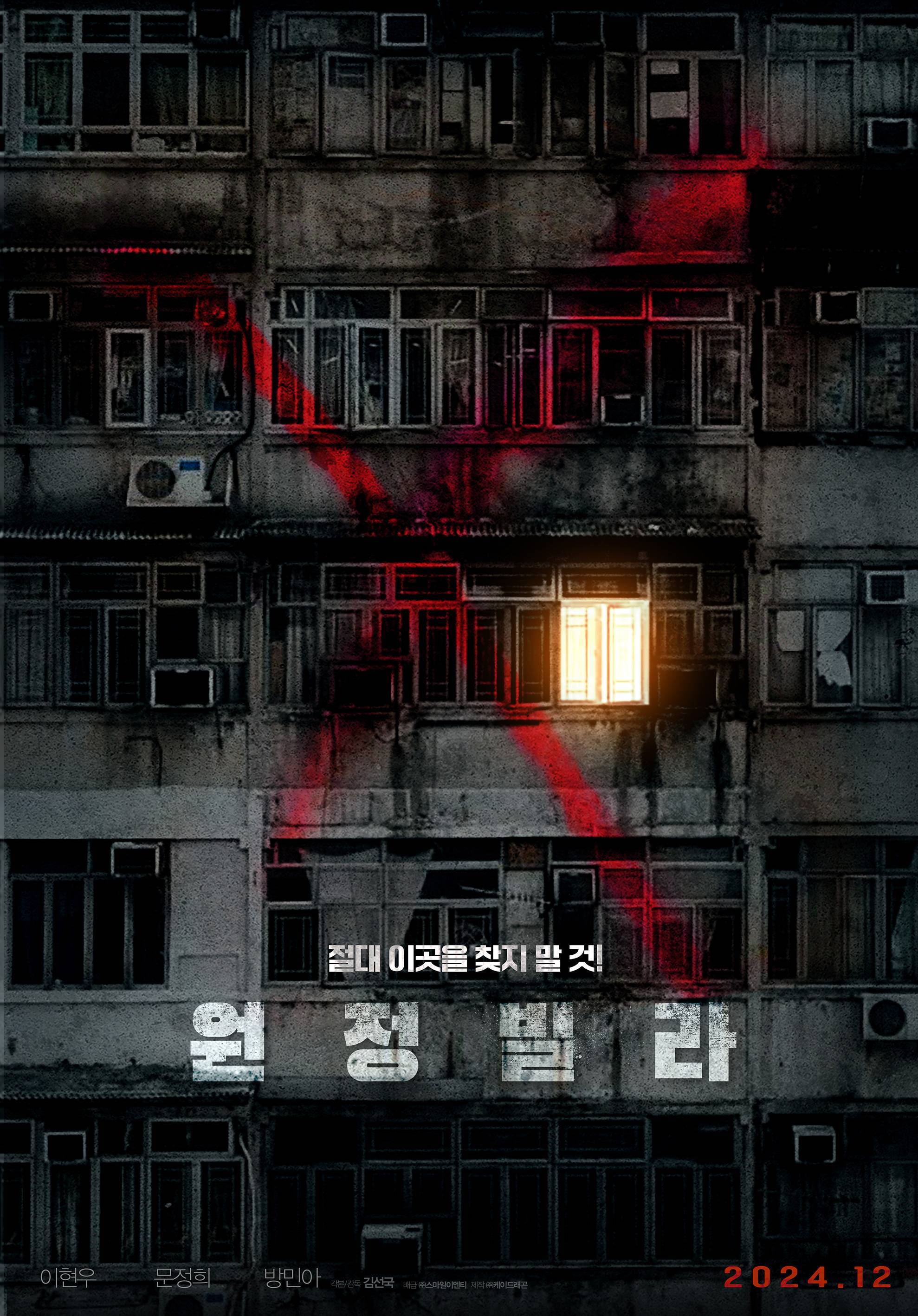
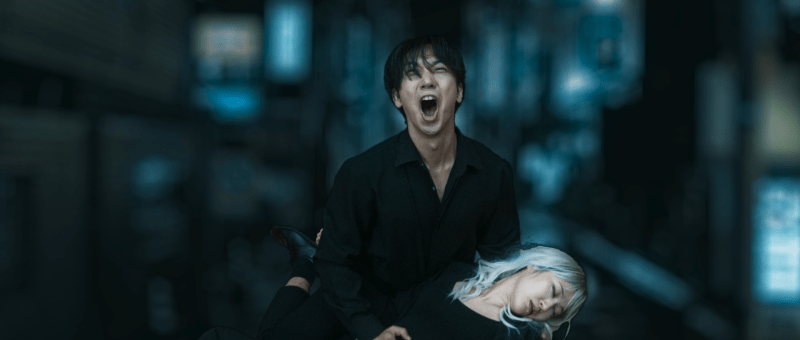
After discovering that all of his neighbours have become members of a religious cult, one young man tries to hold fast to his independence but finds himself confronted by the forces of conformity and mass hysteria in Kim Seon-kuk’s paranoid horror thriller, The Unrighteous (원정빌라, Wonjeong Villa). The film’s English title maybe somewhat misleading, though if anyone is unrighteous, it is the cult themselves rather than non-believer Ju-hyun (Lee Hyun-woo), while it’s also true that he lives in an unrighteous society obsessed with property values and social status.

It begins, however, with apartment complex horror as Ju-hyun gets into a vendetta with his upstairs neighbour Shin-hye (Moon Jeong-Hee) who first tries to bully him out of parking in “her” parking space which she is trying to hold for her husband who “always” parks there. Hearing strange sounds from above, Ju-hyun tries to complain about the noise, but Shin-hye ignores him and ironically insists that “neighbours should be more understanding” as if suggesting that Ju-hyun is being selfish and unreasonable and should rather make allowances for her son who is suffering from a serious illness. Ju-hyun had asked for quiet because his mother is recovering from recent surgery. 

The real problems start shortly after when it becomes apparent that Shin-hye has got religion after joining a Christian-leaning organisation that Ju-hyun has been warned is a cult that targets people with bogus surveys in order to recruit them. Though she had looked tired and took little interest in her appearance, Shin-hye is now nicely turned out with stereotypically middle-class housewife outfits, styled hair, and makeup. Grinning eerily, she seems to be intent on converting her neighbours. Ju-yhyun immediately earns her ire once again when he complains about her inviting the pastor to their residents committee meeting without prior notice. He’s not the only one who objects to being subjected to a religious lecture without his consent, though Shin-hye homes in on the neighbours’ various anxieties from job precarity to loneliness to win them over to her cause.

There seems to be a direct correlation between the literal cult Shin-hye is propagating and that of property ownership in that she often repeats that they are now all “homeowners” as opposed to tenants and “true owners of this land”. Ju-hyun is a property owner too, having paid off his mortgage at a comparatively young age, and himself hopes that the redevelopment project takes place so that he can move to a nicer apartment and have a better quality of life. Everyone is obsessed with how much more profit they might be able to make if the house prices rise in the area which is something the cult is also promising them happen. Ju-hyun isn’t disinterested in that, but also wants to see the town come back to life again and is heartened that so many people are moving to the area to take advantage of the currently lower than average prices.

Studying to become an estate agent, he seems to have an interest in finding people happy homes which might on some level be because of his own disordered familial background. Vague allusions are made to Ju-hyun’s long lost father being in some way abusive to the extent that Ju-hyun can’t forget the look in his eyes and is reluctant to let him back into their lives after he contact his mother to say he wants to apologise and make amends. It’s no surprise that he too has joined the cult, though the way that Ju-hyun reacts makes him something of a complicated hero and unrighteous in his actions. He justifies himself that he’s trying to keep his family safe and ensure the home he’s worked so hard to provide for them won’d be taken away, but his mother also has a point in resenting his bossiness and condescension as he repeatedly instructs her not to  have anything to do with the cult or open the door to strangers. When he has an opportunity to save his neighbours, he wonders whether he should bother given how mean to him they’ve all been through this whole ordeal.

In a sinister manner, the cult begins to encircle him as his employer and the leader of the redevelopment project turn out to be cult members. He’s fired from his job for refusing to join the cult, while the police seem to be in on it too and react to his attempts to explain with exasperation as if he were just a delusional conspiracy theorist. Only the local pharmacist with a side line in investigating cults is willing to help to help him. Nevertheless, the escalating darkness from trance-like religious mania to human sacrifice is quite steep even intended as satire that people would willingly sacrifice the lives of others in the name of house prices, even if they’re tricked into handing over the deeds to their properties to the cult become “the true owners of land”. Ju-hyun, however, resolutely refuses to drink the cool aid, in some ways quite literally, looking on with disdain as his neighbours dance in the street on receiving the news that the long awaited redevelopment project will indeed be happening as if it were a miracle fallen to them from some higher powers.


Trailer (English subtitles)
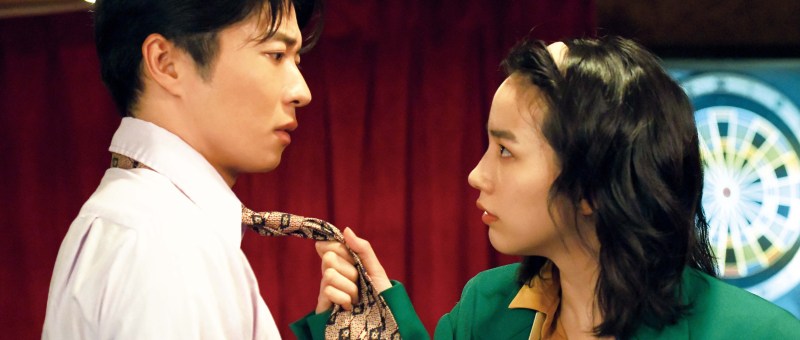
Red Nails (홍이, Hwang Seul-gi, 2024)

A not quite middle-aged woman watches as her mother takes an aerobics class with other similarly aged people at a nursing home. The attendant turns to her and remarks that it can’t have been an easy decision, leading us to think that she has reluctantly decided her mother may be better off living where she can be properly looked after. But Hong (Jang Sun) has actually arrived to take her mother home. Not because she’s had a change of heart, and not exactly because she’s having a hard time and can’t afford to pay for the home any more, but because she’s realised her estranged mother’s a cash cow and the only one she has left to tap.

Hwang Seul-gi’s complex drama Red Nails (홍이, Hong-i) never shies away from its heroine’s flaws even if it tries its best to empathise with her. Hong is clearly irresponsible with money. The piled up boxes in her living room hint that she may have fallen victim to a multi-level marketing scam, but whatever the root causes are, she’s pretty much bankrupt with the bailiffs about to be sent in to seize her goods due to her phenomenally large debts. Even so, we later see her going on shopping sprees as if she were trying to fill some sort of void through guilty consumerism that is really just punishing herself by making her situation even worse. 

Hong’s borrowed money from an ex-boyfriend who has since married someone else but continues to sleep with her while badgering Hong for his money back, claiming his wife’ll throw a fit if he doesn’t get it. Meanwhile, she’s engaged in a fantasy romance with a man from an app, Jin-woo, whom she misleads about her financial circumstances and later uses when she needs a free ride. Hong has a habit of taking advantage of people, including her mother’s old friend Hae-joo who agrees to watch her in the day. Hong often messes her around, staying out late without calling and just expecting Hae-joo is figure something out. Hae-joo eventually confronts her about her unreasonable behaviour while taking advantage of her free labour, but Hong tries to give her money as if that was the problem. Hae-joo is insulted, and bringing money into the equation only threatens to change the nature of the relationship. It makes Hae-joo feel cheap and used when she had been doing this as a friend because she cared about Seo-hee. 

Seo-hee, meanwhile, seems ambivalent about her new living standards and, at times, berates Hong complaining that she wishes she’d never been born. It’s not clear what happened in Hong’s childhood, but they evidently did not get on and still don’t now. Seo-hee wants to go home, complaining that there’s a thief in the house though whether or not she knows that Hong has been dipping into her savings to pay off her debts, she’s still aware that she brought home because she needed money rather than companionship. 

But then Hong is also lonely, and her romance with Jin-woo is an attempt to escape her disappointing circumstances. Her ex suggests she once dreamed of becoming a teacher, but is currently teaching a literacy class for a group of older woman at a local institute where she also cleans the toilets. She also has a second job directing traffic at a construction site where the foreman hates her, docking her pay for neglecting her duties by using her phone while on the job. She cannot her escape her debts through any legitimate means, though that hardly justifies stealing from her mother. 

Even so, it appears that on some level Hong wanted comfort and companionship along with her mother’s approval. As they live together, they begin to draw closer but at the same time it’s clear that they remember things differently, though whether Hong is right to blame Seo-hee’s dementia or has misremembered herself is destined to be an eternal mystery. Hong tries to fulfil her mother’s dream of lighting sparklers, but the pair are yelled by some kind of environmental officer and forced to put them out. Hong looks on forlornly as the glow fades away as if symbolising the flame going out of the relationship between the two women. Despite their growing closeness, there are some things that it seems can never really be made up and all Hong really has is a frustrated memory of a longed-for closeness that can never really be.

Red Nails screened as part of this year’s London Korean Film Festival.

Trailer (no subtitles)

Silver Apricot (은빛살구, Jang Man-min, 2024)

Money ruins everything. It eats away at even the most fundamental of human connections, rendering them all, in their way, transactional. But you need it, in the same way a vampire needs blood and it might be that the only way to get it is to suck it out of someone else’s neck. Or at least, that’s how it is for Jung-seo (Na Ae-jin) in Jang Man-min’s familial drama Silver Apricot (은빛살구, Eunbitsalgu). 

At 32 years old, she’s still being held on a temporary worker contract with her sleazy boss, who is low-key sexually harassing her, using the prospect of full, salaried employment to manipulate her working life. She works “overtime” making posters to advertise other exploitative jobs, such as gig economy delivery driver, with the cheerful slogan “anyone can do it” which she later acknowledges is probably “insulting” to those who do actually do it and are fighting for proper pay and recognition. Secretly, however, she’s working on a webtoon about a vampire, which is how she works out her anxieties and what she actually wants to do and would be doing if money wasn’t getting in the way.

The particular way it’s getting in the way right now is that she’s won an apartment lottery and urgently needs to get the money together for a deposit. Jung-seo plans on going halves with her fiancée Gyeong-hyeon (Kang Bong-sung), but he seems reluctant to put the money in and is clear he won’t make up the shortfall when she’s turned down for the permanent position and won’t be earning as much as she hoped. All that’s left to her is the bank of mum, but her mother’s fed up with her always asking for money and claims she’s saving too with the hope of opening her own restaurant despite the fact that Jung-seo suspects the owner of the place she works at now is romantically interested in her. Perhaps like Jung-seo, she’s lost the ability to trust anyone after having a bad experience with Jung-seo’s father who left them for another woman and still lives in their home town with a new family. 

Jeung-seo’s father Young-joo may also have had artistic dreams in that he was once a saxophonist but gave his sax to her mother as security for a loan he never repaid. Her mother suggests she ask him for the money back instead, but that means opening old wounds that may be better left unresolved. Young-joo (Ahn Suk-hwan) is like a vampire himself, draining those around him of their cash to fund one harebrained scheme or another from stock market speculation to spurious property investments that he swears will pay off but almost never do. Gyeong-hyeon may not be much better in this regard, himself dabbling in stocks despite Jeung-seo making him promise he wouldn’t in a way that makes it hard for her trust him and suggests that men are always hung up on potential future gains rather than what they have concretely right now. 

Predictably, Young-joo doesn’t really want to pay up and insists on meeting Gyeong-hyeon first in and old-fashioned bit of patriarchal nonsense which makes even less sense considering how little of a father he has been to her for all these years. Gyeong-hyeong, meanwhile, is instantly taken in by him and has all but fallen for one of his scams. Maybe it makes sense on paper to abandon the city and live in an area with a lower cost of living doing a less prestigious kind of job like running a cafe which would lessen your financial burden and allow more “free” time to practise your art even if would still be a side hustle, but Jeung-seo knows better than to believe her father’s lies and knows full well that he’s only changed his tune because he overheard how much profit they could make with the apartment and thinks he’s entitled to some of it if he gives them the money.

But it’s not even like Jung-seo is asking for money from him. She’s only asking for money that actually belongs to her mother. Money ruined their relationship too, and it even interferes in her connection with her younger half-sister Jung-hae (Kim Jin-young) who idolises her but also frames her for stealing her mother’s savings after asking her to secretly sign a lease on an apartment she could use for her own art, music, and as a safety net in case her mother really decides to leave Young-joo this time when his plan to redevelop a building in a nearby town inevitably goes belly up. Joo-hee (Choi Jung-hyun) may have this in the back of her mind herself, which explains her coolness toward Jung-seo, fearing her sudden need for the repaying of old debts will destabilise their family and mess things up for Jung-hae. 

Despite the familial tension, being back in her hometown where Gyeong-hyeong’s spineless pragmatism is all the more obvious forces Jung-seo to think about what the apartment actually represents and whether that’s what she wants. Once she signs, she’ll be locked into that very conventional life which is what everyone in Seoul strives for, but might not actually be right for her. Her friend in her hometown, Tae-joo, has joined the navy for the financial security and will be able to get a military apartment when he marries. He’s given up drawing webtoons, and possibly also on his romantic hopes for Jung-seo. When she makes overtures towards him, he replies that he’s not ready to give up on his civil servant girlfriend, suggesting that he isn’t brave enough to break out of this conventionality either. Jung-seo is essentially in a relationship of convenience with Gyeong-hyeon that is not based on love but solely on the ability to buy the apartment which is what he really wants from her. The question is whether she has the courage to get off this train or is willing to settle for a life of dull humiliation submitting herself to the whims of her bosses while gradually abandoning her hopes and dreams to live in an apartment that is itself not a home but an investment in a future that will never really be hers.


Silver Apricot screened as part of this year’s London Korean Film Festival.

Trailer (English subtitles)

Maru (まる, Naoko Ogigami, 2024)

Taken to task by a coworker (Riho Yoshioka) for allowing himself to be exploited as an assistant to an internationally famous artist who views them as little more than tools and takes all the credit for their work, Sawada (Tsuyoshi Domoto) asks if she knows who built Horyu Temple. He has to supply the answer himself, Prince Shotoku. But of course, he didn’t. It wasn’t  as If he drew up the plans or cut the wood with his own hands. 1300 carpenters built it, but no one thinks about them. Only about Prince Shotoku, because he commissioned the work and paid for it. Sawada doesn’t think what he’s doing is all that different, and that times haven’t really changed all that much. Not many people get to make a living doing what they love, so perhaps that’s enough for him. 

But his colleague asks if he sees himself more as a worker than an artist, as if she were unintentionally making a value judgement on the nature of art. The line between artist and artisan maybe so thin as to not exist, but why is it that we think of art which is perceived to have a practical application differently from that which we assume is intended only as a means of self-expression? “What about your own art?” she asks Sawada, but he doesn’t really have a notion of it because he’s been so focussed on earning a living as part of a wider capitalist superstructure in which art too is a commodity. Akimoto (Kotaro Yoshida) is basically running an art sweatshop mass-producing pieces for an international market and operating it like a brand in which everything is released under his own name. When Sawada falls off his bike and breaks his dominant arm, Akimoto simply fires him.

But then, things begin to get strange. Sawada draws some circles with his left hand and includes them with a few things he plans to sell to a second-hand shop where they’re picked up by a strange man who describes himself as a “magician who can’t do magic” and offers him fantastic amounts of money for his work even though all he did was draw a circle. Sawada discovers what he drew is called an “enso” and represents “serene emptiness”, but at the same time others seem to project whatever they want to see in the hole inside while Sawada himself is uncertain what should be there. The magician tells him that his follow-up work is no good because his enso are full of desire in his newfound lust for fame and riches, but at the same time he and his art have also become a commodity and like Akimoto he’s locked into producing more of what people want rather than expressing himself or finding artistic fulfilment. 

His colleague returns to attack him again. Now she criticises him for exploiting art to make money. “Art that’s expensive and just for a few wealthy people isn’t real art,” she says. She sticks to her message that the labour of those like her is being exploited and the world is set up for a few wealthy elites. Their chant of “we want sushi too” might seem flippant, but it represents the world that they’re locked out of. Sawada’s incredibly intense, struggling mangaka neighbour is obsessed with getting sushi too, though there’s plenty of it on the buffet at Sawada’s show which Sawada eyes hungrily. Eventually he’s reduced to grabbing some to eat on his own in a stairwell, signalling his liminal presence within this space. He’s the artist and it’s his show, but he isn’t really part of this world and no one’s really interested in him except when he’s giving mystical quotes as part of his marketing brand. 

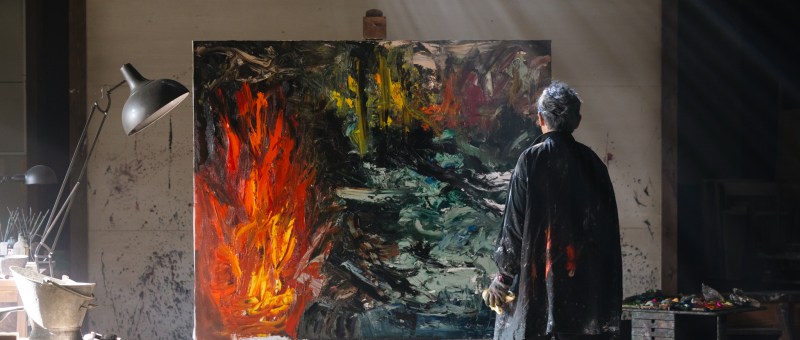
The conclusion that he comes to that his art at least should exist for art’s sake. That all he ever wanted to do was paint as a means of being true to himself, only that simple desire has got lost amid the complications of modern life. It’s very hard to draw circles of serenity when you’re living in a rundown apartment block with a worrying subsidence problem and your neighbour screams all night in despair before punching a hole in your wall which you’ll probably have to pay to have fixed. Nevertheless, through Ogigami’s elliptical tale, Sawada does perhaps begin to find a path back to his own art or at least what art means to him which is after all what’s in the middle circle even if all anyone looks at is the edges. 


Maru screened as part of this year’s Camera Japan.

Trailer (no subtitles)

Make a Girl (メイクアガール, Gensho Yasuda, 2024)

A socially awkward teenage scientist takes a friend’s advice too literally and builds himself a girlfriend in Gensho Yasuda’s indie animation, Make a Girl (メイクアガール). The central irony is that Akira (Shun Horie) makes Zero (Atsumi Tanezaki) to improve his productivity, but in fact ends up learning how to interact with people from her. Nevertheless, consciously or otherwise, he’s started off from a questionable position given that his notions of what a girlfriend should be are bound up with his unresolved feelings for his late mother along with outdated sexist attitudes. 

Akira’s mother Inaba was a genius scientist who passed away of an illness sometime previously leaving Akira alone with only their huge lab and a drive containing her memories. Fearing he can’t live up to his mother’s legacy, Akira’s inventions are largely useless time-wasting devices which make ordinary tasks take longer than they would if done in the normal way. That’s why he’s so taken with his friend’s story about how getting a girlfriend has improved his productivity at his part-time job. Not really understanding why his friend’s productivity improved, he decides to create a “girlfriend” for himself, but is only doing so in the hope that she will magically allow him to level up. She is then a sentient being that exists solely to support him by being cute and sweet while he otherwise puts nothing at all into the relationship.

Zero’s desire to fit into the stereotypical “girlfriend” role is signalled by her learning to cook so that she and Akira can eat together, while when she tries to go on a stereotypical date with him, she opts to go clothes shopping and says that she’s realised that she likes it when he makes all her choices for her. Akira is really in the awkward position of being both a paternal figure and a boyfriend, branded a “father” to his creation by his mentor while at the same time associating Zero with his late mother even as he tries to “date” her, albeit in a curiously asexual way. It turns out that his mother’s AI coding contained several safeguards which effectively mean that Akira has total control over Zero and if she attempts to defy him, she automatically tries to strangle herself. When he begins to find her annoying because her desire to spend more time with him gets in the way of his research, he simply gets her an apartment and says he just wants to be friends.

Led into a quagmire of existential questioning both by Akira’s indifference and the probing of his friends, Zero begins to wonder who she really is and if she only “likes” Akira because he designed her that way. Though she desperately tries to get Akira back by being an even more perfect girlfriend, which is after all her life’s purpose, she begins trying to claim her identity by overcoming her programming, which is to say escaping his control to be her own self. Akira, meanwhile, finally realises that what he felt for her wasn’t “annoyance” but “love”, if only if still rooted in all the things she can do for him rather than an acceptance that what his friend meant was that falling in love had given him an eagerness for life through the mutual exchange of emotion, care, and support. 

In any case, Zero’s actions take on a misogynistic quality as if Akira were, in a way, attacked by a “crazy girlfriend” who was only ever going to mess up his life because women always get in the way. The fact that the antagonist is also a woman who is jealous of his genius and a kind of rival to Zero further rams the idea home that women only cause trouble and are a threat to a man’s autonomy, even as Akira is still clearly overly attached to the memory of his late mother. The voice of reason is his wiser than her years friend Akane (Sora Amamiya), though even she at times seems jealous of Zero and shares many of the same outdated notions about what a woman should be. It’s almost as if Akira too is a construct who was only turned on yesterday which is why he has no idea about human feelings or how to interact with other people and is, in effect, learning them vicariously through Zero, who is mainly picking them up from Akane but getting a double dose of patriarchal programming that proves much harder to break than any of Akira’s code.


Make a Girl screened as part of this year’s Camera Japan.

Trailer (no subtitles)

The Young Strangers (若き見知らぬ者たち, Takuya Uchiyama, 2024)

You have to protect your space from the violence of this world, a compromised father advises his sons, yet it’s something that neither he nor they are fully capable of doing. Billed as the “commercial debut” from the director of the equally emotionally devastating Sasaki in my Mind, Takuya Uchiyama, The Young Strangers (若き見知らぬ者たち, Wakaki Mishiranu Monotachi) paints a somewhat bleak portrait of contemporary Japan as place of desolation and abandonment, but at the same time is melancholy more than miserable in the earnestness with which they all dream of a better life somewhere beyond all of unfairness and injustice.

But Ayato (Hayato Isomura) seems to know that he’s burdened with some kind of karmic fate. His life oddly echoes that of his former policeman father and takes on an ironic symmetry even as he was unfairly left to pick up the pieces as a teenager adrift in the wake of parental betrayal. Now his late 20s, Ayato is a worn out and dejected figure who barely speaks after years of doing multiple jobs, in addition to running the snack bar his parents opened as a new start, to pay off the debts his father left behind. Now his mother has early onset dementia and her care is also something else he must manage as best he can with support from his girlfriend Hinata (Yukino Kishii), a nurse, and less so from his conflicted brother, Sohei (Shodai Fukuyama), who has a path out of here as an MMA champion if only he can stick to the plan and keep up with his training. 

As his best friend Yamato (Shota Sometani) points out, he’s hung onto everything his father left him but is equally in danger of losing his future. He seems wary of his relationship with Hinata, afraid to drag her into his life of poverty and hardship, while he watches friends get married and start families. He once had a promising future too, as the star of the school football team, but like everything else that came to an abrupt end in the wake of family tragedy. There are hints of trouble with law in his younger years that may have made it even more difficult for him to earn a living wage, along with giving him an unfavourable view of authority figures. Seeing another young man hassled by the police, he steps in to inverse but ends up in trouble himself. The policemen, take against him and when he’s beaten up by thugs who drag him out of the bar, they arrest him instead and let the others go. Time and again, bad actors seem to prosper and get away with their crimes, while good people like Ayato continue to suffer. When Yamato tries to come to his defence and questions the police, they lie and tell him Ayato’s just a waster as if the world were better off without him.

The boys have this game they play where put two fingers up against the back of a friend’s head and shout “bang”. It’s like there’s a bullet that always coming for them, and Ayato too fantasises about shooting himself in the head to escape this misery. Sohei, meanwhile, makes violence his weapon in taking the martial arts his father left him to forge a new path for himself while vowing not to be intimidated by violence. But violence is all around them from the literal kinds to that of an uncaring and oppressive society, and as much as Ayato fights in his own way to protect his family he can’t keep them all together nor the darkness at bay. He badly needs Sohei’s help, but also knows he can’t ask him to give up his way out or take away his future while Sohei is already pulling away. He thinks it’s time to look into a more permanent solution for their mother, and that they should let the past go, but Ayato wants to hold on to all of it as a means of giving his life meaning. “It’s not your fault, but it will be if it carries on,” a sympathetic neighbour tells Ayato after finding his mother in his cabbage patch again and leaving him to one again clear up the mess. Haunted by images of the past that in Uchiyama’s masterful staging segue into and out of the present, Ayato desperately searches for a way out of his suffocating existence, but encounters only betrayal and injustice amid the constant violence of an indifferent society.


The Young Strangers screened as part of this year’s Camera Japan.

Trailer (no subtitles)

Welcome Back (Naoto Kawashima, 2024)

“Once you play the heel, you can’t go back,” according to up-and-coming boxer Teru’s (Kaito Yoshimura) coach, but it turns out to be truer than for most for the aspiring champion for whom getting up off the mat proves an act of impossibility. While he plays the hero for younger brother figure Ben (Yugo Mikawa) and talks a big game before stepping into the ring, in reality Teru is riddled with insecurity and using bluster to overcome the fear that he can’t live up to the image Ben has of him.

The terrible thing is, he might be right and Ben, a young man with learning difficulties who later gives his age as 10 though clearly in his 20s, may be beginning to see through him. “I lost because I looked at you,” he later says of a failed attempt to fight off their chief rival, but it might as well go for his life which he’s spent in Teru’s footsteps ever since his mother abandoned him with Teru’s family when they were just children on the same housing estate.

As such, Teru does genuinely care for Ben, but has also been hiding behind him in allowing him to become something like a mascot or cheerleader, someone over whom he feels superior but also looks up to him as the sort of person he wants to be but perhaps isn’t. In any case, his boxing career has been going well and he’s on track to become the Japanese champion, but at the same time he’s proud and arrogant. He thinks he knows better than his coach, and likes to make a big entrance trash talking his opponents in a larger-than-life manner that might be more suited to pro-wrestling than the comparatively more earnest world of boxing and earns him a degree of suspicion as a result. His opponent Kitazawa (Yoshinori Miyata) is his opposite number in that, as Teru points out, he’s deathly serious and certain in his abilities which is why he’s able to KO Teru mere seconds into their title match. No longer “undefeated”, Teru simply gives up and retires from boxing only to spiral downward while working as a supermarket mascot, eg. Ben’s old job from which he also gets him fired by messing it up for both of them because of his pride and temper.

But for Ben, the certain truth of his life has been that “Teru never loses”. Now that Teru lost, something’s very wrong with the universe and he has to put it right, which is why he decides to fight Kitazawa himself even if he has to walk to Osaka from Tokyo to do it because they’ve got no money for transport. What neither Teru nor Aoyama (Yuya Endo), a boxer Teru once defeated in another title fight but ends up helping him and Ben on their quest, is that after obsessively watching Teru all this time, Ben is actually quite a talented, if untrained, fighter. They were hoping they could get him to give up on his plan by finding someone weaker than Kitazawa to defeat him so he’d know he had no chance, but he basically fights his way all across Japan to prove that Teru really is the hero he always thought him to be. 

This turns out to be inconvenient for Teru because inside he feels himself to be a loser and since his single defeat has been running away from the fight. As he later begrudgingly realises, none of this would be happening if he’d knuckled down done the training so he’d be able to beat Kitazawa in the first place rather than being consumed by his pride and arrogance. He should be the one fighting Kitazawa, not Ben who is putting himself in danger because the world doesn’t make sense to him any more. Kitazawa, meanwhile, has his number and seems to look down on him for his lack of fighting spirit, correctly surmising he will walk away from the chance to fight him for real when he opts for a last resort of trying to bribe him to fake a sparring match so that Ben will see him win and be able to go on with his life. 

But nothing quite goes to plan, and it seems like Ben might be starting to see that Teru might actually be using him to bolster his own sense of low self-esteem which obviously means that he does and always has looked down on Ben. Having come to a realisation that he needed to play the role of the hero that Ben needed him to be, perhaps what he sees is that Ben has outgrown him and that despite his constant insistence that “Ben is a child” is capable of doing what he couldn’t in fighting back even when the odds seem impossible. Teru is defeated by life, but fighting back in his case might look like something a little less glamorous that starts with eating some humble pie and calling in a favour to get a shot at a regular job he’ll have to take a little more seriously. In one way or another, their accidental road trip clarifies the dynamics of their “brotherly” relationship, but at the same time leads them to a point of division in which moving forward might necessarily mean they’re going in different directions.


Welcome Back screened as part of this year’s Camera Japan.

Trailer (no subtitles)

4PM (오후 네시, Jay Song, 2024)

What is the proper etiquette for dealing with an unwanted house guest? It is acceptable to ask them to leave directly, to usher them out of the house by making an excuse that you are leaving yourself, or are you duty bound by virtue of your place in society to put up with it and wait politely until said guest leaves of their own accord, assuming that they ever do? At the end of the day, perhaps it’s foolish to allow our time to be wasted on petty worries about propriety when the best thing to do is really to be direct and explain that you do not enjoy this person’s company and would appreciate it if they did not call on you again.

Based on a novel by Amélie Nothomb, Jay Song’s increasingly absurd psychological drama 4PM (오후 네시, Ohu Nesi) is indeed about the suffocating qualities of politeness, but also in the ways that it interacts with class and masculinity along with the very image of ourselves. As a character in an Ibsen play once said, to take away a man’s life lie is to take away his happiness, and professor Jung-in (Oh Dal-su) is keen to caution against looking too deeply into one’s own soul for the only gifts of self-knowledge are unbearable shame and misery. “I am defined by my kindness to others as a educated man,” Jung-in reminds himself, but in saying so he also makes it clear that his politeness is a conscious affectation rather than an innate character trait. He behaves in a certain way because he fears judgement and wants others to approve of him as a nice person who has been raised well to have good manners. Fulfiling this image is key to his idea of self in the persona of a cultured professor and marks him out from those he may secretly see as “lower” than himself, in being “uneducated” and “rude”, ignorant of the “proper” way to behave. 

But whatever way you look at it, Yook-nam’s (Kim Hong-pa) behaviour is “impolite” despite his apparently being a doctor, though we’ve really got his word for it. Having taken a sabbatical, Jung-in and his wife Hyun-sook (Jang Young-nam) have bought a house in the country, but unusually for such a property, it’s overlooked by an adjacent home positioned a little too close for comfort. The couple figure they should introduce themselves, but the lights are always out and the place doesn’t look lived in, so they leave a note inviting the occupant to visit at their convenience. Unfortunately, Yook-nam takes them at their word, shows up at 4pm, barges his way in, and then just sits there for two hours snapping at them with monosyllabic answers to their questions as if he were burning with rage. He does the same thing every day until it begins to drive the couple out of their minds. 

Of course, they have to ask themselves why they allow this. Why can’t they ask him to leave, or refuse to open the door? They find it impossible to break the psychological barrier of politeness by stating pointe-blank that Yook-nam is a bore and they wish him to leave. They are in a sense suffocated by the need to conform to these deeply ingrained social codes of what it means to be a good person even when others are clearly not abiding by the same set of rules. The absurdity eats away at them as they find themselves humiliated by their own cowardice in becoming complicit in Yook-nam’s oppression. Jung-in begins to realise that his civility interferes with the demands of socially defined masculinity in that he is failing to protect his home by being unable even to eject an unwanted guest and in effect ceding power to him even within the safe and personal space of the domestic environment which should also be free of such oppressive rules for being.

Jung-in anfd Hyun-sook may be getting an idea of why the last person moved, but there’s also a kind of symmetry in the two houses which are in their way each haunted. Both couples say they have no children, but there’s a family photo with a little girl in Jung-in and Hyun-sook’s house that does not appear to be of their surrogate daughter, Jung-in’s former student So-jung (Min Do-hee), just as there’s a family photo with a little boy in Yook-nam’s house that hints at a buried tragedy. While Jung-in and Hyun-sook’s house seems to be full of light, uncluttered, clean and tranquil, Yook-nam sleeps in soiled sheets in a room that apparently smells in home that is filled with unwashed dishes while the walls are coated in grime. The whole place is covered in loudly ticking ticks in contrast to the silence of Jung-in’s home which brings new meaning to his words about living in the present. 

It isn’t really clear what Yam-nook wants out of all this, whether he’s just looking for some kind of escape or actively rebelling by being deliberately unpleasant while exerting his power through wasting Jung-in’s time. “He was still my guest,” Jung-in insists emphasising the roles they are each playing along with his own determination not to deviate from them. Perhaps Yook-nam actually wants them to break protocol by telling him to go away, but instead they live in tyranny of 4pm and sit quietly until Yook-nam abruptly leaves at six rather than say anything or at the very least tell their unwanted guest that he’s free to stay but they’re going to get on with their business. Meanwhile, Jung-in’s civility is slowly eroded, exposing the primitive man inside who fantasies about killing Yook-nam and is suffocated by his his hate for him. But in seeing this true side of himself, Jung-in discovers only shame rather than authenticity or empowerment, and in creating another persona is again ironically suffocated, silenced in his own rebellion. Quietly unsettling, the film suggests that we all, in a sense, live in tyranny of 4pm by allowing ourselves to be oppressed for propriety’s sake rather than risk being “rude” in the knowledge that to do so would be to risk releasing the monster inside us that “politeness” alone keeps at bay.


Trailer (English subtitles)
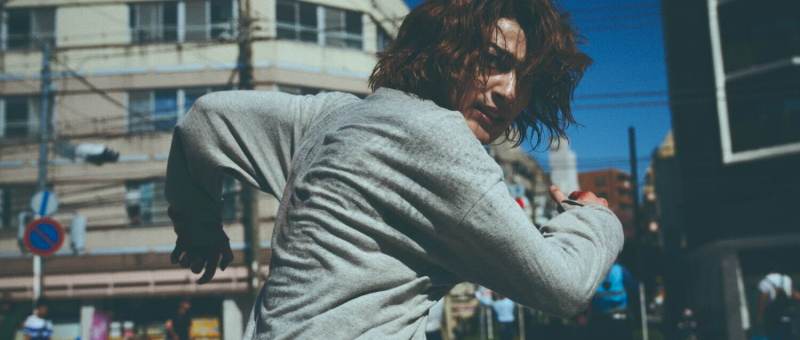
Hidden Face (히든페이스, Kim Dae-woo, 2024)

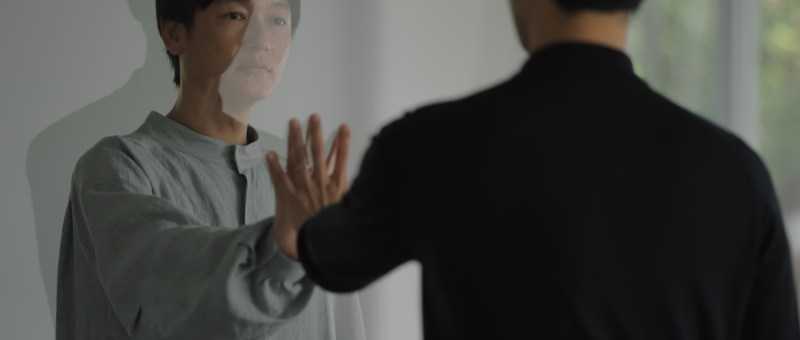
The obvious irony in the title of Kim Dae-woo’s erotic thriller Hidden Face (히든페이스), is that it refers both to the heroine, Su-yeon (Cho Yeo-jeong), who conceals herself within a secret bunker in her home to spy on her indifferent social climber boyfriend Sung-jin (Song Seung-heon), and to the sides of themselves that people choose not to reveal to others. As Su-yeon’s mother (Cha Mi-kyung) says, it’s what people see that matters, but the hidden corridors of Su-yeon’s home symbolise the ways in which she has imprisoned her true self or at least has locked a part of herself away from prying eyes while continuing to pry into the secret lives of others.

It’s in this forbidden space, apparently added to the house by the previous father’s owner who was a member of notorious Japanese Unit 731 during the war and feared exposure, that Su-yeon first kissed fellow student Mi-ju (Park Ji-hyun) with whom she’s been in a long-term, but apparently secret, relationship. While Mi-ju is patiently renovating the house she thinks they’ve bought together, Su-yeon has decided that she wants a “real life that people recognise”, which she evidently doesn’t believe a same-sex relationship can be. The forbidden space of “cold room” is then where she’s locked her queerness, and a manifestation of her fears of the consequences of exposure. The problem is that she doesn’t even like Sung-jin and the points of attraction he seems to hold for her are that he doesn’t like her either and is otherwise easy to manipulate because of the vast class difference between them. 

Part of the reason that Sung-jin keeps Su-yeon at arms’ length is that he resents the power that she holds over him. He resents both her and himself in knowing that he’s really only with her for material reasons, while simultaneously aware that his current success has nothing to do with his own talent and everything to do with Su-yeon’s privilege. Su-yeon’s mother congratulates him on working hard to build an image of himself, while otherwise needling him about his working-class background in which his mother ran a small restaurant and really knows nothing of this elite world of classical music, mansions, and honeymoons to resorts that charge some people’s annual wage for a single night’s stay. But the facade can’t really cover up Sung-jin’s insecurity and the fear that he couldn’t make it on his own though he so desperately wants to be a part of this world and to feel himself worthy of it. He feels emasculated and humiliated in assuming that other people can see that he’s just a puppet while Su-yeon, her mother, and their advisor discuss policy decisions he’s technically responsible for out in the open, he assumes to deliberately embarrass him and keep him under control. 

Yet the truth is that these kinds of hierarchal power structures of class and gender are less relevant when it comes to desire than otherwise might be assumed. Su-yeon refers to Mi-ju as her slave or underling and adopts a dominant role in the relationship yet eventually has the tables turned on her when Mi-ju decides to rebel. The power dynamic of desire is a push and pull between the desire and the desired mediated by the depth of yearning. It may seem to Su-yeon that she is in control, but equally Mi-ju derives power from her willing submission and can overturn the dynamic at any time she chooses upending Su-yeon’s delusion that Mi-ju is a mere plaything, or “tool”, she can take out and put away at will. 

Nevertheless, the question is whether anyone could be content with this shadow life or if Su-yeon, vain, psychopathic, and probably incapable of understanding other people’s feelings, is content to imprison herself within the hidden corridors of her home which come to stand in for the need to conform to the heteronormative, patriarchal, class-based social codes other people see as “real” and “normal”. Sung-jin is apparently all too willing, considering just leaving Su-yeon trapped behind their walls to continue enjoying this life of privilege with a little more freedom without considering that without Su-yeon he has no entitlement to it as her mother later suggests after becoming worried on realising that Su-yeon hasn’t used her credit in days which is extremely uncharacteristic behaviour.

Sung-jin would trade his pride as a man, his sense of self-worth, and even betray his moral code to appear wealthy and successful and deny his working-class origins. Su-yeon would also, it seems, rather be in a conventional marriage to a man for whom she feels only contempt and resents for not liking her, than live an authentic life as a lesbian and face her internalised homophobia along with that of the wider society. Thus she confines Mi-ju to a forbidden space of her mind in an attempt to have her cake and eat it too, while Mi-ju seemingly fulfils herself in wilfully becoming a prisoner of love, even if it may only be in Su-yeon’s fantasy. Perhaps they get what they wanted all along, affirming the primacy of privilege, but only at the cost of their authentic selves and trapped inside the prison of their own self-loathing.


Hidden Face is released Digitally in the US on September 16 courtesy of Well Go USA.

Trailer (English subtitles)
MA – Cry of Silence (မ – Cry of Silence, The Maw Naing, 2024)

After their factory withholds wages for two months, seamstresses decide they have no other option but to strike in The Maw Naing’s hard-hitting drama, Ma – Cry of Silence (မ – Cry of Silence). As the opening title cards explain, Myanmar has seen a series of military coups over the last few decades and is now in a state of civil war. The military’s burning of villages has forced young people into the cities in search of work and shelter, but also left them in a precarious position and vulnerable to exploitative conditions. 

Mi-Thet, at least,ƒ is haunted by memories of her village burning and lives in a kind of hell where smoke is always on the horizon. She has a job as a seamstress and lives in a dorm with other young women in similar positions, but the factory hasn’t paid wages in two weeks and the landlady is beginning to get fed up. She snaps at the girls and ironically asks if they want her to starve to death, laying bare both the domino effects of this world in collapse and the pervasive heartlessness of capitalism. At the factory, the Forman watches over them, ruler in hand and often strikes them if he thinks they aren’t working hard enough while they’re terrified of taking breaks or visiting the bathroom because he also peeps on them or tries to extract sexual favours which some of the girls grant because they need the money.

The foreman’s face is kept offscreen and even when the women confront him, he appears as a ghostly silhouette behind the plastic sheeting. The factory boss, even when he supposedly arrives by car, is never seen at all. It may be that the political situation makes it impossible to run this kind of business, but at the same time it seems more like the factory just don’t want to pay the women because they think they don’t have to. After all, they have money to hire thugs to break up the protests when the women decide to strike rather than just giving them what they’re owed. The foreman alternately threatens them and makes false promises of payment that the women can’t believe because they’re still owed so much money even though as Mi-Thet says, she spends her days between the factory and the dorm. It wouldn’t surprise her if she died at her machine, while one of the others quips they’d still keep them working after they died.

Mi-Thet remains on the fence about even joining the strike, as do many of the other women afraid of the repercussions and of losing the money they’re owed entirely though it doesn’t seem as if it would be paid anyway. Her neighbour U-Tun who is disabled and is covered in scars from the 1988 protests for democracy remains world-weary and not so much encouraging as fatalistic but offers Mi-Thet a series of books that help her commit to the cause though it’s seeing her friend who works as a maid be badly beaten by her employer that convinces her they have to act now. 

As U-Tun says, the country should have changed but it stayed the same, while Mi-Thet can’t figure out if they’re emerging from the darkness or walking deeper into it. News reports speak of torched villages and refugees but also of the food shortages the destruction has caused. Even the cook at the dorm complains prices have gone up so much she can’t get good food and says she’ll cook better when they pay her more. “Better” doesn’t really matter at the factory as long as the girls hit their quotas, but workers can’t work on empty stomachs and no sleep even as the foreman seems intent in working them to their deaths. Mi-Thet and the others attempt to stand up against this cyclical destruction, but discover that they have almost no power and the factory owners don’t care at all if they live or die because they think there’s an endless stream of displaced girls looking for work. Gunshots and the rumble of fire echo in Mi-Thet’s ears, but ultimately she discovers herself trapped within this historical loop but issuing a rallying cry to the youth of Myanmar to rise up against this continuing oppression.


MA – Cry of Silence screened as part of this year’s New York Asian Film Festival.

Trailer (English subtitles)