
Magical Secret Tour (マジカル・シークレット・ツアー, Chihiro Amano, 2026)

When her husband falls into a coma and she discovers he’s left them in huge amounts of debt due to an undisclosed gambling problem, an ordinary housewife finds herself at the mercy of an already strained society in which it seems everyone is struggling to the extent that they have no capacity to listen to other people’s troubles. Inspired by a real-life case in which a group of women was arrested for smuggling gold into the country in 2017, Chihiro Amano’s lighthearted crime drama Magical Secret Tour (マジカル・シークレット・ツアー) is a condemnation both of a society ruled by money and the various ways that women are still expected to clear up the messes of irresponsible men.

Wakako (Kasumi Arimura) is quickly made to feel guilty for not having noticed anything wrong with her husband or their family finances while also expected to shoulder the burden of the repayment plan to his former employer to cover the money he embezzled on top of his hospital fees which must now be paid in full because he was unemployed and had no insurance. When she tries to turn for her own family for her help, her mother is not happy to see her and seems put out that she’s turned up unexpectedly. It seems their family garage business is in trouble while they are already under strain due to needing to pay for their bedridden grandfather’s medical treatment. Her mother leaves abruptly before Wakako has the chance to explain the situation denying her the possibility of both financial assistance and emotional support. 

Apparently ineligible for any kind of government assistance, Wakako’s attempts at job-hunting fail because she is a mother of two with one only an infant and has also been out of the workforce for too long for any career experience to count. Even when her husband does eventually make a partial recovery, he blasts her for neglecting her responsibilities and overburdening his mother by asking for help with childcare. Despite having let her down so badly, he insists he’ll get a job once he’s better and discourages her from continuing to work even though she tells him that she enjoys it and finds it fulfilling. To that extent, her experiences have shown her that she did not really need to be dependent on a man for money as society somewhat encouraged her to be and could also look for fulfilment outside the home as an independent woman. 

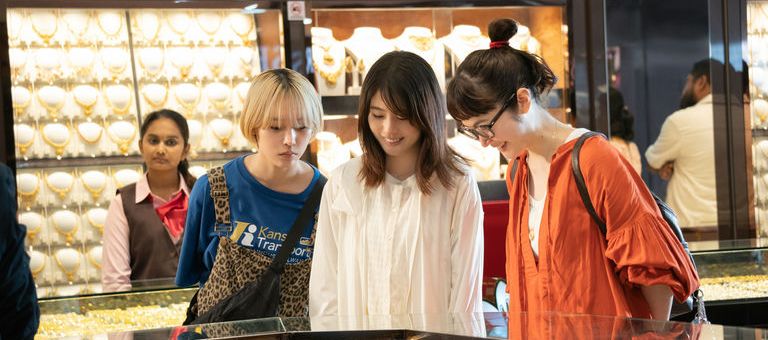
Nevertheless, the only work she can find means turning to criminality, first by agreeing to a loan shark’s dodgy gold-smuggling scheme by taking the kids to Singapore for a few days and then returning laden down by gold bars they smuggle through customs to avoid importation taxes. While there she meets two other women in similar situations. Kiyoe (Haru Kuroki) is a scientific researcher in her early 40s who faces persistent sexism at work where her boss steals credit for her discoveries and faces no consequences for fiddling his expenses. Unable to find a new position thanks to a poor publication history, she wants the money to provide for her future. Mayu (Sara Minami), meanwhile, is trying to escape her toxic mother while pregnant herself and working as a bar hostess. 

The women justify themselves that what they’re doing is basically a victimless crime and just really a bit sneaky rather than morally wrong even if aware it’s illegal. A disclaimer at the end of the film implies the law has been tightened since 2017, but the stakes are also fairly low as it seems they’d mostly likely just be asked to pay the tax if they got caught, so trying to smuggle it seems like a no-brainer to them. Even so, the film skirts around Wakako’s involvement with the criminal gang from whom one would expect some sort of payback after she runs off with some of their gold after her own attempt to run a similar business inevitably runs into trouble. Instead it focuses on her sense of isolation in which the mother can end up being pushed out of both families, disregarded and taken for granted while expected to pick up her husband’s slack even if he hasn’t kept his part of the bargain by providing financial stability while otherwise absent from the domestic space. The only way to make a man play his part in child-rearing might ironically be divorce, though it seems likely it might just be him overburdening his mother this time. In any case, Wakako’s magical secret tour does seem to have led her to a more fulfilling place even it may in other ways be bittersweet. 


Magical Secret Tour screens as part of this year’s New York Asian Film Festival.

Trailer (English subtitles)

Cha-Cha (チャチャ, Mai Sakai, 2024)

Love can make you do funny things. It can also blind you to the world’s realities and colour the way you interpret the actions of others. At least, that’s how it is for the protagonists of Mai Sakai’s Cha-cha (チャチャ) who are all suffering with unrequited love and unbeknownst to them quite mistaken in their assumptions about the loves of others while otherwise solipsistically trapped in a bubble of frustrated romance.

Sometime narrator Rin (Sawako Fujima) is resentful of colleague Cha-Cha (Marika Ito) who is, ironically, the the total opposite of herself in that she’s free spirited and eccentric each qualities she assumes attract the opposite sex which Rin fears she herself does not. Chiefly she resents her because she has an unrequited crush on the boss, Kato, who is married with children though the interoffice gossip incorrectly suggests Cha-cha only got her job because she’s sleeping with him. According to Cha-cha, she is quite popular with men though describes herself as not being conventionally attractive and thinks men’s interest in her is usually more to do with conquest than romance. She develops a small crush on a handsome chef, Raku (Taishi Nakagawa), who smokes on their rooftop but though she ends up moving into his ramshackle home he does not appear to be interested in her and may in fact be suffering unrequited love for someone else. 

Because of all of these emotions can be awkward or embarrassing, no one really talks about them openly which obviously gives rise to a series of misunderstandings about the feelings and actions of others. Jealous of Cha-Cha, Rin ends up stalking her to find out if she really is sleeping with the boss though as she herself is not willing to be an adulteress it seems like something of a moot point. Cha-Cha likes the chef precisely because they have nothing in common and are in fact total opposites, much as she’s also the total opposite of Rin. She likes the idea that they could lead complementary existences because while she hates melon but likes cucumber, he likes cucumber and hates melon. 

She is also possibly drawn to him because they share a certain kind of darkness, admitting that she has a desire to lick the blood of the person she’s dating while he has a secret stash of lenses saved from the animal heads they sometimes get at the restaurant. Ironically, this shared quality may signal doom for their romance or ultimately force them together in a mutual act of settling for second best when their ideal romantic plans are disrupted by an unexpectedly extreme series of events. The most ironic thing is that the only genuine romance where feelings seem to be mutually returned, if imperfectly and with hints of exploitation, is doubted by others and motivates its own series of misapprehensions and petty jealousies. 

The strange events are at times narrated by a utility pole and telephone box who alone stand sturdy amid the changing and emotionally confusing environment of the present society. They are amused by the bizarre goings on among humans who seem incapable of being clear or honest in their romantic desires and often entirely misread the body language and behaviour of those around them to suit their own narrative. Rin thinks Cha-Cha probably is sleeping with the boss because they ignore each other, while a co-worker who admires her thinks she dislikes the boss because she avoids looking at him and assumes she likes another colleague, Aoki, ironically because she looks at him without bashfulness. 

It’s all par for the course in cha cha cha of love, and despite the dark turn the narrative may eventually take Sakai maintains an air of absurdist normality aided by quirky production design and a sense of wonder for a world that remains remains strange and difficult to understand, the protagonists individually blinkered views not withstanding. In any case, Rin’s eventual acceptance of Cha-Cha leads her to a desire to live “a more impulsive life” that will probably never be fulfilled but in some ways perhaps love is better as an unrequited fantasy than compromised reality if only it did not become an all encompassing obsession. As an imperfect man cheerfully in love tells her, perhaps Cha-Cha should focus on how to make herself happy rather than chasing an illusionary dream of love though in the end perhaps it’s all the same anyway. 


Cha-Cha screened as part of this year’s JAPAN CUTS.

Trailer (English subtitles)