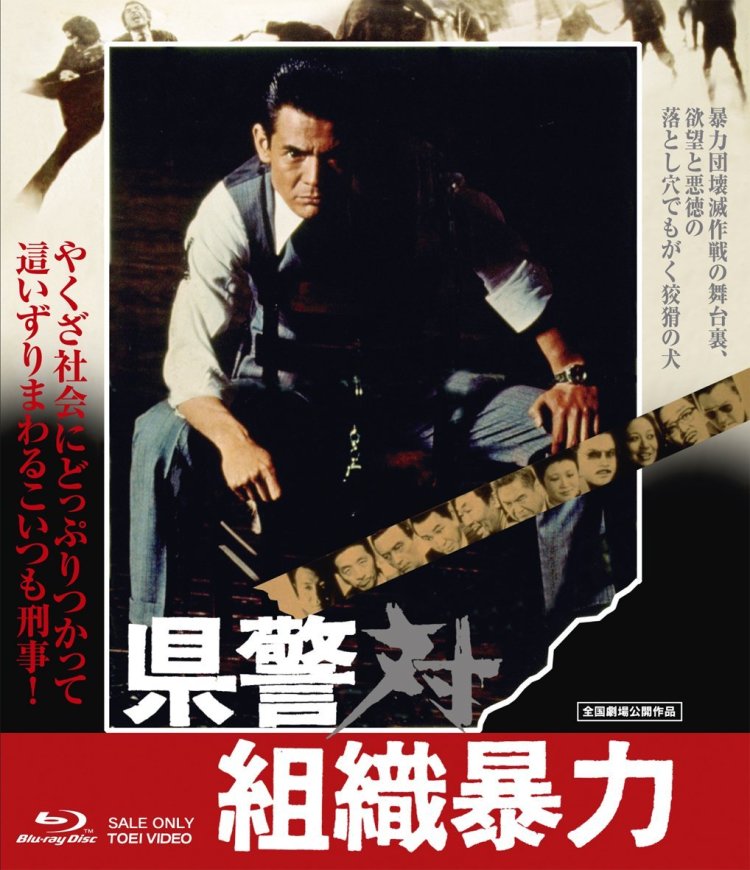
 Cops vs Thugs – a battle fraught with friendly fire. Arising from additional research conducted for the first Battles Without Honour and Humanity series and scripted by the author of the first four films, Kazuo Kasahara, Cops vs Thugs (県警対組織暴力, Kenkei tai Soshiki Boryoku) shifts the action west but otherwise remains firmly within the same universe. This is a world of cops and robbers, but like bored little boys everyone seems to forget which side it was they were on – if they truly were on any other side than their own. There are few winners, and losers hit the ground before feeling the humiliation, but the one thing which is clear is that the thin blue line is so thin as to almost be transparent and if you have to choose your defenders, a thug may do as well as a cop.
A dodgy looking guy in a dirty mac roughs up some equally dodgy looking kids. Given that the shady looking fella is played by Bunta Sugawara you’d peg him for a petty thug, but against the odds Kuno is a cop – just one with a taste for crumpled raincoats. The town he’s policing is one in the midst of ongoing gang strife following a series of breakaways and civil wars throughout the ‘50s. Things are coming to a head as rival bosses of the two breakaway factions, Hirotani (Hiroki Matsukata) and Kawade (Mikio Narita), vie for power while a former yakuza politician, Tomoyasu (Nobuo Kaneko), does his best to stir up trouble between them that Kuno is trying to keep from exploding into all out war.
Cops vs Thugs is as cynical as they come but slightly more sympathetic to its desperate, now middle aged men whose youth was wasted in the post-war wasteland. The central tenet of the film is neatly exposed by a drunken gangster who points out that at heart there’s little difference between a cop and a yakuza aside from their choice of uniform. Policemen, like gangsters, follow a code – the law, carry a gun, are fiercely loyal to their brotherhood, and at the mercy of their superiors. Good jobs were hard to come by in the devastation following the surrender, in fact one of the reasons company uniforms became so popular was that no one had decent clothes to wear and a providing a uniform was a small thing that a company could to do increase someone’s sense of wellbeing, community, and engender the feeling of family within a corporate context. The police uniform, even if it’s reduced to a badge and a gun, does something similar, as do a yakuza’s tattoos. They literally say someone has your back and will come running when you’re in trouble.
These drop outs with nowhere left to turn eventually found themselves one side of a line or on the other – the choice may have been arbitrary. Kuno says he became a cop because he wanted to carry a gun, something he could have done either way but for one reason or another he chose authority over misrule. Cops being friends with yakuza sounds counter intuitive, but many of these men grew up alongside each other, attended the same schools, perhaps even have relatives in common.
Both the police and the yakuza claim to be the defenders of honest, working people but neither of them quite means what they say. Police brutality is rife while yakuza battles reach new levels of violent chaos including, at one point, a beheading in the middle of a sunlit street. Yet the greatest threats to the population at large aren’t coming from such obvious sources, they’re hardwired into the system. Sleazy politico Tomoyasu spends his time in hostess bars and schmoozes with gangsters he uses to do his dirty work while the press look on gleefully at having something to report. Kuno may not be a candidate for police officer of the year, but he tells himself that his policy is one of appeasement, and that working with organised crime is the best way to protect the ordinary citizen. When you’re forced to work within a corrupt system, perhaps there is something to be said for flexibility.
For all of the nihilistic cynicism Fukasaku retains his ironic sense of humour, staging a violent, inefficient, and bloody murder in a tiny room where a sweet song about maternal love in which a woman sings of her hopes for the bright future of her son is playing a healthy volume. Corruption defines this world but more than that it’s the legacy of post-war desperation that says on the one hand that it’s every man for himself, but that it’s also necessary to pick a side. Cops, thugs – the distinction is often unimportant. There is sympathy for these men, and sadness for the world that built them, but there’s anger here too for those who play the system for their own ends and are content to see others pay the price for it.
Available now from Arrow Video!
Original trailer (English subtitles)
Originally published by UK Anime Network.
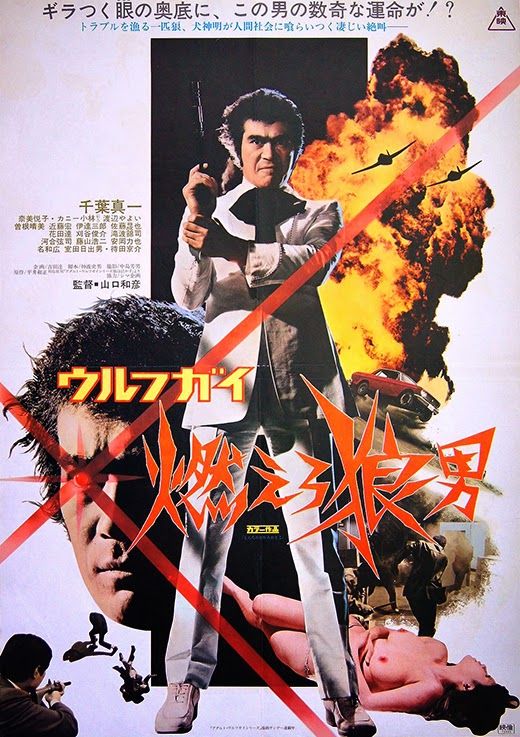 Universal’s Monster series might have a lot to answer for in creating a cinematic canon of ambiguous “heroes” who are by turns both worthy of pity and the embodiment of somehow unnatural evil. Despite the enduring popularity of Dracula, Frankenstein (dropping his “monster” monicker and acceding to his master’s name even if not quite his identity), and even The Mummy, the Wolf Man has, appropriately enough, remained a shadowy figure relegated to a substratum of second-rate classics. Kazuhiko Yamaguchi’s Wolf Guy (ウルフガイ 燃えよ狼男, Wolf Guy: Moero Okami Otoko, AKA Wolfguy: Enraged Lycanthrope) is no exception to this rule and in any case pays little more than lip service to werewolf lore. An adaptation of a popular manga, Wolf Guy is one among dozens of disposable B-movies starring action hero Sonny Chiba which have languished in obscurity save for the attentions of dedicated superfans, but sure as a full moon its time has come again.

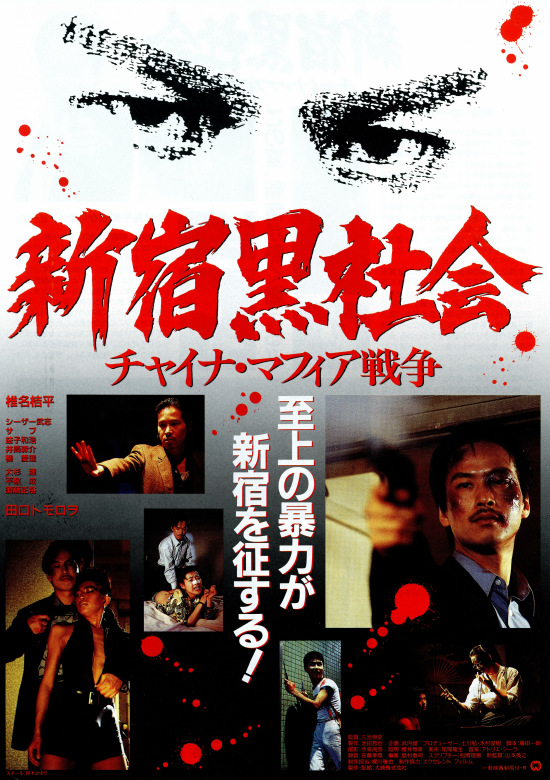 These days Takashi Miike is known as something of an enfant terrible whose rate of production is almost impossible to keep up with and regularly defies classification. Pressed to offer some kind of explanation to the uninitiated, most will point to the unsettling horror of
 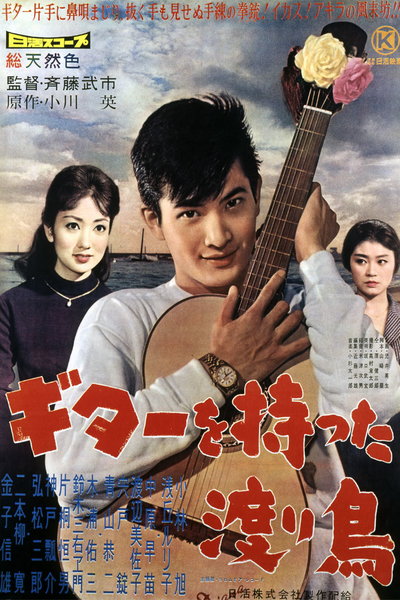 Sometimes, just like an aimless drifter wandering into town, you feel as if you’ve come in during the second reel and missed some vital piece of information leaving you feeling a little at odds with the current situation. So it is with Buichi Saito’s The Rambling Guitarist (ギターを持った渡り鳥, Guitar wo Motta Wataridori) which is, apparently, the first film in a series though feels a little more like the second.
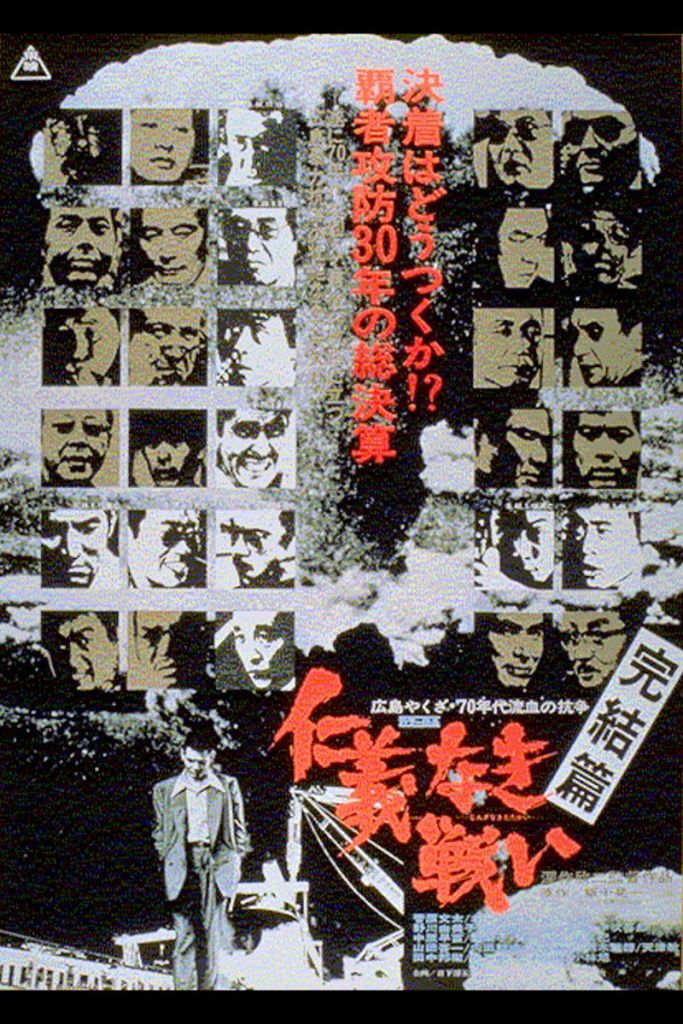 And so, the saga finally reaches its conclusion. Final Episode (仁義なき戦い: 完結篇, Jingi Naki Tatakai: Kanketsu-hen) brings us ever closer to the contemporary era and picks up in the mid ‘60s where Hirono is still in prison and Takeda, released on a technicality, has decided to move the yakuza into the legit arena. The surviving gangs have united and rebranded themselves as a political group known as the Tensei Coalition. However, not everyone has joined the new gangsters’ union and the enterprise is fragile at best.
 It’s 1963 now and the chaos in the yakuza world is only increasing. However, with the Tokyo olympics only a year away and the economic conditions considerably improved the outlaw life is much less justifiable. The public are becoming increasingly intolerant of yakuza violence and the government is keen to clean up their image before the tourists arrive and so the police finally decide to do something about the organised crime problem. This is bad news for Hirono and his guys who are already still in the middle of their own yakuza style cold war.
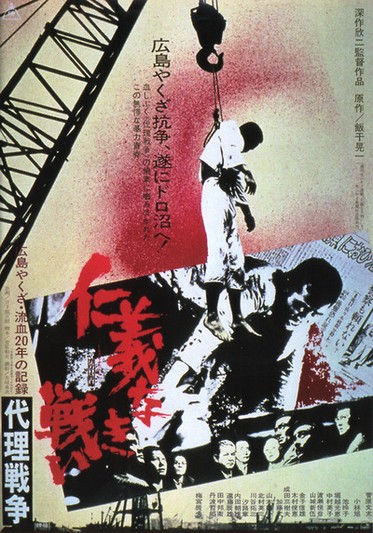 Three films into The Yakuza Papers or Battles Without Honour and Humanity series, Fukasaku slackens the place slightly and brings us a little more intrigue and behind the scenes machinations rather than the wholesale carnage of the first two films. In Proxy War we move on in terms of time period and region following Shozo Hirono into the ’60s where he’s still a petty yakuza, but his fortunes have improved slightly.
 If you thought the story was over when Hirono walked out on the funeral at the end of
  Windows on Worlds