Death at an Old Mansion (本陣殺人事件, Yoichi Takabayashi, 1975)

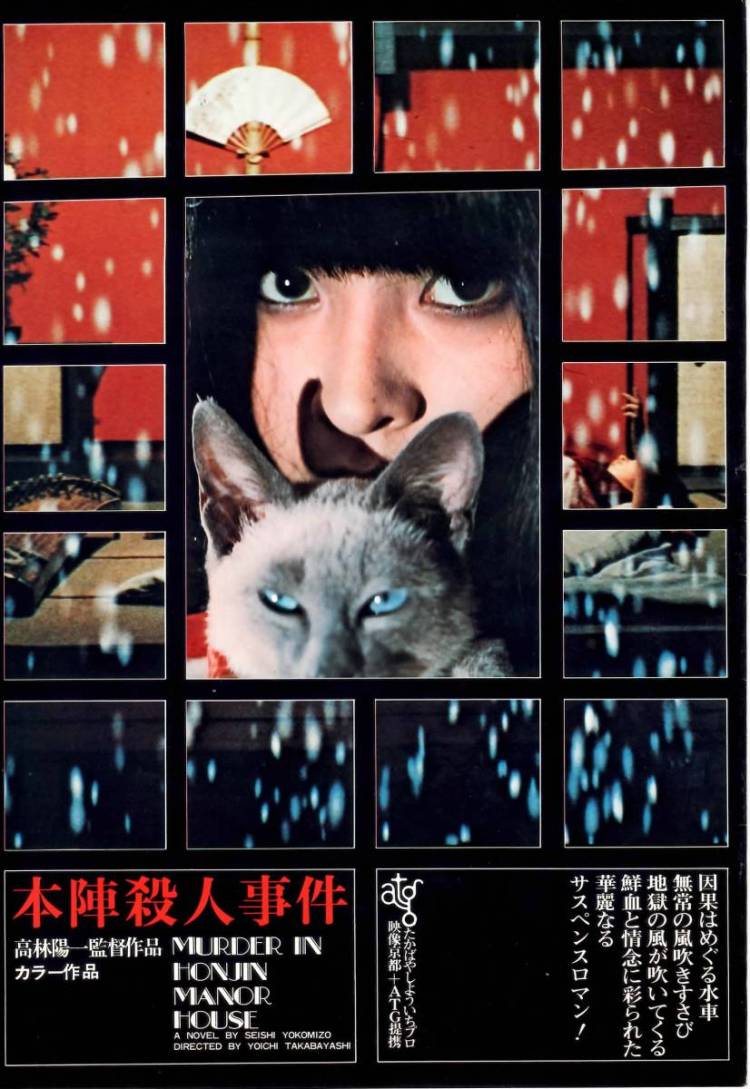
death at an old mansion posterKousuke Kindaichi is one of the best known detectives of Japanese literature. There are 77 books in the Kindaichi series which has spawned numerous cinematic adaptations as well as a popular manga and anime spin-off starring the grandson of the original sleuth. Sadly only one of Seishi Yokomizo’s novels has been translated into English (The Inugami Clan which has the distinction of having been filmed not once but twice by Kon Ichikawa), but many Japanese mystery lovers have ranked his debut, The Murder in the Honjin, as one of the best locked room mysteries ever written. Starring Akira Nakao as the eccentric detective, Yoichi Takabayashi’s Death at an Old Mansion (本陣殺人事件, Honjin Satsujin Jiken) was the first of three films he’d make for The Art Theatre Guild of Japan and updates the 1937 setting of Yokomizu’s novel to the contemporary 1970s.

Beginning at the end, Kindaichi (Akira Nakao) arrives at a country mansion with a sense of foreboding which borne out when he realises that the young lady he’s come to see, Suzu (Junko Takazawa), has died and he’s arrived just in time to witness her funeral. It’s been a year since he first met her, though he did so under less than ideal circumstances. As it happened, Suzu’s older brother, Kenzo (Takahiro Tamura), was married to a young woman of his own choosing, Katsuko (Yuki Mizuhara), despite strong familial opposition. On the night of their wedding, the couple were brutally murdered inside a private annex to the main building. The doors were firmly locked from the inside and there was no murder weapon on site. The only clue was bloody three fingered handprint made by someone wearing the “tsume” or picks used for playing the koto. Kindaichi, already a well known private detective, was summoned to investigate because of a personal connection to Katsuko’s uncle, Ginzo (Kunio Kaga).

The original novel was published in 1946 and it has to be said, some of its themes make more sense in the pre-war 1937 setting than they do for the comparatively more liberal one of 1975 though such small minded attitudes are hardly uncommon even in the world today. The Ichiyanagi family live on a large family estate (apparently not the “Honjin” – a resting place for imperial retinues in the Edo era, of the title but the ancestral association remains) and enjoy a degree of social standing as well as the privilege of wealth in the small rural town. Katsuko, by contrast, is from a “lowly” family of well-to-do farmers – mere peasantry to the Ichiyanagis, many of whom believe Kenzo is making a huge and embarrassing mistake in his choice of wife. Kenzo, a middle-aged scholar, has shocked them all with his sudden determination to marry, not to mention his determination to break with family protocol and marry beneath him.

Japanese mysteries are much less concerned with motive than their Western counterparts, but class conflict is definitely offered as a possible reason for murder. Other clues have more menacing dimensions such as the repeated mentions of a scary looking three fingered man who apparently delivered a threatening letter to the mansion on the night of the murder, and Suzu’s constant questions about her recently deceased cat who liked to listen to her play the koto. Suzu is 17 but has some kind of learning difficulties and is arrested in a childlike state of innocence which leads her to utter simple yet profound words of wisdom whilst also believing that her recently deceased cat, Tama, is some kind of god. Suzu’s “innocence” is contrasted with her brother’s coldhearted rigidity in which he’s described as a sanctimonious snob who believes himself above regular folk and treats his servants with contempt. This same rigidity in fact aligns him with his sister as both share an “atypical” way of thought and behaviour. Kenzo’s unexpected romance turns out not to be middle-aged lust for domination but an innocent first love arriving at 40 with all the pain and complication of adolescence.

Kindaichi arrives to solve the crime and makes an instant partner of the police inspector in charge who’s glad to have such esteemed help on such a difficult case. Putting two and two together, Kindaichi soon comes up with a few ideas after rubbing up against a mystery novel obsessed suspect and numerous red herrings. Once again coincidence plays a huge role, but the business of the murder is certainly elaborate given the pettiness of the reasoning behind it. Takabayashi never plays down the typically generic elements of this classic mystery, but adds to them with eerie, occasionally psychedelic camera work, shifting to sepia for imagined reconstructions and making use of repeated motifs from the fire-like imagery of the water wheel to a shattered photo of Kenzo shot through the eye. Strangely framed in red and gold the murder takes on a theatrical association that’s perfectly in keeping with its well choreographed genesis, and all the more chilling because of it. A satisfying locked room mystery,  Death at an Old Mansion is also a tragedy of out dated ideals equated with a kind of innocence and purity, of those who couldn’t allow their dreams to be sullied or their name besmirched. Perhaps not so different from the world of 1937 after all.


Original trailer (no subtitles)
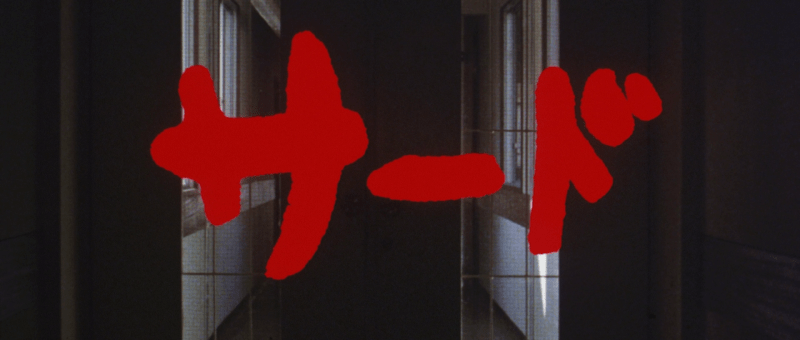
Third Base (サード, Yoichi Higashi, 1978)

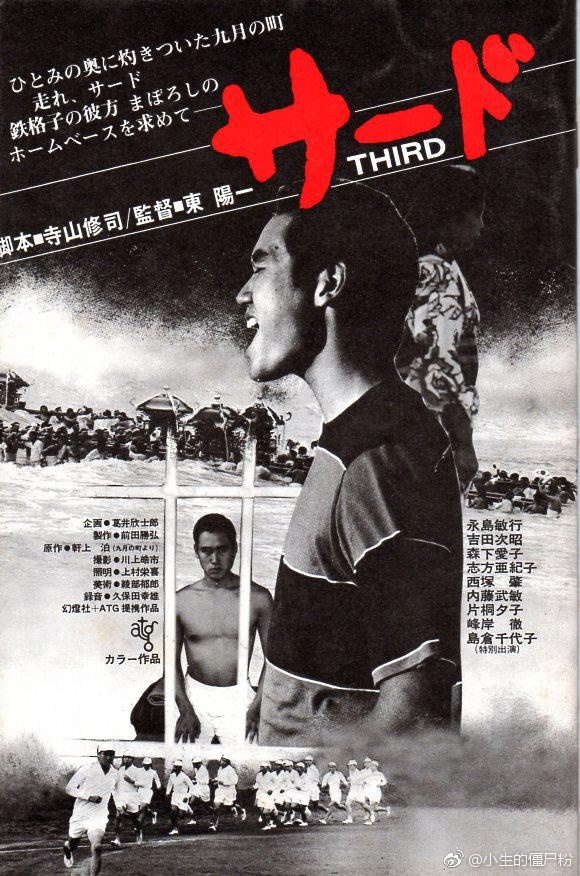
third posterJapanese cinema of the 1970s is a highly charged affair. Stories of alienated youth and nihilistic denials of future possibility predominate as the (usually) male protagonist assesses his place within a rigid and conformist society and often comes to the conclusion that there is none for him. While political turmoil continues to undermine these deeply held values of social conformity and passive acceptance, young men suffer individually and in private until, that is, they find themselves punished by society for the transgressions it causes them to commit. Scripted by Shuji Terayama and adapted from a novel by Haku Kenjo, Yoichi Higashi’s Third Base (サード, Third) is the story of one such young man who has found himself confined to a reformatory with no hope for the future and no direction in which to run.

Seno (Toshiyuki Nagashima), known as “Third”, is an inmate at Kanto – Asahi Reform School. Like most of the other boys, Third is in for violent crime – in his case, murder, and is not exactly a model pupil. In fact, he’s currently in solitary after fighting with another boy who spat in his soup. Though the atmosphere of the school is severe with an emphasis on slightly militarised discipline, it is also progressive and geared towards finding out why these young men came to exhibit such unwelcome behaviours and how they might be able to overcome them. Hence, the fight is not only punished with solitary confinement but a group discussion among all present during which both Seno and the other boy are encouraged to recognise the various ways in which they are both at fault.

A strange thought experiment in Seno’s diary causes mild alarm to one of the staff at the school. “The connection between a car and a spring – which goes around more?” – the doctor is confused by this unusual sentence but on being asked to elaborate Seno makes clear he’s talking about a wind up car. When you wind it up the wheels go round but if you hold the spring the car will turn, and if you hold the car the spring will turn. This is the relationship Seno was puzzled by – which one is turning the other. The doctor draws the conclusion that the “spring” is juvenile delinquency and the car is society, but Seno insists he’s just talking about a toy car.

Yet there is something in it. Some of the boys are inside because of economic oppression, entering lives of crime through lack of other options but there are also upperclass boys in here too who have never been hungry and have no reason to steal. Another of the staff tells a disinterested Third about a relative of his who ended up in a reform school despite coming from an “elite” home. The boy claims he rebelled because “there is no such thing as equality – it is simply a word to make people feel better”. His crimes were intended to expose a societal lie. Likewise, the boy turned the same logic on murder claiming that wars and genocide were abhorrent, but individualist murders were “beautiful”. A short while later the young man took his own life – presumably something the reform school staff are eager Third does not do.

Suicide is a choice which is presented to Third – when one of the other boys runs off during outdoor labour, he hangs himself in the woods rather than try to escape. Third’s nickname is inspired by his position on the baseball field – third base, which he says he played neither well or badly. It is also an ironic comment on his existence in which he is neither one thing nor another, at odds in the free world and among those other outsiders imprisoned in the reformatory. Yet suicide is an idea Third rejects. Considering the other boy’s fate, Third feels himself to be running in “another direction”, wanting to live but not knowing how. A recurrent dream finds him on the baseball field, running the bases only to find there is no home plate. What Third wants is to locate his home base, to finally find his place in the world where he can belong and be accepted, but until he knows where it is he’ll just be running without aim or purpose.

Running in his mind, Third is imprisoned but only through his confinement does he learn to find the world “beautiful”. His cellmate has a similar thought but confesses he’s begun to find his hope “boring”, that freedom only inspires hopelessness. It’s this sense of ennui and apathy which pushes these young men towards violence and frustration, unable to find a more productive way to propel themselves forward and getting stuck at the bottom of the pile in a society which tries to straightjacket them into lives which are both undesirable and unattainable. Running still, Third does seem to have found a potential solution in instructing his breathless running mate to move at his own pace – embracing individualism over social conformity. Nevertheless, home base seems an elusive destination and Third will be a longtime running if ever he really does find his place in an essentially uncaring society.


Original trailer (no subtitles)

The Crazy Family (逆噴射家族, Sogo Ishii, 1984)

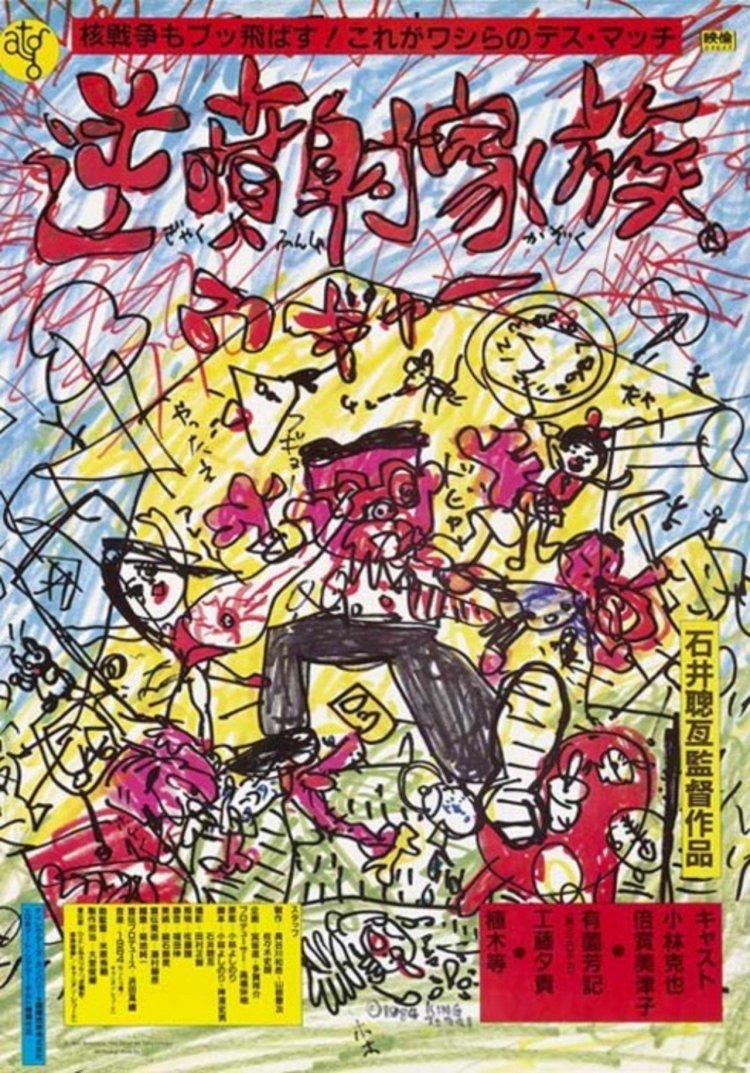
crazy family posterThe family drama went through something of a transformation at the beginning of the 1980s. Gone are the picturesque, sometimes melancholy evocations of the transience of family life, these families are fake, dysfunctional, or unreliable even if trying their best. Morita’s The Family Game, released in 1983, kick started this re-examination of the primary social unit through attacking it Teorema-style as the family’s tutor rips through their generic middle-class existence by adopting each of their pre-defined social roles in turn. One year later Sogo Ishii’s The Crazy Family (逆噴射家族, Gyakufunsha Kazoku) turns the director’s punk aesthetic to a similar theme but this time the family destroys itself in its earnestness to live the Japanese dream in the increasing economic possibility of the pre-bubble era. The Kobayashis are the perfect example of the “typical” aspiring family, but what is the “sickness” that the family patriarch is so afraid of, who (or what) is it that is sick, and if it is possible to be “cured” what would such a cure look like?

Mr and Mrs Kobayashi have achieved their dream – getting out of the danchi and into a suburban house that they own (or will own, once the mortgage is paid off) outright. Mr. Kobayashi, Katsukuni (Katsuya Kobayashi), is a typical salaryman while his wife Saeko (Mitsuko Baisho) stays at home to look after their two children – middle schooler Erika (Yuki Kudo) and her older brother Masaki (Yoshiki Arizono), currently a “ronin” studying to retake his university entrance exams determined to get into the prestigious Tokyo University.

Blissfully happy, the family are adapting well enough to their new home but there’s always that lingering feeling of impending doom, as if all this is too good to be true. Sure enough, Masaki’s adoption of a stray dog alerts the family to a more serious problem – termites. Suddenly terrified that something is literally trying to eat his house out from under him, Katsukuni goes on a fumigating rampage but the termites are not the only source of tension. Turning up right on time, grandpa arrives for a visit after falling out with Katsukuni’s older brother with whom he’d been living. The Kobayashis moved so that the kids could finally have their own rooms (and mum and dad some privacy) but grandpa shows no signs of leaving meaning Katsukuni is sharing with his dad and Saeko has been relegated to Erika’s room.

The house is what the family has always dreamed of – owning one’s own home is no mean feat for those raised in the post-war era, but it’s still a small environment for five people even if much nicer than their tiny city flat. More than just a structure it represents everything the ordinary family dreams of – peace, prosperity, harmony and a life lived in tune with the social order. Katsukuni’s fears that a mysterious “sickness” is plaguing his loved ones is a sign of his discomfort with this ordered way of living. Despite their stereotypical qualities, there is something not exactly right about each of his “ordinary” family members – mum stripteases for grandad’s friends, precocious teenage daughter Erika is not sure if she wants to be a pro-wrestler or an idol and spends all of her time “idolising” her favourite stars, and son Masaki has become a proto-hikikomori so obsessed with studying that he’s taken to stabbing himself in the leg every time he starts to nod off so that he can keep hitting the books rather than the hay.

Yet for all that it’s Katsukuni himself who is the most “sick” in his inability to reconcile himself to social conformity. Despite being apparently successful, he has deep seated feelings of inadequacy which convince him that something is going to go wrong with the family he feels a duty to protect. Wanting to be a good husband and father, Katsukuni thinks he has to “cure” his family of their strange behaviours and make them the sort of people who live in nice houses in the suburbs, but only succeeds in driving himself out of his mind.

Grandpa’s antics have the other family members well and truly fed up but Katsukuni feels just as much filial piety as he does responsibility towards his own children and cannot bring himself to tell his father to go and so he hits on an extreme solution – he’s going to dig a basement, by hacking up the living room floor and pushing downwards, towards hell. Surprise, surprise, his dream home is atop a nest of termites, the bugs are literally working their way in but, ironically enough, Katsukuni is the biggest termite of them all as his very own “hill” begins to appear just in front of the sofa while he tries to find a space for the older generation in a modern home.

Grandpa is an unwelcome manifestation of the inescapable past. When everything goes to hell and the house becomes a battlefield, grandpa manages to dig out his wartime uniform complete with a sword and attempts to assume command by dividing the house into sectors before capturing and trussing his own granddaughter whom he then threatens to rape and torture, apparently eager to revisit his Manchurian military service and all of its implied cruelties. When Katsukuni believes that all is lost and his family can’t be saved he opts for the most culturally appropriate solution – group suicide, but his family won’t play along. Paranoid and delusional, they turn on each other, defending themselves with icons of their respective roles, venting their frustrations and long held grudges in one prolonged battle of violent madness.

When the air finally clears there is only one solution – the house has to go. The desire for a “conventional life” or the feeling of not achieving it is, in that sense, “the sickness” which has infected the Kobayashi family. The finale sees them finally living happily once again but literally “outside” of the mainstream, in a totally open world where there is space for everyone – all quirks embraced, all extremes born. Everyone has their place but the family remains whole, freed from the burden of chasing an unrealisable dream.


A short musical clip from the film

Temple of the Golden Pavilion (金閣寺, Yoichi Takabayashi, 1976)

temple-of-the-golden-pavilionYukio Mishima’s Temple of the Golden Pavilion has become one of his most representative works and seems to be one of those texts endlessly reinterpreted by each new generation. Previously adapted for the screen by Kon Ichikawa under the title of Enjo in 1958,  Yoichi Takabayashi’s 1976 ATG adaptation Temple of the Golden Pavilion (金閣寺, Kinkakuji) moves away from Ichikawa’s abstract examination of the tragic idealist towards the more heated concerns of the day in its dissection of one man’s continued frustrations and his subsequent literal desire to burn the world.

According to Mizoguchi’s father (Yusaku Terashima), Kinkakuji – the Golden Pavilion, is the purest, most beautiful object the world has ever seen. After his father’s death, Kinkakuji becomes Mizoguchi’s (Saburo Shinoda) touchstone and it’s enough for him simply to be near it. Becoming a monk at a nearby temple, Mizoguchi comes under the care of an older priest who had been a friend of his father’s and is determined to look after his interests.

Interfering with his love for the temple is the spectre of a local girl, Uiko (Yoshie Shimamura), from his home town who spurned his affections due to his ugliness, stammer, and difficulty with communication. Mizoguchi’s resentment grows inside him until he begins to pray for Uiko’s death. Tragically, Uiko is indeed killed by her lover, a deserter from the army, after she first betrayed and then tried to warn him about the encroaching military police. Uiko and Kinkakuji become inextricably linked as each time Mizoguchi finds a woman willing to sleep with him, thoughts of Uiko and the temple cloud his mind, preventing him from fulfilling his sexual desires leading him to become obsessed with the idea of arson. The temple is less something too beautiful for an ugly world, than a too perfect mirror for Mizoguchi’s own faults and inadequacies, a constant reminder of the rest of the world’s baseness to which Mizoguchi would like to drag it down.

Quite clearly mentally disturbed from the outset, Mizoguchi is remains obsessed with the prophecies from his divination sticks and experiences various flashbacks to the often traumatic events of his past, all the while offering glimpses of his strange philosophy through his often poetic voice over. Largely friendless thanks to his unapproachable nature, Mizoguchi bonds with the softening influence of a fellow student at the monastery Tsurukawa (Toshio Shiba), but later falls under the spell of the cynical student Kashiwagi (Katsuhiko Yokomitsu) who uses his own disabilities to manipulate the sympathies of various women in order to sleep with and and then exploit them.

Through Kashiwagi’s tutelage, Mizoguchi begins to have more success with women but his original failure with Uiko and his attachment to the temple prevent him from fully venting his desires. Mizoguchi is also carrying a deeper seated resentment after witnessing his mother having sex with another man, seemingly with his father’s knowledge. Unable to reconcile his sexual desires with his feelings towards women by whom he feels rejected, both by his mother’s betrayal and because of his own internalised consciousness of his lack of looks and strange behaviour, Mizoguchi becomes increasingly frustrated, both sexually and politically.

With the end of the war came a new era, the old gods fell – the Emperor is but a man, but now men rule in this “strange” new democracy. Yet, in real terms, Mizoguchi feels no more empowered than he was before. Trapped inside this closing circle of impotence, Mizoguchi fantasises about murdering his mentor, the temple priest, who has since lost faith in him thanks to his cruel and unthinking behaviour. Killing the priest would change nothing, or so Mizoguchi thinks. The temple is eternal, but if he burns it, does he burn the tyranny of eternity? Calling on the ancestral spirits to destroy this venal world but receiving no reply, Mizogichi invokes Uiko and starts a new revolution born in flames designed to bring power to the powerless, burn the ignorant world away and begin again free of the temple’s tyrannous perfection.

Takabayashi’s approach is a surreal one in which Mizoguchi’s delusions are manefested as reality, climaxing as the creature atop the temple’s ornate apex suddenly begins to beat its wings. Shooting in 4:3 and switching into black and white as Mizoguchi relives painful memories, but remaining in colour for his embellished dreams of them, the atmosphere is an uncertain one which drifts from fantasy to reality without warning. Very much a youth movie of the day, the 1976 The Temple of the Golden Pavillion is less an abstract contemplation of the place of beauty in a world of ugliness, than a story of self destructive male insecurity as sexual and political impotence drive a man to destroy the symbol of his oppression. Dark and cynical as the times which produced it, Takabayashi’s Temple is an ugly tale, but a good lesson in the results of failing to listen to unheard voices.


Original trailer (no subtitles)

The Man Who Left His Will on Film (東京戰争戦後秘話, Nagisa Oshima, 1970)

man-who-left-his-will-on-filmEvery story is a ghost story in a sense. In every photograph there’s a presence which cannot be seen but is always felt. The filmmaker is a phantom and an enigma, but can we understand the spirit from what we see? Whose viewpoint are seeing, and can we ever separate that subjective vision from the one we create for ourselves within our own minds? The Man Who Left his Will on Film (東京戰争戦後秘話, Tokyo Senso Sengo Hiwa) is an oblique examination of identity but more specifically how that identity is repurposed through cinema as cinema is repurposed as a political weapon.
The film begins with an anarchic scene in which two men argue over use of an 8mm Bolex camera. The man whose voice we can hear is angry with the cameraman who he claims has stolen his camera only to use it for “trivial” street scenes and landscapes whereas he needs it to “capture the struggle” by filming a nearby student protest. Eventually we can verify that there are two men as the protagonist, Motoki (Kazuo Goto), briefly moves in front of the camera in order to try and snatch it away from the filmmaker. The man holding the camera then runs off as breathless, handheld camera takes over. Motoki follows him and we follow Motoki as the scene takes on an ominous quality. The cameraman reappears atop a nearby building before plunging to his death camera in hand. Stunned, Motoki approaches the bloody scene and, noticing the camera is still intact, tries to retrieve it only to be picked up by the police who confiscate the camera as evidence.

Motoki then wakes up back at his left wing commune with his friends eager to know what happened. Strangely, they do not seem to be aware that one of their number has died and are more worried about the police being in control of one of their “means of production”. Even the dead man’s girlfriend, Yasuko (Emiko Iwasaki), begins to doubt the fact that he ever existed at all. Motoki and Yasuko begin investigating the mysterious presence together, chasing their elusive filmmaker and each taking possession of his form on more than one occasion but the question who owns these images, whose identity defines the narrative, proves an elliptical and ethical dilemma.

Oshima, evidently, was no right wing stooge but even if The Man who left His Will on Film takes the world of the student protests as its milieu, it does so to undermine them. Motoki’s comrades view filmmaking as a revolutionary act. They claim to turn the camera into a weapon by using it confront reality, but as Yasuko later admits much of this is a rationalisation which allows them to continue a “bourgeois” art form without abandoning their left wing principles. The cadre members spout marxist dogma and argue about who has the highest political consciousness, but all they ever do is film the ongoing struggle. Their fight is empty, their vision blank.

Notably, the first of several arguments over dogma relates to “ownership” of the camera itself and whether Motoki and another comrade fought hard enough to retrieve it from the oppressive state. Did Motoki chase after “his” camera, meaning he condones the idea of “private” property which is contrary to the communal nature of the group, or “their” camera which is a revolutionary tool? The camera itself is singular, but the group is plural. This commune is intended to work as a hive mind, the people as one with one vision and one identity but Oshima exposes this as an impossibility. The group is a collective of individuals with different ideas and opinions which do not necessarily conform to a common point of view.

This is further brought out when the camera is retrieved and revealed to contain a collection of seemingly apolitical landscapes and street scenes. The group members are quickly bored with the static shots of everyday subjects, some berating the filmmaker for his “bankrupt” politics and lack of artistry while others vow they must honour their comrade’s struggle by watching the film to its conclusion in order to derive the meaning. The unseen filmmaker has indeed left his “will” on film, not as a testament or embodiment of future policy, but his literal “will”. His individual spirit and vision are contained within the seemingly innocuous shots in a political act of revolutionary individualism. He is the film, the film is him.  His vision dominates, we must accept it or remake it as our own.

Motoki, constantly chasing shadows, attempts to remake the film in the mould of the original filmmaker but unexpectedly encounters aspects of his own life already existing within it. Yasuko’s approach is more proactive. She inserts herself into the film, makes her presence known and refuses to be invisible. She picks up the camera and fights for her place within the frame. Hers is the struggle of the true revolutionary filmmaker, imprinting herself and her vision onto the film.

Where does this leave us? We’re in the film too. We see the film and, in a sense, recreate it in our own minds, recasting ourselves as director and protagonist. We see the film subjectively yet we cannot divorce ourselves from the original vision. Motoki’s venture fails because he only sees the landscapes, whereas Yasuko takes the same images but repossesses them, remaking them in her own image in a true act of cinematic revolution. Yasuko has seized the means of production and overthrown the tyranny of anonymous images in refusing to be constrained by someone else’s will. The camera is a weapon, but it is we who choose what it sees, and in turn what it sees in us.


Original trailer (English subtitles, NSFW)

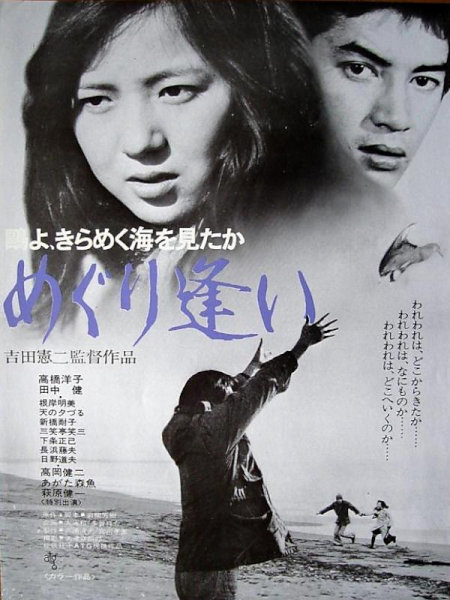
Oh Seagull, Have You Seen the Sparkling Ocean? : An Encounter (鴎よ、きらめく海を見たか めぐり逢い, Kenji Yoshida, 1975)

seagullSparkling seas sound like hopeful things, especially if you’re a majestic seagull flying far above, bathed in perpetual sunshine. But then, perhaps the water below is shining with the shards of broken hopes which float on its surface, is its beauty treacherous or in earnest? So asks the singer of the title song which recurs throughout the film as if to undercut even its brief moments of happiness. There is precious little joy to be found in the lives of the two protagonists of Oh Seagull, Have You Seen the Sparkling Ocean? : An Encounter (鴎よ、きらめく海を見たか めぐり逢い, Kamome yo, Kirameku Umi wo Mitaka: Meguriai), only pain and confusion as they try to rebuild their ruined lives in an uncaring city.

Katsuo is a drifting young man, one of the many to have escaped the mining industry after the pits began to close down but now finds only temporary manual work available to him. In Tokyo, he works as part of a window washing team, gazing into high rise office buildings which are a world away from his precarious hand to mouth existence. In one particular window he spots an office lady attempting to straighten her stockings in an otherwise empty room. Smitten he decides to pursue the woman though she is far from interested in a peeping tom of a window guy who’s coming on far too strong.

Kumi has her own problems. Like Katsuo she’s found herself in the city after escaping a life of poverty and the unwanted attentions of a relative in a fishing village. Her sights are set a little higher in the increasingly consumerist environment of ‘70s Tokyo, hence her high rise career and desire to find the right kind of husband. However, even here, she doesn’t seem able to get away from possessive men and is stalked by an ex-boyfriend who just won’t take no for an answer.

Eventually Kumi and Katsuo grow closer but on a visit to the beach come across an injured seagull which Kumi immediately tries to bury despite the fact it isn’t actually dead yet – better to die than live on in shame, says Kumi. Katsuo disagrees and decides to take it home and nurse it back to health though Kumi breaks up with him because of it. After a chance encounter the pair get back together but their fragile love story is under attack from every possible direction.

Katsuo and Kumi have each led difficult lives though they have very different ways of coping with trauma. Katuso has retreated into a fantasy world inspired by Gaugin’s famous painting Where do we come from? What are we? Where are we going?. When he first meets Kumi, all Katsuo can talk about is Resipuruko and how wonderful everything will be when he gets there. The speech exasperates Kumi who at first feels stupid for not having heard of Resipuruko, but then cheated to discover its just a made up place of the kind that children create out of fun. Nevertheless, Resipuruko continues to become a symbol in their lives, a place of hope and peace in which they would be able to live together freely and in comfort, away from the difficulties of everyday city life.

Katsuo is cheerful and optimistic. Not exactly forward looking but proceeding in the name of hope. Kumi is driven more by fear and resentment, constantly looking behind her rather than ahead. Though Katsuo’s life has not been easy, Kumi has experienced more suffering with less agency which has left her with far less capacity for making the best of things. Like Nina in Chekov’s play, she is the seagull – something beautiful, destroyed, just because it could be. Katsuo’s efforts to heal the wounded bird run in parallel to his desire to save Kumi but then, the seagull wants to be free and Kumi is forced to feel as if she never will be.

At one point Kumi says she and Katsuo are on different sides of an invisible window and it’s true that they’re opposites in many ways – he thrives on fantasy, she is destroyed by reality, but they could be perfectly happy together if it weren’t for the vagaries of fate.  Oh Seagull, Have You Seen the Sparkling Ocean? : An Encounter, is a tale of tragedy as young lives are ruined by time and circumstance, leaving them with only broken hearts to face the unfair world before them. Resipuruko exists only in a spiritual sense, but it can be called forth if you believe in it enough. Dreams are fragile things, whether realistic or fantastical, but they, like the seagull, deserve their time to fly unfettered.


Original trailer (no subtitles)

Aesthetics of a Bullet (鉄砲玉の美学, Sadao Nakajima, 1973)

aesthetics of a bullet1973 is the year the ninkyo eiga died. Or that is to say, staggered off into an alleyway clutching its stomach and vowing revenge whilst simultaneously seeking forgiveness from its beloved oyabun after being cruelly betrayed by the changing times! You might think it was Kinji Fukasaku who turned traitor and hammered the final nail into the coffin of Toei’s most popular genre, but Sadao Nakajima helped ram it home with the riotous explosion of proto-punk youth movie and jitsuroku-style naturalistic look at the pettiness and squalor inherent in the yakuza life – Aesthetics of a Bullet (鉄砲玉の美学, Teppodama no Bigaku). This tale of a small time loser playing the supercool big shot with no clue that he’s a sacrificial pawn in a much larger power struggle is one that has universal resonance despite the unpleasantness of its “hero”.
Kiyoshi Koike is a former chef with a gambling problem and a living room full of rabbits that he bought hoping to sell as pets but his sales patter could use some work and the business is not exactly taking off. Getting violent with his girlfriend after borrowing money from her to play mahjong and then getting annoyed when she doesn’t seem keen to lend him more to change his rabbit business into a dog business, Kiyoshi is at an impasse. So, when the local gangsters are looking for a patsy they can send into enemy territory as a “bullet” Kiyoshi’s name is high on the list. They need someone “hotblooded, must have daredevil courage, when he flips he should make a huge racket” – Kiyoshi more than fits the bill, and more to the point he has no idea what he’s doing.

Given a large amount of money and a gun, Kiyoshi gets a haircut and buys some fancy suits to play his part as a super cool gangster who doesn’t take any shit from anyone. He goes around telling everyone his name and gang affiliation very loudly, waving his pistol and acting like a big shot despite the fact he obviously has no name and no reputation. The plan is he fires his gun, gets killed, his gang swoop in for a gang war and wipe out the opposition. Only, when Kiyoshi gets too invested in his part and beats up a rival gangster, the local boss apologises and offers him a knife to make things even with the guy who just disrespected him…

If he fires his gun, it’s game over but what exactly is keeping his finger off the trigger – fear, or self preservation? Either way, Kiyoshi is way over his head in a game he never understood in the first place.

This is no ninkyo eiga. There’s no nobility here, these men are animals with no humanity let alone a pretence of honour. Kiyoshi is a loser, through and through, but once the gun is in his hand he transforms into something else. The gun becomes an extension of himself, a symbol of his new found gangster hero status. A fancy suit and a fire arm are handy props for a method actor but the performance only runs so deep, what is Kiyoshi now, a man, or a bullet?

Whatever he is, he’s no hero. In his untransformed state he violently beat his girlfriend whom he also forced to work as a prostitute, and even after getting the gun he witnesses a woman being gang raped yet appears to be more amused than anything else. He ends up getting into a fight with the other two guys waiting for their go and seems to feel heroic after the woman gets away but his intention was never to rescue her. Indeed, bumping into her again he makes a clumsy attempt at subtle blackmail though she gets a kind of revenge on him in the end. Even his “romantic” encounter with the glamorous former photo model girlfriend of the rival gang boss ends with a bizarre sex game in which he makes her get on all fours and bark like a dog.

When the time comes, Kiyoshi can’t contemplate the idea of returning to his old loser self and is fixated on reaching the peak of Kirishima which is said to be the place where the gods descended to Earth. When the bullet finally emerges, it heads in the wrong direction. Self inflicted wounds are the name of the game as an aesthetically pleasing, poetic end to this tragic story follows the only trajectory available for a classic yakuza fable.

After beginning with a montage of people sloppily eating junk food set against a proto-punk rock song dedicated to the idea of living the way you please and not letting anyone get in your way, the film contrasts the independent, non-conformist yakuza ideal of total freedom with Kiyoshi’s lowly status in an increasingly consumerist environment. The yakuza life would indeed prove a passport for a man like Kiyoshi to jump into the mainstream, but this fantasy world is one that cannot last and one way or another the curtain must fall on this expensive piece of advanced performance art.

Aesthetics of a Bullet has, like its hero, been abandoned on the roadside. Whereas the Battles Without Honour series has become a landmark of the yakuza genre, Aesthetics of a Bullet has never even received a home video release in Japan and has received barely a mention even the histories of ATG movies. This is surprising as its noir style and art house approach ought to have made it one of ATG’s more commercially viable releases even with its sleazy, nihilistic tone. Opting for a more naturalistic approach, Nakajima nevertheless breaks the action with expressionistic sequences as Kiyoshi fantasises a glorious death for himself, climaxes through gunshot, or remembers the student riots through a blue tinted sequence of still photographs. A complex yet beautifully made, genre infused character piece, Aesthetics of a Bullet is a long lost classic and one in urgent need of reappraisal.


Title sequence and first scene (unsubtitled)

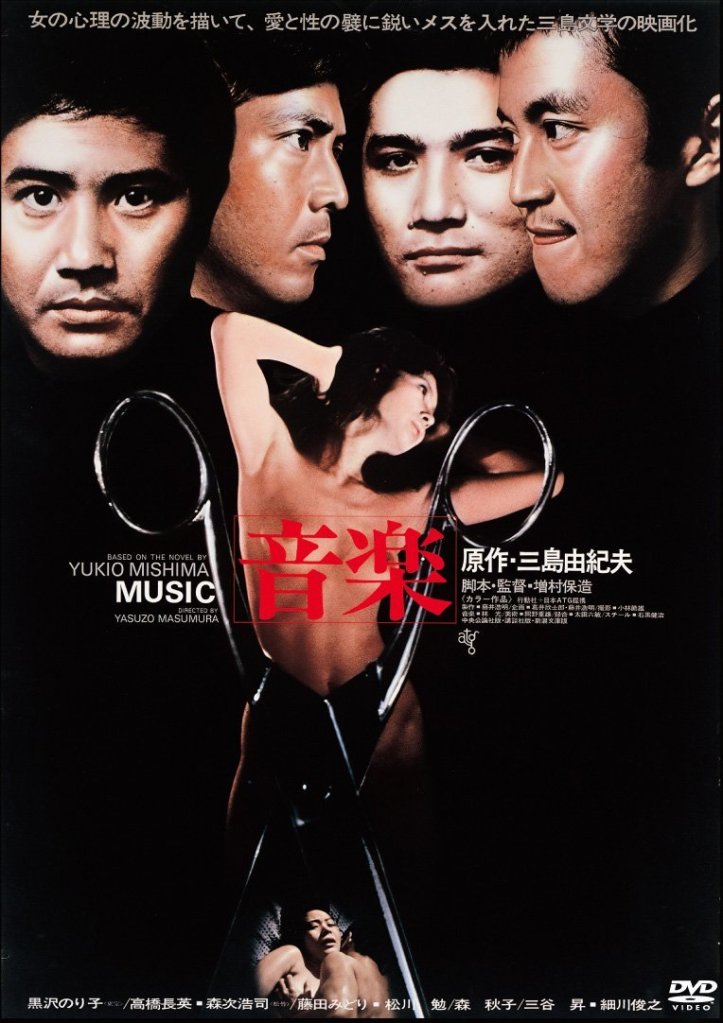
The Music (音楽, Yasuzo Masumura, 1972)

The MusicIf the under seen yet massively influential director Yasuzo Masumura had one recurrent concern throughout his career, passion, and particularly female passion, is the axis around which much of his later work turns. Masumura might have begun with the refreshingly innocent love story Kisses, but later he dived deep into the depths of depravity in Blind Beast and of manipulation in Manji before cycling back around the intense freudian character study which is The Music (音楽, Ongaku) in 1972. Based on a novel by Yukio Mishima (Mishima and Masumura – a match made in heaven), The Music is the story of one woman’s corrupted sexuality caused by a series of inappropriate sexual encounters during her childhood.
The film begins with a symbolic title sequence in which a large pair of scissors opens and closes rhythmically before being superimposed over the body of a woman – Reiko, our protagonist. She has made an appointment with a psychiatrist because, she claims, she has strange symptoms including constant nausea which led her to believe she was pregnant though medical doctors can’t find the cause of her sickness. The other thing is she can’t hear music, she can hear voices and sound effects but if music starts playing it’s like she goes deaf. Her psychiatrist isn’t quite convinced by Reiko and can tell she’s misleading him.

Sure enough he asks her to come back and she admits not hearing music was a symbolic way of explaining that she derives no pleasure from sex. Her boyfriend is a good man and she loves him, she doesn’t think the problem is with him, but she simply feels nothing when he touches her and it’s causing a rift in the relationship. This is the “music” she was talking about and which will become a recurrent motif throughout the film. Later, Reiko finds that she is able to derive a kind of satisfaction from sexual acts with men who are either dying or impotent, but should they simply get better she again loses all interest in them.

As might be expected, the reasons for Reiko’s strange behaviour lie in her childhood. Her fascination with scissors derives from a game of rock paper scissors she once played with the boy to whom she was betrothed to marry when they came of age. Reiko is the only girl in the group and when she loses the boys suddenly declare she’ll have to have her “thing” cut off – only she’s a girl and never had one in the first place. This leaves her feeling disturbed, humiliated, and in some way inherently deficient. From this point on she develops a masculine sensibility symbolised by one side of the closing scissors which becomes her own “thing”, leaving her with a desire for both cutting and being cut.

We also discover that Reiko was assaulted at a young age and that she also experienced early sexual contact with a family member as well as witnessing her aunt engage in an inappropriate relationship which greatly disturbed her. In all, it’s not surprising that Reiko is experiencing such a degree of confusion given all of the traumatic events that have followed her since her youth. Involved in an obsessive, incestuous sexual relationship Reiko is unable to move on with a “normal” life until she addresses the true cause of all her problems.

The psychiatrist is wiley guy, he can spot a lie a mile off and he has Reiko’s number pretty quickly. Amusingly, she does our job for us of trying to diagnose herself with the obvious solutions that seems to emerge from the latest story she’s told, only for the doctor to remind her it’s not so simple and untrained people shouldn’t try to analyse themselves. This is a little ironic in some respects as a trained psychologist would probably give much of Mishima’s cod Freudianism short shrift, but it works well enough in the context of the film. Reiko is about as unreliable a narrator as it’s possible to find but it does seem at last that the truth has been uncovered and Reiko set free from her improper sexual desires.

There’s a degree of campness involved in The Music with its heavy atmosphere and overtly theatrical melodrama. Masumura films with a perverse eye, animating Reiko’s recollections like dreams complete with bizarre perspectives and symbolic imagery to complete his Freudian approach to filmmaking. The Music may not be his most accomplished work, but it is nevertheless interesting and a late career return to his most pressing concerns.


Unsubtitled trailer (NSFW):

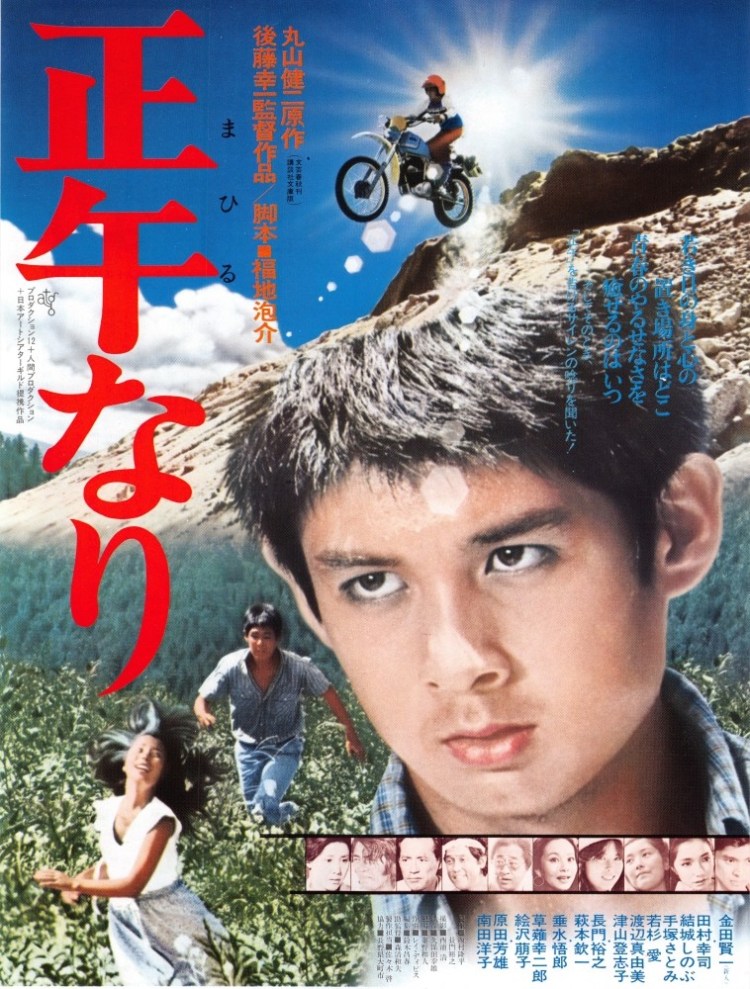
At Noon (正午なり, Koichi Goto, 1978)

at noonKoichi Goto’s Art Theatre Guild adaptation of Kenji Maruyama’s 1968 novel At Noon (正午なり, Mahiru Nari) begins with a young man on a train. Forlornly looking out of the window, he remains aboard until reaching his rural hometown where he makes a late entry to his parents’ house and is greeted a little less than warmly by his mother. The boy, Tadao, refuses to say why he’s left the big city so abruptly to return to the beautiful, if dull, rural backwater where he grew up.

There’s little work here for a young man, which is why Tadao left in the first place. After using some family connections to try and find a job, he finally decides to make use of his abilities by fixing radios and TV sets for a local electronics store. To begin with he doesn’t want to see his old friend, Tetsuji, perhaps out of a sense of shame at having returned home but the pair later strike up their old friendship – that is, until Tetsuji suddenly announces his plans to run away with a local bar hostess.

It’s never quite revealed what happened to Tadao in Tokyo but it seems to have been something serious enough to change the course of his entire life and send him reeling back home depressed and angry. In many ways he’s a typical young man, if slightly sullen, but he’s developed a serious number of sexual hangups which have turned him into some kind of repressed, misogynistic, pervert. He appears to have made a deliberate decision to dislike the idea of women, or at least the idea of women with sexual appeal. He thinks women are trouble, that no good comes of love, but can’t stop himself from spying on the female tourists staying in an upper room. He’s always looking, staring invasively, but resolved not to touch.

Tadao has already been to the city and evidently found it not quite to his liking but his friend, Tetsuji, feels bored in the village and trapped by his parents who need his help in their orchards. When Tadao realises Tetsuji is taking the hostess with him when he skips town, he asks for the money he just agreed to lend him back and tells him to forget about running away and just to go home. Unfortunately for Tetsuji, Tadao’s advice proves sound as his city dreams don’t work out the way he planned either. To end his frequent attempts to escape, Tetsuji’s family float the idea of an arranged marriage which originally horrifies both boys but after meeting his prospective bride, Tetsuji changes his mind. Tadao doesn’t approve, but after meeting the girl in question and seeing that she is quite lovely changes his mind too and is happy for his friend – that is, until he realises Tetsuji has only introduced him to her as a pretext of getting her on her own to enact his marital rights a little ahead of schedule. This breach of morality proves the final straw for Tadao who does not like the idea of his wayward friend deceiving and then ruining this innocent young flower who’s far too good for him anyway.

Tadao’s fascination with another damaged bar girl, Akemi, continues as the two find themselves both looking at the sad figure of a tethered eagle imprisoned at the local zoo. Akemi says she likes to look at the bird as she feels perhaps somehow that helps him escape. She feels like a caged bird too – trapped in a bad relationship with a useless boyfriend who has a vague plan of turning manure into an energy source while she supports them both by working at a hostess bar and hating every second of it. Tadao feels trapped in a hundred different ways, by his town, by his parents, by whatever happened in Tokyo, and by his own pent-up frustrations. By this point, he’s a one man powder keg ready to explode and after blowing his final safety caps, tragedy is the only possible outcome.

At Noon begins with its epilogue, but uncomfortably frames its protagonist’s despicable final actions with an odd kind of heroism as his head eclipses the sun leaving him with a radiant halo. He may have satisfied himself in some way, put to rest some of that inner turmoil, but what he’s done is something truly dreadful and driven by an intensely animalistic instinct. At Noon may have something to say about the dangers of frustrated young men with no work to go to, no ambition to follow, and no luck with the ladies but displays an oddly ambivalent attitude to its deranged protagonist that makes for often uncomfortable viewing.


By the way, After Noon has music by Ray Davis of The Kinks!

Unsubbed Trailer:

The Deserted City (廃市, Haishi, Nobuhiko Obayashi, 1984)

haishiNobuhiko Obayashi might be most closely associated with his debut, Hausu, which takes the form of a surreal, totally psychedelic haunted house movie, but in many ways his first feature is not particularly indicative of the rest of Obayashi’s output. 1984’s The Deserted City (AKA Haishi, 廃市), is a much better reflection of the director’s most prominent preoccupations as it once again sees the protagonist taking a journey of memory back to a distant youth which is both forgotten in name yet ever present like an anonymous ghost haunting the narrator with long held regrets and recriminations.

Based on a novel by Takehiko Fukunaga, The Deserted City is a European influenced, nostalgic, coming of age tale in which university student Eguchi travels to a small Japanese backwater famous for its canals. Though not as sophisticated as Venice itself, the town shares something of the atmosphere of that city as it has often been evoked in literature in its slightly claustrophobic, decaying grandeur. Eguchi has come to the town on an invitation from his uncle and with the intention of spending the summer there to finish his undergraduate dissertation which concerns the work of Edgar Allen Poe.

However, Tokyoite Eguchi immediately finds the town strange, if mostly charming, with its old fashioned rhythms and almost silent soundscape in which only the lapping of the village’s many rivers is audible. Staying in a guest house run by 19 year old Yasuko and her grandmother, Eguchi begins to hear gentle sobbing at night and jumps to the conclusion it must belong to Yasuko’s married older sister, Ikuyo, whom he has yet to meet. Younger brother Saburo also lurks silently in the background with the brother-in-law, Naoyuki, making infrequent appearances. Eguchi had apparently almost forgotten about this single summer in his youth, but was reminded of it after reading a newspaper report that the town had been destroyed in a fire. His memories are coloured by the tragedy which occurred towards the end of his stay and which his youthful soul was not fully able to understand.

The Deserted City revisits many of the themes which came to define Obayashi’s career from the nostalgia for youth and the power of memory to a vaguely supernatural tone which prefigures the final traumatic event that will continue to haunt the protagonist, even if unconsciously, for the rest of his life. Fukunaga was himself very much influenced by European literature and The Deserted City has a distinctly Western feeling with its death ridden canal town and once grand family in decline. Eguchi’s thesis is on the work of Edgar Allen Poe and it wouldn’t be a stretch to say that he is reading his studies into the story of his own life with the mysterious crying and hidden sister not to mention family secrets and the frequent allusions to the sorry state of the moribund city.

Eguchi describes Yasuko as “cheerful” yet she herself offers the most melancholic commentary of her life. She says she hates the town and can’t stand the constant sound of the waters which she likens the death wail of her city – a slothful sound without energy or purpose. She can see all the other young people leaving with only the elderly remaining behind to decay along with the town, but when Eguchi asks why she doesn’t leave too she replies that she can’t, she’s bound to this place in life and death. Similarly when making a visit to her mother’s grave at a nearby temple she remarks that in this place of stillness, she can no longer discern a difference between the living and the dead. Finally, after all the tragedies that have befallen her, Yasuko declares herself to be “nothing at all” and in bidding Eguchi goodbye as he leaves, corrects him when he promises to visit – she knows she’ll never see him again, he will return to the world of the living. He’ll forget all of this, as if it happened in a dream.

Like many of these stories, The Deserted City is filled with the detached melancholy of the older man looking back at the young one. Eguchi says this incident taught him to expect tragedy from the very beginning of things though he also claimed to have forgotten all about the town and its sad stories of longing and misunderstandings, romantic and otherwise. Working with ATG here Obayashi opts for a nostalgic 4:3 frame and a moderately warm colour palate which echoes both the slightly idealised atmosphere of the idyllic waterside village and its nature as a place which exists solely in memory, shaded in tones of nostalgia but also of regret. Much more conventional than some of Obayashi’s other work, The Deserted City is a perfect blend of European romanticism, melodrama and slight gothic undertones which, though a little low on impact, is a perfect synthesis of his themes up to this point.


Unsubbed trailer: