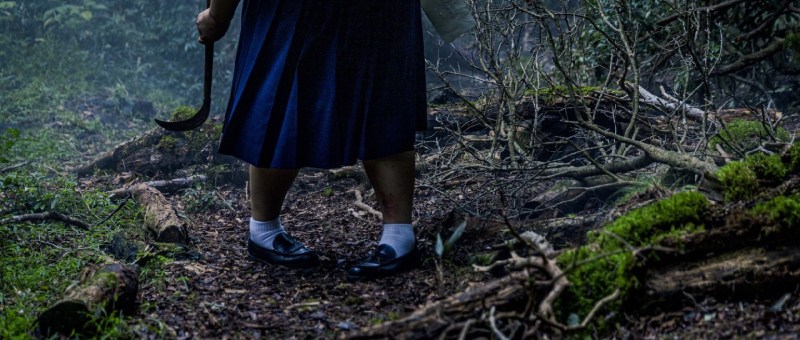

Mag Mag (禍禍女, Yuriyan Retriever, 2025)

The funny thing is, Mag Mag is only visible to the man she’s currently in love with, though what she seems to represent is the grudge of the unrequited lover whose gaze is never returned. The first release from K2 Pictures, a new production company launched in 2024 with the intention of shaking up the Japanese film industry by moving away from the production committee system, comedienne Yuriyan Retriever’s first feature sets out as if it’s asking why women become fixated on terrible men, only to eventually subvert its central premise with a series of unpredictable twists.

It’s true enough that (almost) all of Mag Mags targets deserve exactly what they get. The men are selfish and insensitive, bullying or abusive. Shunsuke (Fuku Suzuki), the first victim appears meticulously doing his hair in the bathroom mirror as if bearing out his vanity and self-obsession. Many of the men are popular and handsome, but the attention they get has only made them cruel and arrogant. Takuya (Junsei Motojima), the original victim said to have given birth to the curse of Mag Mag, is beloved of half the school but can’t resist punching down by making fun of a girl considered to be unattractive who had left him a love letter. Yurika Yoshida (Marina Mizushima), whose name is very similar to that of the director, is believed by some to have become Mag Mag after taking her own life and cursing Takuya in the process, but most of all represents the ugliness of the male gaze in being constantly berated for her appearance. The other kids tell her to lose weight and get plastic surgery, while Takuya takes her love letter as an insult to his status as king of the school. Mag Mag is described as being “freakishly tall” which also hints at ideas of monstrous femininity.

Perhaps this is one reason why Mag Mag rips out the eyes of her victims, though the point is that they were always pointed in the wrong direction anyway. Sanae is obsessed with an artist named Hiroshi (Oshiro Maeda), though he’s made a nude statue of another named Rumi apparently from his imagination and without her consent, which hints again at the self-involved nature of male desire. He does not appear to really notice Sanae (Sara Minami), though Rumi (Mai Fukagawa) may not be lying when she says he found her creepy. After Hiroshi’s death, Sanae begins investigating Mag Mag in attempt to unmask her and avenge Hiroshi, only to ultimately see herself in the vengeful spirt’s sinister cries of “I love you” which aren’t so different from those expressed for Hiroshi while essentially stalking him from her shrine lair. 

Nevertheless, this misdirected gaze is going in both directions as we, the viewers, too do not really see the person we should have been looking at all along. Deep-seated senses of inadequacy can provoke the jealously and resentment of unexpected and seriously inappropriate targets, and perhaps what we’re looking at here isn’t the societal urge to mock an “unattractive” woman who dares to ask for love, but rather the toxic rage of an invisible man who loathes those who seem to be unfairly popular with women despite being terrible human beings and unpleasant to be around. Perhaps in the end, it’s Sanae’s “delusional” fixation pitted against the passivity of a man who believes himself to be unattractive and in fact becomes so because of his intense self-loathing.

But then, there does appear to be a real ghost and unflinching embrace of the arcane with its Shinto priests, lines of prohibition, and apparently magic trees whose ability to end bad relationships is potentially more than just psychosomatic, or just little psycho. Yuriyan Retriever’s absurdist humour blends perfectly with the grimness of the Mag Mag curse and the world it seems to mirror. With an overt reference to Guard of the Underground, she celebrates and subverts J-horror tropes while skewering contemporary entertainment trends in her house share fantasia of hopeful youngsters that turns out to be a quasi-incestuous nest of betrayal and misplaced desire. Influencers too are a one-way relationship, and you only see what they you want you to. Mag Mag, however, just might let you go if only you’re brave enough to say you love her too rather than, like her unfortunate victims, spurning her affections and thereby invoking and ancient curse born of the suffering of an unreturned gaze.


Mag Mag screens in Chicago 10th April as part of the 20th edition of Asian Pop-Up Cinema.

Trailer (English subtitles)

Marriage Hunting Beauty (美人が婚活してみたら, Akiko Ohku, 2018)

out_bijyo_poster_B2Is life really easier for “beautiful” people or do they simply experience a different series of problems? Some might say beauty is a nice problem to have, but however much people may scoff there is perhaps a price to be paid for physical attractiveness as the heroine of Akiko Ohku’s Marriage Hunting Beauty (美人が婚活してみたら, Bijin ga Konkatsu Shite Mitara) is at pains to point out though few are willing to sympathise. What she discovers, however, is that her beauty has perhaps been her blindspot in that it has made her self-centred and entitled while preventing her from realising what is it that has really been bothering her.

At 32, Takako (Mei Kurokawa) remains romantically naive and has wound up in a series of dead end relationships with terrible men who happened to be married (though she didn’t find out until it was too late). Her best friend, married housewife Keiko (Asami Usuda), tells her that her problem is that she’s too beautiful – single guys are too intimidated to make the first move while the married ones are emboldened by their desire to play with fire and the knowledge that the relationship is essentially meaningless because they already have “commitment” elsewhere. Hitting rock bottom, Takako suddenly has an epiphany that she wants to get married if only to prove that she is worthy of becoming someone’s wife rather just their mistress.

Takako is, it has to be said, perfectly aware that she is an attractive woman and sees little point in deflecting praise that comes her way because her of appearance – something that begins to grate on Keiko as Takako fails to submit herself to the level of socially accepted modesty which would require her to protest when called “beautiful”. Keiko’s categorising her as a sad princess is perhaps accurate in that she certainly likes to paint herself as hard done by while refusing to engage with the aspects of her life which cause her to feel miserable and empty. Entering the world of “konkatsu” – accelerated dating with a view to marriage, is then a humbling experience in which she must simultaneously raise and lower her expectations in order to work towards an “ordinary”, conventional kind of settled domesticity.

Of course, “beautiful” people aren’t supposed to need such services, and so Takako’s first few matches on a dedicated marriage orientated website are predictably depressing – a parade of strange older gentlemen hoping to bag a beauty and usually selling their social capital (houses, steady jobs etc) to do so. The one guy she does kind of hit it off with, Sonogi (Tomoya Nakamura), is a shy salaryman who seems nice but lacks confidence and remains creepily in awe of her beauty. Meanwhile, a singles mixer at an “elite” bar introduces her to cynical dentist Yatabe (Kei Tanaka) who seems to have confidence in abundance but very little kindness.

Takako is back to the familiar problem of trying to choose between two men, one nice but servile and the other selfish and indifferent but admittedly exciting. Yatabe is a walking collection of red flags, which is to say that he’s just Takako’s type, but fortunately she’s beginning to figure out that what she likes is not always what’s good for her. Then again, she’s also trying to move past her conception of herself as a “beautiful” woman so Sonogi’s constant deference and gratitude for being allowed in the presence of someone so out of his league is exactly the opposite of what she’s looking for even if she’s beginning to warm to his nice guy charms.

Meanwhile, she remains uncomfortable with her own sense of desire and struggles to reconcile it with society’s preconceived notions of what “beautiful people” should be. Despite their otherwise close friendship, Takako is unable to talk honestly even with Keiko and largely fails to take much of an interest in her friend’s life. Keiko, meanwhile, seems to be trapped in an unfulfilling marriage and secretly may not want Takako to change because she is vicariously enjoying her messy bachelorette lifestyle. Nevertheless, it’s friendship which eventually wins out as the two women agree to meet on more equal terms, sharing their essential selves honestly and without fear as they commit to supporting each other with mutual understanding.

“There are no shortcuts to love”, Takako finally acknowledges as she realises what wanted all along wasn’t superficial acceptance but recognition. What looked like haughtiness was really low self esteem. A quirky tale of a middle-aged woman finding the courage to step into herself, Marriage Hunting Beauty might be telling a familiar story but does so with genuine sympathy for its beautiful heroine as she finally finds the strength to reject the social straightjacket and reclaim her sense of self as a person worthy of respect rather than reverence or ridicule.


Marriage Hunting Beauty was screened as the opening night gala of the 2019 Nippon Connection Film Festival.

Original trailer (no subtitles)