Mag Mag (禍禍女, Yuriyan Retriever, 2025)

The funny thing is, Mag Mag is only visible to the man she’s currently in love with, though what she seems to represent is the grudge of the unrequited lover whose gaze is never returned. The first release from K2 Pictures, a new production company launched in 2024 with the intention of shaking up the Japanese film industry by moving away from the production committee system, comedienne Yuriyan Retriever’s first feature sets out as if it’s asking why women become fixated on terrible men, only to eventually subvert its central premise with a series of unpredictable twists.

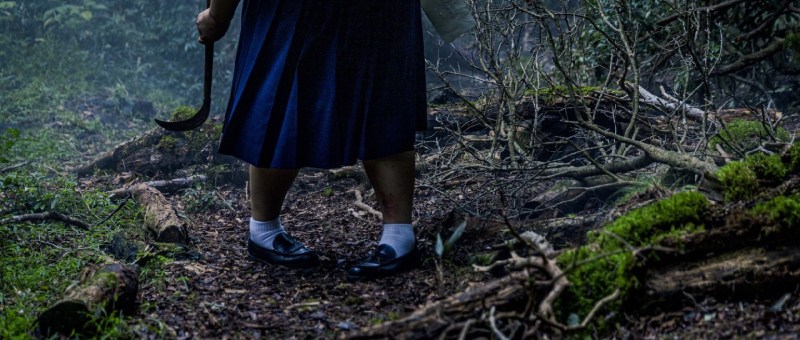
It’s true enough that (almost) all of Mag Mags targets deserve exactly what they get. The men are selfish and insensitive, bullying or abusive. Shunsuke (Fuku Suzuki), the first victim appears meticulously doing his hair in the bathroom mirror as if bearing out his vanity and self-obsession. Many of the men are popular and handsome, but the attention they get has only made them cruel and arrogant. Takuya (Junsei Motojima), the original victim said to have given birth to the curse of Mag Mag, is beloved of half the school but can’t resist punching down by making fun of a girl considered to be unattractive who had left him a love letter. Yurika Yoshida (Marina Mizushima), whose name is very similar to that of the director, is believed by some to have become Mag Mag after taking her own life and cursing Takuya in the process, but most of all represents the ugliness of the male gaze in being constantly berated for her appearance. The other kids tell her to lose weight and get plastic surgery, while Takuya takes her love letter as an insult to his status as king of the school. Mag Mag is described as being “freakishly tall” which also hints at ideas of monstrous femininity.

Perhaps this is one reason why Mag Mag rips out the eyes of her victims, though the point is that they were always pointed in the wrong direction anyway. Sanae is obsessed with an artist named Hiroshi (Oshiro Maeda), though he’s made a nude statue of another named Rumi apparently from his imagination and without her consent, which hints again at the self-involved nature of male desire. He does not appear to really notice Sanae (Sara Minami), though Rumi (Mai Fukagawa) may not be lying when she says he found her creepy. After Hiroshi’s death, Sanae begins investigating Mag Mag in attempt to unmask her and avenge Hiroshi, only to ultimately see herself in the vengeful spirt’s sinister cries of “I love you” which aren’t so different from those expressed for Hiroshi while essentially stalking him from her shrine lair. 

Nevertheless, this misdirected gaze is going in both directions as we, the viewers, too do not really see the person we should have been looking at all along. Deep-seated senses of inadequacy can provoke the jealously and resentment of unexpected and seriously inappropriate targets, and perhaps what we’re looking at here isn’t the societal urge to mock an “unattractive” woman who dares to ask for love, but rather the toxic rage of an invisible man who loathes those who seem to be unfairly popular with women despite being terrible human beings and unpleasant to be around. Perhaps in the end, it’s Sanae’s “delusional” fixation pitted against the passivity of a man who believes himself to be unattractive and in fact becomes so because of his intense self-loathing.

But then, there does appear to be a real ghost and unflinching embrace of the arcane with its Shinto priests, lines of prohibition, and apparently magic trees whose ability to end bad relationships is potentially more than just psychosomatic, or just little psycho. Yuriyan Retriever’s absurdist humour blends perfectly with the grimness of the Mag Mag curse and the world it seems to mirror. With an overt reference to Guard of the Underground, she celebrates and subverts J-horror tropes while skewering contemporary entertainment trends in her house share fantasia of hopeful youngsters that turns out to be a quasi-incestuous nest of betrayal and misplaced desire. Influencers too are a one-way relationship, and you only see what they you want you to. Mag Mag, however, just might let you go if only you’re brave enough to say you love her too rather than, like her unfortunate victims, spurning her affections and thereby invoking and ancient curse born of the suffering of an unreturned gaze.


Mag Mag screens in Chicago 10th April as part of the 20th edition of Asian Pop-Up Cinema.

Trailer (English subtitles)

Six Singing Women (唄う六人の女, Yoshimasa Ishibashi, 2023)

“Don’t take any detours,” the hero of Yoshimasa Ishibashi’s Six Singing Women (唄う六人の女, Utau Rokunin no Onna) is warned by his partner though it’s advice he’ll end up not taking if not entirely of his own volition. Even so, it may be that it’s the society that has gone off track, poisoning the environment and losing respect for the land that has always nurtured and protected us. Part eco-drama, Ishibashi’s surreal odyssey into an etherial realm of nature and spirits has its share of eeriness but also a kind of comfort in the embrace of the natural world.

Only that’s not how it first seems to Shin (Yutaka Takenouchi). After receiving a phone call to inform him his estranged father has passed away, he leaves his partner Kasumi (Rena Takeda) at home in Tokyo and travels into the mountains with the intention of selling his father’s house. But when he arrives, he finds himself in a place stranger than your average remote country hamlet and after signing a contract with the slimy Uwajima (Takayuki Yamada) is kidnapped by a band of mysterious, apparently mute women. While he is looked after in the house. Uwajima is tied up in the shed and tortured.

As we later discover Shin and Uwajima are embodiments of light and dark, a protector of nature and its destroyer. When Shin had asked him what Uwajima’s company, which has also bought up all the neighbours’ land, plans to do with his father’s house he tells him they just want to protect nature but his answer is of course ironic. He represents a corporate entity that cares nothing at all for the mountain but is simply looking to make some money by dumping potentially harmful stuff where no one will find it. Realising that his father had been on some kind of quest to stop the corporate take over, Shin begins to investigate his death and the wider fate of the mountain taking him ever deeper into the woods. 

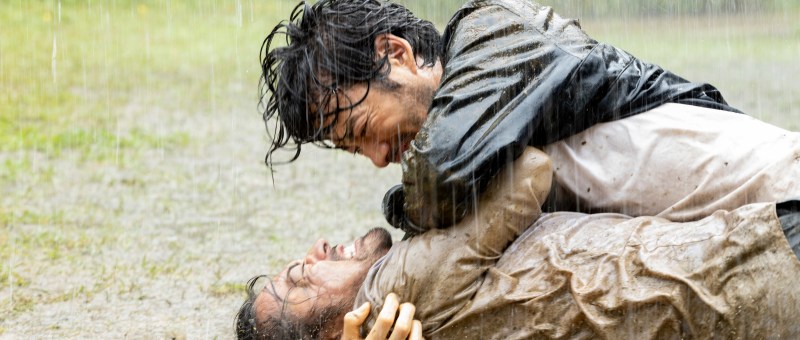
What he finds there is a another realm, a place of spirits that seems somehow sacred if dangerous. Unable to speak, the women appear to have a message a for him but it’s only after reconnecting with his father and accepting his legacy that Shin finally begins to understand. His mother had told him that his father had been “possessed by the mountains,” and there may be something in Shin’s mania as if the spirits had indeed taken him over aside from merely captivating him. Yet despite his newfound desire to protect these women as embodiments of a natural order, he is powerless to do so alone and especially against the destructive corporatism of Uwajima.

Ishibashi strays into folk horror territory in that the strange place Shin finds himself in has the trappings of a cult. He witnesses strange rituals and is prevented from leaving a place he cannot understand by the women who cannot speak to him nor explain themselves. Bees, spiders, frogs and snakes surround him with an air of malice but are perhaps trying to protect, both him and themselves or else realising Shin is no threat to them but a prodigal son returning to accept and claim the legacy he sought to reject from a misunderstood father like him possessed by the mountains. Finally he finds the answer to the question his father asked him, in the woods exactly where he said it would be. 

His solution runs contrary to that of the estate agent who encouraged him to sell his father’s home, that the world is what it is as if it could not be changed and resisting destructive capitalism is merely foolish when it would be better to take the money and run. Ishibashi rams him message home with his haunting capture of the woods as a dreamlike idyll though not without its sense of darkness while lending an air of surreality to Shin’s ethereal quest with all its owl women and inscrutable ritual that somehow hint at a natural order of things that is deeper and older than our society and with which we tussle at our peril for nature is never quite as passive as we thought for all the compassion it may otherwise hold for its prodigal sons and daughters yet to return to the fold.


Six Singing Women screens in New York July 12 as part of of this year’s JAPAN CUTS.

Trailer (English subtitles)


Perfect Days (Wim Wenders, 2023)

A man in late middle-aged quite obviously living in the past begins to wake up to the possibilities of change in Wim Wenders’ Tokyo-set drama, Perfect Days. Even so, Hirayama’s (Koji Yakusho) days may be pretty much the same but that doesn’t necessarily mean that his life is dull or even predictable while it’s clear that he manages to find joy in small moments of serenity even if he may also seem to be harbouring a great sadness. 

The irony is that Hirayama lives in a rundown postwar tenement that happens to be almost directly under the Tokyo Skytree which Wenders often cuts back to as if to signal the disparity between the rich and glitzy skyline of the contemporary city and the lives of those on its margins. Hirayama’s home has an almost eerie quality owing to the glowing purple light shining out of the window of his spare room where he nurtures tiny saplings back to health. The traditional-style two-floor flat has two tatami-mat rooms on the upper level, the other filled with books and cassette tapes amid an otherwise spartan interior. Before leaving for work each morning he brushes his teeth over the kitchen sink, the place has no bathroom, and meticulously takes up his belongings neatly placed in order on a shelf by the front door. 

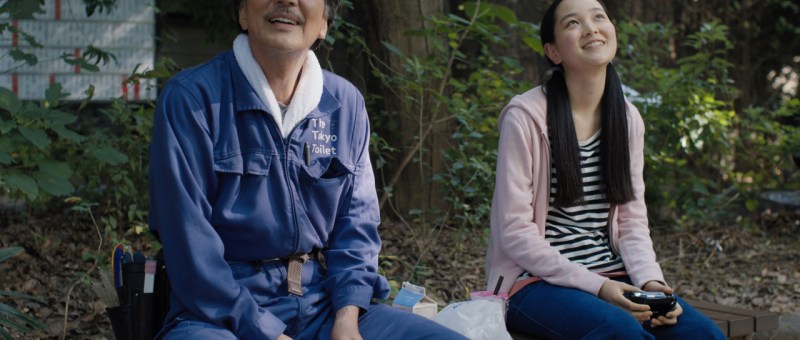
Perhaps it’s this kind of order that Hirayama craves, clinging to the security of the usual and dedicating himself to his work with unusual rigour. A municipal toilet cleaner, he painstakingly scrubs each and every bowl and urinal, checking the nozzles on the bidet function and shining a mirror underneath to make sure everything is as clean and tidy as it could possibly be only for drunken salarymen to push past him and quite literally piss all over his hard work. Like many such workers, he attains a kind of invisibility and should anyone need to use the facilities while he’s cleaning them he’s obliged to step outside and wait before starting all over again. When he finds a little boy crying alone in a park toilet he takes him by the hand and tries to help him find his mum, only when he finds her she completely ignores Hirayama and even goes so far as to wipe the boy’s hand with a wet wipe. The boy’s little wave of thank you as they leave is the only ray of comfort and recognition. 

Yet for all that, it’s as if this the life Hirayama has chosen. He barely interacts with his chatty colleague Takashi (Tokio Emoto) who has a habit of rating everything out of ten and sees no value in his work, hardly bothering to do much cleaning at all while complaining that he has no money to romance the bar hostess he’s hoping to make his girlfriend. Takashi and Aya are fascinated by Hirayama’s collection of cassette tapes which he plays in his van, though Takashi more so for the commercial value that may be attached to them in a world in which everything old is new again and specialised stores in the trendy neighbourhood of Shimokitazawa trade exclusively in secondhand LPs and Sony Walkmans. Even so, Aya too appears to have her private sadnesses drawn to the voice of Patty Smith but pressing stop when the tape mentions suicide. The melancholy office lady in the park and an elderly homeless man who lives there too must have their own stories as unknown to Hirayama as his is to them. 

A surprise visit from a teenage niece suggests that he may have come from a relatively wealthy family with a tyrannical patriarch and that this ascetic life of his is a kind of rebellion or else or a refuge, but there’s a look of pain on his face when the landlady at his favourite bar (played by enka legend Sayuri Ishikawa) laments that she wishes everything could stay the same. Perhaps he’s tired of this very analogue life and its otherwise pleasant monotony as he further confirms for himself realising that it’s not right for things not to change as he engages in a game of shadow tag with another middle-aged man who’s evaluating his life after a terminal cancer diagnosis. In truth, the film risks straying into orientalism in its advocation of Japanese serenity in simplicity (something not helped by the final title card explaining the term komorebi) while the musical choices appear a little on the nose and the celebration of mundanity in Hirayama’s labour might otherwise seem flippant. Even so, Yakusho’s typically astute performance keeps the film on an even keel as Hirayama finds himself on a turbulent journey towards a “new world” of fulfilment and possibility. 


Perfect Days screened as part of this year’s BFI London Film Festival.

Original trailer (English subtitles)