Neo Chinpira: Zoom Goes the Bullet (ネオ チンピラ 鉄砲玉ぴゅ~, Banmei Takahashi, 1990)

In the classic yazkua films of old, going to prison for the gang could be a badge of honour and one of the ways you could catapult yourself into the higher ranks. By the 1990s, however, the yakuza is a much depleted force and it seems few are willing to give up years of their lives on a point of honour for an uncertain reward. At least, that’s how it is for most of the gangsters at the centre of Banmei Takahashi’s Neo Chinpira: Zoom Goes the Bullet (ネオ チンピラ 鉄砲玉ぴゅ~, Neo Chinpira: Teppodama Pyu) , a slacker comedy in which a young hanger on faces a dilemma when he’s made the lookout on a squad sent to bump off a rival only for his squamates go to great lengths to injure themselves first so they won’t have to go through with it.

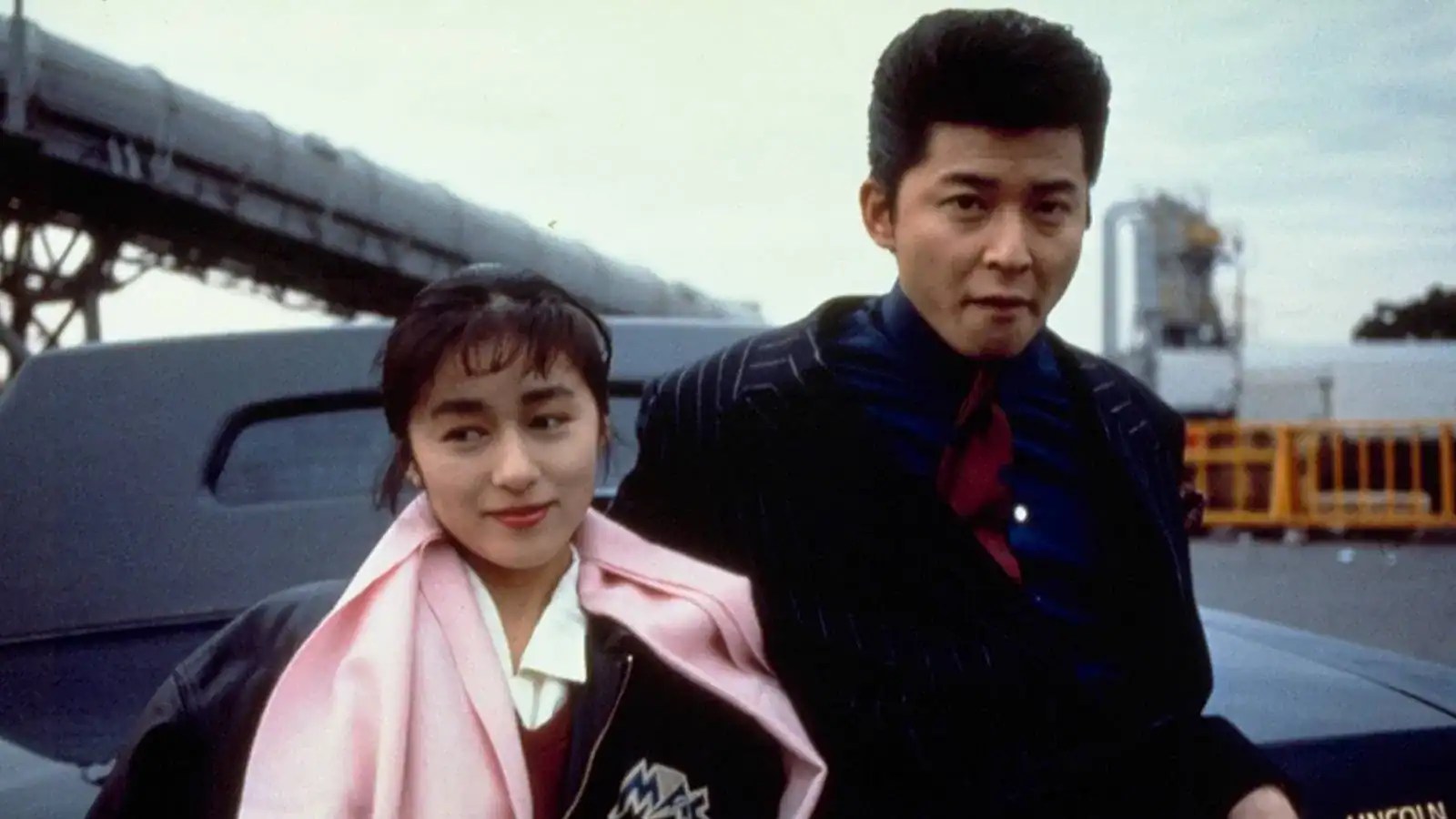
Junko (Sho Aikawa) is an unlikely hero. With a rockabilly quiff and a red jacket, he’s nominally the driver for gangster Yoshikawa (Toru Minegishi) which means he gets to drive his limo and act like a big man for a while making calls on his carphone. But as much as Junko shows off to his girlfriend Noriko, a hostess at a Korean bar, by instructing the landlady not to clear up his empty bottles because they’ll make a good weapon in an emergency, he’s otherwise something of a joke. The limo ends up getting “stolen” by a young woman who just likes American cars and sexually aroused by gunfire.

Even Yumeko (Chikako Aoyama) chuckles that Junko sounds like a girl when he says he wants to see the ocean while they’re driving around. “Junko” is ordinarily a girl’s name. He picked it up as a kind of hazing based on an alternate reading of his name kanji. She says the same thing again when he reveals he’s never brought a girl back to his place before, probably because it’s in a disused building he was given to manage where he’s surrounded by junk like an old barber’s chair and pinball machine while the figure of Humphrey Bogart in the Maltese Falcon looks down at him from a poster as if embodying his unattainable gangster dreams. As masculine icons go, Junko is also plagued by his uncle, Mizuta (Joe Shishido), a legendary gangster and representative of old school yakuza who take the code seriously and wouldn’t put up with people like Junko’s colleagues who engage in “zooming”, deliberately shooting themselves to get out of being ordered to carry out a hit. He’s not overly impressed by Junko either, unable to understand why he’d become an errand boy for a petty gangster rather than be his own boss as a small-time crook.

Junko’s dilemma is whether he’s really up to this task and will be to go through with it or will end up chickening out and injuring himself too. Crows are more cowardly than they seem, Yumeko explains in an obvious allegory for the yakuza. They pick a place and defend it as a group, while their numbers are way up lately so their individual turfs are shrinking. But now Junko’s all on his own and filled with uncertainty not knowing if he can pass this rite of passage and be accorded a man or will forever be trapped in a liminal space of adolescence never to be taken seriously or make any progress in his life. In an effort to toughen up, he swaps his red jacket for a suit and finally puts on a shiny leather overcoat, ripping off the buttons to bind it more tightly around him with the belt as if it were a kind of armour. 

Somehow the lighthearted ridiculousness of this world of bumbling yakuza and creepy corrupt cops lends an additional poignancy to Junko’s final gesture as he sets off on his path, not really believing he will return. He doesn’t even wait for the pictures he had taken at a photo booth. They won’t be much use to him where he’s going, but at the same time it’s like he’s treading water never quite getting closer to his destination but continuing along his long sad walk. Banmei Takahashi sticks firmly to his pink film roots, sticking in a weird sex scene at regular intervals as Yumeko becomes enraptured by pistols, but also has quite a lot of fun with his “uncool” gangsters and the lost young man who looks up to them while perhaps knowing that this image of stone cold masculinity only really exists in the movies.

I Am Kirishima (桐島です, Banmei Takahashi, 2025)

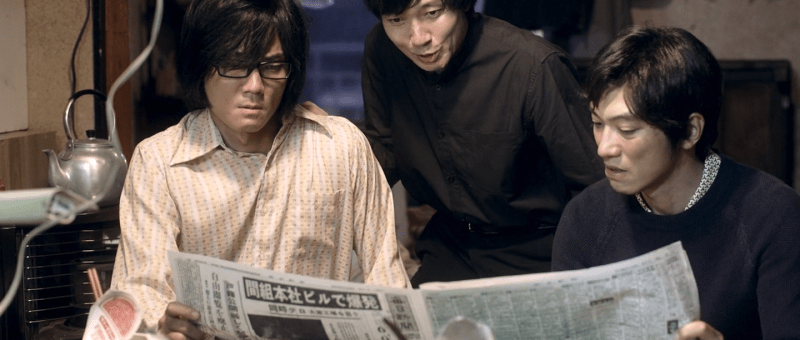
In early 2024, an elderly man made a shocking confession. He told members of the medical staff at the hospital where he was being treated that his name was actually “Satoshi Kirishima” and that he was a fugitive from justice wanted for the terrorist bombing of Mitsubishi Industries in 1974 that resulted in the deaths of eight people. Banmei Takahashi’s I Am Kirishima (桐島です, Kirishima desu) attempts to chart the course of his lifetime on the run but may prove controversial in the depths of its sympathy for a man who was party to this kind violence and to a degree found it justified even if he could not justify that his organisation threatened the lives of ordinary people rather than simply the infrastructure of companies they believed to be fuelling corporate imperialism.

Takashi has visited this era before with 2001’s Rain of Light which like Wakamatsu’s United Red Army readdressed the Asama-Sanso Incident and the failure of the student movement in early 1970s of which both directors had been a part. In February 1972, five members of the URA fleeing a purge inside the group holed up in a mountain lodge taking the innkeeper’s wife hostage. The event was one of the first news events in Japan to be broadcast live and its aftermath exposed the cult-like depths of violence and abuse to which the URA had descended forever the souring the nation as a whole on the idea of left-wing revolution. Meanwhile, the fragmentary groups that remained shifted further towards the extremes such completing bombing campaigns to disrupt the new capitalistic prosperity of the economic miracle. Kirishima and his cell believe these large conglomerates, such as Mitsubishi, to be enacting a new kind of Japanese imperialism through exploitative labour practices often targeting migrant workers in much the same way they made use of the forced labour of Korean and Chinese people trafficked to Japan during the colonial period.

To this extent, Kirishima justifies acts of terrorism but thinks they should avoid ordinary people getting caught up in the blast. The film is keen to cast him as “a man behind the times,” an foolish idealist who is exiled from the modern society because of his outdated beliefs in equality and fairness. As such, it lends an elegiac quality to the tragedy of his life in which his 50 years on the run weren’t all that much better than prison given that he had to live under an assumed identity, forever watching his back and unable to put down roots. A tentative romance with a singer-songwriter is hinted at, but Kirishima forgoes his romantic desires out of a feeling that it would be irresponsible to marry without being able to reveal his true self. 

But the film equally seems to drawn a parallel with contemporary Japan in Kirishima finds himself working alongside a middle school drop out with openly xenophobic views who makes frequent racist remarks such as implicating a co-worker when he’s taken to task for being late by insisting that it must be the other guy’s fault because he’s Korean and Koreans always lie. He also says that the migrant workers whom he claims are working illegally should be grateful to be exploited in Japan and can always go home if they don’t like it. It’s all a little too much for Kirishima who sacrificed his life for an ideal this boy repudiates while Japan has become a nation ruled by capitalism and exploitation with the labour revolution he dreamed of now a distant memory. Watching a Shinzo Abe press conference in which he discusses revising the constitution, Kirishima throws a beer can at the TV in frustration. His old comrade dies in prison leaving only a book of poetry behind, while another is released after serving his time though he obviously can’t make contact with him without risking his identity being exposed and getting picked up after all these years. 

Indeed, the film romanticises this image of Kirishima as a man from a bygone age in which another Japan was possible but did not and now presumably cannot come to pass. In doing so, it gives tacit approval to some of the actions of the extremist groups of the 1970s while simultaneously declaring the end of an era as a “case closed” card is placed over the cheerfully smiling face of a young Kirishima which had graced wanted posters all over the country for the last 50 years. His life itself becomes a failed revolution, but also kind of victory in which he managed to “beat” the police by remaining a fugitive all that time even if in the end he seems to regret the life he was prevented from living along with the isolation and loneliness of which he may now at last be free.


I Am Kirishima screened as part of this year’s Osaka Asian Film Festival.

Trailer (no subtitles)

Door II: Tokyo Diary (Banmei Takahashi, 1991)

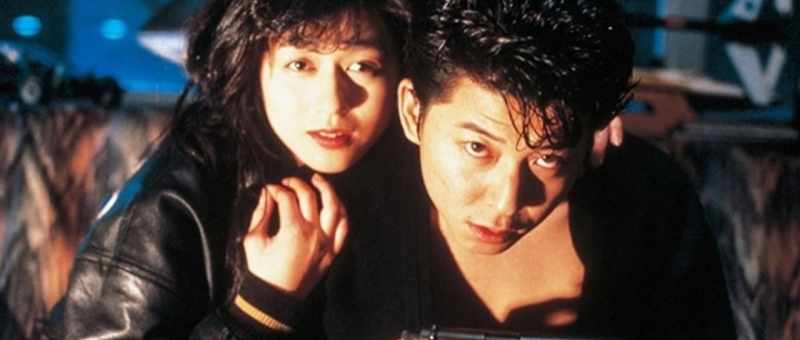
A sequel in name only, Banmei Takahashi’s Door II: Tokyo Diary has almost nothing to do with his previous film Door, the title was apparently tacked on at the behest of studio execs who noticed that it had sold well on home video. Nevertheless, the film has its own door motif as the aimless heroine searches for herself among the many available to her, temporarily trying on other personas while wilfully flirting with danger. 

A menacing voice message reminds Ai (Chikako Aoyama) that her work is dangerous, a woman telling her to back off but for unclear reasons either genuinely concerned for her safety or annoyed she’s infringing on her business. Ironically enough, Ai is a call girl who runs her own operation through the soon-to-be obsolete technology of a telephone answering service which unlike the phones in Door offer her a one way portal of communication that isolates her from her potential clients. She explains that she chooses the men for herself, watching idly having quadruple booked the same appointment until finally deciding which door to open though it seems unclear how far she is aware of her vulnerability given that working alone means there’s no one to call if something goes wrong as it eventually does. Even the first client we see her with changes the moment he steps over the threshold, becoming angry having realised that Ai doubled booked the appointment while playing rough with her and forcing her down onto the bed. 

Ai (whose name means love) seems to treat each of the doors as another world in which she must play her assigned role. As such, she submits herself to every degradation though it’s unclear if the act of submission is empowering or she is really just at the mercy of these wealthy mean who’ve paid to do what they like with her. Then again as Ai explains to sometime love interest Ichiro (Shingo Kazami), her real motive is sex and not money leading her to turn down an appointment with a sweet older gentleman who’s checking call girl experience off his bucket list but does not actually want to sleep with her only go on a date. Meanwhile, she finds herself bound and blindfolded while a man in heavy makeup and a nazi uniform dribbles wine down her face as part of a urination role-play. She later plays the piano for him while he curls up in a little ball at her side. 

Becoming involved with a mysteriously wealthy art dealer (Joe Yamanaka) who treats her with unusual tenderness seems to shift Ai’s world view, but equally does an incredibly dark encounter with a dangerous man who attacks Ai and her friend Tomoyo (Yukino Tobita) with a pair of scissors until Tomoyo bites one of his toes off so they can escape. This is the danger the middle-aged madam (Keiko Takahashi) tried to warn her about and causes her to reconsider her life as a call girl until she finally decides to try the same door again and bursts the fantasy bubble by telling the art dealer she loves him. 

A climatic and hugely inappropriate speech at a wedding which nevertheless earns the appreciation of the bride, allows Ai to begin to rediscover herself realising that it was the sense of anticipation that she craved not knowing what she’d discover beyond each and every door. She decides she’d like to swim in the great ocean of infinite possibility once again, ready to open more doors to find out what lies beyond possibly reassured by the art dealer’s assertion that though most of his paintings are fakes he’s discovered a handful of “originals” too restoring Ai’s sense of self as an individual rather than an anonymous call girl who comes when called and has no direction of her own. A melancholy tale of youthful anxiety in the fracturing economy of the Bubble on the eve of its implosion the film trades on Takahashi’s experience in pink film in its at times perverse eroticism but ultimately presents a tale of a young woman regaining control over her self and her life, willing to embrace new possibilities and their concurrent dangers so long as she chooses them for herself. 


Door II: Tokyo Diary is released in the UK on blu-ray 30th October courtesy of Third Window Films.

Restoration trailer (English subtitles)

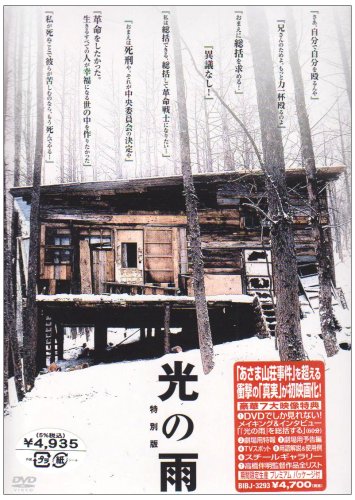
Rain of Light (光の雨, Banmei Takahashi, 2001)

In the closing voice over of Banmei Takahashi’s Rain of Light (光の雨, Hikari no Ame), the elderly narrator thanks us, the younger generation, for listening to this long, sad story. The death of the leftist movement in Japan has never been a subject far from Japanese screens whether from contemporary laments for a perceived failure as the still young protestors swapped revolution for the rat race or a more recent and rigorous desire to examine why it all ended in such a dark place. Rain of Light is an attempt to look at the Asama-Sanso Incident through the eyes of the youth of today and by implication ask a few hard questions about the nature of revolution and social change and if either of those two things have any place in the Japan these young people now live in. Takahashi reframes the tale as docudrama in which his young actors and actresses, along with their increasingly conflicted director, attempt to solve these problems through recreation and role play, bridging the gap between the generations with a warning from those who dreamed of a better world that was never to be.

After beginning with a voice-over and archive footage of the original protests beginning in the ‘60s, Takahashi introduces us to the main thrust of the conceit as veteran TV commercial director Tarumi (Ren Osugi) announces his intention to make a film about the Asama-Sanso Incident and hires indie film director Anan (Masato Hagiwara) as an AD who will also film behind the scenes footage. From here on in we swap between the various levels of the film as we meet the young men and women who will inhabit the roles of the student radicals of 40 years before and then witness the tragic events which befell them eventually culminating in the famous siege which became Japan’s first live broadcast news event gathering a record number of viewers across its ten hour duration.

This is a sad story and a difficult one to watch. As the student movement dwindled in the early 1970s, factionalism was rife and the scene chaotic. Two different factions merged to become known as the United Red Army and retreated to a secret mountain camp where they would train for the coming revolution, believing that only armed insurrection could destroy the old order and allow them to build the bright new socialist future for which they were fighting. However, in the extreme paranoia surrounding the underground movement, there had already been two murders of suspected traitors and suspicion was everywhere. Led by Kurashige (Taro Yamamoto) and Uesugi (Nae Yuki) the mountain lodge quickly becomes a place of fear and rigidity as dogmatic maoist slogans take on near religious significance. Pushing the “soldiers” through the process of continuous “self criticism”, the group places personal revolution as a paramount necessity for social change. Using the system to ease personal grudges or clear the political air, Kurashige and Uesugi bring about the deaths of several cadre members through beatings, exposure, or starvation before resorting to bare faced murder all in the name of “reform”.

Less interested in simply reviewing events, Takahashi’s treatment attempts to speak directly to the young people of today who, at least according to the video interviews conducted by Anan, know little of this traumatic era which presumably formed the backdrop to their parents’ lives. As time moves on it transpires that Tarumi has a much more personal connection to the material than he’d previously been able to admit and one which eventually sees him attempt to absent himself from the film’s completion. In the absence of their director, the cast take on the attributes of their characters in trying to understand his actions. Beginning to self criticise themselves, the actors attempt to find the fault that has driven their leader away despite the fact that his reasoning is entirely personal.

The young discuss the various merits of change and revolution but find their forebears hard to grasp. It is, indeed, impossible and all too possible to understand how this happened. Young men and women who wanted to change the world found their ideals misused, driven half mad by a kind of quasi-religious cultism which demanded nothing less than total commitment the rules of which were entirely decided by a deluded madman terrified of losing his own grip on power. Though some of the performers come to sympathise with their roles, this era of heavily politicised thought and activism is so entirely alien to them as to seem arcane.

Takahashi delineates each of the various media through differing camera effects and aspect ratios from the mid-range digital of the film within the film to the low grade video of the direct to camera “behind the scenes” footage. The film is itself the bridge which the director claims he wants to make yet eventually backs away from as his own painful past becomes the subject he does not want to address. Anan, the AD, pleads with the director to deliver his message to the young. The old, he says, talk about the past like it’s yesterday but refuse offer anything of real substance to those who have come after them. Tarumi does indeed tell his story in all of its pain and sadness, stopping to remind us, as the troupe of actors gleefully start throwing snowballs around, that this was a children’s revolution begun by young men and women who wanted nothing other than to build a better world. So what of the youth of today? Is such idealism still present, and if it is could it ever be as frustrated and misused as the unhappy revolutionaries of the post ’68 generation? The answer seems to be no, but then nothing came of the grand gestures and political posturing of 40 years ago, perhaps the genial, everyday goodness of the youth of today will have more luck.