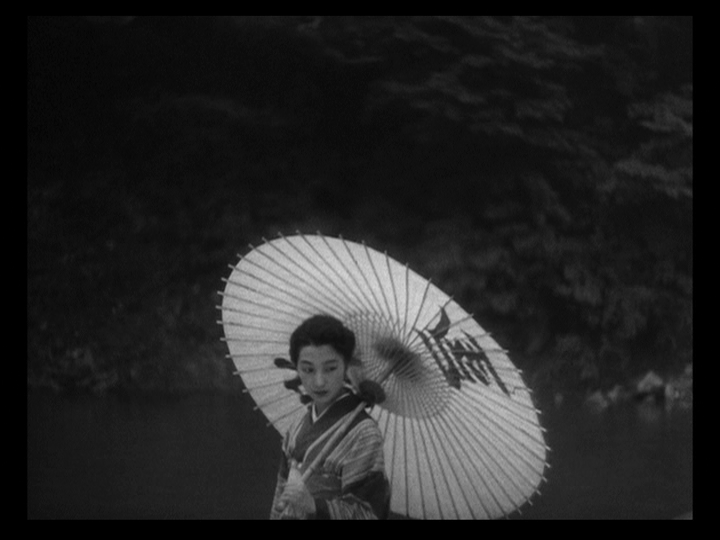
The Masseurs and a Woman (按摩と女, Hiroshi Shimizu, 1938)

vlcsnap-2016-05-19-23h22m51s149Hiroshi Shimizu takes another relaxing sojourn in 1938’s The Masseurs and a Woman (按摩と女, Anma to Onna), this time in a small mountain resort populated by runaways and bullish student hikers. Once again Shimizu follows an atypical narrative structure which begins with the two blind masseurs of the title and the elegant lady from Tokyo but quickly broadens out to investigate the transient hotel environment with even a little crime based intrigue added to the mix.

We arrive at the resort town at the same time as the masseurs themselves who’ve walked all the way passing the time playing games with each other over who can guess how many children are in a group travelling the same way or counting how many people they manage to overtake on the road. Comically, their efforts to pass a group of students actually frighten them a little bit so they take off at speed meaning Fuku and Toku miss their daily target.

As well as the group of male students and another group of female ones, the town is also host to a mysterious and beautiful woman from Tokyo who seems both a little sad and a little scared with a tendency to overreact to small sounds and unusual situations. The other main group is a little boy and his uncle with whom he seems to have something of a troubled relationship.

Toku becomes fascinated with Michiho, the mysterious woman from Tokyo, whom he recognises because of her distinctive perfume. Though he is blind, he “watches” her – sensing where she goes and reading her emotional state. He seems to realise there’s very little possibility that she will return his interest, though he allows her to play on the obvious feelings he has for her, and the pair strike up a melancholic friendship. However, Michiho is only interested in making a play for the good looking uncle of the little boy who she has also befriended but the boy eventually goes cold on her, feeling a little rejected because she spends so long talking to his uncle. The two neglected guys, Toku and the boy, form their own kind of friendship as the blind masseur is the only person who is willing to have some fun with him in this slightly less than child friendly resort in which he’s unspeakably bored.

This being a holiday town, it’s a place that only exists for a small amount of time before sinking back into the mists like Brigadoon when the season ends. All things are transient here and everyone is just passing through. The friends you make are just for now and this brief respite from everyday life will fade from the memory like a pleasant dream. Toku ought to know this as he spends his life in such places, providing additional relief for the weary traveller, yet he still has a yearning to connect which is only exacerbated by the feeling that his blindness cuts him off from everyday society.

When a spate of bath house thefts occur and it turns out Michiho has been seen at each of the crime scenes, Toku comes to the obvious conclusion even though his feelings make him reluctant to suspect her. He tries to help Michiho evade punishment for what he believes are her crimes only to find out a very different sort of truth that sees her eventually decide to continue her journey onward to an uncertain future (though at least one that is 100% of her own devising).

Again, Shimizu opts for a lot of location shooting emphasising the beauty of the scenery and the tranquility of the atmosphere. Mostly he sticks to static camera shots, aside from one lengthly tracking sequence and the hand held finale walking after a departing cart, but when he tries to show us the vision of a blind man it’s a striking moment – a whirling chaos where we too can almost smell the elusive perfume of a woman we know is “beautiful”  though we cannot see her, and also know is deliberately toying with us. A melancholy look at the transience of human relationships and the impossibility of true connection, The Masseurs and a Woman is a genre melding tragicomedy filled with innovative directorial flourishes that are once again far in advance of their time.


The Masseurs and a Woman is the third of four films in Criterion’s Eclipse Series 15: Travels with Hiroshi Shimizu box set.

This is the only video clip I can find but it’s not subtitled and it has quite a long speech about Hiroshi Shimizu’s career at the beginning so skip to 2:17 for the film itself:

Mr. Thank You (有りがとうさん, Hiroshi Shimizu, 1936)

Mr. Thank YouBus trips might be much less painful if only the drivers were all as kind as Mr. Thank You and the passengers as generous of spirit as the put upon rural folk travelling to the big city in Hiroshi Shimizu’s 1936 road trip (有りがとうさん, Arigatou-san). Set in depression era Japan and inspired by a story by Yasunari Kawabata, Mr. Thank You has its share of sorrows but like its cast of down to earth country folk, smiles broadly even through the bleakest of circumstances.

Mr. Thank You is everyone’s favourite bus driver. In fact, some of his passengers have even deliberately decided to “miss” the previous bus because they heard he was driving the next one. It’s not hard to see why, he’s a good a driver and a very polite, nice young man who’s been given the affectionate “Mr. Thank You” nickname because of his habit of shouting a loud thank you to everyone who moves out of the way for his bus to pass in the narrow mountain roads (the aforementioned pedestrians are also to be seen waving wildly and shouting his nickname back at him as he grins at them in the rear view mirror). He’s also prepared to stop and pick up passengers along the way as well as carrying messages between villages and filling requests for the latest records to hit Tokyo stores.

Mr. Thank You was apparently shot without a firm shooting script other than the inspiration of Kawabata’s story so the dialogue has a very immediate, contemporary feeling. There isn’t so much of a story as a journey taken with this disparate group of people all travelling from one place to another for various different reasons with the small interjections of other passersby on the roadside. The main drama occurs between a woman and her daughter who have such ashen faces they might as well be ascending the gallows, a very modern whiskey swilling travelling woman, and a grumpy guy with a handlebar moustache who seems very anxious about the bus being delayed by all these pleasantries. Along the way, Mr. Thank You offers commentary on some of the people he knows from his regular trips which amounts to a collection of sad stories decrying the state of the nation in which fathers are selling their daughters and mad men wander the streets searching for lost love.

“Young women used to laugh, but you never hear that now.” Says one passenger glancing at the sad face of a girl on a bus to the city. The mother and daughter seem reluctant to talk about their journey but it’s obvious to all that the girl is to be sold to a geisha house, never to see her home again. Mr. Thank You is sympathetic to her plight whilst silently listening to the lamentations of his customers like a sober barman. At one point he wonders out loud if he might be better off driving a hearse – acknowledging his own complicity in taking money for escorting this poor girl off to a life of rack and ruin. The flirtatious modern woman sitting behind him (most likely a prostitute herself) reminds him that women who pass these mountains rarely make a return journey, perhaps there is another way he could help her even if he can’t do the same for everyone.

Shimizu also stops a minute to consider the human costs of all this rapid progress. Taking a brief break from driving, Mr. Thank You chats to an acquaintance who has been working on the road building programme. A Korean migrant, she is among the most put upon of workers. She hoped she might have enough money to ride on Mr. Thank You’s bus just the once, but no sooner has one road been completed than she’s despatched off to build another one on another mountain so she’ll have to bid him goodbye. Mr. Thank You (seemingly quite taken with her and sorry to hear they may not meet again) offers to let her ride for free but she looks back at the masses of other people who are walking the mountain passes because they can’t afford the bus either and says it’s OK, she will stay with them, walking onward with everyone else caught in the same predicament as herself.

Filmed in 1936 Mr. Thank You has an extremely modern sensibility with a lot of naturalistic location shooting outside of the cramped environment of the bus which forms the main setting for the drama. The bus drives onward without stopping as obstacles fade from view only to reappear in the rear view mirror like ghosts, phantom images reflected on the landscape here one minute and gone the next. Time and history are marching on though one gets the impression Shimizu at least does not approve of the way his country is heading. The passengers on Mr. Thank You’s bus all have their troubles, but they’re trying to do the best they can by putting a brave face on it. They laugh, they drink, they sing but eventually they will all have to get off the bus, away from the careful protection of Mr. Thank You, and return to land of badgers and foxes where it’s every man for himself and those who cannot pay the fare will have to walk the rest of the way on their own two feet alone.


Mr. Thank You is the second of four films in Criterion’s Eclipse Series 15: Travels with Hiroshi Shimizu box set.

Scene featuring the Korean migrant worker (with English subtitles)

Japanese Girls at the Harbor (港の日本娘, Hiroshi Shimizu, 1933)

japanese girls at the harbourHiroshi Shimizu made over 160 films during his relatively short career but though many of them are hugely influential critically acclaimed movies, his name has never quite reached the levels of international renown acheived by his contemporaries Ozu, Naruse, or Mizoguchi. Early silent effort Japanese Girls at the Harbor (港の日本娘, Minato no Nihon Musume) displays his trademark interest in the lives of everyday people but also demonstrates a directing style and international interest that were each way ahead of their time.

A classic melodrama at heart, Japanese Girls at the Harbor begins with two school girls living their humdrum lives of commuting back and for to school in early 1930s Yokohama. Dora and Sunako attend a Catholic school in the “foreign quarter” of the city and are devoted best friends who swear they’ll stick together for ever. However, motorcycle riding bad boy Henry rips right through their friendship in the way that only a bad boy can. Sunako abandons Dora at the harbour to ride off with Henry (later apologising to her understanding friend) but it turns out that Henry likes hanging round with gangsters and also has something going with an older lady called Yoko.

Dora tells Sunako if she really loves Henry she’ll just have to accept him for what he is before going off to find the cheating louse herself and give him a piece of her mind. However, when Sunako catches Henry and Yoko together she loses the plot entirely and ends up running off out of the city. Time passes and Sunako returns but in shame as she’s become a prostitute living with a painter whom she doesn’t seem to care for very much at all. Can she repair the damage with the now married Dora and Henry and get herself out of the hell her existence has become, or is she forever doomed to the life of a fallen woman?

Made in 1933 just as Japan was heading into its militarist era, Japanese Girls at the Harbour has an oddly international mindset with its Western houses, names and a Christianising atmosphere. An international port, there’s plenty of the outside world to be found in Yokohama where things seem to leave much more often then they arrive. Sunako says watching the boats leave makes her feel sad, but it’s she who will go off on one of Shimizu’s trademark travels, running from a crime of passion and the ache of a breaking heart.

A true friend, Dora has not abandoned Sunako and is willing to welcome her back into her home. Henry, the first to meet Sunako (at her place of employ) is torn between the old attraction, feelings of guilt over what’s happened to her, and his responsibility to Dora as her husband. Shimizu introduces an interesting metaphorical device as Henry and Dora wind a ball of wool whilst sitting together in their Western style house but as soon as Sunako arrives it falls onto the floor and begins to unravel, eventually becoming tangled up around the feet of Henry and Sunako who dance in the living room while Dora prepares a meal. Suddenly seeing her married life unravel just like this shaggy ball of wool, Dora, though still devoted to her friend, begins to feel a little afraid that Sunako may be about to jump back on the bike with Henry, just as she did all those years ago.

Shimizu’s interest is much more with the two young women than it is with Henry who remains very much a prize not worth winning. This is Sunako’s fallen woman story – eventually she comes to feel that she’s bringing too much disruption into the lives of her old friends who were getting on so well before. Henry and Dora were her last lifeline to her old self, the only old friends she could still count on, but if she wants to save them (and herself) she will have to stay away and lose them forever. Her redemption lies in self sacrifice, in giving up something that made her profoundly happy for its own good despite the immense amount of suffering she will incur in doing so.

Shimizu was one of the earliest proponents of location shooting and he does make good use of the atmospheric Yokohama streets before heading indoors for the seedy, smoky clubs and cheap tenement housing. He also introduces a series of strange jump zooms at two moments of unusually high emotion which add a degree of panic to the scene as well as heightening the nuanced reactions of the characters in question. This, coupled with his use of dissolves which often sees characters simply evaporate from the frame like unwelcome ghosts of memory, lends to the almost noir-ish, melancholic tone with its dream-like blurring of the real and the merely recalled.

An interesting example of international cross pollination in the early 1930s before hard line militarism became entrenched, Japanese Girls at the Harbor is a pregnantly titled story of a wronged woman abandoned on the shore and left with the choice to board a boat to fairer climes or remain behind and risk destroying what she most loved. The past becomes something to be absorbed and then put to rest. Ghosts cannot travel by water, and so you must leave them behind, like girls at the harbour staring sadly at departing ships.


Japanese Girls at the Harbor is the first of four films in Criterion’s Eclipse Series 15: Travels with Hiroshi Shimizu box set.

Video clip of a climactic scene which showcases Shimuzu’s jump zoom technique (presented without musical score but does have subtitles for the really quite amazing intertitles which are a definite highlight of the film).

(Video clip courtesy of Mubi)

Temptation (誘惑, Kozaburo Yoshimura, 1948)

TemptationFeelings can creep up just like that, to quote another movie. Like Wong Kar-Wai’s In the Mood for Love, Temptation (誘惑, Yuwaku) also echoes Lean’s Brief Encounter with its strains of accidental romance between unavailable people even if only one of the pair is already married. However, this time there’s much less deliberate moralising though the environment itself is a fertile breeding ground for the judgemental.
The film begins with Takako (Setsuko Hara) paying her respects at the grave of her recently deceased father only to run into an old pupil of  his arriving for the same reason. Takako and Ryukichi (Shin Saburi) are both making the arduous trip back to the city and decide to travel together. Stopping over in Gifu, they find difficulty in getting a hotel room because of a big horse race due to take place the next day and rather awkwardly end up sharing a bed. After Takako becomes upset and ponders what she’s going to do now her father is gone, Ryukichi offers to let her move in with him and the children. Discussing this with his wife who is an invalid living away from the family, he talks paternally of Takako and of a wish to look after her as a way of honouring the memory of his former teacher. However, it isn’t long before the inevitable happens and the pair begin to fall in love.

Ryukichi first met Takako as a little girl when he was her father’s student but she’s 21 years old now – a grown woman by any standard, and plenty old enough to know what she’s doing. He describes her as still “silly”, like a child, and indeed Setsuko Hara breaks out some of her most radiant (if occasionally pained) smiles and almost mocking laughter to play a complex mix of putting a brave face on grief and genuine happiness at being back in a family home. Though feeling the crippling loss of her only family member has left her feeling devoid of a purpose in life, Takako is an essentially good and kind person who sees the best in people and is only too happy to help Ryukichi with the children while his wife is ill as well as continuing with her medical studies.

After leaving academia, Ryukichi has become left leaning politician committed to creating a better, fairer nation. Like Takako he is also an honest and decent person with a high sense of personal integrity. His motives for bringing Takako into the house were innocent, yet gradually his feelings for her begin to shift from the paternal to the romantic causing him a considerable amount of stress as he battles the need to remain faithful to his wife even in her absence while his attraction to Takako continues to grow.

The impending threat of illicit action stalks the screen almost like the stealthy figure of the killer in a slasher movie. At one point where the feelings threaten to overwhelm the couple despite their best efforts to suppress them, Tokie (Haruko Sugimura) – the sickly wife, unexpectedly turns up in true melodrama fashion as if summoned by the lovers’ guilty consciences and accompanied a chorus of stinging strings.

Tokie herself played by veteran actress Hariko Sugimura, is every inch the wounded wife though her plight is played with a little less vindictiveness than in a similarly themed gothic novel where the bedridden spouse suddenly rises as if from the grave itself to haunt the new lovers while still alive. Originally approving of Ryukichi’s desire to help Takako, Tokie’s fears are awaked when seeing her playing with the children on the beach – all long legs and youthful skin, moving in a way she fears she never will again. “Everything inside my chest is ruined” she tells Ryukichi before returning sadly inside, alone, prematurely exiling herself from her own family.

That said, Temptation refuses to follow the established pattern in that it suddenly reverts to a standard romance with no feeling of judgement inflicted on the couple whose love story has occurred in an illicit fashion. Tokie has a late in the game change of heart and the guilty spectre that haunts the couples of European melodrama fails to arise meaning that neither party is left feeling a need to reject their true feelings out of a desire to atone in some way for their inappropriate emotions and putative (if not actualised) betrayal.

This is surprising in some ways as the films also wants to offer a mildly left wing narrative represented by the poor boy fellow student of Takako who is arrested near the beginning of the film for selling flour masquerading as sweetener. He is of peasant stock and ultimately opts to return to simple and honest country life. Offering to take Takako with him, he gives her an opportunity to escape the temptation which is plaguing her and live quietly and naturally in an honest and humble way. In another film, this would be the solution – an abandonment of bourgeois emotion by giving up on her married, middle class politician who, for all his fine talk of open plan houses and rejection of “feudal” ideas, is still a reactionary and part of the system. However, strangely, emotion wins out and the audience gets a “happy ending” (of sorts) which feels a little bit out of place.

Temptation plays with many forms during its running time most notably romantic melodrama but often feels more like a thriller with its various twists and turns which always threaten to disrupt the narrative in unexpected ways. Consequently the film has something of an uneven tone and begins to drag a little even given its fairly short running time. This becomes a particular problem approaching the finale which lacks weight despite its obvious potential for melodrama. Still, even if Temptation is often more interesting than it is engaging it does offer a series of striking visual motifs as well at the superb performances of its leading players.


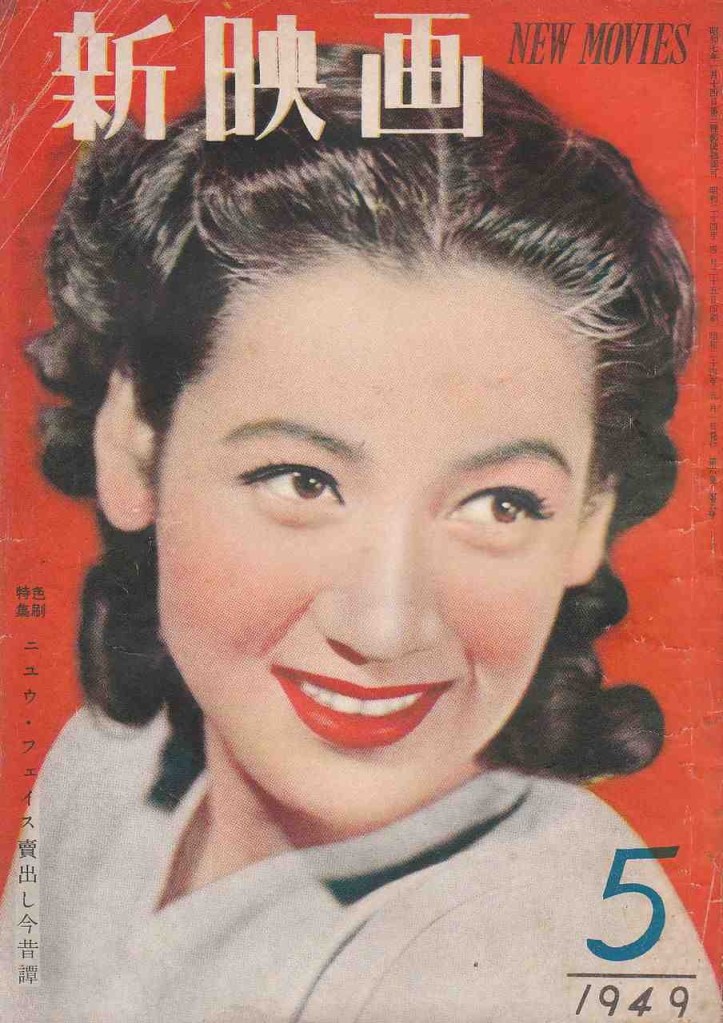
No trailer for this one, but here’s a picture of Setsuko Hara on the cover of Shin Eiga magazine in 1949 (which is a publication I can’t seem to find out much about). Btw, this is another one with a Kaneto Shindo script!

setsuko hara

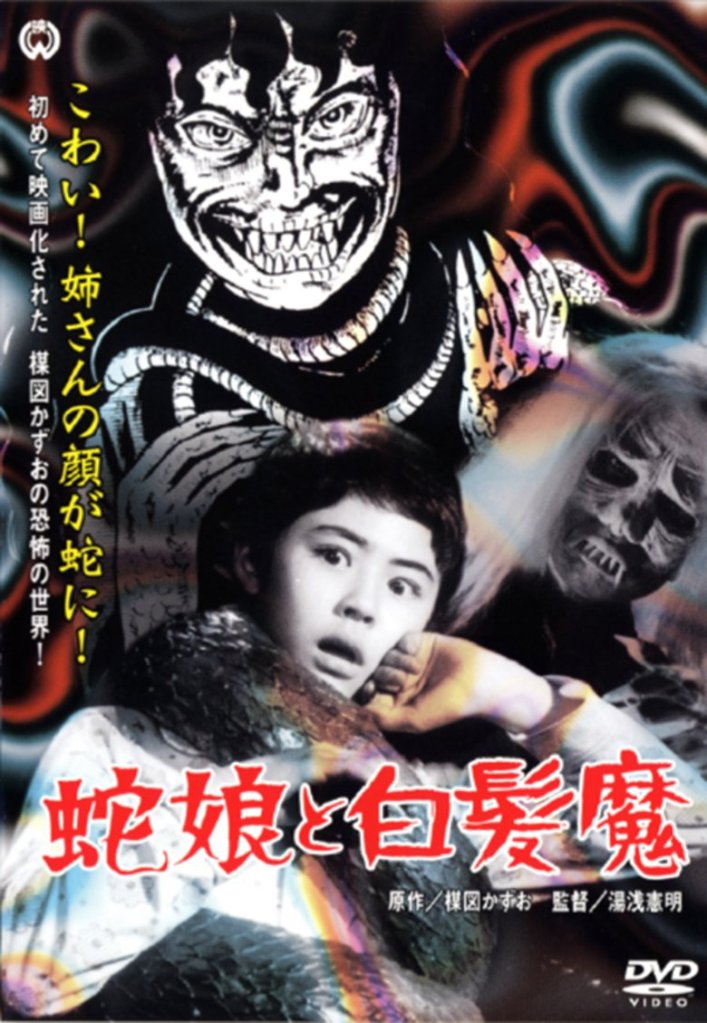
The Snake Girl and the Silver-Haired Witch (蛇娘と白髪魔, Noriaki Yuasa, 1968)

snake girl and the white haired witchLittle Sayuri has had it pretty tough up to now growing up in an orphanage run by Catholic nuns, but her long lost father has finally managed to track her down and she’s going to able to live with her birth family at last! However, on the car ride to her new home her father explains a few things to her to the effect that her mother was involved in some kind of accident and isn’t quite right in the head. Things get weirder when they arrive at the house only to be greated by the guys from the morgue who’ve just arrived to take charge of a maid who’s apparently dropped dead!

If that weren’t enough her “mother” calls her by the wrong name and then dad gets a sudden telegram about needing to go to Africa for “several weeks” to study a new kind of snake! On her tour of the house, Sayuri finds a room full of snakes, reptiles and insects (and also for some reason a large vat of acid?!) as well as a room with a buddhist altar where the food seems to disappear just as if Buddha himself were really eating it. Eventually, Sayuri is introduced to her secret sister, Tamami, who has slight facial disfigurement and a wicked disposition which has seen her locked away from view for quite some time…..

Based on the manga by Kazuo Umezu, Snake Girl and the Silver-Haired Witch (蛇娘と白髪魔, Hebi Musume to Hakuhatsuma) is, apparently, aimed at a younger audience which explains its child’s eye view of events but the film makes no concessions to the supposed softness of little minds. With a host of surreal imagery including dream sequences full of creepy, hypnotic spirals, and moments of shocking violence such as a large frog being suddenly ripped in half right in front of Sayuri’s eyes the film certainly doesn’t stint on blood, horror and general freakiness.

Sayuri herself seems largely unperturbed by these strange goings on outside of her nightmarish serpentine visions. She seems to have been well cared for at the orphanage and is happy to have found her family rather than just to be escaping the institution. On getting “home” she does her best to fit in right away, acting politely and trying to bond with her mother even in her confused state. She even tries to get on well with her mysterious sister despite the ominous warning to keep her very existence a secret from her father. Tamami, however, is a nightmare child with homicidal tendencies who isn’t interested in playing happy families with the girl who’s come to usurp her place in the household.

There’s a little more to the set up than just snake based horror (the clue being the Silver-Haired Witch of the title) but the secondary message seems to be one of remembering that the true beauty of a person lies not in their external appearance but in the goodness of their soul. The previously deformed Tamami is later said to be looking sweeter after having “redeemed” herself and Sayuri pledges to honour Tamami’s sisterly sacrifice by always remembering to hold fast and true to the beautiful things in her own soul without being swayed by worldly charms.

Snake Girl and the Silver-Haired Witch is more of a psychological horror tale than some of the effects laden efforts of the period. However, there are a fair few practical effects on show most notably during the dream sequences – one of which sees Sayuri actually fighting a giant snake with a sword, as well as the creepy spirals and the appearance of weird vampire-like snake women, dancing oni masks and the Silver-Haired Witch herself.

A children’s film that no one in their right mind would actually show to a child, Snake Girl and the Silver-Haired Witch is a freakishly psychological horror show seen through the eyes of a little girl. Part dreamscape and part terrifying reality, the film mixes the real and the imagined with a fiendish intensity and it just goes to show that sometimes you really do need to pay attention to the strange fancies of intrepid young ladies.


This trailer doesn’t have any subtitles but it is actually quite scary…..

https://www.youtube.com/watch?v=rLtwDVvTtA8

Invisible Man Appears (透明人間現る, Nobuo Adachi, 1949)

Invisible man appearsReleased in 1949, The Invisible Man Appears (透明人間現る, Toumei Ningen Arawaru) is the oldest extant Japanese science fiction film. Loosely based on the classic HG Wells story The Invisible Man but taking its cues from the various Hollywood adaptations most prominently the Claude Rains version from 1933, The Invisible Man Appears also adds a hearty dose of moral guidance when it comes to scientific research.
Once again the action centres around an esteemed chemist, Professor Nakazato, who has been working on a serum to render living things invisible. So far he has a sample which works on animals but is reluctant to move on to human testing as A) he hasn’t found a way to reverse the procedure, and B) there are some unpleasant side effects in which the subject becomes increasingly violent and irrational. The professor currently has two top students who are helping him towards his goal and, inconveniently, both have taken a shine to his daughter, Machiko. Half joking, the professor remarks that whoever can solve the problem first will win his daughter’s hand.

A business associate of the professor, Kawabe, is also interested in Machiko and also in the rights to the professor’s important new discovery. The professor, however, is a responsible man and refuses to sell it in case it falls into the wrong hands. Shortly after the professor is kidnapped by a gang of armed thugs who plan to use the serum to steal a set of diamonds known as The Tears of Amour.

There’s plenty of intrigue with various twists and turns to the original story which keep the viewer on their toes as they try to figure out who exactly is the invisible man and what he’s really after. Actually, the solution is sort of obvious and heavily signposted but that doesn’t make it any less fun. Kawabe is a moustache twirling villain from the get go and it’s obvious he has various things going on in the background but there’s more to the story than a greedy business man trying to manipulate everyone around him for his own gains. There’s also an interesting subplot in which the younger sister of one of the scientists is a top actress at the Takarazuka Review and turns out to have a connection to the Tears of Amour.

All of the classic B-movie hallmarks are here from the slightly ridiculous sci-fi jargon to the classic women in peril shenanigans as the serum starts to take hold and the Invisible Man becomes increasingly paranoid. There’s nothing good or bad but thinking makes it so – so it would be for science as far as the film is concerned. According to the message at the film’s beginning and end, there is no scientific discovery which is innately “evil” but each is apt to be misused. It’s not difficult to see why this would be a popular, even essential, message in the Japan of 1949 and indeed it recurs in many films of this type including, of course, the original Godzilla. The professor takes responsibility for having invented something which, although not created with evil intent, has wrought such destruction on society but finds himself with nothing left to do other than apologise.

Director Nobuo Adachi uses a lot of classic silent cinema techniques such as dissolves and montages with a fair amount of handheld camera and some location shooting (though the majority of the film is studio bound). The special effects were supervised by Eiji Tsuburaya who would later become the founding father of tokusatsu and co-creator of the Godzilla franchise and are top notch for the time period. An enjoyably silly B-movie, The Invisible Man appears is a well crafted addition to the Invisible Man corpus and a fantastic example of Daiei’s post-war genre output.


Original trailer (English subtitles) – I wish all trailers were this much fun!

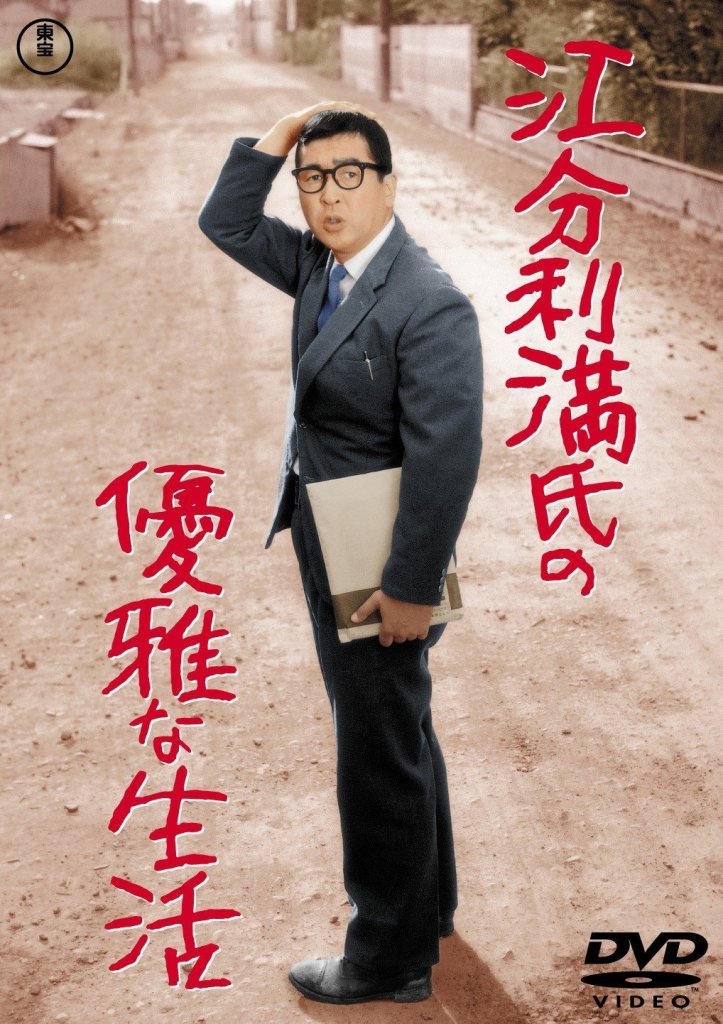
The Elegant Life of Mr. Everyman (江分利満氏の優雅な生活, Kihachi Okamoto, 1963)

81zKsQWUtKL._SL1442_Kihachi Okamoto might be most often remembered for his samurai pictures including the landmark Sword of Doom but he had a long and extremely varied career which saw him tackle just about every conceivable genre and each from his own characteristically off-centre vantage point. The Elegant Life of Mr. Everyman (江分利満氏の優雅な生活, Eburi Man-shi no Yugana Seikatsu) sees him step into the world of the salaryman comedy as his hapless office worker reaches a dull middle age filled with drinking and regret imbued with good humour.
The film opens with an exciting, strangely edited setup of young people having fun singing, dancing and playing sports on a rooftop while a middle aged man sits apart from them looking gloomy with his head in his hands. Eburi is a depressed ad exec who laments that nothing really interests him anymore. It’s all so crushingly dull that he’s taken to drink, only he’s not very good at it so no one wants to join him. When Eburi drinks, he tends to go off on long and often non sensical rants which is probably quite funny for the first half hour but perhaps less so at 3am. One day he runs into some people from a magazine and gets so roaring drunk that he accidentally promises to write them the best magazine serial they’ve ever seen. Only problem being Eburi’s a copywriter, not a novelist, so he’s no idea what he’s doing. Going with “write what you know” he turns his everyday life into a humorous exposé of modern society and ends up becoming one of the most popular writers around.

The Elegant Life of Mr. Everyman is based on the prize winning magazine serial by Hitomi Yamaguchi which was also inspired by the author’s own life. Yamaguchi and Eburi are both of the generation who came of age around the end of the war, spared the front lines but not the post-war chaos. Somehow, they were the ones who were supposed to rebuild their nation whilst trying to make a life for themselves in the difficult post-war economic environment. Eburi spins a humorous yarn about how he ended up marrying his wife for reasons of financial necessity and the pair didn’t even get a proper honeymoon because they hadn’t bothered to book ahead so all of the inns in the resort town they ended up at were full. Eburi also lost his job twice when the companies he worked for went under and seems a little mystified that he has this pretty good position in the ad agency (even if he doesn’t like it much and no one seems to think he’s very good at it).

There’s an awful lot of social comedy here as the Eburis try to lead their “elegant” lifestyle on his relatively modest salary. The family – Eburi, his wife, son, and father, all live in “company accommodation” which is a complex of small homes where all the employees live close to each other. Eburi’s neighbour works in his office and is a much younger man who’s been married for six months and, in contrast to Eburi, comes straight home at 6pm to have dinner with his wife whom he adores. Eburi is wearing army surplus suits, cheap underwear from the thrift store and a vest which is full of holes in contrast to his neighbour who is wearing swanky sports underwear and fashionable outfits including unshined shoes – unthinkable to Eburi (though his own footwear is in such a state that the shoeshine boys send him packing). Eburi’s wife is also quite excited when she realises their garden might just be a little bigger than next door’s, something which also gives Eburi a lot of pleasure.

In keeping with the source material, Okamoto opts for a first person narrative style with Eburi narrating his life in the manner of his book only employing a fair few other devices in addition to the wild and radical editing. When Eburi goes further back into the past to tell the story of how his no good father became a rich man by exploiting the populace during the years of militarism, the film suddenly becomes a chaplin-esque silent comedy complete with over emphasised acting and pantomime-like painted sets before turning into a full on cartoon. He mixes montage with onscreen graphics which appear way ahead of their time considering this is a film from 1963 and a fairly mainstream comedy at that.

The Elegant Life of Mr. Everyman is also extremely funny. Obviously owing a lot to its source material, the script is one of the wittiest ever written and even if it’s talking about early 1960s social mores, the humour has barely dated at all. Much of the success of this is owed to the committed performance of the leading man, Keiju Kobayashi, who is able to give Eburi a sort of soulful weariness as his cynical rants take on an odd quality of warmth, appearing both strangely energetic and endlessly tired.

Whatever else he says and does, Eburi loves and has a duty to his family that proves extremely stressful for him as he feels the pressure to provide though he only wants the best for them (even at one point lamenting that he’s had to give up thinking about suicide because of the responsibilities he now has). These simple things must have struck a cord with the men of Eburi’s age who found themselves in a similar position of feeling eclipsed by the younger generation coupled with resentment towards their parents who had lead Japan into the folly of war and left the mess for their kids to clean up. Keenly observed, hilariously recounted and brilliantly brought to the screen, The Elegant Life of Mr. Everyman might just be one of the funniest films ever made and an unjustly neglected masterpiece of early 1960s Japanese cinema.


Reviewed at the Japan Foundation Touring Film Programme 2016 at London’s ICA 10th February 2016.

http://www.youtube.com/watch?v=20SCQYPoJ6Y


A Japanese Tragedy (日本の悲劇, Keisuke Kinoshita, 1953)

A Japanese Tragedy 1A Japanese tragedy, or the tragedy of Japan? In Kinoshita’s mind, there was no greater tragedy than the war itself though perhaps what came after was little better. Made only eight years after Japan’s defeat, Keisuke Kinoshita’s 1953 film A Japanese Tragedy (日本の悲劇, Nihon no Higeki) is the story of a woman who sacrificed everything it was possible to sacrifice to keep her children safe, well fed and to invest some kind of hope in a better future for them. However, when you’ve had to go to such lengths to merely to stay alive, you may find that afterwards there’s only shame and recrimination from those who ought to be most grateful.
After opening with a series of genuine newsreel segments overlaid with newspaper clippings which tell of nothing other than crime, corruption and suicides, Kinoshita shifts focus to our ordinary mother, Haruko, currently working in an inn. Her son, Seiichi, has something he wants to tell her and will be staying with his sister, Utako, if she’d care to call. Neither of the children seems very excited about seeing their mother and, in fact, Seiichi’s news is that he wants to be adopted into a wealthy medical family so he can eventually take over their hospital. Utako is studying dressmaking and learning English but has also developed an attraction to her married English teacher which is threatening to develop into quite a difficult situation.

Kinoshita makes it plain that everybody suffered during the war which generally brought out the worst in people and even afterwards it was every man for himself as each tried desperately to climb out of the deepening hole that was Japan’s wartime defeat. Haruko lost her husband in the conflict, leaving her alone with two young children to feed and no one to help her. She did what she had to do whether that was a spot of black-marketeering, hoarding, or even casual prostitution but she put her children first every time. Unfortunately, she also falls for some bad self serving advice from her brother-in-law who offers to take over her husband’s land and look after the children while she earns more money out of town. Of course, he didn’t exactly keep his promises and both of the children suffered as a result.

Far from feeling grateful for their mother’s sacrifice, what the children feel is a mixture of shame and resentment. They’re embarrassed by their mother’s hardline personality and rural earthiness which no longer match their postwar upwardly mobile aspirations and force them to remember the unpleasantness of their upbringing. Seiichi is particularly disgusted by his mother’s having prostituted herself, branding her a “loose woman” and calling into question her character even before the disruptive effects of the war. Utako suffered a far greater betrayal at the hands of her relatives which has coloured her entire world view and left her with nothing but lingering resentment towards the mother who placed her in this situation.

Kinoshita intercuts the present day action with completely silent scenes of the family escaping from the military police, or memories of the various traumas each of the family members encountered in the chaotic period immediately after the end of the war. We see them travel from the warm letters sent by the children to their mother which lament the way their aunt and uncle are treating them to the outright hostility of the contemporary era. Haruko may not be the easiest of women, she’s certainly had a difficult life by any standards and it’s understandable why the relationship with her children might be strained, but in this case blood is not enough to overcome all the years of hardship and neither Seiichi nor Utako is willing to fulfil their filial obligations towards their mother.

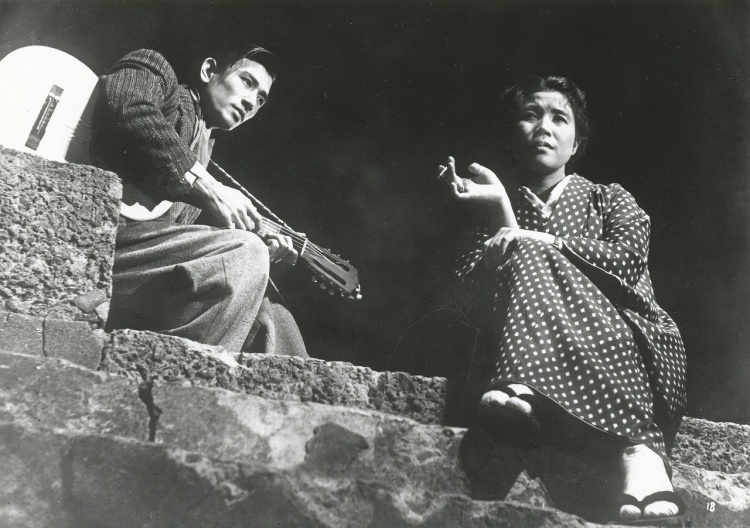
Haruko substitutes the relationship she’s missing with her own children by offering maternal advice to the chef who works in her inn and a sad wandering guitarist who often comes by to serenade the guests. Not much older than her own son, the guitarist also has a mother in the country whom he rarely sees – Haruko gives him some money that he tearfully promises to use to send his mother a present, though he confesses at the end of the film that he drank it himself in the end. He feels guilty about it and he’s moved by Haruko’s kindness towards him but in the end he’s forgotten his own mother too and even if he isn’t treating her with the same level of disdain that Seiichi and Utako display for Haruko, he isn’t doing much better in the filial piety stakes.

An extended metaphor with a series of tightly packed layers, A Japanese Tragedy is a lament for a homeland that’s lost its way. Haruko, like the idealised mother, has given her own life in sacrifice for those of her children only to find that her children disown her for it. Everything she has ever done, good and bad, has been in their name yet they refuse even to acknowledge her suffering but rather apportion blame for their own hardships. Kinoshita litters Haruko’s story with news reports bearing out the depths to which the country has fallen – corrupt politicians, rioting, violence on the streets and mothers who commit suicide taking their children with them. At a moment near the end of the film, Haruko remains motionless on the train station steps as a crowd of passengers surges past her. Left alone, uncertain, and believing herself to have lost the only thing that has ever mattered to her, Haruko becomes a casualty of a society that is so intent on marching forward that it’s lost sight of where it’s going. An enraged state of the nation address, this bleak and tragic tale is nevertheless filled with genuine human feeling and naturalistic detail which only deepen the impact of the desperately sad ending.


Opening sequence of the film:

Reviewed at the 2016 Japan Foundation Touring Film Programme, ICA 7th February 2016.


Red Pier (赤い波止場, Toshio Masuda, 1958)

Snapshot-2016-01-24 at 11_01_43 PM-1747507265Loosely inspired by Julian Duvivier’s 1937 gangster movie Pépé le Moko, Toshio Masuda’s Red Pier (赤い波止場, Akai Hatoba) was designed as a vehicle for Nikkatsu’s rising star of the time, Yujiro Ishihara – later to become the icon of the Sun Tribe generation. On paper it sounds like a fairly conventional plot – young turk of a gangster comes to town to off a guy, sees said guy killed in an “accident”, and shrugs it off as one of life’s little ironies only to accidentally become acquainted with and fall head over heals for the dead guy’s sister. So far, so film noir yet Masuda adds enough of his own characteristic touches to keep things interesting.
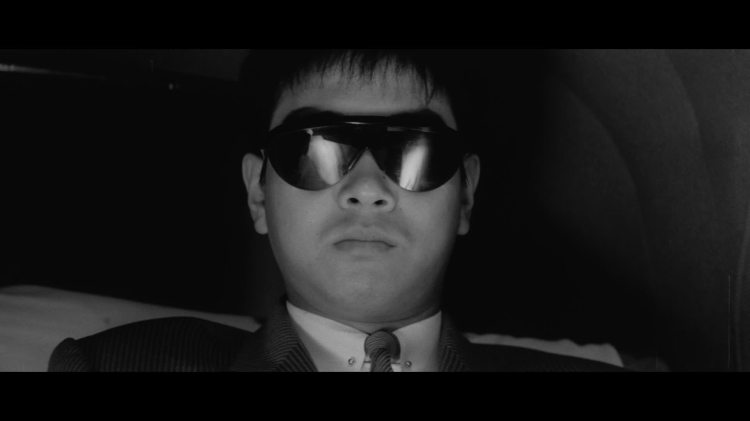
“Jiro the Lefty” (Yujiro Ishihara) is a sharp looking petty yakuza type in a bright white suit and sunglasses. Another of Japan’s post-war abandoned street kids, he found a home in a gang and has never known anything one could call a “normal” way of life. Other than his obvious talent with a gun, he has a cheerful and ironic personality that has him even almost respected by the police and is generally well liked in the area.

Early on Jiro rescues a little boy from almost being hit by a car and later when playing the harmonica for him gets hit by a thunderbolt of love when catching sight of the boy’s aunt, Keiko (Mie Kitahara). This causes him several problems at once: to begin with, she’s the sister of the guy he saw get hit by a crane and she doesn’t seem to know her brother was a gangster, two – Keiko is obviously of a much higher social class and a little out of his reach even if he managed to go straight, three – he can’t go straight, he doesn’t know how to do anything else, four – Mami, his current nightclub dancer “girlfriend” who’s invested a little more in the relationship than he has. Actually this is only the start of a long list of problems Jiro has to deal with, he just doesn’t know about them yet.

The story is set around the docks of Kobe where the living is hard and life is cheap. The local policeman is a fairly laid-back, ironic chap who’s made an odd sort of friendship with Jiro wherein he doesn’t really want to see anything too bad happen to him. He can see this thing with Keiko is not a very good idea and is constantly lurking in the shadows trying to control the situation as much as he can. Jiro, doesn’t know it yet but his own guys are out to get him too and after one of his sworn brothers ends up paying the price for Jiro’s rising profile in the yakuza world, he finds himself on the run from pretty much everyone.

This sounds like quite a complicated set up but Masuda manages to martial everything into a coherent order and even adds a hearty dose of realistic emotion too. As far as the aesthetic goes, Masuda takes his cues from American film noir with harsh lighting and canted angles all employed to show us the crookedness of this underground world but he also makes sure to add occasional touches of artistic flair such as the light bouncing off Jiro’s sunglasses during a night time cab ride or the sheer shock on Ishihara’s face as he first sees Keiko framed against the bright sunshine of Kobe’s harbour.

The too noble for his own good gangster who wants to go straight but knows he has a crooked heart – it’s an old story, but a good one. Red Pier pushes a lot of these ideas to the max but handles them well and adds a traditional “crime doesn’t pay” ending which is both endlessly sad and completely appropriate at the same time. You can’t help feel for Jiro and his small scale existential crisis in which the reluctant gangster wants to jump ship for more peaceful climes but can’t for both personal and societal reasons. Red Pier may not be the best Masuda/Ishihara collaboration but it is certainly an excellent example of everything its genre has to offer.


Red Pier is the Second film included in Arrow’s Nikkatsu Diamond Guys Vol. 1 collection.

http://www.youtube.com/watch?v=JppZs7c9AIY

Voice Without a Shadow (影なき声, Seijun Suzuki, 1958)

Snapshot-2016-01-24 at 10_45_06 PM-571365520
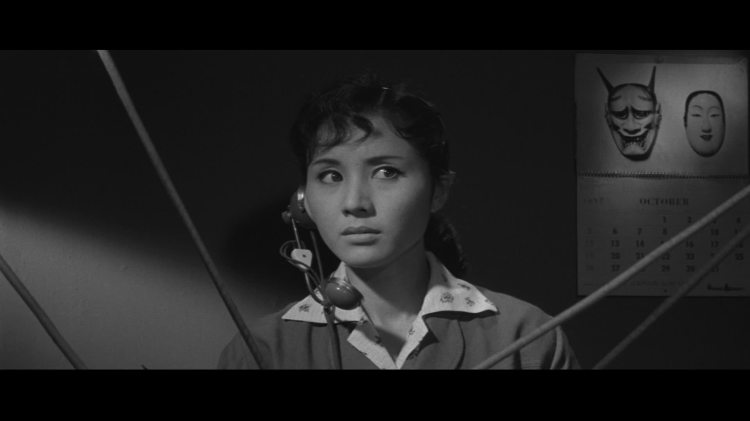
Make friends with this Oni mask – you will be seeing a lot of him throughout the film.

Seijun Suzuki might be best remembered for his surrealist pop art masterpieces from the late sixties or his even less comprehensible art films which followed his return to directing after settling his dispute with Nikkatsu, but everyone’s got to start somewhere and it comes as something of a relief to know that Suzuki was perfectly capable of making a straightforward movie if he wanted to. Voice Without a Shadow (影なき声, Kagenaki Koe) is exactly what it sounds like – a fifties style, US inspired noir however, Suzuki adds his usual flourishes and manages to wrong foot us pretty much the whole way through so that we never end up where we thought it was that we were going.

To begin with, our story is fairly straightforward. Reporter Ishikawa (Hideaki Nitani) provides our film noir style voice over as switchboard operator Asako (Yoko Minamida) accidentally dials a wrong number only have it picked up by a strange man who tells her she’s rung a crematorium then laughs hysterically. It turns out that the number was actually for a pawn shop which was in the process of being knocked over and the owner killed – Asako heard the perpetrator’s voice and thanks to her switchboard experience isn’t going to forget it. Ishikawa grows closer to Asako as the case becomes a media sensation but backs off after learning she’s already engaged.

Three years later Asako hears the voice again – a friend of her husband’s who keeps co-opting their living room for mahjong games that go on for days and cost everyone but him a lot of money. Before long Hamazaki (Jo Shishido) is found dead and Asako’s husband is the prime suspect but did he really do it? And if he didn’t, does Ishikawa really want to find out who did?

As you can see it’s a story that wouldn’t be out of place in any B movie noir from the fifties and the telephone set up is even a little reminiscent of Sorry, Wrong Number (though that film has a very different conclusion indeed). Based on a short story by Seicho Matsumoto, Voice, Voice Without a Shadow is full of the classic play of light and shadow that characterises the best film noir and the mood is ably supported by a suitably jazzy score from Hikaru Hayashi. If there’s a criticism to be made in this area, it’s that Nitani’s Ishikawa is a little too nice and pure hearted in comparison to the broken hearted heroes from the detective serials. He seems content to try and help Asako whilst uncovering the truth even if it ends up costing him in the end.

Although Asako herself is technically the leading character she quickly gets relegated to a more conventional woman in peril role. She is the one who recognises Hamazaki’s voice and the only clue linking him to the pawn shop murder three years ago but, while he’s alive anyway, Hamazaki is more interested in having fun terrorising everyone rather than trying to rub her out. In fact, the sudden demise of Hamazaki, played by an extremely young Jo Shishido, is one of the most surprising things about the film in which you’d expect him to remain the central antagonist right up until the grand finale.

Voice Without a Shadow is then a fairly conventional, noir inflected B movie which wears its Hollywood influences on its sleeve. However, there are glimpses of Suzuki’s individual style leaking through such as in his occasional and surprising use of double exposure, innovative composition and other modernist techniques which all help to lift the rather workmanlike script onto another level. In someways, it’s all a little too nice – even Hamazaki’s nasty lowlife activities are neatly skirted around almost like a film noir that’s been through a car wash though its strange pleasantness also has a nicely refreshing quality.

A minor film from the master of the surreal then, but an interesting one none the less. The mystery element proves satisfying even if it could do with a little more dirt under its fingernails and the committed performances also do their bit to enhance the mood. A prime example of its genre, Voice Without a Shadow is a notably restrained entry in Suzuki’s back catalogue but its classical style mixed with an offbeat, absurdist undercurrent make it one worth seeking out.


Voice Without a Shadow is the first film included in Arrow’s Nikkatsu Diamond Guys Vol. 1 collection.