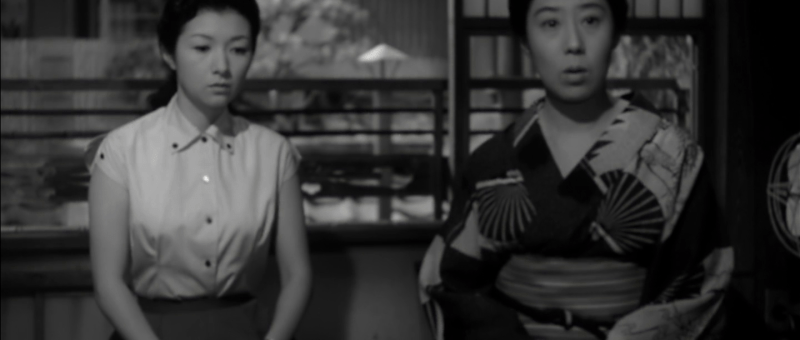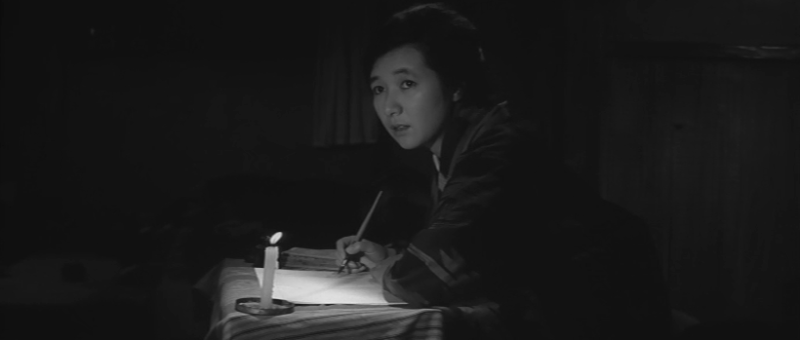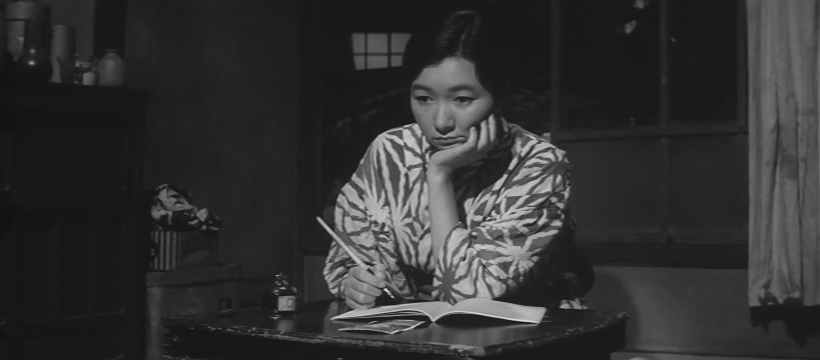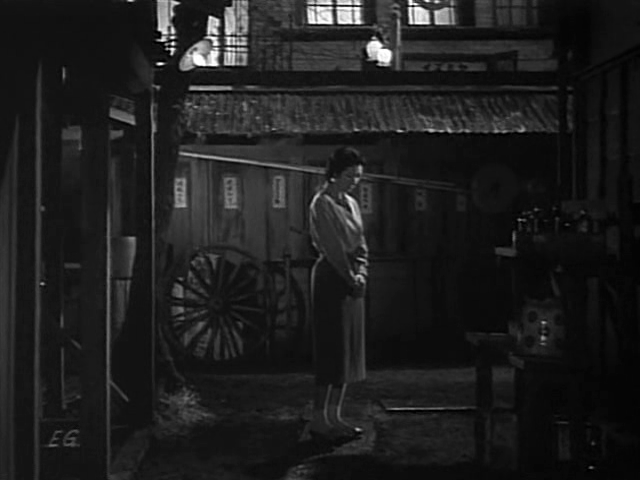
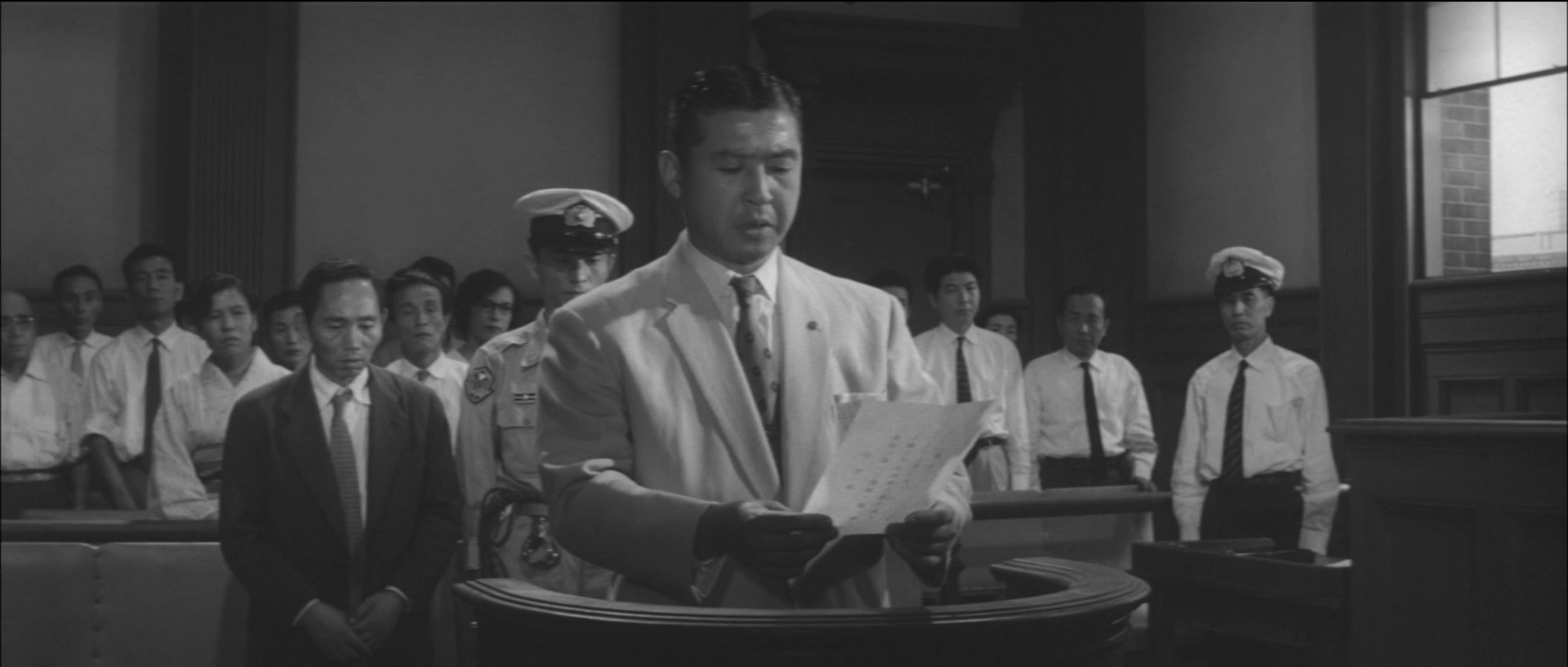
Procurer of Hell (地獄の饗宴, Kihachi Okamoto, 1961)

By 1961, the Japanese economy had largely recovered and the nation was emerging into an era of rising prosperity, but there were also those who were left behind or could progress into the new Japan. Shot with Okamaoto’s trademark irony, Procurer of Hell (地獄の饗宴, Jigoku no Kyoen) is a darkly comic tale of one such man who could have quit while he was ahead and started a new life if only he hadn’t been so greedy or perhaps so hung up on revenge. 

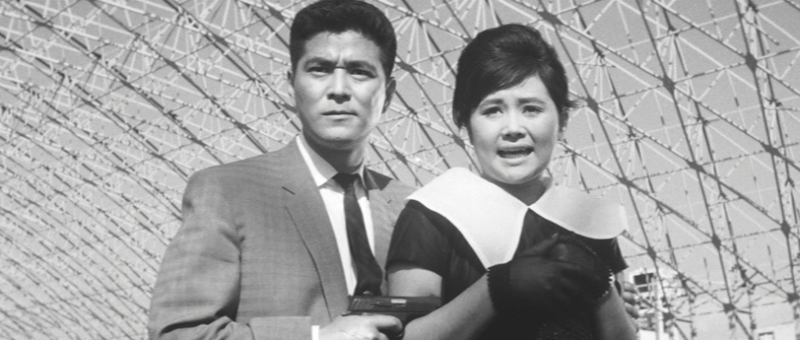
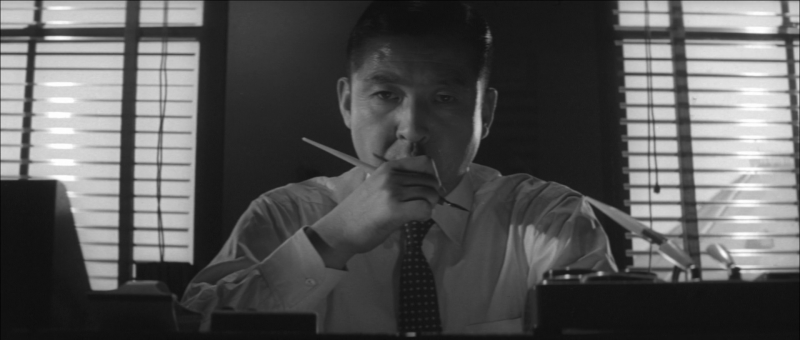
In a sign of the newly international society, Tobe (Tatsuya Mihashi) runs a shady business that claims to provide “English lessons” with blonde women are that are in reality appointments with sex workers. He also peddles pornographic images and dabbles in blackmail. When he finds a roll of film at the station, he gets it developed and discovers it contains photographs of his sergeant during the war, Itami (Jun Tazaki), who raped the Chinese woman he wanted to marry back in Manchuria. Tobe was unable to help her after getting his hand impaled on a tree branch from which he could not free himself. The scar he still bears on his hand is a mark of his corruption and a reminder of the moment which seems to have soured him on humanity and turned him into a cynical and amoral man. He decides to use the photographs to torment and blackmail Itami to get the money to help a widowed single mother he’s interested in secure a better future for herself by taking over a coffee shop from the owner who plans to retire.

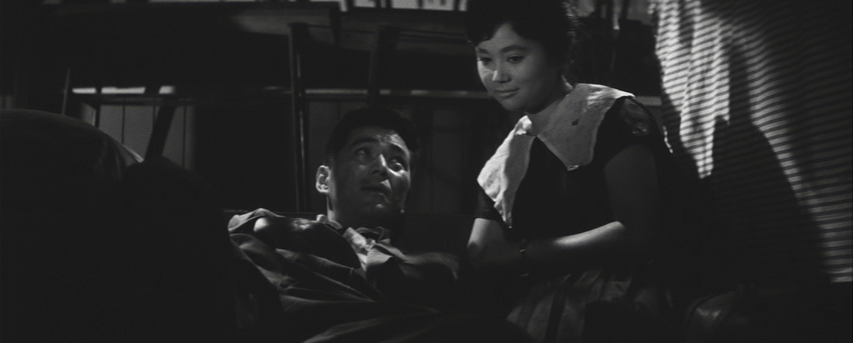
As such, he does it for “good” reasons and Kazuko (Junko Ikeuchi) and her son Saburo represent for him a better future in the new Japan in which he would own a photo studio and live a law-abiding life. Saeko (Reiko Dan), Itami’s secretary with whom he was also having an extra-marital affair, is in other ways his opposite number and the representative of the dark side to which Tobe is drawn. Like him, she tries to play the situation to her advantage by playing the innocent before finally throwing her lot in with Tobe and suggesting he help her double-cross Itami so they can run off with the money he embezzled from his company before faking his own death in a convenient train crash. That Tobe extracts sexual favours from Saeko in return for giving her the photos and negatives interferes with the supposed nobility of his quest and apparently pure-hearted love for Kazuko and her little boy, while Saeko gradually shifts from exploited victim to calculating conspirator manipulating Tobe just as he believes himself to be manipulating her.

In any case, it remains true that he could have just settled for the money he needed for the cafe and walked away from this overly complicated situation involving Itami’s legal wife and associates who have actually embezzled the money and want the pictures back because they need Itami to be dead for their plan to work, but he doesn’t. He becomes fixated on getting his fair share of the ill-gotten gains much more than helping Kazuko or getting his revenge against Itami, which wasn’t really much of a revenge anyway considering what Itami had actually done during the war. But on the other hand, Itami seems to have become a rather powerless figure having married into his wife’s family to work in their business while she plots to have him confined to a psychiatric hospital to keep him out of her way. Saeko too is manipulating him. She has no real feelings for Itami and only wants the money, masterminding this whole scheme to get her hands on it with no intention of fleeing abroad with him. Similarly, she plays the victim with Tobe, telling him that Itami paid for her brother’s school fees and that she wants the photos back to avoid her brother or Mrs Itami finding out it about it and feeling hurt.

But while they’re fixating on the 150 million yen embezzled from the business, there are crowds of angry people turning up at the building society Itami runs complaining that their savings have disappeared and wanting to know if they’re going to get the houses they’ve been promised. Tobe walks through the May Day protests calling for better working conditions and higher wages, pointing to the ways this society is still veering off course in deliberately leaving some-people behind by rooting the new economic prosperity in exploitation. Tobe’s assistant wants to join the protest, but Tobe tells him they don’t really belong with the workers because of their nature of their business. The blackmail scam is his revenge not only on Itami but on everything that’s happened to him since the war and this ridiculous post-war society that he nevertheless hopes to join through these immoral means. The song of the canary he buys for Saburo begins to haunt him as a symbol of the wholesome life he might lead, but that life cannot really be won that way. He and Saeko are really two of a kind, she apparently brought low by her unexpectedly genuine feelings for him as even the police, picking him up for something else, leave them bleeding in the street surrounded only by emptiness and futility mere feet from the hospital in their own relentless pursuit of the “real” criminals.


Husband and Wife (夫婦, Mikio Naruse, 1953)

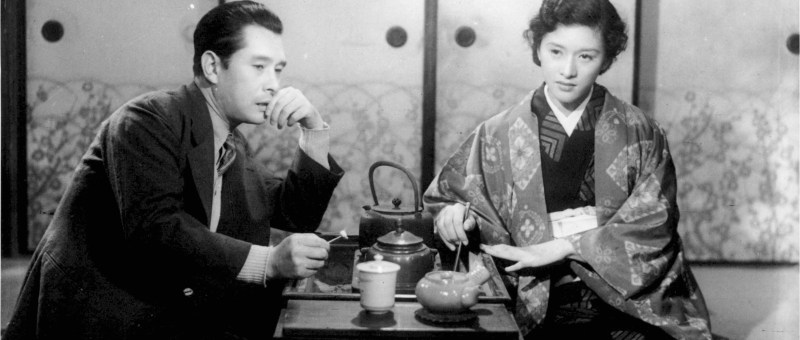
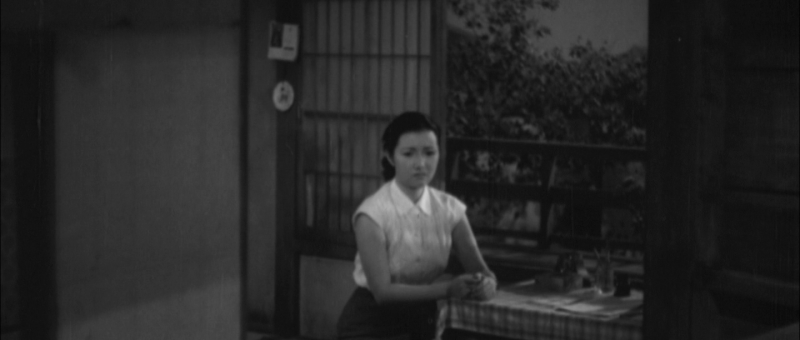
Kikuko (Yoko Sugi) climbs the stairs to the roof of a department store and pauses at the top looking down on her friends below, but they appear to be looking down on her. They’re disappointed. She looks so “provincial”, even though she has no children and therefore more time to spend on herself. They’re envious of her “freedom” to return home late while they have to get back to their husbands or in-laws, but Kikuno isn’t really free at all while trapped in a stifling marriage to the incredibly dull and petulant Isaku (Ken Uehara). 

One of a series of films about marriage and originally envisaged as a sequel to Repast until Setsuko Hara fell ill, Husband and Wife (夫婦, Fufu) paints a rather bleak picture of married life even by Naruse’s standards. The couple are quite literally but also spiritually “homeless” in that they cannot find a home to share, while the absence of a domestic space to call their own prevents them from solidifying their marriage. They’re pushed out of Kikuko’s parents’ home because her brother’s getting married and they need the space, but Isaku drags his feet over finding somewhere else and leaves much of the legwork to Kikuko alone. The main problem seems to be that Isaku can’t afford anything decent, which places a strain on his male pride, but in a repeated motif, rather than confront the situation, he ignores it completely and then crassly presses his recently widowed colleague to let them rent a room in his now much emptier house. 

It’s a mystery why Isaku has so many financial problems when he and Takemura (Rentaro Mikuni) work for the same company, save that Isaku had evidently spent some time working in the provinces, and his colleague had already bought a home with no apparent money worries, but it further sets the two men apart and fuels Isaku’s sense of inadequacy. Having returned from a leave of absence following his wife’s death, Takemura is grief-stricken and apparently uxorious. He complains that he’ll never find another woman like his late wife, all while Isaku won’t shut up about the house and others relentlessly encourage him to remarry. Nevertheless, after the couple move in with him, a natural connection arises between Kikuko and Takemura who is Isaku’s total opposite, both in his treatment of Kikuko and general personality. Where Isaku is sullen and resentful, Takemura is cheerful despite his grief and generous of spirit. Kikuko effectively becomes a wife to both men, taking care of each of them by cooking and cleaning, but while Takemura goes out of his way to thank her, all Isaku does is run her down and humiliate her in front of company.

Then again, having fallen in love with Kikuko precisely because she is a “proper wife,” Takemura then runs his own late wife down by complaining that she wasn’t very pretty and couldn’t cook. The only thing she had going for her was her health, and then she died. He says got a bum deal, and that Kikuko has shown him a different side of womanhood. When two colleagues come to the house and compliment Kikuko’s cooking but are surprised when she eats nothing herself (because they have no money), Isaku responds to their assertion that it’s difficult to be a housewife by replying that men work hard all day while women “only” have to look after the house. For her part, Kikuko says that she was happier when she was working. Men can fall in love several times, but once a woman’s married her romantic life is over. As her friend tells her, men soon get bored of their wives and hers has already taken a mistress at work. 

At several points and with the women in earshot, the men warn each other about the pitfalls of marriage. Irritated that Kikuko has returned to their home on New Year’s Eve after becoming fed up with Isaku, her father advises her brother that women show their true faces after six or seven years and it’s going to horrify him. Isaku tells him not to be too nice or obedient during the early days because his wife will get used to it, while Kikuko counters that men are overgrown children and as long as you make sure to cradle them like babies everything will be fine. Neither of them seem to have a very positive idea of what marriage should be and frame it almost in terms of a war in which they are continually at odds with each other. Isaku describes a husband and wife as a pair of scissors, intending it as a positive metaphor about how one half can’t cut alone, before reframing it as two knives coming together. He becomes unpleasant and chauvinistic, blaming Kikuko for everything by complaining that it’s her fault that he wears a torn up old coat that causes him some embarrassment in front of his boss and a tactless geisha, while criticising her for not having the bath ready when he comes home tired from working all day. Kikuko points out that men seem to assume they’re the only ones who get tired while her loved up brother swears he’ll be different and even if they’re in the honeymoon phase, they do seem much happier and more suited than the already resentful Kikuko and Isaku.

It’s the sister-in-law who throws them a lifeline by introducing them to a relative looking to rent a vacant room, allowing them a means to save their marriage by leaving Takemura’s house. Increasingly resentful of the growing attachment between Kikuko and Takemura, Isaku starts avoiding coming home and hanging out with a young woman at the office with, at least, the danger of a burgeoning affair for which he’s taken to task by Takemura. As Takemura says, it’s not much of a marriage if Isaku can’t trust his wife while Kikuko is eventually so sick of the cold shoulder and constant denigration that she considers leaving him. The new apartment finally gives them a domestic space they can call their own, but it comes with the caveat. The landlady doesn’t allow children because the tenant next door is an ikebana teacher who demands peace and quiet, but Kikuko is in fact already pregnant which might present another means of saving their marriage by becoming a family but Isaku immediately rejects it. He complains he doesn’t have any more money to move again and tells Kikuko to get an abortion, strong-arming her when she refuses. Kikuko can’t go through with it and the nicest thing Isaku says to her in the entire picture is that they can go home, he’s giving in and will raise the child even if it’s difficult. But even this bittersweet moment seems more like condemning them to marriage rather than repairing their relationship with Isaku only grudgingly accepting, most likely because he realises that his marriage is dead anyway if he forces Kikuko to give up their child against her wishes. Despite the changing season, the air between them remains frosty, and marriage is exposed for the prison that it is trapping each of them in loneliness and resentment rather than bringing them together in joy as they prepare to become a family rather than just husband and wife.


Husband and Wife  screened at Japan Society New York as part of Mikio Naruse: The World Betrays Us – Part I.

Lightning (稲妻, Mikio Naruse, 1952)

In many ways despite its matter of fact bleakness, Lightning (稲妻, Inazuma) is among the more optimistic of Mikio Naruse’s films ending on a note of cheerfulness and hope in which the storm has been broken and the heroine seems to have rediscovered a sense a faith in humanity. Yet the attitudes she displays are often contradictory and firmly at odds with the kind of Shitamachi spirit one might find in the films of a director such as Yoji Yamada in films like The Sunshine Girl released a decade later.

The qualities that most define Kiyoko (Hideko Takamine) are, as her mother Osei (Kumeko Urabe) suggests, an inner strength that eludes her older sister Mitsuko (Mitsuko Miura) and a forthrightness that sees her struggle to pursue the kind of life she wants rather than that she is expected to lead. Yet some might see her as snobbish and judgemental, at times attacking her mother for having married four times and given birth to four children each with different fathers. In this she sees a particular moral failing on the part of Osei, but perhaps also expresses a deeper distrust in her mother’s repeated attempts to find stability only through harnessing herself to a man. 

Echoing Takamine’s role in Hideko the Bus Conductor, Kiyoko has a job as a tour guide showing off the sites of bustling Ginza though explaining that this part of the city only really comes alive at night. The job gives her a sense of independence and self-sufficiency a woman in this era is not really permitted to have. Her oldest sister, Nui (Chieko Murata), asks if she contributes to the household but the meeker Mitsuko replies that she wanted to but they told her to save her money instead. In any case, it’s towards marriage that she’s pushed when Nui attempts to play matchmaker brokering an engagement with a 35-year-old baker, Goto (Eitaro Ozawa), who has aspirations of opening a love hotel into which Nui and her feckless husband Ryuzo (Kenzaburo Uemura) have invested. Of course, it turns out that Nui is herself having an affair with the baker who is oily in the extreme and disliked by most of the family though eventually manages to make his way into the beds of two of the sisters.

Kiyoko has little desire to marry and asks her mother if any of her four marriages made her happy, but her mother only says that happiness is not an important concept hinting the hardship she’s faced in her life and that a woman of her generation may have had to put up with a certain of degree dissatisfaction to keep a roof over her head and food on the table. While working on the bus, Kiyoko spots Mitsuko’s husband talking to another woman in the street but decides to say nothing only for him to suddenly die and the woman turn up with a baby asking for financial support. Kiyoko tells her sister that marriage is hell, but she smiles and says Kiyoko will be the exception in an expression of the various ways in which women enforce these arcane social codes against each other despite their own misery. Mitsuko too wants to escape but admits she doesn’t have Kiyoko’s courage which is how she too eventually falls into the clutches of Goto much to her sister’s disappointment. 

There is something undeniably poignant in Kiyoko’s frustrated defiance, looking longingly at the paintings and books of their lodger, a young woman from a more middle-class family working her way through university. Kiyoko says she wants to study too, but her mother shoots her down. She’s already 23, and it’s a little late to be picky about marriage let alone strike out for a more stereotypically middle-class life with a white collar job and nice house in the suburbs. It’s the suburbs though to which she eventually moves, without even bothering to tell any of her family. When the nice landlady asks if she has any she admits she has but also has nothing to do with them, which earns her a confused frown. She later says something similar to the pair of piano-playing siblings who live next-door in a kind of suburban utopia, quite clearly ashamed of her humble Shitamachi roots and family members she sees as common and immodest.

In any case, her admiration of the siblings and obvious attraction to the brother (Jun Negami) who is so much more sensitive and caring than her own (Osamu Maruyama) who appears to use the wartime bullets lodged inside him as an excuse not to move on with his life, suggest that she is still in the end looking for a conventional family only one she sees as more positive (or just posher). Perhaps it’s not so much marriage she rejects but dependency and subjugation, believing a marriage to a man like this might be one more of love and equality than the dissatisfying relationships experienced by her mother and sisters. The expressionistic bolt of lightning which appears during a difficult conversation with her mother is like the breaking of a storm, a kind of letting go in which her resentment begins to melt away and her mother agrees to retreat realising that unlike Mitsuko she can take care of herself and to that extent at least is an independent post-war woman. Ambivalent, but in its way warm and forgiving the film gives Kiyoko permission to embrace her aspiration, defy the social codes which constrain her and seek her own happiness, but also allows her to shed her cynicism in rediscovering a faith in humanity and re-embracing her admittedly imperfect mother all while leaving her behind. 


Flowing (流れる, Mikio Naruse, 1956)

The denizens of a moribund geisha house contemplate visions of independence in post-war Japan Mikio Naruse’s thriving ensemble drama, Flowing (流れる, Nagareru). There is indeed a flowing through the geisha house, a tumble of comings and goings though mostly connected to money which is itself constantly flowing though the for geisha mainly in the wrong direction. Released in the year of Prostitution Prevention Law, the film casts a shadow over the lives of these women who are unwittingly living in their industry’s twilight but asks if it’s really possible for a woman to survive without a man while each of them is in one way or another badly let down by an inconstant lover. 

We’re constantly told that Tsutanoya is the most respectable geisha house in town yet despite its well appointed interiors, it’s clear that business is not good. As the film opens, a young geisha, Namie, is accusing the owner’s daughter Katsuyo (Hideko Takamine) of diddling her on her pay. Katsuyo acts indignant and tries to shift the blame back onto Namie but later admits that the house has indeed been skimming a little more off their wages than was agreed claiming all the geisha houses do it which is probably true but doesn’t make it right. In any case Namie will eventually quit and end up working at “some third rate place” while her uncle (Seiji Miyaguchi) causes problems for proprietress Tsuta (Isuzu Yamada) complaining that Namie was exploited and wanting both the backpay he feels she’s owed and compensation though it seems unlikely any of that money is finding its way back to Namie. Meanwhile the house is a geisha down with only former office worker Nanako (Mariko Okada) and 50-year-old veteran Someka (Haruko Sugimura) on the books.

Despite their financial situation, Tsuta hires a new maid, Rika (Kinuyo Tanaka) who is immediately renamed “Oharu” on her arrival. Oharu is a salt of the Earth type, infinitely capable, maternal, kind and loyal bringing a much needed sense of stability to the ever flowing geisha house while also fascinated by this exotic and arcane world. But then as Tsuta cautions her geisha houses may look glamorous from the outside but the life inside them isn’t always fun. Oharu runs into trouble on her first trip to the grocers when they inform her Tsuta hasn’t paid her tab and they can’t let her add to it until she does. A 45-year-old widow whose only child died a year previously, Oharu is also trying to live an independent life, a conflicted Tsuta struck with wonder at her ability to survive without a man, but may also have struggled, grateful to have been offered the job which others might have declined because of the stigma towards the sex trade as finding employment as a middle-aged woman is near impossible. 

At the film’s conclusion even she may imply it isn’t really possible to live as a woman without some kind of support or losing one’s humanity suggesting that she may return to her husband’s hometown and the family she claims not have gotten along with after learning of Tsuta’s betrayal at the hands of an old friend and former geisha, Ohama (Sumiko Kurishima), who at any rate seems to be living quite well as the proprietress of a restaurant. Traditionally, the profession of geisha was seen as a kind of independence in itself but it’s also one that by its nature is reliant on men. Tsuta is often described as someone who is not able to do anything else yet is highly skilled at music and dance having spent a lifetime in training. Without a patron she is stuck and as we learn she threw hers over to pursue a man she loved but he left her in the lurch having mortgaged the geisha house to invest in his business by taking a loan from her older sister who seems to have a nice sideline as a polite loan shark also having loaned money to Someka. 

The most outwardly cheerful, Someka is in other ways a dark vision of a geisha’s future surviving on nothing but nihilistic hedonism while apparently living with a much younger man who eventually leaves her to marry into another woman’s family. Katsuyo has rejected the geisha life explaining that she is unable to, as Nanaka puts it, say silly things to men in order to earn her keep and is essentially incapable of ingratiating herself with men she doesn’t like. She claims she has no desire to marry, unconvinced that any man would be interested in a geisha’s daughter while certain that for a man marrying into a woman’s family is humiliating while suggesting the same would be true for her. Putting her faith in industry, she buys a sewing machine and sets about figuring out how to use it less because she envisages being able to support herself and her mother through taking in needlework than she just wants to feel as if she’s doing something. 

Meanwhile, Tsuta’s niece Fujiko observes all the comings and goings of the geisha house learning the traditional arts in preparation for a future which will soon be obsolete. In a typically Narusean touch, Tsuta comes to a resolution about her future and envisages a new beginning for herself but is unaware the rug is soon to be pulled from under her by the underhanded capitalist Ohama who plans to turf her out to turn the geisha house into another restaurant. “My days of seeking favours from men are over,” Tsuta admits, not of her own volition but simply understanding that she no longer has access to that kind of independence though in essence surrendering her autonomy in leaving herself to the mercy of Ohama in order to escape her older sister’s control. Someka had laughed raucously at Katsuyo’s insistence that she need not be dependent on a man (and after everything she’s seen why would she want to be?) but the younger woman is undeterred even as we see her struggling, doubting that her efforts will in the end be enough to win her her freedom. Ever the optimist, Tsuta is perhaps doing something similar but even Oharu is considering giving up and going home, too good to survive in the dog eat dog world of the contemporary capital where the flow of currency is the lifeblood of the city implying that perhaps the answer to her question is no, a woman can’t survive alone, nor can she rely on female solidarity, but she’ll have to try anyway because there is no other choice. 


A Wanderer’s Notebook (放浪記, Mikio Naruse, 1962)

Many of Mikio Naruse’s most famous films are adapted from the work of Fumiko Hayashi, a pioneering female author who chronicled the life of a working class woman with startling frankness. Yet his dramatisation of her life, A Wanderer’s Notebook (放浪記, Horo-ki), is both a little more reactionary than one might have expected and surprisingly unflattering even in the heroine’s eventual triumph in escaping her poverty through artistry. Even so if perhaps sentimentalising the economically difficult society of the 1920s in emphasising the suffering which gave rise to Hayashi’s art, the film does lay bare the divisions of class and gender that she did to some extent transgress in pursuit of her literary destiny. 

Naruse and his screenwriters Toshiro Ide and Sumie Tanaka bookend the the film with a literal “lonely lane” which the young Fumiko walks with her itinerant salespeople parents. As a small child, she sees her father arrested for a snake oil scam peddling some kind of wondrous lotion, setting up both her disdain for men in general and her determination not to be deceived by them at least unwittingly. She has no formal education but is a voracious reader well versed in the literary culture of the time and intensely resentful of if resigned to her poverty. In the frequent sections of text which litter the screen taken directly from her novels, she details her purchases, wages, and longing for the small luxuries she can in no way afford. 

As an uneducated woman in the 1920s her working opportunities are few. She exasperatedly relates standing in a queue with hundreds of other women waiting for an interview for a company job only to be told they’ll let her know, while her other opportunity involves meeting a theatre director at a station who later takes her to his hotel/office and makes it plain he’s not really interested in her CV. She gets a job at the office of a stockbroker, but lies about being able to do accounts and is flummoxed by double entry bookkeeping getting herself fired on day one. After a brief stint in factory painting toys, she leaves with a friend to become a hostess but is also fired on her first day for getting drunk and being unwilling to ingratiate herself with the boorish men who frequent such establishments. 

Despite her animosity, she is drawn towards men who are callous and self-involved, firstly taking up with a poet and actor who praises her work but turns out to have several “wives” on the go, and then begins living with a broody writer, Fukuchi, who is insecure and violent, resentful at her success in wake of his failure. Perhaps because of her experiences, she seems to resent any hint of kindness though sometimes kind herself, lending money to her friend whose mother is in need and often ready to stand up for others whom she feels are being mistreated. A kindly widower in the boarding house where she lives with her mother, Yasuoka, falls in love with her but she repeatedly rejects him partly as someone suggests because he is not handsome, but mainly because of his goodness and kindness towards her. Nevertheless, he continues to support always ready in her time of need though having accepted that she will never return his feelings or accept his proposal. 

Perhaps her might have liked to have been kinder, but was too wounded by her experiences to permit herself. In any case at the film’s conclusion in which she has achieved success and in fact become wealthy it appears to have made her cold and judgemental. She instructs her maid to send a man away believing he is from a charity set up to help the poor, insisting that the poor must work for industry is the only path out of poverty implying that as she managed it herself those who cannot are simply not applying themselves when she of all people should know how fallacious the sentiment is. As if to bear out the chip on her shoulder, she forces her mother to wear a ridiculous kimono from a bygone era that is heavy for an old woman and makes her feel foolish because of her own mental image of the finery she dreamed of providing her on escaping the persistent hardship of their lives. 

As she says, she’s no interest in the socialist politics espoused by the literary circles in which she later comes to move, pointing out that the poor have no time for waving flags. One of her greatest supporters is himself from a noble family despite his progressive politics and in truth can never really understand the lives of women like Fumiko. He describes her work as like upending a rubbish bin and poking through it with a stick, at once fascinated and repulsed by a frankness he may see as vulgar. At one point he accuses her of writing poverty porn, playing on her humble origins for copy and becoming something of a one note writer. 

In truth, the film is not really based on the novel from which it takes its title but on the play that was adapted from it, while the novel itself was apparently reworked and republished several times in response to reader taste giving rise to a series of questions both about its essential authenticity and what it was that it was attempting to convey. In the film at least, moments after her literary success, Fumiko is challenged by a fellow female writer, Kyoko, who was once her love rival, that she cheated in a contest by failing to submit Kyoko’s entry until after the deadline had passed, though as it seems she would have won anyway. She is occasionally underhanded, perhaps because she feels she has no other choice, but then as we can see there is no particular solidarity between women save the kindly landladies who often let her delay her rent payments. Fumiko feels herself to be alone and her quest is not really for literary success but simply for her next meal, though she feels the slights of the bitchy women and arrogant men who mock her commonness while simultaneously exploiting it as entertainment. 

On the one hand, her success seems to signal a triumph of independence having freed herself from the need to depend on terrible men though she also she seems to have met and married a warmhearted painter who cares for her and supports her work while she has also been able to give her mother the level of comfort they both once dreamed of. Even so, the unavoidable fact that she dies at such a young age implies she’s worked herself into an early grave in a sense punishing her for her rejection of contemporary social norms undercutting her achievements with some regressive moralising while the one thing she still desires, rest, is given to her only in death. In Takamine’s highly stylised performance, as some have implied perhaps intended to mimic the silent screen, Fumiko is at once a carefree young woman who dances and sings and a melancholy fatalist with a self-destructive talent for choosing insecure and self-involved men, but above all else a woman walking a lonely road towards her own fulfilment while searching for a way out of poverty that need not transgress her particular sense of righteousness. 


Original trailer (no subtitles)

A Wife’s Heart (妻の心, Mikio Naruse, 1956)

“We’re too late for everything these days,” mutters an overly cheerful geisha whose behaviour is becoming ever more erratic. A sense of fatalism, that everything has already been decided and there is no real escape from the misery of life, hangs over much of Naruse’s filmmaking even if his heroines often do their best to rail against it and on occasion succeed. Kiyoko (Hideko Takamine), the heroine of A Wife’s Heart (妻の心, Tsuma no Kokoro), finds herself faced with just this dilemma while considering which side of a generational divide she might be on and whether she has the power to escape from her disappointing life to chase emotional fulfilment. 

We can see the literal distance between herself and her husband Shinji (Keiju Kobayashi) in the opening sequence as he stands in a vacant lot at the back of their property and she firmly within the domestic space hanging washing. Yet for all that she seems excited, perhaps even a little giddy as they plot their escape together through planning to turn that vacant space into a cafe in an attempt to fend off the economic changes ravaging their town and wider society of Japan in the mid-1950s. Out and about on his bike, Shinji looks anxiously at the construction of a new pharmacy much larger than his own and with flashy modern signage. Their business is failing and they don’t know how to save it so the cafe is their way out and also a break with the depressing past represented by Shinji’s grumpy mother, Ko (Eiko Miyoshi), who is predictably dead against the cafe idea. 

The new business, in its way, is also a stand-in for the child they don’t have and a means for Kiyoko to find domestic fulfilment in a society ruled by motherhood. This one reason that the sudden arrival of her sister-in-law Kaoru (Chieko Nakakita) with her small daughter Rumiko causes so much disruption. Kaoru has fulfilled the social obligations which Kiyoko has not and quickly insinuates herself within the house, taking over the domestic space as symbolised by her otherwise trivial action of putting back a pair of nail clippers in the place she sees fit rather than their usual home. Yet she does this in part because her husband, Zenichi (Minoru Chiaki) who left the family to become a salaryman in Tokyo, is so obviously unreliable and appears to have not for the first time lost his job while employed at a company possibly involved in something untoward. On getting wind of Shinji’s plans to open a cafe, Zenichi announces he’s thinking of opening one himself and gets his mother to put pressure on the couple to give him the money they borrowed for their dream project.

It’s the loan that in part allowed Kiyoko to consider life beyond her marriage in reuniting with the still unmarried brother of her best friend Yumiko (Yoko Sugi). Kenkichi (Toshiro Mifune) is everything Shinji is not, handsome, well dressed, and with a good, middle-class job working at a bank. On a visit to her relatives, Kiyoko’s aunt remarks that everyone wanted to marry her provoking a slight twinge of pain in Kiyoko’s face. Mother-in-law Ko arranges marriages and it’s likely she arranged the one between Kiyoko and her son and that Kiyoko likely agreed out to of social obligation under the rationale that Shinji was a good catch as the proprietor of a successful business. The implication is that if, like Yumiko, she had held out a little longer she probably would have fallen in love and married Kenkichi. As the atmosphere in the family home grows ever more toxic, she grows closer to him yet at least in part as a symbol of the path not taken, what her life may have been like if only she had resisted and claimed a little more freedom for herself. 

Ko has also arranged a marriage for youngest daughter Sumiko (Akemi Negishi) who asks her if all of her matches were happy. An indignant Ko replies that only one or two have split up, but as Sumiko points out just because a couple stays together does not mean they are happy. “Women don’t have the courage, they just give up,” she remarks implying that she, as a representative of the younger generation, might be less minded to simply accept a disappointing situation in the same way as someone of Kiyoko’s age may feel she had to. For these reasons Kiyoko is torn. Yumiko remarks that she and Shinji didn’t even particularly like each other when they married and perhaps remain indifferent to each other now. The cafe may have brought them closer as a couple, but now it’s causing a rift in the wider family while also offering Kiyoko the faintest glimmer of an escape route. When she returns to the cafe where she was learning the ropes as a part-time employee, much to Ko’s chagrin at losing a domestic helper, it’s clear that she’s doing so in part to have a means of supporting herself as she leans closer to the idea of leaving Shinji. 

But for all that it seems unlikely that she has the courage, as Sumiko put it, to break with the traditional social codes of feminity by leaving a husband who was not really bad but that she did not love and made her unhappy. In rebellion, Shinji has an indiscretion with a local geisha who goes missing on the way home from a hot springs and is later found dead having taken her own life because she was trapped in a bad relationship with her husband. The implication is that this is the only way many women find to escape from their dismal circumstances and may soon present itself to Kiyoko if she cannot find a way to reconcile herself to her life with Shinji or find the confidence to leave it. The enemy is the increasingly outdated institution of arranged marriages as advocated by the austere Ko who refuses to hire maids while believing herself entitled to the free labour of her daughters-in-law, and the patriarchal social codes of a modernising nation in which Shinji can have his dalliance with a geisha and his wife is expected to put up with it, but merely being seen walking with a man not one’s husband provokes gossip and jealousy. 

When Shinji implies he suspects her of having an affair with Kenkichi, he tells her that she’s free to follow her heart and he understands if she chooses to leave him but of course by telling her this he seals her fate by making it almost impossible for her to do so. The couple repairs itself, but the resolution is far from comfortable as it becomes clear that each is essentially resigning themselves to misery because of social convention vowing that they’ll build their cafe in the next season though it seems like a dream destined to go unfulfilled while the institution of Rumiko left behind in the family superficially fills the void it was designed to fill. The fades to black between scenes seem to echo an exhalation of bleakness as the interrupted thought of Kenkichi’s dangerous “Kiyoko…” as an admission that the prospect of escape is only ever a torturous fantasy and a heart is something that must be sacrificed in the name of conventional success. 


Three Women of the North (北の三人, Kiyoshi Saeki, 1945)

Film was the primary medium for propaganda and Japan had been pumping out increasingly patriotic fare under the National Policy programme since the late 1930s but what’s interesting about those which appeared towards the war’s end is that they do not try to sugarcoat the situation or pretend that the conflict is going well, rather they use the encroaching sense of desperation as an additional motivator to get all hands on deck. Released on Aug. 5, 1945, Three Women of the North (北の三人, Kita no Sannin) was the last propaganda film to be produced and the only film currently screening when the war ended on Aug. 15. Of course, after that it was swiftly withdrawn by the Occupation forces never to be seen again except perhaps as a historical document. 

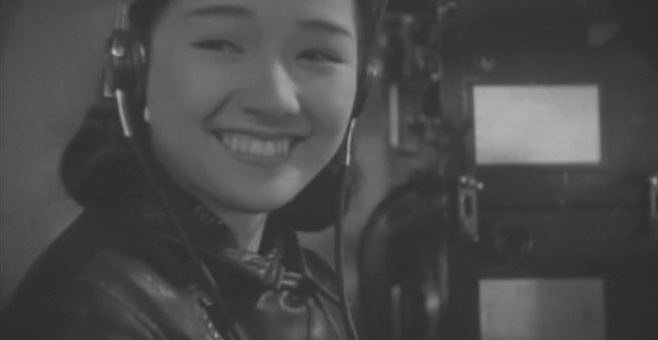
Like The Most Beautiful, the film skews accidentally feminist in its focus on three female radio operators who seem to be regarded as something of pioneers in the field. After encountering technical issues, a plane with a top secret mission is guided into an airfield in Aomori by nothing more than the voice of radio operator Sumiko (Setsuko Hara) yet on landing the pilot expresses surprise apparently stunned that a young woman would be able to perform such a stellar job. The sexist attitudes seem almost set up so they can be shot down, the pilot is quickly corrected by the ground control chief (Takashi Shimura) who explains “nowadays women can become excellent radio operators.”

Of course, this is born of necessity seeing as at this late stage there is a huge untapped resource of young and widowed middle-aged women previously discouraged from getting directly involved with the war effort. In earlier propaganda films, the most important thing a woman could do was get married and particularly to a young man who was going to the war, but this time a conflict develops between two of the women, Yoshie (Hideko Takamine) and Sumiko, because Sumiko declined to marry Yoshie’s brother Kazuo before he left because she too wanted to do her bit for the war effort and would not have been able to do so as a married woman. On learning from Yoshie that Kazuo has been killed after volunteering to lead a suicide mission, she breaks down in tears and cries that she should have married him but Yoshie, who has forgiven her on learning of her patriotic reasoning, tells her that she has done the right thing and her brother would be proud of her for serving her country. 

Meanwhile, at another airfield even deeper into the frozen north their friend Akiko (Hisako Yamane) has a developed a fondness for a research scientist but their romance is of course frustrated by the war. In a moment of fraught emotion, he tells her that he will be returning after delivering his findings and she should wait for him there which is almost to say that they will be granted their romantic resolution once the war is over. The curious thing is that Hara (Shin Saburi) is a weather scientist whose cloud forecasts have apparently been very useful to the pilots. A slightly strange diversion sees the film try to argue that at this point the greatest threat to the Japanese war effort is the weather, which aside from sounding like a very British excuse makes very little sense even if it is obviously a factor in mission success. 

The radio operators obviously can’t do much about the weather, but they can pull together with plucky spirit dedicating themselves to the national good and giving all to the war effort. While Sumiko and Yoshie are having their emotional confrontation they’re interrupted by a trio of young women who were supposed to be getting a radio demonstration from Sumiko but they’ve come to say they can’t make it because one of the other girl’s mothers has been taken ill so they’re walking up the snowy mountain to the observatory in the middle of the night to send her back and take over her shift. When the radio operator on the special flight is taken down by pneumonia (the weather, again), Yoshie volunteers insisting that she’s prepared if the worst should happen but on landing remarks that she couldn’t have got through it without Sumiko and Akiko on the other end of the line resting their success on female solidarity. Though it’s clear the film was made on a shoe string it does feature special effects by none other than Eiji Tsuburaya along with some well conceived action sequences that lend an uncomfortably thrilling note to this extremely late entry into the realms of propaganda filmmaking. 


The Silent Duel (静かなる決闘, Akira Kurosawa, 1949)

Amid the labour strikes crippling Toho in the late ‘40s, Akira Kurosawa formed an association with other directors and film professionals and began working with different studios, the first being Daiei on a loose adaptation of a popular play in which an idealistic doctor struggles with his repressed desires while watching others wilfully embrace post-war selfishness and cynicism. Like many of Kurosawa’s films from this period, The Silent Duel (静かなる決闘, Shizukanaru Ketto) is essentially a meditation on post-war moral decline and what’s needed to correct it but also if somewhat accidentally the destructive effects of secret keeping and miscommunication. 

Kurosawa opens the film in 1944 with exhausted field medic Kyoji (Toshiro Mifune) operating on a badly wounded solider, Nakata (Kenjiro Uemura). Distracted by the constant dripping of a leaky roof, the adverse weather conditions outside, and the general stressfulness of the situation, Kyoji makes the fateful decision to remove his gloves to better accomplish the fiddly operation he is performing only to drop a scalpel and cut himself. He continues with the surgery, but realises that Nakata is likely infected with syphilis which he may have contracted through the wound on his finger. Kyoji tells Nakata, otherwise recovering well, that he should make sure to seek treatment but overhears him boasting that his injuries may soon save him from the battlefield. Kyoji continues to serve but is unable to treat the infection effectively with the limited resources available to him as a frontline medic allowing the disease to continue its progression largely unmitigated.

Taking a job at his father’s obstetrics clinic on his return to Japan, Kyoji breaks off his longstanding engagement to pre-war girlfriend Misao (Miki Sanjo) who has been waiting for him the last six years but refuses to explain to her why he cannot go through with their marriage. She assumes it must in some way be related to his war trauma, and in a way it is. The syphilis is an obvious metaphor for the corruptions of militarism. He declines to explain, he claims, because he is certain that Misao would vow to go on waiting for him until the disease is cured which would take at least three to five years assuming it can be cured at all. As she is already 27, he would be taking away Misao’s opportunity to make a happy marriage and have children with another man. In any case, he makes her decision for her which ironically conflicts with his later statement that she should be free to seek happiness on her own, not least because it seems she has been pressured into an arranged marriage by her financially troubled father. The act of childbirth is symbolically relevant though he does not seem to consider the idea of a platonic marriage perhaps uncertain that he could go on repressing his desires as a married man. So morally upright is he, that he also refuses to lie, saying nothing rather than allowing Misao to believe that he has fallen out of love with her, met someone else, or has another war-related issue that prevents his marrying her. Nor does he seem to consider telling her that he has syphilis and allowing her to come to the same conclusion as everyone else, that he contracted it through sleeping with sex workers during his military service which is most likely how Nakata became infected. 

The stigma associated with the disease adds a further dimension to Kyoji’s frustration given that he describes himself as having wilfully sublimated his physical desires in order to be able to return to a “peaceful marriage” with Misao whereas as Nakata who satisfied himself without a second thought returned home symptomless, married, and is soon to be a father. Re-encountering him by chance, Nakata who seems to have become wealthy doing something that is likely immoral if not illegal, tells Kyoji that his sickness is cured but does eventually bring his wife in for a free checkup to discover that he has passed the disease to her and to their unborn child. Yet even confronted with the truth, Nakata lies again and suggests that Kyoji has made all this up as revenge for something that happened in the war keeping the fact that he infected him from his wife. He blames Kyoji for destroying his family rather than accept his own responsibility and sees nothing wrong in his actions until directly confronted with the body of his stillborn child apparently so deformed and monstrous that they wouldn’t let the mother see it. 

The two men have clearly taken different paths, Kyoji certain that he must put others before himself and suppressing his own desires to ensure he cannot pass the disease on while Nakata buries his head in the sand and ignores it. It is a kind of metaphor for the post-war future, those like Kyoji acknowledging that the legacy of wartime trauma is something that must be acknowledged and actively healed before happiness is possible while those like Nakata simply plow on like nothing ever happened with no thought or consideration for those around them. Yet it is also Kyoji who lies by omission even in his selflessness just Nakata lied to his wife while the truth is only discovered by accident, firstly by reluctant nurse Minegishi (Noriko Sengoku) who walks in on him injecting the remedy for syphilis, she in turn then overheard by Kyoji’s father (Takashi Shimura) while Minegishi then overhears the explanation Kyoji gives him. She in a sense completes the cycle when she asks Misao to apologise to Kyoji on her behalf as she is too embarrassed to do so herself after realising that she got him wrong having resolved to turn her life around after learning of the depths of his selflessness. 

Minegishi had been a nightclub dancer who tried to take her own life after becoming pregnant by a man who abandoned her but was saved by Kyoji who gave her a job at the clinic and convinced her to raise the child. It’s this child, at first unwanted but later loved and embraced by all despite the stigma of his being born out of wedlock, that offers the clearest path towards a healthier future suggesting that the solution lies in accepting the past with a willingness to make something new out of it rather than in wilful denial and resentful self-interest. Yet Kyoji is also human and privately resentful. “If I’d known it would happen to me I would’ve done things differently” he sneers petulantly suggesting that his properness may be an affectation rather than deeply felt conviction but equally frustrated in feeling his fate is unjust and that he’s suffering for someone else’s sin. 

“Because of the blood of a shameless guy, my body became dirty without knowing any pleasure” he complains, hinting at a metaphor for his wartime contamination dragged into a conflict by forces outside of his control. The roles he plays are ironic, firstly a healer in a place of death and destruction and then as a deliverer of life at his father’s obstetrics clinic though he fears he will never have children of his own. He is in a sense trapped by his past as shown in the repeated visual metaphor of the closed gates outside the clinic on which the flowers that represent his relationship with Misao and hope for the future gradually wither. Minegishi tells him she’s in love with him and is willing to accept the risk of his disease to alleviate his desire, but he once again chooses to say nothing, immediately returning to business. As his father points out, he has (for the most part) resolved to channel his resentment into helping those less happy than himself but if he had been happy he may have become a snob, indifferent to the suffering of others. In some ways his problem is the familiar giri/ninjo conflict as he fights a silent duel within himself between his natural desires and his better nature but it’s also a battle against the slow poison of the wartime legacy through compassion and selflessness that may, like his inescapable illness, eventually drive him into madness.


The Silent Duel screens at the BFI Southbank, London on 2nd & 11th February 2023 as part of the Kurosawa season.

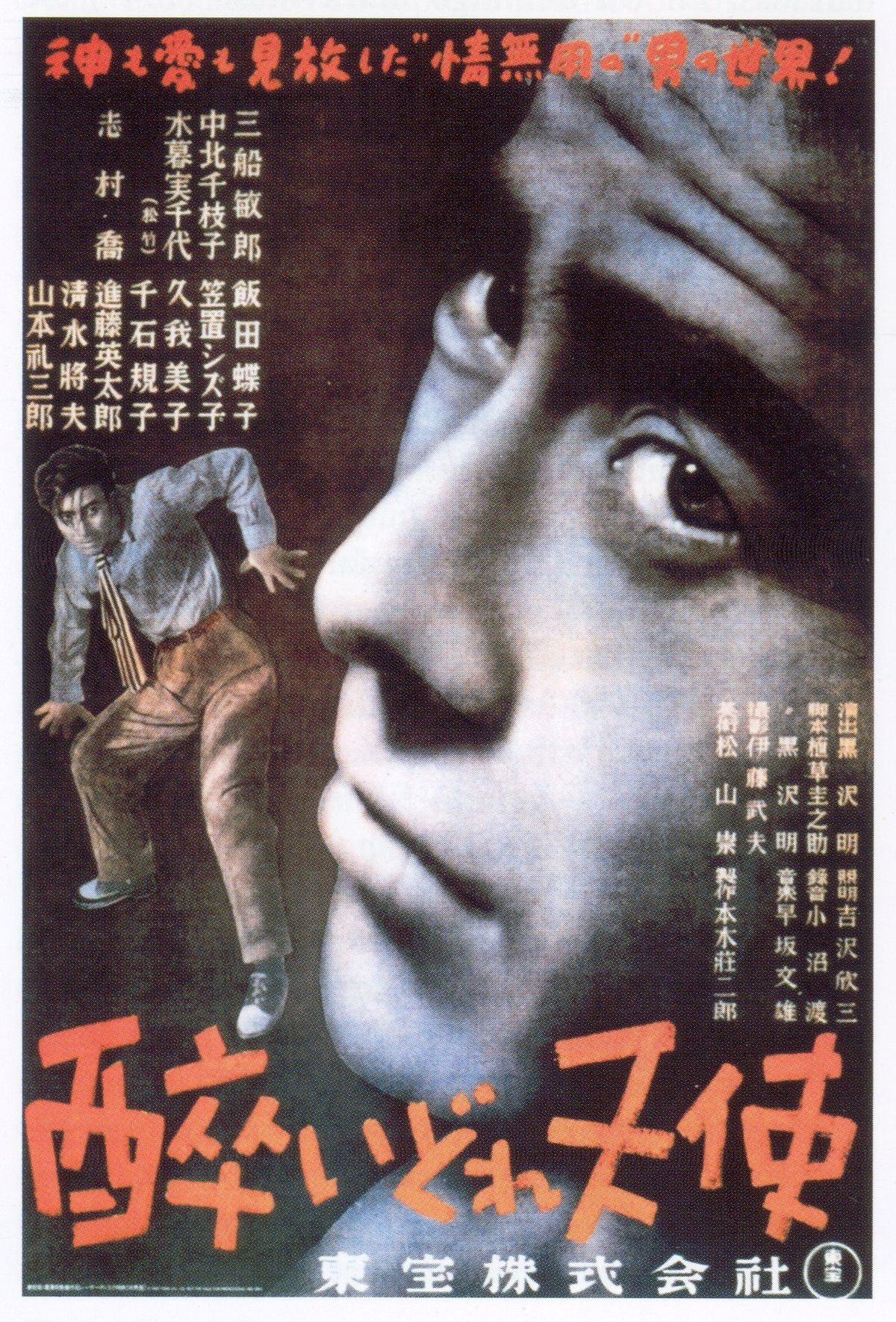
Drunken Angel (酔いどれ天使, Akira Kurosawa, 1948)

A gruff yet well intentioned doctor does his best to cure the ills of post-war Japan in a rundown slum on the edge of a fetid swamp in Akira Kurosawa’s noir tragedy, Drunken Angel (酔いどれ天使, Yoidore Tenshi). The doctor is most obviously the drunken angel of the title though it could equally apply to the unhappy yakuza he tries so hard to redeem whom most agree is not suited to that kind of life and trapped by the feudalistic thinking of the pre-war past.

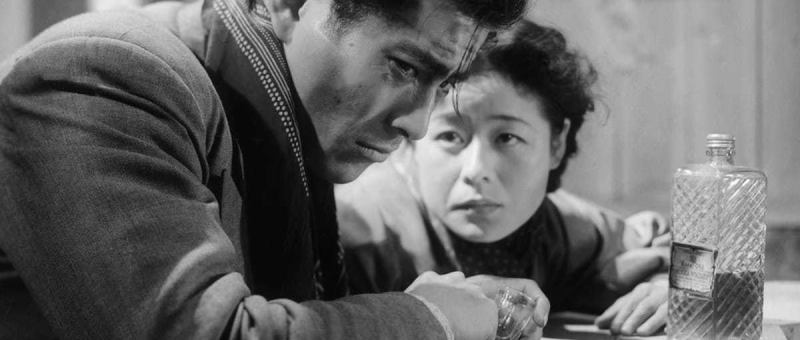
Matsunaga (Toshiro Mifune) is the big man around town, but jaded physician Sanada (Takashi Shimura) sees straight through him. “He acts tough and swaggers around but I know in his heart he’s incredibly lonely,” Sanada tells his assistant, Miyo (Chieko Nakakita), a young woman he took in to help her escape the clutches of the violent yakuza ex who left her with syphilis. Miyo bemoans Sanada’s terrible bedside manner and tendency to bully his patients but praises his dedication and remarks that few doctors go as far for those under their care as he does especially ones like these who don’t often have the money to pay. This is a little ironic given Matsunaga’s original objection that he doesn’t trust doctors because it’s not in their best interests to cure you, something which Sanada jokingly acknowledges while expressing the futility he feels in the face of the mass sickness that confronts him. 

When Matsunaga first comes into his office, Sanada remarks that’s its not just his lungs that are sick, he’s sick to the core. But still he seems to think that Matsunaga can be saved, not just physically but spiritually redeemed if only he can coax him away from the yakuza underworld. Matsunaga is suffering from tuberculosis, a common disease of the post-war era and closely linked to the squalid conditions in which he lives which are themselves symbolised by the swamp in the centre of town onto which Sanada’s clinic backs. Sanada tries to warn the local children not to play in it because of the risk of typhus not to mention the mosquitos it attracts but the kids don’t really listen to him and shout back that he’s “just a drunk”. Yet the swamp represents a world upside-down, the neon sign for the No. 1 cabaret bar constantly reflected in its bubbling waters while as the film opens we see a trio of sex workers preparing to head into the red light district and a pair of petty thugs fighting while a young man plays Spanish guitar on the ruins of a bomb damaged building. 

It’s as if it were this world that is slowly consuming Matsunaga, an old-school yakuza who insists “we still believe in things like honour and loyalty” certain that the big boss will side with him against the returned upstart Okada (Reizaburo Yamamoto), Miyo’s yakuza ex, even as Sanada tells him it’s money that matters and Matsunaga no longer makes any. Everyone tells him that he already looks like a ghost, his appearance increasingly gaunt in his parallel decline as the illness takes hold and he begins to lose his status to Okada only to overhear his boss call him an “amateur” that he was only keeping around as a potential sacrifice. In the end, Matsunaga is too good for this world. Naively believing in things like honour and loyalty which no longer mean anything in the dog-eat-dog post-war society he is left with nothing other than a nihilistic bid for vengeance and a desire to repay Sanada’s faith in him if only in the most ironic of ways. 

Like Matsunaga, Sanada sometimes says the opposite of what he means claiming that he doesn’t care what happens to Matsunaga but is determined to wipe out the TB inside him to stop it spreading it to others. He’s on a mission to “sterilise this contaminated town” by eradicating the twin threats of disease and the yakuza, calling Matsunaga a coward for failing to face his fear and loneliness succumbing to the quick fixes of his hedonistic yakuza lifestyle. He’s not perfect either, a doctor who drinks his medical ethanol supplies and berates his patients when he them catches out them out drinking when he told them not to, but is also very at home with who he is and doing his best with it. His disappointment in Matsunaga is mainly in his swagger, the false bravado that masks his human frailty and unwillingness to face his fear of death which manifests itself in a hauntingly expressionistic dream sequence. Using silent cinema composition and canted angles Kurosawa conjures a world of constant uncertainty amid the vagaries of the post-war society in which the only sign of salvation is a drunken doctor and his “rational approach” to the sickness of the age.


Drunken Angel screens at the BFI Southbank, London on 2nd & 10th February 2023 as part of the Kurosawa season.

Get ’em All (「みな殺しの歌」より 拳銃よさらば, Eizo Sugawa, 1960)

A recently released young man is forced onto a nihilistic path of meaningless violence when his bank robber brother is killed in a hit and run in Eizo Sugawa’s moody post-war noir, Get ‘em All (「みな殺しの歌」より 拳銃よさらば, ‘Minagoroshi no uta’ yori kenju yo saraba). Adapted from a novel from Japan’s hardboiled master Haruhiko Oyabu who also provided the source material for Sugawa’s The Beast Shall Die, the film is as much about defeated aspiration and personal despair as it is about the corrupting influence of money and the futility of vengeance.

After waiting a year to divide the loot from a bank robbery, a random syndicate of crooks is shocked to discover that it has gone missing from its hiding place in an ancestral tomb belonging to one of their members along with a gun connected to the crime which is presumably being kept for insurance purposes. Everyone is convinced someone else has taken it with Tanabe (Tetsuro Tanba), the owner of the tomb, most particular about getting his hands on his share as quickly as possible and directing his suspicion towards the heist’s mastermind, Koromogawa (Akihiko Hirata). 

Koromogawa is currently doing quite well for himself, having recently married and moved into a fancy new flat on a danchi. His brother Kyosuke (Hiroshi Mizuwara) has just been released from prison for an undisclosed juvenile crime and evidently has never met his sister-in-law Mamiko (Yukiko Shimazaki). Strangely buoyant and incredibly naive for someone who’s spent time inside, Kyosuke is determined to go straight and is intending to save money to buy a truck he can use to start his own business. He has no idea that his brother’s newfound wealth is down to robbing banks and is absolutely certain that he is a morally upright person who’d never have anything to do with criminality. When Koromogawa is killed in a hit and run after leaving to meet Tanabe, the suspicion is that he’s been murdered by one of the crooks in a dispute over the money though that would admittedly be quite a counterproductive move as if he really has taken it now that he’s dead no one knows where it is.   

Kyosuke is shocked by Mamiko’s apparently indifference to her husband’s death, even going so far as openly flirt with him. After discovering a receipt for a coin locker in his brother’s wallet, he opens it and finds a pistol first planting the seeds of doubt in his mind about Koromogawa’s life and death. The gun, however, begins to take him over. After reuniting with old girlfriend Yuriko (Akemi Kita), Kyosuke was beaten up by her new squeeze but when he tries the same thing again and notices the pistol tucked into Kyosuke’s waistband he immediately backs down. With the gun in his hand, Kyosuke is able to completely humiliate him, forcing the man to crawl on the floor like a pig and drink dirty water from a puddle in the road. This new sense of ultimate power fuels his desire for revenge setting him on a killing spree starting with Tanabe in an effort to figure out what happened to his brother, an exercise often frustrated by his killing those concerned before turning up any real information. 

Meanwhile, using the gun is also quite a stupid and naive thing to do as the police already have it on file from a shot that was fired during the robbery bringing the crime back into police consciousness and therefore making it impossible for any of the men to spend the money should they finally get their hands on it. Each has a different reason for wanting the loot, a clockmaker wanting to support a daughter left with disabilities after contracting polio, a former record producer realising that he’s aged out of his industry, a former boxer with a lame leg (Tatsuya Nakadai) dreaming of buying a small plot of land, and a couple of embezzlers looking for ways out along with in one case divorcing a wife to marry a bar hostess mistress. But then as in the last two cases and Koromogawa’s own it is perhaps the allure of rising consumerism that has already corrupted them. So much of the action revolves around big American cars, while we’re also told that the gun was one manufactured in Nazi Germany and was most likely bought or stolen from an American serviceman. 

So drunk is Kyosuke on the power of the gun that he doesn’t really take stock of what he’s doing until it’s already too late, realising he’s become an accidental serial killer and no longer has a possibility of leading a normal life. He had begun to feel that way before, especially in the wake of his brother’s death, as he finds each of his job applications failing when prospective employers learn of his criminal past. He’s repaid his debt to society, but if society refuses to give him a second chance then realistically he has no other avenue than heading deeper into crime. Kyosuke liked it that the gun made people fear him but is confronted by the illusionary quality of its power when a child suddenly grabs it in the middle of a game of cops and robbers, pointing the gun at him believing it to be a toy while passers-by laugh at the amusing sight of this little boy holding a grownup hostage. It seemed to confuse Kyosuke that Yuriko had not been afraid of him even with the gun in his hand, but her sudden terror on realising that he has killed and may yet kill her only shows him what he’s become. 

He wanted revenge for his brother’s death, but what if it really was just an accident? The gang begin to turn on each other after the money disappears, some believing Koromogawa took it for safekeeping to prevent them incriminating each other by spending it too early and others that he just took it for himself while each suspecting one another believing one of them is slowly killing the others to pocket the whole amount for themselves. But in the end it’s all for nothing, they couldn’t spend it anyway and several of them decide they’d rather not have the bother and are ready to live quiet lives in the country only it’s too late for that now. A final revelation confirming his brother’s criminality coupled with the betrayal of a friend’s well-meaning attempt to keep him in the dark lead only to an internecine confrontation with the futility of crime. With its noirish jazz score and photography reminiscent of contemporary American independent cinema Sugawa captures a sense of restless youth but also the latent desperation of those left languishing on the margins of an increasingly prosperous society.


Original trailer (English subtitles)