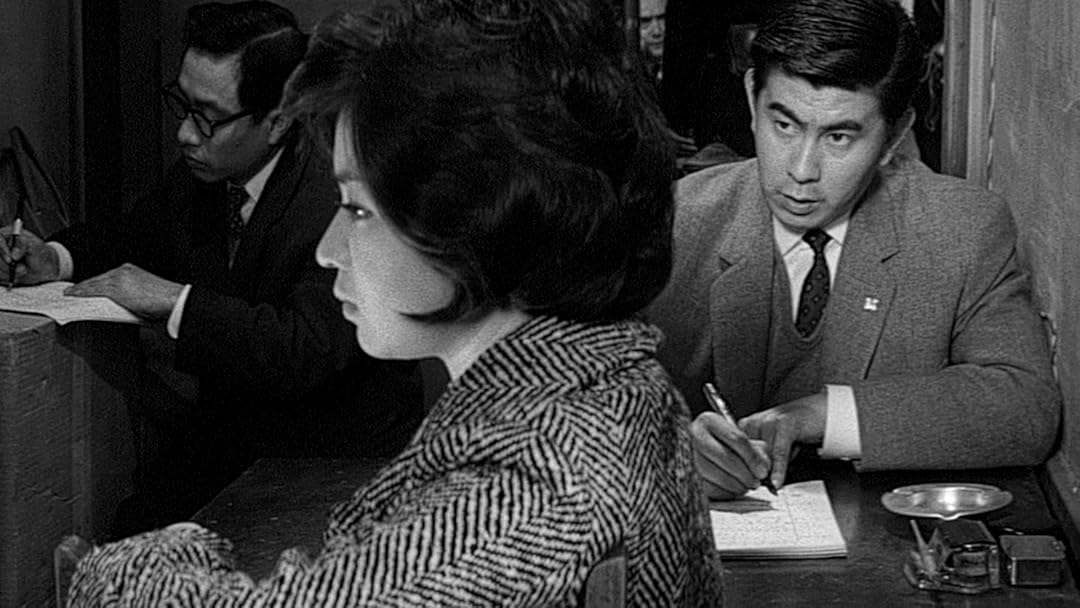
Disobedience (親不孝通り, Yasuzo Masumura, 1958)

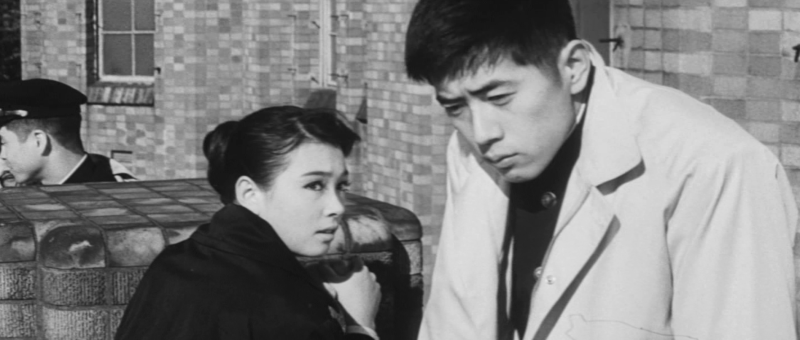
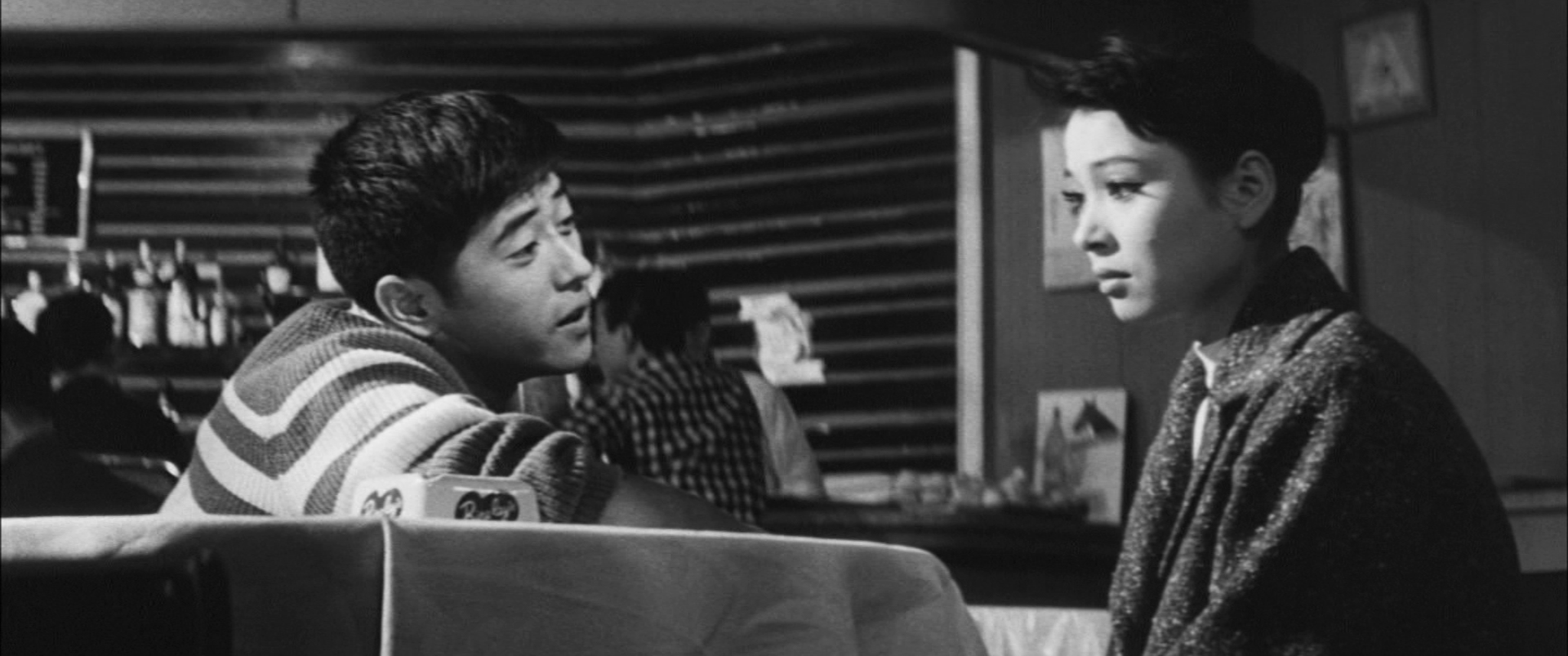
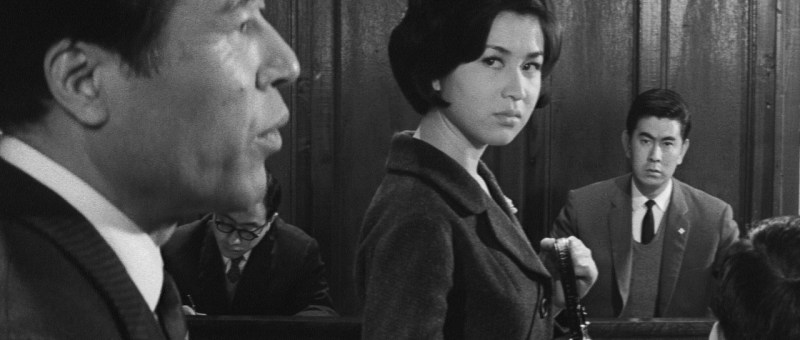
After finding out his older sister has had an abortion after her lover tells her he has no interest in marriage, a college student vows revenge in Yasuzo Masumura’s Disobedience (親不孝通り, Oyafuko Dori). The film’s Japanese title translates as something like “lack of filial piety street” and refers to an area where youth congregates to misbehave, bringing shame on their families with their debauched behaviour. It’s into this world that the cynical hero attempts to drag the sheltered heroine as part of his revenge plot while she apparently decides to stick with him even after he raped her during a college camping trip.

It is though notable that neither of them have much parental input to begin with. Kaneko’s (Hitomi Nozoe) mother has died and we’re told that their father spends all his time with a mistress and never comes home leaving her in the care of older brother Shuichi (Eiji Funakoshi), a salaryman. It’s not exactly clear where Katsuya’s (Hiroshi Kawaguchi) mother is, only that she lives somewhere else and occasionally writes while he is technically in the care of his older sister Akie (Yoko Katsuragi) who works as a tailor in a boutique store selling western fashions. Akie had been carrying on an affair with Shuichi she assumed would lead to marriage and was initially happy about the pregnancy only to be blindsided by Shuichi’s reaction. When he tells her that he has no intention to marry, she realises that the relationship is at a dead end and that an abortion is her only real option given the situation.

The irony is that Katsuya resents Shuichi for failing to take responsibility as a man and vows to take revenge by doing the same thing to his sister and seeing how he likes that. Though Akie points out that it’s nothing to do with Kaneko and tries to stop him, Katsuya is hellbent on playing the cad to make a point. Of course, he may also resent Shuichi, an executive salaryman, precisely because of the position he is in. There has been an economic downturn and he’s having trouble securing a job for after his university graduation. Some companies have halted recruitment entirely and another of Katsuya’s friends has already been through 11 unsuccessful interviews. Other young men have taken to politics, protesting new authoritarian legislation and investing in socialism. Katsuya and friends find this to be disingenuous, assuming it’s just another shrewd move to get on the ladder by finding employment in government or unions. The salaryman dream is a fairly new post-war invention, but it seems to be dying already and Katsuya can’t even really see what his education was for. He tells Kaneko that he only studies well enough to pass so that he can get a good job and the point of life is to figure out how to make money. If he can’t do that, then his life is meaningless and futile. That might be why he spends his time scamming entitled Americans (the only people with money), beating them at bowling, and hanging out in jazz bars. Though the Occupation is long over, the film has a strong but subtle sense of anti-Americanism as symbolised by the aeroplane flying above as Katsuya rapes Kaneko out in the mountains. 

But for Kaneko the situation is not much different. The young women complain it’s even harder for them to secure employment. Katsuya dismisses Kaneko’s university education by calling it a bridal academy, though most of the women lament that marriage is the ultimate job and perhaps the point of university for them is meeting a husband, just as it’s securing employment for Katsuya. Later, when he confronts Shuichi, Katsuya describes Kaneko as damaged goods now that she’s no longer a virgin and is currently carrying a child for which he accepts no responsibility. That may be one reason that she decides to stick with her rapist, realising that her situation is now impossible given it may be difficult for her to marry someone else while supporting herself financially as a single woman is not yet a viable option. By pursuing a relationship with Katsuya, she reasserts control over the situation along with the narrative of what happened between them on the mountains. 

On learning the truth, however, she makes a different decision from Akie in declaring that she will drop out of university and move to Osaka to live with an aunt and raise the baby alone there, declaring that she has decided to go on loving Katsuya no matter what he might think about it. Kaneko’s decision prompts a reversal of Akie’s thinking too. Though she had decided to be independent, starting her own business rather than planning for marriage, she returns to Shuichi and suggests they should get back together. To her the idea of running her own business and being married seem incompatible. Chastened by this whole affair, Shuichi’s thinking seems to have reversed too, to the extent that he decides to marry Akie after all, while Katsuya also decides to accept responsibility and go to Osaka with Kaneko where they will marry and stay together forever. It’s a strange “happy” ending, though it’s difficult to see how these marriages could ever really be happy given the circumstances that led to them and the discordant music that strikes over an ironic Merry Christmas sign as the film comes to an end suggests they probably won’t be. Nevertheless, the ending reverses a lack of filial piety in the shift toward conservatism through heteronormative marriages and the formation of new families as Katsuya, at least, takes responsibility for his paternity and exits the nihilistic world of clubs, bars, and bowling alleys in which his friends remain trapped.


Lightning (稲妻, Mikio Naruse, 1952)

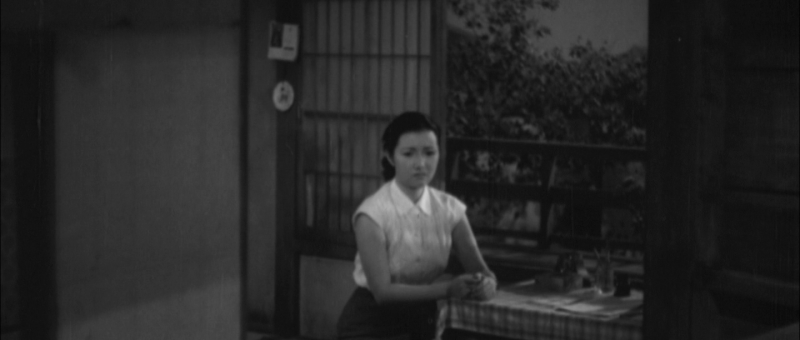
In many ways despite its matter of fact bleakness, Lightning (稲妻, Inazuma) is among the more optimistic of Mikio Naruse’s films ending on a note of cheerfulness and hope in which the storm has been broken and the heroine seems to have rediscovered a sense a faith in humanity. Yet the attitudes she displays are often contradictory and firmly at odds with the kind of Shitamachi spirit one might find in the films of a director such as Yoji Yamada in films like The Sunshine Girl released a decade later.

The qualities that most define Kiyoko (Hideko Takamine) are, as her mother Osei (Kumeko Urabe) suggests, an inner strength that eludes her older sister Mitsuko (Mitsuko Miura) and a forthrightness that sees her struggle to pursue the kind of life she wants rather than that she is expected to lead. Yet some might see her as snobbish and judgemental, at times attacking her mother for having married four times and given birth to four children each with different fathers. In this she sees a particular moral failing on the part of Osei, but perhaps also expresses a deeper distrust in her mother’s repeated attempts to find stability only through harnessing herself to a man. 

Echoing Takamine’s role in Hideko the Bus Conductor, Kiyoko has a job as a tour guide showing off the sites of bustling Ginza though explaining that this part of the city only really comes alive at night. The job gives her a sense of independence and self-sufficiency a woman in this era is not really permitted to have. Her oldest sister, Nui (Chieko Murata), asks if she contributes to the household but the meeker Mitsuko replies that she wanted to but they told her to save her money instead. In any case, it’s towards marriage that she’s pushed when Nui attempts to play matchmaker brokering an engagement with a 35-year-old baker, Goto (Eitaro Ozawa), who has aspirations of opening a love hotel into which Nui and her feckless husband Ryuzo (Kenzaburo Uemura) have invested. Of course, it turns out that Nui is herself having an affair with the baker who is oily in the extreme and disliked by most of the family though eventually manages to make his way into the beds of two of the sisters.

Kiyoko has little desire to marry and asks her mother if any of her four marriages made her happy, but her mother only says that happiness is not an important concept hinting the hardship she’s faced in her life and that a woman of her generation may have had to put up with a certain of degree dissatisfaction to keep a roof over her head and food on the table. While working on the bus, Kiyoko spots Mitsuko’s husband talking to another woman in the street but decides to say nothing only for him to suddenly die and the woman turn up with a baby asking for financial support. Kiyoko tells her sister that marriage is hell, but she smiles and says Kiyoko will be the exception in an expression of the various ways in which women enforce these arcane social codes against each other despite their own misery. Mitsuko too wants to escape but admits she doesn’t have Kiyoko’s courage which is how she too eventually falls into the clutches of Goto much to her sister’s disappointment. 

There is something undeniably poignant in Kiyoko’s frustrated defiance, looking longingly at the paintings and books of their lodger, a young woman from a more middle-class family working her way through university. Kiyoko says she wants to study too, but her mother shoots her down. She’s already 23, and it’s a little late to be picky about marriage let alone strike out for a more stereotypically middle-class life with a white collar job and nice house in the suburbs. It’s the suburbs though to which she eventually moves, without even bothering to tell any of her family. When the nice landlady asks if she has any she admits she has but also has nothing to do with them, which earns her a confused frown. She later says something similar to the pair of piano-playing siblings who live next-door in a kind of suburban utopia, quite clearly ashamed of her humble Shitamachi roots and family members she sees as common and immodest.

In any case, her admiration of the siblings and obvious attraction to the brother (Jun Negami) who is so much more sensitive and caring than her own (Osamu Maruyama) who appears to use the wartime bullets lodged inside him as an excuse not to move on with his life, suggest that she is still in the end looking for a conventional family only one she sees as more positive (or just posher). Perhaps it’s not so much marriage she rejects but dependency and subjugation, believing a marriage to a man like this might be one more of love and equality than the dissatisfying relationships experienced by her mother and sisters. The expressionistic bolt of lightning which appears during a difficult conversation with her mother is like the breaking of a storm, a kind of letting go in which her resentment begins to melt away and her mother agrees to retreat realising that unlike Mitsuko she can take care of herself and to that extent at least is an independent post-war woman. Ambivalent, but in its way warm and forgiving the film gives Kiyoko permission to embrace her aspiration, defy the social codes which constrain her and seek her own happiness, but also allows her to shed her cynicism in rediscovering a faith in humanity and re-embracing her admittedly imperfect mother all while leaving her behind.