Suicide Troops of the Watchtower (望楼の決死隊, Tadashi Imai, 1943)

Produced by Toho and Chosun Film Production Corporation, Suicide Troops of the Watchtower (望楼の決死隊, Boro no kesshitai) was intended as a piece of imperial propaganda promoting a sense of unity between Koreans and the Japanese who had annexed their country in 1910 and thereafter ruled in an oppressive and often brutal fashion. Not that you would know any of that from the film which is directed by committed communist Tadashi Imai while equally surprisingly crediting Choi In-gyu as an “assistant director”, though Choi was already an established and successful director of colonial films such as Tuition (1940) and Angels on the Street (1941). 

Like Tuition the film is almost entirely in Japanese, Korean having been banned onscreen by this point, though small smatterings of Korean are heard in the background. The film is set in 1935, but there are signs visible at certain points reminding people to “use only the national language,” eg. Japanese, though one of the Japanese officers has apparently learned Korean to better communicate with the local community. Likewise, though Korean actors also appear in the film, they are mainly in smaller parts with the most prominent roles being played by well-known Japanese stars. Nevertheless, Korean characters have not generally taken Japanese names, but are referred to by the Japanese reading of the Chinese characters with which their names are written. Thus, the sister of the Korean border patrol officer who is killed is referred to as Eishuku (played by Korean actress Kim Shin-jae), rather than as Yong-suk. Meanwhile, another man remarks that if he called himself “Hayashi” he might feel more Japanese, while his wife has become accustomed to wearing Japanese kimono.

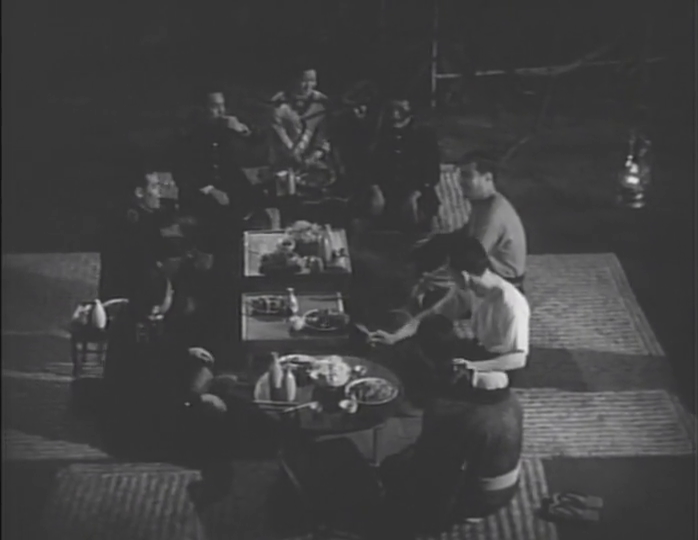
The earliest scenes of the film capture the idyllic pastorality of the Korean landscape and are intended to extend a degree of exoticism to the mainland Japanese audience who are likely less familiar with Korea or Korean culture. This is also true of the early scene in which members of the border patrol hold a welcome party for Asano (Hideo Saito) which takes place at a traditional Korean home. The men eat and drink outside sitting at low tables while the Japanese soldiers attempt to learn a Korean folksong taught to them by Kin. These scenes seek to paint colonial life as a more genial form of cultural exchange brokered by friendliness and respect even though in reality expressions of Koreanness are generally discouraged while the people are brutally oppressed and economically exploited. 

Unlike some similar films, however, Suicide Troops of the Watchtower presents Korean and Japanese people as equals who are fighting for the Japanese empire together. Though they are also portrayed as simple, rural people, the Koreans are never seen to be stupid or incapable and are overall honest and kind if grateful to the Japanese border patrol officers for protecting them from the bandits. In some surprising ways, the film at times presents a more progressive view of society than might be expected as the border patrol is universally supportive of Eishuku’s desire to become a doctor with one of the officers selling off his rice field to ensure she can continue her education after her brother’s death. The implication might be that this is an opportunity afforded to her by the “civilising” force of Japanese colonialism, but she is nevertheless encouraged to become an independent working woman who will also use her skills in support of the empire. 

On the other hand, the Chinese characters seen in the film are all played by Japanese actors and are generally viewed with a degree of suspicion. Cafe owner Wanryu (Ichiro Sugai) has crossed the border expressly to escape the violent bandits of Manchuria, but is still mistrusted by the border patrol despite repeatedly pledging his loyalty to them. When a man in stereotypical Chinese dress with a wounded arm turns up in Wanryu’s cafe and ends up killing officer Kin when challenged, suspicion falls on Wanryu. The Chinese population has essentially been characterised as the “other” and the force against which the Japanese and Koreans are unified, which somewhat undermines the final pronouncement that the bandit problem has been solved by the elimination of the border now that Japan has conquered Manchuria. 

Though they are described as “bandits” and it is said that they have been pushed into Korean territory by Japanese soldiers pursuing them, it easy to read these insurgents as Korean Independence fighters many of whom had gone into exile in China, particularly in Shanghai. Wanko, the estranged son of Wanryu, is not just a young man who ran off to live a life of banditry, but a guerrilla fighter resisting Japanese imperialism. His eventual conversion born the desire to avenge the death of his father at the hands of bandit leader Koryo who meant to kill Wanryu fearing he had betrayed them by warning his father of the imminent attack, is then depicted as a kind of homecoming as border patrol chief Takatsu (Minoru Takada) agrees to release him so that he can fight alongside them. 

To that extent, it might seem surprising that the film makes the bandits seem so powerful to the degree that they pose a genuine threat the security of the empire. Their assault is staged in a way that resembles Hollywood westerns. At the film’s conclusion, it really appears as if all is lost and the border patrol will be wiped out by the bandits, partly because they are clearly understaffed which would seem to be a strategic failure on the part of the authorities. Takatsu’s ever capable wife Yoshiko (Setsuko Hara) is seen lugging weaponry around bearing out the all hands on deck mentality. At the lowest moment, Takatsu gives his pistol to his wife with the intention that she use it on herself when they are overrun while the Korean residents make similar plans with a new mother preparing to smother her baby if the need arises. 

In the end they are saved by the timely arrival of reinforcements thanks to the efforts of the new arrival Asano who had been unable to cope with the harsh life on the border and was determined to quit. Even the one Korean who had subversively complained about being exploited as free labour by the entitled Japanese occupiers chips in to help so that the bandits are eventually defeated by the united force of Koreans and Japanese officers fighting side by side. Even so, the closing speech insists that the colonial authorities will now continue with their ideal of bringing “order” to Korea. Commander Takatsu proves his commitment by giving up  the opportunity to return home to see his dying mother, while his wife becomes a maternal figure to the local community. Released in 1943, the film is perhaps an advocation for unity born of increasing desperation as Japan suffered repeated defeat and domestic strain, preparing its audience for the necessity of defending themselves against a similar onslaught while suggesting that all must work together to save the nation.

Three Women of the North (北の三人, Kiyoshi Saeki, 1945)

Film was the primary medium for propaganda and Japan had been pumping out increasingly patriotic fare under the National Policy programme since the late 1930s but what’s interesting about those which appeared towards the war’s end is that they do not try to sugarcoat the situation or pretend that the conflict is going well, rather they use the encroaching sense of desperation as an additional motivator to get all hands on deck. Released on Aug. 5, 1945, Three Women of the North (北の三人, Kita no Sannin) was the last propaganda film to be produced and the only film currently screening when the war ended on Aug. 15. Of course, after that it was swiftly withdrawn by the Occupation forces never to be seen again except perhaps as a historical document. 

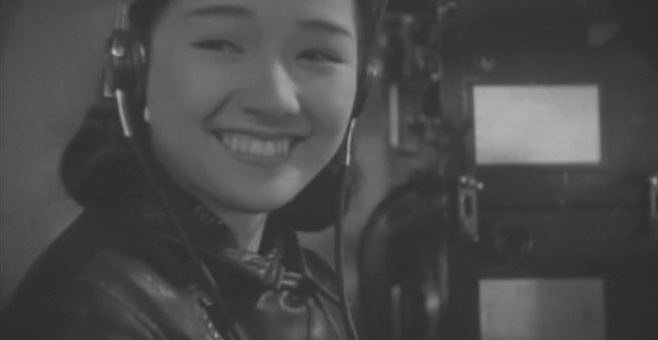
Like The Most Beautiful, the film skews accidentally feminist in its focus on three female radio operators who seem to be regarded as something of pioneers in the field. After encountering technical issues, a plane with a top secret mission is guided into an airfield in Aomori by nothing more than the voice of radio operator Sumiko (Setsuko Hara) yet on landing the pilot expresses surprise apparently stunned that a young woman would be able to perform such a stellar job. The sexist attitudes seem almost set up so they can be shot down, the pilot is quickly corrected by the ground control chief (Takashi Shimura) who explains “nowadays women can become excellent radio operators.”

Of course, this is born of necessity seeing as at this late stage there is a huge untapped resource of young and widowed middle-aged women previously discouraged from getting directly involved with the war effort. In earlier propaganda films, the most important thing a woman could do was get married and particularly to a young man who was going to the war, but this time a conflict develops between two of the women, Yoshie (Hideko Takamine) and Sumiko, because Sumiko declined to marry Yoshie’s brother Kazuo before he left because she too wanted to do her bit for the war effort and would not have been able to do so as a married woman. On learning from Yoshie that Kazuo has been killed after volunteering to lead a suicide mission, she breaks down in tears and cries that she should have married him but Yoshie, who has forgiven her on learning of her patriotic reasoning, tells her that she has done the right thing and her brother would be proud of her for serving her country. 

Meanwhile, at another airfield even deeper into the frozen north their friend Akiko (Hisako Yamane) has a developed a fondness for a research scientist but their romance is of course frustrated by the war. In a moment of fraught emotion, he tells her that he will be returning after delivering his findings and she should wait for him there which is almost to say that they will be granted their romantic resolution once the war is over. The curious thing is that Hara (Shin Saburi) is a weather scientist whose cloud forecasts have apparently been very useful to the pilots. A slightly strange diversion sees the film try to argue that at this point the greatest threat to the Japanese war effort is the weather, which aside from sounding like a very British excuse makes very little sense even if it is obviously a factor in mission success. 

The radio operators obviously can’t do much about the weather, but they can pull together with plucky spirit dedicating themselves to the national good and giving all to the war effort. While Sumiko and Yoshie are having their emotional confrontation they’re interrupted by a trio of young women who were supposed to be getting a radio demonstration from Sumiko but they’ve come to say they can’t make it because one of the other girl’s mothers has been taken ill so they’re walking up the snowy mountain to the observatory in the middle of the night to send her back and take over her shift. When the radio operator on the special flight is taken down by pneumonia (the weather, again), Yoshie volunteers insisting that she’s prepared if the worst should happen but on landing remarks that she couldn’t have got through it without Sumiko and Akiko on the other end of the line resting their success on female solidarity. Though it’s clear the film was made on a shoe string it does feature special effects by none other than Eiji Tsuburaya along with some well conceived action sequences that lend an uncomfortably thrilling note to this extremely late entry into the realms of propaganda filmmaking. 


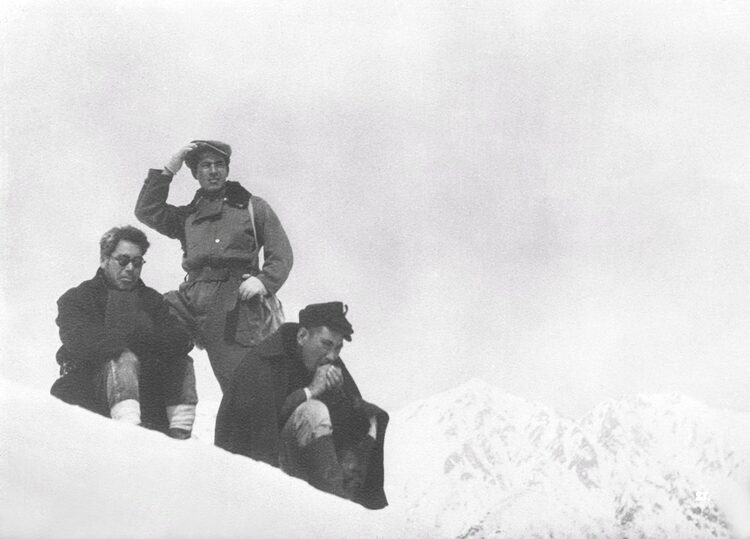
Snow Trail (銀嶺の果て, Senkichi Taniguchi, 1947)

The cinema of the immediate post-war era might in a sense be aspirational, but it rarely shies away from hardship or from the sometimes difficult choices which had to be made both in terms of individual survival and the future direction of a society. Remembered chiefly for featuring the debut of screen legend Toshiro Mifune, Senkichi Taniguchi’s Snow Trail (銀嶺の果て, Ginrei no Hate) is less a crime doesn’t pay story than it is an affirmation that it’s never too late to turn back and that people who do “bad” things aren’t always “bad”, only troubled and desperate, but can be guided back towards the right path by the power of simple human goodness. 

As the film opens, a trio of thieves commits a daring bank robbery and then heads off on the run intending to hideout in the mountains posing as tourists on a skiing trip. To facilitate their ruse, they’ve cut off communication by fiddling with radios and disabling telephones but two young men with too much time on their hands have already heard about the robbery and figured out the three suspicious gentlemen might be the fugitive criminals. In another picture, the two young guys would be the bumbling heroes, mistaken in their assumption that their world has been invaded by crime and probably finding romantic disappointment before heading home. This time however their guess is correct and their investigation has placed them in danger. The leader, Nojiri (Takashi Shimura), whips out a gun on a collection of drunken labourers and forces them out of their clothes and into the hot spring so the gang can make their escape further up the mountain, eventually taking refuge in a tiny lodge run by a philosophical grandpa (Kokuten Kōdo) and his cheerful teenage granddaughter (Setsuko Wakayama).

The police are in hot pursuit, but it is by nature which we will be judged. After leaving the hotel, the trio stop briefly in a ranger’s hut where hotheaded youngster Eijima (Toshiro Mifune) suggests splitting up. Nojiri divides the loot, giving each their promised share, but the other guy, Takasugi (Yoshio Kosugi), objects. He doesn’t want to go it alone and resents being forced to make his own way, even wondering out loud how long they’d get if they gave themselves up now. After a fight knocks Takasugi out, Eijima is keen to leave him behind, but he ends up spelling his own doom when he fires his gun at the police and provokes an avalanche.  

Later the patient grandfather tells us that the “mighty mountain punishes the bad”, and Takasugi is presumably its first victim, paying the price for panic and cowardice. Meanwhile, Nojiri and Eijima find themselves playing tourists once again in the mountain lodge where Nojiri is touched by the simple innocence of the young girl and her grandfather and Eijima paces around impatiently like a caged animal, cruelly killing the little girl’s prized carrier pigeon in case it takes it upon itself to signal the authorities. Threatening the girl’s life, Eijima convinces another guest, Honda (Akitake Kono), to guide them safely over the mountains to escape, but becomes increasingly paranoid that he will be betrayed, knowing he does not have the skills to survive alone in this environment. 

Nojiri meanwhile is drawn back towards humanity. Already softened by Harue, the cheerful young woman at the lodge who innocently offers him honey tea and reminds him of his own daughter who passed away at a similar age, he remains conflicted in their coercion of Honda and even more chastened after Honda saves both of their lives when Nojiri slips breaking own his arm in the process. Later, Nojiri asks him why he helped them rather than just cutting the rope and escaping. He replies that all he did was respect the code of the mountains. “The rope that ties one life to another must never be touched” he tells him. 

In an unexpected twist, Nojiri’s humanity is reawakened by a song filled with nostalgia but it isn’t Furusato or Akatombo, it’s “My Old Kentucky Home” played in an instrumental version on Harue’s portable record player, previously used by Honda who performed a silly dance to tune of Oh Suzannah. The choice of music perhaps echoes the movie’s Hollywood inspiration, but otherwise follows the pattern of other similarly themed contemporary crime movies in which the hero is eventually redeemed by connecting with his own childhood innocence through the “furusato” spirit. Still able to find this essential goodness within himself, the mountain has judged Nojiri favourably, proving that as grandpa says he isn’t a “bad” person even if he’s made “bad” choices. Filled with a new respect for the ropes that bind one human to another, he is allowed to return to the world presumably to live a more connected existence cheerfully helping others rather than remaining selfishly alone.