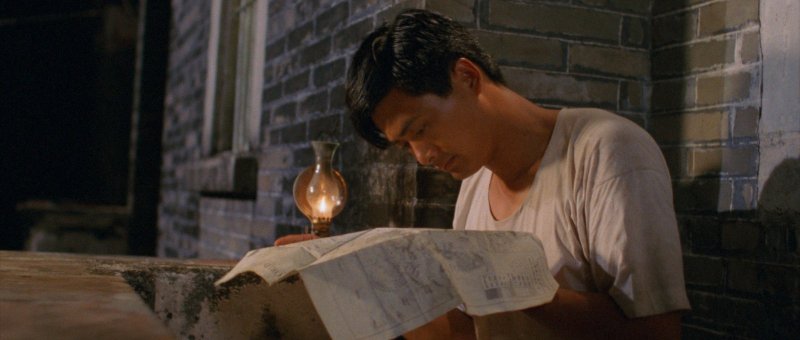
Hong Kong 1941 (等待黎明, Leong Po-Chih, 1984)

“Britain has reassured the people that it will not give up Hong Kong,” according to a radio broadcast at the beginning of Leong Po-Chih’s Hong Kong 1941 (等待黎明). The words have a kind of irony to them and not only because Britain did abandon the people following the Japanese invasion, but because the film was released on the eve of the Sino-British Joint Declaration in which it said something quite similar. 

But then again, the opening scenes are themselves quite critical of British rule as they, on the one hand, insist they aren’t going anywhere and, on the other, start evacuating women and children to “safer” areas of the commonwealth such as Australia. Out of work actor Fei (Chow Yun-fat) fled the Japanese incursion on the Mainland and came to Hong Kong, but now tries to stowaway abroad a boat going to Australia. He’s caught by a little British girl who speaks fluent Cantonese yet refers to him as her “slave” and insists that he “kowtow to me, now.” But then the girl suddenly adopts the persona of the Empress Dowager Cixi and demands the same. Fei makes the first of his many jumps into the water around Hong Kong, as if only in this liminal space can he be free. Anticipating the wave of migration occurring before and after the Handover, and also that of the present day, he and his friends Keung (Alexander Man Chi-leung) and Nam (Cecilia Yip Tung) set their sights on leaving to find Gold Mountain in Australia or America.

But they’re one day too late because the date of their departure is that the Japanese arrive in Hong Kong. Their haste to leave was in part caused by the fact that Nam’s father, Ha Chung-sun (Shih Kien), was trying to force her to go through with an arranged marriage her prospective groom didn’t want either. Nam is never really free as, as she points out, even after her father relents and allows Keung to marry her after she is raped by a police officer emboldened by the chaos and therefore worthless to him as currency, Keung never actually asked her and she’s in effect forced into a marriage with him instead. In fact, she returns to the shrine Keung lives in two find the two men constructing her marital bed for her with the double helix symbol of happiness already placed above it in an ironic expression of patriarchal oppression.

Indeed, her position is more precarious than either of the men and we see other families roughly cutting their daughters’ long hair to make them look like boys in fear of a rapacious Japanese army. But it largely turns out that it wasn’t so much the Japanese they needed to be worried about as the local population, experiencing a temporary limbo in which the social order has been suspended. Police officer Fa Wing (Paul Chun) who had acted as a lackey for Ha Chung-sun while constantly eying up Nam leads a gang of looters to Ha’s house to take their own revenge against his capitalistic oppression of them. Ha had largely made his money through rice profiteering and exploiting the local workforce. Recent layoffs at the warehouse had led to a labour riot, while Keung and his friends had been running a sideline skimming sacks of rice to sell on the black market. 

Ha and his henchmen anxiously await the arrival of the Japanese hoping that they will protect them from retribution, but the Japanese do not arrive fast enough. When they do, Ha collaborates and attempts to ingratiate himself with the Japanese officer in charge of the colony who once again takes a liking to Nam. General Kanezawa (Stuart Ong) also uses their poverty to starve them into submission, promising rice to anyone who will come and sing with him. The song he chooses is “Shina no Yoru” by Li Hsiang-lan, whom he describes as “their very own”, yet was actually a Japanese woman, Yoshiko Yamaguchi, groomed for stardom in Manchuria and marketed a Chinese star in propaganda films. Another song of hers, Ieraishan, can be heard earlier on the soundtrack as if heralding Japanese arrival. 

Though Nam tries to resist, Fei raises the trio’s arms in a cry of “banzai” in a moment of ostensible collaboration designed to buy them temporary safety. His philosophy and that of many others is to take the rice and deal with the rest later, which Fei does by becoming an enforcement officer with the Japanese to get papers that will allow all of them leave. He uses his position to help a gang of Mainlanders who are resisting the Japanese, and are, in fact, the last ones to stay behind and defend the colony, as well as well as save Keung when his attempt to rescue two friends who have been sold out for forced labour on another Japanese-controlled island by a local gangster backfires and he’s captured himself. 

Ironically enough, Fei had been the first one to try to leave and described himself as “selfish” after jumping back into the water to return to Nam and Keung who didn’t make the boat on time because they were trying to save a local eccentric everyone calls “emperor” played by the director himself. Fei is quite obviously in love with Nam, and she gradually falls for him in return though symbolically wedded to Keung, if not in the legal sense. Again, she has no say over her romantic future which is sorted out between the two men with Fei abiding to a code of honour in continuing to protect the relationship between Keung and Nam. Perhaps this echoes the way in which the Hong Kong people of 1941 or 1984 have little say in their future either as their fate is decided by two distant powers. Nevertheless, it leaves Keung feeling awkward and inadequate, realising that Nam likely prefers the smart and dynamic Fei over his constant failures and inability to protect her, though he is never jealous or resentful towards him only knowing that he is continually indebted. Yet it’s Nam who eventually strikes back for Hong Kong and for her own freedom while Fei looks on as children in the street play at beheadings as if they were Japanese soldiers. She embodies the spirit of Hong and carries it with her, and as the Chinese title of the film suggests, waits for a new dawn while accepting that just like old memories it will be replaced by what is to come. She speaks from a perspective that is both historical and uncertain, mourning the past while fearful of the future, but all the while continuing to live as one new dawn replaces another.


Hong Kong 1941 screened as part of this year’s Focus Hong Kong.

Trailer

The Goldfinger (金手指, Felix Chong Man-keung, 2023)

Following Wong Jing’s Chasing the Dragon and Philip Yung’s Where the Wind Blows, Felix Chong’s financial thriller The Goldfinger (金手指) is the latest in a series of Hong Kong films revolving around colonial-era corruption in which the apparent lawlessness of the pre-Handover society allowed crime to flourish along with a nascent greed nurtured by the island’s rising prosperity as an increasingly important financial centre. In an ironic touch, the film even opens with mass protests against the introduction of ICAC with protestors calling for more respect for law enforcement officers while implying some dark authoritarian force is in play even as angry policemen demand the right to immunity from their own misconduct.

In any case, what arises is a cat and mouse game between wily conman/entrepreneur Henry Ching (Tony Leung Chiu-Wai) and ICAC investigator Lau (Andy Lau Tak-Wah) who chases him for 15 years trying to expose his web of financial fraud. A failed businessman on the run from debt having supposedly abandoned an idealistic desire to build homes for people, Ching arrives in Hong Kong seeking a land of opportunity and largely finds it though through dubious means. Teaming up with similarly embittered businessman KK (Simon Yam Tat-Wah), who is resentful towards his family who treat him with disdain for being a mistress’ son and force him to do their dirty work, to build a giant real-estate based empire that is in reality rooted in complex financial fraud.

Working on the rationale that stocks can be spent like money, Ching makes contacts and manipulates markets which is all very well as long as no one asks for the cash because it doesn’t exist. Chong hints at the realities of the housing market in Hong Kong today in which land is at a premium and apartments largely unattainable as Ching alternately allies with and subverts British rule to build a property empire, setting his sights on acquiring prestigious Golden Hill building as symbol of a new Hong Kong and his own hubristic desire for personal success. With shades of Wolf of Wall Street and The Great Beauty, Ching attends soirees organised by the British and puts on a show for his targets. In his attempts to woo a British bank, his office is suddenly invaded by salsa dancers and gold glitter falls from the ceiling much to the chagrin of a bemused and increasingly mistrustful KK.

Even so the title of the film is echoed in a comment Ching makes to Lau that though he may thinks he’s some genius with the Midas touch he’s really just a patsy, pushing him to investigate possible international conspiracy that is bigger than either of them. Ching has already become a legend with a series of stories about how he made his stake money which range from running into Imelda Marcos in a shoe shop and getting backing from the oppressive regime in the Philippines, to narrowly escaping a war zone and catching a CIA spy in Moscow. He even has the hutzpah to attempt to bribe Lau by offering him a vast fortune and a scholarship for his daughter to study abroad if only he’d find a way to nix the case.

The corruption is indeed embedded, as is obvious when a judge with a posh British accent actively welcomes Ching to the court in a friendly manner and suggests they conduct their business swiftly to avoid any unnecessary turmoil to the Hong Kong economy. Friends in high places largely assist him, whether through personal greed or blackmail though as another of his associates admits, in the end there is no real loyalty among thieves only increasing fear and desperation along with resentment that Ching seems to be taking more than his fair share of the loot. Loosely based on the Carrian Group scandal, the film never loses sight of the damage one man’s greed and duplicity can do as millions of Hong Kong citizens find themselves out of pocket and uncompensated when the shares they bought become worthless, but equally suggests that in the end justice will always be denied to ordinary people while men like Ching will never fully pay for their crimes. With gorgeous production design, Chong beautifully the woozy world of Hong Kong in the ’70s and ’80s amid an intense cat and mouse game of financial fraudsters and a compromised authority.


The Goldfinger previews from 30th December ahead of opening in UK cinemas 5th January courtesy of CineAsia.

UK trailer (Traditional Chinese / English subtitles)

All U Need Is Love (總是有愛在隔離, Vincent Kok Tak-chiu, 2021)

All things considered, there are worse places to quarantine than a five star hotel especially if it’s free but then again forced proximity with those you love, or those you don’t, can prove emotionally difficult. An old school ensemble comedy, Vincent Kok’s All U Need Is Love (總是有愛在隔離) features a host of A-list stars each providing their talent for free in order to support the struggling Hong Kong film industry in the wake of the COVID-19 pandemic but as its name suggests eventually offers a small ray of hope that the enforced period of reflection may have fostered a spirit of mutual solidarity and personal growth. 

Kok opens, however, with a tense chase sequence as a shifty looking man runs from the authorities at the airport only to be picked up by the PPE-clad Epidemic Task Force who whisk him away to a secret location where he’s placed inside a weird bubble and interrogated by Louis Koo. Several more top HK stars including Gordon Lam fetch up in the bubble each implicating the Grande Hotel as the centre of of a coronavirus cluster at which point an order is given to place it under total lockdown requiring everyone inside to remain for a 14-day quarantine. 

Essentially a series of intersecting skits, Kok’s ramshackle drama nevertheless has its moments of satire as the hotel chief takes to the stairs for an inspirational speech in which he frequently slips into English and bizarrely likens himself to the captain of the Titanic because we all know how well that went. He spends the rest of the picture trying to escape without anyone noticing while his dejected security guard/brother tries to bump him off. Meanwhile, two gangsters develop a homoerotic bromance while plotting how best to profiteer off the pandemic through smuggling anti-COVID paraphernalia just as panic buying takes hold on the outside. 

Nevertheless, it can’t be denied that All U Need Is Love is also guilty of some rather old fashioned, sexist humour particularly in the antics of a pair of old men (Tony Leung Ka-Fai and Eric Tsang reprising their roles from Men Suddenly in Black) and their minions who misled their wives in order to embark on a sexual odyssey only to have their plans both improved and then ruined by the quarantine order. Meanwhile, a young couple who were in the hotel preparing for their wedding banquet ironically scheduled for the last day of the quarantine find themselves at loggerheads as the man gets cold feet over his fiancée’s bridezilla micromanaging, and her father undergoes a total makeover while continuously watching Japanese pornography in his room. 

Watching it all, a little girl, Cici, becomes the moral voice of the pandemic innocently hoping that nature will continue to heal itself even after the sickness ends. It’s she who shows the gangsters the error of their ways in pointing out that if they steal all the anti-COVID equipment then they will end up being more at risk because no one else is protected, while she also softens the heart of the hotel’s cynical manager to the point that he too makes a lengthy speech about becoming a better person thanks to his experiences during in the pandemic. 

During their enforced proximity friends and strangers have indeed needed to rediscover their love for their fellow man as they band together in mutual solidarity waiting for their freedom. Culminating in an oddly uplifting wedding decked out with balloons and messages from friends and family played via iPad, Kok’s anarchic ensemble farce does its best to discover a silver lining among the fear and anxiety of the pandemic as it ironically brings people together through driving them apart. Along with his A-list cast, Kok throws in a series of movie parodies and pop culture references from an impromptu rendition of Baby Shark to a surprise appearance from the Landlady from Kung Fu Hustle as well as a suitably random cameo from Jackie Chan. Repurposing the traditional Lunar New Year movie, All U Need is Love is a classic nonsense comedy designed to lighten the mood in these trying times while celebrating the essence of Hong Kong cinema through, arguably, its most idiosyncratic of genres. 


All U Need Is Love streamed as part of this year’s New York Asian Film Festival.

Original trailer (Traditional Chinese/English subtitles)

Moon Warriors (戰神傳說, Sammo Hung, 1992)

“In fact, some stories are true. Especially the heartbreaking ones” according to a melancholy fisherman in Sammo Hung’s tragic wuxia romance, Moon Warriors (戰神傳說). Arriving in the middle of a fantasy martial arts boom, Moon Warriors boasts some of the biggest stars of the day in a beautifully composed tale of intrigue and derring-do as well as featuring an A-list creative team with such high profile talent as Mabel Cheung, Alex Law, Ching Siu-Tung, and Corey Yuen also involved in the production. 

Somewhere in feudal China, 13th Prince Shih-san (Kenny Bee) is on the run after being usurped by his evil brother, the predictably named 14th Prince (Kelvin Wong Siu) who burnt down his castle and has been following him throughout the land razing villages wherever he goes. Accompanied by trusty bodyguard Merlin (Maggie Cheung Man-Yuk) who is silently in love with him, Shih-san is desperate to get in touch with the Lord of Langling (Chang Yu), also the father of his betrothed princess Moony (Anita Mui Yim-Fong), in the hope of uniting their forces to retake the country together. Meanwhile, goodhearted yet eccentric fisherman Philip (Andy Lau Tak-Wah) is doing a spot of hunting in a bamboo grove during which he notices Shih-san and the others wading into a trap and leaps to the rescue, helping to despatch the black-clad assassins. As Shih-san is badly injured, he takes them back to his cheerfully idyllic village, serves them the local delicacy of spicy shark fin soup, and generally befriends them before 14th Prince’s goons track them all down again at which point he takes them to his secret hideout which turns out to be an ancient temple dedicated to Shih-san’s emperor ancestors. 

We find out just how evil 14th Prince is when he gets his minions to kill all of Moony’s ladies-in-waiting and dress up in their clothes to mount a sneak attack on the Langling estate while holding on to the pretty kites Moony was flying before the gang arrived. Though petulantly flying kites seems like quite a childish activity for a princess about to be married off, Moony more than holds her own in the fight even if finding it difficult to deal with having killed someone for the first time. Sent to protect her, Philip is less than sympathetic, but after a few arguments, a near death experience, and some magic glitter, the pair begin to fall in love, which is a problem because Moony is betrothed to Shih-san. 

What develops is a complicated love square in which Merlin pines for Shih-san who seems more interested in Philip, while Philip repeatedly tries to leave the group because of his conflicted loyalties and a feeling of inferiority as a peasant suddenly mixed up in imperial intrigue and forbidden romance. Moony tries to give him her half of a precious jade talisman which plays beautiful music, but her melancholy suggestion that it will sound better with his flute than with the other half which is held by Shih-san flies right over his head. Shih-san, meanwhile, who was spying on them talking, suddenly decides to give him his half too, leaving Philip holding the whole thing. Merlin, as it turns out, has a series of interior conflicts of her own that leave her resentful of just about everyone except Shih-san. 

Eventually, however, nowhere is safe from the destructive effects of political instability and Philip’s fishing village is soon a target for the vicious 14th Prince, ensuring he enters the fight with the help of his improbable best friend, a killer whale named “Sea-Wayne”. Before the romantic dilemmas can be resolved, the courtly intrigue collapses in on itself, fostering an accidental revolution in the literal implosion of an old order, suddenly becoming dust as in some long forgotten prophecy. In a strange moment of flirtatious smalltalk, Philip had remarked that legend has it the flowers in these fields are only so beautiful because they grow on top of bodies buried far below, something he later discovers to be more than just a fanciful story. 

There might be something in the tragic tale of two branches of elites destroying each other in order to take control of a disputed territory while the ordinary man is left behind alone to reflect on the fall of empires, but perhaps that’s a reading too far in a melancholy wuxia of 1992 and its unexpectedly gloomy ending in which true feelings are spoken only when all hope is lost. Nevertheless, with all of its high octane fight scenes, painful stories of romance frustrated by the oppressions of feudalism, and surreal killer whale action, Moon Warriors is a strangely poetic affair as doomed love meets its end in political strife.


Trailer (no subtitles)