
Cook up a Storm (决战食神, Raymond Yip Wai-man, 2017)

Raymond Yip Wai-man’s Cook up a Storm (决战食神, Juézhàn Shíshén) was scheduled to open at Chinese New Year but eventually found itself delayed and awkwardly repositioned as a Valentine’s Day date movie. Something of a rarity, there is no real romance in Cook up a Storm though it may inspire a post-movie visit to the nearest Chinese restaurant with its deeply felt tribute to classic Chinese cuisine and the raucous social gathering that often goes with it. Yip does his best to throw in as many themes as possible from the familiar tradition vs modernity to fathers and sons and the undue influence to China’s new ruling class who possess extreme wealth but (apparently) no taste. Most of these get somewhat lost in the meandering script which eventually falls into a conventional tournament narrative as two very different chefs face off in the kitchen before realising they have more in common than not.

Laidback young man Sky (Nicholas Tse) has inherited the traditional and extremely popular Seven restaurant in a tiny alleyway as yet untouched by the rest of the city’s lurch towards modernisation but all that is set to change when a Michelin starred Korean/Chinese chef, Paul Ahn (Jung Yong-hwa), is given the opportunity to open a high class restaurant right across the street. Sky is not particularly worried as he knows they aren’t chasing the same clientele but Ahn continues to muscle in on his business from outbidding him at the fish market to blocking the entrance to Seven’s restaurant with fancy customer cars.

Seven and Ahn’s restaurant Stella eventually find themselves rivals in a TV cooking competition where Ahn’s modern take prizing innovation and elaborate presentation is directly contrasted with Sky’s traditional skills but there are other conflicts lurking in the background as Ahn’s corporate backers fuss about the marketing and Sky obsesses over proving himself to his estranged father who is currently the “god of cooking” and a world champion celebrity chef.

Half Korean Ahn honed his skills abroad cooking for European royalty and has never quite “got” Chinese cuisine which he finds stagnant, turned off by its fierce traditionalism. Street cook Sky does not care for Ahn’s “tricks” which distract from the simple purity of the food. Yip is pulled between the two extremes, painting the tiny alleyway as unrealistic for trying to stave off the march of time yet seing something to respect in their fierce defence of their community and way of life which is constantly under threat. Ahn, though originally cold and driven, is not quite the villain he seems as he quite clearly recognises a fellow craftsman in Sky and is willing to extend at least a professional courtesy to him even if he doesn’t immediately leap to his defence. After a number of setbacks and reversals, the two men patch up their differences by coming together to fight a common enemy which represents both future and past in the twin pronged assault of the heartless developers and Sky’s soulless father.

Corporate greed is the film’s central villain as these super rich businessmen continue to ride roughshod over the little guy from refusing to queue for a table to threatening to burn the whole place to the ground if they don’t get their way. Ahn, having accepted their offer to run “his own” restaurant quickly discovers that he is just another short order talent fit to be cast aside when another hotshot rears their head. Caring only for money and status, the restaurant owners have no love for food which, in the film’s terms, is the ultimate betrayal.

Betrayed is the way Sky feels towards his long absent father who skipped town after telling him he had no feeling for cookery leaving him with lingering feelings of resentment and inadequacy. Sky is determined to prove his father’s life philosophy wrong by demonstrating that it is possible to be both successful and a good person. Sadly, only one of these is destined to work out for him (Yip’s vision of the new China is not altogether charitable) but then Sky’s idea of “success” is very different to his father’s and to that of the development wave currently washing over his neighbourhood.

In keeping with the New Year theme food is the main focus and Yip does his best to give the simple art of cooking all of the shine it truly deserves piling visual tricks on top of well choreographed action sequences more akin to a martial arts film than your usual food fiesta. The narrative may be a familiar one, two cooks enter everyone leaves full, but then that’s more or less what is expected from a New Year movie. Inconsequential and somewhat throwaway, Cook up a Storm still manages to pack in enough gentle comedy and tributes to the power of community as found family to make up for its otherwise insubstantial nature.


HK trailer (Cantonese with English subtitles)
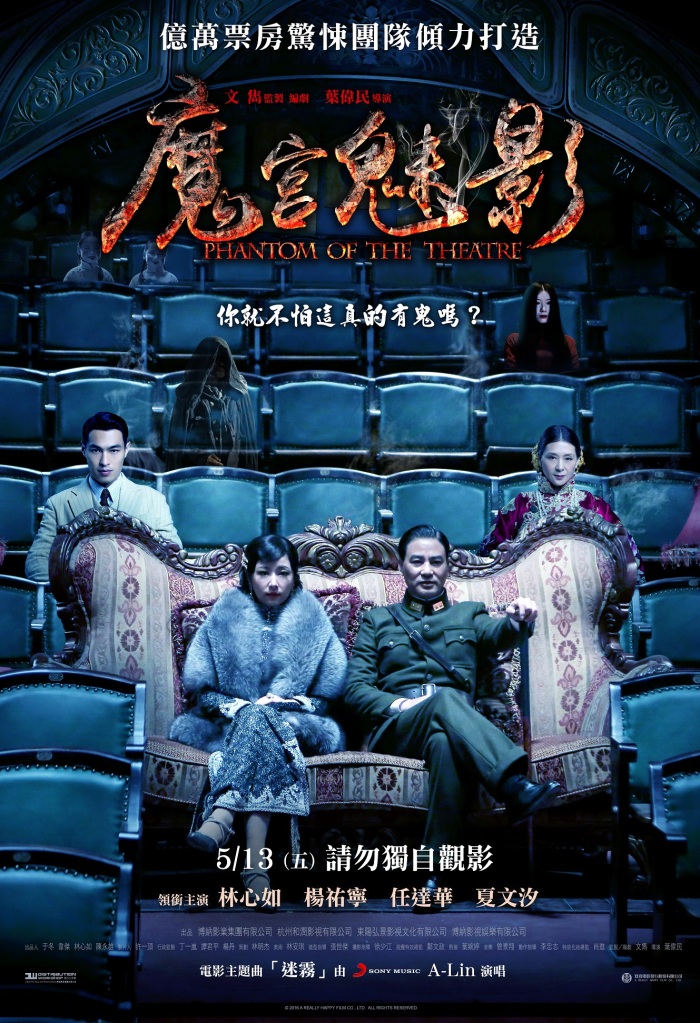
Phantom of the Theatre (魔宫魅影, Raymond Yip Wai-man, 2016)

phantom-of-the-theatreNo ghosts! That’s one of the big rules when it comes to the Chinese censors, but then these “ghosts” are not quite what they seem and belong to the pre-communist era when the people were far less enlightened than they are now. One of the few directors brave enough to tackle horror in China, Raymond Yip Wai-man goes for the gothic in this Phantom of the Opera inspired tale of love and the supernatural set in bohemian ‘30s Shanghai, Phantom of the Theatre (魔宫魅影, Mó Gōng Mèi Yǐng). As expected, the thrills and chills remain mild as the ghostly threat edges closer to its true role as metaphor in a revenge tale that is in perfect keeping with the melodrama inherent in the genre, but the full force of its tragic inevitability gets lost in the miasma of awkward CGI and theatrical artifice.
Shanghai was a swinging, cosmopolitan town in the 1930s. A multicultural melting pot it was both a business centre and a bohemian paradise in which the Chinese film industry flourished. Aspiring film director Gu Weibang (Tony Yang) has just returned from studying in France and is looking for an actress to star in his first project. Attempting to hand his script to the winner of the local awards ceremony, Weibang’s plan is frustrated by some awkward political shenanigans between an older actress, a younger one, and the patron that’s trying to abandon one woman for the other, but Weibang is soon to have more problems on his plate connected to the series of strange deaths which have begun to occur in the “haunted” theatre in which he wants to shoot his upcoming masterpiece.

The mystery element fades relatively quickly as we’re introduced to the very human villain who does, however, behave in an appropriately phantom fashion as he appears and disappears in various locations around the ruined theatre, making use of secret passages and hidden doorways to put his dastardly plan into action. The main thrust of the narrative is the gothic romance between Weibang and his leading actress Meng Si-fan (Ruby Lin) which is complicated both by his existing girlfriend (the pathologist working on the mysterious theatre deaths) and the spectre of the long buried past. The fire which destroyed the theatre 13 years previously resulting in the deaths of a troupe of acrobats lies at the centre of the mystery but places the two lovers on different sides of an unbridgeable divide as powerless bystanders in the newly post feudal world.

Weibang wants to make films about the things people can’t say – an interesting meta comment given that ghosts are still taboo all these years later, but the irony is that film is a seductive dream, a distraction from the reality, a haunted theatre all of its own. Dreams, reality, and cinema begin to overlap as Weibang finds himself playing the leading man and falling for the leading lady in a tragic supernatural romance whilst his creepy setting continues to give up its own ghosts. In the end the only ghosts Weibang and Si-fan will have to deal with are ones of their own pasts. Faced with a final showdown, long buried truths are finally revealed and choices made but the bittersweet ending leaves us on a positive note as those concerned discover the power of forgiveness – that forgiving others is an act of kindness to oneself and revenge little more than the theft of your own life in pointless pursuit of retribution.

Yip places the emphasis on his visuals with a sumptuous, truly gothic aesthetic filled with faded grandeur, Western architecture, and candle lit rooms perfect for suggestive shadows and ghosts which lurk in mirrors. Though occasionally plagued with poor quality CGI and leaning towards theatrical artificiality in its studio bound look, Phantom of the Theatre does succeed in building a generally creepy atmosphere even if failing to reach the giddy heights of China’s finest take on the material so far – A Song at Midnight. Despite the solid visuals, Phantom of the Theatre never achieves the levels of doomladen fatalism and inexorable malevolence which the genre demands nor does it succeed in making its central romance truly matter lending it a slightly underwhelming quality. Still, the impressive visuals and melancholy tone make for a charmingly old fashioned ghost story in which the haunting is all too real.


Original trailer (Mandarin with English/Traditional Chinese subtitles)

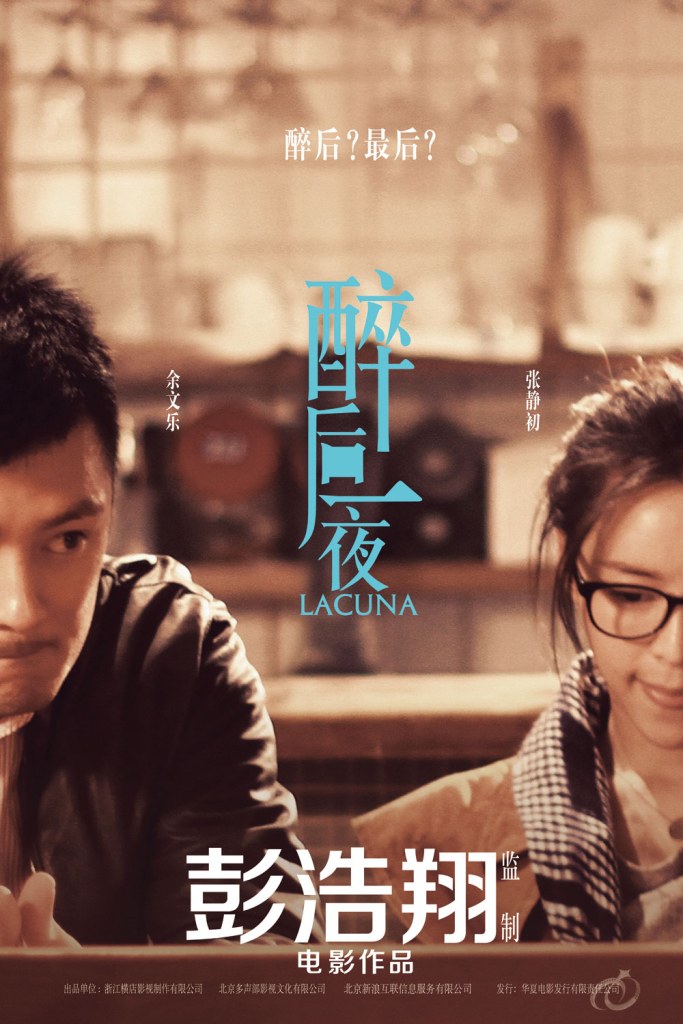
Lacuna (醉后一夜, Derek Tsang & Jimmy Wan, 2012)

lacunaWaking up in a strange place with absolutely no recollection of how you got there is bad enough. Waking up next to a total stranger is another degree of awkward. Waking up not in someone else’s apartment but in a department store furniture showroom is another kind of problem entirely (let’s hope the CCTV cameras were on the blink, eh?). This improbable situation is exactly what has befallen two lonely Beijinger’s in Derek Tsang and Jimmy Wan’s elegantly constructed romantic comedy meets procedural, Lacuna (醉后一夜, Zuì Hòu Yīyè). An extreme number of unexpected events is required to bring these two perfectly matched souls together, but the love gods were smiling on this particular night and, once the booze has worn off, romance looks set to bloom .

Shen Wei (Shawn Yue) and Tong Xin (Zhang Jingchu) wake up undressed and with their arms around each other, but with no recollection of what exactly led them to this position. Awkwardly dressing and getting ready to part ways as quickly as possible, the pair are stunned to realise they’re trapped in a department store. Things get weirder when Shen Wei gets back to his hotel room to find it full of passed out revellers before arriving at work where his co-workers have a lot of questions about the previous night’s activities which seem to have been live blogged on the Weibo account of a well known actress.

Meanwhile, Tong Xin has returned home to feed her cat, but remembers she was carrying a large amount of money that her boss wanted her to give to a woman in a bar, and she can’t remember what happened to it. Shen Wei has also forgotten where he parked his car but a more serious problem occurs when he’s contacted by the police who are very keen for both Shen Wei and his “girlfriend” to come and pick up the “pet” they were so keen to find the night before. Luckily Tong Xin’s Weibo account is linked on the photos so he manages to get in touch with her in the hope that she can help him figure out what on earth happened last night.

Rom-coms thrive on coincidences, but luckily for Shen Wei and Tong Xin, the stars have aligned to allow them to find each other in midst of the busy Beijing nightlife despite the fact that neither of them seem the type to be particular frequenters of it. Both are, in different ways, a little lost. Shen Wei is a mild mannered Hong Konger slightly adrift in the mainland capital, whereas Tong Xin has just gone through a (seemingly amicable but perhaps painful) breakup and is also at a crisis point in her unsatisfying career which has her playing errand girl to a hack director with a scandal hanging over his head in the form of a affair gone sour with the aforementioned Weibo-ing actress – Qiqi (Mia Yam).

An anonymous night of passion is an out of character surprise for both of these otherwise straight laced, serious minded city dwellers. Both hugely embarrassed and a little bit stunned, reconnecting was never a likely prospect. Forced to get together to try and figure out their respective problems resulting from the previous night’s activities, the pair get the chance to relive their initial whirlwind romance, perhaps leading to something deeper and more substantial than just a mad one night stand. Gradually piecing together the details including random lamas and licking bull frogs with gangsters, it’s clear the pair have shared a very strange night together though its conclusion in a romantic “dream” apartment helped to showcase bashful Shen Wei’s romantic side and if all of this really does go somewhere they’ll have a heck of a story to tell the grandkids.

The “lacuna” in the their memories wasn’t the only thing missing in their lives, though it has helped each to perhaps find something to plug some of those empty spaces. Both Shen Wei and Tong Xin are left looking for something literal, but also seeking something less tangible which may have just found them thanks to the improbable coincidence of both “enjoying” an out of character night of heavy drinking, brought together by their mutual inability to hold their drink. Elegantly photographed with its series of disparate locations from upscale nightclubs to grungy dive bars and dusty construction sites, Lacuna’s whimsical approach somehow makes all of this craziness seem perfectly plausible adding to the sweet and heartfelt tone and restoring faith in playful, genuine romance even in a busy and increasingly disconnected capital.


Original trailer (no subtitles)

Knife in the Clear Water (清水里的刀子, Wang Xuebo, 2016)

knife-in-the-clear-waterTharlo producer Wang Xuebo looks north in this rare cinematic showcase for China’s Hui people, a largely Muslim ethnic group concentrated in the rural North West. Using a cast of non-professional actors, Knife in the Clear Water (清水里的刀子, Qingshui Li De Daozi) marries a neorealist aesthetic with a Tarkovskian poetry as a widowed man faces the coming end of his own life largely through his self identification with his faithful bull, about to be sacrificed in the name of dead for the pleasure of the living. Setting religion to one side, this tale of rural poverty and people eclipsed by a landscape that’s as unforgiving as it is beautiful has an infinitely timeless quality even if this traditional way of life is just as moribund as the bull which drives it.
The family matriarch has died. Mild mannered paterfamilias Ma Zishan (Yang Shengcang) is now alone, bereft of both family and purpose. His wife may not long be dead, but there is the 40 day anniversary memorial to think of. Even if old Ma is not in the mood, Ma’s son, Yakub (Yang Shengcang – different actor, same name), is eager to make sure his mother has a fitting send off to mark her long years of sacrifice and toil. They could kill a chicken or perhaps a lamb, but with all the extended family coming in it might not be enough. Why not, he suggests, slaughter the family bull? They can’t afford to buy a new one, but the bull is already old and slow and no longer makes a good return on the resources needed to maintain it. Ma does not want this, but is powerless to refuse given all the financial and cultural concerns bound up in his son’s request.

All things considered, Ma had few pressing concerns in his life. He was not wealthy but he did not starve and does not seem to be unhappy in his lot other than his growing existential worries. Poverty is the normal way of things, but given the extreme need all around him, can Ma really conscience his son’s intention to spend lavish sums on a funeral feast which is intended to celebrate the dead – his own wife whom he would like honour, when his younger brother approaches him for rice in desperation at the thought of not being able to feed his pregnant wife? Touchingly, Ma visits a relative who relates a story of having met his wife in the marketplace not so long ago and lent her some money to buy a pair of shoes she’d been admiring. The woman meant to tease her by suggesting she ought to be able to buy anything she liked with her son’s fancy job in the city but could see Ma’s wife was upset as she sadly confessed that her son had his own family to think of and so she couldn’t bring herself to ask him for money.

Ma would have liked his son to return and farm the land as he, and generations before him, had done but Yakub tells him the life is so much better in the city – work is plentiful and much easier than tilling the soil in this inhospitable terrain. A scene of the family quickly whipping out the buckets and basins to harvest water during a sudden storm may reinforce the reasons he wouldn’t want to return but there is something serene about Ma’s simple life of prayer and farming which neatly contrasts with his son’s comparatively frenetic and nervous approach to life, caring more about the spectacle and less about the meaning.

This is perhaps why he acts so insensitively regarding the bull despite his father’s unusually sentimental attachment to it. Aside from being a long standing companion, as silent and pliant as Ma himself as they plough the fields and walk the mountain roads together, the bull serves to remind Ma of his own impending fate – an unwilling sacrifice to an unforgiving landscape. Ma, about to be put out to pasture himself, can see a kindred spirit in this weary beast, chained and cajoled, cruelly discarded now he’s outlived his usefulness. The bull, like Ma seems to be aware of his fate leading its master to wonder if, like the old story, it has seen the reflection of a knife in clear water warning of what is to come. No longer eating or drinking, the bull may not last until the fateful ceremony but whether its abstinence is a kind of self purification or a symptom of total despair, Ma is unable to say.

When the time comes, Ma turns away, wandering through the snowy, grave filled landscape alone until he finally becomes lost to us. The land swallows him, his chain may have been severed but he’s anything but free. Wang’s 4:3 framing is apparently inspired by Tarkovsky, as well as the painters Andrew Wyeth and Jean-Francois Millet, and his images do often have a classically inspired beauty reliant on static camera and noticeably contrived composition which may be at odds with the otherwise naturalistic approach. A sad tale of an old man and a bull contemplating the end of their world, Knife in the Clear Water is a familiar journey into the dying of the light but one no less well expressed for all of its subtlety and emotional weight.


Available to stream online from Festival Scope until 20th February 2017 in conjunction with International Film Festival Rotterdam.

Short clip from near the beginning of the film (English subtitles)

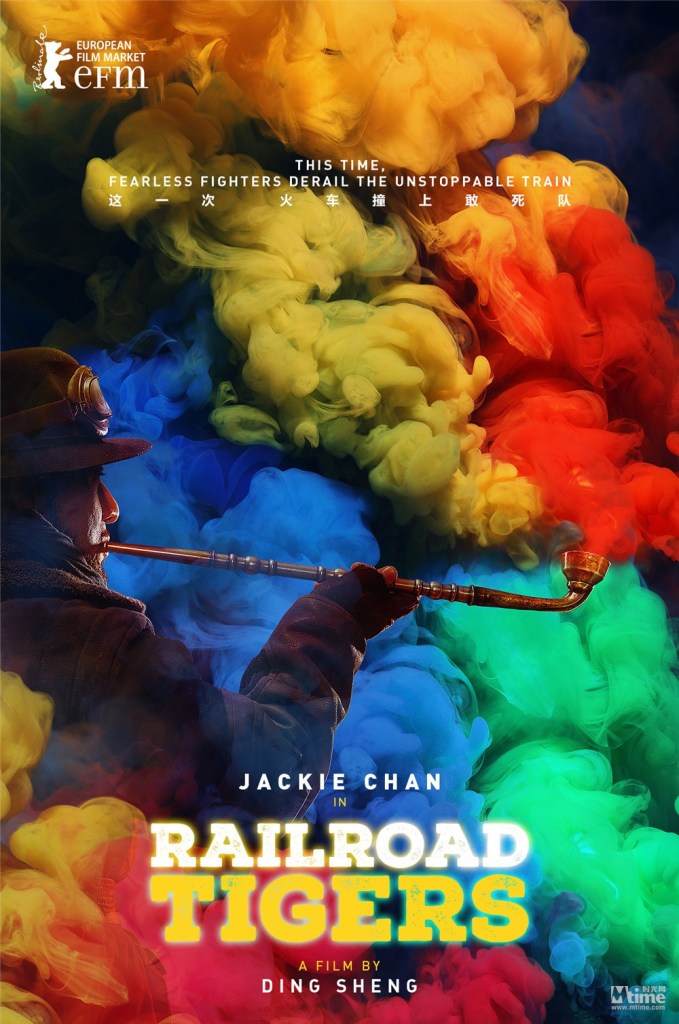
Railroad Tigers (铁道飞虎, Ding Sheng, 2016)

railroad-tigersTrains! They seem to be the latest big thing in Chinese cinema, but at least Railroad Tigers (铁道飞虎, Tiědào Fēi Hǔ) has more rolling stock on offer than the disappointingly CGI enhanced effort which formed the finale of The Vanished Murderer. The latest collaboration between the iconic but ageing Jackie Chan and director Ding Sheng, Railroad Tigers is a kind of western/war movie in which a gang of robin hood style railway bandits decide to get involved with the resistance movement during the ongoing Japanese invasion in 1941. Keeping the action to a minimum and stepping into the background for this comedy ensemble caper, Jackie channels Keaton but makes sure to backup this humorous yarn with a degree of pathos for these fatalistic patriots.
Ma Yuan (Jackie Chan) is a railway worker at a large interstation currently operated by the Japanese. He and his men hatch elaborate plots to raid the incoming supply trains for foodstuffs and Japanese military equipment, but what they’re mostly doing is laughing at their captors rather than actively opposing them. When they return home one day to find a wounded resistance soldier collapsed in their courtyard, the game changes as they decide to help him complete his “secret” mission to blow up a local bridge. Eventually teaming up with a local noodle shop owner who used to be a dashing, sharp shooting hero bodyguard for a defeated warlord, the gang take on the entirety of the Japanese military in Manchuria armed with little more than good humour and hope.

If you were hoping for a nuanced take on the Japanese forces operating in China in the quite climactic year of 1941, you’d best look elsewhere because Railroad Tigers is another bumper outing for the “comedy Kempeitai” who, on the basis of the evidence here provided, could not successfully occupy their own uniforms for any great length of time. Hiroyuki Ikeuchi plays the local commander, Yamaguchi, with the necessary degree of moustache twirling, scenery munching hamminess which the ridiculous set up requires before being joined by the evil and improbable presence of a top female Kempeitai officer, Yuko (Zhang Lanxin), who mostly exists to provide the icy steel so obviously absent from her completely ridiculous countrymen. By and large the gang’s opposition pose very little real threat from the stationmaster who’s always in trouble for smiling too much, to the buffoonish soldier who fails to complete his harakiri because it looks too painful.

Somewhere between the classic western train robbery set piece and the derailment dramas familiar to the resistance movie, Railroad Tigers positions itself as a broad comedy in which it’s slapstick humour rather than high octane thrills which take centre stage. Thus Jackie takes down opponents by jokingly unloading their guns or accidentally knocking them over the side of the train. Enemies are downed as much by trickery as by skill, with several meeting an ignominious end such as being shot in the bum or simply running away. What it lacks in innovative action, Railroad Tigers makes up for with silly comedy set pieces making the most of the real-life father son comradery between Jackie and the recently disgraced Jaycee such as in a slapstick interrogation sequence where they argue about their distinctive noses and which of them is the most handsome.

Wildly uneven in terms of pace, Railroad Tigers takes its time to get moving as we’re introduced to the members of Ma Yuan’s team and their various oppositing counterparts, many of them under drawn in the already crowded rosta. Ding signposts each of the major players with a comic book style illustrated splash featuring names and occupations which is echoed in the stylishly illustrated title sequence and handful of animated segments which follow as well as in the video game style mission heading title cards. Inexplicably, the film begins with a modern day framing sequence of a young boy on a school trip to a train museum in which he wanders off and climbs inside a train, finding the flying tiger marker chalked on the coal hatch. Otherwise redundant and offering little concrete value, the sequence seems only to exist as an excuse for a ten second cameo from one of Hong Kong’s biggest stars. Still, even if far too long, old fashioned in execution and occasionally plagued by substandard CGI, Railroad Tigers does offer enough silly humour and low stakes action to make it fun for all the family, even if guilty of overdoing the patriotic fervour in its lightweight approach to a traumatic era.


International trailer (English subtitles)

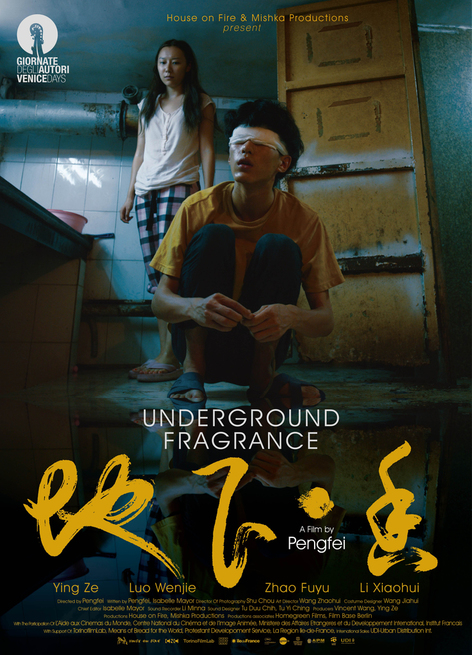
Underground Fragrance (地下・香, Pengfei, 2015)

underground_fragranceThe original Chinese title of recent Tsai Ming-liang collaborator (Song) Pengfei’s debut feature 地下・香 (dìxìa・xiāng) has an intriguing full stop in the middle which the English version loses, but nevertheless these two concepts “underground” and “fragance” become inextricably linked as the four similarly trapped protagonists desperately try to fight their way to better kind of life. Recalling Tsai’s dreamy symbolism, Hou Hsiao-Hsien’s romantic melancholy, and Jia Zhangke’s lament for the working man lost in China’s rapidly changing landscape, Pengfei’s film is nevertheless resolutely his own as it chases the ever elusive Chinese dream all the way from dank basements and ruined villages to the shiny high rise cities which promise a tomorrow they may never be able to deliver.
Yong Le (Luo Wenjie) is just one such young man, trying to buy a future by raiding the past. He has a small van he uses to “reclaim” furniture and sell it second hand. One day he has an accident whilst working which costs him his sight. Finding it difficult to manage in the cramped, noisy corridors of the subterranean cavern he is currently living in, Yong Le strikes up a friendship with his kindly new next door neighbour, Xiao Yun (Ying Ze), who helps him with some of his everyday problems like telling the time and finding food. Xiao Yun is currently working as a pole dancer in a seedy club which she longs to quit and is hoping to bag a salesgirl position at a new development office.

Yong Le is also friends with an older man, Lao Jin (Zhao Fuyu), who lives above ground with his wife (Li Xiaohui) in a large, old fashioned courtyard style house. Lao Jin and his wife are the only remaining residents of the village, the rest of which has been knocked down already after the other homeowners settled with the development company for what they considered the best deal they could get. Lao Jin, however,  thinks it’s worth holding out and has been “in negotiations” for eight years. Dreaming of a mega payout he can use to by a fancy city flat and be a big shot at last, Lao Jin has already run through his savings and is dangerously close to losing everything.

In a rather pointed piece of symbolism, Xiao Yun walks past a large mural with the slogan “Run Towards Your Dreams” prominently displayed in the middle. Later, this same wall will be reduced to rubble, a handful of brightly coloured stones marking the spot where once a village stood. Xiao Yun and Yong Le have very different dreams to those of Lao Jin, reflecting the way that even aspiration has shifted with the generations. He wants the fancy penthouse life for himself and his wife, even if it means selling their furniture and sacrificing his wife’s beloved white rooster, but all Yong Le and Xiao Yun want is out of the dingy basement and into a cleaner sort of life.

Yong Le and Xiao Yun may begin to fall in love during his period of blindness, but it’s a luxury neither of them can afford. There’s a slight irony in the fact that Xiao Yun who’s come to hate the men who visit her bar, some of them trying to buy more than a show, becomes attached to a man who cannot see her, but her desperation to escape her dead end life before it’s too late means she can’t afford to hang around for romance to bloom. A heart stopping moment sees the sight restored Yong Le unexpectedly end up at the bar where Xiao Yun dances, but having been blind the entire time he knew her, he doesn’t recognise the woman on stage (though to his credit he does not particularly look). Pulled apart by the increasing harshness of the economic environment, romance is an unattainable dream for those like Yong Le and Xiao Yun, drifting around from one thing to the next barely able to touch the ground let alone live on it.

Pengfei’s camera operates with a formalist grace, putting architecture at the forefront of his storytelling. From the ruins of a village to lie of the as yet unfinished high-rise future and the dank, dangerous underground world of the casual drifters always aiming for something better, the landscape gives voice to the often despairing nature of life on edges of a society where the rate of change threatens to leave vast swathes of its citizens behind. Adding a touch of the surreal such as a supremely timed return of the electricity in which Lao Jin’s attempt to oust a noisy owl with fireworks lines up with his peking opera record, or the couple’s later attempt to woo the developers with a musical performance of their own (another demonstration of the way their old world customs have become obsolete), Pengfei undercuts the ever present melancholy with a dose of whimsical irony. Wistfully romantic, and dreaming of a better, fairer society Underground Fragrance is a snapshot of a world in flux in which even the most essential of human connections can become lost in the crowd of faces all running towards tomorrow.


Currently screening for free on Festival Scope as part of their Torino Film Lab selection.

Trailer from Venice (English subtitles)

De Lan (德蘭, Liu Jie, 2015)

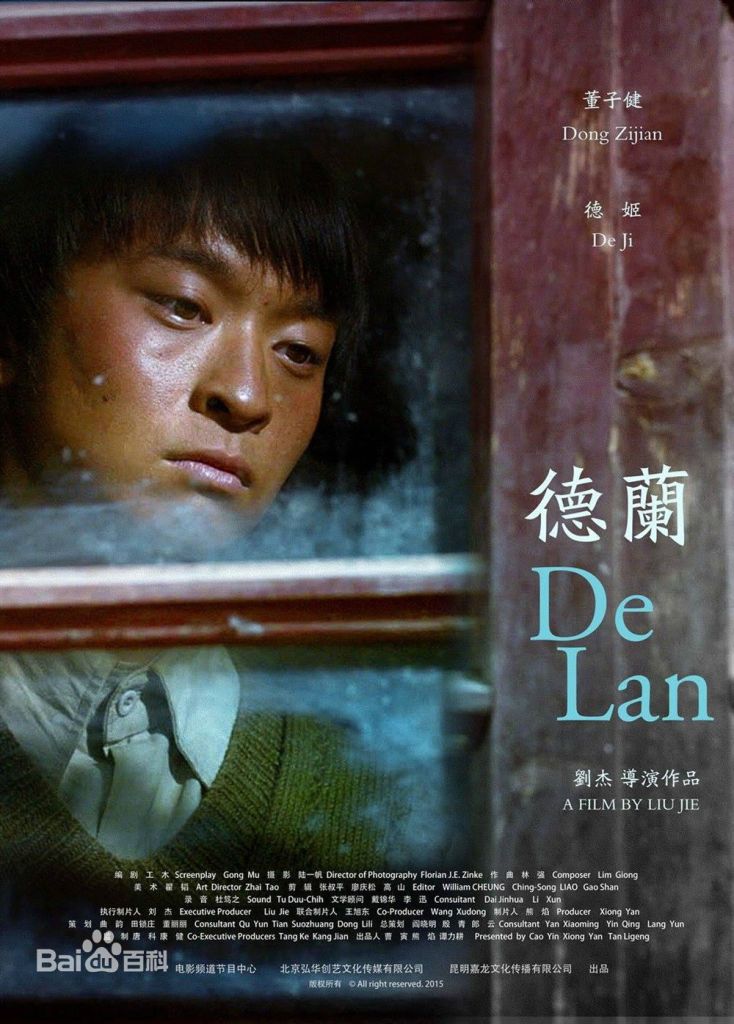
Set in 1984 in a rural Chinese backwater, De Lan (德蘭) is named not for its central character, but for his first love – a mountain woman far from home in search of a missing relative. Tasked with following De Lan (De Ji), Wang (Dong Zijian) finds himself entering a strange new world which he is incapable of fully understanding, not least because he doesn’t speak the language. A wordless love story between the tragic De Lan and the adolescent Wang is destined to end unhappily, but will affect both of them in quite profound ways.
Wang’s father has been missing for three months, and what’s worse is that around 2000 yuan went missing with him. Mr. Wang had been the loans officer for the local party office in this dreary mountain town and now the best idea anyone has come up with is for Wang to take over the position and pay back the missing money with deductions from his wages (this should take around ten years). Hardly fair, but what can you do? Wang’s first assignment is to take an audit of a mountain town where the residents have a lot of outstanding payments. Seeing as they’re heading to the same place, Wang is to accompany a mountain woman, De Lan, who had been travelling around local towns looking for a missing person but has now run out of money and must go home alone.

Wang is told to trust De Lan when it comes to the terrain, but that he should keep control of the food supplies in case she tries to run off. All things considered, the people at the foot of the mountains, aren’t very well disposed to those at the top. Wang is young and unused to walking such long distances, frustrating De Lan with his inability to keep up and frequent needs to rest. Nevertheless a kind of mutual affection seems to build up between them but largely goes unspoken and unacknowledged. Finding himself installed in De Lan’s home, Wang begins to feel very awkward indeed, unable to work out the strange family dynamic between the gruff man with the lame leg, ancient blind old woman, and the feisty De Lan.

Wang has, after all, been sent to the town to collect on loans – an entirely pointless enterprise as no one here has any money. Wang’s father was a much loved presence, mostly because he always came with cash and never pressed them on repayments. His son, with a father’s debt around his neck, is not quite so nonchalant. Calling a village meeting with no notice, Wang makes it clear he won’t be following his father’s lax approach and will not be issuing any new loans, rather he will be calling in the old ones. This does not make him popular in the village.

Eventually he changes his mind and decides to flash some cash but his worst assumptions are confirmed when the villagers, far from using the money they claimed to so desperately need to survive to invest in their businesses, club together to buy all the booze in the surrounding area and have a giant party. Originally put out by their trickery and De Lan’s ongoing unavailability, Wang suddenly finds himself trying some of their liquor and joining in with a dance around the fire. Perhaps learning to adjust to the Earthy, less ordered way of life, Wang has embraced the new found freedom of the place, but he will also discover that it only runs so deep.

De Lan’s life has undoubtedly been a difficult one which she faces with stoic resignation. Shared between two men and longing only for a child, De Lan has very little say in anything that happens to her yet she was able to set off all alone to look for her missing person. During the trip, De Lan is dismayed when a teenage boy in a home they spend a night in makes a vulgar comment about her body, leading her to try to leave as soon as possible only for Wang to pledge his protection. De Lan is aware of the dangers of the road, as well as the constraints placed on her life, whereas as Wang is still naive enough to think his physical strength and government position would be enough to keep De Lan any safer than she would be alone.

As Wang’s feelings for De Lan grow he fantasises about saving her from this strange, cold household though he barely stops to ask himself if saving is really what she wants. Unable to speak the local dialect, Wang necessarily needs to rely on look and gesture which is largely how he and De Lan have come to communicate – a pure kind of dialogue without need of words. Wang’s love for De Lan is destined to cost him dearly both in financial and emotional terms. A beautifully sad tale of frustrated first love set against the picturesque Chinese countryside and inside it’s much less pretty political system, De Lan is the story of one man’s transition from adolescence to manhood through heartbreak, filled with quiet, yet intense, emotion.


Reviewed at the 2016 London East Asia Film Festival.

Trailer (English subtitles)

Mission Milano (王牌逗王牌, Wong Jing, 2016)

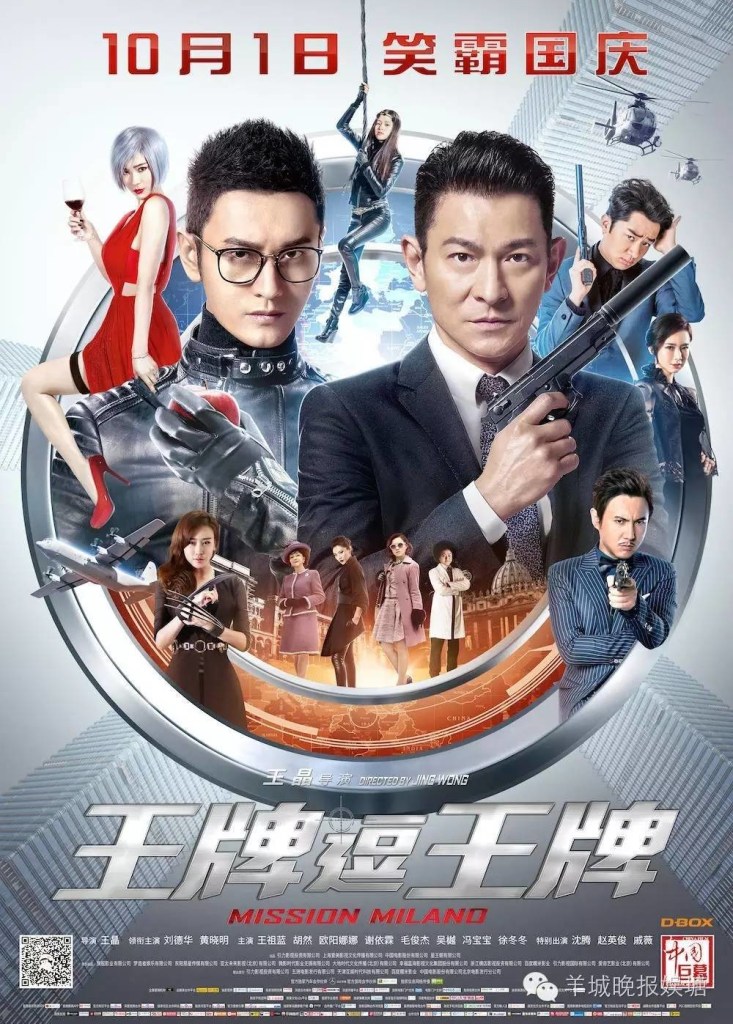
mission-milanoDespite its title, Mission Milano (王牌逗王牌, Wángpái Dòu Wángpái) spends relatively little time in the Northern Italian city and otherwise bounces back and forth over several worldwide locations as bumbling Interpol agent Sampan Hung (Andy Lau) chases down a gang of international crooks trying to harness a new, potentially world changing technology. Inspired by the classic spy parodies of old, Wong Jing’s latest effort proves another tiresome attempt at the comedy caper as its nonsensical plot and overplayed broad humour resolutely fail to capture attention.

The film opens with its strongest scene as Andy Lau’s bumbling Interpol agent Sampan Hung escapes from a Parisian hotel room after being attacked by a machine-gun wielding, cross-dressing French maid. Like much of the rest of the film this sequence is not particularly connected to the subsequent goings on, but on his return to China Hung begins investigating reports that a top technology firm run by the descendants of a famous Robin Hood inspired criminal is about to unveil a new bio product known as Seed of God. During the meeting, the Swedish professor presenting the research is kidnapped by a Japanese vigilante group known as Crescent which Hung believes is working for the evil worldwide organisation KMAX. Teaming up with the tech firm’s CEO Louis Luo (Huang Xiaoming), Luo’s sister (Nana Ouyang), and sidekick (Wong Cho-lam), Hung sets out to retrieve the technology before it falls into the wrong hands.

Seed of God is a bioengineered crop which can flower even if thrown on stony ground. All it needs is water and away you go – instant mango tree wherever and whenever you want. This discovery could end world hunger, but it would also be very bad news for anyone involved in traditional agriculture. Hung and Luo recognise the danger and neither want to see this new technology end up with KMAX who would not be particularly interested in applying it ethically.

Originally reluctant teammates, Hung and Luo build up a buddy buddy relationship through competitive games before eventually agreeing to work together. Luo does most of the hardline fighting while Lau’s Hung backs him up with splapstick-style comic relief. Though often mildly exciting, the action sequences have a comedy vibe dominated by Hung getting thrown into ladies’ bathrooms or knocked back on his behind by a skilled lady assassin while Luo keeps losing his glasses to a particularly mean opponent. Unfortunately, Wong relies heavily on CGI for many of the action set pieces beginning with the obvious rooftops of Paris backdrop, right up to the sports car meets heavy duty lorry incident in the middle and aeroplane based finale.

The humour itself has a heavily retro feel filled with sexist jokes such as Hung crashing into hotel bedroom containing a confused topless woman in the opening sequence and a seduction section in the middle in which a key asset is wooed using her teenage love of Alain Delon and supposed desperation for male attention. Hung is clearly modelled on Bond and even has the agent number 119 though in truth he’s more like Maxwell Smart meets Inspector Gadget with his clean cut nerdiness and ubiquitous trench coat. He even has a Q-style tech specialist (named Bing Bing so we have the “classic” Li vs Fan joke) who’s made him a killer phone with every kind of spy feature conceivable including lightsaber, but can’t actually make a phone call. Add in genre tropes of unusual weaponry and laser filled corridors, and Mission Milano is looking very uninspired.

Despite its Italian destination, Mission Milano employs a frequent musical motif that it is distinctly Spanish – another clue to how all at sea the film is in terms of coherence. A minimal stab at romance between Luo and a friendly agent on the other side, and Hung’s ongoing pining for his ex-wife who left him because his world saving habit was just too stressful, attempt to add some character drama to the piece which remains lukewarm in approach to its cast. Lau turns in an uncharacteristically large performance, grinning and gurning his way through the lacklustre script,  but not even his presence can heal the many problems plaguing the film. Never as funny as it desperately wants to be Mission Milano is a trying experience which, although intermittently amusing, (thankfully) proves instantly forgettable.


Original trailer (English/Traditional Chinese subtitles)

What’s in the Darkness (黑处有什么, Wang Yichun, 2015)

whats-in-the-darknessFirst time writer/director Wang Yichun draws on her own experiences for What’s in the Darkness (黑处有什么, Hei chu you shenme), a beautifully shot coming of age piece with serial killer intrigue running in the background. Seen through the eyes of its protagonist, What’s in the Darkness neatly matches the heroine’s journey into adolescence with the changing nature of Chinese society.

In May 1991 a series of horrific killings rock a small, rural town. Schoolgirl Qu Jing (Su Xiaotong) learns of the first murder of young and popular girl from the village when her policeman father Zhicheng (Guo Xiao) is called to investigate. A crowd has gathered around the crime scene where local women gossip and speculate, assuming the poor girl must have been raped and then murdered to prevent her going to the authorities.

Unaccustomed to such violent crimes, the police get busy but predictably lack the expertise to properly investigate. Zhicheng is unusual among his peers as he has a university degree and is keen on deduction, but his colleagues think his efforts are just going to make trouble for everyone and quickly decide on a suspect to beat a confession out of so that they will be seen to have done something. This plan goes haywire when a second murder occurs whilst the accused is in custody leaving the police with no option other than to allow him to “escape”. When one of Jing’s friends, whose estranged father is also a policeman, goes missing the stakes are raised but the possibility of successfully solving the crime seems increasingly remote.

Many things were changing in 1991, even in small rural towns. Jing is a wide eyed, naive and innocent girl with an intense curiosity and an ethereal nature which sets her apart from her more ordinary schoolmates. Her best friend, Zhang Xue (Lu Qiwei), is a slightly older, more mature girl ostracised by her peers who have decided that she is, in some way, immoral. Living within an extremely repressed society, Jing has very little concrete knowledge about sex or relationships – she even had to look up the word “rape” in a dictionary after hearing it at the crime scene because she’d never heard it before. Her only other information comes from pamphlets about pregnancy (with which she seems to be strangely fascinated) and her attempts to get more information out of the supposedly more experienced Xue backfire when she realises they’re both as clueless as each other.

Jing’s big hobby involves heading out to a disused factory area and singing pop songs to an imaginary crowd (and a boy who’s secretly watching her from the shadows). When she and Xue visit a hair salon there are pictures of movie stars all over the walls and the TV shows the fluffy pop entertainment of the day rather the propaganda films Jing’s parents might be more used to. Having lived through the Cultural Revolution, Jing’s mother and father have experienced far more hardship than she could ever know. Jing can’t understand their preoccupation with food, but to those who’ve experienced the threat of starvation, the presence of a full rice bowl makes almost anything endurable. Trained to keep their heads down and make sure they eat, the villagers of Jing’s parents’ generation are determined to maintain the status quo, even if it means continuing to reinforce the old values in order to avoid reprisal.

The trappings of communism are everywhere from the school room where the kids rehearse patriotic songs under banners of Marx, Engels, Lenin, Stalin, and of course Mao, to the security forces lurking in the background. Representing the state, the police force is staffed by a collection of lazy, corrupt petty officials content to throw their weight around in the absence of any real crime to deal with. Zhicheng refuses to engage in the same level of corruption as his comrades, but his honesty and steadfastness only arise resentment. Jing finds herself experiencing the same phenomenon when the headmaster finds out about her volunteering at the old people’s home and decides to give her an award thereby singling her out in front of her friends and irritating her harsh and grumpy teacher.

It’s at the old people’s home that Jing encounters her first randy old man when one of the residents she’s been asked to read to suddenly swaps out the book she’s been assigned for a probably banned erotic classical text with the only saving grace that Jing, even if she can read all the characters, does not quite understand what she’s reading.

Through Wang’s camera every man in town begins to look suspicious from the ice lolly seller eying up the behinds of the school girls as they walk away from him with their frozen treats, to an odd looking man with physical ailments who is often seen lurking in the background behind Jing. Visiting a friend’s house, Jing is unceremoniously dumped into a backroom when the older brother turns up with a porn film only for the house to be raided and everyone arrested. In a quest to finally find out what all of this is about, Jing buys a ticket for an adult movie from a man positively overjoyed at the idea of sending an underage girl into a room full of sweaty guys who all instantly turn away from the onscreen action to stare at the anomaly of Jing as she openly weeps at what she sees.

One of the benefits that communism claimed to bring was equality between the sexes. Women may hold up half the sky, but they still have to conform to an arcane set of social mores whilst they do so. Zhicheng forces Jing to ride sidesaddle on his bicycle rather than sit with her legs open and when she complains to him about the guy watching her sing, he tells her it’s all her fault for dressing in too alluring a manner. The murdered women are posthumously berated for their decision to be out on their own despite the fact that at least one of the killings must have occurred in broad daylight and when one of Jing’s schoolmates is feared to be the latest victim, their teacher reminds them that this is the kind of thing that happens when you fall in with a bad crowd. The police avoid serious investigation not only because they are lazy and corrupt, but because this kind of state sanctioned sexism is a tool they themselves (even if unwittingly) use to keep their womenfolk where they want them.

The identity of the murderer becomes irrelevant, this world is killing young women and it’s getting away with it because nobody cares. The women who die are written off as tainted, a lesson in failed femininity and evidence of what can happen if you don’t play by the rules. Little attention is paid to the perpetrator of the crimes who may also be a victim of this repressive environment as his desires are refused any other outlet than violence.

Although beginning in the vein of a serial killer movie, What’s in the Darkness is, at heart, a coming of age tale and social issue film. The era has shifted as the fear and austerity of the Cultural Revolution gives way to rising consumerism, placing a wedge between Jing’s generation and that of her parents. Wang rejects the classic procedural ending, leaving only questions in place of answers. As Jing stands alone with a little dog in her arms in the film’s final scene, she looks almost like Dorothy before the Emerald city as she plunges deeper into the reeds in search of answers, most definitely not in Kansas anymore. Jing’s eyes have been opened, her curiosity remains intact and unsated, as she alone remains unafraid to look at what’s really waiting for her out in the dark.


Reviewed at the BFI London Film Festival 2016

Original trailer (Chinese subtitles only)

The Vanished Murderer (消失的凶手, Law Chi-leung, 2015)

vanished-murderWhen The Bullet Vanishes was first released back in 2012, the film received unfair criticism in some quarters due to its enormous debt to Guy Richie’s then popular Sherlock Holmes. Derivative or not, The Bullet Vanishes remains an innovative and intricately plotted cerebral thriller, primed to launch the return of its central detective, former prison warden, Inspector Song (Sean Lau). Only slightly late, Song is finally back to address another series of baffling deaths and conspiracies in 1930s China only this time he’s landed in a pulpy LA noir rather than the cowboy-tinged action of the previous film.

The Murderer Vanishes (消失的凶手, Xiāoshī de Xiōngshōu) revolves around Song’s Irene Adler figure, Fu Yuan (Jiang Yiyan), whom we saw Song making frequent prison visits to in The Bullet Vanishes. Song is called to the prison because Fu Yuan has mysteriously disappeared from her cell leaving only a Shawshank Redemption inspired red herring behind her. The strange bond between Song and Fu Yuan in which they chastely dance around each other in the ultimate long distance romance, dictates that Fu Yuan send him a letter to tell him exactly where she is so he can come and arrest her all over again.

After a hot date at the cemetery, Fu Yuan takes Song to a philosophy lecture in which the speaker, Professor Hua (Gordon Lam), muses on a thought experiment in which he discusses the ethical problem of making an active choice to sacrifice one life in order to save multiple lives and whether making such a choice is any different from committing a murder – i.e. pushing another person in front of a moving train to stop it hitting a crowd further up the track. The experiment is eerily echoed when a body falls out of the sky just as Song is about to re-arrest Fu Yuan, allowing her to once again slip away.

Song investigates and is arrested only to be recruited to solve the mystery of why so many of the workers at evil corporate boss Gao Minxiong’s (Guo Xiaodong) string of factories are suddenly leaping to their deaths whilst wearing shirts bearing slogans which decry him as a slave driver.  Song is assisted by the girl he jilted at the alter eight years ago with whom he was improbably reunited on the train, Chang Sheng (Li Xiaolu), and a local policeman, Mao Jin (Rhydian Vaughan), as well as the philosophy professor but somehow this must all be linked to Fu Yuan’s mysteriously timed prison escape.

The biggest departure The Vanished Murderer has to deal with is the absence of co-star Nicholas Tse. Rather than give Song a new partner or attempt to ditch the buddy format altogether, Tse’s role has been awkwardly split into four with Song surrounded by his cohorts of varying stripes but never achieving the same kind of bond that made The Bullet Vanishes so satisfying. Many of the first film’s plot elements are also ported over wholesale, rehashing the same political subplots and betrayals but without the subtlety.

One again we have an exploited work force of factory workers suffering at the hands of a heartless capitalistic sociopath. Gao Minxiong is seen early on collaborating with a British businessman who warns him about the effects of the depression only for Gao to explain the “measures” he’s taken which include burning harvests to increase demand and therefore drive prices up, as well as closing factories to increase competition for jobs and therefore drive wages down. Gao also has a private militia he uses for strike breaking and indiscriminate massacre. The people suffer while the elites prosper, it’s an old story.

The Bullet Vanishes may have had one foot in the Old West, but The Vanished Murderer has stayed in the same geographical area whilst jumping fifty years into the future in terms of tone. Gone are the lawless, dingy back alleys and saloons – The Murderer Vanishes takes place under bright sunlight, in an airy city surrounded by green country estates. Song has even switched up his zany bowler hat from the first film for a wide brimmed fedora and the musical score also pulls in some Spanish guitar to ram home that West coast style. This is a land of flappers and jazz babies, filled with art deco elegance and international flair.

For all that it’s a pulp world too and as such exempts itself from the need to make any kind of real sense. The central mystery is nowhere near as compelling as that of The Bullet Vanishes and resolves in a less than satisfactory manner. In the great pulp tradition action set pieces become increasingly ridiculous until the point Song and Fu Yuan attempt to escape by riding a horse through a building. The film’s finale takes place entirely on a train and does at least make good use of its CGI budget even if it’s a disappointingly simple way to conclude.

A slight misstep after the well plotted charm of The Bullet Vanishes, The Vanished Murderer can’t live up to the promise of the first film. The relationship between Song and Fu Yuan ought to take centre stage but the pair spend too much time apart to make it work and the film kills off a promising ongoing plot strand for the sake of cheap melodrama in the closing moments. Still, The Vanished Murderer provides enough thrills of its own even if lighter in tone and with a weaker central mystery to make the continuing adventures of Inspector Song worth investigating.


Original trailer (Mandarin with English subtitles)