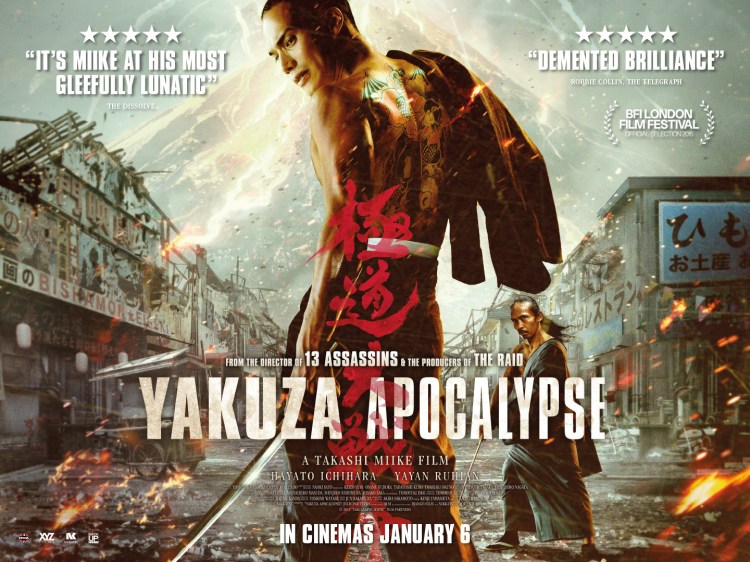
Yakuza Apocalypse (極道大戦争, Takashi Miike, 2015)

Yakuza-Apocalypse-Quad-HalfSize-NEWBelated review from the 2015 London Film Festival – Yakuza Apocalypse is released in UK cinemas for one day only on 6th January 2016 courtesy of Manga who will also be releasing on home video at a later date.


Takashi Miike shuffles back towards the yakuza plains in the western inspired horror comedy Yakuza Apocalypse (極道大戦争, Gokudo Daisenso) trailing ever more zany humour behind him. Yakuza gungslingers, bloodsucking, high school girls running away from things and, finally, a guy with a magic belly button wearing a frog suit who just happens to be “The World’s Toughest Terrorist”.

We open in media res as vampire yakuza boss Kamiura (Lily Franky) cuts up a storm in settling some local disputes. There’s a handy voice over from our soon to be protagonist, Kageyama (Hayato Ichihara), lamenting the old yakuza world of tough guys and honour codes but things don’t really take off until a very geeky looking guy and a Van Helsing type in 17th century attire suddenly turn up hoping to re-recruit the boss to “The Syndicate”. When he refuses, they fight and the geek twists Kamiura’s head right off. Using his last ounce of strength and in a touch right out of Hausu, Kamiura clamps onto Kageyama’s neck turning him into a vampire. However, in his just turned state, the honourable Kageyama turns a few more vampires of his own – and not only vampires, the bite also transmits yakuzaism too. This increase in bloodsucking gangsters is a bit of a problem for the regular guys as it does mean their pool of victims is being steadily depleted…

Not making much sense is not generally much of a problem in a Miike film. In fact, it’s a pretty much a given at this stage of the prolific director’s career. However, in the case of Yakuza Apocalypse it’s even more pointless than usual to pay any attention at all to any kind of narrative. Looking over Kageyama’s shoulder, we move from set to piece to set piece as, first of all, the non-vampire yakuza guys struggle for power between themselves and then with the vampire variety before the giant frog turns up to ruin everything.

There are some rules, Miike takes a while explaining to us how this yakuza business works with Kamiura as the “good” kind of yakuza committed to protecting his townspeople above all else – essentially, he’s the sherriff around these parts. He’s a vampire, yes, but he only feeds on yakuza who he’s “reforming” by means of an underground knitting circle held prisoner in his basement. Apparently yakuza blood tastes bad and isn’t very good for you but eating civilians is dishonourable and anyway, limited in supply, because when you turn someone they also become a foul mouthed yakuza fighting machine.

The world building is shaky at best, none of this really hangs together making for a fairly disappointing series of one note jokes. There is an attempt at a bit of more sophisticated satire with the regular gangsters suddenly lamenting that there will be no one left for them to prey on if everyone turns yakuza vampire but otherwise it’s crazy piled on crazy. Not a bad thing in itself but somewhat lacking in substance.

Despite that, the film offers some quality performances notably from its lead, Kageyama, played by Hayato Ichihara, as the yakuza who’s so sensitive his delicate skin won’t allow him to get a proper yakuza tattoo. That is, until he becomes a brooding, conflicted vampire mourning the loss of his boss and of those long held tough guy ideals. Lily Franky also offers a high impact though short lived appearance as the honourable vampire boss with a hinted at backstory, though the much publicised cameo of The Raid’s Yayan Ruhian feels a little wasted as he’s just generally hanging around for a handful of fight scenes. That said, the action scenes themselves are extremely impressive, both exciting and often funny too.

Yakuza Apocalypse is not one of Miike’s most well thought out efforts. Its collection of crazy ideas feels thrown together and there’s disappointingly little depth to its world building. Even its media res conclusion looks more like running out of ideas than a deliberate decision. However, that’s not to say it isn’t heaps of fun, which it often is. A crazy frog riding a bicycle who somehow wakes up the giant king of the crazy frog people after some kind of emergency plaster is ripped off his belly button – really, what could be more fun than that? That really is all there is though and those who prefer their absurdist action thrills with a little more substance had best look elsewhere.


Yakuza Apocalypse is in released in UK cinemas for one night only on 6th January 2016. Luckily the film is playing across the UK even if it’s only the one night and you can see if it’s on anywhere near you by checking out this handy link! If it’s not, don’t despair! It’ll also be available in all the normal ways from Manga later in the year.

Reviewed at the 2015 BFI London Film Festival.
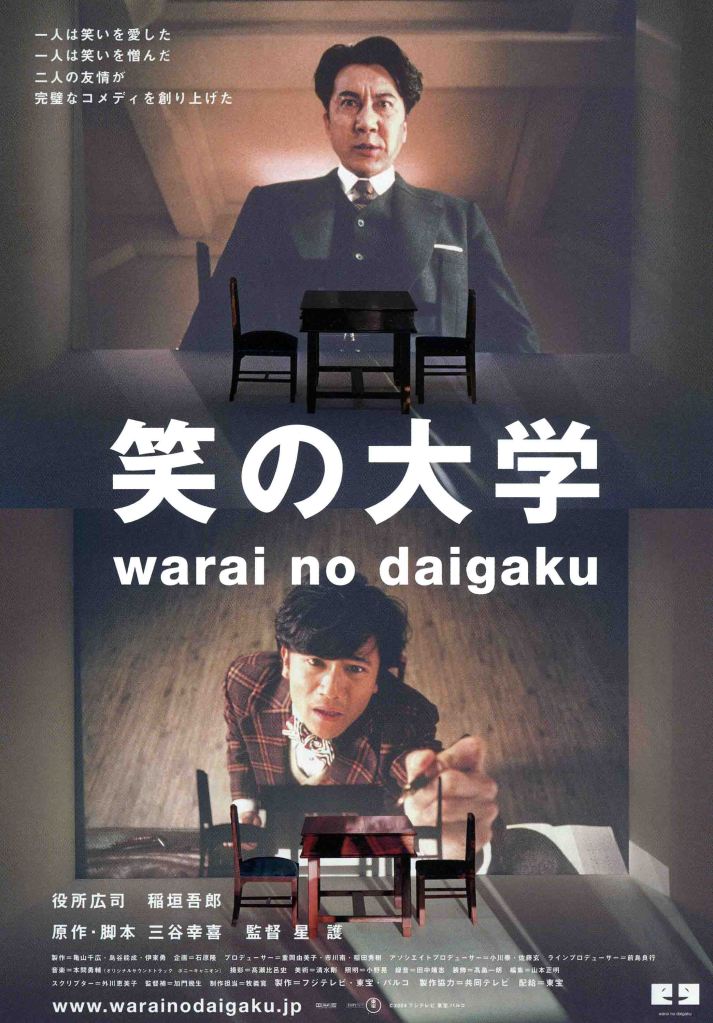
 

University of Laughs (笑の大学, Mamoru Hoshi, 2004)

warainodaigakuUniversity of Laughs (笑の大学, Warai no Daigaku) is certainly an apt name for a film which aims to teach the universal power of comedy. Based on a 1997 stage play by Japanese comedy master Koki Mitani and directed by Mamoru Hoshi, the film is set in 1940 at the height of Japan’s militaristic fervour. With the annexation of Manchuria only three years previously and the war in full swing, there is no room for such petty bourgeois pleasures as slapstick comedy shows. The censor’s stamp rules all and if the piece doesn’t exult the glorious nature of the empire, then what good is it?

Or so thinks recent Manchurian returnee Sakisaka (Koji Yakusho) – the newly appointed occupier of the censor’s chair. Sakisaka has been appointed because he has no sense of humour at all and very little in the way of human feeling. In fact, he even thinks this censorship business is a little pointless and it would be better to just ban everything outright. Then, one day, he encounters quite the stupidest piece of low comedy he’s ever come across in the form of the latest play by a company called “University of Laughs” written by their company director, Tsubaki (Goro Inagaki).

Tsubaki is a nervous, neurotic young man. “Don’t worry, we very rarely use torture” Sakisaka reassures him. Still, Tsubaki tries to talk him through his parodic play script called “The Tragedy of Juleo and Romiet”. However, Tsubaki’s play is no good at all! It’s full of foreigners! And there’s romance, and no one talks about how amazing Japan is, what the hell sort of play is this!? Sakisaka tells him to bring it back tomorrow with the requisite changes. However, tomorrow’s effort is only a little better. Maybe another day? Gradually over the course of a week the pair become uneasy collaborators as Sakisaka eventually rediscovers his sense of humour.

The central irony being that in trying to eliminate all subversive elements in the script, Sakisaka actually ends up in the position of editor – all of the changes he suggests only succeed in making the play funnier and more coherent. The more advice he receives from Sakisaka, the better a writer Tsubaki becomes. However, Sakisaka is the representative of everything the true artists abhors as the tool of an oppressive state which seeks to repress all independent thought. In going along with Sakisaka’s recommendations, isn’t Tsubaki becoming just another government lapdog? Is it better to compromise, go as far as you can go, and stay open or should you staunchly refuse and boycott the regime in its entirety?

For Tsubaki, comedy is a religion. He’s a comedy writer, if he can’t write comedies he may as well not exist at all and the way he sees it, this stuff is making the work better so who cares what it’s all about, really, so long as the work is good. His actors, though, feel differently and Tsubaki is paying a heavy price for his awkward quasi-friendship with the government stooge. Nevertheless, the two develop a strange bond with the previously stiff Sakisaka bucking his rigid adherence to government doublespeak in opening up to Tsubaki’s comedic education. However, their friendship may not be as deep as Tsubaki hopes when he unwisely reveals his real feelings about the regime causing Sakisaka to remind him where his loyalties lie. This is 1940 after all and the spectre of war lies all around. In the end, even if Tsubaki’s now near perfect work is passed for presentation, he may be unable to realise it in person.

Consciously old fashioned, University of Laughs has echoes of Fellini though perhaps filtered through mid period Woody Allen. The Nino Rota-esque score further enhances the association as does the idea of the fascist state as a mad circus where one is forced repeat the same actions over and over again until the ringmasters finally applaud. Warm, witty and surprisingly engaging for a film that is essentially two guys in a room for two hours, University of Laughs is another impressive effort from the pen of Mitani which offers both a cutting critique of oppressive censorship, a defence of the artist and an exultation of the universal power of laughter.

Summer Time Machine Blues (サマータイムマシン・ブルース, Katsuyuki Motohiro, 2005)

summertimemachineblues-2There ain’t no cure for the summer time blues! Unless, of course, you have a time machine. For the boys of the sci-fi club the long, boring summer vacation is just getting started. They mess around playing baseball while the two girls from the photography club who’ve been unceremoniously ousted from their club room in favour of the boys take photos of them. Then some weird stuff starts happening and their air con remote gets broken and it’s just so hot! When the boys somehow end up with a mysterious time machine, the solution is obvious…

Full of nostalgic charm, Summer Time Machine Blues is a fitting tribute to all those endless, golden summers of adolescence. Hanging out in the university club room even though they’re on their summer break, the kids waste time in distinctly old fashioned ways – playing baseball, going to the baths, working on a photo project etc. Though the guys are nominally the “science-fiction club” they actually aren’t very interested in science fiction and kind of make fun of the sort of people who would belong to the very club that they do, actually, belong to. Perhaps they just wanted the bigger room with the air conditioner and were lucky enough to get it as their two female friends are the only two members of the photography club and mostly hang out in the dark room at the back anyway.

The film began as a stage play put together by Europa Kikaku and though it makes the cinematic jump extremely confidently also maintains its youthful absurdist tones and theatrical comedy beats. The humour itself is cheerfully bizarre, full of fast comebacks and naturalistic sounding banter between a group of young guys. Added to this there are numerous references to other popular science fiction and time travel themed franchises such as the obvious homage to the Back to the Future series which is even prominently showcased in poster form at the local rep cinema. The cinema itself (a mini plot point in the movie) is run by a total sci-fi buff and time travel story expert who dresses (from the waist up) in a Star Trek: The Next Generation Command uniform complete with Communicator Badge. He seems to have something of a beef with the only actual scientist in the film who never has much success with his discoveries and only succeeds in boring everyone around him with his needlessly complicated theories.

Directed by Katsuyuki Motohiro who may be best known for the Bayside Shakedown series, Summer Time Machine Blues, also mixes in plenty of fun stylistic devices like the anachronistic tape rewinds or the elaborate disappearing of the time machine itself. He also makes good use of split screens to compare and contrast what’s happening where and pays especial attention to make sure everything works out in the most completely satisfying way.

Indeed, one of the most satisfying things about Summer Time Machine Blues is that despite essentially becoming a parody of time travel movies, all of its complicated paradoxes are internally consistent and even though it doesn’t really have an obligation to, it all makes sense no matter how hard you poke at it trying to find the holes. Of course, there’s also the more melancholic side of time on show as the scientist points out he’s riding a time machine as well – just one that will never go backwards, only very slowly into the future. This aimless summer will end at some point, as will college and eventually the universe too, one supposes.

However, that’s no reason not to enjoy the time you have, as one character realises towards the end as he fears his romantic desires may come to nothing going on some hints from the future. An enjoyably absurd and youthful farce, Summer Time Machine Blues is lives up to its name as a transporting delight which carts the viewer back to their own days of long and boring summers filled with improbable adventures. Smart, funny and beautifully crafted, Summer Time Machine Blues is the perfect way to while away an aimless afternoon at any time of the year.


http://www.youtube.com/watch?v=pX51ppP5wg0

Miss Granny (수상한 그녀, Hwang Dong-hyeok, 2014)

131212-001_1401140436597Review of Hwang Dong-hyeok’s age swap comedy Miss Granny (수상한 그녀, Soosanghan Geunyeo) up at UK Anime Network.


Miss Granny is something of a departure for Korean director Hwang Dong-hyeok whose previous two films have both explored fairly weighty subjects firstly in The Father which, based on a true story, features an American adoptee looking for his father only to find him languishing on death row, and more recently in Silenced (also known as The Crucible) which depicted the harrowing, and again true, events that occurred at the Gwangju Inhwa School for the Deaf in which pupils were routinely abused by teachers and staff. So far as we know, Miss Granny is not based on a true story and is a more mainstream comedy in which a “difficult” old lady suddenly finds herself transformed into her 20 year old self.

At the beginning of the film, Oh Mal-soon is a bad tempered 74 year old woman who terrorises everyone around her into submission including her middle aged daughter-in-law who eventually lands up in the hospital with a heart condition that may in part have been brought on by Mal-soon’s constant criticism. Mal-soon’s son faces an impossible choice, ship his mother off to a home and give his wife some peace or risk losing either his marriage or his wife by keeping his mother around. Heartbroken at the thought her son maybe about to abandon her, Mal-soon wanders around the city before deciding to enter a mysterious portrait photographers and dolling herself up for a “funeral photo”. However, when she emerges she’s mysteriously transformed into a lithe and pretty 20 year old! Suddenly young again with potentially a whole life in front of her, what sort of choices will Mal-soon make this time around?

Much of the comedy of Miss Granny centres around the young Mal-soon, renamed Oh Doo-ri after her favourite actress, Audrey Hepburn, speaking and acting as if she really really were a 74 year old woman with all of the freedoms (and the invisibilities) that age grants you. Snapping away in her thick rural dialect and handing out unsolicited advice in the way only a nosy old woman can, Doo-ri is a very strange, and perhaps a slightly frightening, young woman. Undoubtedly, as we find out, Mal-soon has had a difficult life – starting out as an upperclass woman before becoming a young, penniless single mother dependent on the kindness of others and doing everything in her power to ensure that her son will grow up a fine man. Life has made her hard and in turn she makes things hard for all around her.

As a young woman she’s initially much the same yet comes to understand something of who she was and who she is. In her younger days she dreamed of being a singer and even as an old woman was well known for her fine voice. After unexpectedly jumping up to sing at a senior’s event in order to best another old lady rival, she’s “discovered” by a producer who’s tired of all the soulless idol stars who walk across his stage. Doo-ri is exactly what he’s been looking for, a young and pretty face with a voice that’s full of a lifetime’s heartbreak. Here is the real coup of the film – the younger actress, Shim Eun-kyung, reinterprets these classic pop songs from 40 years ago beautifully with exactly the right levels of pain and regret perfectly matching the montage flashbacks to Mal-soon’s youth. Becoming young again, experiencing everything again as if for the first time – opportunity, romance, friendship, Mal-soon finally begins to soften as if some of the harsh years of her original young life had been smoothed away.

Of course, nothing lasts forever and Mal-soon eventually has to make a choice between her newly returned youth and something else precious to her. She comes to understand that however hard it was she’d do it the same all over again because the same things would always have been the most important to her. Though it’s far from original and drags a little in the middle, Miss Granny still proves a warm and funny tale that walks the difficult line between serious and funny with ease and throws in a pretty catchy soundtrack to boot.


Reviewed at the London Korean Film Festival 2015.

Also here is one of the musical sequences in the film – I think this is a famous song from the ’70s (?) called White Butterfly. ‘Tis quite beautiful (mild spoilers for the film as it includes a montage of Mal-soon’s youth in the ’60s).


Veteran (베테랑, Ryoo Seung-wan, 2015)

1439210220_베테랑1Review of Ryoo Seung-wan’s Veteran (베테랑) – first published on UK Anime Network.


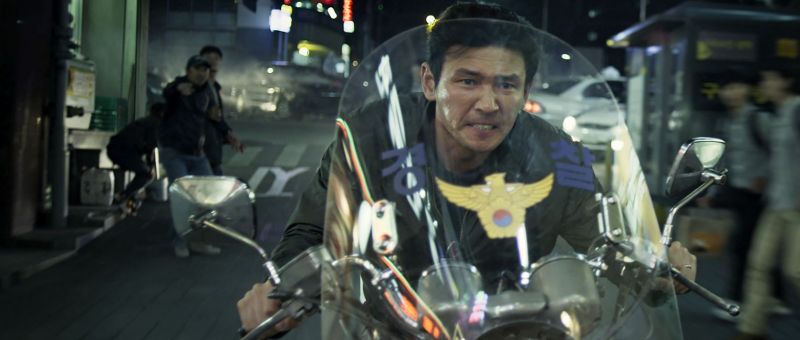
One of the top Korean box office hits of 2015, Ryoo Seung-wan’s Veteran is a glorious throw back to the uncomplicated days of ‘80s buddy cop crime comedy thrillers. A little less than subtle in its social commentary, Veteran nevertheless takes aim at corrupt corporate culture and the second generation rich kids who inherit daddy’s company but are filled with an apathetic, bored arrogance that is mostly their own.

Seo Do-cheol (Hwang Jung-min) is, as one other officer puts it, the kind of police officer who joined the force just to beat people up. He loves to fight and isn’t afraid of initiating a little “resisting arrest” action just to make things run a little more smoothly. However, when he strikes up a friendship with a put upon truck driver and his cute as a button son only to miss a crucial telephone call that eventually lands said truck driver in the hospital, Do-cheol’s sense of social justice is inflamed. After trying to join a trade union, Bae, the truck driver, is unceremoniously let go from his company. On taking his complaint directly to the head of Sin Jin Trading, play boy rich kid Tae-oh, Bae is subjected to the most cruel and humiliating “interview” of his life before apparently attempting to commit suicide after having realised the utter hopelessness of his situation. Incensed on his new friend’s behalf, Do-cheol is determined to take down these arrogant corporatists what ever the costs may be!

Veteran makes no secret of its retro roots. It even opens with a joyously fun sequence set to Blondie’s 1979 disco hit, Heart of Glass. Like those classic ‘80s movies, Veteran manages to mix in a background level of mischievous comedy which adds to the overall feeling of effortless cool that fills the film even when things look as if they might be about to take a darker turn. The action sequences are each exquisitely choreographed and filled with sight gags as the fight crazy Do-cheol turns just about any random object that appears to be close to hand into an improbable weapon.

Make no mistake about it either, this is a fight heavy film. Though Veteran has a very masculine feeling, it is to some degree evened out by the supreme Miss Bong whose high class high kicks can take out even the toughest opponents and seem to have most of her teammates looking on in awe, and the withering gaze of Do-cheol’s put upon wife who seems determined to remind him that he’s not some delinquent punk anymore but a respectable police officer with a wife and child who could benefit from a little more consideration.

Indeed, Tae-oh and his henchmen aren’t above going after policemen’s wives in an effort to get them to back off. Though this initial overture begins with an attempt at straightforward bribery (brilliantly dealt with by  Mrs. Seo who proves more than a match more the arrogant lackeys), there is a hint of future violence if the situation is not resolved. Tae-oh is a spoiled, psychopathic rich kid who lacks any kind of empathy for any other living thing and actively lives to inflict pain on others in order to breathe his own superiority. Probably he’s got issues galore following in his successful father’s footsteps and essentially having not much else to do but here he’s just an evil bastard who delights in torturing poor folk and thinks he can do whatever he likes just because he has money (and as far as the film would have it he is not wrong in that assumption).

He also loves to fight and finally meets his match in the long form finale sequence in which everything is decided in a no holds barred fist fight between maverick cop and good guy Do-cheol and irredeemable but good looking villain Tae-oh. Veteran never scores any points for subtlety and if it has any drawbacks it’s that its characterisations tend to be on the large side but what it does offer is good, old fashioned (in a good way) action comedy that has you cheering for its team of bumbling yet surprisingly decent cops from the get go. Luckily it seems Veteran already has a couple of sequels in the pipeline and if they’re anywhere near as enjoyable as the first film another new classic franchise may have just been born.


Reviewed at the first London East Asia Film Festival and the London Korean Film Festival.

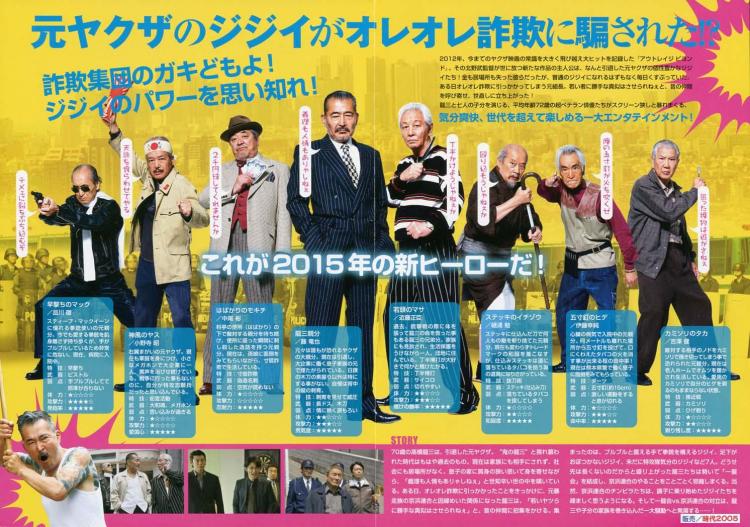
Ryuzo and the Seven Henchmen (龍三と七人の子分たち, Takeshi Kitano, 2015)

142984037484393493178_ryuzo-7nin-kobuntachi-g4First published on UK Anime Network – review of Takeshi Kitano’s Ryuzo and the Seven Henchman (龍三と七人の子分たち Ryuzo to Shichinin no Kobuntachi) from LFF 2015.


Most people probably know Takeshi Kitano best for his series of ultra violent ’90s gangster movies, his role as the sadistic teacher in the controversial Battle Royale or as the host of bizarre Japanese endurance game show Takeshi’s Castle. However, in Japan he’s probably best known as a comedian though few of his comedy films have ever made it overseas. This may change with his latest effort, Ryuzo and the Seven Henchmen, which both takes him back to his yakuza roots and celebrates his comedic talents.

Ryuzo “the demon” was once a yakuza more feared the than respected whose very name alone made women swoon and struck fear into the hearts of men. Now though, he’s a grumpy grandpa living with his ultra conservative son who’d rather the neighbours didn’t know he had a gangster living in his house. After some punks make the mistake of trying an “ore ore” scam on him, Ryuzo gets back into the spirit of his gangster days and takes the guy down in a classic intimidation play. However, some of his other yakuza buddies also seem to be getting into trouble with upstart youngsters and once again it’s up to Ryuzo and his seven old timer yakuza buddies to set the town to rights.

The world has changed since Ryuzo and his guys were ruling the streets. In the old days the yakuza were a family, they had rules and ethics and they stuck to them. They saw themselves both as heroic outlaws and as defenders of the rights of ordinary people (even if they made their money through extorting those very people they claimed to protect). This new brand of crooks doesn’t care about honour, or morality or human kindness – they aren’t above conning the vulnerable into falling for obvious telephone scams or loaning large amounts of money to desperate people at ridiculously high interest just to make a buck. These guys are “business men” running a “legitimate enterprise” where the only rules are that you get rich and stay rich.

Ryuzo and co may be old, but they still have their honour and their pride. Watching the old guys trying to relive their former glory days is often funny, if a little sad as their grand schemes take on the absurd quality of little boys playing cops and robbers. It goes without saying that the film is hilarious though perhaps takes certain instances of low humour a too little far. Each of the main eight old timer yakuza has his own particular strength which endures despite their advanced ages though perhaps in slightly different forms and even if they’re coasting on former glory none of them has forgotten their former status.

Though not quite a return to the artistic highs of Sonatine or Hana-bi, Ryuzo and the Seven Henchmen is nevertheless an entertaining mix of Kitano’s tough guy yakuza and absurd comedian personas. Unlikely to walk away with any awards or lasting praise, Ryuzo and the Seven Henchmen is sure to be remembered fondly for its expertly timed and often gleefully absurd humour.


Reviewed at LFF 2015.


Cute Girl (AKA Loveable You 就是溜溜的她 Hou Hsiao-Hsien 1980)

f_10046820_1If you’re familiar with the name Hou Hsiao-Hsien, it’s probably for his role in the Taiwanese new wave and as one of the major directors of so called “slow cinema”. It might come as a surprise then that his first three movies were pop star vehicles, heavy on catchy tunes and universal humour but light on deep themes and social commentary. However, even if everything about his first film Cute Girl is intended to be just another run of the mill populist rom-com, many of the elements from Hou’s later films are already present from long lenses and longer takes to interesting ideas about composition and a noticeable town/country divide.

The story is predictable enough, poor boy Da-gang falls for wealthy Wen Wen who quite literally doesn’t give him a second glance. That is until she runs off to stay with an aunt in the country for a last holiday before her father has her married off to the son of an important businessman. Da-gang coincidentally ends up in the same village as part of a survey team for a new road (that’s going to go right through the middle of someone’s house). Being Da-gang he also gets bitten by a caterpillar and ends up being left behind to recover whereupon he begins a tentative romance with Wen Wen at last! However, disaster strikes when her father calls her home to meet her prospective husband – will Wen Wen and Da-gang ever find the happiness they deserve? The answer’s sort of obvious but it’s still fun finding out!

The film features pop stars Fong Fei-Fei and Kenny Bee (from Hong Kong) and is unsurprisingly heavy on pop music including the title track which recurs several times throughout the film. Though Cute Girl is undeniably formulaic and intended as nothing other than disposable entertainment hoping to capitalise on its stars profile and sell a few more records, the film has undeniable quirky charm. Full of strange, not quite slapstick humour and silliness you can’t help but find yourself hugely invested in the screwball style love story of Wen Wen and Da-gang.

No, it’s not a film for the ages. It doesn’t tackle the deep themes Hou would return to time and again in his later career but it does have a degree of heart and commitment that make it a very enjoyable example of the late ’70s/’80s Taiwanese musical romantic comedies.

For the extra curious, here is the undeniably catchy tune itself!

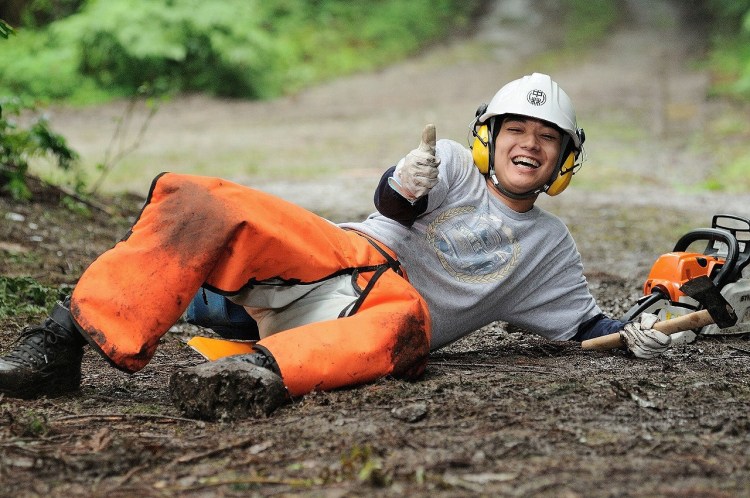
Wood Job! (Wood Job(ウッジョブ)神去なあなあ日常, Shinobu Yaguchi, 2014)

ff20140516a1aHe’s a lumberjack and he’s OK! Well, after a while anyway – climbing trees all day is not quite as much fun as it sounds in Shinobu Yaguchi’s latest comedy which sees a streetwise city kid randomly decide on a career on forestry. Not so much fish out of water as duck in a tree, Wood Job! is a heartwarming comedy drama which more than lives up to the puntastic comedy of its title.

Yuki Hirano is your typical slacker teenager. Like many guys his age, he’s run into something of a life crisis as he didn’t get into university and he hasn’t really thought about what to do. At first he thinks it’s no big deal, he’ll just take the tests again next year but after being abandoned by his girlfriend and seeing all his friends set off without him Yuki feels a little lost. That is until he notices a shiny magazine advertising a new life in the open air – “come and work with me!” it says next to a picture of a pretty girl. Yuki’s packed his bags and caught the next train before you can even say “Where’s the nearest combini”? but his new found occupation is a little more intensive than he was expecting and Yuki’s not sure he’s cut out for this no frills life. Then however he meets the girl from the advert herself – can Yuki really stick around long enough to convince her he’s not some city boy layabout but a real mountain man?

Wood Job! is that rare film that manages to mix a fair amount of slapstick comedy with the kind of naturalistic, everyday humour that can’t help but give it an endearingly warm quality. Taking the classic fish out of water approach as its basis, the film highlights the absurdity of country life (at least to eyes more accustomed to the city) but crucially never mocks it and seems to have a profound respect for the rural way of life and all that entails. Neither does it shy away from the fact forestry is hard work which is often dangerous and requires an extremely specific skill set – you can’t just rock up one day because you’ve seen a picture of a pretty girl on a poster and instantly become a man of the mountains over night. The villagers are all too used to people who turn up in the country with romantic ideas about getting back to the land or living a more simple life but go home after a week or so because they can’t adapt to this very different environment. Already pre-conditioned to expect disappointment, their approval is hard to win but worth all the more because of its rarity.

Yuki Hirano is something of a departure for Sometani who ranks as one of Japan’s most promising young actors. Having hitherto made a name for himself playing “intense” characters, Wood Job!’s laid back slacker couldn’t be more different than the tortured soul of Himizu though Sometani carries off this seeming 180 degree turn with aplomb further proving his versatility as an actor. He’s also surrounded by an equally talented cast including Hideaki Ito (most recently seen as the sociopathic teacher in Lesson of Evil, also alongside Sometani in a small role) as his hard tasking forestry mentor as well as Ken Mitsuishi and Akira Emoto in smaller roles and Masami Nagasaki as Yuki’s longed for poster girl for the world of forestry. Filled with realistically drawn characters near perfectly pitched by its well put together cast, Wood Job! manages to achieve just the right comedy-drama balance which makes some its more outlandish moments seem perfectly plausible.

It may be a very conventional film in many ways, but Wood Job! succeeds in doing what it set out to do incredibly well. Filled with warmth and good humour, director Shinobu Yaguchi manages to breath new life into this old idea to create a charming and engaging tale of the virtues of country life. Any film which manages to pack not one, but two distinct puns into its title alone has to be worth a look but Wood Job! more than lives up to the comedic promise of its name.


This is playing as part of the Japan Foundation Touring Film Programme so it’ll be a bunch of places between now and the end of March including:

  • MAC Birmingham (24th February)
  • Dundee Contemporary Arts (25 February)
  • Tyneside Cinema Newcastle (15th march)
  • Nottingham Broadway (25th March)
  • Brewery Arts Centre Cumbria (25th March).

So if you’re near any of these be sure to check it out! Also because people always say this – if the festival isn’t coming near you it’s most likely not Japan Foundation deliberately snubbing you, get in touch with your local indie cinema and try and convince them to book some of these films. If you don’t have a local indie cinema you’re probably out of luck though as the big chains often won’t take these kinds of special screenings :(. In short, support your local indie (or a not so local one if it’s your only option).

http://www.youtube.com/watch?v=ypQi69XGs6U

Review of the forestry themed comedy Wood Job! up at UK Anime Network. I love how many puns they managed to pack into the title of this film, it wins just for that.

Greatful Dead (グレイトフルデッド, Eiji Uchida, 2013)

OEO9ONpIf there’s one thing Third Window Films have proved themselves adept at, it’s finding those smaller, off kilter and cultish films that often fall through the cracks. Greatful Dead, the deliberate misspelling the title of which is only the first sign of its oddness, is the latest find in what might be thought of as “weird cinema”. Evoking comparisons with Sion Sono’s Love Exposure thanks to its christianising themes, wry tone and sheer craziness, Greatful Dead is not all together as successful but is likely to find its own fans through its undeniably cultish appeal.

Nami, like many movie heroines, starts by recounting her childhood as a lonely, neglected child. The younger of two sisters, she desperately tries to get the attention of her mother who is only interested in saving disadvantaged children in other countries whilst ignoring the needs of her own two daughters, or her father who is so entirely wrapped up in their mother that he’s barely noticed the two girls either. Eventually after her mother leaves and her father slowly disintegrates, Nami becomes increasingly isolated. After inheriting a sizeable fortune, grown-up Nami wastes her time in idle pursuits before hitting on her favourite hobby – an amateur anthropological study of the “Solitarian” or those who have driven themselves completely mad through loneliness. Her favourite kind of Solitarian is randy old men whom she likes to watch as they spiral deeper into depravity before eventually reaching their end game. Old Mr. Shiomi, who was once something of a big shot but is now an embittered old man, is her perfect specimen but after he receives a visit from a pretty Korean Christian missionary and becomes “reborn” her observational project is ruined! Mr Shiomi’s been stolen by God, what lengths will Nami go to to get him back?

Of course, the irony is Nami is the biggest Solitarian of them all and the one she’ll never be able to identify. In the accompanying DVD interviews, the director states his intention to highlight the increasing numbers of lonely, older people in Japan thanks to the declining birth rate and fracturing of traditional community bonds but in actual fact many of the Solitarians Nami identifies are younger people and some of them even appear to have quite serious mental issues which require more serious intervention. Taking frequent field trips and noting down rare specimens in a little notebook like some deranged “twitcher”, Nami joyfully enjoys the darker side of her hobby as her favourite part seems to be watching lonely people die at the zenith of their craziness. Though in fact both she and Mr. Shiomi have both in some senses chosen their lonely lives as both have rejected the interest of family members – Nami the insistences of her sister that the normal is best and to be strived for and Mr Shiomi those of his son (who may or may not be mainly interested in his money).

There is then, obviously, a veneer of social commentary, though it feels fairly thin at best. The main appeal is in the degree of tonal shifts that occur throughout the film. Starting out in a similar way to many a quirky comedy as young Nami goes to extreme lengths just to get some kind of attention from her indifferent parents, to her carefree adult life the film plunges off a cliff face about two thirds of the way through thanks to Mr. Shiomi’s “betrayal”. Where another film would end with Nami meeting another lonely person and becoming slightly less unhinged, Greatful Dead veers into some seriously dark alleyways filled with blood, murder and pensioner rape among other perversions. The wildest thing is the resurgence of Mr. Shiomi as he decides he’s mad as hell and isn’t going to take this anymore! Fighting back in an equally strange way (why does no one ever just call the police? No, sharpening a mop into a spear seems like a more rational solution), the furious battle between subject and observer is quite literally in the lap of the gods.

Greatful Dead is an undeniably enjoyable, wild ride that escalates in a gently expert manner from its black comedy beginnings to exploitation ending but never quite coalesces into something more. Its views on the place of religion in this lonely world seem a little ambiguous – would Mr. Shiomi have opened his door to the male missionary quite as readily as he opened it to a pretty Korean girl and how long would his quite radical conversion really have lasted? Is the church actually helping some of these elderly people who might just want company or exploiting them? The film doesn’t seem sure, not that it’s that much of a problem. In the end, Grateful Dead is a wild ride through crazy town and destined to become another cult classic entry in to the world of wacky Japanese horror.


Review of Greatful Dead up at UK Anime Network – released courtesy of Third Window Films this coming Monday 26th January 2015.

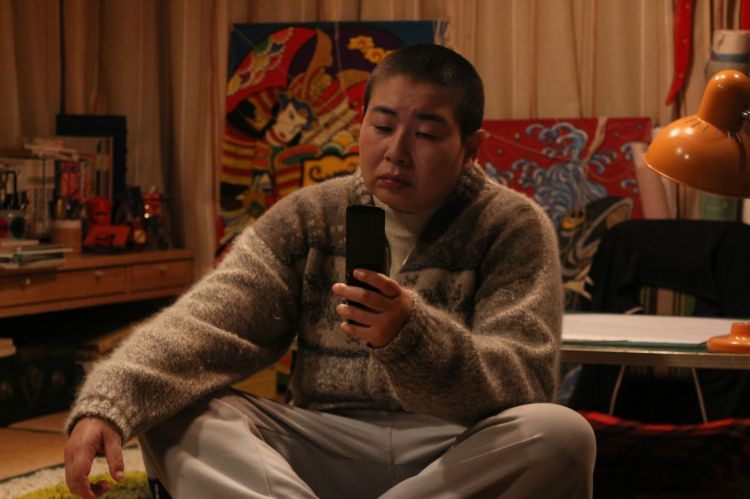
Fuku-chan of FukuFuku Flats (福福荘の福ちゃん, Yosuke Fujita, 2014)

cbTezoQReview of Fuku-chan of FukuFuku Flats up at Uk-anime.net! Screening in London as part of the 2014 Raindance Film Festival on 30th September / 1st October. Tickets still available and the director will be in attendance!


It’s been quite a while since Yosuke Fujita released his first feature length film – the charming comedy Fine, Totally Fine in which two childhood friends who haven’t quite grown up fall in love with the same kind of strange girl, but now he’s finally back with another feature following his short film Cheer Girls which formed part of the Quirky Guys and Gals anthology film. Like those two previous efforts, Fuku-chan of FukuFuku Flats is another warm and funny tale of the strange lives of ordinary people.

The titular Fuku-chan (played by actress Miyuki Oshima) is a painter and decorator and something of a parental figure at the small block of modest apartments at which he lives, Fukufuku Flats. As well as defusing work place disputes including one character breaking wind in the face of another to try and wake him up after lunch, and ones at home such as two neighbours disagreeing about the ownership of an exotic pet, Fuku-chan lives a fairly quiet, solitary life. On the other side of the story, a once high-flying executive, Chiho, has quit her lucrative and steady job to pursue a career in photography only to discover her idol and mentor is interested less in her artistic attributes than her physical ones. As you might expect, the path of these two characters is destined to cross – however an unlikely pair they may seem. In fact as it turns out, they share connection that for one of the them has become a long buried memory but for the other is an unforgettable scar that has coloured the rest of their life.

The more observant among you may wonder if there’s a mistake in the above paragraph. The titular Fuku-chan is indeed a male but the character is being played by the popular Japanese comedienne Miyuki Oshima. Though this is by no means the first time that an actress has portrayed a male character on screen – Linda Hunt even won an oscar for playing a male photographer in The Year of Living Dangerously, some viewers may initially be thrown by the decision. Fuku-chan’s shyness, caring nature and reluctance when it comes to dating women might, after all, be explained if ‘he’ were in reality a ‘she’. However, that is not where our story takes us and a joke about the size of Fuku-chan’s ‘maleness’ is perhaps designed to reassure us about his true nature.

As with Fine, Totally Fine Fujita’s world is packed out with eccentric characters and instances of everyday surrealism. From the the completely crazy ‘avant-garde’ photographer with his strange dress sense and giant camera wrapped up in some kind of alien-like yellow suit to the owner of an Indian restaurant who’s philosophically opposed to the idea of drinking water whilst ‘enjoying’ a spicy curry, these are some very strange people but crucially the sort of strange you might just come across in your everyday life – they never feel contrived or deliberately bizarre, just people that are little abstracted from the norm. Also to the film’s credit is that the characters’ individual quirks are just those – amusing, as character traits, but not ‘jokes’ in and of themselves.

There is, however, a slightly dark undertone to the film. The traumatic incident that binds the two central characters together is of a fairly ordinary variety, a typical sort of thoughtless teenage prank that happens everywhere, everyday (in fact, something similar happened to the author of this review in the dim and distant days of youth). Its ubiquity doesn’t make it any less cruel and even if it wasn’t exactly malicious in its intention, the effects of such humiliation can have an enormous effect on the rest of someone’s life. It’s not hard to see how such an experience could make someone bitter, withdrawn and misanthropic and it’s testament to Fuku-chan’s innately warm nature that his ability to help others remains undimmed even if he keeps himself in protective isolation. Conversely, you have to accept that some people’s problems are in need of more specialist care than even the kindest of hearts can provide, no matter how much you may want to help them.

Fuku-chan of FukuFuku Flats is another excellent entry in the ‘human comedy’ genre. Warm, genuinely funny and in the end even a little moving, it’s impossible not to be charmed by the film’s whimsical, absurd world. Though darkness sometimes creeps in around the edges, it only makes the light seem brighter and actually adds a little real world turmoil to Fuku-chan’s otherwise innocent world. An unconventional (not quite) romantic comedy, Fuku-chan of FukuFuku Flats is nevertheless a masterclass in the genre and genuinely one of the most fun films to come out of Japan (or anywhere else for that matter) for quite some time.