The Killer (喋血雙雄, John Woo, 1989)

“We’re outmoded characters,” a dying man laments, having previously advanced that “nostalgia is one of our saving graces.” The heroes of The Killer (喋血雙雄) are indeed remnants of an earlier time, out of place amid the modern city and adhering to a code that has long since fallen by the wayside. “Our world is changing so fast,” hitman Jeff (Chow Yun-fat) exclaims of a Hong Kong hurtling not only towards the Handover but an increasingly amoral capitalism in which friendship and brotherhood no longer have any currency.

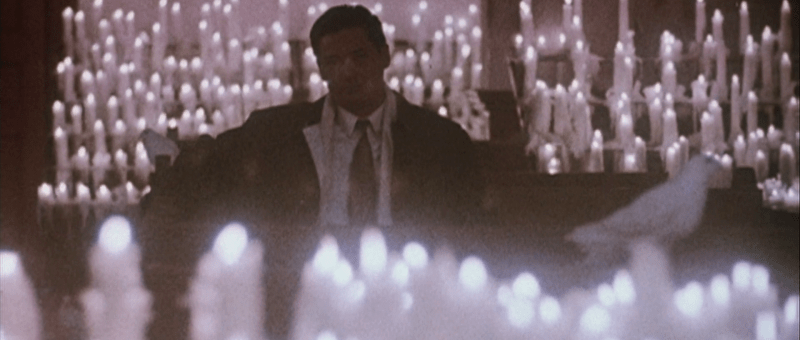
We can tell this straightaway from the fact that the man who ordered the hit on the drug lord Jeff took out at the dragon boat races was his own nephew, Weng (Shing Fui-on). To tie up loose ends, Weng also sends his own hitmen to take out Jeff, who can’t be sure if his handler and best friend Sidney (Chu Kong) is involved in the plot to knock him off. Later in the film, Inspector Li (Danny Lee) asks what Jeff will do if Sidney betrays him, but he merely says that he will still treat him as a friend because he has been good to him in the past. Jeff says this in an abandoned church, echoing not only the codes of jianghu brotherhood now largely absent in the contemporary society but Christianising notions of forgiveness and acceptance. 

Jeff claims that he isn’t a religious man but appreciates the tranquillity of the disused chapel. Inspector Li meanwhile is often pictured next a statue of the Buddhist god of war and dressed in black in opposition to Jeff’s white, but what emerges is that the two men are effectively the same and somewhat interchangeable. Jennie (Sally Yeh), the nightclub singer Jeff accidentally blinded during a a chaotic hit and subsequently falls in love with, first mistakes Li for Jeff while Woo also pictures him sitting in Jeff’s chair and pulling a gun on his partner in much the same way Jeff cooly dispatched an assassin sent by Weng. Chang had told Li that he looked exactly like what he was, an undercover policeman, which is obviously a problem, but Jeff remarks that he is a “very unusual cop,”while Li agrees he’s a very unusual killer. 

In some senses, Li will also become the killer of the film’s title in the closing moments, a man who believes in justice but is not himself believed and knows that there will be no real justice for a man like Weng. Both men share a code which is essentially the same, a more primal kind of morality largely incompatible with the modern society and in many ways rightly so. Li even says that Jeff does not look like a killer, that there’s something “heroic” about him, and that his eyes are full of passion as if he had a dream. His words have a kind of irony to them, but Jeff does indeed have a dream in the desire to gain redemption for himself by restoring Jennie’s eyesight, which is the reason for his last big job having now been reformed by her no longer believing that the people he killed deserved to die but that everyone has a right to live.

Despite the triangular relationship with Jennie, there is an undeniably homoerotic tension in the connection between Li and Jeff even if they are also two sides of the same coin. They train their guns on each other and lock eyes, but unexpectedly find a kindred spirit in a man who should be an enemy. “The only person who really knows me turns out to be a cop,” Jeff chuckles but has an equally deep relationship with handler Sidney just as Li has with parter Chang (Kenneth Tsang) while the homosociality that defines their world is subverted by Weng who simply shoots his own underling when he becomes inconvenient to him. 

Both Li and Jeff are effectively men left with “no way out” and “nowhere to go” because their code of brotherhood is no longer understood by the contemporary society. Jennie’s progressive loss of sight also echoes their dwindling futures as if the light were going out of their world long before Woo shatters the statue of the Virgin Mary and unleashes the doves of futility inside the no longer quite so tranquil church that becomes the final resting place of manly honour and brotherly love. “Perhaps we are too nostalgic,” Jeff sighs but nostalgia is indeed his saving grace in a world in which honour and friendship exist only in a mythologised past or may never have really existed at all.


Trailer (no subtitles)

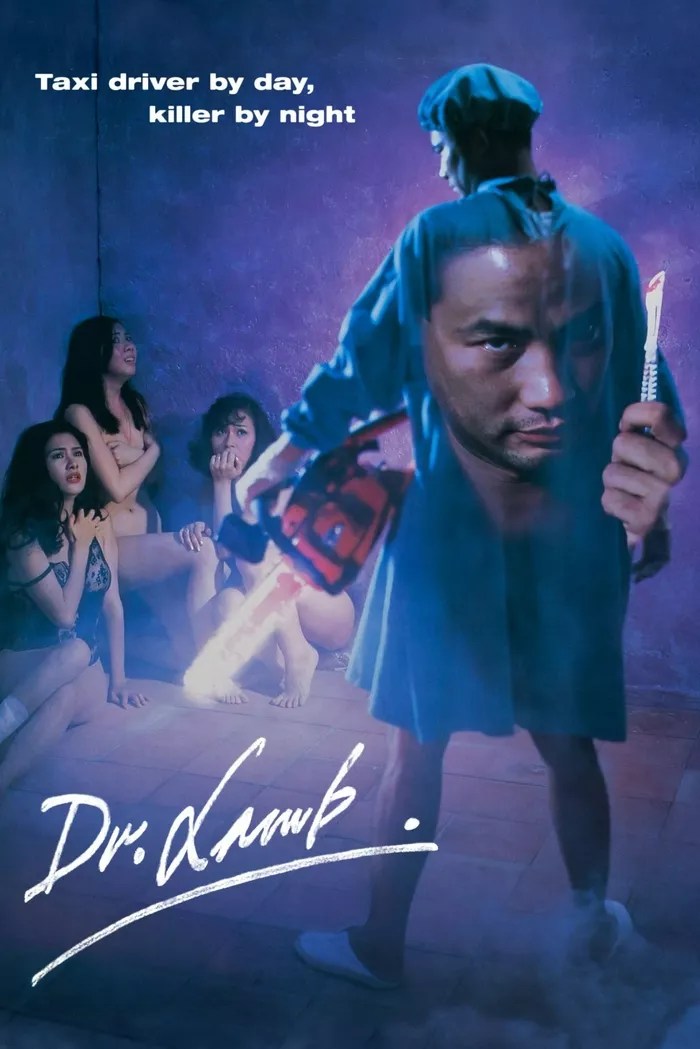
Dr. Lamb (羔羊醫生, Danny Lee Sau-Yin & Billy Tang Hin-Shing, 1992) [Fantasia 2022]

“Every good man should get revenge” the young protagonist of Danny Lee Sau-Yin and Billy Tang Hin-Shing’s depraved Cat III shocker Dr. Lamb (羔羊醫生) is told though as will become apparent, he is not a good man and if his heinous crimes are born of vengeance the target may remain indistinct. Long available only in a censored version which perhaps helped to create its gruesome reputation, the film like others in the early ‘90s Cat III boom is based on a real life case, that of taxi driver Lam Kor-wan who murdered four female passengers before being caught by police when an assistant at a photo shop alerted them to the disturbing quality of the negatives he had brought in to be developed. 

As such, the film is not a procedural. It begins with the arrest of a man here called Lin Gwao-yu (Simon Yam Tat-Wah) who claims the negatives are not his and that he brought them in on behalf of a friend named Chang (which is also coincidentally the name of the half-brother he continues to resent). On investigating the flat where he lives with his father, half-siblings, and niece, the police realise that Gwao-yu is in indeed a serial killer and the rest of the film is divided into a series of flashbacks as they try to convince him to confess and reveal how and why he committed these crimes the last of which he actually videoed himself doing. 

Nevertheless, the police themselves are depicted not quite as bumbling but certainly not much better than the criminals they prosecute in their own lust for violence, savagely beating Gwao-yu who refuses to speak in order to force him to confess. Fat Bing (Kent Cheng Jak-Si) is portrayed as a particularly bad example, encouraging the other cops to play cards rather than focus on their stakeout of the photo shop almost allowing Gwao-yu to escape and then titillated by the more normal pinups and glamour shots pinned to Gwao-yu’s wardrobe as well as some of the less normal ones before realising that the women in them are dead. There is some original controversy over whether they should be investigating at all given that taking weird pictures of nude women is not in itself illegal while the misogynistic attitudes of the police are carried over onto one of their own officers who is forced to play the part of the victim during a re-enactment and is later struck by a stray body part as a result of Fat Bing’s crime scene incompetence. One of the murders even takes place directly outside a police box where the victim had tried to ask for help but got no reply.

Pressed for a reason for his crimes Gwao-yu offers only that all but the last of his victims were bad women who deserved die, each in a repeated motif fatalistically colliding with his cab and crawling inside having had too much to drink. Flashbacks to his childhood place the blame on his wicked step-mother’s rejection along with that of his siblings while his father alone defends him if somewhat indifferently, describing him as merely “curious” on catching Gwao-yu voyeuristically spying on he and his wife having sex and disowning him only on discovering that he has also been abusing his niece who is strangely the only member of the family who seems to be fond of him. Yet it’s also this problematically incestuous living environment that has facilitated his crimes. Gwao-yu takes the bodies home to play with and dismember having the house to himself during the day because he works nights while continuing to share a pair of bunk beds with the brother he hates at the age of 28 either unwilling or unable to get a place of his own on a taxi driver’s earnings. Aside from his brother noticing a strange smell, the family who all think him weird anyway apparently remain oblivious to Gwao-yu’s crimes despite the jars containing body parts he keeps in a locked cupboard along with disturbing photographs of his dark deeds. Nevertheless it’s their police-sanctioned beating of him which eventually provokes his confessions. 

Set off by rainy nights, Gwao-yu twitches, gurns, and howls like a dog leering at his victims like a predatory wolf. In the police interrogation scenes he continues with his strange, dancelike movements as if in a trance reliving his crimes. The truth is that the police had not really investigated the disappearances of the women he killed, had no clue a serial killer was operating, and would not have caught Gwao-yu if it were not for his own lack of interest in not being caught in taking the photos to be developed publicly despite claiming to have the ability to have simply developed them himself while videoing his brutal treatment of one victim’s body and his disturbing “wedding night” with another. A final scene of Inspector Lee visiting Gwao-yu in prison visually references Clarice’s first visit to Dr. Lecter in Silence of the Lambs which might go someway to explaining the title which is otherwise perhaps ironic in Gwao-yu’s ritualistic use of a scalpel and specimen jars. In any case for all its lurid, disturbing content the film has a strange beauty in its atmospheric capture of a neon-lit Hong Kong stalked as it is by an almost palpable evil. 


Dr. Lamb screened as part of this year’s Fantasia International Film Festival and is available on blu-ray in the US courtesy of Unearthed Films.

Original trailer (no subtitles)

The Teahouse (成記茶樓, Kuei Chih-Hung, 1974)

TheTeaHouse+1974-248-bWhere oh where are the put upon citizens of martial arts movies supposed to grab a quiet cup of tea and some dim sum? Definitely not at Boss Cheng’s teahouse as all hell is about to break loose in there when it becomes the centre of a turf war in gloomy director Kuei Chih-Hung’s social minded modern day kung-fu movie The Teahouse (成記茶樓, Cheng Ji Cha Lou).

Wang Cheng runs a small teahouse which prides itself on being the kind of progressive environment where everyone looks after each other as long as they play by the rules. Unfortunately, one of his young guys – Blackie, fresh off the boat from the mainland, has got himself into bad company and into trouble with the law. However, as he’s a minor, he gets off with barely any punishment at all. Cheng tells him he can stay at the teahouse only if he pays properly for his crime leading him to try and get himself arrested all over again so he can go to jail (which actually proves very difficult).

Another unfortunate side effect of Blackie’s adventure is that it brings some unwanted gangster attention and when two young thugs come looking for one of the waitresses, Boss Cheng is not going to stand for any nonsense. However, after his attempts to help the girl have failed, he finds himself in trouble with two different sets of gangsters and also a meddling police inspector who seems intent on using the teahouse to trap the triads.

Boss Cheng is a good and decent man but also someone with his own opinions on justice who is not afraid to take matters into his own hands. His rules for workers at the teahouse emphasise obeying the law and behaving like responsible citizens, but he’s not above carrying out a little corrective action of his own if the need arises.

The biggest theme of the film is the rising inequality and place of migrants from the mainland in contemporary Hong Kong society but the first target Kuei has his sights set on is out of control youth. Because of the lenient laws regarding child criminality, the young men of Hong Kong run rampant, safe in the knowledge that nothing is going to happen to them while they remain under the age of responsibility. The two gangsters accused of raping and attempting to force the teenage waitress at the teahouse into prostitution give their ages as 14 and 15 respectively to the trial judge and are released without charge to go back to their life of crime with impunity and no respect for the law or conventional morality. Sadly, this system just creates another child criminal but one who will receive a jail sentence even if a lighter one to be served in a reform school rather than a prison.

Blackie was seduced into crime by a lack of funds – having managed to make it over from the mainland he has nothing other than his job at the teahouse and the support of Boss Cheng. One day a ragged looking little boy leading his sister by the hand wanders into the teahouse to beg for food. It turns out his small family escaped from the mainland too but his father never made it to Hong Kong and his mother is ill, leaving the children to try and fend for themselves. Boss Cheng takes pity on them and gives the boy a job plus paying for his school fees but he still finds himself beaten up by thugs not much older than himself in the street.

All the while, corrupt fat cats are messing with the system to keep the poor in their place while the rich get richer. Cheng takes great pleasure in playing off a corrupt industrialist who tried to use him as a sacrificial pawn in his own war against the triads (well, the triads he doesn’t like, anyway). Amusingly, one of the triad bosses seems to think Cheng is also a brother forcing him to pretend to know all about triad rituals to attempt to make a truce with them. The teahouse is situated right between the territories of two rival gangs making it a prime spot for conflict. However, the real problem comes when the police start muscling in, giving off the impression that Cheng has turned traitor on the triads. Soon, Cheng becomes the single biggest threat to his own teahouse and the progressive environment he hoped it would foster.

The Teahouse is actually a little ahead of its time concentrating not on kung fu or street fighting but mixing in a little gun play and some bloody knife crime. The shooting style is impressive throughout with a realistic, gritty atmosphere which aims to put the real streets on screen. The film does, however, have a tendency to fall into an episodic rhythm and suffers from its abrupt and slightly odd, downbeat ending which finishes things on an unsatisfying note. That said, The Teahouse is a stylishly shot and socially engaged action extravaganza that makes up for its minor shortcomings with a degree of chutzpah which looks forward to the classic heroic bloodshed movies of the ‘80s.


Seen as part of HOME’s CRIME: Hong Kong Style touring season.

Unsubtitled trailer (Mandarin):