Finale in Blood (大鬧廣昌隆, Fruit Chan, 1993)

A wandering ghost trapped in an umbrella sticks around to get revenge on her philandering husband while becoming an accidental radio star in Fruit Chan’s torrid answer to Stanley Kwan’s Rouge, Finale in Blood (大鬧廣昌隆). Inspired by a classic folk legend passed down through Cantonese recitative, the film uses the medium of a ghost story to examine the nature of love as, as someone later puts it, love doesn’t necessarily “possession”.

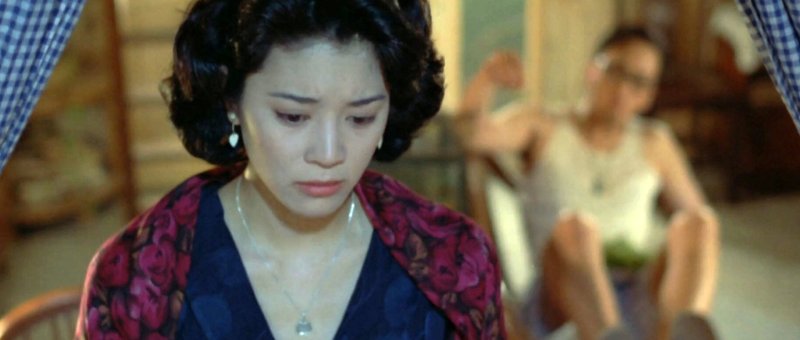
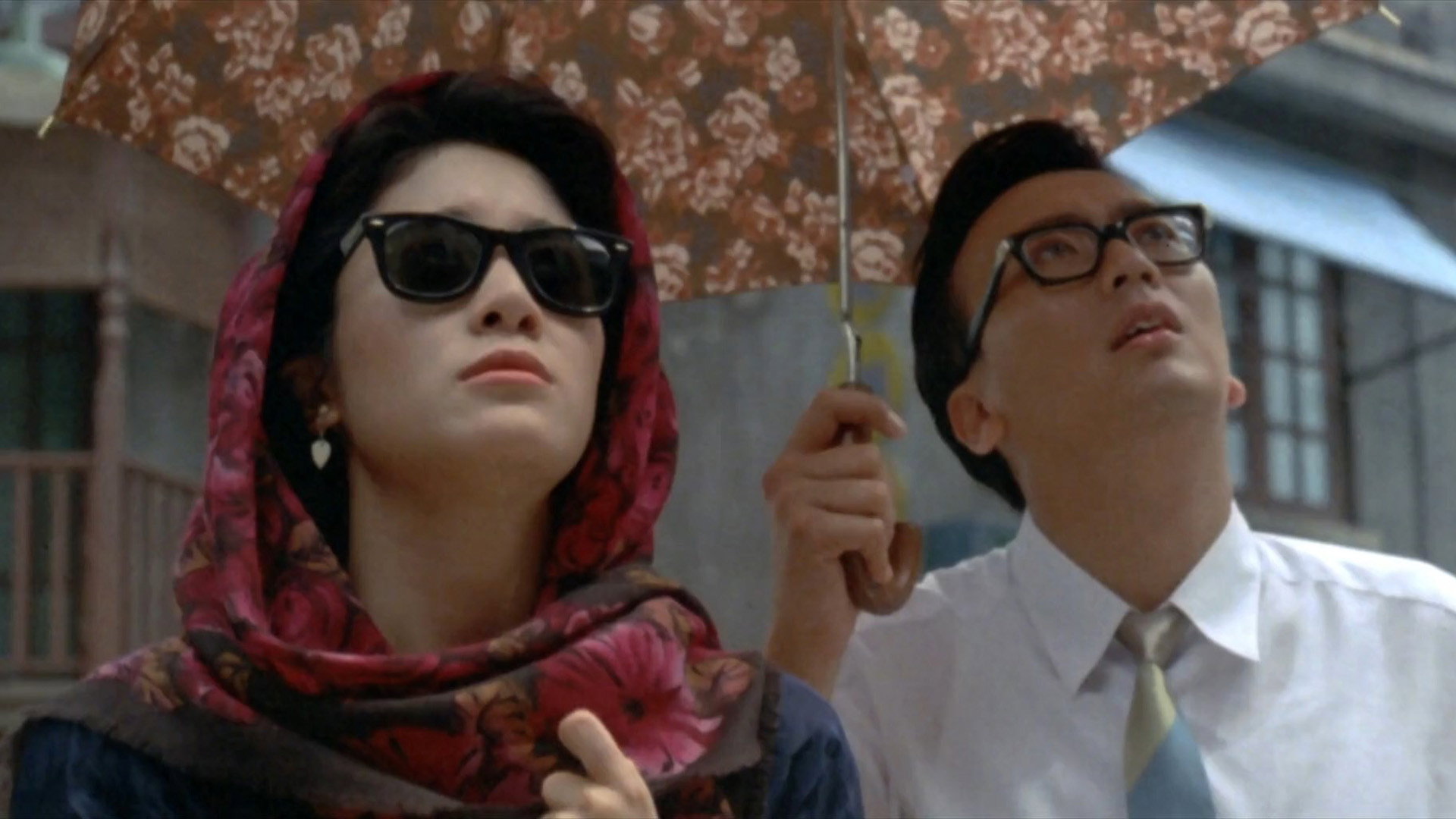
The witness to the tale is hapless radio announcer Ming-Pao (Lawrence Cheng Tan-Shui) whose job it is to read out food prices on a station that has become popular for its soap opera-esque tales of horror. Down on his luck, he agrees to help a friend who smuggles Western medicine complete a job only to find himself subject to a police rad during which he gets knocked into the harbour. Somehow he is saved by the haunted umbrella which turns out to belong to Fang Yin (Ruth Winona Tao), a recently deceased young woman who subsequently becomes attached to him and co-opts Ming-Pao into helping her get vengeance against her cheating husband, Ma (David Wu).

Ming-Pao ends up unexpectedly hosting the ghost story spot during which Fang Yin steps in to tell her own story, though everyone assumes it’s Ming-Pao mimicking a woman’s voice, and becoming a huge hit as the populace appears to sympathise with the various ways Fang Yin was made to suffer because of her husband’s poor treatment. The way she tells it, she came to Hong Kong to take over her father’s hotel, but found it quite a dull business before taking a liking to a mysterious guest who turned out to be an undercover policeman whose case she accidentally blows. Nevertheless, the pair enter an awkward courtship in which Ma seems to delight in introducing her to the seedier side of Hong Kong in its brothels and opium dens. Ma is evidently not a particularly diligent policeman, and has a kind of arrangement with a sex worker (Chikako Aoyama) who intensely resents Fang Yin and is confused about the ambiguous nature of the relationship she has with Ma.

Fang Yin also finds herself confused and humiliated as Ma often fails to return home, forcing her to go looking for him low places and often discovering him with his mistress. Ma meanwhile, defends himself claiming that it’s only natural for a man to stray and that he was just “on a moral holiday” when Fang Yin returned early from a trip and found the pair together. Ming-pao, meanwhile, is the total opposite of Ma. Though he may be a bit hapless, getting involved in his friend’s smuggling business, he feels sorry for Fang Yin and the way her husband treated her. Though he is originally irritated to have been saddled with a ghost, after that he tries his best to help Fang Yin, even digging up her body and placing it in moonlight so she can temporarily possess it. This does, however, place him at risk as Ma and his mistress begin noticing the similarities between the radio story and the murder they’ve committed.

In helping Fang Yin, however, Ming-Pao effectively uses the studio’s biggest star who has, against the odds, taken a likening to him mostly because of his performance on the radio show which is, of course, actually performed by Fang Yin. Though Sha-sha (Josephine Koo Mei-Wah) initially comes to the conclusion that Ming-Pao is the killer, she later sympathises with Fang Yin too and laments her situation as one third of an incredibly destructive love triangle. The unnamed sex worker is very possessive of Ma and almost boasts in claiming to have buried Fang Yin’s body herself. Ma is more equivocal, trying to placate Fang Yin though with a gun behind his back. Likewise, he eventually tells the sex worker that he never loved her and their relationship was always transactional. A coward, it’s never quite clear what his real feelings are, but only that this three-way relationship was always doomed to failure. Nevertheless, Ming-Pao’s smuggling friend diagnoses the problem as less one of Ma’s moral transgressions and more one of selfishness on the part of the women who should simply have learned how to be less “possessive” and share their man. Ming-Pao’s Hong Kong is though a more helpless place filled with a sense of despair and defeat. Chan lends the picture a kind of sleaziness, embracing the fetid atmosphere with rainstorms and sweatiness before ending on an ironic note of serenity as the three lovers are seemingly reunited for all eternity.


Trailer (no subtitles)

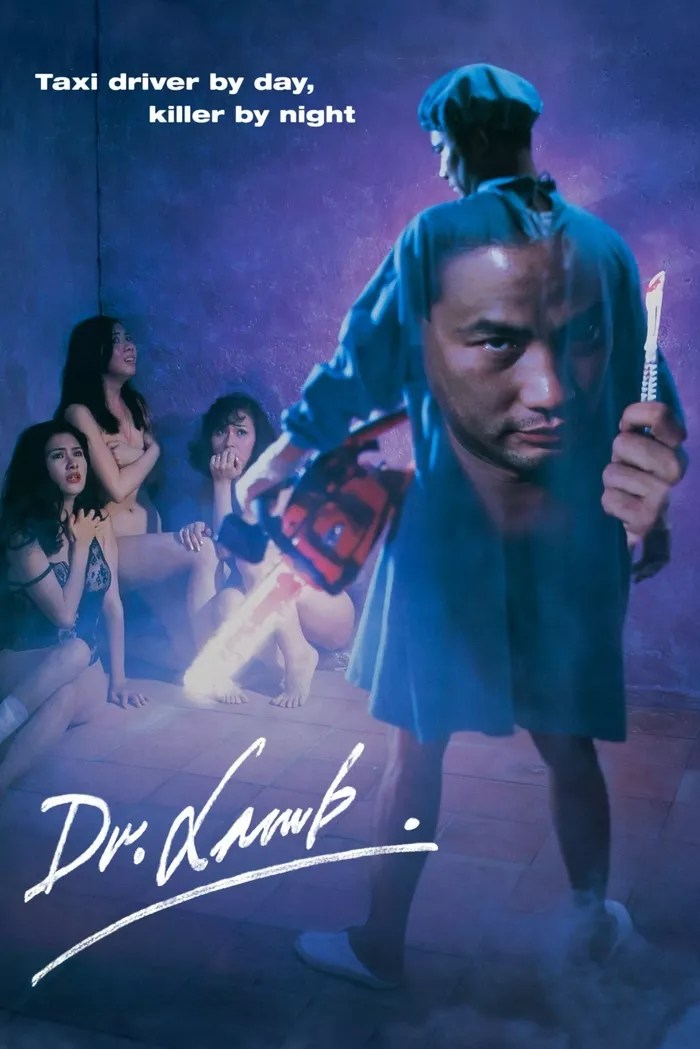
Dr. Lamb (羔羊醫生, Danny Lee Sau-Yin & Billy Tang Hin-Shing, 1992) [Fantasia 2022]

“Every good man should get revenge” the young protagonist of Danny Lee Sau-Yin and Billy Tang Hin-Shing’s depraved Cat III shocker Dr. Lamb (羔羊醫生) is told though as will become apparent, he is not a good man and if his heinous crimes are born of vengeance the target may remain indistinct. Long available only in a censored version which perhaps helped to create its gruesome reputation, the film like others in the early ‘90s Cat III boom is based on a real life case, that of taxi driver Lam Kor-wan who murdered four female passengers before being caught by police when an assistant at a photo shop alerted them to the disturbing quality of the negatives he had brought in to be developed. 

As such, the film is not a procedural. It begins with the arrest of a man here called Lin Gwao-yu (Simon Yam Tat-Wah) who claims the negatives are not his and that he brought them in on behalf of a friend named Chang (which is also coincidentally the name of the half-brother he continues to resent). On investigating the flat where he lives with his father, half-siblings, and niece, the police realise that Gwao-yu is in indeed a serial killer and the rest of the film is divided into a series of flashbacks as they try to convince him to confess and reveal how and why he committed these crimes the last of which he actually videoed himself doing. 

Nevertheless, the police themselves are depicted not quite as bumbling but certainly not much better than the criminals they prosecute in their own lust for violence, savagely beating Gwao-yu who refuses to speak in order to force him to confess. Fat Bing (Kent Cheng Jak-Si) is portrayed as a particularly bad example, encouraging the other cops to play cards rather than focus on their stakeout of the photo shop almost allowing Gwao-yu to escape and then titillated by the more normal pinups and glamour shots pinned to Gwao-yu’s wardrobe as well as some of the less normal ones before realising that the women in them are dead. There is some original controversy over whether they should be investigating at all given that taking weird pictures of nude women is not in itself illegal while the misogynistic attitudes of the police are carried over onto one of their own officers who is forced to play the part of the victim during a re-enactment and is later struck by a stray body part as a result of Fat Bing’s crime scene incompetence. One of the murders even takes place directly outside a police box where the victim had tried to ask for help but got no reply.

Pressed for a reason for his crimes Gwao-yu offers only that all but the last of his victims were bad women who deserved die, each in a repeated motif fatalistically colliding with his cab and crawling inside having had too much to drink. Flashbacks to his childhood place the blame on his wicked step-mother’s rejection along with that of his siblings while his father alone defends him if somewhat indifferently, describing him as merely “curious” on catching Gwao-yu voyeuristically spying on he and his wife having sex and disowning him only on discovering that he has also been abusing his niece who is strangely the only member of the family who seems to be fond of him. Yet it’s also this problematically incestuous living environment that has facilitated his crimes. Gwao-yu takes the bodies home to play with and dismember having the house to himself during the day because he works nights while continuing to share a pair of bunk beds with the brother he hates at the age of 28 either unwilling or unable to get a place of his own on a taxi driver’s earnings. Aside from his brother noticing a strange smell, the family who all think him weird anyway apparently remain oblivious to Gwao-yu’s crimes despite the jars containing body parts he keeps in a locked cupboard along with disturbing photographs of his dark deeds. Nevertheless it’s their police-sanctioned beating of him which eventually provokes his confessions. 

Set off by rainy nights, Gwao-yu twitches, gurns, and howls like a dog leering at his victims like a predatory wolf. In the police interrogation scenes he continues with his strange, dancelike movements as if in a trance reliving his crimes. The truth is that the police had not really investigated the disappearances of the women he killed, had no clue a serial killer was operating, and would not have caught Gwao-yu if it were not for his own lack of interest in not being caught in taking the photos to be developed publicly despite claiming to have the ability to have simply developed them himself while videoing his brutal treatment of one victim’s body and his disturbing “wedding night” with another. A final scene of Inspector Lee visiting Gwao-yu in prison visually references Clarice’s first visit to Dr. Lecter in Silence of the Lambs which might go someway to explaining the title which is otherwise perhaps ironic in Gwao-yu’s ritualistic use of a scalpel and specimen jars. In any case for all its lurid, disturbing content the film has a strange beauty in its atmospheric capture of a neon-lit Hong Kong stalked as it is by an almost palpable evil. 


Dr. Lamb screened as part of this year’s Fantasia International Film Festival and is available on blu-ray in the US courtesy of Unearthed Films.

Original trailer (no subtitles)