The Hitman: Blood Smells Like Roses (ザ・ヒットマン 血はバラの匂い, Teruo Ishii, 1991)

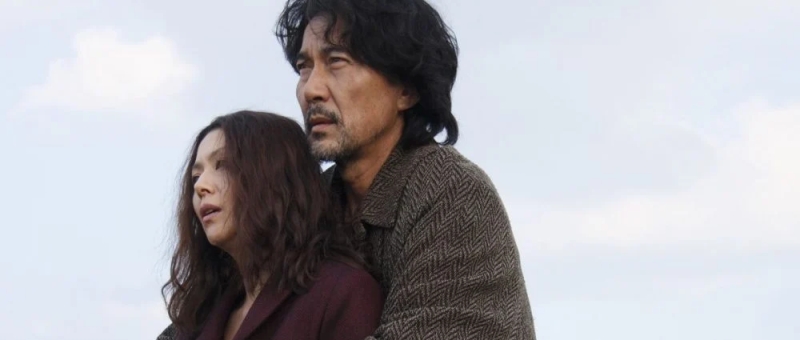
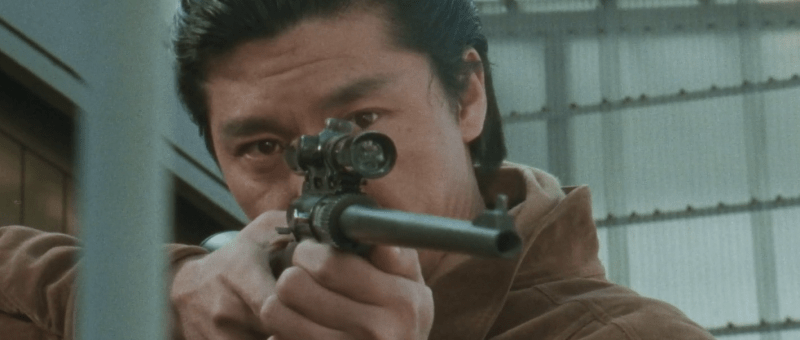
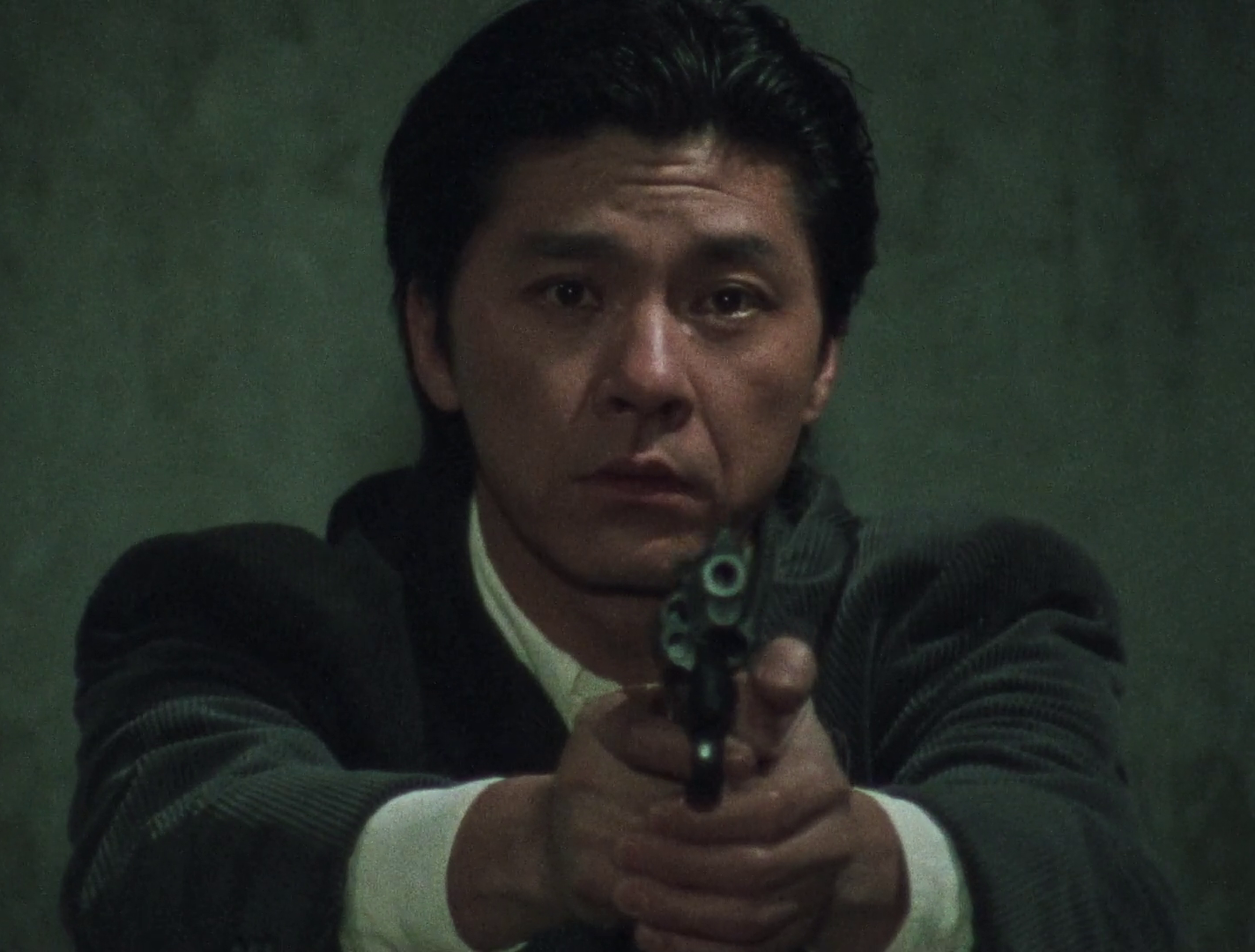
After his fiancée is killed during a yakuza shootout in a restaurant, a former spy in training plots revenge in Teruo Ishii’s Hitman: Blood Smells Like Roses (ザ・ヒットマン 血はバラの匂い, The Hitman: Chi wa Bara no Nioi). Ishii has been in retirement for 12 years before making the film but steps right into the zeitgeist with his bubble-era nightclub opening in which a yakuza goon pretends to be the son of a stockbroker to seduce a young woman he intends to press into prostitution, while looking back to classic noir and the borderless action past.

The young woman is rescued, though not soon enough to escape harm, by the titular hitman, Takanashi (Hideki Saijo), though he does not intervene to save her, only to take out the trio of yakuza who were one side of the gun battle in which his fiancée Reiko (Mikiko Ozawa) was killed. Reiko’s innocence is emphasised by her position as a teacher at a Christian school which is directly contrasted with the sleazy world of contemporary Shinjuku in which Takanashi becomes involved with a series of women. The Asia Town that he strays into is another international space with its samba bars and Filipina hostesses, while Takanashi is later sent to track a boat coming in from the Philippines which is thought to be smuggling guns. 

That’s a tip off he receives from Nakatsuka (Kiyoshi Nakajo), an old mentor from the defence academy who now works for the Cabinet Intelligence and Research Office, the nation’s primary intelligence authority. Nakatsuka is also seen meeting with the police chief who tells him that the yakuza have been complaining that police are encouraging the gang war rather than trying to stop it. So much the better, Nakatsuka says, let them massacre each other then take them all out right before the election to manipulate public opinion. If the election goes their way, the police chief will have additional budget to hire more policemen. Thus Takanashi also becomes a kind of pawn in cynical political machinations conducted by Nakatsuka and CIRO who are helping him both out of friendship and sympathy and because it is useful for him to make use of Takanashi and his desire for revenge. Only veteran policeman Uchino (Tetsuro Tanba) smells a rat, but even he later lets Takanashi go after making a moral judgement that justice has been served and Takanashi hasn’t really done anything wrong.

And so Takanashi tries to avenge Reiko by setting the gangs against each other in a recreation of the original gang war. He’s first frustrated and then aided by Shinjuku party girl Rumi (Natsumi Nanase) who steals his briefcase and gives it to the yakuza, and also be her friend Hisako (Yuki Semba) whom he meets after ducking into a soapland to escape the police. Hisako’s apartment is well furnished with even the modern convenience of an exercise bike, while Rumi’s feels empty, like a hideout with its bare floors and sparse decor. The walls are decorated with posters for Casablanca and Bonnie and Clyde that bring home and older noir past that Takanashi is echoing in his quest to avenge Reiko’s death at the hands of a crime-ridden society. We’re told that he gave up his place at the defence academy and became a truck driver when his parents objected to their marriage, but now fulfils his destiny in tackling the yakuza threat head on.

Meanwhile, as a kind of counter to Rumi, Hisako, and Yasuda’s girlfriend, Kumasa’s woman Beniko (Kimiko Yo) who is very much involved in policy decisions and actively fights back in defence of Kumasa who is otherwise a bit useless. The film is sleazy from its opening rape sequence to the soapland escapade and inexplicable closing credits which consist of a number of raunchy gravure shots backed by a power ballad that otherwise have little to do with the rest of the film, but is perhaps less cynical that it appears or at least seems to edge away from nihilism towards something that appreciates that a more emotional, poetic kind of justice is possible and valid. Takanashi is allowed to complete his quest, though it incurs additional casualties, and then leave the scene having achieved a kind of closure and brought the cycle to an end leaving the rest to Nakatsuka and Uchino who now seems to have crossed over to Nakatsuka’s side if perhaps lamenting that he may be working far too hard to a achieve a justice that now seems surprisingly easy to enact.
The Parades (パレード, Michihito Fujii, 2024)

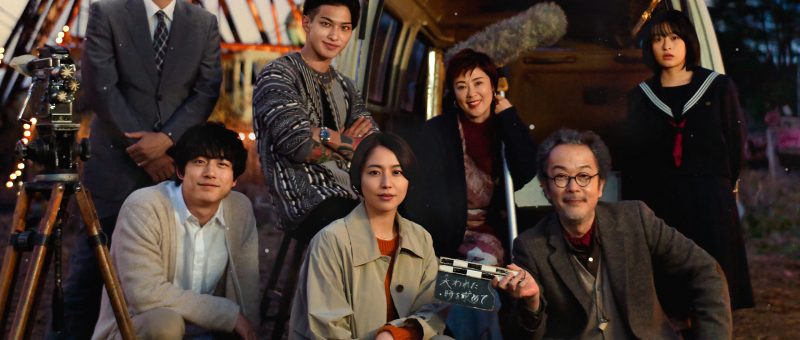
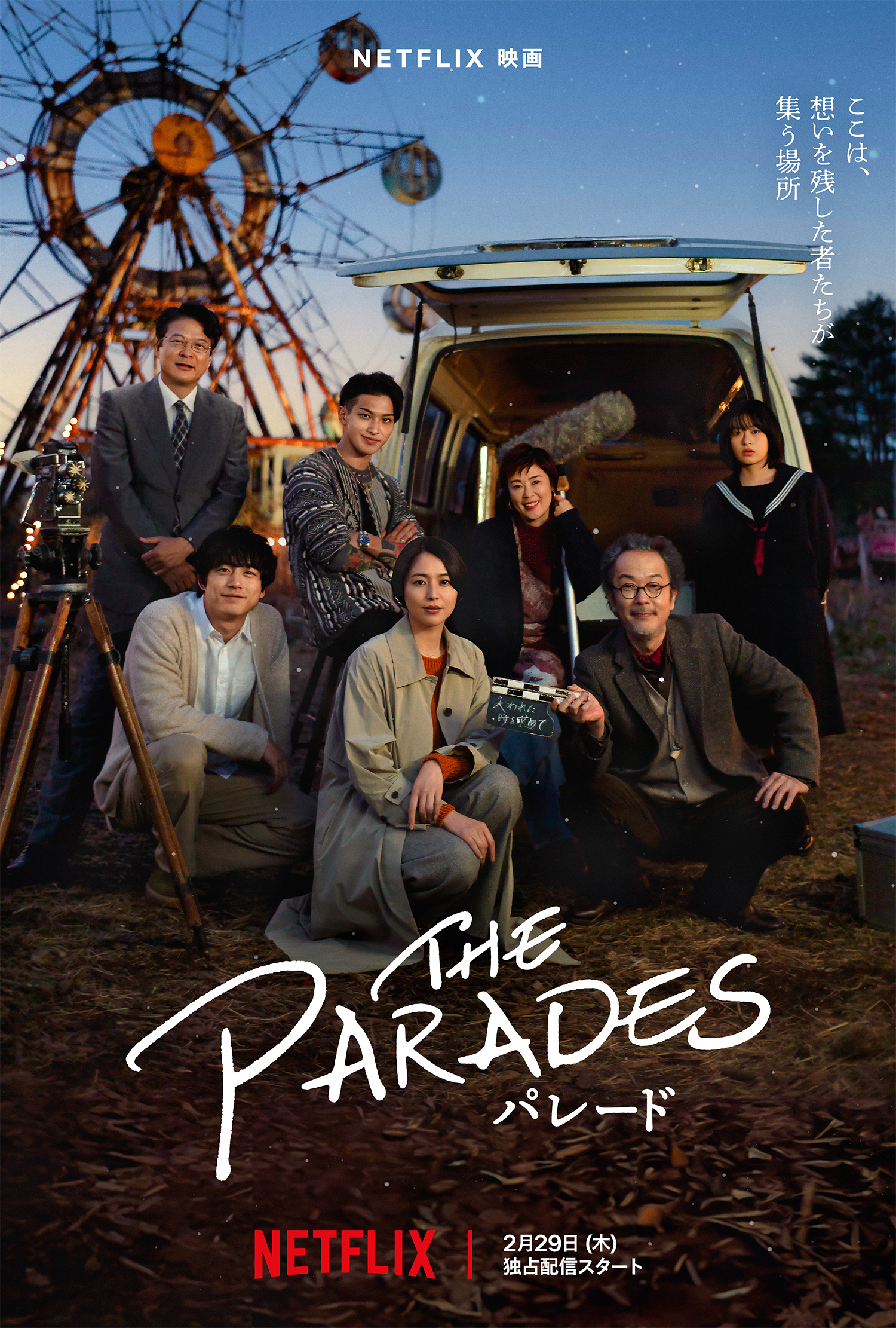
Living a life without regrets is easier said than done. The protagonists of Michihito Fujii’s The Parades (パレード, Parade) each have unfinished business that prevents them moving on from this world, but what they discover is an unexpected sense of solidarity among similarly lost souls as they try to lay themselves to rest. After all, all they can do now is observe and reflect while helping others like them with their own lingering doubts and regrets.

Drawing inspiration from the 2011 earthquake and tsunami, Fujii first introduces us to Minako (Masami Nagasawa). A 35-year-old single mother, she wakes up on a beach and frantically looks for her seven-year-old son Ryo (Haru Iwakawa) little realising that the reason no one seems to be able to hear or react to her is because she’s already dead. Picked up by fellow ghost Akira (Kentaro Sakaguchi), she’s taken to a disused fairground that doubles as a hub for wandering souls. Though it takes her a while to accept her new situation, she gradually bonds with others at the camp each of whom have their own unfinished business which isn’t all that different from her own in that they mostly want to be sure the people they left behind will be alright.

The film takes its name from the monthly processions in which wandering souls meet by lantern light to look for their missing people together. This sense of solidarity and empathy seems to echo the best of humanity along with a melancholy longing. There appears to be little rancour in this afterlife, a yakuza who was killed in a gang war simply feels sorry for his father and so guilty about the girlfriend he left behind that he’s been afraid to face her for the last seven years, and a high school girl who took her own life because of bullying first thinks her unfinished business is vengeance on the bullies but later accepts is actually a desire to apologise to her best friend who then had to take the brunt of the bullies’ cruelty on her own.

What the film seems to say is that we should have more of this fellow feeling in life. Former film producer Michael (Lily Franky) constantly references his days as a student protestor remarking that they might not have amounted to very much but at least they had unity. His regret is less his failed revolution than a moment of emotional cowardice that saw the woman he loved marry someone else instead. Constant references to the end of Casablanca echo their plight as if Maiko (Yuina Kuroshima / Hana Kino) married Sasaki (Ayumu Nakajima / Hiroshi Tachi) for the good of the revolution though she really loved Michael who unlike Rick just walked out on it because in the end he wasn’t brave enough to risk the consequences of its success or failure. 

The world building may not always be consistent and the rules of this universe appear unclear. It seems that in general the ghosts don’t linger long. Even the heavenly liaison Tanaka (Tetsushi Tanaka) appears to have been dead not longer than 40 years with Michael seemingly the only other long-stayer with the others’ deaths fairly recent. In general they are only really waiting for themselves or others, wanting to make sure that their loved ones will be alright in their absence even though there’s nothing more they can do for them now other than observe. Though they can walk through this world and interact with physical objects, their presence is otherwise invisible unless the person they wish to contact happens to be in an altered state. To this extent, the resolution may seem like a bit of a cop-out but does lend an additional poignancy and imply that these lessons learned in limbo can still be taken into the mortal realm creating additional empathy and solidarity among the living so that they may be able to live their lives freely and fully perhaps not entirely without regrets but at least with fewer of those that would prevent them from moving on when their time comes. But even if they find themselves trapped in limbo, they’ll hopefully find others like themselves and a gentle sense of hopefulness about what’s to come even as they prepare to leave this world.


Trailer (English subtitles)

Living in Two Worlds (ぼくが生きてる、ふたつの世界, Mipo O, 2024)

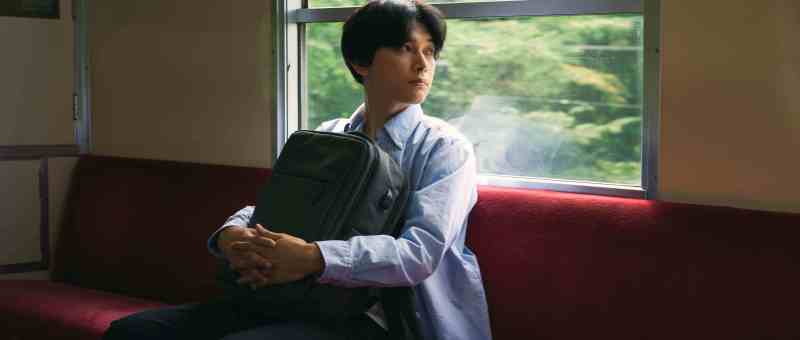
Mipo O had been quietly building a reputation as one of Japan’s most promising young indie directors with such lauded films as The Light Shines Only There but has been on an extended hiatus since 2015’s Being Good. Living in Two Worlds (ぼくが生きてる、ふたつの世界, Boku ga Ikiteru, Futatsu no Sekai) marks her return to filmmaking after taking a break to raise a family and, adapted from from an autobiographical book by Daisuke Igarashi, not only explores the realities faced by the deaf community but the complicated relationship between a son and his mother.

Indeed, at times the issue is less that both of Daisuke’s (Ryo Yoshizawa) parents are deaf as it is that he does not listen. When he becomes a teenager, his mother Akiko (Akiko Oshidari) spends a huge amount of money on a high tech hearing aid because she wants to hear his voice, though most of what he says to her is hurtful and unpleasant. His older self is probably regretful, ashamed of the way he treated his mother in particular but also in regards to his rejection of his family because he felt embarrassed by their difference in what is a fiercely conformist culture. He doesn’t give his mother a letter about parents’ day because he doesn’t want her to come and also thinks it would be pointless because she wouldn’t be able to hear anything anyway. Later he tries to get his grandmother to come with him to a parent teacher meeting about his plans for high school and beyond, telling his mother she’d only be in the way. In fact, the meeting is quite awkward because the teacher talks directly to him without trying to include Akiko while Daisuke makes infrequent signs under the table as if embarrassed to have the teacher see them.

As a young child, Daisuke had interpreted for his mother using sign language publicly despite the awkward attitude towards it at home. His grandmother writes things down on paper instead, telling him that it’s too difficult for her to learn. That doesn’t make sense to his young brain as after all he’s picked it up since birth. But this early tension perhaps contributes to his increasingly conflicted feelings. When he brings a friend home, he asks him why his mother speaks in such a funny way but of course it’s normal to Daisuke and this perhaps innocent question begins to cement for him that his family isn’t “normal” and he isn’t like the other children. Resentment towards his mother only grows to the point he begins to blame all of his problems on her including his failure to get into the better high school though she has done nothing but support and encourage him. As she points out, she never had any choice about her schooling and received little education because her parents thought she’d recover her hearing and refused to send her to a specialist school until she was 14 meaning she was just sat there all day twiddling her thumbs while unable to make friends with hearing children who mostly ignored her.

The parents were also against the idea of her marrying her husband Yosuke (Akito Imai) because he was also deaf, nor did they support their decision to have a child believing two deaf parents would not be able to raise one safely or effectively. Such attitudes lay bare the lingering stigma towards disability which remains even within the family unit. Unable to separate himself from being the child of working class deaf parents, the teenage Daisuke abruptly moves to Tokyo with a vague idea of becoming an actor signalling his internal search for an independent identity. The film hints that his liminal status existing between the worlds of the hearing and the deaf has left him with subpar communication skills as seen in his repeated faux pas at job interviews until he finally tells the truth and is offered a job on the spot. There’s an intimacy involved in his interactions with his parents which often can’t be understood by others, but also a less pleasant undercurrent in the way these interplay with speech and his own decisions of when to switch between dialogue and sign. 

Having gone to Tokyo to escape being the child of deaf parents, he discovers that being “ordinary” doesn’t really suit him either and only begins to accept his identity after meeting a deaf woman at a pachinko parlour who invites him to her class for learning sign language in a more a formal way while another of her pupils gently explains to him that though he means well he sometimes does them a disservice by taking over as a hearing person when he should let them do the things they can do for themselves. The absence of musical score and variation in the sound mix emphasise Daisuke’s transition between worlds and his own attempts to locate himself within them eventually discovering the equilibrium that allows him to realise he was the one who couldn’t hear along though his mother had always been talking to him. Touching but resisting sentimentality, O’s poignant drama never shies away from the failings of its protagonist but equally from those of the society within which he lives that can itself be unwelcoming of difference.


Living in Two Worlds screened as part of this year’s BFI London Film Festival

International trailer (English subtitles)

Tokyo Sonata (トウキョウソナタ, Kiyoshi Kurosawa, 2008)

Orphaned salarymen are the soulless ghosts haunting an increasingly empty city in Kiyoshi Kurosawa’s eerie tale of urban anxiety Tokyo Sonata (トウキョウソナタ). Undermining the certainty of the traditional family, Kurosawa paints it as a simulacrum dependent on each member playing their respective role blindly or otherwise, though in this case the integrity of the family unit is shaken by an economic intervention in which the accepted rules of the society have been upended with a vindictiveness that seems inexplicably unfair. 

This is the bargain of the salaryman dream. A man like Sasaki (Teruyuki Kagawa) now aged 46 came of age at the tail end of an era of economic prosperity. He was brought up in an atmosphere of jobs for life in which the corporate family was almost more “real” than the emotional which is one reason why it comes as such a shock when his boss effectively divorces him. He’s found someone new, planning to outsource Sasaki’s entire department to China while less than kindly explaining that as he has no other skills he of no more use to the company. Sasaki immediately clears his desk in anger, walking home early with a pair of carrier bags then, after meeting his son in the street, attempting to climb in through an upstairs window to avoid alerting his wife, Megumi (Kyoko Koizumi), to the fact he’s home early.

Sasaki is unable to tell her that he’s lost his job in part because of the acute embarrassment it would cause him. Somewhat dazed and confused, he’s become one of many disenfranchised salarymen who survived the 15 years of economic stagnation only to have the rug pulled out from under them. Being a salaryman was in a way his whole identity and without it he doesn’t know who he is, which is one reason he puts on a suit every day and goes to sit in the park surrounded by other similarly dressed men with briefcases who now seem to haunt the city like crows ominously dotting the horizon. In a repeated motif, Kurosawa shows us people trapped in kafkaesque queuing situations shuffling around buildings while prevented from moving forward but forced to keep pace with the increasingly glacial environment. At the moment an old school friend he runs into, Kurosu (Kanji Tsuda), seems to give up he is swept into a great parade of the suited and hopeless while Sasaki hovers on its edges. 

It’s this threat to Sasaki’s masculine pride which is largely founded on his economic ability to support a family that kickstarts a chain reaction in his home even he becoming increasingly violent and authoritarian in an effort to overcome the sense of humiliation and powerlessness he feels after being made “redundant”. His younger son, Kenji (Kai Inowaki), tells him he wants to learn the piano but Sasaki irritably shuts him down either because he’s now worried about the money or simply sees it as a frivolous waste of time. Later when Megumi asks him why he won’t he change his mind he insists that he has to stick to his original decision otherwise it would undermine his patriarchal authority as a father. 

But this “authority” was perhaps already largely illusionary given that an intense work schedule meant he was rarely home to do much parenting. After finding out Kenji spent his lunch money on piano lessons behind his back he ironically shouts at him for lying and keeping secrets even though this is obviously what he himself has been doing in keeping up the illusion of his identity as a conventional salaryman. His older son, Takashi (Yu Koyanagi), was keeping secrets too his being his desire to join the US military believing that Japan no longer has a future for him in an atmosphere of stagnation not only economic but emotional and spiritual. Takashi tells his mother she should leave Sasaki, but to her question of who would play the role of mother replies that it makes no difference simultaneously encouraging her to reclaim an individual identity and perhaps robbing her of one just as Sasaki lost his in being shorn of his salaryman credentials. 

Lying on the sofa one evening she raises her arms and poignantly asks someone to lift her up but Sasaki has already gone to bed without even looking at her. Her life as a housewife is thankless and emotionally unfulfilling. Donuts she spent ages making go uneaten while her husband and sons brood on their own problems alone. At a car dealership, the salesman shows her a people carrier explaining that it’s perfect for family camping trips while she gravitates towards a red convertible, mesmerised by the way the roof can just disappear as if it were literally freeing her of her stultifying existence. On showing Takashi the shiny new driving license she’s just got as a symbol of her desire for independence, he scoffs that she’ll never use it but she counters him that it’s for “ID” which it is in more ways than one.

The family is imploded, the illusions of a conventional middle-class life upturned as Sasaki and Megumi each ask themselves if there’s a way to start again and escape their sense of middle-aged futility and disappointment. Cracking under the weight of conventionality, the foundations begin to fracture but the family nevertheless finds itself returning if with greater degrees of clarity and perhaps with less inclination to play the play the roles assigned to them rather than those they might wish to play as embodied by Kenji’s moving performance at the piano capturing all of the chaos and confusion of the world around him but finding in it also harmony and a gentle breeze that feels almost as if the city itself were breathing once again.


Tokyo Sonata screens Feb. 18 as part of Family Portrait: Japanese Family in Flux

International trailer (English subtitles)

Baian the Assassin, M.D. (Part 1) (仕掛人・藤枝梅安, Shunsaku Kawake, 2023)

A traumatised assassin takes it upon himself to get rid of a few villains on realising there’s something not quite right with his latest contract in Shunsaku Kawake’s classic jidaigeki homage, Baian the Assassin, MD: (Part 1) (仕掛人・藤枝梅安, Shikakenin Fujieda Baian). The titular hero is the protagonist of a series of novels by Shotaro Ikenami which have spawned several previous adaptations on the big and small screens. Produced in celebration of Ikenami’s centenary the film, one of two, harks back to the golden age of period drama if with a more contemporary sensibility. 

Baian (Etsushi Toyokawa) is ostensibly an acupuncturist though by night he uses his needles to kill rather than to heal. Hired to take out the second wife an inn owner, Omino (Yuki Amami), his suspicions are raised on realising that he had also been the assassin who killed the man’s first wife two years earlier. He blames himself in part for having agreed to assassinate a woman in the first place, and remains conflicted even after accepting the job wondering if Omino is next in the firing line or if she was actually the one who had the other woman killed in order to usurp her place. 

The film makes clear from the outset what a difficult place Edo could be for a woman as Baian carries out an assassination on a boatman who had raped a samurai’s wife and then blackmailed her into further sexual favours only for her to hire an assassin and then kill herself confessing all. Omino had apparently been the stepdaughter of a gang leader who sexually abused her and then died leaving her with no support and nowhere to turn except to sex work. Maybe no one could blame her for taking advantage of a besotted client to escape her terrible circumstances though getting rid of his wife would obviously be a different matter. Omon (Miho Kanno), a maid Baian takes a liking to while investigating, admits something similar that as a widow with a young son realistically speaking there is nowhere else that could she work to support him except on the fringes of the sex trade. Then again, as she says the previous mistress was strict but it was because she cared, whereas Omino is just mean and self-interested. She’s fired all the old staff and brought in pretty young women who are quite obviously being expected to entertain their male customers in more direct ways. 

In any case, Baian soon finds himself drawn into a wider series of plots when his friend Hiko (Ainosuke Kataoka), a skewer maker who assassinates people with poison darts, is tasked with taking out first a lascivious carpenter and then a rogue samurai who has supposedly raped and kidnapped the daughter of his lord which obviously turns out not quite to be the case. Rape and kidnap are depressingly common in Edo-era society where it is largely women who suffer under a patriarchal society with intensely oppressive social codes that demand female purity. In a post-credits sequence, we come to understand that Hiko too is seeking vengeance for the death of a woman who killed herself and her child after being raped by bandits. Meanwhile, Baian reveals that he had a mild hatred of women himself born of pain in having been abandoned by his mother who left with another man and took only his sister with her after his father’s death. He had to overcome that resentment in order to fulfil himself as a doctor treating women’s bodies but struggles when he realises that someone involved in the case is closely linked with his own traumatic past and death may be the only way to save them. 

Both he and Hiko end up breaking the assassin’s code but only in defence of justice, which might sound odd considering the nature of their work. Nevertheless, they each have their scruples and don’t like to think of themselves as having been used or inadvertently killed someone who didn’t really deserve it. As Baian puts it, the greatest villains may really be “well-meaning weak cowards” though perhaps corrupt lords can’t really complain about falling victim to their own tactics. With noticeably polished production values and atmospheric cinematography, Kawake pays tribute to classic jidaigeki and eventually sets his heroes back on the road awaiting the next battle for justice in the distinctly unjust feudal era. 


Baian the Assassin, M.D. (Part 1) screened as part of this year’s Camera Japan.

Original trailer (English subtitles)

Insomniacs After School (君は放課後インソムニア, Chihiro Ikeda, 2023) [Fantasia 2023]

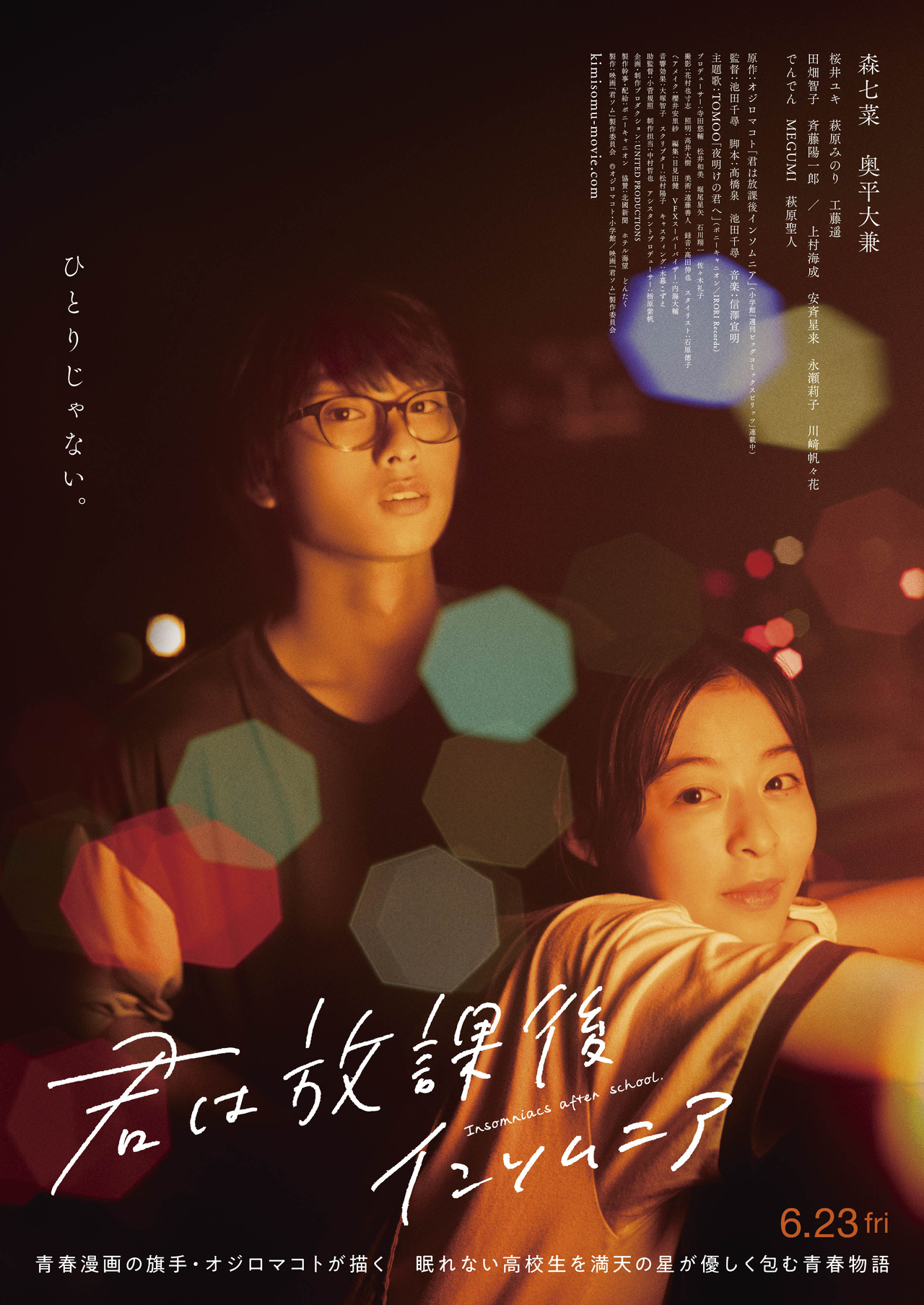
Two teens begin to overcome their fears and anxieties after bonding over their shared insomnia in Chihiro Ikeda’s adaptation of the Makoto Ojiro manga, Insomniacs After School (君は放課後インソムニア, Kimi wa Hokago Insomnia). It may seem strange in some ways that the pair find their inability to sleep so embarrassing that they keep it a secret from those around them, but then it’s difficult to tell people you’re having trouble sleeping without explaining why which is admittedly to enter the place of emotional vulnerability that each of them is otherwise avoiding. 

Namiki (Daiken Okudaira) describes himself as being overwhelmed by negative thoughts while his days are filled with despair. Unable to sleep at home he struggles to keep his eyes open at school and is otherwise reserved, rejected by many of his peers for being gloomy and aloof with only one real friend to whom he has disclosed his persistent insomnia. When he ventures into a part of the school others avoid thinking it is haunted, he discovers another “ghost” in classmate Isaki (Nana Mori) who also suffers from insomnia and had carved out this small corner of the disused astronomy club as a private lunchtime nap space. Luckily for him, Isaki, who is cheerful and outgoing, is willing to share and soon they become firm friends who decide that their empty nights of dark despair could otherwise be filled with fun and adventure. 

Neither of them really discuss why they aren’t able to sleep until their friendship is more deeply established and the facts emerge somewhat naturally but instead draw strength from their new connection while laying claim to their “sanctuary” in the school’s disused observatory as a place where they can find peace. Discovered by a teacher they have to keep up the pretence of restarting the astronomy club which means deciding on some sort of goal activity as proof that they have a right to the space all of which leads them down a secondary path that distracts them from their sleeplessness as they determine to put on stargazing events and enter a photography competition which requires a short sojourn in the country as well as making entreaties to their classmates for additional help and support. 

Then again, that might be contrary to their original wishes given that what they wanted from the observatory was a private place to sleep free from the stresses of their home lives which are in themselves fairly wholesome problems running from health anxiety to abandonment issues. Parallel scenes remind us that their struggles are largely the same, each has come to blame themselves for things which weren’t their fault and has developed a need to be seen as “good” which has led to chronic people pleasing and low self-esteem. But what their stargazing mission begins to teach them is that some things in life are beyond your control so there’s no point worrying about them, while the sense of eternity they discover watching the movement in the skies helps them overcome an adolescent fear of mortality in realising that “human existence doesn’t disappear so easily” and those who are gone still live on in the hearts of minds of others in the great confluence of humanity. 

Where night had been something to endure, they now find new ways to appreciate their lives in a world that seems more full of possibility than fear. Ikeda’s adaptation revels in its wholesomeness with even its slow-burn romantic subplot relatively innocent in its earnestness as the pair monologue over a voice notes app and quite literally lean on each other for support even if it’s not clear whether their insomnia actually improves or they just find better ways of living with it thanks to the new community they’ve found in the re-formed astronomy club which like most clubs is more about just hanging out than it is about serious study of the stars. Making the most of its picturesque small-town setting, the film discovers a quiet sense of serenity in the beauty of the landscape along with its ever expanding vistas in which the teens learn to overcome their mutual anxieties and embrace the infinite possibilities of life thanks to a true friendship founded on empathy and compassion.


Insomniacs After School screened as part of this year’s Fantasia International Film Festival.

Original trailer (English subtitles)

Mountain Woman (山女, Takeshi Fukunaga, 2022)

A young woman charged with disposing of the corpse of an infant has only a few words to impart as she lowers its body to the river, “Don’t be born human in your next life.” Set in late 18th century Tohoku where famine ravages the land, Takeshi Fukunaga’s bleak fable Mountain Woman (山女, Yama Onna) sees humanity in extremis pushed to its most inhumane but also offers refuge in spirituality and a retreat to a less sophisticated existence. 

Calling this existence sophisticated might be a stretch, but there is more than a little constraint attached to the idea of community in this typical farming village in a feudal society. Bad weather has produced two poor harvests, and the villagers are beginning to feel desperate. As the film opens, a woman goes through a painful and traumatic labour only for the midwife to silently offer a cloth to her husband (Takashi Yamanaka) who ignores her pleas and smothers the child. They have nothing to feed it, and perhaps a part of him thinks it’s kinder this way. A young woman, Rin (Anna Yamada), waits outside for the inevitable and accepts a few coins to spirit the baby’s body away. Rin’s family is shunned by the other villagers because of a crime her ancestors apparently committed, and it’s for this reason that they deal with the dead. 

When it comes to handing out the rice rations, the village chief gives Rin’s father Ihei (Masatoshi Nagase) only half but justifies it as a kindness explaining that he is entitled to nothing because his family owns no land (it was taken from them because of their ancestral crime) but even those tainted with the legacy of criminality are still considered part of the community and so they are doing what they can. It’s this liminal status that begins to eat away at Rin. She’s expected to support a community that as she later says considers her less than human and gives her nothing in return. When her father is caught stealing from the rice reserves, she selflessly claims responsibility and Ihei lets her, savagely beating his daughter in front of the village elders as if he thought that might be enough to settle the matter.

It’s at this point that Rin decides to leave the village, taking off her sandals and leaving them at the gate to imply that she has been “spirited away” though everyone likely knows she has walked into the mountains to die. Several times we see her gazing at Mt. Hayachine which is where locals believe souls go after death, praying to its goddess who was herself apparently a thief and sympathetic to those who find themselves in moments of desperation. As Rin tells her younger brother who is rejected by the community because he is blind, the goddess Hayachine accepts everyone the same, good or bad, rich or poor, unlike the hypocrites from the village desperate to find a scapegoat on whom to blame their plight. There is no longer any space for sentimentality in their lives. Listening only to an old shamaness who claims to be in contact with the gods, they squabble amongst themselves for what little that remains before deciding they must sacrifice a virgin girl to the Weather God to end the bad harvests. 

But what Rin discovers in the mountains is freedom in simplicity. Having broken a taboo in stepping beyond the Mountain God Stone, she is freed from the constraints of “civility” and later tells a man who has come to rescue her that she has no desire to return for only in the mountains has felt herself to be a true human being. She encounters another person there she assumes is the mysterious Mountain Man (Mirai Moriyama) and is kind to him though he never speaks and shows her only silent comfort. It may be this that later saves her life in a fable-like moment that frees her to return to the mountain and the only place she has ever felt alive, but also says something of the inhumanity of so-called civilisation that only in a “savage” land can she find comfort and serenity. Often shot in crushing darkness contrasted with the overwhelming light and beauty of the forest, Fukunaga’s bleak tale of human selfishness implies that only by shaking off the false sophistication of an oppressive “civilisation” can one discover true humanity.


Mountain Woman screened as part of this year’s Nippon Connection.

Original trailer (dialogue free)

Images: ©YAMAONNA FILM COMMITTEE

A Man (ある男, Kei Ishikawa, 2022)

©2022 "A MAN" FILM PARTNERS

“Why was living so hard for him?” a brother remarks of man he assumed to have died in an accident after severing ties with his family, though with little sympathy in his voice and in truth should the brother be dead it would be all the better for him. Adapted from  a novel by Keiichiro Hirano, Kei Ishikawa’s A Man (ある男, Aru Otoko) asks questions not so much about the limits of identity and the existence of an authentic self, but the kinds of labels we place on others and the prejudice that often accompanies them that makes some want to run from themselves. 

Accidental detective Kido (Satoshi Tsumabuki), a lawyer who previously represented the recently widowed Rie (Sakura Ando) in her divorce from her first husband, is a case in point. He tries not to react while his wealthy and extremely conservative father-in-law runs down a case he’s just won representing the parents of a man who took his own life after being expected to work extreme overtime by an exploitative company solely to fulfil the image of the salaryman. The father-in-law sneers and complaints about the family receiving compensation before moving on to a rant about the welfare state scoffing that “real” Japanese don’t rely on such things which are only for “Koreans and people of that ilk”. 

Aside from its unpleasant xenophobia, the remark is insensitive as Kido is himself third generation Zainichi Korean, though a naturalised citizen of Japan. Throughout the film, he’s bombarded with social prejudice and racist abuse to which he chooses to say nothing, because there’s nothing he can really say, though leaving us to wonder if his decision to marry his wife (Yoko Maki), the daughter of a wealthy and conservative family, is an attempt to secure his own identity as a member of Japanese society even while bristling at her further demands, that they should invest in a more impressive, larger detached house as recommended by her father and also have another child. 

Kido’s quest to uncover the “true” identity of Rie’s husband Daisuke (Masataka Kubota) who is discovered to have been living an assumed identity when the brother of the man whose name he borrowed arrives at his memorial service, is also a quest to affirm his own identity which is in many ways as self-constructed as Daisuke’s is assumed to be. The interesting thing is that Daisuke, who said little of his past, used the other man’s backstory leaving no doubt that is not quite a case of mistaken identity that brings Kyoichi (Hidekazu Mashima) to Daisuke’s memorial service, though he is quick enough to disparage the life the deceased man shared with Rie in a rural “backwater” while making vague references to insurance policies and inheritances and simultaneously offering to pay for the funeral expenses as if reclaiming ownership over Daisuke’s legacy. 

Like Kido’s father-in-law, Kyoichi appears to be a cynical and self-interested man and it’s not difficult to see why the other Daisuke may have wished to escape his life with him. As an older man points out, everyone has things in their past and though they might not seem like much to others it’s natural enough to want run from yourself, to leave everything behind and start again somewhere else. In Japan, this is much easier to do than in some other countries and it’s true enough that changing one’s name is not that uncommon either. Rie’s young son Yuto, now old enough to question his own identity, took his mother’s maiden name after the divorce, then Daisuke’s surname Taniguchi when he married his mother. Now he wonders what his name should be if it is not Taniguchi and who he really is underneath it. 

In essence, we give people names as a kind of label to describe our relationship to them as a means of mapping out the world. These labels also come with prejudices such as that directed towards Kido as a Zainichi Korean and to another of the “disappeared” men who struggled to emerge from the shadow of his father’s crime as a death row felon. The projection of an identity can be harder to live with than the identity itself. When Kido’s wife tells him that he doesn’t seem himself and she wants him to go back to the way he was before, it’s a rejection of the new identity that has begun to surface through his quest to identify Daisuke and an instruction that he conform to the image of him she has constructed for herself as a typical Japanese salaryman not so different from her father in their affluent, middle-class existence.

Having satisfied himself that he understands the man Daisuke came to be, Kido’s self-image and sense of identity seem to be reaffirmed. He is happier with his wife and son, and has fewer doubts about his place in the world, but then he’s suddenly confronted with an unexpected revelation that undermines his new sense of security in causing him to doubt the veracity of the image he has of others, and consequently of their relationship with him which again leaves him unanchored unable to affirm his image of himself without its reflection. Rie’s final acceptance that in the end she never needed the “truth” (now that she has it) points to the same answer, that in the end Daisuke’s name was irrelevant because he was the man he was to her at the time that she knew him and this is all we can ever really know of each other in a continual act of faith in interpersonal connection. A man can be many people at once, or in quick succession, and none of them any less “real” than another. “It’s nobody’s life but your own,” Kido is reminded even as he struggles to reorient himself in a merging of identities self-constructed or otherwise but perhaps destined to remain forever a stranger to himself.


A Man screens in Chicago March 18 as part of the 16th season of Asian Pop-Up Cinema.

International trailer (English subtitles)

Not Quite Dead Yet (一度死んでみた, Shinji Hamasaki, 2020)

©2020 Shochiku Co., Ltd. Fuji Television Network, Inc.

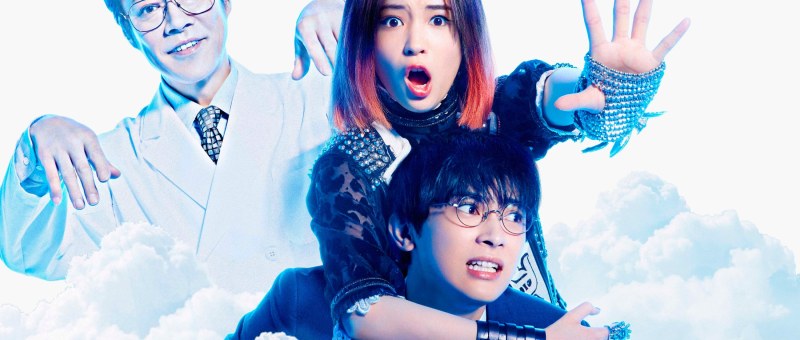
“What’s important is purpose, to live for something. Without it you’re as good as dead” according to the hero of madcap existentialist farce Not Quite Dead Yet (一度死んでみた, Ichido Shinde Mita). The feature debut from ad director Shinji Hamasaki pits a rebellious student against her overly literal, authoritarian dad as the pair begin to come to a kind mutual understanding only once he “dies” after being tricked into taking an experimental drug in order to unmask conspiracy within his own organisation. 

College student Nanase (Suzu Hirose) intensely resents her father (Shinichi Tsutsumi), the CEO of Nobata Pharmaceuticals which he has long been pressuring her to join. She’s currently the lead singer in death metal band Soulzz only according to a record scout at one of their shows their problem is that they’re all “zz” and no soul. Meanwhile, Nobata has assigned an underling, Matsuoka (Ryo Yoshizawa), to shadow her partly because Matsuoka too has very little presence and is in fact nicknamed “ghost” for his essential invisibility. The trouble starts with the escalation of a corporate feud as Nobata’s old buddy Tanabe (Kyusaku Shimada) starts manoeuvring to get his hands on the company’s research into an anti-ageing serum codenamed “Romeo”, planting a mole inside the organisation. As a consequence of his research another of the scientists nicknamed “Gramps” has stumbled on another drug which renders someone temporarily “dead” for a period of two days, naming it “Juliet”. Watabe (Yukiyoshi Ozawa), a consultant Nobata has brought in to streamline the business, convinces him to take the experimental drug in order to flush out the mole while secretly working with Tanabe to take over the company by forcing through a merger while Nobata is out of action. 

A typical socially awkward scientist, Nobata believes that life is about experiment and observation, a belief system which has thoroughly irritated his daughter who still lives at home but has divided the territory in half with clearly marked red tape. Nanase’s animosity towards her father apparently stems back to the death of her late mother Yuriko (Tae Kimura), angry with him that he never left his desk and didn’t make it to the hospital in time to see her before she passed away. “Life’s not a lab experiment” she sings, recalling her childhood during which her overly literal father took away life’s magic by patiently over explaining fairytales, scoffing that Prince Charming probably didn’t revive Sleeping Beauty with a kiss but a transfer of static electricity, while continuing to order her around in fatherly fashion now she’s all grown up. Perhaps still stuck in a petulant adolescence she started the band to vent her frustrations with the world in the form of a death metal “mass”, but she’s growing up. Her bandmates are getting jobs or getting married, she’s still stuck with no real clue about what it is she actually wants to do with her life except that she doesn’t want anything to do with Nobuta Pharmaceuticals.  

Once her father “dies”, however, she begins to gain a new appreciation for his life philosophy able to see but not hear his “ghost” while his body lies on a table in the office cafeteria. Nobata went into pharmaceuticals to help people, but has been led on a dark and vacuous path pursuing anti-ageing technology which is in itself a rejection of change and transience. Ending all her sentences with the word “death”, that’s not something Nanase can get behind. She believes in growing old gracefully, that they make drugs not to cheat death but to be able to spend longer with those they love. As her father had advised Matsuoka to do, she begins to find her purpose, rediscovers her soul, and figures out what it is she’s supposed to do with her life.

Matsuoka, however, seems to be permanently “invisible” despite the tentative romance that develops as he and Nanase attempt to subvert the conspiracy to stop them doing her dad in for good, brushing up against the venal Tanabe who seems set to muster all his corporate advantages against them partly because of an old grudge against Nobata. Of course, you have to wonder why the conspirators didn’t just poison him rather than having him go Juliet and then entering a race against time to cremate him before he wakes up, but as Nobata reminds us there are many things which science cannot explain. A cheerfully silly Christmas tale of rediscovering what it means to be “alive” in the presence of death, Not Quite Dead Yet is zany seasonal fun but with plenty of soul as its heroes learn to shake off cynical corporatism for a healthy respect of the values of transience.


Not Quite Dead Yet screened as part of Camera Japan 2020.

Original trailer (English subtitles)

Images: ©2020 Shochiku Co., Ltd. Fuji Television Network, Inc.

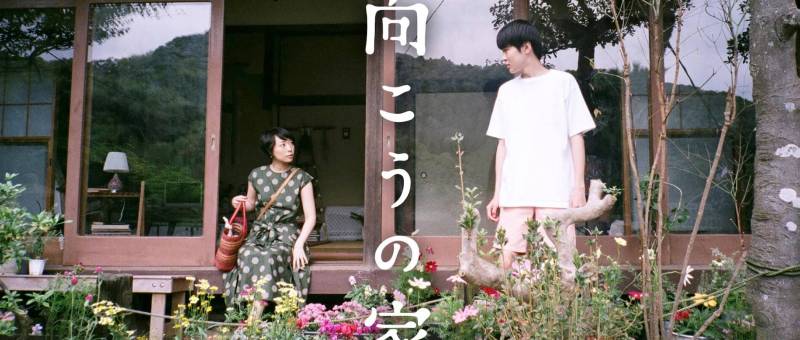
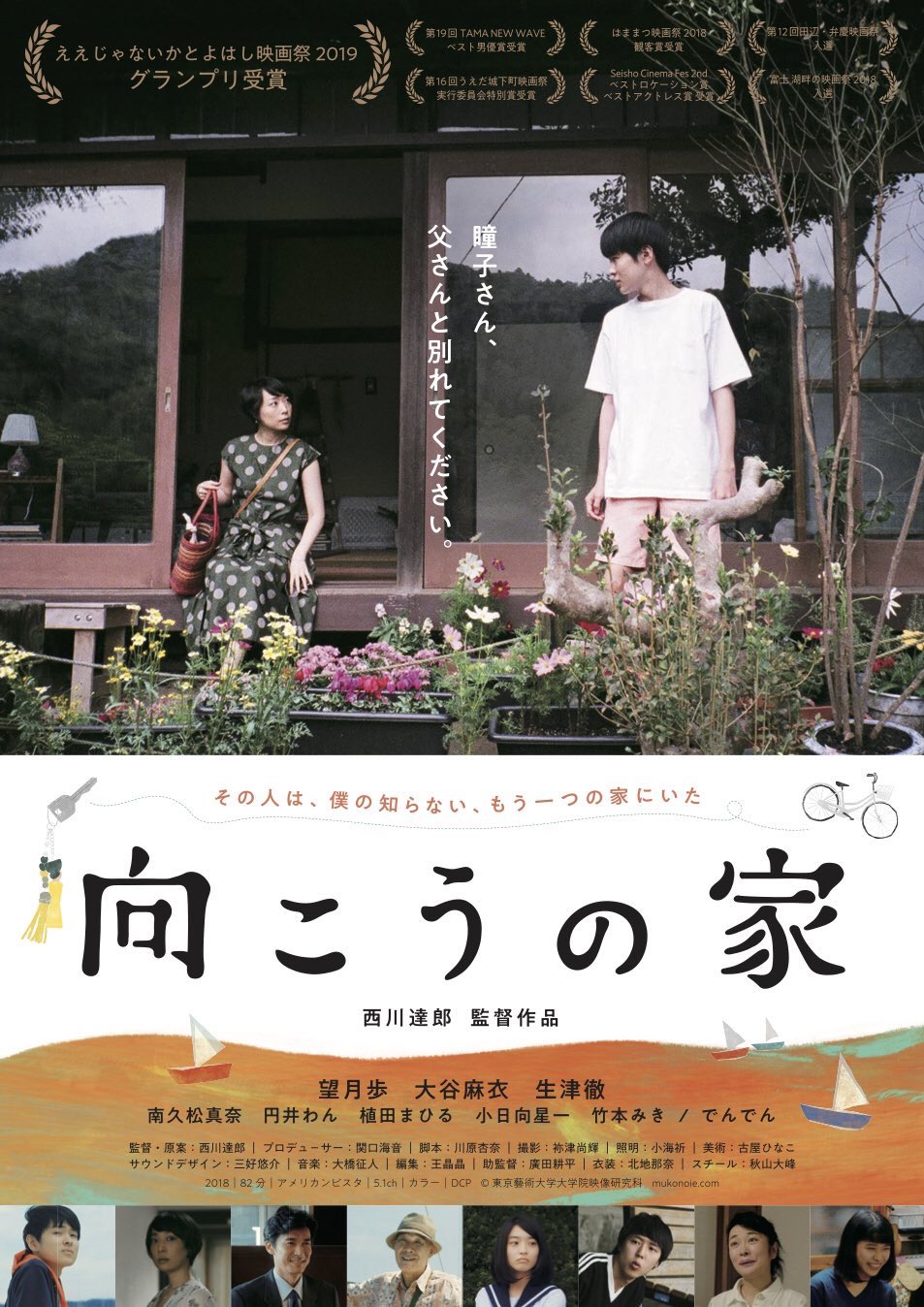
The Other Home (向こうの家, Tatsuro Nishikawa, 2018)

There comes a time in everyone’s life when they start to realise that things are not always as they appear and no matter how happy and settled your family life might seem, your parents aren’t perfect though they are probably doing their best. For Hagi (Ayumu Mochizuki), that moment comes at 16 when he gets fed up with school and takes some time off believing he might be able to learn more outside of the classroom than in. An unconventional coming-of-age tale, Tatsuro Nishikawa’s graduation project The Other Home (向こうの家, Mukou no Ie) is also a meditation on the modern family and the patriarchal order. 

Getting back to school after the summer break gets off to a rocky start when Hagi and his friend are told that the fishing club of which they are members is being shut down as the teacher who was in charge of it is scaling back her workload because she’s just got engaged and will eventually be leaving to get married. Hagi takes this in his stride, mostly at a loss over where to eat his lunch because his girlfriend, Naruse (Mahiru Ueta), for some reason thinks it’s embarrassing to eat alone in the classroom. In any case, Hagi reacts by deciding not to go to school at all. His parents don’t approve, but decide to give him some space to figure out what’s going on. Meanwhile, he’s beginning to wonder if it’s odd that his family never fight, his parents committed to talking things through peacefully rather than resentfully hiding their true feelings. 

Or, so he thought. There is something childishly naive in his conviction that because his parents never fight in front of him they never fight at all, though it’s true enough that he comes from a talking about things family in which his mother Naoko (Mana Minamihisamatsu), in particular, is keen that they share their thoughts and feelings honestly, looking forward to her husband Yoshiro (Toru Kizu) returning home each day after which they share a drink and make time to talk. It comes to something of a surprise to him then when his dad asks him to pick up a set of keys he’s forgotten and bring them to a cafe near where he works without letting his mother know. Hagi does as he’s told only to learn the keys are for a cheerful cottage by the sea which he’s been renting for his mistress, Toko (Mai Ohtani), with whom he now wants to break up preferably before the lease is due for renewal. Too cowardly to do it himself, Yoshiro enlists his teenage son’s help to break up with the woman he’s been cheating on his family with. 

Strangely, this revelation does not seem to sour him on his dad even if he realises the threat it poses to their happy family life. “Protecting the family peace. Men must uphold that promise” Yoshiro unironically tells his son, problematically implying that the way to do that is by covering up affairs rather than simply not having them. Dutifully Hagi heads over to “the other home”, only to be thrown out by Mr. Chiba (Denden), a friend of Toko’s who not unreasonably tells him that this is something his father should be dealing with himself rather than sending his teenage son to guilt his mistress into moving out of her house. Failing to engage with his father’s betrayal, Hagi nevertheless comes to sympathise with Toko who is about to be rendered homeless thanks to his father’s moral cowardice, staying with her in the cottage while lying to his mother that he’s doing an internship at his father’s company. 

Nevertheless, each of his parents is eventually found wanting as Toko teaches him the things they perhaps should have including how to ride a bike, an embarrassing oversight which had seen him deemed “uncool” by his exasperated girlfriend. The film has little time for Naoko’s talking about things philosophy, her husband merely lying to her while engaging in the same patriarchal double standards simultaneously insisting it’s a man’s duty to “protect family peace” while deliberately endangering it through an extramarital affair. Hagi too perhaps picks up these uncomfortably old fashioned ideas partly from his teacher who proudly shows off her engagement ring boasting that it cost her fiancé three months’ salary, the expense apparently proof that he intends to look after her well for the rest of her life as if she couldn’t do that herself. He begins to feel sorry for Toko as she outlines her life as a kept woman, a backroom full of unwanted presents from various men who too looked after her for a time, but in the end merely offers to look after her himself by quitting school to get a job so he can renew the lease to make up for his father’s moral cowardice.

The reason they were so happy, it seems, is that Yoshiro gave himself an escape valve. “Sometimes it’s hard for me to be dad” he admits, apologising for his inability to share his burdens honestly, his male failure neatly undercutting the tacit acceptance of the patriarchal authority which stands in contrast to Naoko’s ideal of a healthy relationship founded on emotional authenticity. Finally learning to ride a bike, Hagi finds himself entering a less innocent world as a young man now fully aware of the universe’s moral greyness if perhaps not quite so enlightened as he might feel himself to be.


The Other Home screened as part of Camera Japan 2020.

Original trailer (no subtitles)