Tokai no Kaii 7-ji 03-bun (都会の怪異7時03分, Sotoji Kimura, 1935)

Though less well remembered now, Sotoji Kimura was a fairly prominent director at PCL in the 1930s having made Japan’s first musical Tipsy Life in 1933. A left-wing filmmaker who had been associated with keiko eiga and proletarian cinema, he nevertheless also later made imperial propaganda films and eventually decamped to Manei in Manchuria, remaining in China until 1953. Though he returned to filmmaking after his return to Japan, he never regained the same kind of success he’d experienced before the war.

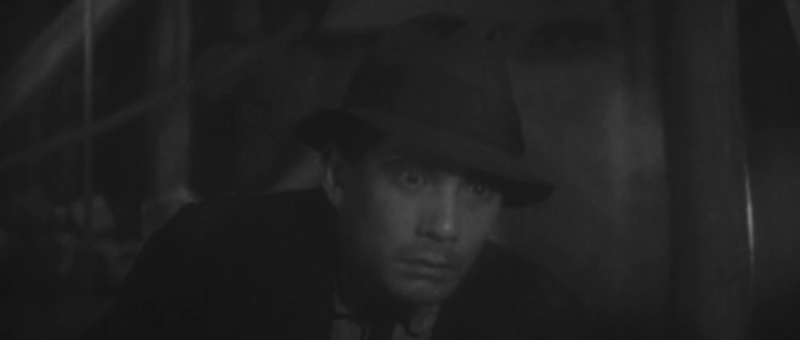
Tokai no Kaii 7-ji 03-bun (Lit, “Urban Mystery: 7:03) seems like it may have been an outlier in his earlier career which doesn’t appear to have leaned much towards genre cinema. Though in some quarters billed as a horror film, likely because of the inclusion of the word “怪異” which implies some kind of strangeness or connection with the supernatural, it’s more of a noirish morality tale with an otherworldly edge as a compromised man attempting to reform himself after a living a dissolute life makes a series of poor choices after being given a copy of the following evening’s newspaper. A title card at the beginning states that the film is adapted from the final story written by Itsuma Maki penned especially for PCL. Itsuma Maki was a pen name used by Kotaro Hasegawa specifically for his true life mystery stories and his picture that is featured. Hasegawa had passed away from asthma at the young age of 35 a few months before the film’s release.

The story itself is said to be inspired by British writer Holloway Horn’s The Old Man, though all it seems to take from it is the morally compromised protagonist and the newspaper from the future. Miyamoto is in a bind because his girlfriend is pregnant and even with both of them working they’re struggling to make ends meet as is it. He calls his friend Tarama, who is a reporter, for financial help. It’s at this point that we learn both that Miyamoto used to live a fairly debauched life in the bars and clubs of Ginza and may also have had issues with gambling. He has, though, attempted to give all that up after meeting Noriko (Sachiko Chiba), a kimono-wearing respectable young woman who works in a shop selling Western fashions. They do not appear to be legally married, though Miyamoto refers to her as his wife, possibly because their financial situation does not allow it seeing as Noriko may have to give up her job if she married. Miyamoto is currently working for some kind of shady company that sells financial information and is in the middle of a dodgy deal with a government minister who suggests the nation is on the brink of financial collapse, but that they also have to at least appear financially responsible in a strange echo of Miyamoto’s situation.

Miyamoto has already tried asking his boss for financial assistance, but the boss is incredibly judgemental and unsympathetic. He calls Miyamoto irresponsible and suggests he’s embarrassed himself just by asking his employer for this kind of favour. To add insult to injury, he also tells him he should pay for the personal call he just made to Tarama on the office phone. When he’s approached by a strange old man on the street who seems to know his name, Miyamoto is rude at first and flat out tells him he doesn’t have money to buy the newspaper he’s selling. But the old man badgers him into taking one, claiming that it’s the edition from the following evening. The old man walks away smiling, remarking that Miyamoto is the only person on earth on who knows what’s going to happen tomorrow. Comparing the paper those of other passengers on the way home, Miyamoto confirms that it does seem to be from the following day, though when he disembarks he’s followed by hysterical laughter from the other passengers having repeatedly tried to confirm the day’s date along with obvious facts such as Friday 27th following Thursday 26th.

In any case, some of the newspaper headlines, including an earthquake and a fire breaking out at the bar where he was due to meet Tarama the following evening, come true further convincing him the content is accurate. An obvious solution presents itself in using the racing report to place a bet and win financial security for his new family, but Miyamoto doesn’t have the stake money. He only needs 20 yen, but even after waking a pawnbroker in the middle of the night, he can’t get more than eight. It’s at this point he becomes increasingly greedy and desperate, deciding to take advantage of a report of a late night robbery, staking the place out and robbing the thief as he makes his escape only to end up killing a seemingly innocent man who had even less in his wallet than he did.

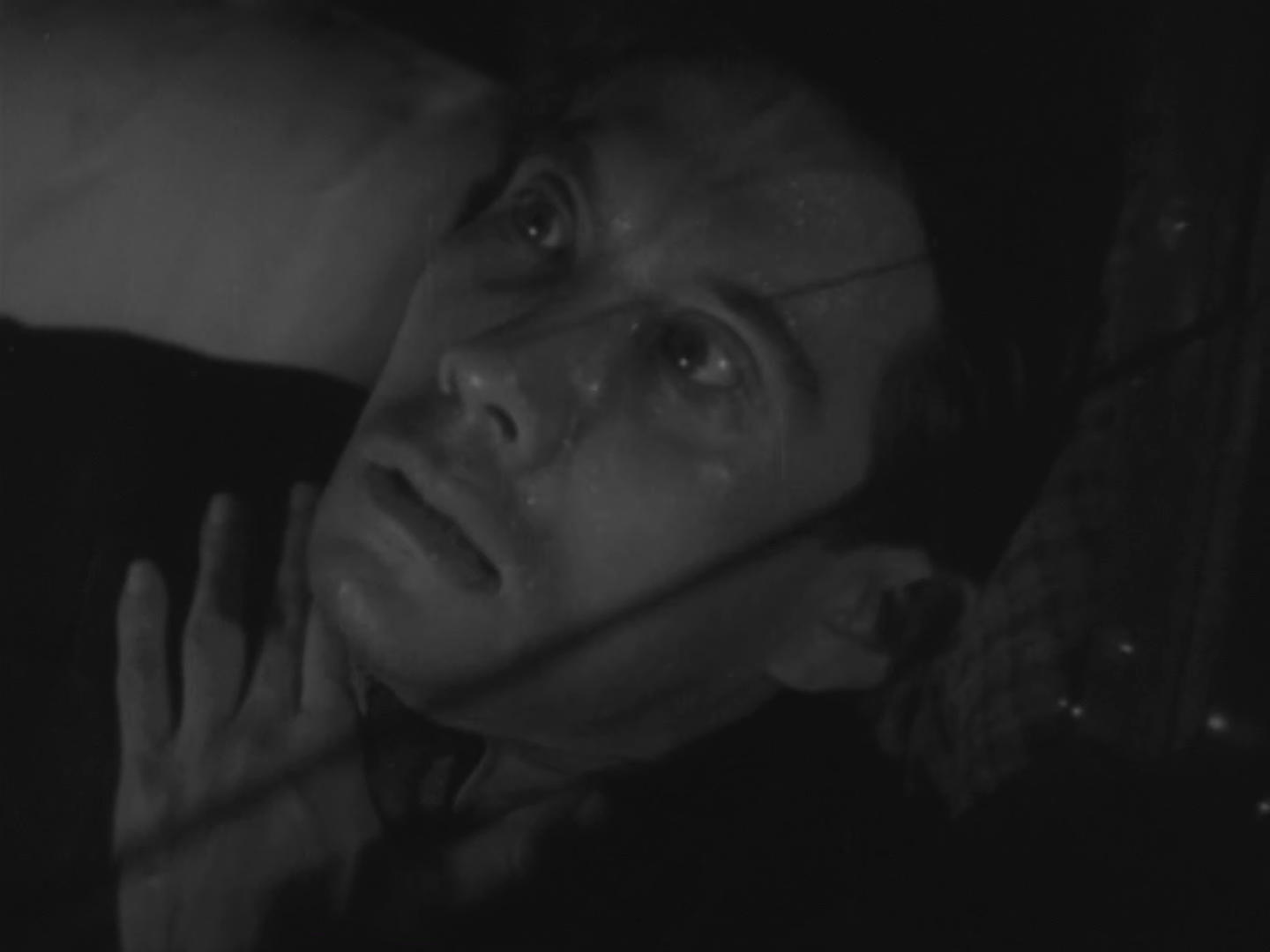
That the man had no money perhaps further bears out the straitened nature of the contemporary economy, though it seems clear enough that most of Miyamoto’s issues are the result of his personal failings. Perhaps the best thing to do would have been to throw the newspaper away. His attempt to use it to cheat at gambling might be understandable, but his decision to rob a man who had committed theft as if that were somehow more morally justifiable than committing the crime himself directly is not really defensible. On realising he may have killed the man, he simply shrugs and says he was “scum” anyway, as he steals his disappointingly empty wallet. His repeated attempts to get rid of it, which all fail as the universe mysteriously returns it to him, may symbolise his desire to discard his crime, but in the end he cannot escape his fate just as he failed to overcome his nature when presented with the newspaper. Kimura conjures an atmosphere of increasing dread as Miyamoto becomes ever more sweaty and paranoid amid the foggy streets of Tokyo before beginning to realise that he may have got his priorities all wrong and should perhaps have paid more attention to what the newspaper had to say before accepting its dubious bargains.
Policeman (警察官, Tomu Uchida, 1933)

“No one knows what will happen to us in this world of illusion” muses a conflicted villain in Tomu Uchida’s seminal proto-procedural, Policeman (警察官, Keisatsukan, AKA Police Officer). Forever an enigma, Uchida had made his name through a series of broadly progressive, left-wing films featuring strong social critique, yet he also made this mildly authoritarian, overtly pro-police piece of militarist propaganda long before it became necessary to do so. But then, look a little closer and you’ll find him subtly undercutting the messaging, reconfiguring his tale of a courageous policeman who sets aside his personal feelings in the pursuit of justice as one of tragedy in which a man ultimately imprisons himself by doing so. 

The hero, earnest policeman Itami (Isamu Kosugi), was once as he later reveals a wayward young man. “The world was against me, I thought. I was young then” he sighs, explaining that he owes his life to his boss and mentor, Sgt. Miyabe (Taisuke Matsumoto), who became a second father and set him on the right path which he now of course follows. His long lost childhood friend Tetsuo (Eiji Nakano), with whom he reconnects during a routine vehicle check, apparently experienced something similar having fallen out with his wealthy industrialist father but claims that he’s become an elite layabout spending all his time at the golf course and asking his dad for money every time he runs out which seems nothing if not contradictory but then familial relationships can be complex. In any case, a repeated motif sees the two men taking diverging paths, literally, the implication being that they’ve each chosen different directions in response in to the same adolescent crisis when in a sense “orphaned” through parental disconnection. 

On hearing Tetsuo’s story, Itami asks him with thinly veiled horror if he hasn’t become a communist, that being a fairly common and fashionable way for a young man from a wealthy family to fall out with his father. Tetsuo laughs it off, wishing it were political but claiming somewhat vaguely that it was a matter of feeling. The exchange is revealing in that screenwriter Eizo Yamauchi had apparently been instructed to portray the criminal gang at the film’s centre, of which Tetsuo is later revealed to be a member, as “communist” though no political ideology or identity is ever directly stated. Nevertheless, the central drama is clearly inspired by the Omori Bank Robbery (1932) in which a three members of the Communist Party robbed the Kawasaki Daiichi Bank without the knowledge or authority of party officials in order to gain funding for the movement. The incident backfired, badly discrediting the Communist Party (illegal at the time) and thereby imploding the most viable source of opposition to rising militarism. Armed bank robbery not being a common occurrence in Japan, most viewers would necessarily associate this brand of criminality with “communism”, killing two birds with one stone as the film does its intended job of making the world seem more dangerous than it is while reinforcing an authoritarian message that the police will protect. 

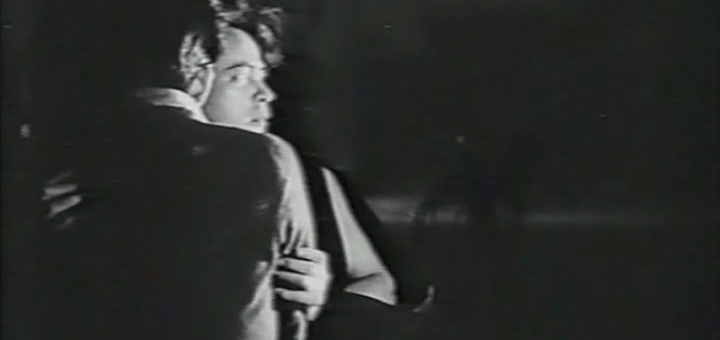
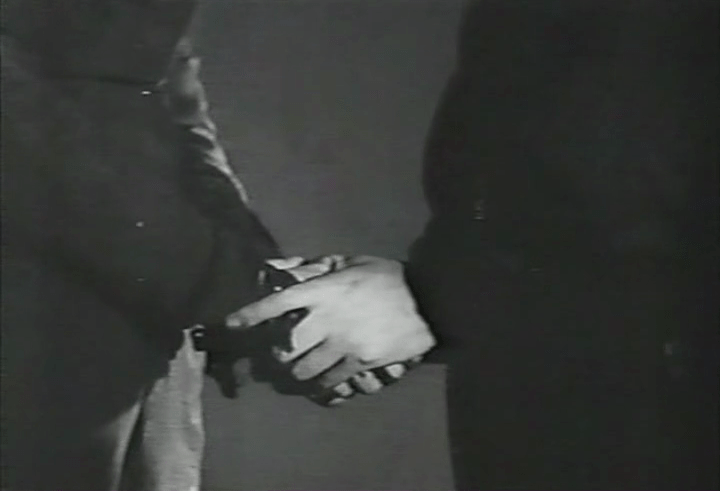
Yet, on the other hand, perhaps it really was “feeling” after all. The relationship between the two men has an intensely homoerotic quality with frequent flashbacks to their carefree high school days during which they read each other romantic German poetry, played rugby, and frolicked on a beach in the company of a very large dog. Itami largely ignores his potential love interest in Miyabe’s pretty daughter, save for briefly thinking about her while on a three-day stakeout of the robbers’ den, while constantly chasing Tetsuo after becoming suspicious that he may be the man responsible for shooting Miyabe and fleeing the scene after a robbery. His inner torment lies partly in the conflict between his responsibilities to friendship and the law, but also perhaps in his unresolved feelings for Tetsuo. Driven half out of his mind, his final epiphany crying out “I am a policeman” is as much a rejection of an identity as a claiming of one, entirely sublimating himself within the image of the role that he has chosen to play in society shedding his personal feeling and desires as he does so. In “saving” Tetsuo, shooting him in the hand to prevent his suicide, tenderly cuffing and then embracing him, he evokes both a sense of return and forgiveness and another of goodbye further enhanced by the abruptness of the transition which follows. 

Taken in this light, the late and extremely jarring slide into overt propaganda through a series of title cards loudly proclaiming the virtue of the police takes on a differing kind of anxiety in its authoritarian dimensions as a force which destroys rather than protects in its capacity to erase individual identity. Nevertheless, Uchida also includes numerous shots of heroic policemen in their dashing uniforms as they assemble for drill or show up en masse on their bikes ready to fight crime. Tetsuo’s final appearance, meanwhile, is extremely sinister dressed as he is in an outfit which would later become associated with fascism, his meticulous uniformity in strong contrast to the then crazed and dishevelled Itami still in his crumpled kimono with messy hair and three days’ worth of beard growth from his stakeout. Yet there’s nothing but pain and fear in his eyes as he realises that his friend has seen through him, Itami rather ostentatiously bundling Tetsuo’s lighter into a handkerchief almost as if he meant to him let know. 

Shooting mainly on location, Uchida’s camera is rarely at rest even employing a series of complicated vehicle tracking shots one of which eventually resolves itself into a first person perspective while the final sequence is tense in the extreme with its gunfire, search lights, and complex choreography. His use of flashback is precise and unusual, far ahead of its time in its acuity as if we actually see Itami’s thought process on screen jumping from one idea to another, while the meeting of the two men on the desolate docks seems to be drenched in loneliness and a sense of futility even while free of the oppressive shadows from the buildings which seemed to dwarf them in the city. Somehow desperately sad despite the catharsis of its final scene, Policeman subtly implies there might not be much difference between hero and villain, or between communist and militarist, save walking one way and not another as two men find their friendship frustrated by time and circumstance coming together only to be driven apart.