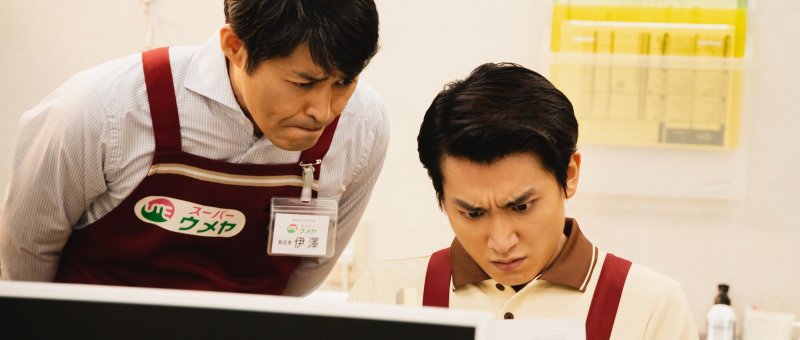
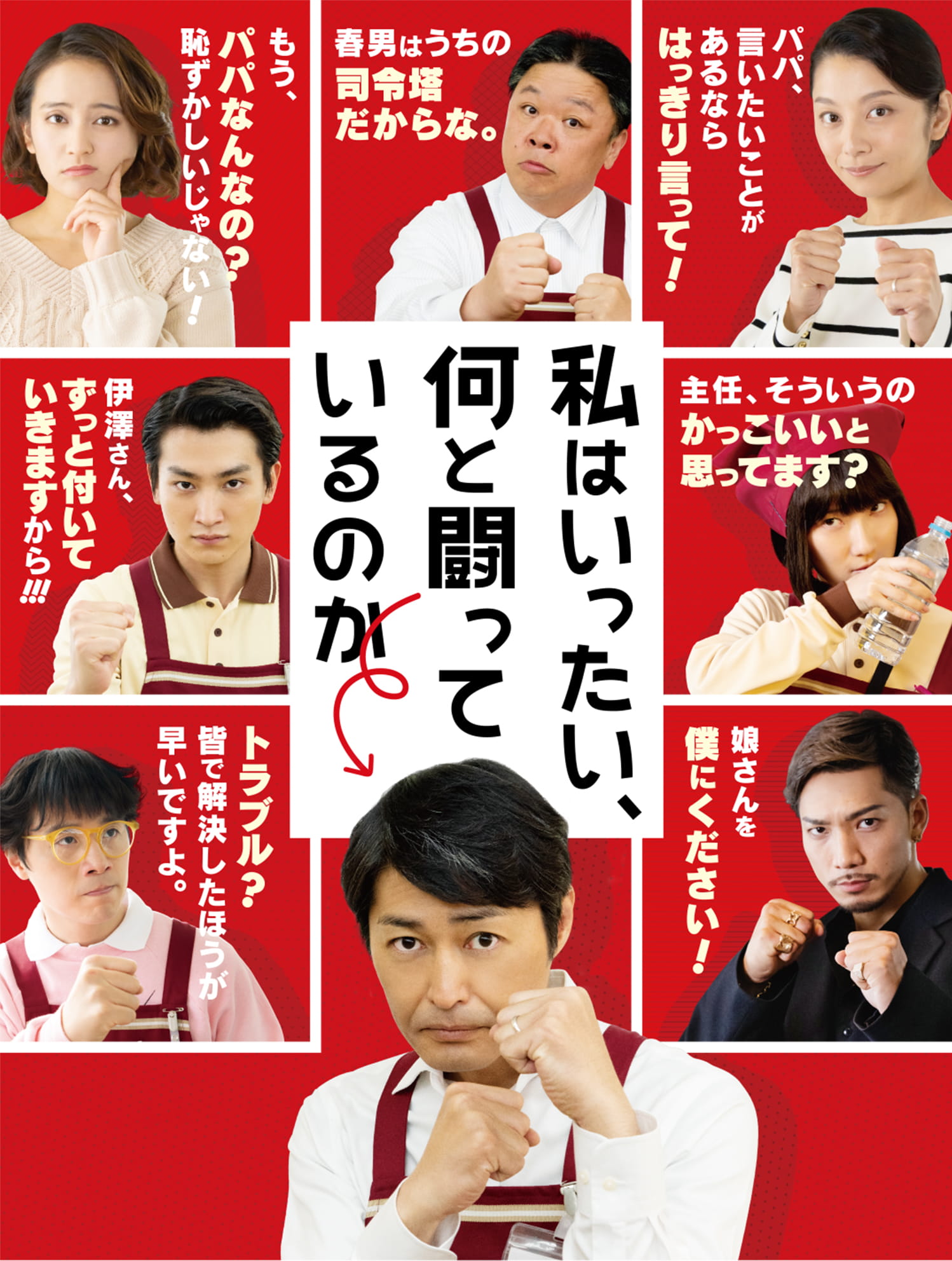
Life is a lonely battlefield for the middle-aged hero of Toshio Lee’s Struggling Man (私はいったい、何と闘っているのか, Watashi wa Ittai Nani to Tatakatteiru no ka). The film’s English-language title and supermarket setting may recall Juzo Itami’s Supermarket Woman, but Lee’s lighthearted dramedy soon takes an unexpected left turn as the hero battles a kind of mid-life crisis of fracturing masculinity as his professional and family lives come under simultaneous threat firstly by his failure to land a long overdue promotion and secondly by his eldest daughter’s impending marriage.
After 25 years working at the same small-town supermarket, Haruo Izawa (Ken Yasuda) is well respected by his colleagues and often depended on by his boss Mr. Ueda (Hikaru Ijuin) yet harbours an internalised inferiority complex that he has not yet made manager. When Mr. Ueda passes away suddenly, everyone, including Haruo himself, just assumes he’ll finally be getting promoted but head office soon parachute in an extremely strange man from accounts, Nishiguchi (Kentaro Tamura), who knows nothing at all about how to run a supermarket. Haruo ends up with an awkward horizontal promotion to deputy manager while Nishiguchi basically leaves everything up to him.
Haruo is always being told that he’s too nice but as he later tells another employee, he too is really just thinking of himself as revealed by his ever running interior monologue in which he often imagines himself in situations which will show him in a good light only for things not to pan out as he’d hoped. It’s clear that what he’s experiencing is partly a middle-aged man’s masculinity crisis often comparing himself to others and embarrassed on a personal level in not having achieved his career goals while directly threatened by the presence of his daughter’s new boyfriend fearing that he will lose his patriarchal authority within his own household in which he is already somewhat mocked by an otherwise genuinely loving and supportive family. His anxiety is compounded by the fact that he is a stepfather to the two daughters while he and his perspicacious wife Ritsuko (Eiko Koike) have a son together. The discovery of plane tickets sent by the girls’ estranged birth father in Okinawa with the hope that they will visit unbalances him in his increasing fear of displacement.
As in the Japanese title of the film, Haruo is always asking himself what it is he seems to be fighting with the obvious answers being an internalised inferiority complex and toxic masculinity while constantly told that he doesn’t help himself with his Mr. Nice Guy approach to life. When he discovers an employee may be defrauding the business, he stops his assistant from reporting it and after discovering the truth decides to help cover it up so they won’t lose their job but later loses out himself when his simple act of kindness and compassion is viewed in bad faith by a potential employer. He tries to make things work with Nishiguchi, but Nishiguchi is a defiantly strange person and so all of Haruo’s attempts to help him integrate into supermarket life backfire. As it turns out, he’s in a constant battle with himself against his better nature but always resolving to be kind and put others first while privately annoyed that the universe often seems to be unkind to him.
Then again as an old lady running a curry house puts it, happiness is having a full belly and so long as Haruo has a healthy appetite things can’t really be that bad. His life is quite nice, which is something he comes to appreciate more fully while reclaiming his image of himself as a father and along with it a sense of security brokered by a truly selfless act of kindness informed by paternal empathy. Professional validation may be a little harder to win, but lies more in the gentle camaraderie with fellow employees than in ruthless workplace politics or rabid ambition. Life need not be a lonely battle as Haruo begins to learn setting aside his manly stoicism and trusting in his ace detective wife who has been engaging in a similar and apparently victorious battle herself reaffirming her love for the kind of sweets so unexciting no one remembers they’re there which may seem a little plain on the outside but have their own kind of wholesome sweetness.
Struggling Man streams in the US Sept. 17 – 23 as part of the 15th season of Asian Pop-Up Cinema.
International trailer (English subtitles)


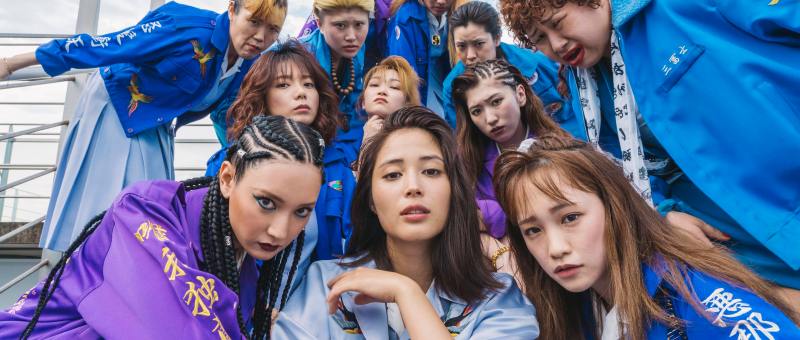







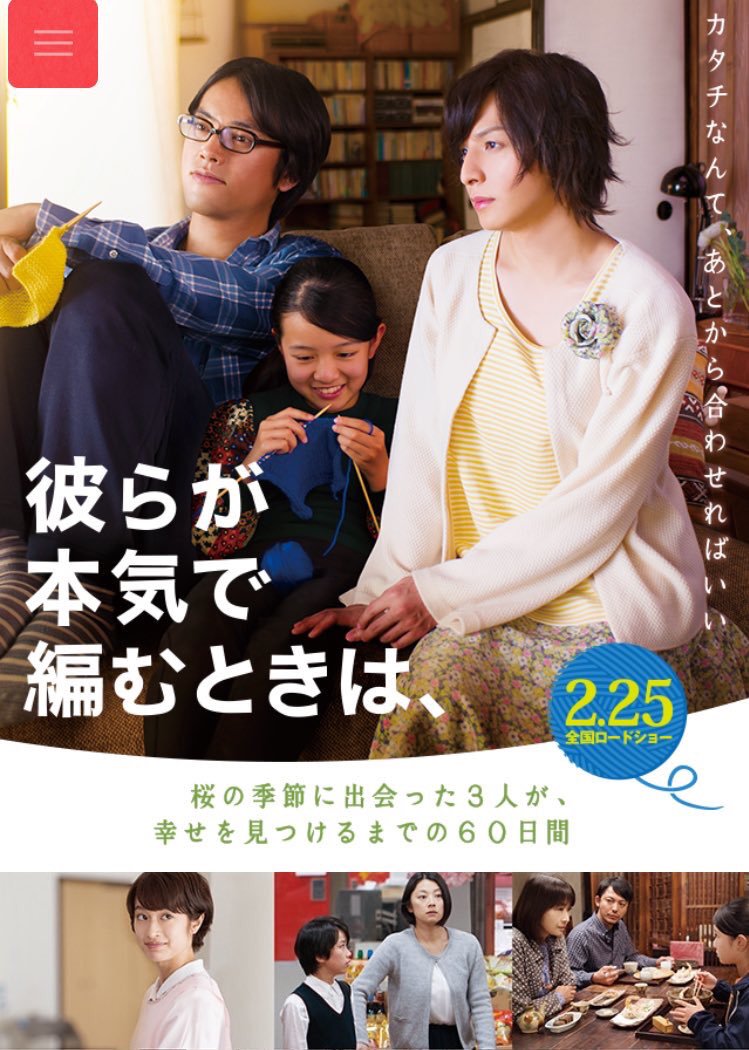 While studying in the US, director Naoko Ogigami encountered people from all walks of life but on her return to Japan was immediately struck by the invisibility of the LGBT community and particularly that of transgender people. Close-Knit (彼らが本気で編むときは, Karera ga Honki de Amu Toki wa) is her response to a still prevalent social conservatism which sometimes gives rise to fear, discrimination and prejudice. Moving away from the quirkier sides of her previous work, Ogigami nevertheless opts for a gentle, warm approach to this potentially heavy subject matter, preferring to focus on positivity rather than dwell on suffering.
 In this brand new, post truth world where spin rules all, it’s important to look on the bright side and recognise the enormous positive power of the lie. 2015’s April Fools (エイプリルフールズ) is suddenly seeming just as prophetic as the machinations of the weird old woman buried at its centre seeing as its central message is “who cares about the truth so long as everyone (pretends) to be happy in the end?”. A dangerous message to be sure though perhaps there is something to be said about forgiving those who’ve misled you after understanding their reasoning. Or, then again, maybe not.
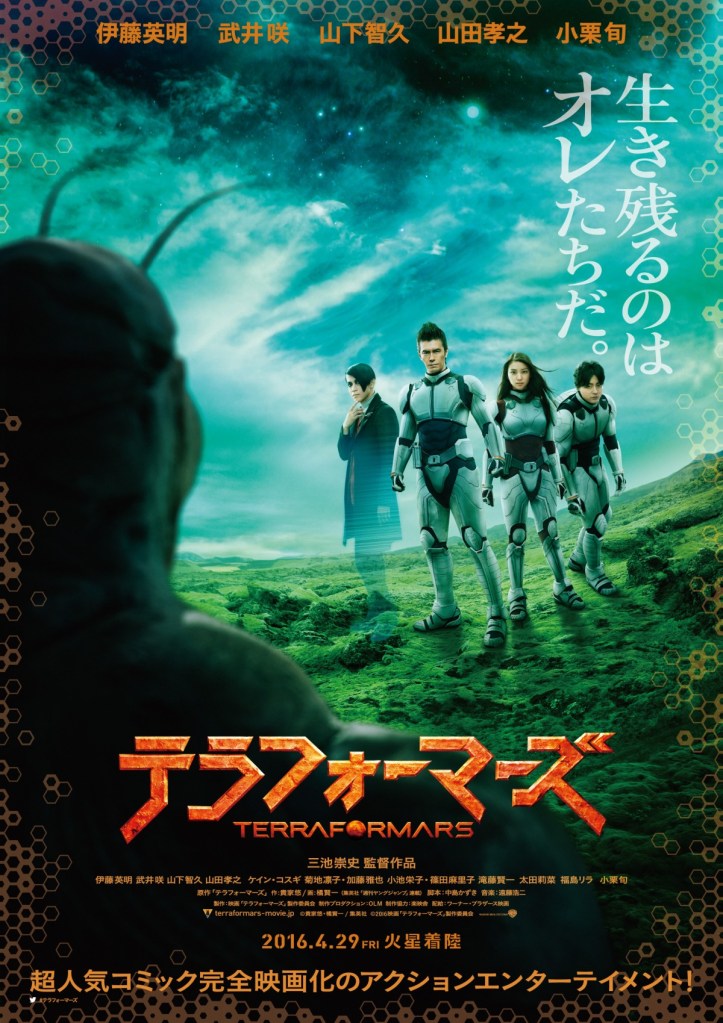 Terra Formars – Terror for Mars? It’s all about terror in the quest for terra and reform in Takashi Miike’s bug hunt extravaganza adaptation of Yu Sasuga and Kenichi Tachibana’s manga. In fact, much of the plot is more or less the same as Aliens, but our motley crew is not a crack team of space marines headed by a recently awoken from stasis super survivor who proves unexpectedly dextrous in a robotic forklift exoskeleton, but a collection of human “bugs”, parasitical criminals who’ve each been made an offer they can’t refuse. High budget and boasting a starry cast, Terra Formars (テラフォーマーズ) definitely falls into the throwaway Miike category and proves curiously dull despite its ridiculous set up, but then if you happen to be into bugs there’s really a lot to like here.
 The Fallen Angel (人間失格, Ningen Shikkaku), based on one of the best known works of Japanese literary giant Osamu Dazai – No Longer Human, was the last in a series of commemorative film projects marking the 100th anniversary of the author’s birth in 2009. Like much of Dazai’s work, No Longer Human is semi-autobiographical, fixated on the idea of suicide, and charts the course of its protagonist as he becomes hopelessly lost in a life of dissipation, alcohol, drugs, and overwhelming depression.
 Windows on Worlds