
You Are the Film (君は映画, Makoto Ueda, 2026) [Fantasia 2026]

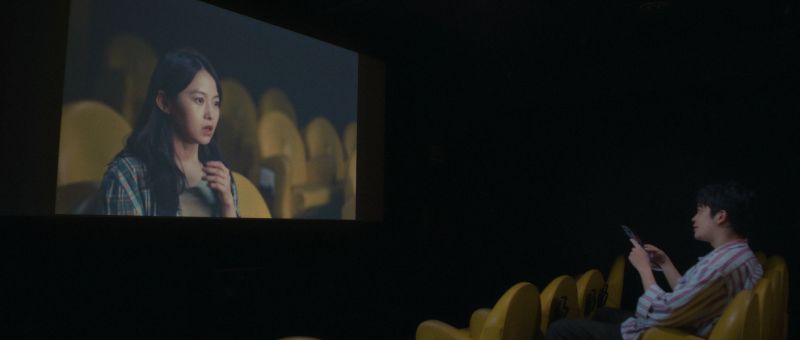
What if you went to see a film, but it was actually just a Zoom meeting with another person who thought they were there to see a film about you? That isn’t quite what happens in Makoto Ueda’s directorial debut You Are the Film (君は映画, Kimi wa Eiga), but it does take the protagonists longer than one would expect to stop suspending their disbelief, convinced that “a film” is conversing with them, and consider that they’re actually just watching a live feed of another person who is also watching them. 

But then again, the image reflected back at them from the screen is also a kind of wilful fantasy designed as both an escapist flight from an unsatisfying “reality” and a means of reframing their current dilemmas so that they can think about them more clearly. Effectively, it’s a way of realising what you might advise someone else to do in this situation, but wouldn’t actually consider doing yourself until you’re given this external vision of your own life. Ueda hints at this subtlety in the film’s opening sequence as he has playwright Madoka (Marika Ito) walk past a forked road representing a bifurcated reality, just as the film she’s going to see takes place directly adjacent to where she’s currently watching it, which is also the environment in which she spends the majority of her life. 

Both she and struggling musician Kazuma (Kai Inowaki) have enough in common to see themselves in the protagonist of the other film, and not just because Kazuma also inhabits this physical space too just on the other side of Madoka. He has a strained relationship with a band member and is so far failing to sell enough tickets for their upcoming concert. Madoka, meanwhile, has been offered the opportunity to put on a play at a larger, more prestigious venue but is feeling the pressure and struggling to complete her script. Despite what originally seems to be a very weird and uncanny situation, they eventually realise that they are able to help each other in a more direct way such as feeding back information about their respective “films” from the pamphlets they sell at the cinema.

But at the same time, the film seems to be in a way satirising these kinds of indie dramas or at least the sci-plot that develops on Madoka’s side is not that far away from the kind zany fringe theatre that troupes like hers often perform. In fact it’s even foreshadowed in the opening sequence as her co-stars seemingly play princess and retainer from another world mystified by the existence of a thermal tumbler, an apparent symbol of corporate oppression. Kazuma’s meanwhile spirals into an unlikely crime drama when his bandmate steals some money from a pair of counterfeiters which eventually exposes that the rock cafe he frequents is a front for an illegal gambling den run by an undercover gangster.

Despite these seemingly apocalyptic scenarios, what they learn is that they are able to change the script and eventually escape their own movie by transcending it, leading to the creation of a third movie starring those they left behind. It turns out that their friends are also yearning for escape in one way or another as Madoka’s friend Shiho has been offered a promising opportunity and secretly wants to move on, while the other actress sort of longs to escape by staying with the troupe but says she wants to leave as her parents have finally found out that she hasn’t been studying for the civil service exam after all. While watching these dramas play out Kazuma comes to his own realisations about his relationships with his bandmates, just Madoka begins to realise that all these desires must also be respected. If she wants to escape her movie, so does everyone else, and in order to be free she will have to let them go.

Nevertheless, each of them learn to embrace their status as the protagonist of their own lives with full authorial power to change the script, rejecting the meddling interference of some kind of engineer sent to rectify the “entanglement in filmspace” and get everyone back inside the right movie again. It turns out that you really are the film, and so is everyone else, but our realities aren’t as separate as they first seemed and we can still help each other out as we go along rather than remaining passive spectators within our own lives and those of others.


You Are the Film screened as part of this year’s Fantasia International Film Festival.

Trailer (English subtitles)
Struggling Man (私はいったい、何と闘っているのか, Toshio Lee, 2021)

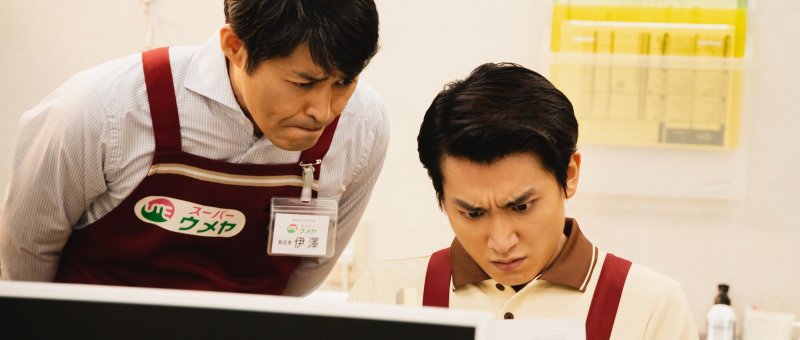
Life is a lonely battlefield for the middle-aged hero of Toshio Lee’s Struggling Man (私はいったい、何と闘っているのか, Watashi wa Ittai Nani to Tatakatteiru no ka). The film’s English-language title and supermarket setting may recall Juzo Itami’s Supermarket Woman, but Lee’s lighthearted dramedy soon takes an unexpected left turn as the hero battles a kind of mid-life crisis of fracturing masculinity as his professional and family lives come under simultaneous threat firstly by his failure to land a long overdue promotion and secondly by his eldest daughter’s impending marriage. 

After 25 years working at the same small-town supermarket, Haruo Izawa (Ken Yasuda) is well respected by his colleagues and often depended on by his boss Mr. Ueda (Hikaru Ijuin) yet harbours an internalised inferiority complex that he has not yet made manager. When Mr. Ueda passes away suddenly, everyone, including Haruo himself, just assumes he’ll finally be getting promoted but head office soon parachute in an extremely strange man from accounts, Nishiguchi (Kentaro Tamura), who knows nothing at all about how to run a supermarket. Haruo ends up with an awkward horizontal promotion to deputy manager while Nishiguchi basically leaves everything up to him. 

Haruo is always being told that he’s too nice but as he later tells another employee, he too is really just thinking of himself as revealed by his ever running interior monologue in which he often imagines himself in situations which will show him in a good light only for things not to pan out as he’d hoped. It’s clear that what he’s experiencing is partly a middle-aged man’s masculinity crisis often comparing himself to others and embarrassed on a personal level in not having achieved his career goals while directly threatened by the presence of his daughter’s new boyfriend fearing that he will lose his patriarchal authority within his own household in which he is already somewhat mocked by an otherwise genuinely loving and supportive family. His anxiety is compounded by the fact that he is a stepfather to the two daughters while he and his perspicacious wife Ritsuko (Eiko Koike) have a son together. The discovery of plane tickets sent by the girls’ estranged birth father in Okinawa with the hope that they will visit unbalances him in his increasing fear of displacement.  

As in the Japanese title of the film, Haruo is always asking himself what it is he seems to be fighting with the obvious answers being an internalised inferiority complex and toxic masculinity while constantly told that he doesn’t help himself with his Mr. Nice Guy approach to life. When he discovers an employee may be defrauding the business, he stops his assistant from reporting it and after discovering the truth decides to help cover it up so they won’t lose their job but later loses out himself when his simple act of kindness and compassion is viewed in bad faith by a potential employer. He tries to make things work with Nishiguchi, but Nishiguchi is a defiantly strange person and so all of Haruo’s attempts to help him integrate into supermarket life backfire. As it turns out, he’s in a constant battle with himself against his better nature but always resolving to be kind and put others first while privately annoyed that the universe often seems to be unkind to him. 

Then again as an old lady running a curry house puts it, happiness is having a full belly and so long as Haruo has a healthy appetite things can’t really be that bad. His life is quite nice, which is something he comes to appreciate more fully while reclaiming his image of himself as a father and along with it a sense of security brokered by a truly selfless act of kindness informed by paternal empathy. Professional validation may be a little harder to win, but lies more in the gentle camaraderie with fellow employees than in ruthless workplace politics or rabid ambition. Life need not be a lonely battle as Haruo begins to learn setting aside his manly stoicism and trusting in his ace detective wife who has been engaging in a similar and apparently victorious battle herself reaffirming her love for the kind of sweets so unexciting no one remembers they’re there which may seem a little plain on the outside but have their own kind of wholesome sweetness. 


Struggling Man streams in the US Sept. 17 – 23 as part of the 15th season of Asian Pop-Up Cinema.

International trailer (English subtitles)