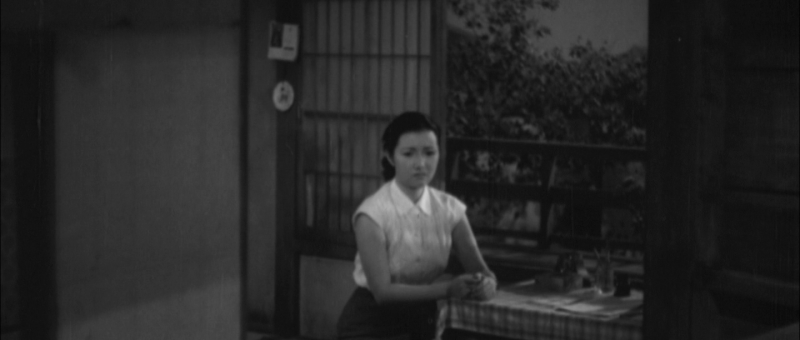
Lightning (稲妻, Mikio Naruse, 1952)

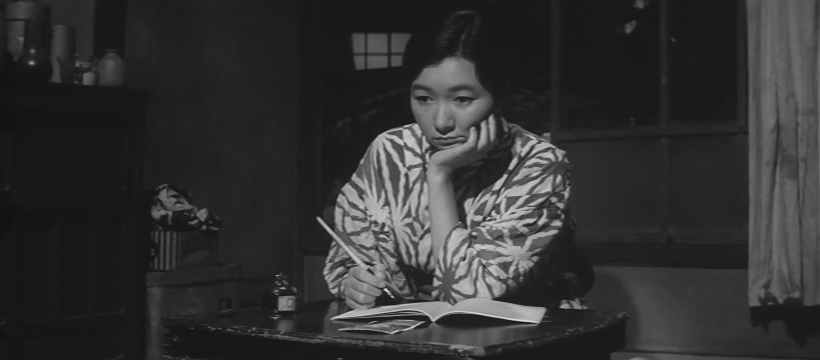
In many ways despite its matter of fact bleakness, Lightning (稲妻, Inazuma) is among the more optimistic of Mikio Naruse’s films ending on a note of cheerfulness and hope in which the storm has been broken and the heroine seems to have rediscovered a sense a faith in humanity. Yet the attitudes she displays are often contradictory and firmly at odds with the kind of Shitamachi spirit one might find in the films of a director such as Yoji Yamada in films like The Sunshine Girl released a decade later.

The qualities that most define Kiyoko (Hideko Takamine) are, as her mother Osei (Kumeko Urabe) suggests, an inner strength that eludes her older sister Mitsuko (Mitsuko Miura) and a forthrightness that sees her struggle to pursue the kind of life she wants rather than that she is expected to lead. Yet some might see her as snobbish and judgemental, at times attacking her mother for having married four times and given birth to four children each with different fathers. In this she sees a particular moral failing on the part of Osei, but perhaps also expresses a deeper distrust in her mother’s repeated attempts to find stability only through harnessing herself to a man. 

Echoing Takamine’s role in Hideko the Bus Conductor, Kiyoko has a job as a tour guide showing off the sites of bustling Ginza though explaining that this part of the city only really comes alive at night. The job gives her a sense of independence and self-sufficiency a woman in this era is not really permitted to have. Her oldest sister, Nui (Chieko Murata), asks if she contributes to the household but the meeker Mitsuko replies that she wanted to but they told her to save her money instead. In any case, it’s towards marriage that she’s pushed when Nui attempts to play matchmaker brokering an engagement with a 35-year-old baker, Goto (Eitaro Ozawa), who has aspirations of opening a love hotel into which Nui and her feckless husband Ryuzo (Kenzaburo Uemura) have invested. Of course, it turns out that Nui is herself having an affair with the baker who is oily in the extreme and disliked by most of the family though eventually manages to make his way into the beds of two of the sisters.

Kiyoko has little desire to marry and asks her mother if any of her four marriages made her happy, but her mother only says that happiness is not an important concept hinting the hardship she’s faced in her life and that a woman of her generation may have had to put up with a certain of degree dissatisfaction to keep a roof over her head and food on the table. While working on the bus, Kiyoko spots Mitsuko’s husband talking to another woman in the street but decides to say nothing only for him to suddenly die and the woman turn up with a baby asking for financial support. Kiyoko tells her sister that marriage is hell, but she smiles and says Kiyoko will be the exception in an expression of the various ways in which women enforce these arcane social codes against each other despite their own misery. Mitsuko too wants to escape but admits she doesn’t have Kiyoko’s courage which is how she too eventually falls into the clutches of Goto much to her sister’s disappointment. 

There is something undeniably poignant in Kiyoko’s frustrated defiance, looking longingly at the paintings and books of their lodger, a young woman from a more middle-class family working her way through university. Kiyoko says she wants to study too, but her mother shoots her down. She’s already 23, and it’s a little late to be picky about marriage let alone strike out for a more stereotypically middle-class life with a white collar job and nice house in the suburbs. It’s the suburbs though to which she eventually moves, without even bothering to tell any of her family. When the nice landlady asks if she has any she admits she has but also has nothing to do with them, which earns her a confused frown. She later says something similar to the pair of piano-playing siblings who live next-door in a kind of suburban utopia, quite clearly ashamed of her humble Shitamachi roots and family members she sees as common and immodest.

In any case, her admiration of the siblings and obvious attraction to the brother (Jun Negami) who is so much more sensitive and caring than her own (Osamu Maruyama) who appears to use the wartime bullets lodged inside him as an excuse not to move on with his life, suggest that she is still in the end looking for a conventional family only one she sees as more positive (or just posher). Perhaps it’s not so much marriage she rejects but dependency and subjugation, believing a marriage to a man like this might be one more of love and equality than the dissatisfying relationships experienced by her mother and sisters. The expressionistic bolt of lightning which appears during a difficult conversation with her mother is like the breaking of a storm, a kind of letting go in which her resentment begins to melt away and her mother agrees to retreat realising that unlike Mitsuko she can take care of herself and to that extent at least is an independent post-war woman. Ambivalent, but in its way warm and forgiving the film gives Kiyoko permission to embrace her aspiration, defy the social codes which constrain her and seek her own happiness, but also allows her to shed her cynicism in rediscovering a faith in humanity and re-embracing her admittedly imperfect mother all while leaving her behind. 
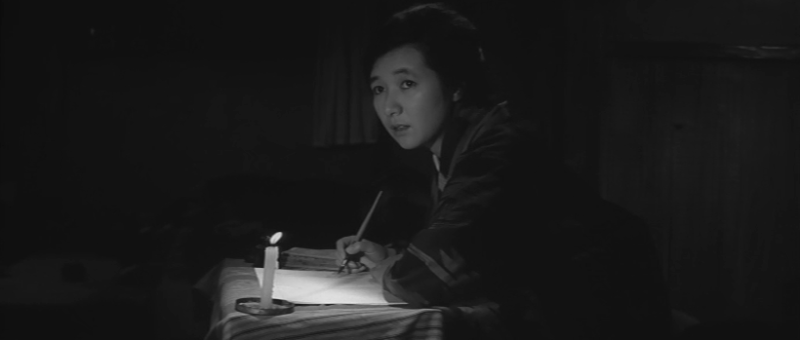

A Wanderer’s Notebook (放浪記, Mikio Naruse, 1962)

Many of Mikio Naruse’s most famous films are adapted from the work of Fumiko Hayashi, a pioneering female author who chronicled the life of a working class woman with startling frankness. Yet his dramatisation of her life, A Wanderer’s Notebook (放浪記, Horo-ki), is both a little more reactionary than one might have expected and surprisingly unflattering even in the heroine’s eventual triumph in escaping her poverty through artistry. Even so if perhaps sentimentalising the economically difficult society of the 1920s in emphasising the suffering which gave rise to Hayashi’s art, the film does lay bare the divisions of class and gender that she did to some extent transgress in pursuit of her literary destiny. 

Naruse and his screenwriters Toshiro Ide and Sumie Tanaka bookend the the film with a literal “lonely lane” which the young Fumiko walks with her itinerant salespeople parents. As a small child, she sees her father arrested for a snake oil scam peddling some kind of wondrous lotion, setting up both her disdain for men in general and her determination not to be deceived by them at least unwittingly. She has no formal education but is a voracious reader well versed in the literary culture of the time and intensely resentful of if resigned to her poverty. In the frequent sections of text which litter the screen taken directly from her novels, she details her purchases, wages, and longing for the small luxuries she can in no way afford. 

As an uneducated woman in the 1920s her working opportunities are few. She exasperatedly relates standing in a queue with hundreds of other women waiting for an interview for a company job only to be told they’ll let her know, while her other opportunity involves meeting a theatre director at a station who later takes her to his hotel/office and makes it plain he’s not really interested in her CV. She gets a job at the office of a stockbroker, but lies about being able to do accounts and is flummoxed by double entry bookkeeping getting herself fired on day one. After a brief stint in factory painting toys, she leaves with a friend to become a hostess but is also fired on her first day for getting drunk and being unwilling to ingratiate herself with the boorish men who frequent such establishments. 

Despite her animosity, she is drawn towards men who are callous and self-involved, firstly taking up with a poet and actor who praises her work but turns out to have several “wives” on the go, and then begins living with a broody writer, Fukuchi, who is insecure and violent, resentful at her success in wake of his failure. Perhaps because of her experiences, she seems to resent any hint of kindness though sometimes kind herself, lending money to her friend whose mother is in need and often ready to stand up for others whom she feels are being mistreated. A kindly widower in the boarding house where she lives with her mother, Yasuoka, falls in love with her but she repeatedly rejects him partly as someone suggests because he is not handsome, but mainly because of his goodness and kindness towards her. Nevertheless, he continues to support always ready in her time of need though having accepted that she will never return his feelings or accept his proposal. 

Perhaps her might have liked to have been kinder, but was too wounded by her experiences to permit herself. In any case at the film’s conclusion in which she has achieved success and in fact become wealthy it appears to have made her cold and judgemental. She instructs her maid to send a man away believing he is from a charity set up to help the poor, insisting that the poor must work for industry is the only path out of poverty implying that as she managed it herself those who cannot are simply not applying themselves when she of all people should know how fallacious the sentiment is. As if to bear out the chip on her shoulder, she forces her mother to wear a ridiculous kimono from a bygone era that is heavy for an old woman and makes her feel foolish because of her own mental image of the finery she dreamed of providing her on escaping the persistent hardship of their lives. 

As she says, she’s no interest in the socialist politics espoused by the literary circles in which she later comes to move, pointing out that the poor have no time for waving flags. One of her greatest supporters is himself from a noble family despite his progressive politics and in truth can never really understand the lives of women like Fumiko. He describes her work as like upending a rubbish bin and poking through it with a stick, at once fascinated and repulsed by a frankness he may see as vulgar. At one point he accuses her of writing poverty porn, playing on her humble origins for copy and becoming something of a one note writer. 

In truth, the film is not really based on the novel from which it takes its title but on the play that was adapted from it, while the novel itself was apparently reworked and republished several times in response to reader taste giving rise to a series of questions both about its essential authenticity and what it was that it was attempting to convey. In the film at least, moments after her literary success, Fumiko is challenged by a fellow female writer, Kyoko, who was once her love rival, that she cheated in a contest by failing to submit Kyoko’s entry until after the deadline had passed, though as it seems she would have won anyway. She is occasionally underhanded, perhaps because she feels she has no other choice, but then as we can see there is no particular solidarity between women save the kindly landladies who often let her delay her rent payments. Fumiko feels herself to be alone and her quest is not really for literary success but simply for her next meal, though she feels the slights of the bitchy women and arrogant men who mock her commonness while simultaneously exploiting it as entertainment. 

On the one hand, her success seems to signal a triumph of independence having freed herself from the need to depend on terrible men though she also she seems to have met and married a warmhearted painter who cares for her and supports her work while she has also been able to give her mother the level of comfort they both once dreamed of. Even so, the unavoidable fact that she dies at such a young age implies she’s worked herself into an early grave in a sense punishing her for her rejection of contemporary social norms undercutting her achievements with some regressive moralising while the one thing she still desires, rest, is given to her only in death. In Takamine’s highly stylised performance, as some have implied perhaps intended to mimic the silent screen, Fumiko is at once a carefree young woman who dances and sings and a melancholy fatalist with a self-destructive talent for choosing insecure and self-involved men, but above all else a woman walking a lonely road towards her own fulfilment while searching for a way out of poverty that need not transgress her particular sense of righteousness. 


Original trailer (no subtitles)

Late Chrysanthemums (晩菊, Mikio Naruse, 1954)

The post-war economy was difficult for most, though by the mid-1950s the situation was perhaps improving. The four former geishas at the centre of Naruse’s Late Chrysanthemums (晩菊, Bangiku) , adapted once again from a series of stories by Fumiko Hayashi, are all in their way attempting to find a way through to the modern society but are nevertheless stuck in the past, unable to move forward as women more or less left behind by a changing idea of “modernity” which no longer has a place for them. 

The most successful of the women, Kin (Haruko Sugimura), has become a ruthless moneylender engaging in real estate speculation. As the film opens she’s waiting for the arrival of a business associate for a meeting about a house she’s trying to flip, clear that they’ll need to kick out the desperate widow who is currently living there. Kin has lent money to her old “friends” with whom she spent her youth as a geisha before the war. Otamae (Chikako Hosokawa) and Otomi (Yuko Mochizuki) are widows with unfilial children, Otamae now working as a maid in a love hotel while her son Kiyoshi (Hiroshi Koizumi) struggles to find a job, and Otomi a washerwoman selling blackmarket cigarettes as a sideline while her daughter Sachiko (Ineko Arima) is a forthright modern woman who refuses to enable her mother’s irresponsible vices. Nobu (Sadako Sawamura), meanwhile, married late to a man from outside of Japan and has opened a small bar where she hopes to start a family, brushing off Kin’s insensitive insistence that she is already too old to bear a child. 

Kin has prospered and become wealthy, but she’s done so largely at the sacrifice of maternity. She disparages the other women, telling them she’s grateful not to have had children because not even they can be depended upon, but is also embittered that she’s missed out on life and love, substituting material wealth for emotional fulfilment. Otomi and Otamae have problems with their children and regrets about their lives, but they both resent Kin for her heartless rationality. Kin is in a sense supporting them with her money, even if she wants it back with interest, and continues to see herself as doing a favour for women she considers friends, hurt that they often run or hide when they see her coming but insisting that she is only trying to survive while implying that the other women have failed to achieve the self-sufficiency she has achieved because they’ve lived irresponsibly by placing their trust in men and frittering their money away on the temporary pleasures of drink and gambling. 

Otomi’s thoroughly modern daughter Sachiko thinks something much the same. When Otomi approaches her for a loan, she says no, fearing that her mother has another lover she will end up subsidising or that she will spend it all on drink and pachinko. Sachiko does, however, offer to buy her mother dinner which at least ensures she will get a good meal. Sachiko’s shock news is that she plans to marry an older man, though he seems not to be particularly wealthy seeing as she later sarcastically asks Kin to buy her a house because they’ll be living with other tenants in a small flat. Otomi objects, not only because Sachiko hasn’t mentioned any of this to her before, but because she thinks Sachiko is being overly practical and gives her some surprisingly transgressive advice to the effect that she should have her fun with various men while she’s young so she’ll be able to figure out which is the best to spend a life with. Sachiko quite reasonably asks how that worked out for her, to which Otomi obviously has no answer and leaves the restaurant feeling dejected enough to ask Kin for the money she was after instead. 

Otamae’s problem is of the opposite order. Her son Kiyoshi cheerfully rolls home in the morning after staying out all night and tells her he’s become a kind of gigalo, dating a slightly older woman who is technically the kept mistress of another man. The situation is ironic in the extreme, but despite her own past as a geisha, Otamae doesn’t like it that her son is engaging in a compensated relationship, while he suggests that perhaps she messed him up by making him refer to her as his sister in public. Eventually Kiyoshi is offered a job in a mine in Hokkaido, salmoning the post-war migratory movement and leaving his mother (as well as the mistress) behind to fuel the economic recovery from the provinces. 

Otomi and Otamae have only each other to rely on, men and children have all proved undependable. Kin, the most fiercely independent, is literally haunted by the spectre of failed romance. Nobu, snaps that Kin made her money by swindling her clients, which might be why she takes the side of Seki (Bontaro Miake), a man who tried to commit double suicide with Kin but survived and was ruined. Kin sees it differently. Seki tried to kill her when she refused to die with him, so understandably she is not keen to reconnect. Nobu advises him to visit her and ask for money as “compensation”, which whichever way you look at it is crass and troubling, that Kin is expected to compensate a man for his ruined prospects caused by his obsessive romantic violence towards her which she claims has put her off men for life. Nevertheless, she continues to meditate on the memory of Tabe (Ken Uehara) whom she loved when he was a student, even visiting him in his Hiroshima barracks after he was drafted. She is thrilled to receive a letter from her first love, but declares herself disappointed minutes after he arrives for a visit. Tabe is just another failed salaryman who thinks women like her have it easy and harps on about how looking at his “old” wife makes him nostalgic for the women he loved in his youth. Like everyone else, he’s after her money. Kin burns the photo of him in uniform and gives up any lingering dream she might have had of romantic fulfilment. 

The women find themselves trapped by conflicting visions of “modernity” which are wildly different from those of their youth. They miss their “carefree” lives as geishas, now perhaps somewhat romanticised, along with the misplaced idealism of their time of Manchuria, while lamenting that as single older women they cannot be anything other than dependent. Only Kin is able to achieve self-sufficiency, but does so effectively as the film suggests at the cost of her “femininity”, becoming hard and cold, ruthlessly practical but not perhaps uncaring even as she continues to subsidise the only “friends” she has perhaps in the knowledge that they fiercely resent her. Yet their lives continue. Nobu runs her bar, Otomi and Otamae send their children off with grudging respect while vowing to follow their examples, and Kin, after a moment of crisis, ventures off towards new prospects. For good or ill they shift towards the modern world, more understanding of its rhythms and their place within it than before, but perhaps no more secure.


Repast (めし, Mikio Naruse, 1951)

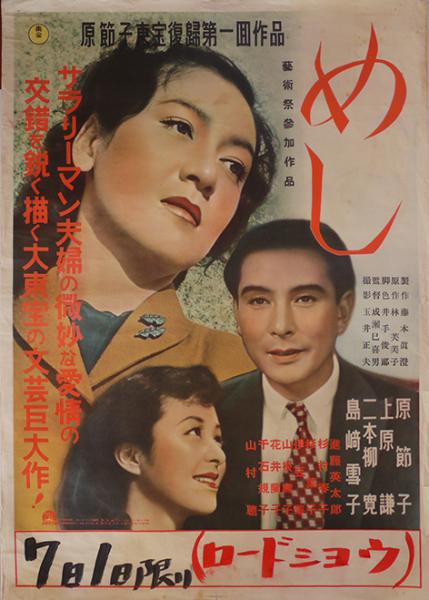
“Must every woman grow old and die feeling empty?” asks the unhappy heroine of Naruse’s 1951 melodrama Repast (めし, Meshi) only to conclude that yes, she must, but that this in fact constitutes “happiness” as a woman. The first of Naruse’s Fumiko Hayashi adaptations Repast arrived in the year of the author’s death and is inspired by a short story left unfinished at the time of her passing. Screenwriter Sumie Tanaka was apparently convinced that the film should end with a divorce, as Sound of the Mountain would two years later, and consequently left the project after the studio mandated a more “sympathetic” ending. Superficially happy as it might seem, however, the conclusion is as bleak as one might expect from Naruse in which the heroine simply accepts that she must recalibrate her idea of happiness to that which is available to her and learn to find fulfilment in shared endeavour with her husband. 

As she explains in her opening voiceover, Michiyo (Setsuko Hara) married her husband Hatsunosuke (Ken Uehara) five years ago in Tokyo against her family’s wishes and has been living on the outskirts of Osaka for the past three. Marital bliss has quite clearly worn off. As we see from the repeated morning scenes of the local community sending their sons off to school and husbands to the office, every day is the same and all Michiyo ever seems to do is cook and clean. The only words Hatsunosuke says to her are “I’m hungry”, and the only source of solace in her life is her cat, Yuri. Yet even this constant state of unhappy frustration is disrupted by the unexpected arrival of Hatsunosuke’s spoilt and immature niece Satoko (Yukiko Shimazaki) who has apparently run away from home in rebellion against an arranged marriage. 

There is obviously a blood relation between Hatsunosuke and Satoko, but Michiyo’s jealously is not exactly unreasonable given the young woman’s childish flirtation with her uncle, perhaps an adolescent extension of her propensity to pout and preen to get her own way. Aside from all that, finances weigh heavily on Michiyo’s mind. Other than her drudgery, the constant source of friction in the relationship is Hatsunosuke’s low salary and lack of career success. Satoko’s family are a little wealthier and having been brought up in relative comfort she has little idea of the real world and is often tactless, remarking on Hatsunosuke’s worn out tie much to Michiyo’s chagrin. Hatsunosuke is happy enough to have her, but Michiyo is wondering if there’s enough rice in the jar to see them through and Satoko never stops to consider that they’re feeding her for free even falling asleep when Michiyo enjoys her one and only day off reuniting with old friends rather than preparing dinner as she’d been asked. Perhaps aware of the disruptive effect of her presence, Satoko pours salt on the wound by constantly asking her uncle if Michiyo doesn’t like her or is angry, further placing a wedge between husband and wife. 

For all that, however, Hatsunosuke would not be accounted a “bad” husband for the time save perhaps for his lack of career success. He is not cruel or violent, merely insensitive and distant, taking his wife for granted and unable to see that she is deeply unhappy while otherwise internalising a sense of guilt and failure in his inability to adequately provide for her. She meanwhile sometimes takes her dissatisfaction out on him in barbed comments about his low salary, her barely hidden contempt never far from the surface. Yet as her mother later points out in encouraging her go back to him he is “reliable, discreet, and honest”, qualities borne out by his later refusal to go along with a dodgy scheme organised by the old elite along with his nervous rebuttal of the attentions of the “mistress” from across the way. 

At heart a conservative woman, Michiyo too looks down on Ms Kanazawa (Kumeko Otowa) for her taboo status as the illicit lover of a wealthy man which is only in a sense her way of seizing her future as an independent woman running her own bar. Satoko, a woman of the modern era, sees less of a problem with it and is far less judgemental, though her own attempts are destined to end in failure thanks to her inability to work out that her present lifestyle is far above her current reach. Retreating to her Tokyo home, Michiyo looks for other options, admiring the apparently happier relationship between her younger sister and brother-in-law who now run the family shop. She asks a sympathetic cousin, Kazuo (Hiroshi Nihonyanagi) who provides an alternate love interest, to help her find work but encounters the brutalising line outside the local employment office and then an old friend now a war widow desperate for employment because her benefits are about to run out and she has a young son to support. Later she spots the same woman handing out flyers, suddenly realising the fallacy of her fantasy of starting again as an independent woman. She pens a letter to her husband admitting that she’s realised how vulnerable she is without his protection, but remains undecided enough to avoid sending it. 

Hearing that Satoko, still childish but perhaps not quite as naive as she assumed her to be, has been laying her claws into Kazuo the final nail seems to have been struck. Michiyo knows she will return to Osaka, but does so not because she has rekindled her love for her husband but because she has accepted there are no better options. Hatsunosuke is dull, but he is in a sense reliable, and honest to the extent that he may be about to be rewarded for his moral unshakability. He cares enough about her to show up in Tokyo hoping, but not insisting, she will return with him which is perhaps as close to a declaration of love that one could hope for. On reflection she decides that a woman’s happiness is found in sharing the journey with her husband, accepting that she must subsume her own desires into his and cannot hope to expect emotional fulfilment other than that found in his satisfaction. Even for a Naruse film, and one as peppered with moments of slapstick humour as this one is, it’s an extraordinarily bleak conclusion subtly hinting at the iniquities of life in a patriarchal society in which the best a woman can hope for is a life of unrewarded drudgery. 


Wife (妻, Mikio Naruse, 1953)

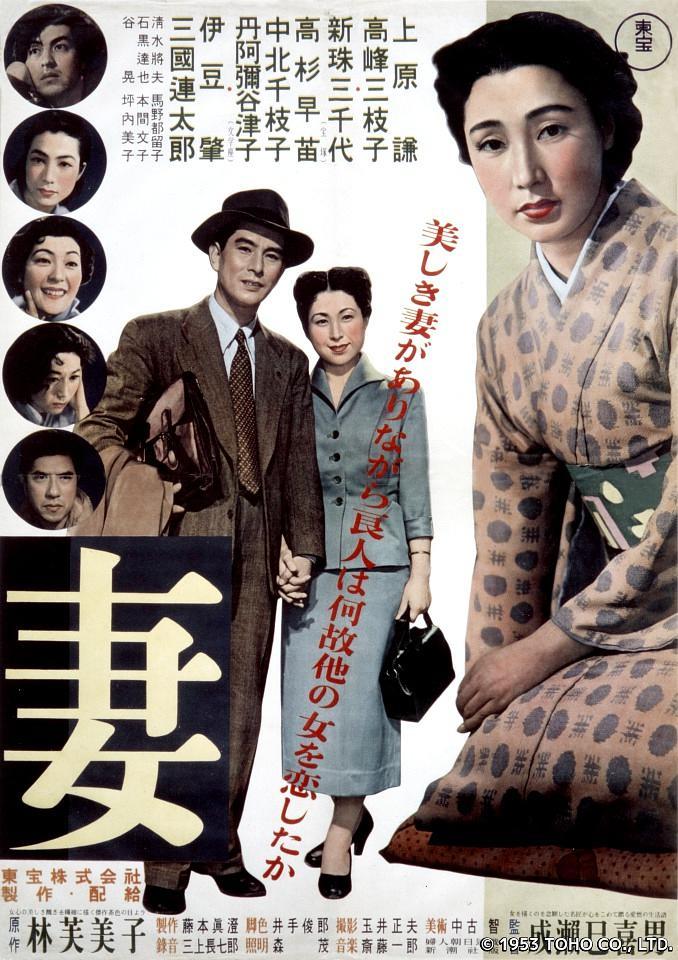
The post-war world, to a certain way of thinking at least, promised a greater degree of freedom in which it might no longer be necessary to go on stoically bearing unhappiness in service to a social ideal. Then again, old habits are hard to break and not everyone is quite so equipped to acknowledge that misery can in a sense be a choice. Mikio Naruse’s Wife (妻, Tsuma) finds itself at a moment of transition in which the meaning of everything the word meant was perhaps beginning to change while the idea that a woman might choose to reject the role was no longer a taboo but an increasingly viable possibility. 

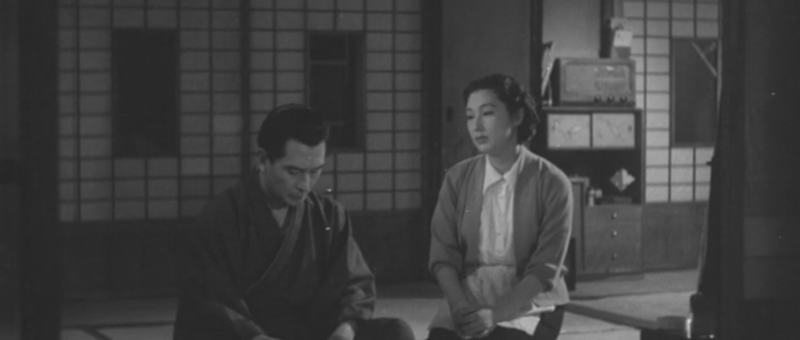
To the unhappily married Mineko (Mieko Takamine), however, the idea of independence remains somewhat distasteful. Each morning her husband, Nakagawa (Ken Uehara), leaves the house without a word. In fact, he doesn’t even look at her before silently walking away. She complains that she has no idea what he’s thinking, all he ever tells her is that he’s “tired” but she also resents him for failing to provide for her in the way that she perhaps expected. The couple live in a sizeable home, but Mineko has to rent out the upstairs to a series of lodgers as well as taking in sewing as a side job to make ends meet. What seems perfectly apparent is that the couple are ill suited, both in terms of temperament and of personal desires. Nakagawa is a soft hearted, romantic sort of man who isn’t particularly bothered if their lodgers pay their rent or not, while his wife is emotionally distant and infinitely practical as perhaps life has taught her to be. 

The peculiarities of life in Japan in 1953 place considerable strain on not only on the Nakagawas but on each of the other couples that we see. Those who married in haste during the war may be regretting their choices, while others, like Eiko (Chieko Nakakita) who rents the upstairs room with her husband Matsuyama (Hajime Izu), complain that the men they waited so long for came back changed. That Matsuyama cannot find a job in the difficult economic circumstances of the post-war society may not be his fault, but the necessity of relying on his wife for economic support has nevertheless eroded his sense of masculinity and left him a resentful drunk, destroying his wife’s love for him. Mineko is slightly scandalised when another tenant, art student Tanimura (Rentaro Mikuni), reveals that Eiko works not in a store but in a bar in Ginza, that being in truth the only kind of job that pays enough to support a married couple and a mother-in-law that a woman can get in 1953. Eventually Eiko leaves her husband, something else that scandalises Mineko, and resolves to live an independent life rather than remarry.

The idea of independence is repeatedly mentioned to her, but Mineko continues to reject it. Her sister jokingly suggests going into business together, while another customer, a widow with a young son, floats the idea of leaving the home of her late husband and opening a shop to support herself independently. She believes remarriage is not a viable option because she has a child, a thought echoed by another widow, Fusako (Yatsuko Tanami), who eventually decides to do something similar by returning to her hometown and going into business with a friend. Opening a shop is a popular option, but it of course requires investment and relies on having strong support, in Fusako’s case from female solidarity in teaming up with another woman in a similar situation. 

It might be easy enough to say that becoming financially independent is a choice on offer only to widows with children who have, in some way, already fulfilled their social obligations, while women like Eiko who chose childless self-sufficiency would still struggle to find acceptance even if their career were not dependent on an industry still itself taboo. That Nakagawa and Mineko have no children perhaps places an additional strain on the marriage. Nakagawa tells a colleague complaining about his family that he wonders if children might have made his life easier, while his only moment of contentment seems to be in playing with Fusako’s young son on the morning after spending an illicit night with her in an inn at Osaka. She sadly tries to ask what might be next for them, but he only wants to live in that moment knowing that their future is an impossibility. 

Despite his unhappiness, Nakagawa doesn’t seem motivated towards ending his marriage, perhaps out of guilt or because as friend later suggests it’s not so much Fusako that he loves as the possibility of a different future. On his return from his Osaka trip, he encounters a new tenant, Mineuchi, who has found her own way to be independent in becoming a mistress. Nakagawa seems to find the arrangement mildly distasteful, though it’s perhaps not so far off what he’s planning to do with Fusako. Mineuchi paid premium for the room and has even brought her own refrigerator and an electric gramophone so she is in a sense living the dream, especially as her “patron”, a furniture store owner, only visits twice a month. 

After learning that Nakagawa has fallen in love with Fusako, Mineko wonders if she should pay her a visit, but then receives one herself from the furniture store owner’s tearful wife who reveals that he is not a wealthy man and has ruined himself, and therefore her, after being bewitched by a Ginza bar hostess. Later, Mineko discovers that the furniture store owner’s wife took her own life in humiliation, lamenting that she didn’t have to go so far just because of her husband’s indiscretion, but also threatens to do the same herself to try and guilt Fusako into giving up her husband. 

Yet, pretty much everyone seems to tell Mineko that this is all her own fault and the reason her perfectly good husband has looked elsewhere is because she has failed as a wife. Sharp and emotionally distant, she alienates those around her but is devastated to realise that she’s lost her husband’s love and will most likely never be able to regain it. Her decision to talk not to him but to Fusako hints at the way in which women see each other as rivals and not as friends, actively holding each other back, as her sister Yoshimi (Michiyo Aratama) also does in insisting on the social order over personal feeling, rather than attempting to find understanding or mutual support. It doesn’t seem to occur to her that ending her husband’s dream of romantic escape through emotional manipulation is unlikely to improve the quality of her married life. 

Mineko, however, never contemplates independence. She tells Fusako that she won’t consent to a divorce just to claim alimony, but privately wonders what would become of her if she left her husband. She might be able to put a stop to it this time, but who’s to say he won’t find someone else. What she seems primed to choose is socially mandated misery, rejecting the “freedoms” of the post-war age to end an unhappy marriage because she can’t conceive of herself as anything other than a “wife” and being miserable is apparently better than being nothing at all. 


Floating Clouds (浮雲, Mikio Naruse, 1955)

(C) 1955 Toho

floating clouds poster“The past is our only reality” the melancholy Yukiko (Hideko Takamine) intones, only to be told that her past was but a dream and now she is awake. Adapted from a novel by Fumiko Hayashi – a writer whose work proved a frequent inspiration for director Mikio Naruse, Floating Clouds (浮雲, Ukigumo) is a story of the post-war era as its central pair of lovers find themselves caught in a moment of cultural confusion, unsure of how to move forward and unable to leave the traumatic past behind.

We begin with defeat. Shifting from stock footage featuring returnees from Indochina, Naruse’s camera picks out the weary figure of a young woman, Yukiko, drawing her government issue jacket around her. She eventually arrives in the city and at the home of an older man, Kengo (Masayuki Mori), whom we later find out had been her lover when they were both stationed overseas working for the forestry commission but has now returned “home” to his family. Kengo had promised to divorce his wife, Kuniko (Chieko Nakakita), in order to marry Yukiko but now declares their romance one of many casualties of war. With only the brother-in-law who once raped her left of her family, Yukiko has nowhere left to turn, eventually becoming the mistress of an American soldier but despite his earlier declarations the increasingly desperate Kengo cannot bear to let her go and their on again off again affair continues much to Yukiko’s constant suffering.

Floating Clouds is as much about the post-war world as it is about a doomed love affair (if indeed love is really what it is). Kengo and Yukiko are the floating clouds of the title, unable to settle in the chaos of defeat where there is no clear foothold to forge a path into the future, no clear direction in which to head, and no clear sign that the future itself is even a possibility. Naruse begins with the painful present marked by crushing defeat and hopelessness, flashing back to the brighter, warmer forests of Indochina to show us the lovers as they had been in a more “innocent” world. At 22, Yukiko smiles brightly and walks tall with a lightness in her step. She went to Indochina in the middle of a war to escape violence at home and, working in the peaceful environment of the forestry commission, begins to find a kind of serenity even whilst dragged into an ill-advised affair with a moody older man more out of loneliness than lust.

Yet, Yukiko’s troubles started long before the war. Assaulted by her brother-in-law she escapes Japan but falls straight into the arms of Kengo who is thought a good, trustworthy man but proves to be anything but. Kengo, frustrated and broken, attempts to lose himself through intense yet temporary relationships with younger women. Every woman he becomes involved with throughout the course of the film comes to a bad end – his wife, Kuniko, dies of tuberculosis while Kengo was unable to pay for treatment which might perhaps have saved her, an inn keeper’s wife he has a brief fling with is eventually murdered by a jealous husband (a guilty Kengo later attempts to raise money for a better lawyer to defend him), Yukiko’s life is more or less destroyed, and goodness only knows what will happen to a very young errand runner for the local bar whom he apparently kissed in a drunken moment of passion.

The lovers remain trapped by the past, even if Kengo repeatedly insists that one cannot live on memory and that their love died in Dalat where perhaps they should have remained. Yukiko’s tragedy is that she had nothing else than her love for Kengo to cling to, while Kengo’s is that he consistently tries to negate the past rather than accept it, craving the purity of memory over an attainable reality, chasing that same sense of possibility in new and younger lovers but once again squandering each opportunity for happiness through intense self obsession. “Things can’t be the same after a war”, intones Kengo as an excuse for his continued callousness, but they find themselves retreating into the past anyway, taking off for tropical, rainy Yakushima which might not be so different from the Indochina of their memories but the past is not somewhere one can easily return and there can be only tragedy for those who cannot let go of an idealised history in order to move forward into a new and uncertain world.