Egoist (エゴイスト, Daishi Matsunaga, 2022)

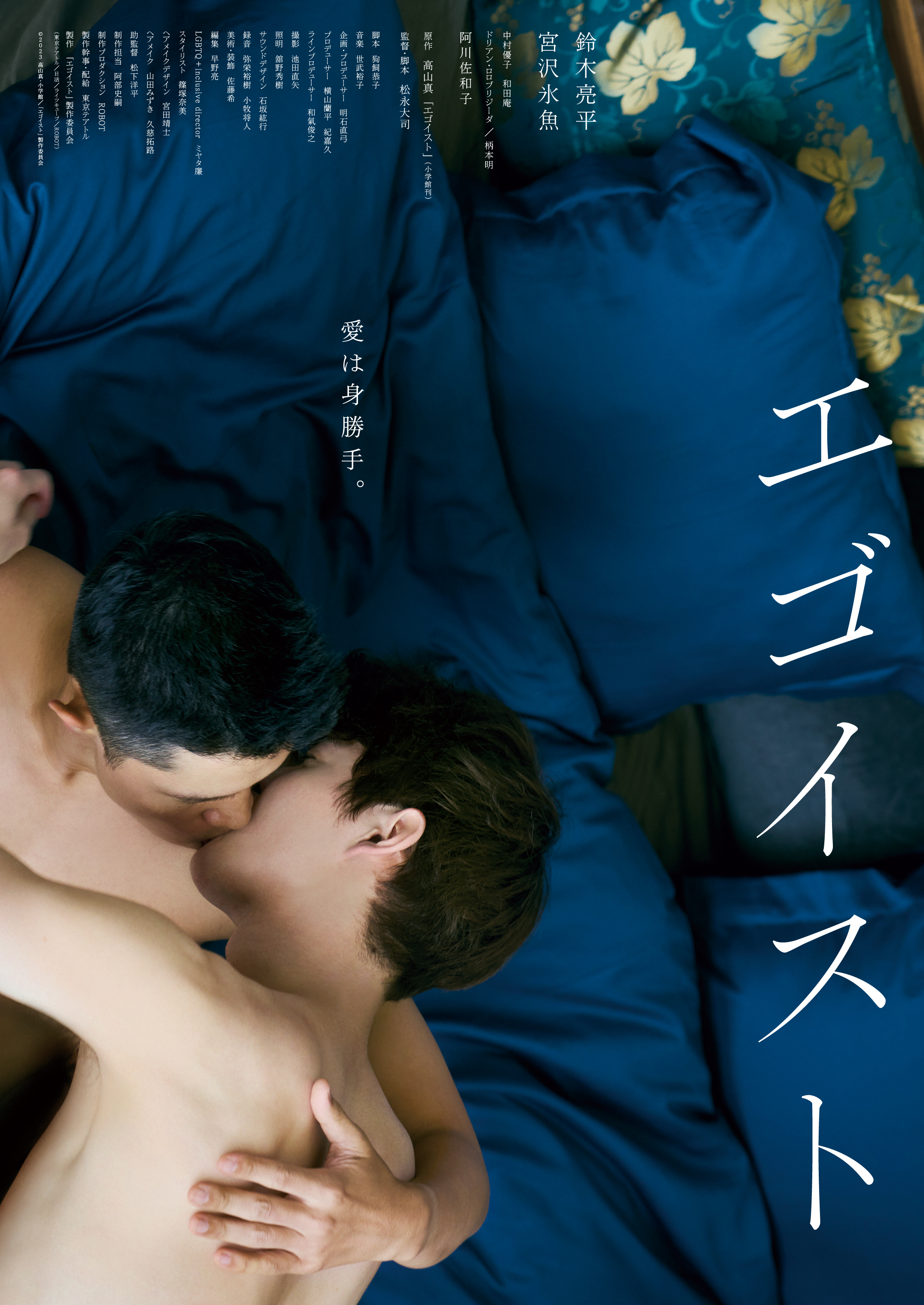
If love is unselfish, is it really love at all? Based on a semi-autobiographical novel by Makoto Takayama, Daishi Matsunaga’s deeply moving romantic drama Egoist (エゴイスト) asks if all love is in the end transactional and if to deny its “selfishness” is akin to denying love itself because it would mean denying a basic human need for connection and reciprocity. In the end, perhaps selfish is what we should be with love because we are always running out of time and if we aren’t careful it will slip away from us unnoticed.

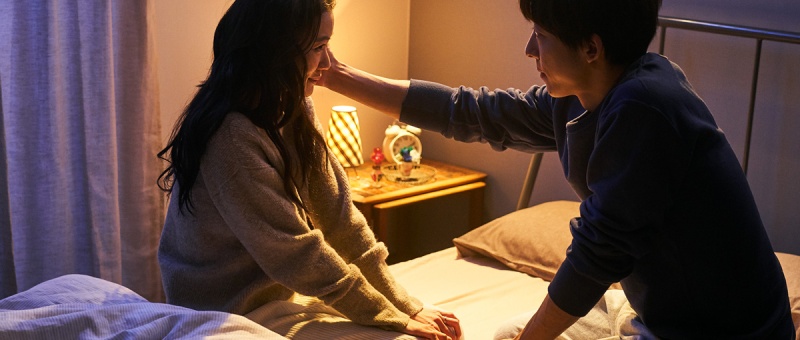
An “extreme realist”, fashion editor Kosuke (Ryohei Suzuki) is already full of regrets and many of them linking back to the early death of his mother from illness when he was only 14. It’s clear that his financial wealth helps to fill an emotional void but also that he’s lonely and longs for a sense of family that’s long been absent from his life. He rarely visits the conservative hometown where he was bullied for being different, and seems to have a strained relationship with his widowed father (Akira Emoto) who doesn’t know that Kosuke is gay and continues to ask him about getting married and settling down. Early on in his courtship with Ryuta (Hio Miyazawa), a personal trainer he met through a friend, Kosuke remarks that he’s never met a lover’s mother before hinting at the landmarks of a relationship such as marriage that LGBTQ+ people often miss out on in a conservative culture in which such things cannot always be discussed openly.

Later, Ryuta’s mother Taeko (Sawako Agawa) tells Kosuke that knew from that first meeting that they were more than just friends and was happy that her son had someone he loved who loved him regardless if they were a man or a woman. But just when the relationship had seemed to be blossoming, Ryuta had abruptly tried to break up with Kosuke explaining that he had been involved in sex work since his early teens in order to support his mother who was unable to work due to illness. Now that he’s experienced real romantic love he finds sex work “painful” but has no other means of supporting himself and so gives up love for economic necessity. “I’ll buy you,” Kosuke unironically counters adding a note of literal transactionality to their relationship which is already fraught with disparity in the respective differences in their ages along with Kosuke’s wealth and Ryuta’s poverty. 

Kosuke later describes his gesture as “pure”, something he’d previously called Ryuta while also remarking that he found him too “polite” in bed and would rather he be a little more “selfish”. In a way it’s altruistic, he isn’t really trying to trap Ryuta into a compensated relationship only to help him while simultaneously ensuring that he stays in his life. His wealth fills a void, but it’s by giving pieces of it away that he feels that void decreasing. Kosuke first gives Ryuta gifts for his mother, knowing that it’s easier for him to accept them because doing so is unselfish when the gift is for someone else. Even so as he later acknowledges sometimes the gift is more for himself than the recipient, a means not of manipulation but of healing. Kosuke claims not to know what love is and largely mediates it through money along with additional acts of care, but as Taeko later tells him it doesn’t really matter if he doesn’t know because they felt his love anyway. 

Matsunaga frequently cuts backs to visual motifs such as door numbers, envelopes, and dropped coins to hint at the transactionality of love but eventually reflects that love is an act of exchange in which the desire to be loved is an essential component. Kosuke eventually asks his father how it was for him when his mother was dying and he recalls a conversation in which she said she wanted to leave him because she couldn’t bear to see him suffering for her, a request which could in itself be read as “selfish” even in its “selflessness” with his reply implying that it’s alright to be selfish in love because in way it might be its ultimate expression. Filming with handheld realism, Matsunaga captures the rhythms of contemporary gay life along with the easy giddiness of burgeoning romance and the poignancy of profound loss tempered only by a fleeting feeling of warmth and the jealous memory of a “selfish” love. 


Egoist screens in Frankfurt 9th June as part of this year’s Nippon Connection.

International trailer (English subtitles)
Intolerance (空白, Keisuke Yoshida, 2021)

At times of tragedy it may be natural to look for someone to blame, as if being able to pin all of this pain and anger on a single source would somehow help you to accept it. But in other ways tragedy is just a confluence of circumstances that are either everyone’s fault or no one’s. How far back can you really trace the blame? There would be no end it. That’s perhaps the conclusion that the protagonists of Keisuke Yoshida’s Intolerance (空白, Kuhaku) eventually come to, realising that their attempts to blame others are often born of a desire to deny their own responsibility or else to protect something else they fear losing. 

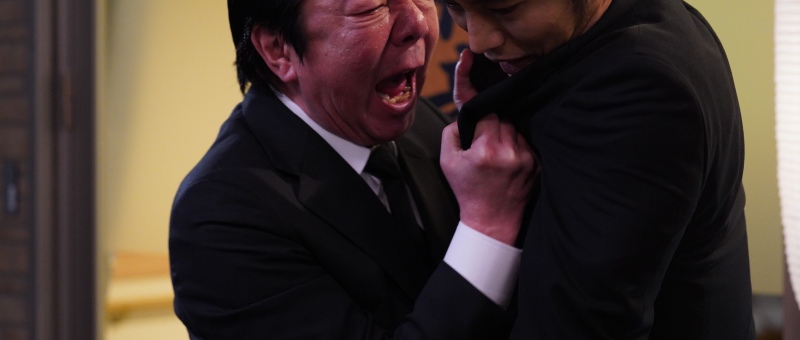
At least that’s how it is for grizzled fisherman Mitsuru (Arata Furuta), a man well liked by no one. A rude and violent bully, he terrorises all around him not least his teenage daughter Kanon (Aoi Ito) who is meek and passive with a slightly ethereal quality as if she’s learned that blending into the background is the best way to protect herself. Stopping in to a local convenience store on her way home from school, she’s accosted by resentful store manager Naoto (Tori Matsuzaka) who grabs her by the arm and accuses her of shoplifting nail polish. At some point, Kanon panics and bolts out of the store. Naoto chases her along a busy highway until she suddenly darts out into the road trying to get away from him and is hit first by a car driven by a young woman and then by a truck travelling in the opposite direction. Despite his gruff exterior, Mitsuru is quite clearly destroyed by his daughter’s death but becomes fixated on clearing her name of the shoplifting, insisting that he never saw her wear any makeup and that Naoto is to blame for her death in acting with such a heavy hand. 

Of course, it doesn’t occur to Mitsuru that Kanon may have worn makeup in secret and made sure to keep it from him knowing how he’d likely react. Likewise, perhaps she ran from the store because Naoto would have called her father and she was frightened of what he’d do if he found out she was caught pilfering, and pilfering nail polish at that. He remembers that she wanted to talk to him about something to do with school the night before she died but he didn’t listen, assuming she must have been being bullied and was forced to steal the nail polish only to hear that no one at school really even remembers her. She was a just a vague presence they can’t even quite identify. Her teacher meanwhile begins to reproach herself, realising that she failed in her duty of care repeatedly shouting at Kanon that she had “no motivation” rather than trying to help her find some or to get along in her own way, let alone figuring out what caused her to behave the way she did or if there were problems at home. Sick of Mitsuru’s belligerence the school finally set him on the new target of Naoto who was once accused of molesting a teenage girl he accused of shoplifting. 

Like Kanon, Naoto is a slightly hollow presence who also had a strained relationship with his father. As he lay dying, Naoto failed to answer his calls because he was playing pachinko and felt ashamed, afraid of another lecture from his dad about wasting his life on gambling. He struggles with his role in Kanon’s death, on the one hand guilty feeling he overreacted and inadvertently caused her to stray into harm’s way while otherwise resentful, justifying himself that it’s only natural for a storeowner to chase a shoplifter down the street. Both he and Mitsuru soon fall foul of a media culture that likes sympathetic victims and heartless villains, the media shocked by Mitsuru’s boorish behaviour but more so by Naoto’s callous indifference trimming an otherwise nuanced statement to imply that he feels his supermarket is the real victim as customers stay away or else issue complaints about their obviously heavy-handed shoplifter policy. 

“Imposing your own views on others is nothing more than torture” Naoto tells a well-meaning middle aged woman whose narcissistic cheerfulness is a neat mirror of Mitsuru’s intimidating aggression. Aggressively mothered by Kusakabe (Shinobu Terajima), Naoto carries an additional burden of guilt in realising he’s lost the store his father left to him, but she embarks on a tasteless “real victim” campaign insisting they did nothing wrong and it’s all Kanon’s fault for stealing in the first place. Kusakabe can’t bear to lose the store because it seems there’s not much else in her life. The film’s Japanese title translates as “blank” or “void” and it is indeed a void that Kusakabe is trying to fill in needing to feel needed by centring herself in her various volunteer activities such as working at a soup kitchen in addition to her crusade to save the store. 

It’s this giant abyss of grief and guilt which pulls each of them towards the edge, but in the end there’s really no way to apportion blame. The poor woman who first knocked Kanon down is completely undone by the experience though it really wasn’t her fault, repeatedly approaching Mitsuru asking for his forgiveness only to be cruelly rebuffed. It’s her mother’s (Reiko Kataoka) quiet show of dignity which stands in such stark contrast to his own white hot rage that finally forces him to realise the destructive quality of his intimidating behaviour, accepting his responsibility in his daughter’s death while understanding that in his fierce desire to control he robbed himself of the ability to know her. Really you can’t say whose fault it was, Mitsuru’s for the fear he instilled into his daughter, Naoto’s for his insecurity and misplaced zeal in hunting down a thief, the drivers’ for failing to brake, Kanon’s mother’s (Tomoko Tabata) for remarrying and having another child, the teacher’s for making Kanon feel useless, the other kids’ for rejecting her, or Kanon’s own for darting out into the road. For each of those there are a hundred other branches. There would be no end to it. But then, the strange thing is that Kanon shares her name with Buddhist deity of mercy, Mitsuru beginning to soften now willing to offer an apology where it’s due and to bear his own degree of guilt if not yet entirely able to forgive. In any case, ending in bright sunshine, Yoshida concludes with a return of the gaze between father and daughter that suggests forgiveness may indeed have arrived. 


Intolerance screened as part of this year’s Camera Japan

Original trailer (English subtitles)

Romance Doll (ロマンスドール, Yuki Tanada, 2020)

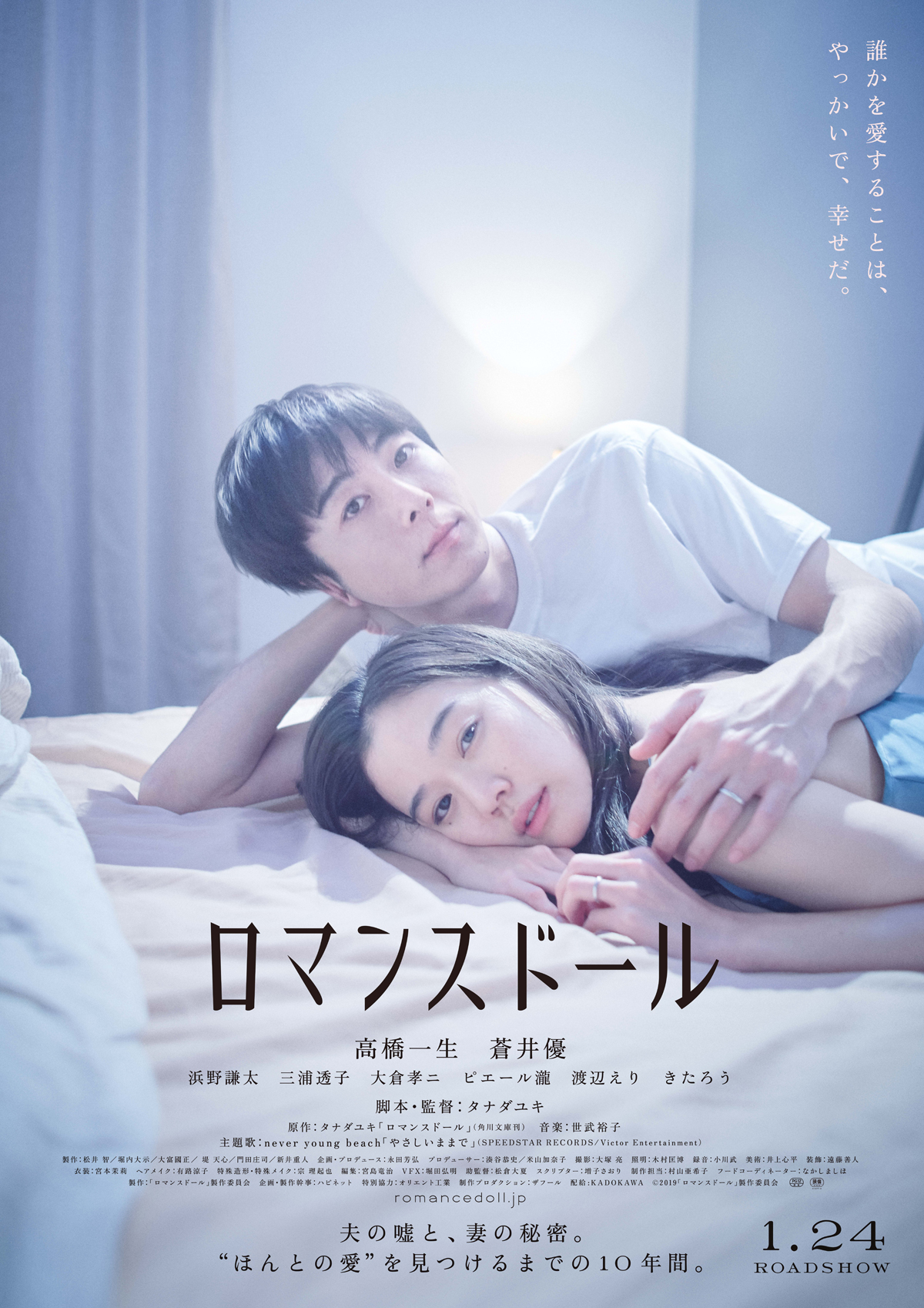
According to an assistant at the factory where the hero of Yuki Tanada’s Romance Doll (ロマンスドール) is eventually employed, what were once called “sex dolls” or the euphemistic “Dutch Wives” (apparently named for a kind of bolster used by sailors) are now marketed as “love dolls”. The difference may be largely semantic, subsuming the physical within the emotional, but speaks to a discomforting dehumanisation of the female form something which barely occurs to the sculptor even as he slowly chips away at his patient wife, gradually erasing her as he dedicates himself to crafting the perfect love doll which is, it has to be said, a woman devoid of agency who can never talk back, challenge male authority, or wound the male ego. 

It’s this insecure fear of intimacy which eventually creates distance and loneliness in the marriage of the sculptor Tetsuo (Issey Takahashi) who hides the fact that he sculpts sex dolls for a living from his wife Sonoko (Yu Aoi) for fear that she will reject him. Tetsuo was himself “tricked” into taking the job as an unemployed graduate in need of work. He does so because he needs the money but also feels guilty, not because he finds the work morally objectionable, but because he has no investment in sex dolls as a craft while the man who’s just employed him, Kinji (Kitaro), has made the creation of the perfect model his life’s dream. 

One the one hand, Tetsuo and Kinji are craftsmen and so the fact of what they’re crafting is largely irrelevant, the important thing being the earnest pursuit of artistry in building beautiful devices whether they be sex aids or sewing machines. But others might not see it that way and in fact the dolls can only be sold as novelties with strict regulations in place to prevent “obscenity”. Concerned that the models lack realism, Kinji comes up with the idea of taking a mould of a real woman’s breasts but given all of the above they can hardly advertise what it’s for. Sonoko answers the ad because she thinks it’s for medical prosthetics, that she’ll be helping other women not providing masturbatory aids for lonely men. The moment Tetsuo touches her breasts he’s hit with a kind of epiphany and is moved to confess his real feelings as he says possibly for the first and last time in his life, while Sonoko too recounts that in his touch she could innately feel that he was an awkward but kind person which is why she fell in love with him. They marry and are happy, but he keeps the nature of his work a secret and becomes so consumed with the idea of capturing the perfection of the female form that he never looks beyond the surface of his wife and, ironically, begins to neglect her physically. 

It’s the secret keeping, the miscommunication and the fear of intimacy that eventually begin to drive them apart. She wants to tell him something important, but he doesn’t listen to her, never notices that she is unhappy or suffering and becomes petulant and resentful on realising that she has lied to him about where she was while she was away from home not realising that she felt unable to tell him because he is not and never has been emotionally available to her. He pours his “love” into the doll, and by doing so he depletes her. Sonoko becomes merely fuel for her husband’s artistic fulfilment until her metamorphosis into a doll is finally complete.

Told entirely from Tetsuo’s perspective, Tanada’s screenplay leans unexpectedly hard into a series of outdated patriarchal social codes which it ultimately reinforces rather than critiques. Tetsuo’s marital dilemma is reframed as a workplace conundrum over whether to pursue the new frontiers of elastomer or stick with the tried and tested silicone which is apparently fragile yet beautiful much like life as Tetsuo is forced to reflect on the transience of all things including love and romance. Something can be beautiful even as it rots, cherry trees still blossom even while they’re dying and there’s nothing that lasts “forever” except perhaps loss. Tetsuo tells himself that others saw Sonoko as the “ideal wife” in that she was “beautiful, a good cook, pristine, modest, and respects her husband” but apparently only he knew that she was also “nice and horny” which even if charitably taken as reclaiming her right to sexual agency is still a crass statement in the circumstances given that he has just reduced her to a literal receptacle for male desire. 

Tetsuo may feel a smattering of conflict when an early model proves successful enough to hit the mainstream media, a happy customer declaring that he’s giving up on real women, but continues to pursue his craft even while reflecting on the poetic symmetry that his wife is disappearing as his creation grows. It’s impossible to avoid the implication that what men want is a sex doll who can cook and clean, a vacant automaton who caters entirely to their desires with no interior life of her own because they are too insecure to want to deal with a real woman who is capable of hurting them emotionally. Straying uncomfortably towards a kind of sublimated necrophilia, Tetsuo only belatedly realises that his wife was more than mere object in the uncomfortable vacancy of the unresponsive silicone. Kinji had wanted to create a doll which looked as if it may come to life, as if it almost had a soul, but the key is in the almost. Rather than a meditation on the destructive effects of miscommunication and emotional insecurity, we’re left with a contemplation of art and the artist in which a man’s artistic fulfilment is valued above a woman’s life, his destruction of her permissible in the perfection of his art. Some things it seems don’t change, women are mere “romance dolls” valued only for their response to male desire be it in art or in “love”.


Romance Doll is currently available to stream via Netflix in the UK (and possibly other territories).

Original trailer (English subtitles)

My Dad and Mr. Ito (お父さんと伊藤さん, Yuki Tanada, 2016)

Family. It can be surprisingly hard work. The rootless patriarch at the centre of Yuki Tanada’s exploration of the dissolution of the family in contemporary society My Dad and Mr. Ito (お父さんと伊藤さん, Otosan to Ito-san) is a case in point, “stubborn and difficult” as his daughter describes him to the man she lives with but had never seen the need to introduce to her relatives. He might be impossible, a “ticking time bomb”, but he’s still your dad even if he doesn’t approve of any of your life choices and insists on presiding over your home as if it were a schoolroom and he the headmaster. 

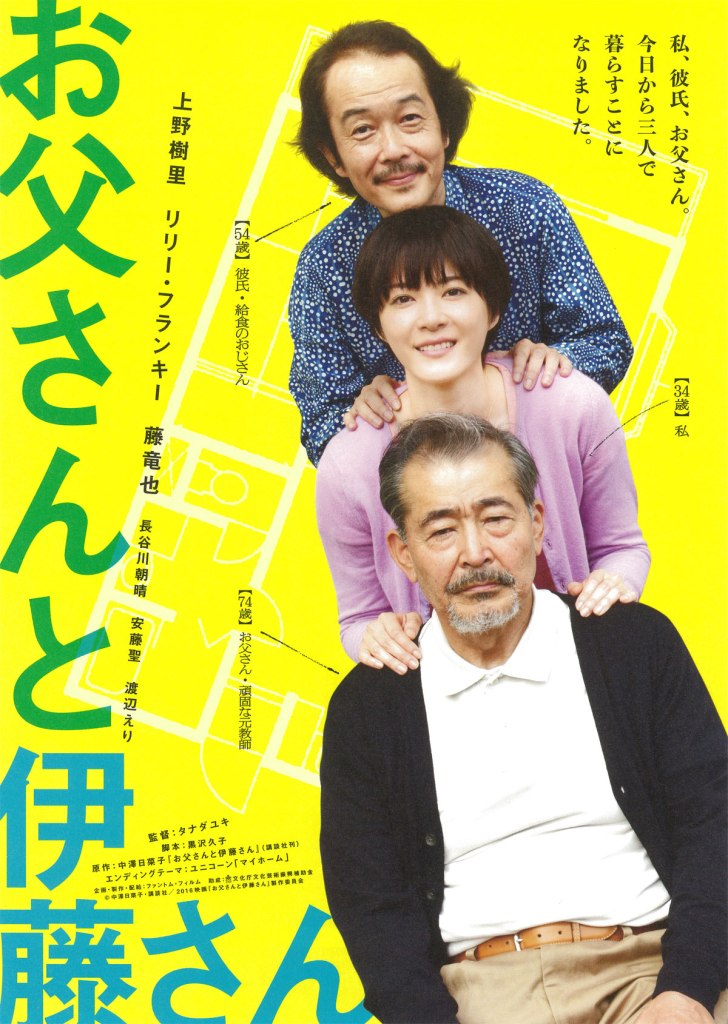
34-year-old Aya (Juri Ueno) is currently living with but not legally married to Mr. Ito (Lily Franky), a 54-year-old school cafeteria assistant she met while they were both working part-time at the same convenience store. Despite the age difference, the couple are very well suited and though they are not exactly wealthy, Aya now working part-time in a bookshop, they have enough for what they need and enjoy a quiet life growing their own produce in the small patch of garden behind their apartment. She is evidently not particularly close with her brother Kiyoshi (Tomoharu Hasegawa) who had no idea she is no longer living alone, otherwise he might not have asked her to take in their widowed 74-year old father for the next six months while his twins cram for exams to get them into an elite middle school. He quickly apologises, but as soon as Aya gets home she realises they have an unexpected visitor. Dad (Tatsuya Fuji) has already arrived carrying a mysterious box and is non-plussed to say the least on having encountered Mr. Ito. Nevertheless, he abruptly declares that he’ll be moving in, announcing that he prefers Japanese-style food, lightly seasoned. 

Dad, as he points out, was a schoolteacher for 40 years and has a distinctly conservative, authoritarian outlook. He’s not been in Aya’s apartment more than a few minutes before he starts criticising her lifestyle choices, though evidently like Kiyoshi he knew almost nothing about her and had no idea that she is not a regular company employee but a laidback part-timer. Obviously, he has issues with Mr. Ito, not least the age gap, but also with his equally laidback approach to life, poking Aya for information by idly remarking on the private lives of baseball players in the paper while she reveals that she knows almost nothing of him save that as far as she can remember he’s from Yokohama and has been married once before. She has no desire to know who he was before he met her and is happy enough to know the man he is now and draw her conclusions from that. 

Mr. Ito does indeed seem to be a very nice man, played by Franky with a characteristically laidback charm. Detecting a degree of hostility between father and daughter he tries to diffuse the situation with patience and kindness, immediately making space for Dad in their lives and trying to accommodate him as best as possible despite his unpleasantness and tendency to correct their “bad habits” such as serving teriyaki sauce with tonkatsu like common people while the civilised settle only for “Wooster”. After an initial period of hostility, Dad eventually warms to Mr. Ito, describing him as “my son-in-law” and bonding with him over manly things like power drills and oversize screws to the extent that he eventually considers moving back to his childhood country home and randomly asks Mr. Ito, but not his daughter, to come too. 

Mr. Ito, however is no Noriko, the child-by-marriage who alone is willing to shoulder the burden of filial responsibility, only someone attempting to mediate a difficult family situation. We realise that the reason Dad has been kicked out of Kiyoshi’s house is because he’s driven his wife Ririko (Sei Ando) into a near nervous breakdown with his tyrannous tendency for “correcting” what he sees as poor behaviour, apparently even criticising the way his late wife held her chopsticks right up until the day she died. His behaviour borders on the abusive and though we have no idea how his wife coped with it, it’s clearly too much for Ririko who is consumed with guilt in having “failed” in her filial responsibilities as daughter-in-law by no longer being able to bear his constant microaggressions, the final straw of which is apparently his attempt to interfere in the kids’ education by demanding they put a stop to the intensive cram schooling and give-up on elitist private tuition.

Aya and Kiyoshi could not be more different, he a wealthy and conservative middle-class salaryman obsessed with money and status, and she a laidback, hippieish part-timer happy to live the simple life. Dad disapproves of them both. After all things were different in his day, but perhaps he’s not quite as rigid as you’d think, quickly getting over his qualms about his daughter living over the brush with a man 20 years her senior while sick of his children’s “pity” and realising that he’s not wanted in either home even if superficially tolerated. Mr. Ito advises him to take some responsibility for himself, but is also keen to help Aya do the same by supporting her desire to take care of her difficult dad even if traditionally speaking the “obligation” is Kiyoshi’s by reassuring her she won’t have to make a choice even if Dad is a definite loose cannon. Capricious to the last, he may surprise them yet again with another unilateral decision but perhaps it’s never really too late to make up for lost time.


My Dad and Mr. Ito streams for free in the US on June 20 as part of Asian Pop-Up Cinema’s Father’s Day Cheer mini series. Sign up to receive the viewing link (limited to 300 views) and activate it between 2pm and 10pm CDT after which you’ll have 24 hours to complete watching the movie.

International trailer (English subtitles)

Every Day a Good Day (日日是好日, Tatsushi Omori, 2018)

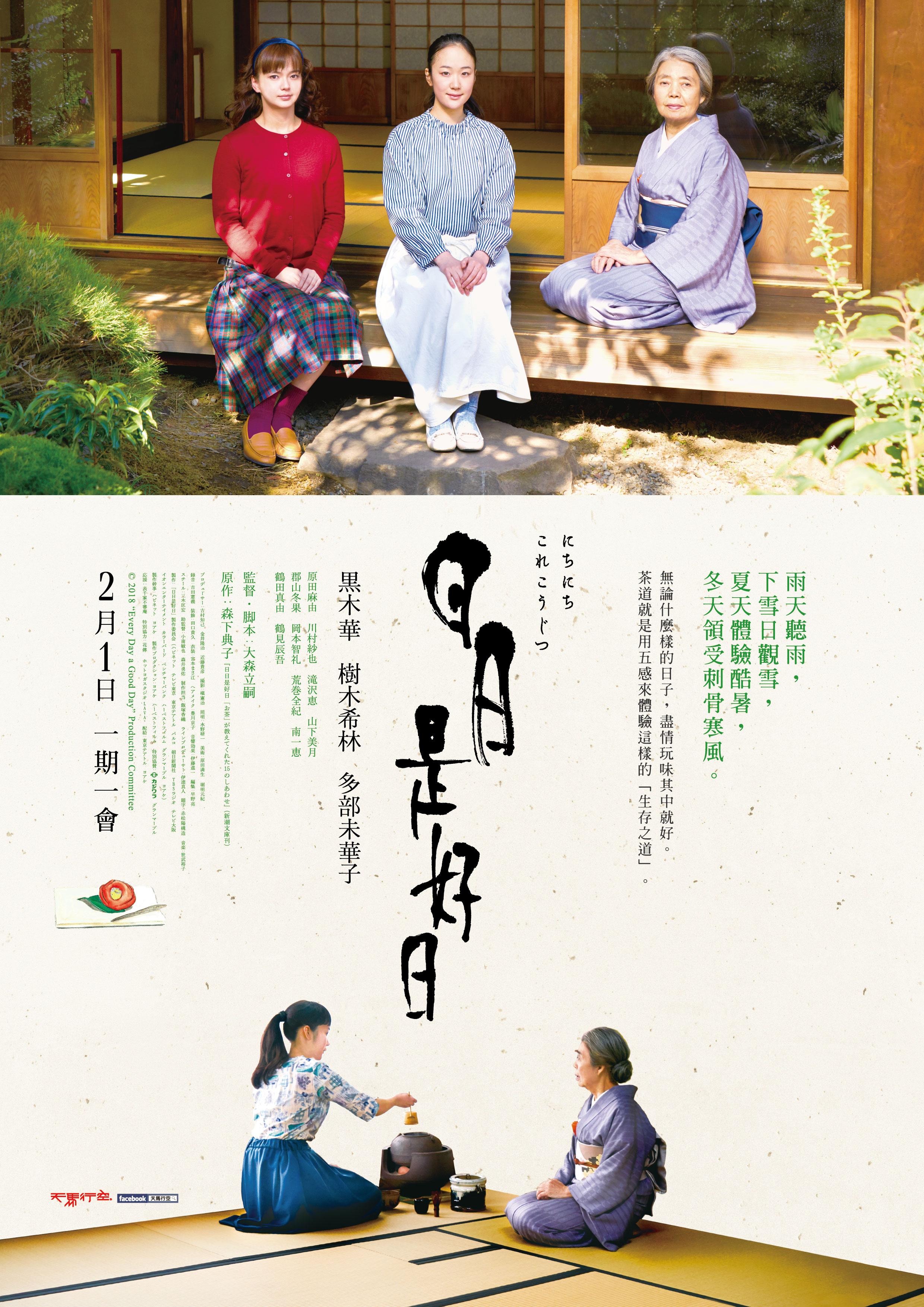
Everyday a good day posterTatsushi Omori burst onto the scene in 2005 with the extremely hard-hitting and infinitely controversial The Whispering of the Gods before going on to build a career on chronicling the unpalatable facets of human nature. He does have his lighter sides as the delightfully whimsical Seto and Utsumi proves, but even so he might be thought an odd fit for directing an adaptation of a series of autobiographical essays detailing one woman’s personal growth over a 20 year period spent perfecting the art of the Japanese tea ceremony. Every Day a Good Day (日日是好日, Nichinichi Kore Kojitsu) is, however, like much of his previous work, a story of youthful ennui and existential despair only one in which it turns out that the world is basically good once you agree to embrace it for what it is.

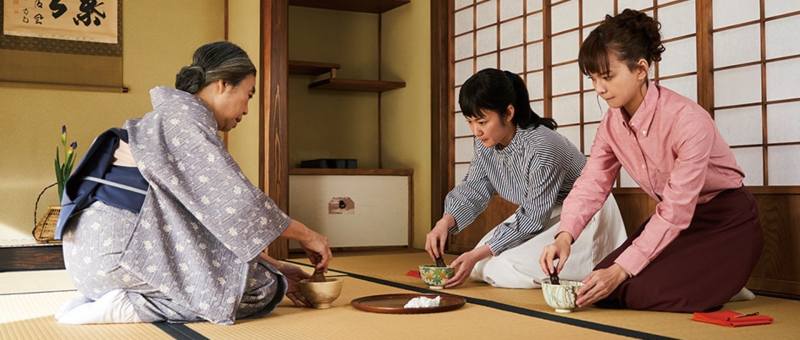
The film opens in 1993 with the heroine, Noriko (Haru Kuroki), a confused college student unsure of the forward direction of her life. Often ridiculed by her family for being clumsy and neurotic, Noriko compares herself unfavourably with her glamorous cousin Michiko (Mikako Tabe) who has come to the city from the country to study and appears to have her whole life already mapped out with a confidence Noriko could only dream of. A turning point arrives when she’s talked into accompanying Michiko to learn tea ceremony from a kindly old lady, Mrs. Takeda (Kirin Kiki), who lives nearby. Despite regarding tea ceremony as something fussy and old fashioned that only conservative housewives aspire to learn, Noriko begins to develop a fondness for its formalist rigour and continues dutifully attending classes for the next 24 years.

“Carry light things as if they were heavy, and heavy things as if they were light” Noriko is told as she clumsily tries to carry an urn from one room to another, though like much of Takeda-sensei’s advice it serves as a general lesson on life itself. Mystified by the entire process, Noriko and Michiko make the mistake of trying to ask practical questions about why something must be done in a particular way only for Takeda-sensei to admit she doesn’t know, it simply is and must be so. To look for that kind of literal meaning would be a waste of time.

Of course, she doesn’t quite put it that way. As Noriko later realises, some things are easy to understand and need only be done once. Other things take longer and can only be understood through a weight of experience. Just as she was bored out her mind by La Strada at 10 but moved to tears at 20, the discrete pleasures of the tea ceremony are something only fully comprehended when the right moment arrives. What was once empty formalism becomes a framework for appreciating the world in all its complexity, embracing each of the seasons as they pass and learning to live exactly in the moment in the knowledge that a moment is both eternal and transient.

Noriko continues to feel herself out of place as she witnesses those around her progress in their careers, get married, or go abroad while she remains stuck, unable to find a direction in which to move. Even tea ceremony occasionally betrays her as new pupils arrive, depart, and sometimes wound her newfound sense of confidence by quickly eclipsing her. Nevertheless, the calm and serenity of ritualised motion become a place of refuge from the confusing outside world while also offering a warmth and friendship perhaps unexpected in such an otherwise ordered existence.

Over almost a quarter of a century, Noriko’s life goes through a series of changes from career worries to romantic heartbreak, learning to love again, and bereavement, while tea ceremony remains her only constant. She may not yet have discovered the path to happiness, but perhaps has begun to reach an understanding of it and believe that it might exist in some future moment – as Takeda-sensei says, there are flowers which bloom only in winter. In any case, what she’s learned is that sometimes it’s better not to overthink things and simply experience them to the best of your ability while you’re both still around. Every day really is a good day when you learn to slow down and truly appreciate it, living in the moment while the moment lasts in acknowledgement that it will never come again.


Every Day a Good Day was screened as part of the 2019 Udine Far East Film Festival.

Original trailer (English subtitles)
River’s Edge (リバーズ・エッジ, Isao Yukisada, 2018)

River's Edge poster 2The ‘90s were a strange time to be a teenager, but then what age isn’t? Isao Yukisada, surprisingly making his first manga adaptation, brings Kyoko Okazaki’s cult hit River’s Edge (リバーズ・エッジ) to the big screen, recreating those days of nihilistic despair in which ordinary teens spiralled out of control in the wake the bubble bursting, watching all their possibilities disappear in a cloud of smoke. Set in 1994, River’s Edge is a post-bubble story but it also takes place in the period immediately before everything started to go wrong. In 1995 there was a devastating earthquake followed by terror in Tokyo and somehow it all seemed so dark – something the kids at the centre of River’s Edge already seem to see as they watch time flow, knowing all that awaits them is yet more emptiness.

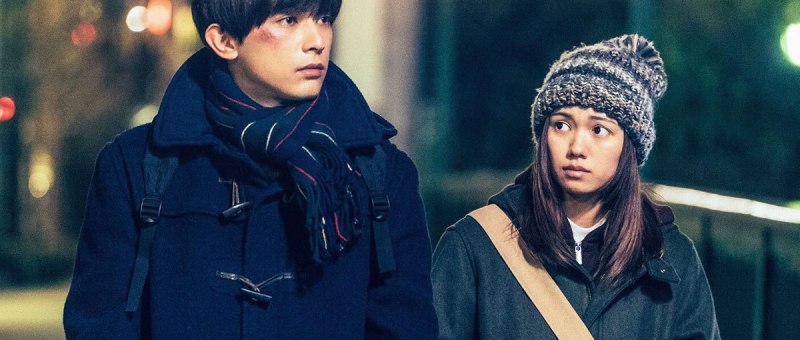
Haruna (Fumi Nikaido), a spirited tomboy and latchkey kid living with her busy single-mother, is in a lazy relationship with violent popular boy Kannonzaki (Shuhei Uesugi) though in truth she doesn’t seem to like him very much. One of her major problems with Kannonzaki is that he keeps picking on one particular guy, Yamada (Ryo Yoshizawa), who is rumoured to be gay. Warned by one of Kannonzaki’s minions, Haruna races off to an abandoned storeroom where she finds Yamada trussed up and naked hidden inside a locker. The pair become friends and he offers to show her his “special treasure” which turns out to be a dead body hidden among the reeds near the edge of the river. Yamada, with another friend, Kozue (Sumire) – a model with an eating disorder, likes to come to the river to gaze at the body in an effort to feel alive.

The ‘90s were full of tales of cruel, emotionless youth torturing itself without mercy and there is something of the era’s insensitivity in the detachment of the central trio. Unable to feel alive, the teens of River’s Edge chase sensation and oblivion through indiscriminate sex, drugs, violence, and self harm but rarely find the kind of fulfilment they so desperately crave. Kannonzaki, the rowdy delinquent, blames his broken home for his lack of connection, making a fierce resentment of a perceived rejection his excuse for his dangerously violent proclivities which run not only to venting his rage on the figure of the gay outsider Yamada but also to drug fuelled rough sex with one of Haruna’s classmates, Rumi (Shiori Doi), who is also chasing agency through sexuality but eventually finds herself cornered in the most terrible of ways.

Yamada is indeed gay, but can hardly say so in the environment in which he lives and so has turned in on himself with a near sociopathic detachment. Having given up on the idea of romantic fulfilment he has resigned himself to loving the object of his affection from afar, happy enough that he exists in the world even if he can never declare himself let alone dare to hope his feelings may be returned. Yamada works as a rent boy in the evenings, going to hotels with middle-aged men for money, but has a fake girlfriend at school, Kanna (Aoi Morikawa), whom he uses as a beard. Kanna, seemingly sweet and oblivious, soon becomes jealous of her boyfriend’s friendship with Haruna and is driven into her own kind of despair by Yamada’s continued coldness.

There’s an especial irony in Yamada’s use of Kanna which is almost certainly not lost on him. These kids, like many before them, abhor the fakery of the adult world but are also unable to embrace their own painful truths. Yamada covers up his sexuality through misleading Kanna, while Kannonzaki is resentful towards his parents who put on a front of marital harmony even after his father ran off with his mistress only to come back a week later with his tail between his legs, and Kozue laments the superficiality of her industry in which everyone falls over themselves to declare something ugly beautiful in order to make themselves feel better. There are no responsible adults here, having ruined the future for their kids they no longer have any kind of moral authority that can offer guidance or support to a jaded generation.

Shooting in the classic 4:3 of a ‘90s TV, Yukisada recreates the narrowness of an era in which the kids struggle to see past themselves, blinkered by their own solipsistic perspective and trapped by the shallowness of their perceptions. Permanently dark, gloomy, and lonely their world is one nihilistic despair in which they feel themselves already dead, living in the half-dug grave of a moribund city giving off its last few puffs of toxic industrial smoke before the whole thing collapses in on itself. In one sense nothing changes, there are no answers or cures for adolescent malaise, but something does eventually seem to shift in the genuine connection formed between two detached outsiders standing on the brink, watching the decay of their era flow past them with melancholy resignation.


Screened at Nippon Connection 2018.

Original trailer (no subtitles)