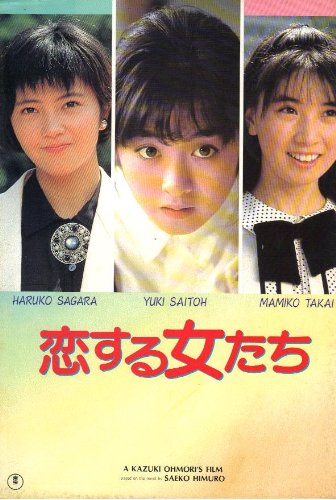
Young Girls in Love (恋する女たち, Kazuki Omori, 1986)

young women in loveThe friends you make in high school are the friends you’ll have the rest of your life, says Takako – the heroine of Kazuki Omori’s Young Girls in Love (恋する女たち, Koisuru Onnatachi). Only she doesn’t quite want hers – they’re weird and cause her nothing but trouble. Also one of them is too pretty so she soaks up all of the attention – where’s the fun in that? Takako is not altogether happy in her adolescence but at least she has her friends there beside her, right?

Takako’s two best friends have both recently fallen in love leaving her feeling a little left out. Midoriko (Mamiko Takai), the most “unusual” girl in her group (but also thought to be the prettiest), had fallen in love with a teacher and even struck up something of a friendship with him as evidenced by her collection of cute photos of them together. However, he’s recently got married leaving her heartbroken so Midoriko is having another one of her trademark “funerals” in which she buries painful memories from her past. Previously she’s had funerals for an unfortunate PE related incident in which she ripped her shorts during gymnastics, and another for when her grades got so bad that the teachers told her she probably wouldn’t graduate from high school.

Teiko has a difficult homelife as her literature professor father has left the family for unspecified reasons and her mother is still mourning the end of the marriage. However, she has found herself and older poet who formerly wrote lyrics for cheesy teen idol pop songs (though he’s a serious poet now so that’s all beneath and behind him). Teiko knows that this relationship is doomed to failure but is pursuing it in any case.

Takako is so wound up by her friend’s series of love stories that she finds herself visiting “raunchy” movies like 9 1/2 weeks. This is where she encounters possible crush and high school baseball star Kutsukake (Toshiro Yanagiba), but does she really like him or is she just lovesick and jealous of her friends? A new complication also arises in the form of fellow student Kanzake (Yusuke Kawazu) who previously had a crush on older sister Hiroko (Kiwako Harada) but seems to have shifted his attentions on to Takako.

Young Girls in Love is a little broader than the average idol drama though it maintains an overall quirky tone with a few swings towards melodrama. Takako continues with her romantic dilemma although in contrast to what she says towards the opening of the film she mostly does so alone. Rather than her similarly romantically troubled friends, Takako confides in a painter friend, Kinuko (Satomi Kobayashi) who has some rather more grown up advice for her than other friends (or sister) are willing or able to offer.

During her troubles Takako also goes to visit another girl who is kind of involved with low level bosozoku motorcycle gangs, and finds out that her morbid friend Midoriko has gone seriously off the rails. Leading some kind of double life, Midoriko is a disco queen in another town, dancing her troubles away and enchanting all the boys in the club (including the other girl’s biker boyfriend). Distressed, yet a little envious of Midoriko’s ability to soak up all the attention for herself, Takako is the only one to try and intervene during a drag race duel though little heed is given to her desperate plea for sanity and she is only one that gets hurt during the proceedings.

It’s all fairly innocent stuff even though biker gangs, older boyfriends, and boyfriend stealing, all fall into the mix. Omori keeps things simple and brings his idols to the fore to do what they do best though he does overly rely on TV style reaction shots for some of his gags. According to the anecdote Takako offers at the end, none of the various love stories have worked out they way the girls hoped (at least for now) but everything carries on more or less as normal. The three girls have another of their traditional extreme tea ceremonies dressed in kimono and sitting on the edge of a cliff, but they’re all still together despite their recent romantic adventures. The real love story is between three childhood friends who may have temporarily drifted apart over teenage drama, but their bonds are strong enough to withstand the storm and, as Takako stated in the beginning of the film, they’ll be together for the rest of their lives.


Original trailer (no subtitles)
https://www.youtube.com/watch?v=HCLCCflxD28

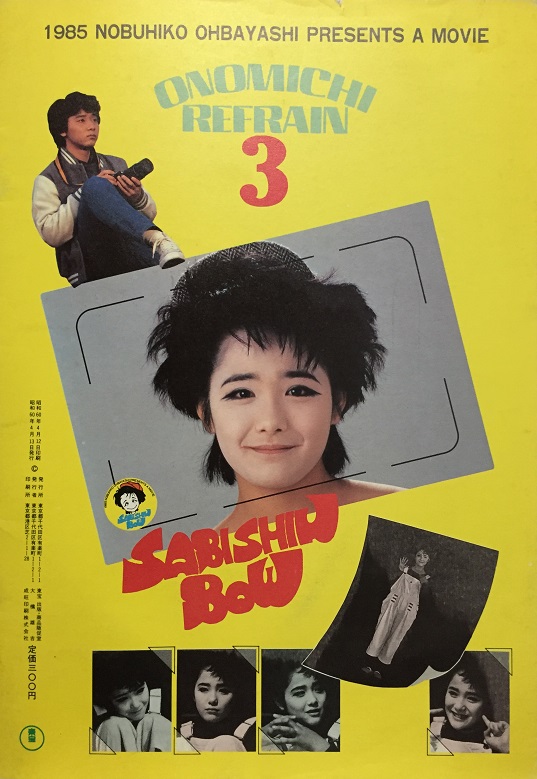
Miss Lonely (さびしんぼう, Nobuhiko Obayashi, 1985)

Miss LonelyMiss Lonely (さびしんぼう, Sabishinbou, AKA Lonelyheart) is the final film in Obayashi’s Onomichi Trilogy all of which are set in his own hometown of Onomichi. This time Obayashi casts up and coming idol of the time, Yasuko Tomita, in a dual role of a reserved high school student and a mysterious spirit known as Miss Lonely. In typical idol film fashion, Tomita also sings the theme tune though this is a much more male lead effort than many an idol themed teen movie.
Obayashi begins with an intertitle-like tribute to a “brusied, brilliant boyhood” before giving way to a wistful voiceover from the film’s protagonist Hiroki Inoue (played by frequent Obayashi collaborator, Toshinori Omi). His life is a fairly ordinary one of high school days spent with his two good friends, getting up to energetic mischief as teenage boys are want to do. The only thing that’s a little different about Hiroki is that his father is a Buddhist priest so he lives in the temple with his feisty mother who is always urging him to study more, and he’ll one day be expected to start training to take over the temple from his father (he has no particular aversion to this idea).

Hiroki’s big hobby is photography and he’s recently splashed out on a zoom lens but rarely has money for film to put in the camera so he’s mostly just playing around, accidentally spying on people. The main object of his interest is a sad looking high school girl who spends her days playing the piano. Hiroki, as an observer of human nature, has decided that she must be just as lonely as he is and has given her the name of “Miss Lonely”. It comes as a shock to him then that a very similar looking sprite appears, also called “Miss Lonely” and proceeds to cause havoc in his very ordinary life.

Although the film is filled with Obayashi’s trademark melancholy nostalgia, there is also ample room for quirky teen comedy as the central trio of boys amuse them selves with practical jokes. The best of these involves a lengthly sequence with the headmaster’s prized parrot which he has painstakingly taught to recite poetry. On being sent to clean up the headmaster’s office after misbehaving in class, the boys quickly set about teaching it a bawdy song instead causing the poor bird to hopelessly mangle both speeches into one very strange recitation. This comes to light when the headmaster attempts to show off his prowess with the parrot to an important visitor but when the mothers of the three boys are called in to account for their sons’ behaviour, they cannot control their laughter. That’s in addition to a repeated motif of the boys’ teacher’s loose skirt always falling off at impromptu moments, and a tendency to head off into surreal set pieces such as the anarchic musical number which erupts at the stall where one of the boys works part time.

Miss Lonely herself appears in a classic mime inspired clown outfit, dressed as if she’d just walked out of an audition for a Fellini film. To begin with, Hiroki can only see Miss Lonely through his camera lens, but she quickly incarnates and eventually even becomes visible to others as well as Hiroki himself. Past and present overlap as Miss Lonely takes on a ghostly quality, perhaps reliving a former romance of memory which may be easily destroyed by water and is sure to be short lived. Love makes you lonely, Hiroki tells us, revelling in the failure to launch of his first love story. Though, if the epilogue he offers us is to be believed, perhaps he is over romanticising his teenage heartbreak and is heading for a happy ending after all.

Chopin also becomes a repeated motif in the film, bringing our trio of lovesick teens together with his music and adding to their romantic malaise with his own history of a difficult yet intense relationship with French novelist George Sand. There’s a necessarily sad quality to Hiroki’s tale, an acceptance of lost love and lost opportunities leaving their scars across otherwise not unhappy lifetimes. Set in Obayashi’s own hometown Miss Lonely takes on a very heartfelt quality, marking a final farewell to youth whilst also acknowledging the traces of sadness left behind when it’s time to say goodbye.


Original trailer (no subtitles)

And here’s idol star Yasuko Tomita singing the title song on a variety show from way back in 1985

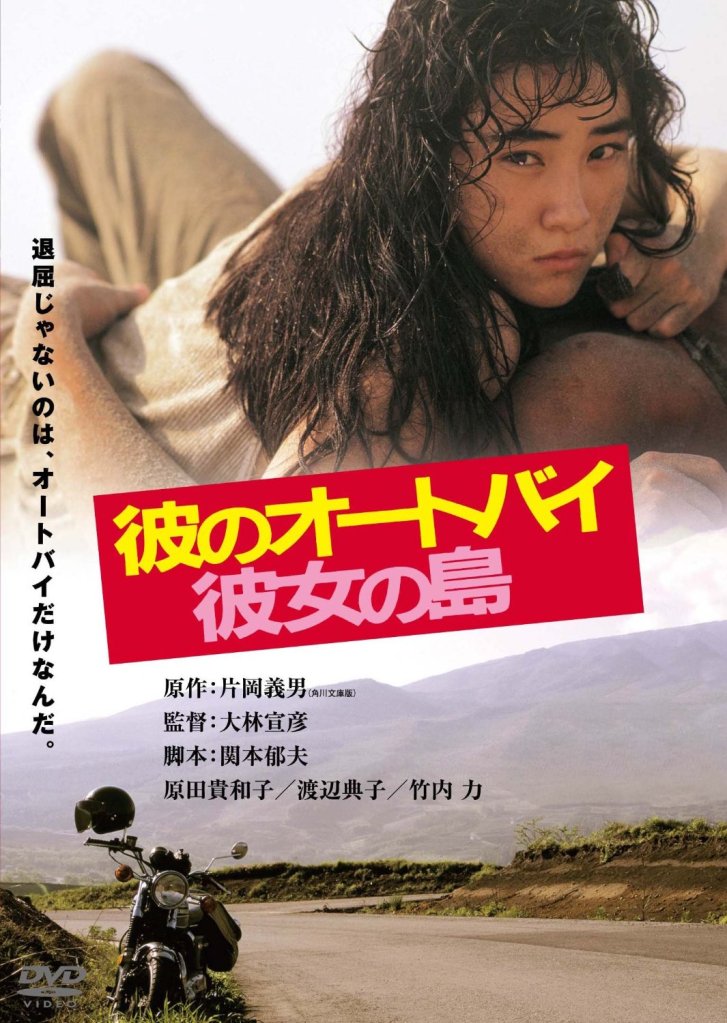
His Motorbike, Her Island (彼のオートバイ彼女の島, Nobuhiko Obayashi, 1986)

His Motorcycle Her IslandLike many directors during the 1980s, Nobuhiko Obayashi was unable to resist the lure of a Kadokawa teen movie but His Motorbike, Her Island (彼のオートバイ彼女の島, Kare no Ootobai, Kanojo no Shima) is a typically strange 1950s throwback with its tale of motorcycle loving youngsters and their ennui filled days. Switching between black and white and colour, Obayashi paints a picture of a young man trapped in an eternal summer from which he has no desire to escape.

Ko (Riki Takeuchi) tells us that he’s an unusual guy because most people dream in colour but all of his dreams are in monochrome. He’s a student and dispatch rider overly attached to his admittedly very handsome Kawasaki motorbike. After getting beaten up by his boss due to deflowering the guy’s sister and then breaking her heart, Ko skips town for the open road, just him and his bike. However, he repeatedly runs into the same mysterious girl who lives on an equally mysterious island and develops a deep seated need for her, secondary only to that for his bike. Miyo (Kiwako Harada) has also taken a liking to the Kawasaki and is intent on getting her full motorcycle license. Her growing obsession with the bike threatens to become an all consuming need driving a wedge between the two young lovers.

Obayashi begins in a black and white sequence window boxed in the centre of the screen before expanding to 4:3 when Ko has his fight with his boss and only hits 16:9 for the first colour scene which sees Ko taking off on his beloved bike. He told us that his dreams are in black and white but the film seems to disagree with him, segueing into various gradated colour schemes as Ko narrates his melancholy tale of tragic lost love. Ko is not necessarily a very reliable narrator in any case, but in each instance the on screen action is always coloured by the recollections of the older man who offers his voice over commentary.

Like many Obayashi films, the overriding feeling is one of melancholy mixed with a youthful apathy.  This is a story about modern young people, but refracted through rebellious ‘50s movies from Rebel Without a Cause to The Wild One and a hundred others inbetween. Ko is a university student (of what we don’t know) but seems to have no great ambitions. He takes things as he finds them and his only passion is the bike itself. When he first meets Miyo and she asks him where he’s going, he simply replies that he’s “looking for the wind” – a motif which recurs throughout the film.

Later on when he arrives at Miyo’s island, it takes on an opposing symbolism to his bike. Just as Miyo can’t get enough of the Kawasaki, Ko is originally attracted to the island much more than to the girl. It’s not quite a coincidence that each time he visits there it’s the Bon festival where the dead are temporarily allowed to return to the world of the living. Later he says that Miyo wasn’t just a girl but an island, and he wan’t just a boy but a bike, and together the two of them became the wind. They became one entity, inseparable one from the other. Finally the esoteric colour scheme begins to make sense, we’ve been watching a ghost story all along. This island is an unreal place, existing only inside Ko’s memory where Miyo waits for him with a full tank of gas.

Once again youth is seen as a brief yet unforgettable period filled with longing and regret. The older man is forever trapped by this one glorious summer, a place to which he can never return but neither can he escape. The nihilistic tone and voice over narration have an edge of the French New Wave but ‘50s American cinema of alienation seems closer to Obayashi’s intentions. An elliptical and strange tale of tragic love retold as a ghost story, filled with phantoms of memory and landscapes coloured by dream and emotion, His Motorbike, Her Island is another characteristically offbeat effort from Obayashi which once again embraces the aimlessness of youth and age’s regret.


Unsubtitled trailer – goes through to a video of Kiwako Harada singing the title song, in case you were in any doubt what this movie is for.

https://www.youtube.com/watch?v=9VfgFICO9fs

Or, here is the film’s opening (which also features the title song)

https://www.youtube.com/watch?v=bE78KK2UgmA

Main Theme (メイン・テーマ, Yoshimitsu Morita, 1984)

main themeDespite being one of the most prolific directors of the ‘80s and ‘90s, the work of Yoshimitsu Morita has not often travelled extensively overseas. Though frequently appearing at high profile international film festivals, few of Morita’s films have been released outside of Japan and largely he’s still best remembered for his hugely influential (and oft re-visited) 1983 black comedy, The Family Game. In part, this has to be down to Morita’s own zigzagging career which saw him mixing arthouse aesthetics with more populist projects. Main Theme is definitely in the latter category and is one of the many commercial teen idol vehicles he tackled in the 1980s.

A tale of two intersecting love stories, Main Theme begins with nursery nurse Shibuki getting close to the father of one of her pupils, Omaezaki, who will shortly be transferred to Osaka. Omaezaki also has a long running thing with a cabaret jazz singer, Kayoko, which seems to be a messy situation to begin with. Shibuki then ends up running into magician with a pick-up truck Ken who drives her to Osaka where she’s set to meet up with Omaezaki to become some kind of nanny living with him and his wife. En route, the pair pick up Kayako little knowing of her relationship with Omaezaki. Eventually, everyone ends up in Okinawa where Ken lives and Shibuki has an older sister each hoping to sort out their romantic difficulties under the blue island skies.

Main Theme stars popular idol of the time Hiroko Yakushimaru (star of Sailor Suit and Machine Gun) and is, unsurprisingly, centred around her chart topping song of the same name. A neat, new Japanese arrangement of the classic jazz standard Sway, the song fits neatly into the movie’s soundtrack which also features a number of other jazz hits such as The Man I Love and most notably Bei Mir Bistu Shein (or Shoen, or Shön depending on which version you’re looking at) courtesy of our cabaret singer (and her rivals) but being an ‘80s movie there’s still a bit of pop synth in there too though our central couple do seem to have oddly sophisticated tastes.

Though it is, as it’s intended to be, a teen romantic comedy, Morita tries (not entirely successfully) to put a little more substance into the background by also showing us the unhappy romance of middle-aged jazz singer Kayoko and the non-committal Omaezaki. It seems the pair have had an entailment probably stemming back years, perhaps even before Omaezaki’s marriage. Mrs. Omaezaki is a fairly ditzy and neurotic woman who loves shopping and seems to be more interested in the appearance of things than the reality. The status of the marriage itself is difficult to discern and it’s not quite clear if Omaezaki’s problem is a lack of will to leave his wife or that he’s already “left” and is trying to find a way to support her. In any case, introducing Shibuki, a 19yr old with an obvious crush on him, to the household is not one of his better ideas.

Needless to say, Ken also ends up forming an attraction to the older, melancholy musician who doesn’t seem to know what it is she wants (or knows but chooses to run away from it) leaving us in an odd kind of love square with the couples really each wanting their age appropriate partners but getting distracted by foolish dalliances with age and youth respectively. It does feel as if Morita could have made more of this dramatically interesting idea as Kayoko in particular is drawn in by Ken’s youthful innocence, but this isn’t what the film is for so it remains an intriguing yet perverse addition to the film’s otherwise straightforward narrative.

The “perversity” or strangeness of the film doesn’t end there as Morita has also added a number of quirky, absurd touches to offset the flatness of the teenage love drama. Perhaps because he’s a magician we get these odd flashes of Ken where he’s suddenly got crazy eyebrows (just for one 15 second shot) or crazy hair and there’s another charming scene where he’s pulling artificial flowers out of his suit only to have the magic bouquet suddenly droop as his heart starts to break. In another intriguing trope there’s also a strange illustrated map which lead’s Shibuki to her sister’s house by outlining common scenes from the area and when she gets there the gates are covered in light up ornamental tropical fruits. Add to this that the backing behind Kayoko’s final cabaret reads “Bates Motel Live” and there’s definitely a very strange mind behind the production design on this run of the mill, idol pop pushing rom-com.

Undoubtedly of its time, there is probably a reason Main Theme has not proved a big overseas hit though it seems to have been massively popular at the time and is fondly remembered for nostalgic reasons even if not particularly well regarded today. This is perhaps how the film is best approached – as a monument of its times and as a prime example of the 80s idol dramas studios such as Kadokawa put out to push their inoffensive pop music. However, Morita does add his own quirky touches to the film which does provide its fair share of youthful fun even if it isn’t always successful.


Unsubtitled trailer:

And a more recent version of Hiroko Yakushimaru singing the title song: