West North West (西北西, Takuro Nakamura, 2015)

This area has a weird magnetic field, claims one of the central characters in Takuro Nakamura’s West North West (西北西, Seihokusei), it’ll throw you off course. Barriers to love both cultural and psychological present themselves with almost gleeful melancholy in this indie exploration of directionless youth in modern day Tokyo. Three young women wrestle with themselves and each other in a complex cycle of interconnected anxieties as they attempt to carve out their own paths, each somehow aware of the shape their lives should take yet afraid to pursue it. The Tokyo of West North West is one defined by disconnection, loneliness and permanent anxiety but it is not the city which is the enemy of happiness but an internal unwillingness to find release from self imposed imprisonment.

After beginning with the twilight scene of a city in fog, Nakamura cuts to Iranian student Naima (Sahel Rosa) leaving the visa bureau with something on her mind. An attempt to call a friend strikes out when she discovers her with her fellow Chinese students busily chatting away in a language she does not understand. Taking refuge in a coffee shop, Naima spots another similarly depressed woman silently crying at a table in the very back corner.

Striking up a conversation, the two women unexpectedly begin a tentative friendship but Kei (Hanae Kan) has problems of her own. Trapped in a toxic relationship with fashion model Ai (Yuka Yamauchi) whose possessive, jealous, and entirely self-centred behaviour have turned her into a nervous wreck, Kei is acutely preoccupied with her lack of forward motion, feeling as if she’s just been somehow pushed out into the world with no clear idea of what it is she’s supposed to be doing.

Kei and Naima have much more in common than it might at first seem. Culturally displaced, Naima is at odds with her surroundings despite her native level language abilities but she finds a kind of ally in the taciturn Kei when an emotional outburst in the cafe causes commotion with an unpleasant fellow customer who objects either to the “inappropriate” loudness of her phone call or that it’s in another language. Naima is a retiring sort and mortified to have caused a fuss but Kei, coming to her rescue, is bored with accepting other people’s intolerance. Having felt so alone, pushed away from her only other real friend by an impenetrable barrier of culture and language, someone arriving and actively taking her side is an almost miraculous development.

Bonding instantly in their shared melancholy, the two women share a deepening sense of recognition as Naima begins spending more time with Kei, sleeping on her sofa and getting her to look after the pet bird which she refuses to name so that it will hurt less when they are eventually forced to part. Kei’s prejudices and preconceptions are pushed by Naima’s fierce attachment to her religion, but her eventual decision to casually state that she has a girlfriend meets with only mild surprise rather than rejection or moral questioning. Attempting to clarify Kei’s vague reply, Naima asks directly if Kei is a “lesbian” only for her to irritatedly deny the label – it’s just that she only falls in love with women, she says. Naima’s reasoned response that that’s pretty much the definition of “lesbian” leads to Kei quickly exiting the scene in confusion, not wanting to pursue this line of thought any further though it perhaps sends Naima in exactly the opposite direction.

Kei’s intense insecurity regarding her sexuality is one reason she seems to find it so hard to break things off with high maintenance girlfriend Ai despite her obvious unhappiness with the relationship. Ai, a low level fashion model, has a series of intense insecurities of her own though these have less to do with sexuality and more with power and control. Having realised that Kei is not as attached to her as she is to Kei, Ai’s jealous rages have Kei in a permanent state of fear from which she attempts to hide at a local pool only to have a full blown panic attack on receiving an unexpected phone call from her girlfriend.

An awkward hospital waiting room conversation with Ai’s mother explains much of her behaviour as she begins to lay out the various failings of her child and desire for her to give up modelling and live a “normal” life. Ai had not shared the fact that her lover was another woman, leaving her mother to feign politeness even whilst feeling he need to voice her “disgust” that her child had “these kinds of feelings”. Indifferent to Kei’s ongoing discomfort, Ai’s mother has a few home truths for the woman who’s corrupted her daughter, advising her to break up with Ai as soon as possible seeing as the relationship is doomed to failure.

In principle, Ai’s mother might have offended Kei but she has to concede that she has a point. Kei is not happy with Ai, but Ai will not let her go. Ai’s jealousy is both the catalyst and barrier for Kei’s growing feelings for Naima as she seeks a kindred spirit and gentle soul in refuge from Ai’s emotional violence. An awkward dinner party between the two makes plain the degree to which they are ill suited when Ai berates the sullen Kei for a lack of emotional readability ironically missing that Kei needs someone to understand her feelings instinctively – a level of connection on which self-centred Ai is ultimately unwilling to engage.

Ai’s attempt to warn off Naima in a worryingly threatening “stay away from my girl” speech eventually forces her to confront her own feelings and what exactly Kei is to her. Both women are repeatedly asked to provide a definition of their relationship, faltering each time, but Naima’s crisis runs deeper as she’s forced to confront herself on a more profound level. A group job interview provokes an unexpected moment of introspection as she’s cruelly asked what exactly she’s learned during her time in Japan and is thrown into silence before admitting that she does not know. Naima may indeed have learned or perhaps confirmed a few things about herself, but if she has she is still unable to accept them.

Beautifully played by Sahel Rosa, Naima’s isolation is palpable in her pain filled eyes and longing looks as she finds herself captivated by the more certain yet diffident Kei. Hanae Kan’s Kei is equally trapped within herself, essentially kind yet reserved, afraid to break things off with the controlling Ai yet confused by her growing feelings for the increasingly conflicted Naima. Returning to the fog filled cityscape, Nakamura leaves things as he finds them, refusing resolution as each of the central characters compromises themselves in one way or another, settling for something that seems “right” but feels essentially wrong. The melancholy greyness of a wintery sunset descends once again, leaving each of the three women rudderless but with an added burden of self knowledge tinged with regret and sorrow.


Reviewed at BFI Flare 2017.

Original trailer (English subtitles)

If you happen to understand either Japanese or German there’s an interesting video interview with director Takuro Nakamura produced for the Munich Film Festival:
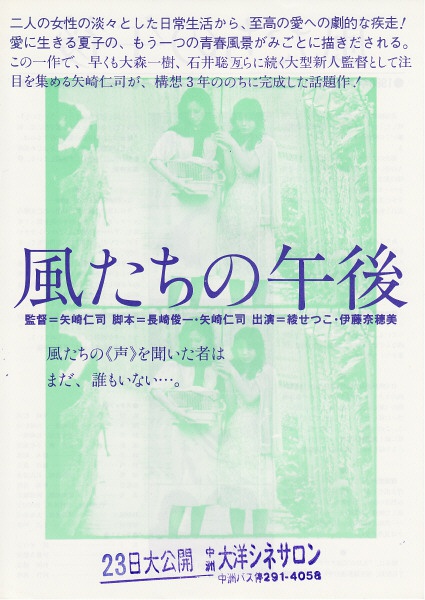
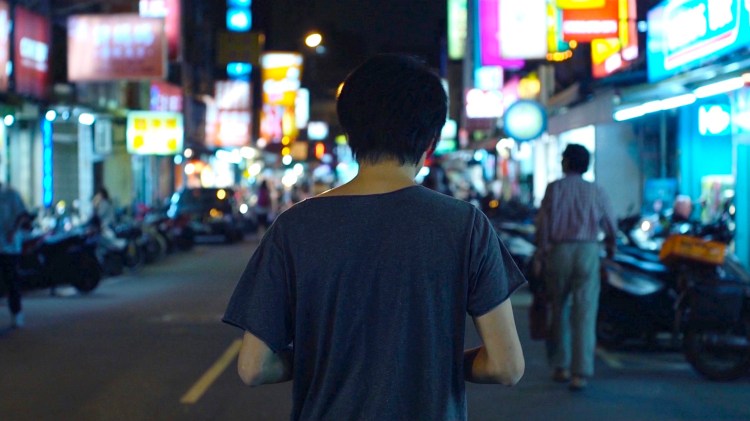
Afternoon Breezes (風たちの午後, Hitoshi Yazaki, 1980)

Even in the Japan of 1980, many kinds of love are impossible. Afternoon Breezes (風たちの午後, Kazetachi no gogo), the indie debut from Hitoshi Yazaki follows just one of them as a repressed gay nursery nurse falls hopelessly in love with her straight roommate. Based on a salacious newspaper report of the time, Afternoon Breezes is a textbook examination of obsessive unrequited love as its heroine is drawn ever deeper into a spiral of inescapable despair and incurable loneliness.

Nursery nurse Natsuko (Setsuko Aya) is in love with her hairdresser roommate Mitsu (Naomi Ito), who seems to be completely oblivious of her friend’s feelings. Mitsu has a boyfriend, Hideo (Hiroshi Sugita), and the relationship is becoming serious enough to have Natsuko worried. Hideo, unlike Mitsu, is pretty sure Natsuko is a lesbian and in love with his girlfriend but finds the situation amusing more than anything else. Beginning to go out of her mind with frustration, Natsuko tries just about everything she can to break Mitsu and Hideo up including introducing him to another pretty girl from the nursery, Etsuko (Mari Atake). Hideo is not exactly a great guy and shows interest in Etsuko though does not seem as intent on leaving Mitsu as Natsuko had hoped. Desperate times call for desperate measures and so Natsuko steels herself against her revulsion of men and seduces Hideo on the condition that he end things with her beloved Mitsu. He does, but the plan goes awry when Natsuko realises she is pregnant with Hideo’s child.

Less about lesbianism and more about love which can never be returned slowly eroding a mind, Afternoon Breezes perfectly captures the hopeless fate of its heroine as she idly dreams a future for herself which she knows she will never have. Natsuko buys expensive gifts for her roommate, returns home with flowers and courts her in all of the various ways a shy lover reveals themselves but if Mitsu ever recognises these overtures for what they are she never acknowledges them. Her boyfriend, Hideo, seems more worldly wise and makes a point of cracking jokes about Natsuko, asking Mitsu directly if her friend has a crush on her but Mitsu always laughs the questioning off. Mitsu may know on some level that Natsuko is in love with her, she seems to be aware of her distaste for men even if she tries to take her out to pick one up, but if she does it’s a truth she does not want to own and when it is finally impossible to ignore she will have nothing to do with it.

Despite Mitsu’s ongoing refusal to confront the situation, Natsuko basks in idealised visions of domesticity as she and Mitsu enjoy a romantic walk in the rain only to have their reverie interrupted by a passing pram containing a newborn baby. What Natsuko wants is a conventional family life with Mitsu, including children. After their walk, the pair adopt a pet mouse which Natsuko comes to think of as their “baby” but like a grim harbinger of her unrealisable dream, the mouse dies leading Mitsu to bundle it into a envelope and leave it on a rubbish heap along with Natsuko’s heart and dreams for the future.

When her colleagues at the nursery get stuck into the girl talk and ask Natsuko about boyfriends, her response is that she would not “degrade” herself yet that is exactly what she finally resorts to in an increasingly desperate effort to get close to Mitsu. After her attempts to get him to fall for another girl fail, Natsuko’s last sacrificial offering is her own body, surrendered on the altar of love as she pleads with the heartless Hideo to leave Mitsu for good. Though her bodily submission is painful to watch in her obvious discomfort her mental degradation has been steadily progressing as Hideo deliberately places himself between the two women, even going so far as to disrupt a seaside holiday planned for two by inviting himself along.

Yazaki perfectly captures Natsuko’s ever fracturing mental state through the inescapable presence of the dripping tap in the girls’ apartment which becomes a dangerous ticking in Natsuko’s time bomb mind. Occasionally gelling with clocks and doors and other oppressive noises, the internal banging inside Natsuko’s head only intensifies as she’s forced to endure the literal banging of Mitsu and Hideo’s lovemaking during her romantic getaway. Just as an earlier scene found Natsuko sitting on the swing outside embracing the flowers she’d brought for Mitsu only to find Hideo already there, Natsuko’s fate is to be perpetually left out in the cold, eventually resorting to rifling through her true love’s rubbish and biting into a half eaten apple in a desperate attempt at contact.

Natsuko’s love is an impossible one, not only because Mitsu is unable to return it, but because it is essentially unembraceable. In a society where her love is a taboo, Natsuko is not able to voice her desires clearly or live in an ordinary, straightforward way but is forced to act with clandestine subtlety. After Hideo unwittingly deflowers her and laughs about it, stating that she “must really be gay” Natsuko lunges at him with a knife, suddenly overburdened with one degradation too many. Though the prospect of the baby may raise the possibility of a happy family, albeit an unconventional one, the signs point more towards funerals than christenings, so devoid of hope does Natsuko’s world seem to be. Shot in a crisp 16mm black and white, Afternoon Breezes owes an obvious debt to the art films of twenty years before with its long takes, static camera giving way to handheld, and flower-filled conclusion, but adds an additional layer of youthful anxiety as its heroines find themselves moving into a more prosperous, socially liberal age only to discover some dreams are still off limits.


Out There (Takehiro Ito, 2016)

out-thereWe don’t move forward in this dance, comments the lady currently being waltzed by a charming lost soul. Don’t worry, he says, that’s not a bad thing. Indeed, Out There, the first independent feature film from director Takehiro Ito exists in a fixed yet liminal space, here and not there as its protagonist finds himself without the proper place to be. Conceived as a way of salvaging some of the material collated for a documentary on the late Taiwanese director Edward Yang, Out There takes more of its cues from Tsai Ming-liang or even Lav Diaz in its preoccupation with the intersection between time, existence, and place. If that all sounds to weighty, there’s a little whimsy in here too, but the intent is a serious one as nationhood (or the lack of it), drifting cultures, love and history all conspire to confuse and distract the course of a young man in search of an identity which is entirely his own.

Beginning with an interview or perhaps an audition, the onscreen director questions the man who will be our star, Ma, about his motivations for applying – only, characteristically, he doesn’t quite know. From what he tells us, it seems his interests are largely introspective, unable to find a place to exist, perhaps he can carve one out for himself inside the fictional world of a film. Ito returns to this interview (or series of interviews?) throughout the action as Ma shows an apt desire to dissect himself on camera. The director is a minor player as Ma takes over, but like Ito he is trying to recover something from the ashes of a lost project, his producer sitting to the side, neatly picking apart the director’s somewhat thin proposal for a film about a cross cultural couple in which “everything happens by chance”.

The historical relationship between Tokyo and Taipei is perhaps a complicated one (though significantly less complicated than with many of its other neighbours), but there is a third party in this difficult romance in the spectre of America. Returning to Taiwan in the second segment, notably titled Land of Shadows, Ma talks to his parents about their views on global culture as Green Card holding Taiwanese who never made the move. In his original interview, Ma explained that one of the reasons he came to Japan was that he always felt like an outsider in Taiwan, unable to express himself fully. Having spent some time in the US as a child, Ma has a feeling America is “not for him”, but has also found that Japan is probably not the place he’s supposed to be either, and unlike his family he does not feel as if he can simply live out his days in his native Taiwan.

In a final discussion with Ayako – the actress in the film which never quite happens (in a sense, outside of the way it’s happening for us), Ma talks about the importance of memory which prompts Ayako to remark that it’s as if everything is already in the past for him. As if to symbolise Ma’s lack of forward progress, everything which happens in Tokyo bar a single flash of colour at the end of the interview sequence is cast in sharp black and white. Taiwan, by contrast, is shot in verdant colour though allowing for 16mm and 4:3 framing adding to the sense of nostalgia and homesickness which seem to invade Ma’s mind. This Taiwan is a place of backstreets and ruins, faded grandeur and unseen histories. Empty cinemas and abandoned film eventually give up their ghosts, but it’s Ma himself who seems to join them as he fades into the frame, here and not here as he repeatedly doubts the matter of his own existence.

There’s a slight irony in the way America has been idealised as a place of possibility given its (until extremely recently) severing of diplomatic ties with the island nation of Taiwan. Seeking a home in a place which refuses to acknowledge the land in which you were born exists may make one feel like a ghost, but Ma’s sense of existential dislocation runs deeper. A kind of hiraeth, a longing for a home which doesn’t quite exist, becomes a force which propels and halts in equal measure. Skating around Tokyo on his roller blades, Ma has no particular destination in mind except perhaps to escape himself. He takes photos of places because he doesn’t want to point his camera at people, refusing human connections which will have to be broken in his ongoing quest for a sense of belonging. As the director puts it, there are many endings but as long as he remains fixed on the concept of “there”, Ma risks losing the idea of “here” which remains in a state of perpetual future past, outside of this liminal space in which nothing moves or changes.

Ito’s drifting, experimental approach moving between documentary, narrative and fantasy with the borders between each as unclear as the hero’s sense of identity is one which defies categorisation, as much about the idea of place as the characterisation of the two cities at hand and the ever unseen spectre of the hovering America. Poetic, wistful, and imbued with a sense of loss, Out There is a poignant exploration of cultural dysphoria and existential confusion in an ever widening world in which past, present and future become indistinct in an endless journey onward to place or no place at all.


Currently available to stream worldwide via Festival Scope in connection with the International Film Festival Rotterdam.

Short scene from the end of the film:

Our Love Story (연애담, Lee Hyun-ju, 2016)

cyaykwjucaav5frThe history of LGBT cinema in Korea is admittedly thin though recent years have seen an increase in big screen representation with an interest in exploring the reality rather than indulging in stereotypes. The debut feature from Lee Hyun-ju, Our Love Story (연애담, Yeonaedam), is among the first to chart the course of an ordinary romance between two women with all of the everyday drama that modern love entails. A beautiful, bittersweet tale of frustrated connection, Our Love Story is a realistic look at messy first love taking place under the snowy skies of Seoul.
Yoon-ju (Lee Sang-hee) is a busy fine arts graduate student working on her final project. Busy as she is, none of Yoon-ju’s friends can get their heads around her lack of interest in dating, but Yoon-ju is happy enough on her own and doesn’t get what all the fuss is about. Whilst perusing a local junk yard looking for interesting things for her art project, something unexpected catches her eye in the form of a young woman delivering magazines but after the woman completes her business she leaves Yoon-ju’s slightly stunned field of vision, presumably forever.

Because these things happen in a city, Yoon-ju runs into the same woman again in a convenience store where she is having trouble buying cigarettes because she’s forgotten her ID and the cashier is being pedantic about the rules. Coming to the rescue, Yoon-ju buys the cigarettes for her with her ID, which leads to the opportunity of sharing one outside. The mysterious woman is named Ji-soo (Ryu Sun-young) and works part-time at a nearby bar to which she invites Yoon-ju if she happens to fancy a drink of an evening. Yoon-ju doesn’t drink, particularly, but convinces some friends to accompany her to to Ji-soo’s bar – a plan which backfires when they drink too much and argue with each other causing a scene. The two women don’t get much of an opportunity to chat and it all seems like it might end there with Yoon-ju heading home to bed only to receive an unexpected phone call from Ji-soo inviting her over for a late night drinking session.

So begins Yoon-ju’s first romance, and Ji-soo’s 78th as she later jokes. The first night slips into the first day and before long the pair have established a happy domesticity but their original euphoria is short lived as Ji-soo is due to be moving back to her hometown to live with her recently widowed father for a while. The relationship also has adverse effects on Yoon-ju’s life as she begins to neglect her art project and lets her colleagues down by forgetting important meetings, while other events leave her questioning if Ji-soo is really as committed to Yoon-ju as Yoon-ju is to her.

After Ji-soo moves back home, the pair make sure to meet up every so often either in Ji-soo’s hometown of Incheon or in Seoul but there’s an undeniable change in their relationship aside from the distance. In the city, Ji-soo had been outgoing and unafraid but in Incheon she’s a completely different person, closed off and permanently anxious. Ji-soo’s father is a more conservative and religious type who has no idea that his daughter is gay and still expecting her to get married, preferably as soon as possible. Worried that Ji-soo “does not date” he sets her up with a family friend and she has little choice but to play along even if she’s not intending to let it get anywhere. Yoon-ju’s first visit occurs while Ji-soo’s father is away, but even so Ji-soo is uncomfortable with having her in the house. When her father turns up unexpectedly one day while Yoon-ju is there, Ji-soo describes her as “a friend” and makes a point of answering all of Yoon-ju’s questions for her in case she lets something slip.

Hurt and confused, spending time in Incheon becomes a painful experience for Yoon-ju considering the permanently jumpy Ji-soo doesn’t even want her father to know she smokes, let alone anything else he might not approve of. Earlier on the relationship, Yoon-ju made the decision to confide in an old friend from her hometown and found him broadly supportive, once he got over the surprise. Ji-soo, more experienced, warns Yoon-ju that she’ll lose friends if she isn’t careful. This Yoon-ju finds out to her cost when she decides to try talking to her roommate about her troubles with Ji-soo as even someone she felt close to and had trusted suddenly rejects her. Realising you’ve placed your trust in someone who wasn’t worthy of it is a terrible feeling, but it isn’t just familial opposition the two women will be facing if they decide to make a go of things together, even in the big city.

Post Incheon, awkwardness grows and the distance deepens prompting one to fight back and the other to retreat but eventually Ji-soo appears to make her choice in way which seems cuttingly final in its coldness. Later trying to fix what she broke, Ji-soo again goes about things in an inadvisable way, still only superficially committed and unable to fully connect on a deeper level. Ending on an ambiguous, bittersweet note which seems to offer either hope or the despairing vision of an ever repeating cycle of pain, Our Love Story is a beautifully nuanced and interestingly composed addition to the Korean indie scene finally bringing a very ordinary romance to the cinema screen in all of its everyday melodrama.


Reviewed at the 2016 London Korean Film Festival.

Clip from halfway through the film (English subtitles)

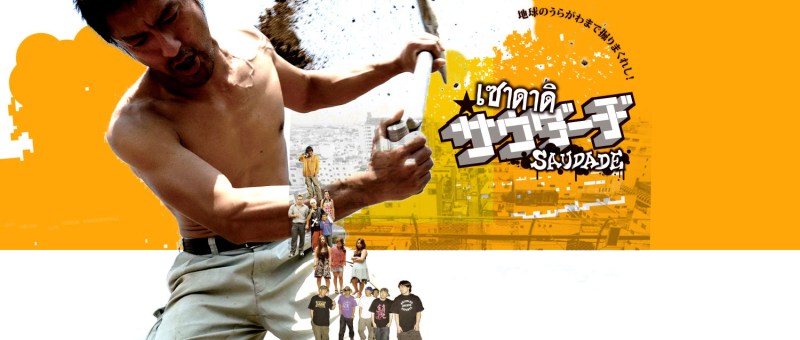
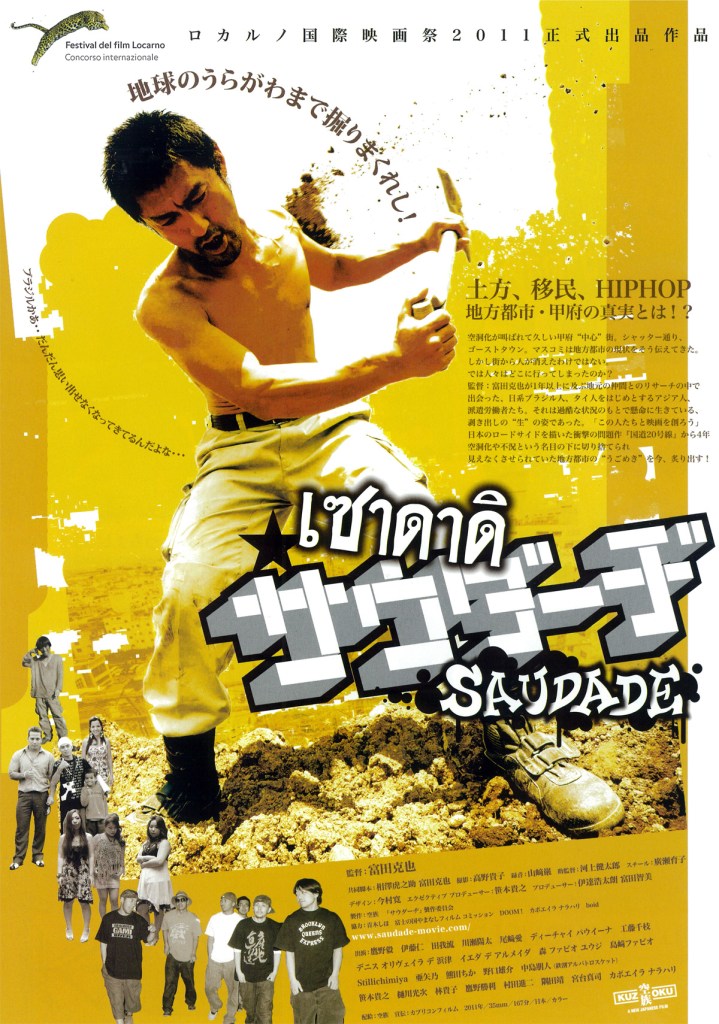
Saudade (サウダーヂ, Katsuya Tomita, 2011)

saudadeReworked from a review first published by UK Anime Network in September 2012.

Saudade is one of those words that’s so unique to a particular language that it’s extremely difficult to translate into another. The recent Portuguese film, Tabu, is almost a literal expression of “saudade” itself but offers this brief explanation of it – a feeling of deep yearning or nostalgia for something that is past and can never be regained. Each of the residents in the small town of Kofu (which is, in many ways, a character itself) are all yearning for something, whether for a new life, opportunity or just a simple return to the promise of one’s youth. As the town’s prospects continue to decline its residents continue to long for something different – some kind of progress to lift them out of the tedious downward spiral in which they feel themselves to be trapped.

Seiji works in construction, employed on short term projects – when there is work going that is, something that’s becoming increasingly scarce. Married to a beautician whom he’s come to dislike due to her social climbing ambitions and desire to start a family, Seiji fantasises about running away with his Thai mistress and starting a new life with her in her home country. He’s joined by a new friend, Hosaka, who, coincidentally, has just returned from a long period of time living abroad in Thailand but seems to have his own problems and perhaps serious reasons for his flight and subsequent return. The newest member of the construction crew is the reluctant Amano, a leader of right leaning hip hop group, who has come to blame Japan’s immigrant population for his own inability to find work and progress in life.

There are also, of course, the non-Japanese populations including the Brazilians who came to Japan on the promise of wages ten times those they could earn in their home country but have found only poverty and discrimination. Many have decided to return home, others contemplate moving on – perhaps to the Philippines in search of a better life for themselves and their families. Some have been in Japan so long that although they are proud of their Brazilian heritage they barely remember their home country and feel they have nowhere to go besides Japan. Desperately trying to walk the line between integration and embracing their own culture, the non-native residents must also devote time to trying to gain acceptance from the local population. That’s not to mention the Thais working as hostesses or dancers or elsewhere in the entertainment industries – accepted but perhaps only in that specific context.

In painting a portrait of his own hometown, director Katsuya Tomita shows a side of Japan that is often absent from Western perceptions – blue collar workers trying to keep pace with the economic downturn while old prejudices rear their ugly heads in defence. The fact that most of the actors are non-professionals and residents of Kofu themselves gives the film a new weight, indeed the two main stars are friends of the director from childhood. Tomita spent a year researching his subject matter and many of these actors are simply repeating their former conversations in a new context for the camera. As the city crumbles and people pull away from each other in their search for something better, the tensions of everyday life grow stronger and threaten to tip over into violent intensity.

The film, however, seeks to remind us that we are all the same. We all have saudades for one thing or another – something we strive to reattain even though we know it’s impossible. The non-native residents yearn for home or for the acceptance they once felt, the Japanese for the prosperous Japan they grew up in and all the possibilities it afforded them in their youth. Seiji must know on one level that his dream of running away to Thailand with his girlfriend is an impossible fantasy, yet he continues to long for it with varying degrees of intensity. Amano’s problems are perhaps more to do with his own circumstances than the political stance he gives them – longing to be ‘someone’, admired, respected and perhaps loved even if the reason for that acclaim is something abhorrent.

At 164 minutes Saudade takes its time and, being an ensemble drama, perhaps lacks enough narrative focus to engage the majority of viewers. However, for those with long attention spans the film excels in character detail and in building a truly authentic atmosphere in the depiction of the decaying Kofu. Not always an easy watch, Saudade is an interesting and unflinching look at an all too often unacknowledged aspect of its home country.


Original trailer (English subtitles)

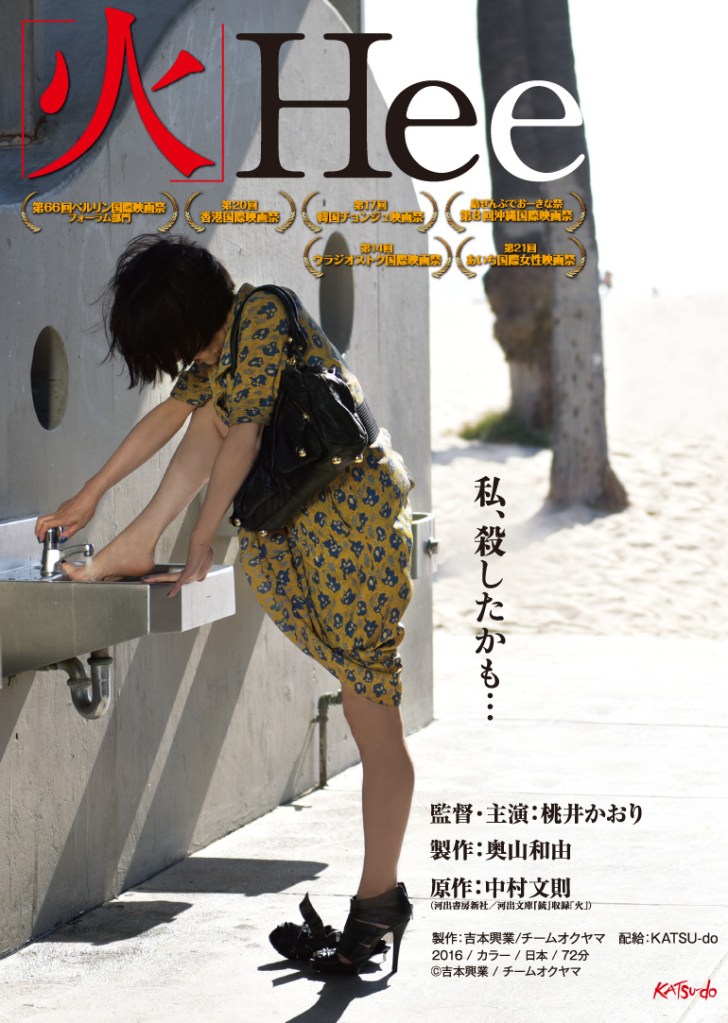
Hee (火, Kaori Momoi, 2016)

heeOne of Japan’s best known actresses with a career spanning over forty years, Kaori Momoi is perhaps just as well known for her outspoken and refreshingly direct approach to interviews as she is for her work with such esteemed directors as Akira Kurosawa, Kon Ichikawa, Yoji Yamada, and Shohei Imamura. One of the few Japanese actors to have made a successful international career starring in Hollywood movies such as Rob Marshall’s Memoirs of a Geisha and international art house fare in Alexander Sukurov’s The Sun, Momoi currently lives in LA and is even reportedly preparing to play Scarlett Johansson’s mother in the upcoming US live action adaptation of Ghost in the Shell. It’s perhaps less surprising then that in choosing to adapt a short story by one of Japan’s best young writers, Fuminori Nakamura, Momoi has chosen to shift the story to LA whilst maintaining its Japanese characters.

We first meet Azusa (Kaori Momoi) as she’s washing her foot in a public sink near a beach. A strange conversation with an American man implies that she’s involved in some kind of sex work and the pair head into a hotel where they’re stuck in a crowded lift with a collection of noisy strangers. Aside from this lift scene which is replayed with slightly different emphasises throughout the film, the narrative, such as it is, is provided by Azusa’s two sessions with passive psychiatrist, Dr. Sanada (Yugo Saso). In the first of these she discusses her feelings of guilt over the death of her family, killed in a fire started (perhaps not) by accident as she carelessly played with matches as a child. Later sessions see her accompanied by an official looking American man, seated in the corner but unable to understand much of what’s going on. Now Azusa is suspected of a violent crime but finds herself confessing to various other moral and criminal transgressions, but then again perhaps “confessing” is the wrong word.

Transposing the story from Japan to LA brings an additional layer of alienation to Azusa’s story as she finds herself alone and set adrift far from home. The slightly rundown, beachside faded glamour of the outside world contrasts neatly with the cool, ordered interior of the psychiatrist’s office where Sanada appears almost indifferent to Azusa’s monologue as he makes coffee in a vacuum pot and stares blankly straight ahead. It’s little wonder why Azusa remarks that perhaps he’s just not suited to this kind of work during her first session and even later states that he’s really just a sounding board for her – she’s monologuing for real, applying the talking cure to herself.

Intercut with Azusa’s monologues and the reoccurring lift scene in which Sanada also appears, Sanada is seen with his own, not quite happy, family. Married to a fellow doctor working at the same clinic, Sanada seems a little uncomfortable with his confident, dominant wife. Conversing in English at home the couple share extravagant meals prepared by their housekeeper with their little daughter but as Azusa’s monologues continue the family scenes become ever more strange and disjointed and Sanada is even seen wolfing down a plate of high grade beef in his pyjamas whilst sitting next to a bright burning fire inside a patio chimney heater. Azusa maintains control, both in the room and out, with Sanada left behind as passive observer.

Expertly played by director and lead actress Momoi, Azusa is a necessarily unreliable narrator as she offers her series of sad stories each of which leads towards a fire. Betrayed by men from her father onwards leading to a failed marriage, inappropriate relationship with another Japanese man in the US, and an ill fated assignation with an American possibly more interested in her daughter, Azusa’s only constant has been the fire but it also seems to spark her madness. It’s impossible to tell how much of what Azusa is saying is “true” at any given time as her oddly circular narratives fracture off yet return to the same point but what she appears to crave from Sanada is the simple act of acknowledgement – of being seen, understood, and respected as a human being.

Reportedly shot in just ten days for a minuscule budget, Hee is anchored by a strong performance from its leading lady but is occasionally undercut by Sanada’s passivity which leaves her without the necessary pushback. The English language actors offer their lines in a slightly surreal manner which adds to the heightened atmosphere of the piece but does not always gel with the other theatrical elements and, at times, proves jarring. Though sometimes too obtuse for its own good, Hee takes an interesting, experimental approach to its material and displays a nice flair for composition even if the cinematography itself remains more conventional. A frustrating, if sometimes fascinating, experience, Hee is the story of woman trapped in flames with only the last remaining hope that we will be able to see through the smoke and heat haze to finally acknowledge her presence.


Reviewed at the 2016 London East Asia Film Festival.

Original trailer (no subtitles)

Worst Woman (최악의 하루, Kim Jong-kwan, 2016)

movie_imageKim Jong-kwan’s award winning unexpected indie box office hit has been given the rather odd English title of Worst Woman (최악의 하루, Choeakui Haru) in contrast with the original Korean which simply means “The Worst Day”. In fact, the film is about two people – an aspiring Korean actress with problems in her personal life, and a Japanese writer visiting for the launch of the Korean translation of his novel, each of whom is indeed having an exceptionally unlucky day. Part walking and talking, part split focus romantic comedy, Worst Woman is a polished piece of indie filmmaking anchored by quality performances and an interesting approach to its material.
Eun-hee (Han Ye-ri) is supposed to be rehearsing for a play but somehow she’s not really into it, much to the consternation of her coach. Heading off to meet up with her vacuous soap star boyfriend, Hyun-Oh (Kwon Yool ), Eun-hee runs into a hopelessly lost Japanese man who asks her for directions but mangles the pronunciation of the address leaving her with little idea of the destination. Nevertheless, Eun-hee eventually helps the mysterious traveller, Ryohei (Ryo Iwase), find the place he’s looking for only to realise he’s been given the completely the wrong time and there’s no one there to meet him. The pair then decide to have coffee together in a nearby cafe before Eun-hee leaves to track down Hyun-oh.

At this point their paths diverge but each is in for a disastrous day. Eun-hee argues with Hyun-oh about a previous (married) boyfriend before teasing him about his decision to wear a face mask and sunglasses “in case someone recognises him” (hilariously, he still gets snapped when a passing woman realises only a celebrity would be wearing such an attention seeking disguise). The playful argument suddenly turns ugly when Hyun-oh calls Eun-hee by another girl’s name leading her to dump him on the spot and leave as quickly as possible. Moping around, she posts a picture of the view from the park on Twitter which “concerns” the aforementioned married ex-boyfriend, Woon-Chul (Lee Hee-joon), who also wants to take Eun-hee for coffee in an attempt to rehash the past.

Meanwhile, Ryohei has finally met up with his publisher but quickly discovers his book launch is not all that it seemed to be. Not only has the venue changed, but only two people have turned up (and even that was an accident). Making the best of things, Ryohei takes the “guests” to a nearby coffee shop and attempts to talk to them about literature with mixed results. The apologetic publisher is Ryohei’s biggest supporter, translating the book himself and determined to share it with his fellow countrymen, but has problems of his own which mean that the Korean edition of Ryohei’s novel is set to remain on the shelf a little longer.

Chatting awkwardly in English in the cafe, Eun-hee asks Ryohei what he does for a living to which he jokingly replies that he “lies”. His job is, in essence, to make things up – he’s a novelist, albeit one with only a single book to his name. Eun-hee laughs and says she’s same, only she’s an actress, and like Ryohei she is not yet famous or even particularly successful. In fact, Eun-hee has been giving the performance of her life off stage where lying has become something of a bad habit. Though she had told Hyun-oh about her relationship with Woon-chul, even explaining that he was a married man, it appears that perhaps she hadn’t been sharing the whole truth with either man. Needless to say, her taste in men has not served her well and the choice between the petty and self obsessed Hyun-oh and the possessive, persistent and obsessive Woon-chul may not be worth making.

If Eun-hee’s romantic difficulties undermine her sense of self confidence, Ryohei gets a professional dressing down from a bilingual journalist (Choi Yu-hwa) who claims to be a fan of his work but has serious questions about his approach to character. Why, she asks him, does he create such violent and sadistic scenarios and then allow his characters to suffer within them. If the writer is god, does he not owe it to his creations to show a little benevolence? Ryohei is a put out to receive such an underhanded criticism during an interview, especially as he doesn’t consider himself to be a cruel person, but now realises that perhaps his world view is a little bleaker than he’d previously thought.

Both having experienced one of those days which throw everything else into stark relief, the pair run into each other again at twilight in the picturesque Namsan Park. Eun-hee revisits the opening monologue from her play, now managing to breathe life into the lines informed by her recent experiences, before reuniting with Ryohei and making another surprising suggestion – that they set off on a long walk along the park trail which she has never managed to complete. The opening narration from Ryohei told us that he’d been dreaming a lot of his home town and had, unusually, come up with a story idea whilst travelling. Smarting from the criticisms of the journalist and realising many of the characters he’s denied a happy ending to are slightly lost, essentially nice women just like Eun-hee, Ryohei decides that it’s time to make an exception. He imagines the same place he is right now, only it’s snowing and a woman is looking nervously back along the path. This time there is no need to worry, he doesn’t know all the details yet, but this woman is definitely going to be happy, at least someday.

Featuring a light jazz score and indie-style straightforward direction, Worst Woman recalls both the distant irony of Hong Sang-soo and other recent cross-cultural romances such as A Midsummer’s Fantasia (which also starred leading man Ryo Iwase) and Hong’s own Hill of Freedom. A tale of city serendipity, the film makes use of constant reoccurring motifs from coffee shops and national parks to professional insecurity and confused relationships but even if Eun-hee has been playing the role of herself with both of the men in her life, her connection with Ryohei seems to have a more authentic quality. Light yet poignant and filled with sophisticated comic touches, Worst Woman is a delightful late summer romance which ends on a refreshingly upbeat, open ended, note careful to leave the door open for these two frustrated artists to make the best of their worst day.


Reviewed at the 2016 London East Asia Film Festival.

Original trailer (English subtitles)

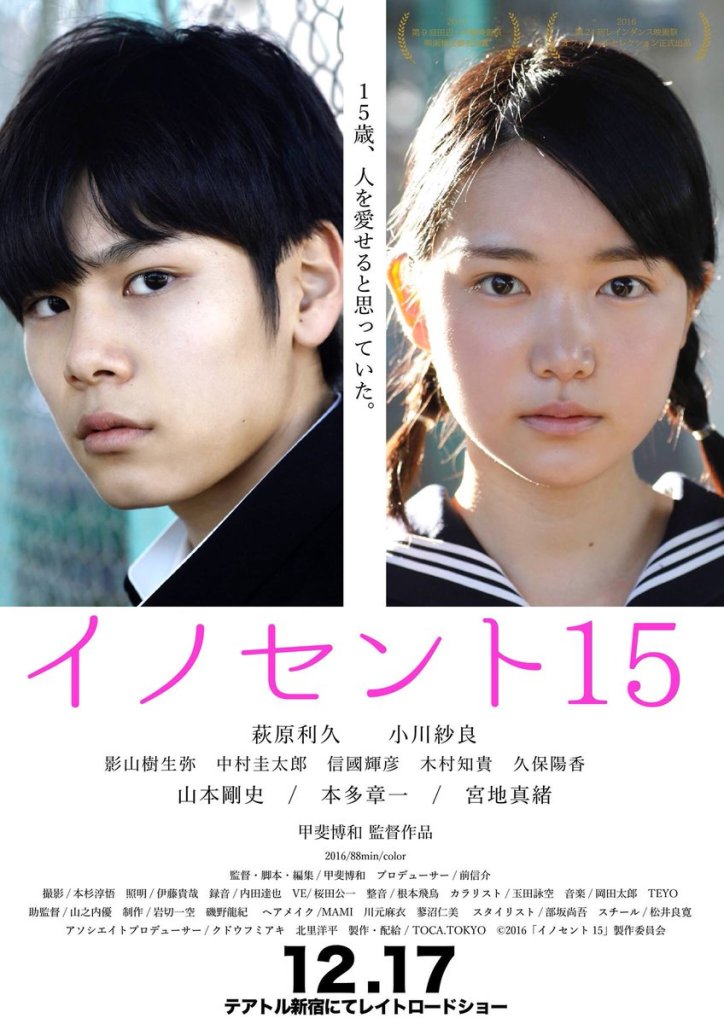
Innocent15 (イノセント15, Hirokazu Kai, 2016)

innocent-15Innocence is a fairly nebulous concept and one often misused but if you were expecting an “innocent” tale of youthful romance, Hirokazu Kai’s Innocent15 (イノセント15) is out to wrong foot you from the get go. Kai does not shy away from the darker sides of human nature in examining abusive parenting and forced prostitution as well as the damage done when a secret is broken after long years of being unable to be honest about who you really are. This is a bleak tale, but one with with hope shining round the edges, even if uncertainly.
Narumi (Sara Ogawa) and Gin (Riku Hagiwara) are ordinary middle school students living in small town not far from the capital. When Narumi plucks up the courage to confess her love to her friend, she receives the kindest of brush offs but Gin is left confused. His two drop out friends who spend their days skateboarding around the neighbourhood can’t understand his decision to turn down such a pretty girl though they remember that he’s done the same thing before. Gin himself doesn’t quite know why, but even if he feels sorry for not returning Narumi’s feelings, he is unable to accept them.

Though Narumi may seem like the perfect high school girl – quiet, studious, and refined, if a little sad, her home life is anything but ordinary. Saddled with an aggressive woman child for a mother who demands Narumi abandon her homework to cook her dinner while she plays on her gameboy, Narumi keeps her head down and makes the best of things. After putting up with her mother’s regular beatings, she finally decides to leave when she learns that her mother has sold her virginity to her boyfriend for 100,000 yen.

Meanwhile, Gin’s life is turned upside-down when he learns his father is in love with another man. Already in a state of confusion about his own adolescent feelings, Gin is unable to comprehend this sudden bombshell and lashes out at all around him. Therefore when Narumi arrives and tells him she’s leaving for Tokyo to look for her father he immediately says he’ll come with her. However, their youthful ideas of going it alone in the big city are quickly dashed.

Gin’s problems are of a more immediate kind but Narumi has endured long term suffering at the hands of her abusive mother. When she belittles Narumi’s studying and remarks that she’s no need to go to high school because the world always needs more hookers, it seems like an instance of cruel sarcasm but it turns out she really is intent on prostituting her own daughter to her no good boyfriend.

When her mother’s boyfriend viciously attacks Gin, Narumi is left with nowhere else to go. The tragedy is that intense social pressures and her already existing isolation make it impossible for Narumi to confide in someone about the abuse she’s suffering at home. Being only 15, even if she were to simply walk out of her mother’s house she would have no way to support herself, leaving her with little choice between possible starvation on the streets and allowing her mother to sell her to her cruel and violent boyfriend.

Narumi’s “innocent” love for Gin becomes her last lifeline and his rejection a crushing end to her dreams of being saved. By contrast, Gin’s problems are much easier to solve. His resentment towards his father is more likely driven by the shock of the revelation rather than directly because he has fallen in love with another man. Gin may have temporarily rejected his father, but his father has not rejected him. Guilt and embarrassment over his actions aside, Gin is always welcome to return home where his father would welcome him with open arms. All of Gin’s problems are internal as he struggles with his adolescent confusion. All of Narumi’s problems are external – when Gin spots the scars and bruises on her shoulder, she tells him that she was able to put up with her mother’s cruelty because it only hurt her body and never touched her soul. Narumi’s interior is solid, but she’s trapped in a desperate situation from which there is no obvious way to escape.

Mirroring each other, Gin and Narumi try to run away from their problems but are each unable to escape. Kai opts for a series of reverses towards the film’s conclusion which offer hope only to dash it again and the final scene with only the sound of a motorbike’s flooded engine and eventual kickstart adds a note of anxious ambivalence in which there is a chance for the pair to ride away together but no further evidence that this attempt will be any more successful than the last. The general tone is one of gritty realism though Kai also admits the existence of life’s strange coincidence’s such as in the repeated appearance of a “weird lady” on a pink mobility scooter whose eccentric driving style has disastrous consequences. A necessarily bleak tale highlighting the plight of children in danger in their own homes and left with nowhere else to go coupled with a tentative, innocent teenage love story, Innocent15 is a tense, often horrifying experience filled with outrage but is careful to leave at least the possibility of a better way out, however far off it may be.


Reviewed at Raindance 2016.

Original trailer (English subtitles)

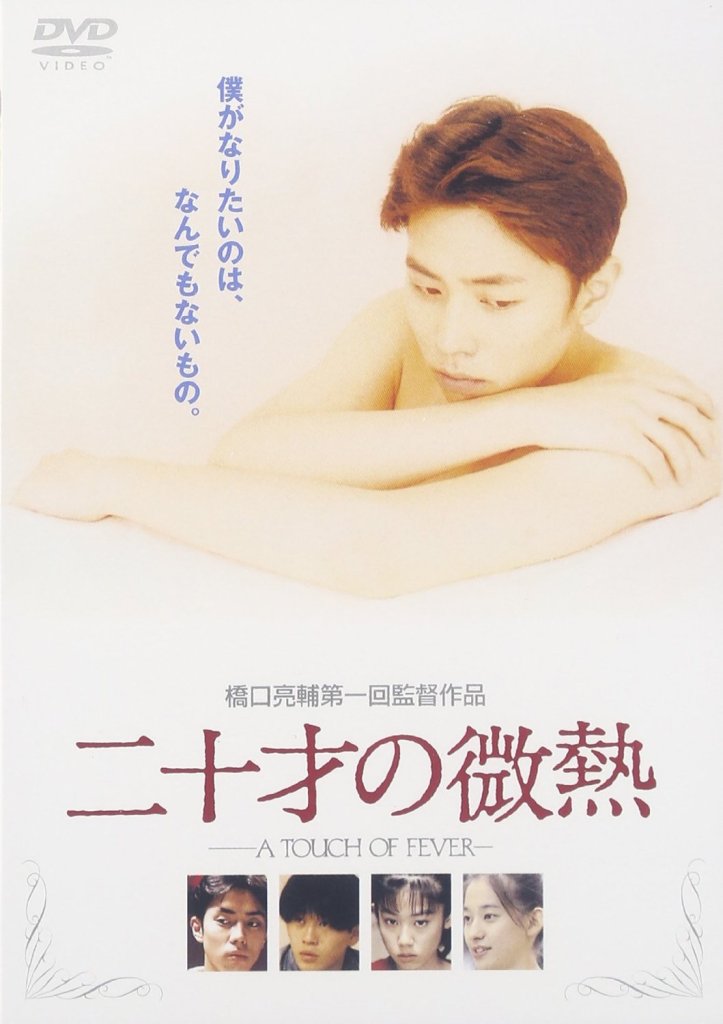
A Touch of Fever (二十才の微熱, Ryosuke Hashiguchi, 1993)

Touch of FeverRyosuke Hashiguchi’s debut feature A Touch of Fever (二十才の微熱, Hatachi no Binetsu) proved a surprise box office hit in Japan and is also credited for helping to bring male homosexuality into the mainstream. A no-budget movie shot on 16mm, A Touch of Fever is the story of two ordinary boys each going about their everyday lives whilst also beginning to understand themselves in terms of their sexualities, mirroring each other perfectly in their inner confusion.

Tatsuru is a college student by day, but he spends his nights working at Pinocchio’s where he entertains male customers looking for some no strings action with a disinterested young man. Among the other youngish guys working at the club is Shin who is actually still in high school. Shin is out to his parents, but they haven’t taken it well so he’s couch surfing, leading to him to ask Tatsuru if he could temporarily move in with him. Along with all of the practical problems this may raise, Shin has something of a crush on his older colleague, but Tatsuru is filled with doubts about many things and his apartment is in no way big enough to contain this particular elephant in the room.

Tatsuru is about as detached as they come. He claims that he can separate love and sex and that for him his work is just a mechanical action that he happens to be pretty good at. The first client we see him with interrogates him about his non-compensatory love life, assuming that he must have a girlfriend. Tatsuru gives a non-committal answer about whether he also sleeps with women which offers the first indication of his slight resistance to the idea of being gay even if he has no problem earning a living through sleeping with men. Throughout the film he also conducts a parallel (platonic, if fliratious) relationship with an older female student, though when he decides to try and take things further she more or less shuts him down explaining that she’s confused about her feelings for him – she wants him in her life, but probably not in a romantic way. As if to underline the point, an attendant begins to spray cleaning fluid over the passenger side window of the car Tatsuru is sitting in, effectively painting him out of the picture.

Shin, on the other hand, is very clear about his sexuality but less so about the idea of selling it for money. Uncomfortable with the atmosphere at the club, Shin has decided he only wants to do it with people he likes, as impractical as that may turn out to be. What Shin wants is romance, but that’s exactly what Tatsuru is currently unable to acknowledge. When taken to task by one of Shin’s female friends, Tatsuru offers a series of justifications about different kinds of love but remains rational and closed down. At the moment it appears something may happen between the pair, it’s Shin who ultimately can’t follow through. Whether due to “chickening out” as his friend accuses, a lack of belief in his object of affection, or simple vulnerability, Shin is not quite ready to acknowledge his true feelings either.

Both boys have also become estranged from their families and particularly with their fathers. Tatsuru’s father leaves gruff answerphone messages and then when he finally gets through, suggests that his son is a drain on his resources that he could well do without. Having left Tatsuru’s mother for another woman, dad is now cash strapped – so much so that his new partner has had to have an abortion because of all the loans he’s taken out for Tatsuru’s fees. The final parting blow is to say that (contrary to the suggestion of a complete divorce between father and son) Tatsuru is now the sole heir of the Shinomori name which is yet another burden for guy who may be gay and therefore may not necessarily be looking to pass that name on. Shin’s father had something of an apoplexy when he found out his son was gay and threatened to have him sent away to the self defence force for some “toughening” up, going so far to trample all over Shin’s dreams of becoming a fashion designer and leading him to leave home at such a young age.

Hashiguchi’s first feature is his most melancholy but also oddly innocent. A theme which recurs throughout his career – that love is sad and ultimately impossible, rears its head during the film’s final scene in which Hashiguchi himself plays a sinister customer. This uncomfortably long sequence which breaks with the formalist camera movements of the the earlier part in favour of destabilising, unbroken handheld, acts as the climax of the film as the pair are once again symmetrically opposed. Tatsuru likes things impersonal but this guy wants to talk, whereas Shin craves connection but finds the customer unpleasant in his wheedling, direct and almost forceful approach. “You wouldn’t know the pain of being unable to speak out about how you really feel”, says the customer, oblivious to the obvious subtext. This long, strange, and uncomfortable encounter does at least lead both boys into the centre ground, making each clearer both about themselves independently and about whatever it is that exists between them.

Contrary to the customer’s assertion about the impossibility of true connection, the film ends on a note of hope as the boys walk home together with a little more lightness in their steps. When Shin enquires how much Tatsuru was paid for something that he previously disapproved of but seems to have got over now, he tells him he’s underselling himself and ought to value himself more. Tatsuru says he’ll bear that in mind – that has, after all, been the problem all along. In one sense, the “fever” has broken – a weight has been lifted, leaving both boys freer to go about their lives with more clarity and less angst. Perhaps it isn’t all so sad and impossible after all.


Original trailer (no subtitles)

https://www.youtube.com/watch?v=ZN6xyL4cKPY

Daytime Drinking (낮술, Noh Young-seok, 2009)

daytime drinkingPoor old Hyuk-jin is about to have the worst “holiday” of his life in Noh Young-seok’s ultra low budget debut, Daytime Drinking (낮술, Natsul). Currently heartbroken and lovesick as his girlfriend has just broken up with him, Hyuk-jin is trying to cheer himself up with an evening out drinking with old university friends. Truth be told, they aren’t terribly sympathetic to his pain though one of them suddenly suggests they all take a trip together just like they did when they were students. Hyuk-jin plays the party pooper by saying he can’t go because he’s meant to be looking after the family dog but after some gentle ribbing he relents and says he’ll come if he can get someone to look in on the puppy for him while he’s gone. He will regret this.

Sure enough, Hyuk-jin arrives at the bus terminal in the town where his friend supposedly knows someone with a cosy inn where they do delicious barbecues only it’s freezing cold and his friends are nowhere to be seen. That’s right – his ultra flaky friends have forgotten all about it and stood him up. Already quite annoyed, Hyuk-jin argues with his “friend” but later accepts his offer to stay over at the inn on his own at his friend’s expense and wait for him to join him there in a couple of days. However, firstly, Hyuk-jin somehow ends up at the wrong inn which seems to be run by a madman where he also meets a female solo traveller who’s apparently fond of a drink. Everywhere he goes, everyone keeps offering Hyuk-jin a drink in a way which makes it very hard for him to say no, though there’s almost nothing else to do around here anyway. Pretty girls and drink are about to land Hyuk-jin in a series of embarrassing incidents that are most likely only bearable because of the residual booze cloud Hyuk-jin is currently residing under.

Following a loose road trip structure, Daytime Drinking follows Hyuk-jin on his strange and accidental odyssey where just about everything conspires against him. Hyuk-jin is not entirely blameless in his fate – he’s far too taken by pretty faces and gets himself into trouble by behaving rudely towards a not so pretty older woman as she bores him with endless prattle, completely failing to take the hint that he’s finding her constant conversation a little too much to bear. Hyuk-jin’s distress continues to grow as his friend keeps delaying his trip, and his troubles only increase until he is deprived of both his phone and his wallet (not to mention his trousers!), leaving him entirely dependent on the kindness of strangers. Unfortunately, though some strangers may seem kind they often have ulterior motives whether they just want someone else to pay for the drinks or they’ve only booked one bed and are planning to creep into the shower just as you’re lathering up…

Daytime Drinking is the first feature from Noh Young-seok in which he acts as scriptwriter, cinematographer and editor so it’s a real indie production. Made on a true shoestring budget of only $9000, production values are surprisingly high even if obviously filmed on low grade equipment. Noh sticks to straightforward composition with Hong Sang-soo style static camera and zooms though he manages to effortlessly bring out the sympathetic humour inherent in Hyuk-jin’s very disappointing mountain holiday. Hyuk-jin himself is never a figure of fun and though hapless is clearly an ordinary person with ordinary failings such as his weakness for pretty girls and booze or his polite way of being impolite in trying to evade the attentions of a boring fellow traveller when he’s already tired and fed up himself.

Noh’s world view seems quite a bleak one but is also undoubtedly very funny. When things get as bad as this perhaps there’s nothing left to do but laugh. You’d think a trip as disastrous as this one would have Hyuk-jin vowing never to leave the house again, but then there’s yet another pretty face at the train station so perhaps a holiday to get over one’s holiday is order? Don’t do it Hyuk-jin! Some people never learn….


US release trailer: