Tokyo Nightfall (トーキョーナイトフォール, Yuto Shimizu, 2026)

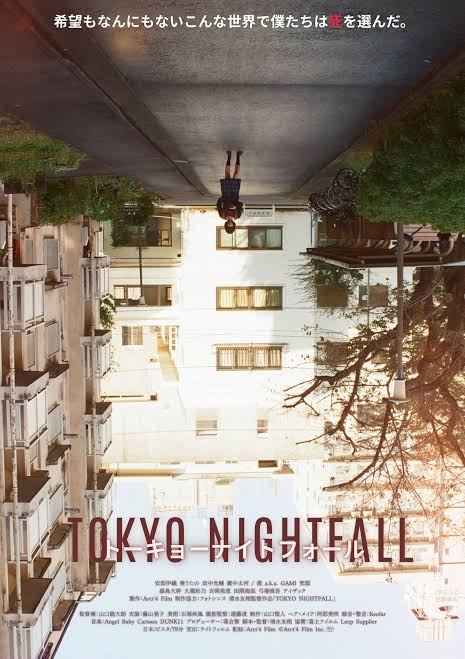
Struggling to deal with his feelings of grief and guilt following his younger sister’s suicide, a young man finds himself at an end of the world party for those who want to end their lives in Yuto Shimizu’s melancholy urban drama Tokyo Nightfall (トーキョーナイトフォール). The Tokyo these young people inhabit is one of loneliness and futility in which there is no real hope for future and the past holds only painful memories. 

The bleakness might best be demonstrated by Anna’s (Utano Aoi) reply that her happiest moment in life was her parents’ divorce. The pair hint at a childhood marked by domestic violence, but any hope they might have had for a better future was cut short when Anna witnessed the suicide of a friend of her brother Amenashi (Iori Abe) who jumped from their eighth floor flat. This even seems to have changed Anna who relates that it wasn’t so much the horror or the blood but the fact that she saw a person turn into an object in real time. It made her feel as if being alive wasn’t all that important. 

Working a soulless job as a delivery driver where his clients are often similarly withdrawn or hostile, Amenashi blames himself for Anna’s death and wonders if there was something more he could have done to prevent it while drawn into the same kind of darkness she was. Amenashi’s friend, Hattori (Taiga Hironaka), even states that he is worried about him because his erratic behaviour reminds him of that of Anna shortly before she died. It seems that the party he goes to a gathering for those planning to end their lives where they can have one last night of fun before they go.

Amenashi goes to the party, but is followed by his friends Hattori and Nozu (Kosuke Tanaka) who don’t quite know what the party is, but just want to find their friend. While Nozu, otherwise a comic relief character giving lewd and disgusting answers to the questions put to him, Nozu too sets out to enjoy the night even bonding with a young woman, but is also drawn into the darkness of the evening and reconsiders his own life. Others in the club react with irritation, telling Hattori he should respect his friend’s decision and has no business being here. Haunted by visions of Anna, Amenashi remains uncertain not quite knowing whether to live or die. Another guest at the club tells him that he should forget about this cold world and stay with them, dragging him over to the side of death, while Hattori does him best to encourage him to live.

The video camera sequences play out as a kind of will as Anna, Hattori, and Nozu look back over their lives. Shimizu sometimes replays the same video only to let the conversation run to add more information that changes our impressions of what’s gone before. Speaking about their happiest and saddest moments, the friends paint a bleak picture of familial disconnection and loneliness but are saved only by their bond with each other as Hattori names his happiest moment as spending time on the roof with them.

The irony is that may not be enough. The ghost of Anna tells Amenashi that neither choice is wrong and the film is non-judgemental about the idea of suicide, perhaps feeling that those who make the deacon to leave should be allowed to do so while Amenishi wrestles with himself about the right thing to do. Others may have the decision taken away from them, but he does at least have the power to decide his own future. Hattori had told him that there may be no point in thinking. People are full of contradictions and don’t even understand themselves. “We are here for each other,” Nozu adds, offering the only possible source of salvation in a world that otherwise seems hopeless and devoid of possibility. As Amenashi cycles around the city, he looks on at young couples and is struck by a sense of urban disconnection and loneliness, but does perhaps begin to rediscover something of the will to live in the power of friendship and the memories of those he’s lost, if perhaps only too late.


Tokyo Nightfall screened as part of this year’s Raindance Film Festival.

Trailer (English subtitles)
Song Lang (Leon Le, 2018)

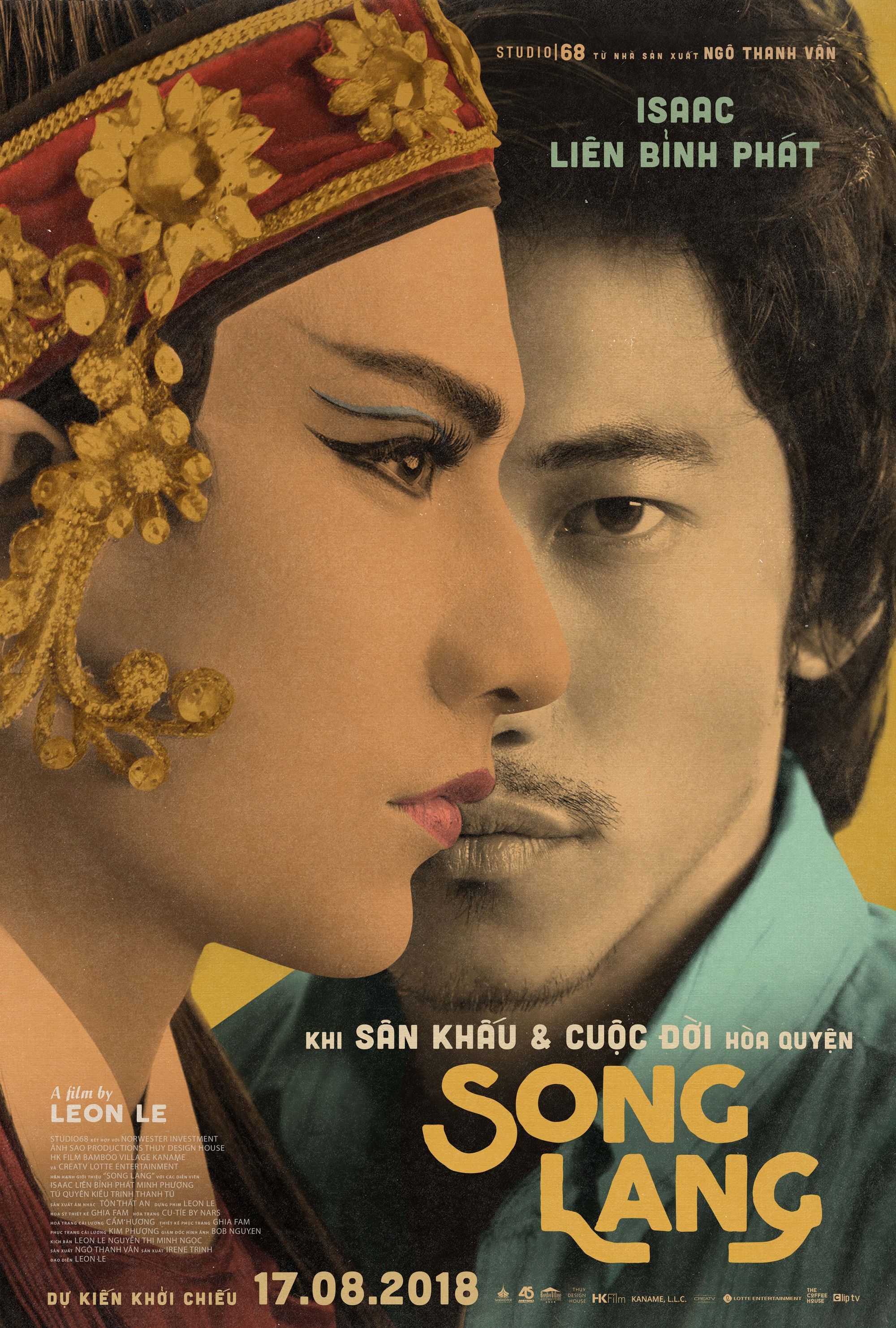
Song Lang poster 1“How could the gods be so cruel” a ci lương performer intones, “Allowing us to be together yet worlds apart”. An achingly nostalgic return to the Saigon of the 1980s, Leon Le’s melancholy debut Song Lang is a lament for frustrated connections and the inevitability of heartbreak, taking its lonely heroes on a slow path towards self realisation only to have fate intervene at the worst possible moment.

An enforcer for the steely “Auntie Nga” (Phuong Minh), Dung Thunderbolt (Lien Binh Phat) has long been trying to take revenge on his unhappy life through the intense act of self-harm which is his way of living. A routine job, however, jolts him out of his inertia when he wanders into a theatre where a ci lương opera company is preparing for a performance. There he finds himself catching sight of the famous performer Linh Phung (Isaac), only to run away, in flight from the intensity of being woken from his reverie. Later he returns to claim the debt, threatening to burn the company’s precious costumes until Linh Phung arrives and interrupts him, proudly insisting he will pay the balance after the first performance. Dung leaves confused, refusing to accept the watch and necklace that Linh Phung offered in partial payment.

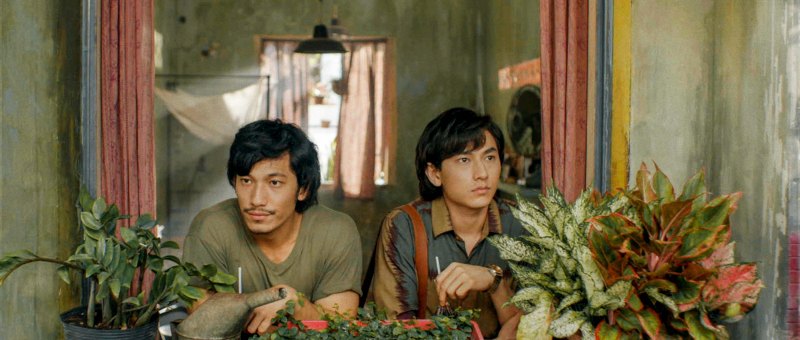
A second chance meeting confirms that the two men might have more in common than they’d first assumed. The lonely Linh Phung, eating alone in a nearby cafe, gets into a fight with some drunken louts who wanted him to sing a few tunes, but as surprisingly handy as he turns out to be quickly gets himself knocked out at which point Dung steps in to rescue him, eventually taking him home to sleep it off where they later bond through a shared love of violent video games. An opportune power cut allows the two men to enter a greater level of intimacy during which Dung begins to re-embrace his ci lương childhood through the instrument his father left behind.

The Song Lang, as the opening informs us, is an embodiment of the god of music delivering the rhythm of life and guiding musicians towards the moral path. That’s a path that Dung knows all too well that he has strayed from and is perhaps looking to return to. The central theme of ci lương is “nostalgia for the past” – something echoed in Linh Phung’s peculiar philosophy of time travel through people, objects, and places which seems to be borne out in Dung’s constant flashbacks to a more innocent age before his happy childhood ended in parental betrayal and sudden abandonment.

Linh Phung, meanwhile, is nursing his own wounds. His mentor tells him that though he is popular his performance lacks depth because he lacks life experience while his co-star mocks him for never having been in love. Rooting through Dung’s belongings, he discovers a book he’d loved in childhood about a lonely elephant taken away from his jungle and sold to a circus. Both men are, in a sense, exiles from their pack walking a lonely path of confusion and despair but finding an unexpected kindred spirit one in the other as they search for new, more fulfilling ways of being. Bonding with Dung opens new emotional vistas for Linh Phung which allow him to perfect his art, while reconnecting with his childhood self through Linh Phung’s music gives Dung the courage leave his nihilistic life of shady moral justifications behind.

Fate, however, may have other plans and karma is always lurking. Linh Phung’s claim that an artist must know great grief proves truer than he realised, but it’s another passage from the book with which he eventually leaves us, affirming that it’s best to learn to enjoy these present moments rather than lingering in an unchangeable past. Yet the art of ci lương is itself steeped in nostalgia, perfect for a “time traveller” like Linh Phung returning to his sadness through his art, proving in a sense that the past is always present and wilfully inescapable. A melancholy, romantic evocation of Saigon in the 1980s, Song Lang is also a beautifully pitched paen to a fading art form and an  “unfinished love song” to lost lovers in which two lonely souls find an echo in each other but discover only tragedy in the implacability of fate.


Song Lang screened as part of the 2019 New York Asian Film Festival.

Original trailer (Vietnamese subtitles only)