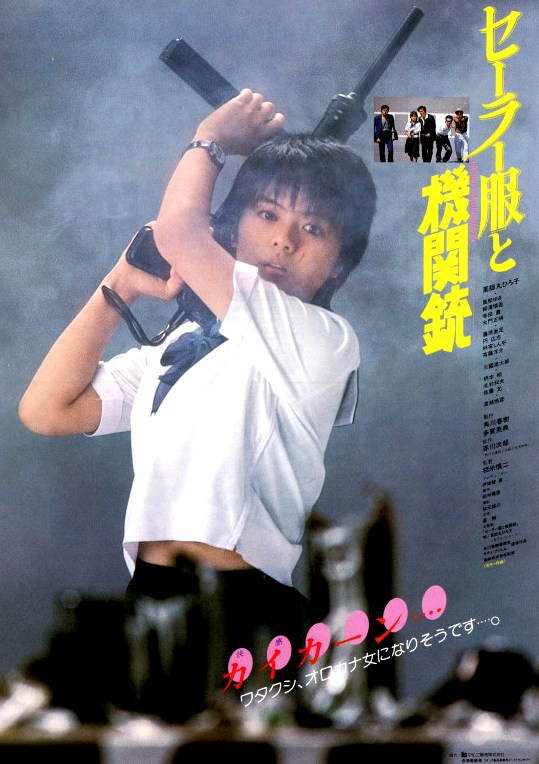
Sailor Suit and Machine Gun (セーラー服と機関銃, Shinji Somai, 1981)

sailor-suit-and-machine-gun

For good or ill, Haruki Kadokawa’s entry into the film industry was to have a profound effect both culturally and commercially. Rising from the ashes of the studio system, Kadokawa’s stable of cute and perky idols presented him with the opportunity to build a multimedia empire formed of a union between cinema, books, and music in which each could be used to sell the other.

1981’s Sailor Suit and Machine Gun (セーラー服と機関銃, Sailor-fuku to kikanju) was one of his earliest successes and helped to solidify his approach. Featuring one of the biggest idol stars of the 1980s, Hiroko Yakushimaru, in her most iconic role, the film adapts a Kadokawa teen novel as its source material and includes an end credits song with the same title sung by the film’s star. It was a winning formula, but then Sailor Suit and Machine is not just another idol movie. Directed by Shinji Somai whose work is much more well known in Japan than it is abroad, this strange story of a high school girl and her unlikely role as a yakuza boss is both a surreal coming of age tale and an arthouse-influenced character piece which came to become the defining youth movie for a generation of female cinema goers.

Izumi Hoshi (Hiroko Yakushimaru) is now an orphan. Her mother died some time ago and today is her father’s funeral. Thinking herself all alone in the world, Izumi is surprised when an older woman, Mayumi (Yuki Kazamatsuri), suddenly appears with a letter from her father claiming he asked her to look after his daughter if anything should happen to him. More surprises follow when her school is surrounded by black-suited yakuza. Prophetically, the other students are terrified, but Izumi marches straight up them to find out what’s going on. As it turns out, they’ve come for her, an uncle of Izumi’s father was the head of a yakuza clan and now that he’s dead they need a blood relative to succeed him. Izumi’s father out of the picture, the position falls to his daughter, teenage high school girl or not. At first she refuses but realising that with no boss the guys will all have to die, Izumi relents and orders them to live. So begins her long, strange, not altogether successful career as the head of moribund clan of dejected yakuza.

In many ways, Sailor Suit and Machine Gun is a parody of a standard yakuza flick in which rival groups vie for power in the crowded backstreets of a busy city. The idea of a tiny 17-year-old girl heading up an organised crime syndicate and going toe-to-toe with grizzled fifty year old veterans is an inherently absurd one as exemplified by Izumi’s courtesy visit to the area’s most powerful gang boss in which he he more or less laughs her out of the office.

Despite the incongruity, Izumi is a tough kid and more than holds her own in the very male underground world. In her father’s letter to Mayumi, he describes his daughter as tough but naive, an analysis which proves true in her tenure as a yakuza boss. There is a degree of silliness in her actions, playing the role assigned for her as if acting a part in a movie, but as her guys start getting knifed it suddenly doesn’t seem so funny after all. The film revolves around a MacGuffin of some missing heroin which belongs to a gangster named Fatso but is also sought by rival gangs. Out of her depth, Izumi has no knowledge of the whereabouts of the missing drugs or even the reason why anyone would want them. This is a situation that can’t be blustered through and Izumi does not have the ability to navigate it.

The idea of an ordinary high school girl plunged into the criminal underworld is as ridiculous as it’s intended to be. However, Izumi is not quite the ordinary high school girl she first appears. Gangly and boyish, she is supported by three male friends who often flank her as entourage but always recede into the background, bowing to her leadership. Already dominant and possessing obvious leadership potential, Izumi’s bold decision to approach the yakuza at the school gates also hints at her curious and fearless personality, even if it also speaks to her youthful recklessness.

These more masculine qualities of forcefulness and dynamism as opposed the stereotypical image of the cute and submissive school girl are perfectly suited to her new life as a crime boss but for all of that her leadership takes on an oddly maternal quality. A wounded footsoldier remarks that Izumi smells like his mother as she’s awkwardly winding bandages around his torso, and the guys flock around her like they would the family matriarch. Tellingly Izumi later tells Mayumi that part of the reason she rejected her was because of her extreme femininity, something the adolescent Izumi did not quite know what to do with, especially given the maleness of her new environment.

Izumi’s short lived career in the yakuza cannot be termed a success in the normal manner of things, she acts honourably and may win a final victory but it comes at great cost. When Izumi finally picks up the machine gun of the film’s title for the intense finale, she finds herself enjoying it a little too much as the word “fantastic” escapes her lips seconds after letting rip intro a rival gang boss’ office. Rather than the romantic awakening which is the climax of many female centred teen movies, Izumi’s major consummatory event is with her machine gun. As she puts it at the end, Izumi’s first kiss goes to a (deceased) middle aged man and she looks set to become a “foolish” woman, her path into womanhood has been an unusually transgressive and as yet unresolved one.

Somai’s camera is is both slippery and precise as he casts us as voyeur in Izumi’s world, shooting through exterior windows and even at one point from behind the shrubbery. Preferring long takes and often at extreme distances, Somai mixes static camera with unusual fluidity for an effect that’s far more arthouse influenced than your usual teen idol picture. As with many of Kadokawa’s ‘80s movies, the film is steeped in the naivety of the teenage world view as Izumi goes about her new life with a kind of fearless determination despite the inherent violence and unexpected adult sexuality. A deserved classic, Sailor Suit and Machine Gun is the archetypal Kadokawa movie, creating a vehicle for its idol star in the fascinating, iconic presence of its central heroine whilst simultaneously generating an enduring pop culture phenomenon.


Original trailer (no subtitles)

And here’s star Hiroko Yakushimaru singing the title song at her 35th anniversary celebration concert in 2013:

Kids Return (キッズ リタ-ン, Takeshi Kitano, 1996)

kids-returnReview of Kitano’s Kids Return first published by UK Anime Network.


Kids Return (キッズ リタ-ン), completed in 1996, marks Kitano’s return to filmmaking after the serious motorcycle accident which almost claimed his life and has continued to have long term effects both personally and in terms of his career. Once again he remains firmly behind the camera but displays a more contemplative, nostalgic approach than had been present in much of his previous work. The tale of two delinquent slackers in small town Japan, Kids Return has an obvious autobiographical quality and even if the future looks bleak, Shinji (Masanobu Ando) and Masaru (Ken Kaneko), like Kitano himself, are not beaten yet.

Beginning with a sequence of the older Shinji delivering rice and sharing a melancholy reunion with school friend Masaru, Kitano then hops back to their carefree school days of slacking off and intermittently trolling the entire institution. Masaru is the leader of the pair, loud mouthed and violent, always trying to big himself up, while Shinji is the classic sidekick – always following dutifully behind and lost without his friend’s leadership. Their paths diverge when Masaru decides to join a boxing club after someone he’d bullied and extorted money from hires a boxer to get revenge on him. Masaru is hopeless in the ring and lacks the dedication it would take to become a serious althete but Shinji shows promise, eventually knocking Masaru out after being forced into a humiliating duel. Masaru ends up joining the yakuza gang which hangs out in his favourite ramen joint and quickly rises through the ranks. Though both boys look to be going somewhere along their chosen paths, they each squander their given advantages through a series of poor decisions and eventually find themselves right back where they started.

Shinji and Masaru are typical of many young men of their generation and social class. They “go to school” but rarely attend lessons and are often to be found riding their bike around the playground or pranking the other students such as in a particularly elaborate plot where they dangle a stick figure of a teacher down from the roof to the classroom window below, joyfully erecting the “penis” they’ve given it by attaching a torch to the middle section complete with wire brush hair and cotton balls. Such tricks may seem like innocent, juvenile behaviour but a more serious side emerges when an obnoxious teacher’s car is set on fire.

The teachers at the school have already written the boys off as not worth saving. Always referring to them as “the morons”, the school seems reluctant to actually expel the pair and has come to view them as amusing inconveniences more than anything else. None of the teachers is interested in reaching out to Shinji or Masaru and, in fact, they appear to be a cynical bunch with no real interest in the children in their care. At the end of the school year the teachers begin discussing their progress and reveal that only a handful of students will be going to university (and only one to a public, rather than private institution) and that those who are have largely achieved it through their own steam. The education system has nothing to offer these students who have already been judged unworthy of advancement and is in no way interested in providing any kind of pastoral care or social support.

Shinji and Masaru are expected to find their own paths, but the film posits that this idea of total, individual freedom of the modern era is at the root of their problems because it leaves them with too many choices and no clear direction. Failed by education, the pair must find new ways to move forward but the opportunities on offer are not exactly appealing. Masaru, the loud mouth of the pair, ends up on the obvious path of the disaffected young man by joining a gang and finding for himself the familial comradeship of the criminal brotherhood rather than that of a traditional family.

Shinji’s path looks more solid as he begins to train as a serious athlete, honing his skills and perfecting his physique. He is, however, still unable to take control of his own life and repeatedly looks for more dominant male role models to follow. This might have worked out OK for him if he’d stuck with the paternal influence of the coaches, but Shinji is easily led and falls under the influence of an embittered older boxer, Hayashi, who is full of bad advice. Under Hayashi’s tutelage, Shinji learns illegal moves and that he can still drink and eat what he likes because you can just throw it all up again afterwards. When even that doesn’t work, Hayashi begins giving him diet pills which exemplify the quick fix approach he’s taking with his life. Needless to say, his training suffers and his previously promising career is soon on the rocks.

It’s not just the two guys either. Their shy friend with crush on the cafe girl leaves school and gets a good job as a salesman but the aggressive boss makes his working life a misery leading him to take a stand with a colleague and quit to become a taxi driver. No good at that either, he experiences exactly the same treatment and is now unable to earn enough money to support both himself and his wife. In fact, the only success story is the manzai standup comedy duo which Masaru mocked in the beginning. Knowing exactly what they wanted to do and working hard to get there, the pair have built a career and an audience through steadfastly sticking to their guns and refusing to listen to the naysayers. If you have direction, progress is possible, but for Shinji and Masaru who have no strong calling the future is a maze of uncertainties.

The kids have returned, not quite as men but in the first flush of failure, ready to start again. When Shinji asks Masaru if it’s really all over for them already, he tells him not to be silly – it hasn’t even started yet. The town goes on as normal, unchanging, kids goof off lessons and melancholy people waste time over coffee. Perhaps nothing will change for Masaru and Shinji and their aimless days of drifting from one thing to the next, looking for guidance and finding none, will continue but there’s fight in them yet and the possibility remains for them to find their way, as difficult as it may prove to be.


Out now on blu-ray (in the UK) from Third Window Films.

Original trailer (no subtitles)

Bangkok Nites (バンコクナイツ, Katsuya Tomita, 2016)

bangkok-nites“Asia is a paradise for men” though not for anyone else, if Bangkok Nites (バンコクナイツ) is anything to go by. In Tomita’s previous film, Saudade, he explored the intercultural exchange between Thailand and Japan with one character having tried to escape there and failed, and another idly dreaming of running away with his Thai mistress. Five years later he revisits the same idea but from the other side as he weaves a meandering trail through the Japan-centric element of Bangkok’s red light district which eventually leads him on to other neighbouring nations whose landscapes still bear the scars of war and colonialism decades into a supposedly enlightened age.
We begin with Luck (Subenja Pongkorn), caught in reflection against a swanky hotel window overlooking her city. Her client is a Japanese man, clingy in the extreme though it’s unclear if his desire to avoid paying is out of consideration to his wallet or a genuine case of affection. Nevertheless, his whining is too much for Luck who eventually manages to escape the room and get back to work. Employed by a bar on Thaniya Road, an area of Bangkok’s red light district popular with Japanese tourists, Luck’s job involves sitting on a shelf in a large stable area where she and her colleagues wear colour coded badges so the customer can see their rates and services offered at a single glance.

Good friends with a Japanese man who works as a kind of procurer for the club, Luck ends up at a party where she runs into Ozawa (Katsuya Tomita) – a quasi-customer with whom she’d developed a deeper relationship around five years previously but subsequently lost contact. A former Self Defence Force soldier, Ozawa first came to Asia on a peacekeeping mission to Cambodia and has been back and fore ever since. During this most recent stay he’s begun to strike up a friendship with fellow Japanese guys working around the edges of the sex industry and related businesses including the drugs trade. After getting to know each other again, Luck takes Ozawa to her peaceful, rural, hometown beginning a journey which is to have a profound impact on his view of the continent.

There’s something a little sad about the small, sleazy world of the red light district and its collection of melancholy ex-pats eking out a living by exploiting desperate local women. Ozawa hovers on the fringes of this group, obviously a visitor to the brothels of Thaniya Road, but not quite a devotee. The other guys repeatedly refer to Thailand and other surrounding countries as “paradise” or a “utopia” where the women are “easy” and can be had at will and with few strings. One visitor remarks that he can have twenty nights of debauchery in Bangkok for the cost of one fancy night out in Roppongi. Yet for every one like him just trying to blow in and blow out with no fuss, there are a handful who can’t separate a transaction from a romance, becoming overly attached to women merely providing a service who, naturally, are not particularly seeking a long-term relationship with the sort of man who thinks a woman can be bought wholesale.

Luck is the number one on Thaniya Road, though she’s aware her time is limited. The work pays well and she’s been able to acquire an elegant Bangkok apartment as well as a house for her mother and siblings back in the country, but her heart is set on saving enough money to open an upscale European restaurant when she finally leaves the sex trade behind. Taking Ozawa back to her hometown, she explains to him that her life in Bangkok is just what happens to girls from the country. Children are raised by aunts while mothers live in the city, sending money back home, until they swap places and the children head to the city while the women return to raise the children of relatives. Most of her friends are also involved in the local sex trade, catering to foreign travellers with less than romantic ideas about the country and its “exotic” women.

Tomita paints this as another ongoing echo of the colonial past as foreign men come to Thailand for purposes of discreet pleasure, giving little thought to the interior lives of the real breathing women in front of them. Taking Ozawa around her home town, Luck shows him the beautiful European style mansion she grew up in with her mother’s second husband (her step-father and the only positive male input she ever mentions) who was an American working at a local air base. The bases are a relic of the Vietnam war, the legacy of which also rears its head once Ozawa makes his way into Laos where giant bomb craters still scar the landscape like pock marks on the face of the Earth more than forty years later. Ultimately these colonial wars trace themselves back to the first waves of colonisation but when Luck tries to look forwards she only sees the past – her desires are for the European, fancy restaurants and urban sophistication.

Ozawa looks at Luck’s hometown and (thinks he) sees a “paradise”, a calm and peaceful place where people drink and smoke their lives away with no worries. He thinks this ought to be enough, and perhaps he’s right, but women like Luck and her friends are still left with no other choice than to enter the sex industry in order to feed their families while the men bum around smoking, drinking, and whoring with other women. It could be a paradise for Ozawa, but it would only be supported by the private hell of the women all around him.

Tomita shoots in a straightforward style but also adds epic sweeping pastoral shots thanks to drone  camerawork and occasional touches of the surreal such as groups of shadowy figures in the forests who may be real or imagined, perhaps the ghostly spirits of past rebellions. Another figure encountered by Ozawa may also be a manifestation of these long-standing ghosts as he recites patriotic speeches and asks for money to help look after the refugees flooding into the forests thanks to the Vietnam war. Ozawa later meets the descendant groups of the guerrillas in Laos which includes disaffected Filipinos, Japanese, and Thais all looking for alternative ways of living.

Harnessing the power of popular song from classic ‘60s Thai pop to indie folk tunes about sold daughters and karaoke covers of The Carpenters, Tomita demonstrates how even music receives external influence but repurposes and exports it as a form of popular protest. Everyone is looking for an elusive form of paradise which does not exist, but their own actions and desires are often the very thing which prevents them from finding it. Tomita’s four years of research have been put to good use in creating a nuanced, thoughtful dissection of the ongoing effects of colonialism in a land still scarred by war and the painful wounds of the unexamined past.


Reviewed at the 2016 London East Asia Film Festival.

International trailer (dialogue free)

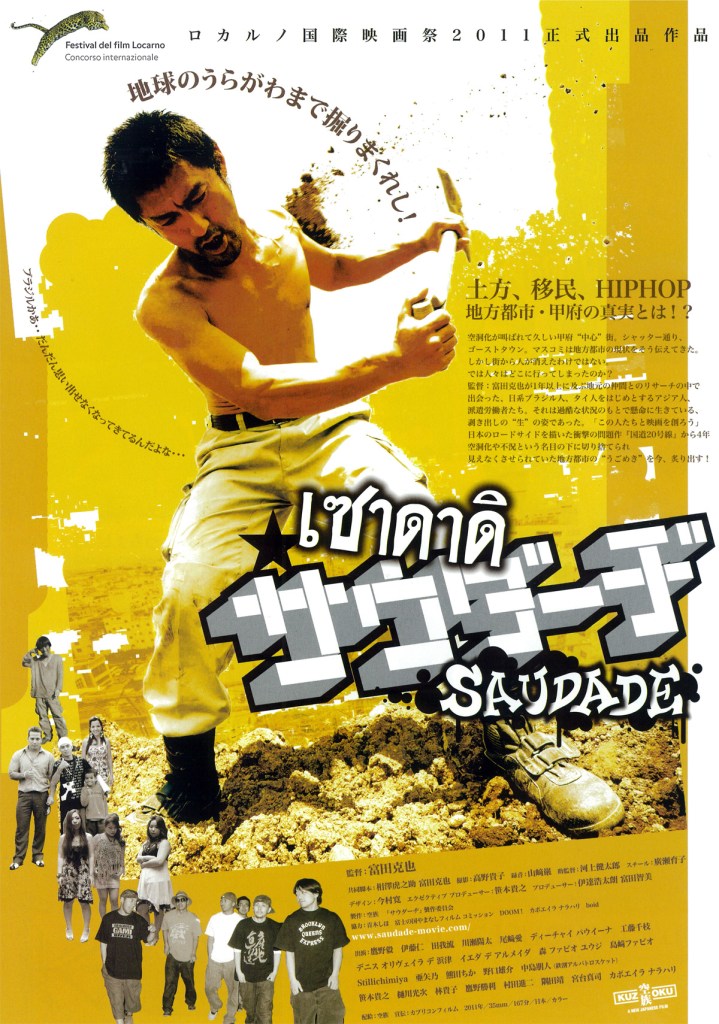
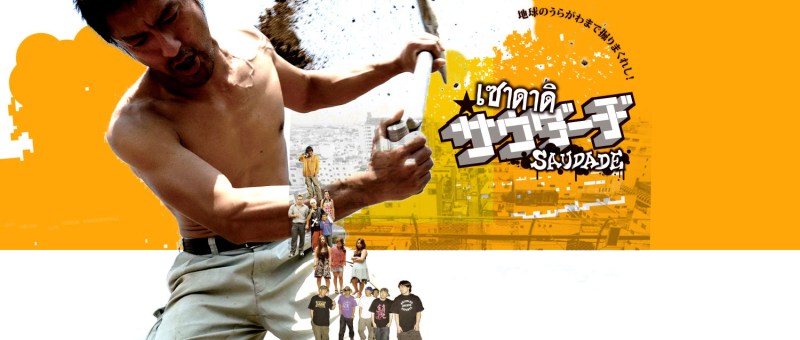
Saudade (サウダーヂ, Katsuya Tomita, 2011)

saudadeReworked from a review first published by UK Anime Network in September 2012.


Saudade is one of those words that’s so unique to a particular language that it’s extremely difficult to translate into another. The recent Portuguese film, Tabu, is almost a literal expression of “saudade” itself but offers this brief explanation of it – a feeling of deep yearning or nostalgia for something that is past and can never be regained. Each of the residents in the small town of Kofu (which is, in many ways, a character itself) are all yearning for something, whether for a new life, opportunity or just a simple return to the promise of one’s youth. As the town’s prospects continue to decline its residents continue to long for something different – some kind of progress to lift them out of the tedious downward spiral in which they feel themselves to be trapped.

Seiji works in construction, employed on short term projects – when there is work going that is, something that’s becoming increasingly scarce. Married to a beautician whom he’s come to dislike due to her social climbing ambitions and desire to start a family, Seiji fantasises about running away with his Thai mistress and starting a new life with her in her home country. He’s joined by a new friend, Hosaka, who, coincidentally, has just returned from a long period of time living abroad in Thailand but seems to have his own problems and perhaps serious reasons for his flight and subsequent return. The newest member of the construction crew is the reluctant Amano, a leader of right leaning hip hop group, who has come to blame Japan’s immigrant population for his own inability to find work and progress in life.

There are also, of course, the non-Japanese populations including the Brazilians who came to Japan on the promise of wages ten times those they could earn in their home country but have found only poverty and discrimination. Many have decided to return home, others contemplate moving on – perhaps to the Philippines in search of a better life for themselves and their families. Some have been in Japan so long that although they are proud of their Brazilian heritage they barely remember their home country and feel they have nowhere to go besides Japan. Desperately trying to walk the line between integration and embracing their own culture, the non-native residents must also devote time to trying to gain acceptance from the local population. That’s not to mention the Thais working as hostesses or dancers or elsewhere in the entertainment industries – accepted but perhaps only in that specific context.

In painting a portrait of his own hometown, director Katsuya Tomita shows a side of Japan that is often absent from Western perceptions – blue collar workers trying to keep pace with the economic downturn while old prejudices rear their ugly heads in defence. The fact that most of the actors are non-professionals and residents of Kofu themselves gives the film a new weight, indeed the two main stars are friends of the director from childhood. Tomita spent a year researching his subject matter and many of these actors are simply repeating their former conversations in a new context for the camera. As the city crumbles and people pull away from each other in their search for something better, the tensions of everyday life grow stronger and threaten to tip over into violent intensity.

The film, however, seeks to remind us that we are all the same. We all have saudades for one thing or another – something we strive to reattain even though we know it’s impossible. The non-native residents yearn for home or for the acceptance they once felt, the Japanese for the prosperous Japan they grew up in and all the possibilities it afforded them in their youth. Seiji must know on one level that his dream of running away to Thailand with his girlfriend is an impossible fantasy, yet he continues to long for it with varying degrees of intensity. Amano’s problems are perhaps more to do with his own circumstances than the political stance he gives them – longing to be ‘someone’, admired, respected and perhaps loved even if the reason for that acclaim is something abhorrent.

At 164 minutes Saudade takes its time and, being an ensemble drama, perhaps lacks enough narrative focus to engage the majority of viewers. However, for those with long attention spans the film excels in character detail and in building a truly authentic atmosphere in the depiction of the decaying Kofu. Not always an easy watch, Saudade is an interesting and unflinching look at an all too often unacknowledged aspect of its home country.


Original trailer (English subtitles)

Hee (火, Kaori Momoi, 2016)

heeOne of Japan’s best known actresses with a career spanning over forty years, Kaori Momoi is perhaps just as well known for her outspoken and refreshingly direct approach to interviews as she is for her work with such esteemed directors as Akira Kurosawa, Kon Ichikawa, Yoji Yamada, and Shohei Imamura. One of the few Japanese actors to have made a successful international career starring in Hollywood movies such as Rob Marshall’s Memoirs of a Geisha and international art house fare in Alexander Sukurov’s The Sun, Momoi currently lives in LA and is even reportedly preparing to play Scarlett Johansson’s mother in the upcoming US live action adaptation of Ghost in the Shell. It’s perhaps less surprising then that in choosing to adapt a short story by one of Japan’s best young writers, Fuminori Nakamura, Momoi has chosen to shift the story to LA whilst maintaining its Japanese characters.
We first meet Azusa (Kaori Momoi) as she’s washing her foot in a public sink near a beach. A strange conversation with an American man implies that she’s involved in some kind of sex work and the pair head into a hotel where they’re stuck in a crowded lift with a collection of noisy strangers. Aside from this lift scene which is replayed with slightly different emphasises throughout the film, the narrative, such as it is, is provided by Azusa’s two sessions with passive psychiatrist, Dr. Sanada (Yugo Saso). In the first of these she discusses her feelings of guilt over the death of her family, killed in a fire started (perhaps not) by accident as she carelessly played with matches as a child. Later sessions see her accompanied by an official looking American man, seated in the corner but unable to understand much of what’s going on. Now Azusa is suspected of a violent crime but finds herself confessing to various other moral and criminal transgressions, but then again perhaps “confessing” is the wrong word.

Transposing the story from Japan to LA brings an additional layer of alienation to Azusa’s story as she finds herself alone and set adrift far from home. The slightly rundown, beachside faded glamour of the outside world contrasts neatly with the cool, ordered interior of the psychiatrist’s office where Sanada appears almost indifferent to Azusa’s monologue as he makes coffee in a vacuum pot and stares blankly straight ahead. It’s little wonder why Azusa remarks that perhaps he’s just not suited to this kind of work during her first session and even later states that he’s really just a sounding board for her – she’s monologuing for real, applying the talking cure to herself.

Intercut with Azusa’s monologues and the reoccurring lift scene in which Sanada also appears, Sanada is seen with his own, not quite happy, family. Married to a fellow doctor working at the same clinic, Sanada seems a little uncomfortable with his confident, dominant wife. Conversing in English at home the couple share extravagant meals prepared by their housekeeper with their little daughter but as Azusa’s monologues continue the family scenes become ever more strange and disjointed and Sanada is even seen wolfing down a plate of high grade beef in his pyjamas whilst sitting next to a bright burning fire inside a patio chimney heater. Azusa maintains control, both in the room and out, with Sanada left behind as passive observer.

Expertly played by director and lead actress Momoi, Azusa is a necessarily unreliable narrator as she offers her series of sad stories each of which leads towards a fire. Betrayed by men from her father onwards leading to a failed marriage, inappropriate relationship with another Japanese man in the US, and an ill fated assignation with an American possibly more interested in her daughter, Azusa’s only constant has been the fire but it also seems to spark her madness. It’s impossible to tell how much of what Azusa is saying is “true” at any given time as her oddly circular narratives fracture off yet return to the same point but what she appears to crave from Sanada is the simple act of acknowledgement – of being seen, understood, and respected as a human being.

Reportedly shot in just ten days for a minuscule budget, Hee is anchored by a strong performance from its leading lady but is occasionally undercut by Sanada’s passivity which leaves her without the necessary pushback. The English language actors offer their lines in a slightly surreal manner which adds to the heightened atmosphere of the piece but does not always gel with the other theatrical elements and, at times, proves jarring. Though sometimes too obtuse for its own good, Hee takes an interesting, experimental approach to its material and displays a nice flair for composition even if the cinematography itself remains more conventional. A frustrating, if sometimes fascinating, experience, Hee is the story of woman trapped in flames with only the last remaining hope that we will be able to see through the smoke and heat haze to finally acknowledge her presence.


Reviewed at the 2016 London East Asia Film Festival.

Original trailer (no subtitles)

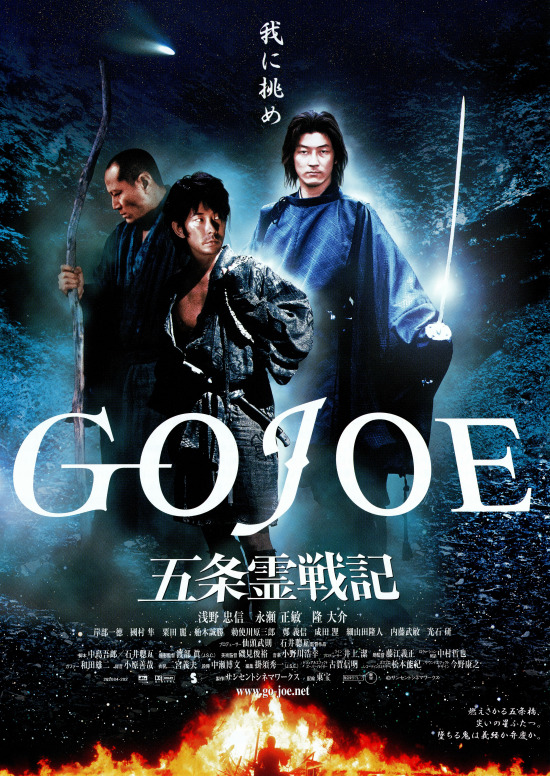
Gojoe (五条霊戦記, Sogo Ishii, 2000)

gojoe-2Not your mama’s jidaigeki – the punk messiah who brought us such landmarks of energetic, surreal filmmaking as Crazy Family and Burst City casts himself back to the Middle Ages for an experimental take on the samurai genre. In Gojoe (五条霊戦記, Gojo reisenki), Sogo Ishii remains a radical even within this often most conservative of genres through reinterpreting one of the best loved Japanese historical legends – the battle at Kyoto’s Gojoe Bridge . Far from the firm friends of the legends, this Benkei and this Shanao (Yoshitsune in waiting) are mortal enemies, bound to each other by cosmic fate but locked in combat.

Following a war between the Heike and Genji clans, the Heike have assumed power sending the Genji into retreat and exile. All should be well, but a mysterious force is taking the lives of Heike guardsmen. Around this time, former bloody warrior turned Buddhist monk Benkei (Daisuke Ryu) has received a prophecy that his path to enlightenment lies in vanquishing the “demon” which is killing soldiers in needlessly bloodthirsty ways. The Heike are not so much afraid of a supernatural threat as they are of a predictable one – the first son of the Genji whom they intended to murder as a child but later set free. Shanao (Tadanobu Asano ), only just come of age, wants his right and just revenge to restore his clan to its rightful place, but this is a dark time and there are more powerful forces at play than traumatised monks and disinherited princes.

The world of the jidaigeki, though often violent, has its own degree of careful order – rules which must be followed, pledges which must be honoured, and causes which must be seen through at any cost. The world of Gojoe is a necessarily chaotic one in which a fragile peace has been forged through violence and trickery but the sins of the past weigh heavy on those trying to forge ahead in the new era.

The Benkei of the legends is fiercely loyal to his lord, but this Benkei is very much a lone wolf, standing apart in his desire to expiate his sins. Though his fellow monk tries to convince him that the prophecy he’s been given is nothing but a delusion, Benkei is determined to find his peace through killing a literal demon rather than tackle the ones inside his mind. Nevertheless, the past is ever present through flashbacks, even at one point revisiting one of the darker elements of the Benkei story – the killing of a child who might be his own.

The “demon” which Benkei seeks turns out to be three orphaned children who have been trained by the remnants of their clan to seek nothing other than revenge. Shanao is more killing machine than man, thinking of nothing other than assuming his rightful role as the head of the Genji and restoring his family honour. When the two meet, each regards the other as “demonic” but Shanao has a point when he asks Benkei if it’s not his own heart which is unquiet. Where Benkei is contained rage, Shanao is calmness and refinement personified.

Benkei is joined for some of his journey by the comparatively more everyman presence of Tetsukichi (Masatoshi Nagase), formerly a master sword maker who’s taken to robbing corpses after growing disillusioned with his craft which often saw his beautiful handiwork in the hands of hypocritical warrior monks. “What’s so great about being alive anyway?” he asks at one point, not long after reminding Benkei that “this hell” is all of his making. Hell this is, Ishii’s world is bathed in fire and blood as petty clan conflict burns the villages of ordinary peasants who are so far removed from this sword bearing society as to be otherwise unaware of it. The peasants have their own problems to deal with as a shaman calls for the brutal beating to death of a pregnant woman supposedly infected by a “demon” and about to give birth to a “demon child”, but even if Benkei is moved to counter this instance of injustice, he is not willing to follow through when it comes to the larger implications of his decision.

The supernatural elements are more a means of cosmological explanation than they are of real threat yet Ishii conjures a dark and creepy world of ominous shadows and ever present danger. Fantasy tinged action allows for giant blood sprays as heads come off with abandon, but the sword fights themselves are both beautifully choreographed and filled with intensity. The final battle between Shanao and Benkei heads off in an unexpectedly experimental direction as swords spark against a starless sky until a cosmic event allows their fierce conflict to erupt into a raging fire, destroying the bridge and everything it stands for. There is no resolution here, only a passage of one state to the next as Benkei and Shanao live on in altered forms. Conducted to the pulsing, warlike drumbeats of a typically exhilarating Ishii score (composed by Ishii’s own band, Mach 1.67), Gojoe is jidaigeki reimagined for the modern era bringing all of the genre’s anxiety and spiritual conflict with it.


Original trailer (no subtitles)

Harmonium (淵に立つ, Koji Fukada, 2016)

harmoniumKoji Fukada first ventured into the family drama arena with the darkly comic satire Hospitalité in 2010 in which frequent collaborator Kanji Furutachi played the decidedly odd “family friend” who quickly took over the household and exposed all of its weaknesses before departing as mysteriously as he arrived. This time Furutachi plays the man of the house, though like his counterpart in Hospitalité, has not been telling the whole truth. Unlike much of Fukada’s previous work, Harmonium (淵に立つ, Fuchi ni Tatsu) abandons the comedy overtones for a truly bleak and tragic atmosphere which seems to speak of the death of the family unit itself.

On a morning just like any other, Toshio (Kanji Furutachi), Akie (Mariko Tsutsui), and their small daughter Hotaru (Momone Shinokawa), take breakfast together around the kitchen table. Akie leads grace while Toshio reads his paper before Hotaru moves on to a story about the baby spiders in the garden and how they collectively eat their mother. After his wife and daughter have left for the day, Toshio lifts the shutter on his workshop only to see a familiar, if long forgotten, face standing behind it.

The two men talk and it’s clear they’re old friends but have not seen each other in a long time. Fresh out of prison, Yasaka (Tadanobu Asano) is dressed in an odd looking suit without a jacket, the top button of his pristine white shirt neatly buttoned up. Toshio offers Yasaka a job in his workshop and a room in his house – all without a word to Akie, but somehow there’s something other than an altruistic desire to help an old friend who’s fallen on hard times at play.

Yasaka moves in and is permanently on his best behaviour but it isn’t until it’s discovered that he has a talent for the harmonium and begins to help Hotaru improve her playing that Akie starts to warm to him. It also helps that he’s interested in her spiritual life at the local protestant church, unlike her husband, and is generally around and available to her. Learning how Yasaka ended up in prison and how he now feels about his crime, Akie comes to feel this melancholy man must be especially worthy to God, and sure enough a mutual attraction begins to arise between the pair.

There’s a kind of debt implied in the relationship between Yasaka and Toshio which has Toshio running scared, trying to keep his old friend sweet lest he call it in. Yasaka’s intentions remain unclear, has he come for revenge or for comfort, to restart his life or to rehash the past? There’s something inescapably odd about his presence with his identical black suit trousered, white shirted figure which simultaneously makes him look like someone who just came out of prison and has been given one outfit to help them get a job, and like a dodgy TV evangelist or cult leader – ever so slightly too buttoned down and contained. At one point he tells Toshio he’s starting to wonder why Toshio has all of this ordinary success and he doesn’t, he could take it if he wanted to. Toshio, it has to be said, is not trying very hard to protect his place at the head of the table.

Like Yoshimitsu Morita in that other landmark of the family drama turned inside out by an unscheduled visitor, The Family Game, Fukada also makes the dinner table the centre of the conversation. We can see right away that this is not a “harmonious” household through the unbalanced seating arrangements – Toshio on one side, barely speaking and reading his paper, while Akie and Hotaru sit together opposite him reciting grace before they eat. There’s an ugly, empty space at the expected fourth position which is soon to be filled by Yasaka, but his presence does little to alleviate the anxiety of three people sitting at a table meant for four. Notably, after an unexpected tragedy occurs in the second part of the film the table itself has been rotated ninety degrees and only half of it is ever used as the lower part is cut off with a small TV showing live footage from another room. The family no longer take meals together, the kitchen is no longer a warm and organised place but a cold and chaotic one.

The sins of the father are visited upon the child. Everyone thinks they’re guilty of something, and that someone else is paying for their wrongdoing (and by implication forcing them to suffer by proxy). The presence of the harmonium – a staple in small churches and parlours of the 19th century, has a strangely religious resonance that perfectly tallies with Akie’s adherence to her Protestant faith which infuses the house even in the absence of crosses or other forms of iconography. Yasaka carries with him a sense of malevolence, like a visiting demon tempting and provoking as he goes, though it ultimately remains unclear if he is even to blame for the tragedy which befalls the family or is simply another victim of it.

Retaining his elegantly composed, static camera, Fukada makes use of unusual and high impact cuts as well as a daring, unannounced jump forward in time. Red becomes a recurrent theme as it alarmingly cuts through the otherwise subdued colour scheme whether as a T-shirt hidden behind a calm white boiler suit, or the reflections of a car window as a particularly dark thought passes through a passenger’s mind. Filled with mismatched pairs and asymmetrical setups, the family find themselves locked into a wheel of repetitions until the final scene which sees them recreate a “happy” family photo in a kind of grim tableau as neglectful father Toshio desperately fights to revive his family. Darker in tone and filled with an almost supernatural malevolence, Harmonium is a tense and unpredictable drama probing at the status of the traditional family in an increasingly uncertain world.


Reviewed at the 2016 London East Asia Film Festival.

UK release trailer (English subtitles)

The Man Who Left His Will on Film (東京戰争戦後秘話, Nagisa Oshima, 1970)

man-who-left-his-will-on-filmEvery story is a ghost story in a sense. In every photograph there’s a presence which cannot be seen but is always felt. The filmmaker is a phantom and an enigma, but can we understand the spirit from what we see? Whose viewpoint are seeing, and can we ever separate that subjective vision from the one we create for ourselves within our own minds? The Man Who Left his Will on Film (東京戰争戦後秘話, Tokyo Senso Sengo Hiwa) is an oblique examination of identity but more specifically how that identity is repurposed through cinema as cinema is repurposed as a political weapon.
The film begins with an anarchic scene in which two men argue over use of an 8mm Bolex camera. The man whose voice we can hear is angry with the cameraman who he claims has stolen his camera only to use it for “trivial” street scenes and landscapes whereas he needs it to “capture the struggle” by filming a nearby student protest. Eventually we can verify that there are two men as the protagonist, Motoki (Kazuo Goto), briefly moves in front of the camera in order to try and snatch it away from the filmmaker. The man holding the camera then runs off as breathless, handheld camera takes over. Motoki follows him and we follow Motoki as the scene takes on an ominous quality. The cameraman reappears atop a nearby building before plunging to his death camera in hand. Stunned, Motoki approaches the bloody scene and, noticing the camera is still intact, tries to retrieve it only to be picked up by the police who confiscate the camera as evidence.

Motoki then wakes up back at his left wing commune with his friends eager to know what happened. Strangely, they do not seem to be aware that one of their number has died and are more worried about the police being in control of one of their “means of production”. Even the dead man’s girlfriend, Yasuko (Emiko Iwasaki), begins to doubt the fact that he ever existed at all. Motoki and Yasuko begin investigating the mysterious presence together, chasing their elusive filmmaker and each taking possession of his form on more than one occasion but the question who owns these images, whose identity defines the narrative, proves an elliptical and ethical dilemma.

Oshima, evidently, was no right wing stooge but even if The Man who left His Will on Film takes the world of the student protests as its milieu, it does so to undermine them. Motoki’s comrades view filmmaking as a revolutionary act. They claim to turn the camera into a weapon by using it confront reality, but as Yasuko later admits much of this is a rationalisation which allows them to continue a “bourgeois” art form without abandoning their left wing principles. The cadre members spout marxist dogma and argue about who has the highest political consciousness, but all they ever do is film the ongoing struggle. Their fight is empty, their vision blank.

Notably, the first of several arguments over dogma relates to “ownership” of the camera itself and whether Motoki and another comrade fought hard enough to retrieve it from the oppressive state. Did Motoki chase after “his” camera, meaning he condones the idea of “private” property which is contrary to the communal nature of the group, or “their” camera which is a revolutionary tool? The camera itself is singular, but the group is plural. This commune is intended to work as a hive mind, the people as one with one vision and one identity but Oshima exposes this as an impossibility. The group is a collective of individuals with different ideas and opinions which do not necessarily conform to a common point of view.

This is further brought out when the camera is retrieved and revealed to contain a collection of seemingly apolitical landscapes and street scenes. The group members are quickly bored with the static shots of everyday subjects, some berating the filmmaker for his “bankrupt” politics and lack of artistry while others vow they must honour their comrade’s struggle by watching the film to its conclusion in order to derive the meaning. The unseen filmmaker has indeed left his “will” on film, not as a testament or embodiment of future policy, but his literal “will”. His individual spirit and vision are contained within the seemingly innocuous shots in a political act of revolutionary individualism. He is the film, the film is him.  His vision dominates, we must accept it or remake it as our own.

Motoki, constantly chasing shadows, attempts to remake the film in the mould of the original filmmaker but unexpectedly encounters aspects of his own life already existing within it. Yasuko’s approach is more proactive. She inserts herself into the film, makes her presence known and refuses to be invisible. She picks up the camera and fights for her place within the frame. Hers is the struggle of the true revolutionary filmmaker, imprinting herself and her vision onto the film.

Where does this leave us? We’re in the film too. We see the film and, in a sense, recreate it in our own minds, recasting ourselves as director and protagonist. We see the film subjectively yet we cannot divorce ourselves from the original vision. Motoki’s venture fails because he only sees the landscapes, whereas Yasuko takes the same images but repossesses them, remaking them in her own image in a true act of cinematic revolution. Yasuko has seized the means of production and overthrown the tyranny of anonymous images in refusing to be constrained by someone else’s will. The camera is a weapon, but it is we who choose what it sees, and in turn what it sees in us.


Original trailer (English subtitles, NSFW)

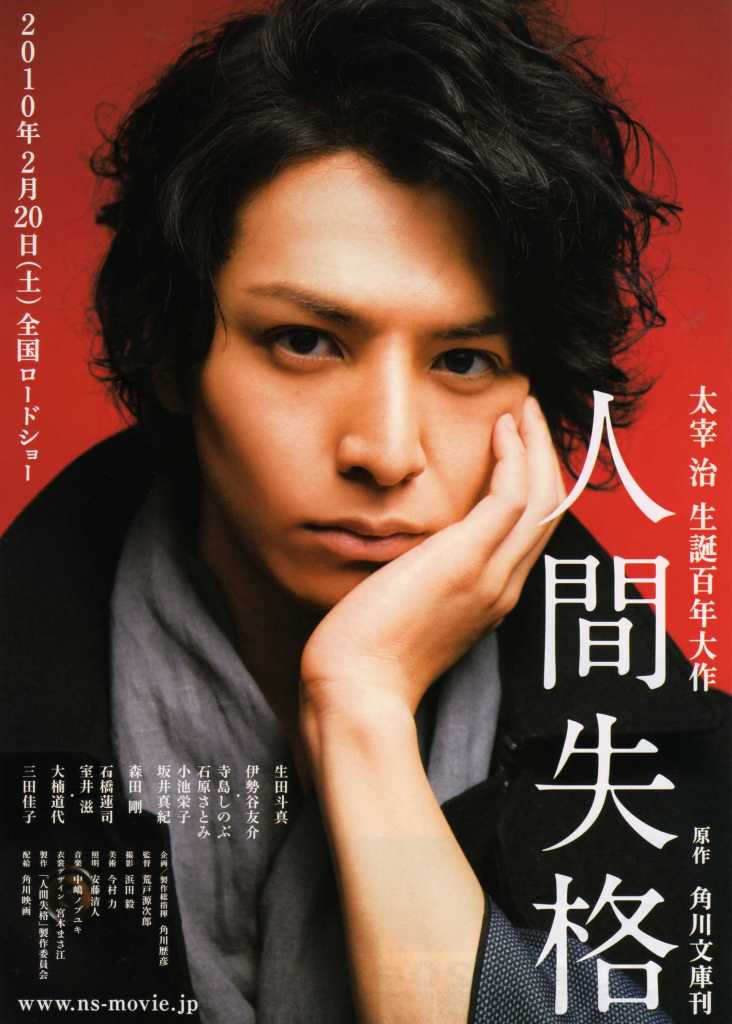
The Fallen Angel (人間失格, Genjiro Arato, 2010)

fallen-angelThe Fallen Angel (人間失格, Ningen Shikkaku), based on one of the best known works of Japanese literary giant Osamu Dazai – No Longer Human, was the last in a series of commemorative film projects marking the 100th anniversary of the author’s birth in 2009. Like much of Dazai’s work, No Longer Human is semi-autobiographical, fixated on the idea of suicide, and charts the course of its protagonist as he becomes hopelessly lost in a life of dissipation, alcohol, drugs, and overwhelming depression.

Even when we meet him as a small child, Yozo Oba (Toma Ikuta), feels himself set apart from his peers. Unable to connect fully with the people around him, Yozo gets through life by playing the clown. As a teenager, he meets another boy, Takeichi, who can see straight through his mask and encourages him in his artistic pursuits. Eventually, Yozo moves to Tokyo where he meets another artist, Horiki (Yusuke Iseya), who introduces him to the seedier pleasures of the city including drinking and hostess bars.

Yozo still feels adrift and is unable to cement his new found friendship with true connection. After asking Horiki to die with him (which he laughingly refuses to do), Yozo begins an ill-starred romance with a melancholy bar hostess with whom he does actually attempt double suicide. She dies, he doesn’t but his life is changed when he loses access to his familial wealth and is kicked out of university because of the scandal. Yozo has another shot at conventional happiness by briefly forming a family with a single mother and her little girl before leaving them because of problems resulting from his alcoholism. Eventually marrying a kind hearted woman, Yozo kicks the booze for a while and builds a career in manga but sure enough Horiki finds him and ruins his marital bliss by setting him back on the road to dissipation.

Arato makes a few changes to Dazai’s novel, mostly streamlining the book’s tripartite structure by eliding two events into one, but perhaps because of the well known nature of the story, he feels comfortable in making abrupt cuts and wide ranging shifts in terms of time. Dazai’s novel is much more focussed on the mental condition of its protagonist, whereas Arato has opted for a more overt display of the increasingly tense political environment with soldiers lurking in the background, later occupying a train shortly before the scene turns into a surreal segment in which Yozo reacquaints himself with all those he’s wronged throughout the course of the film.

Yozo’s tragedy is his inability to connect with other people even though he leads an ostensibly successful social life. Making himself an amiable presence, Yozo keeps people around him by making himself a figure of fun – a mask which gradually becomes far too heavy to wear. This buffoonish aspect of his personality is not very much in evidence in Arato’s film which focusses much more on his underlying depression than the joviality he uses to try and prevent anyone noticing just how broken he is inside. For this reason it becomes harder to see why everybody lets Yozo get away with his extremely bad behaviour for so long. Toma Ikuta captures Yozo’s listlessness and despair but without the necessary intensity to back them up and, ironically, without his sad clown routine Yozo does not always seem like someone anyone would want to hang out with for any great length of time.

Arato has recreated the novel’s pervading sense of numbness and despair to the letter with the consequence that his film remains resolutely cold. As appropriate as that may be, it makes it harder to achieve the kind of connection forged through Yozo’s first person narrative in the book. This approach brings out Yozo’s unpleasant qualities – his selfishness, weakness, cowardice, and propensity to addiction, but fails to display his better ones which lead to him being characterised as the ruined “angel” of the title. In distancing us from Yozo, Arato encourages us to see him either as a metaphor for the political turmoil taking place in his country during his lifetime, or simply as a someone whose intense self loathing eventually destroys his sense of self. What it does not encourage us to do is see that Yozo’s struggle is our own struggle, his despair is our despair felt to a greater or lesser degree. Too obtuse to be affecting, The Fallen Angel fails to capture the overwhelming nihilism of Dazai’s novel and ironically remains far too distant to achieve true connection.


Original trailer (no subtitles)

Dark Water (仄暗い水の底から, Hideo Nakata, 2002)

dark-water

Review of Hideo Nakata’s Dark Water first published by UK Anime Network.


For good or ill, the J-horror boom came to dominate Japanese cinema at the turn of the century and if anyone can be said to have been instrumental in ushering it in, director Hideo Nakata and novelist Koji Suzuki, whose landmark collaboration on The Ring has become symbolic of the entire genre, must be at the head of the list. Dark Water (仄暗い水の底から, Honogurai Mizu no Soko Kara) finds the pair working together again on another supernaturally tinged, creepy psychological thriller. Neatly marrying the classic J-horror tropes of freaky children and dripping wet ghosts, Dark Water also embraces aspects of the uniquely Japanese “hahamono” or mother movie which prizes maternal sacrifice and suffering above all else.

Yoshimi (Hitomi Kuroki), a nervous middle aged woman, is in the middle of a messy divorce with her exceedingly smug salaryman husband. Despite having been less than present during the marriage, Yoshimi’s husband now wants full custody of the couple’s five year old daughter, Ikuko (Rio Kanno). In order to aid her case, Yoshimi quickly finds an apartment and starts looking for a job. All seems to be going well except for the mysterious dripping stain on the ceiling which the building manager doesn’t seem very interested in fixing. Before long, strange events begin unfolding including unexplained puddles, a mysterious red children’s shoulder bag which keeps reappearing after being thrown out, and brief sightings of a little girl in a yellow raincoat….

Nakata opens the film with what is in effect a flashback sequence as Yoshimi waits for her own mother to pick her up from primary school. It quickly becomes apparent that Yoshimi’s relationship with her birth mother was an imperfect one which later ended in neglect and abandonment. Yoshimi continues to have frequent flashbacks to her childhood and harbours and intense fear of inflicting the same kind of damage her mother inflicted on her onto her own daughter. Ikuko is also left waiting at school when Yoshimi is kept late at a job interview – something which is eventually used against her in the court case. Though Yoshimi’s aunt reassures her that she’s doing a much better job than her mother did for her, Yoshimi is filled with doubts as to her suitability as a mother which are only further compounded by her intense love for her daughter and fear of losing her.

On top of her maternal worries and residual abandonment issues, Yoshimi also has a history of mental distress which her ex-husband uses to discredit her. It’s open to debate exactly how much of what appears to be happening is actually happening and how much a manifestation of a possible nervous breakdown, but aside from the supernatural shenanigans there are also real world dangers to consider including the missing posters for a girl who was around Ikuko’s age when she disappeared two years previously. The primary school headmaster is convinced that the girl was abducted by a third party but it also transpires that Mitsuko, like Yoshimi and as Yoshimi fears for Ikuko, was abandoned by her mother.

When it comes right down to it, Dark Water lays the blame for its supernaturally tinged evil firmly at the feet of divorce and family breakdown. The supposedly progressive primary school in which the main aim is to allow children freedom of expression is quick to tell the already overwrought Yoshimi that the “strange behaviour” they’ve been witnessing in Ikuko is essentially all her fault because of the divorce and disruption to Ikuko’s home life. Similarly, the central supernatural threat is born of maternal neglect, a symptom of the selfish individualism of the mother who has chosen to leave her child behind. Yoshimi has been jettisoned by her controlling ex-husband and her only thought is to keep her daughter with her, yet she is being made to pay for a social prejudice against atypical families such as those resulting from a “selfish” decision to dissolve a marriage.

Dark Water cleverly recasts Yoshimi as an idealised mother willing to sacrifice all to protect her child. As the situation intensifies, Yoshimi begins to feel as if she’s becoming a toxic presence in her daughter’s life. Rather than risk the same fate befalling her own daughter as has befallen her, Yoshimi opts to make herself the last link in the chain of abuse, freeing her daughter from her own baggage. In contrast with both Yoshimi and Mitsuko, Ikuko will always know that her mother loved her and will always be with her even if protecting her from afar.

Nakata conjures up a supremely creepy atmosphere filled with everyday horrors. The run down apartment complex in which Yoshimi finds her (presumably very reasonably priced) apartment is an unsettling world of its own with its strangely moist, dripping walls, eccentric residents, and rapidly decaying exterior. One of the most effective and visually interesting entries in the J-horror genre, Dark Water perfectly mixes creepy, supernatural horror with psychological drama culminating in a final sequence which doesn’t stint on the scares but proves emotionally devastating in the process.


Original trailer (English subtitles)