Cantankerous Edo (大江戸喧嘩纏, Kiyoshi Saeki, 1957)

A noble-hearted samurai on the run falls for a fireman’s sister in Kiyoshi Saeki’s hugely enjoyable jidaigeki musical adventure Cantankerous Edo (大江戸喧嘩纏, Oedo Kenka Matoi). Another vehicle for Hibari Misora and samurai movie star Hashizo Okawa, Saeki’s wholesome drama finds its heroes not only standing up to the oppressions of a rigid class system but also taking on a bunch of entitled sumo wrestlers intent on throwing their weight around having apparently lost sight of the tenets of traditional sumo wrestling such as fighting for justice and having a kind heart. 

To begin at the beginning, however, young samurai Shinzaburo (Hashizo Okawa) is on the run believing that he has accidentally killed another man who attacked him in order to clear the path towards his fiancée, Otae (Hiroko Sakuramachi), whom he wasn’t going to marry anyway because he realised she was in love with someone else and wanted to help marry him instead. Having escaped to Edo, he takes refuge inside a parade of firemen lead by Tatsugoro (Ryutaro Otomo) and his feisty sister Oyuki (Hibari Misora) who decide to take him in after hearing his story. Adopting the simpler, common name of “Shinza” he begins life as a fireman and gradually falls for Oyuki but remains a wanted man constantly dodging the attentions of his uncle, the local inquisitor, and the magistrates. 

More a vehicle for Okawa than Misora who plays a relatively subdued role save for boldly stealing the standard and climbing a roof herself when the others are delayed, Cantankerous Edo takes aim not particularly at a corrupt social order but of the oppressive nature of class divisions as Shinza discovers a sense of freedom and possibility he was previously denied as a samurai while living as a common man. It’s this desire for personal autonomy and the freedom to follow one’s heart that led to his exile from his clan, unwilling to marry a woman he knew not only did not love him but in fact loved someone else and would have been forever miserable if forced to marry him out of duty alone. “The life of a samurai who has to be somebody or not to suit another’s convenience is utterly stupid” he bluntly tells his uncle and Otae’s father, “how you cling onto family status, heritage, and honour. All that fuss, I hate it.” he adds before turning to Otae and encouraging her too to stand up to her father and insist on marrying the man she loves rather than be traded to another. 

Meanwhile, the two women exchange some contradictory messages about the nature of class and womanhood, the samurai lady Otae confessing that she isn’t sure she’s strong enough to fight for love in the face of tradition and filial duty in contrast to Oyuki’s spirited defence of Shinza the fireman insisting that firemen don’t think about such trivial things as name or family status before throwing themselves into harm’s way for the public good. “All women are weak” Otae sighs, Oyuki replying that they need to be strong for the men they love, “that’s what it means to be a woman”. Love may be in this sense a force of liberation, destabilising the social order but also a means of improving it, yet it still reduces women to a supporting role ironically as perhaps the film does to Misora who in contrast to some of her feistier performances takes something of a back seat. 

Romance aside, the main drama revolves around a conflict between the local sumo wrestlers who have turned into thuggish louts under their boorish leader Yotsuguruma (Nakajiro Tomita), taking against the fireman and forever spoiling for a fight. The samurai proving unexpectedly understanding, the sumo wrestlers become the main source of oppression in usurping a class status they don’t really have. The noble Tatusgoro tries to stave off the fight insisting that they aren’t brawling yakuza but responsible firemen here to serve the public good and should save their energy for fighting fires rather than their obnoxious neighbours. Nevertheless the fight cannot be held off forever. Tatsugoro is forced to redefine the nature of “fire” after hearing a warning bell informing him one of his men is in grave danger unable to manage their anger anymore.  

Saeki’s jidaigeki musical has surprisingly good production values for a Toei programmer, making space for a few songs along the way celebrating the valour of the firemen while Oyuki meditates on her potentially impossible romance and the perils of love across the class divide. While the conclusion may end up ironically reinforcing the hierarchical society, it does however make the case for the right to romantic freedom along with the necessity of human compassion in the face of inconsiderate arrogance and intimidation.


Note: This film is sometimes titled “Fight Festival in Edo” but according to Eirin’s database, the official English-language title is “Cantankerous Edo”. Rather confusingly, a very similar film with a very similar title (大江戸喧嘩まつり) was produced in colour at Toei in 1961 and is known as “Fight Festival in Edo” in English. Meanwhile, Hibari Misora also starred in another colour film with a very similar storyline in 1958 (唄祭りかんざし纏) which is known as “Girl with the Fire Banner” in English but listed as “Festival of Song” on Eirin’s database.
The Last Kamikaze (最後の特攻隊, Junya Sato, 1970)

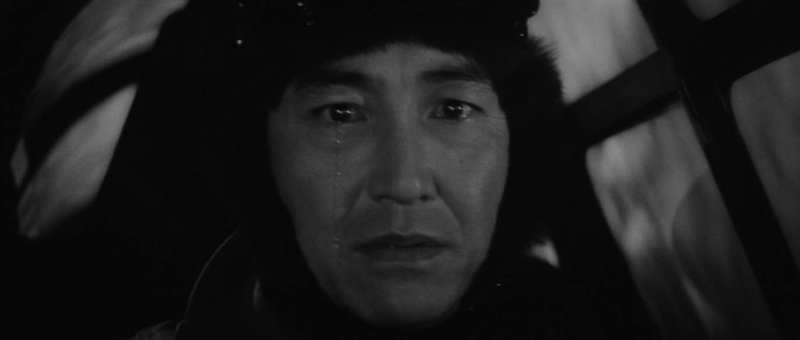
Junya Sato’s The Last Kamikaze (最後の特攻隊, Saigo no Tokkotai) opens with a title card explaining that it has nothing to do with the life of Matome Ugaki, which seems disingenuous at best given that the narrative has tremendous similarities with his life. In any case, 25 years after the war in a very different Japan which is perhaps becoming more willing to reexamine its wartime history, Sato’s film nevertheless walks an ambivalent line clearly rejecting the idea of the kamikaze special attack squadrons as absurd and inhuman yet simultaneously glorifying the deaths of the men who willingly took part in them. 

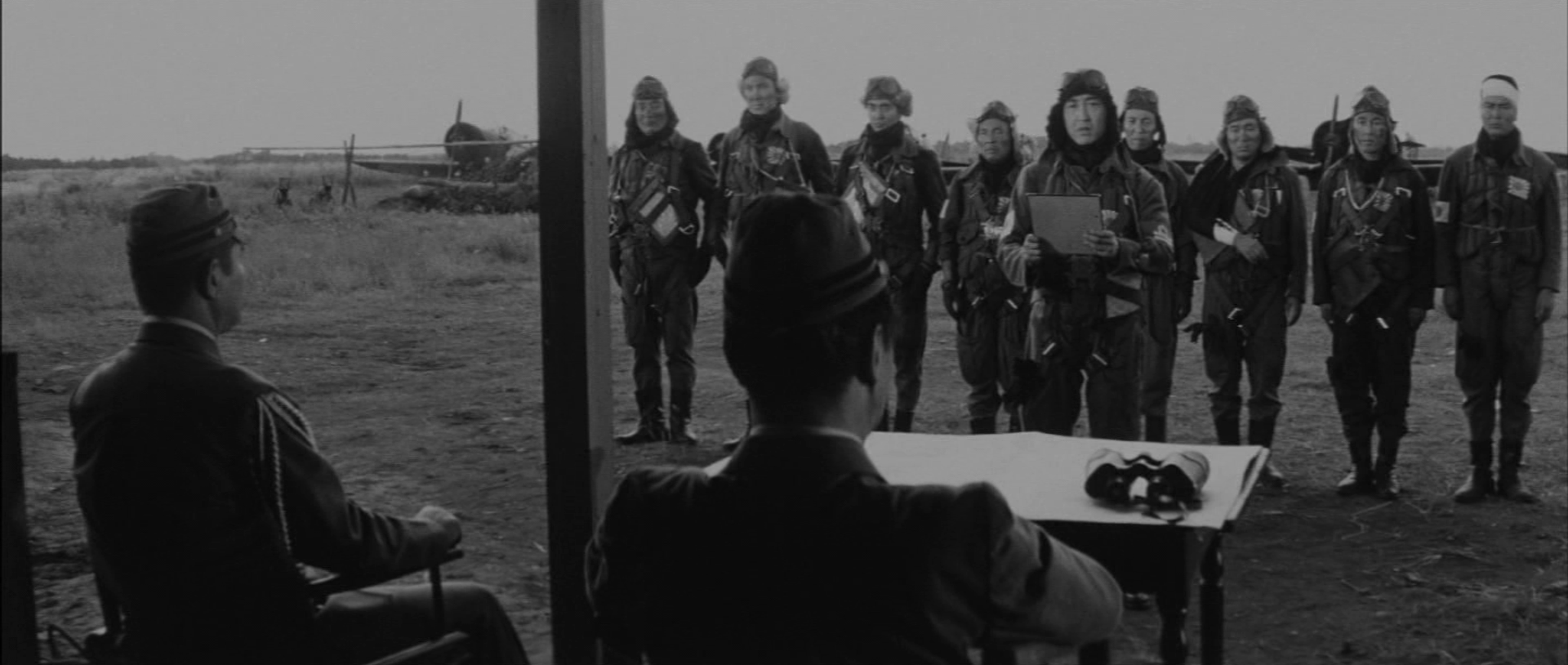
For sympathetic Captain Munakata (Koji Tsuruta) the issue is one of consent and willingness more than it is of essential immorality. Placed in charge of the very first suicide attack, he elects to go himself rather than ask someone else but is first overruled before deciding to go anyway after appealing for volunteers and coming up one short. His general, Yashiro (Bontaro Miake), who had voiced his opposition to the policy in the opening sequence reminding his own commander than even when men were given impossible missions in previous wars they were always ordered to return home if possible, takes the unprecedented step of climbing into an aircraft himself in an act of protest insisting that this be the last and final time that men were ordered to their deaths. The mission, however, does not succeed. All of the pilots bar Yashiro are shot down before reaching their targets while Munakata, injured and having lost sight of the general, aborts his mission and returns to base only to face censure from his superior officers. 

Sent back to Japan, he wrestles with himself over whether his decision was one of cowardice and he turned back because he was afraid to die rather than, as he justifies, because he did not want to die in vain and did what he thought was right. Far from cowardice, it may have taken more courage for him to ignore his orders and choose to live yet there must also be a part of him that believes dying to be heroic if not to do so is to be a coward. As the situation continues to decline and suicide attacks become the only real strategy, Munakata is recalled for an ironic mission of heading the escort squad designed to protect the pilots from enemy attack so they can reach their targets. He first turns this down too not wanting to be an angel of death but is finally convinced to accept on the grounds that the men will die anyway and at least this way their deaths will have meaning. 

Munakata was greeted on his return to Japan by the sight of his father (Chishu Ryu) being carted off by the military police for expressing anti-war views, stopping only to tell him that people should be true to their own beliefs. Nevertheless, even if Munataka objects to the tokkotai strategy he does not oppose it only emphasise that the men should should be willing and resolved rather than forced or bullied. There is indeed a shade of toxic masculinity in the constant cries of cowardice along with a shaming culture that insists a man who refuses to give his life for his country is not a real man. Munakata comes to the rescue of a young recruit, Yoshikawa (Atsushi Watanabe), who twice returns from a tokkotai mission claiming engine trouble but does not try to save him only to petition his superiors that he be given ground duty until such time as he gets used to the idea of dying. Because of Munakata’s kindness in saving him from a suicide attempt after being rejected by the mother he worried for if he were to die, Yoshikawa is pushed towards a “hero’s death” that does at least help to change the mind of Yashiro’s zealot son (Ken Takakura) who knew nothing of the reasons behind his father’s suicide and believed wholeheartedly in the necessity of the special attack squadrons. 

The younger Yashiro’s rationale had been that to show compassion to a man like Yoshikawa was to shame the memories of the men who had already died, yet even in realising the futility of the gesture he still resolves to proceed towards his own death as do others like him such as a student who had been against the war and ironically consents to the suicide mission in order to end it more quickly. “There’s nowhere to run to” Yoshikawa’s mother (Shizuko Kasagi) had said on his attempted desertion, echoing the words of another that there was no escape from this war, while poignantly crying over her son’s ashes that she wishes she had raised him to be a coward. The human cost is brought fully home as the families storm the airfield fence in an attempt to wave goodbye to their loved ones as they prepare for their glorious deaths, another pilot reflecting on the fact that each of these men is someone’s precious son rendered little more than cannon fodder in an unwinnable war. Even with the escort squads, only 30% of the special attacks succeed. Most of the pilots are so young and inexperienced that even assuming they survive the anti-aircraft fire they are incapable of hitting their targets. 

To add insult to injury, Munakata returns from his final mission to an empty airfield where a drunken engineer (Tomisaburo Wakayama) explains to him that the war is over and the generals knew it 10 days earlier but still sent these men to their deaths anyway. Overcome with remorse, Munakata posits his own suicide mission but is instructed to live on behalf of all those who died only to take off and fly into a technicolor sunset as Sato switches from the period appropriate black and white to vibrant colour elegising Munakata’s death while lending it an otherwise uncomfortable heroism. Casting ninkyo eiga icons Koji Tsuruta and Ken Takakura as the infinitely noble yet conflicted pilots and employing jitsuroku-esque narratorial voice to offer historical context the majority of the audience probably does not strictly need, Sato rams home the righteousness of these men while casting them as victims of their times trying their best to be true to what they believe but finding little prospect of escape from the absurdity of war. 


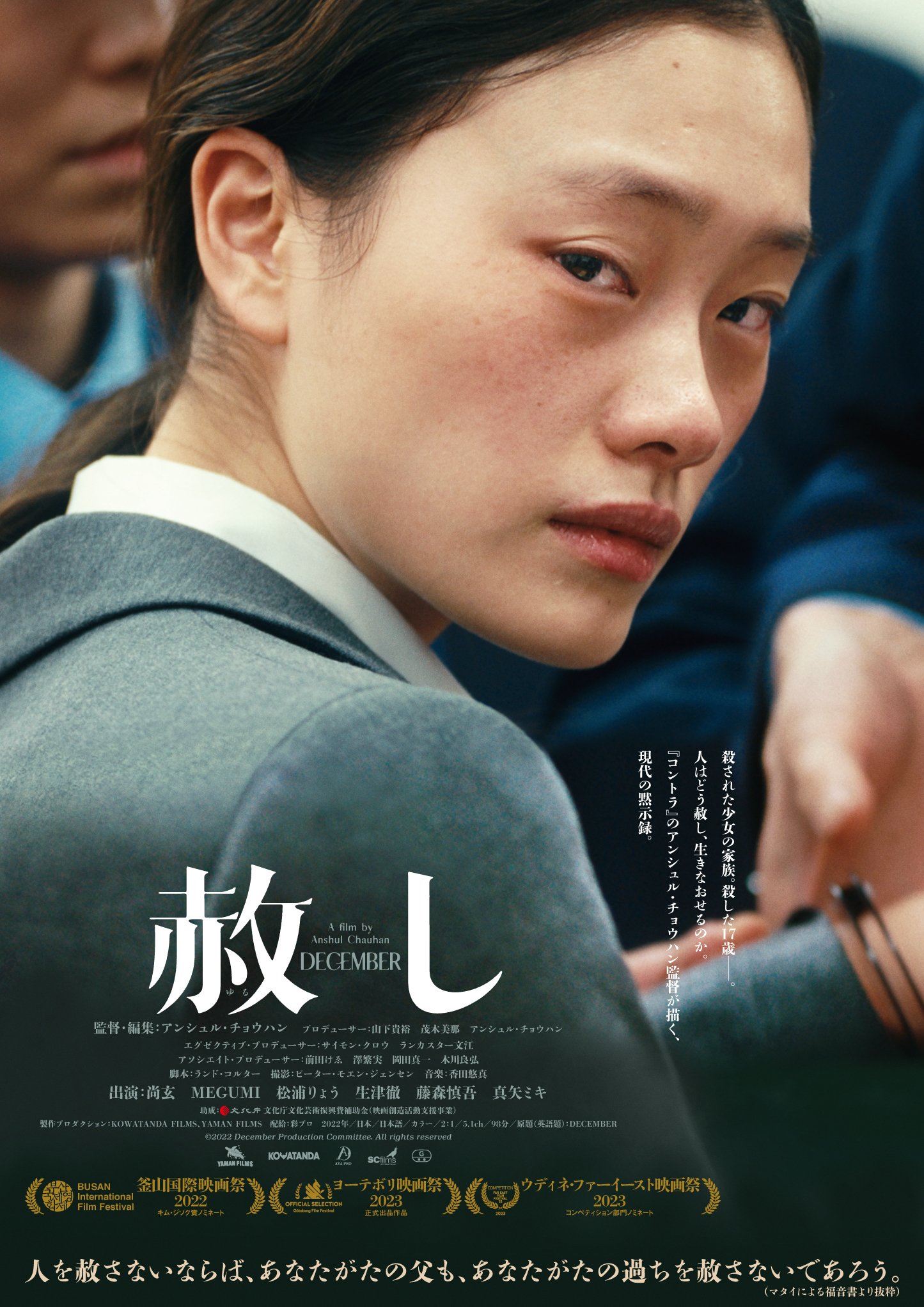
December (赦し, Anshul Chauhan, 2022)

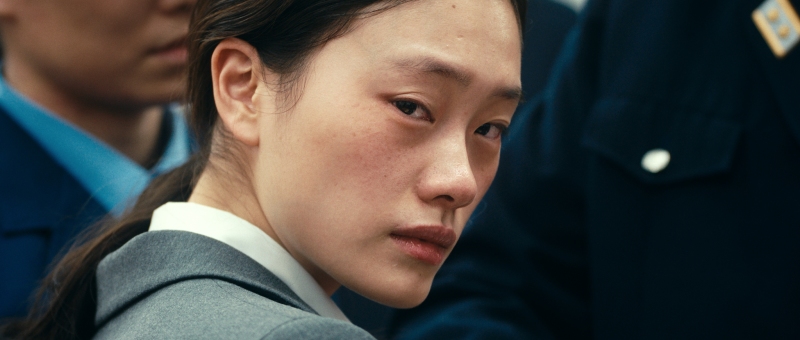
Where is the line between justice and vengeance? The grieving father at the centre of Anshul Chauhan’s December (赦し, Yurushi) is determined that the teenage girl who stabbed his daughter to death should never leave prison, but what he wants is a kind of equivalent exchange in that the person who stole his future along with his child’s should have no right to one herself. A more mainstream effort than either of his previous films Bad Poetry Tokyo and Kontora each of which dealt with similarly thorny themes, Chauhan’s unusually tense courtroom drama is the latest to put the legal system on trial while asking difficult questions about grief, guilt, and what exactly it is we mean when we talk about “justice”.

Seven years previously, 17-year-old Kana (Ryo Matsuura) stabbed her classmate Emi (Kanon Narumi) multiple times in a frenzied attack that resulted in her death. She was sentenced to 20 years in prison and has never attempted to deny her crime. It isn’t she who has asked for her sentence to be reviewed but an independent lawyer, Sato (Toru Kizu), who claims he’s doing it for “justice” though as Kana points out might have half an eye on compensation money she’d be able to claim for wrongful imprisonment if the case were successful. Sato seems to think it will be on the grounds that Kana was unfairly tried as an adult, mitigating circumstances were never brought to the defence’s attention, and the judge’s sentencing was swayed by personal feeling placing it outside of conventional guidelines that should be applied in cases like these.

For Emi’s parents, Katsu (Shogen) and Sumiko (Megumi), the appeal is a slap in the face. The couple have separated and while Sumiko has attempted to move on with her life, marrying a man she met in a support group for bereaved parents, Katsu has become a bitter alcoholic living a purgatorial existence of almost total inertia. Outraged, he is determined to make sure that Kana never leaves prison and is only sorry that she could not receive the death sentence because of her age, while Sumiko would rather not be involved at all, uncertain that she would be able to endure the emotionally draining process of another court case. They settle on presenting a united front, but discover that to do so is also to put themselves on trial while being confronted by a past neither has ever really faced.

The strain on Sumiko is evident as she walks along along a bridge at night and peers over the edge as if about to jump. She later learns that Kana had a mother too who did in fact take her own life after selling everything she owned to pay the compensation money that is used against them in court to imply that they’ve already been served “justice” in the form of monetary recompense from the defendant’s family which ought to declare the matter closed. Unlike Katsu, Sumiko had said her goal wasn’t vengeance but only to make sure that no other mother suffers as she has done, yet another mother already has for she lost a daughter too. Kana meanwhile has no one left to turn to even if she were released, she will have to make a new life for herself alone. Kana is herself victimised by an unforgiving society, the subtext suggesting that she was bullied for being the daughter of a single mother who was unable to fully care for her or provide the kind of material comfort children like Emi receive. The “happy family home” Katsu accuses her of destroying is also a symbol of everything Kana was denied but she did not kill out of jealousy or resentment only, ironically, to escape a kind of imprisonment and free herself of an oppressive bully.

Katsu says he’d kill her himself if he had the chance, but as Sumiko points out then he’d just end up in prison for the rest of his life with only his “righteousness” to comfort him. How could he claim to be any better? As Sato says, emotion has no place in a court of law. That’s why the law the exists and we mediate “justice” through a dispassionate third party to ensure the sentence is fair and not merely “vengeance”. Katsu certainly sees himself as a righteous man. In a repeated motif, Chauhan shows him taking the long way round by walking on the pathways of the grid-like forecourt leading to the courthouse while others hurriedly take the direct route crossing the squares at a diagonal angle. For him the answer is only ever black and white and he is very certain of his truths, but also blinded by his pain and unable to see that his desire for vengeance is more for himself than it is for Emi.

Only by accepting a painful truth can he begin to move past his grief, despite himself moved by Kana’s quiet dignity in which she admits her responsibility and suggests that she will never really be “free” even if she is released. What she offers, in her way, is peace allowing the bereaved parents to bring an end to their ordeal or least enter a new phase in their grief which allows them to move forward in memory rather than remaining trapped within the unresolved past. Perhaps in the end that’s what we mean by “justice”, a just peace with no more recrimination only sorrow and regret with renewed possibility for the future.


December screened as part of this year’s Osaka Asian Film Festival.

Original trailer (no subtitles)

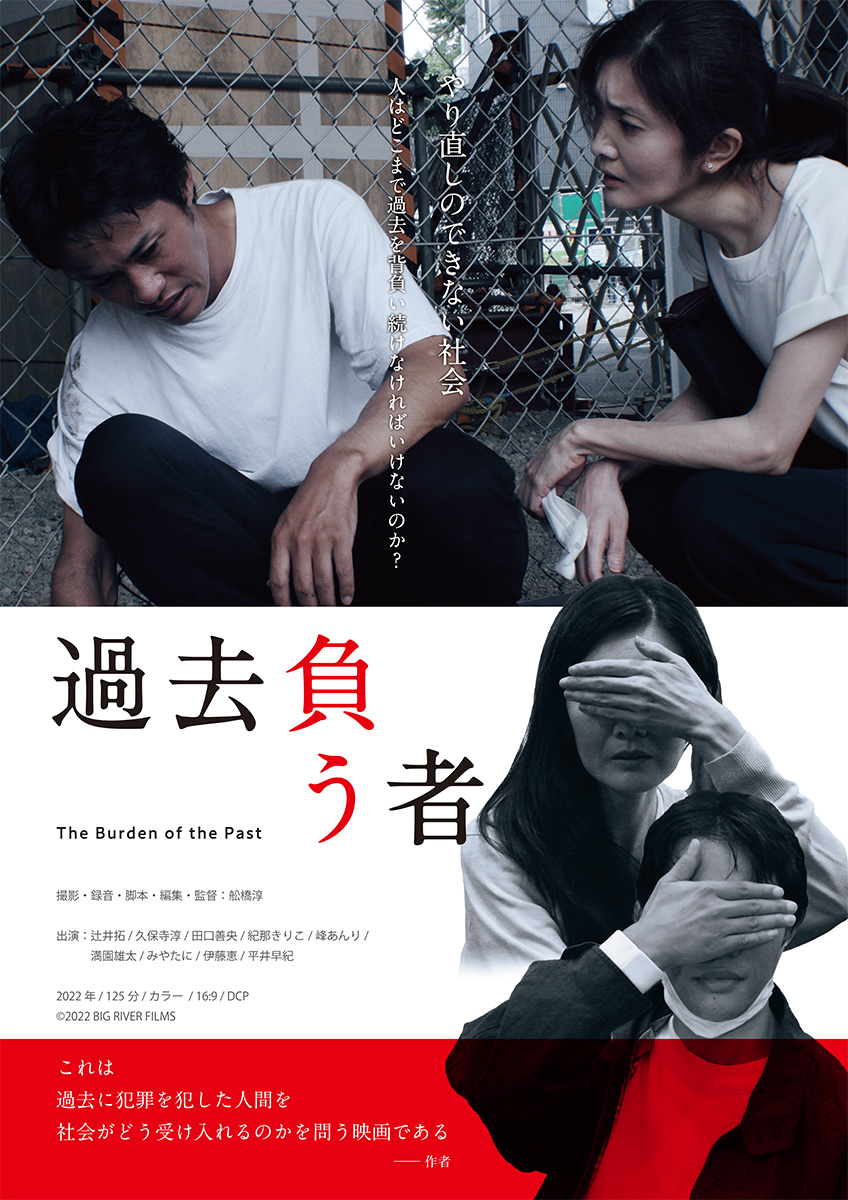
The Burden of the Past (過去負う者, Atsushi Funahashi, 2023)

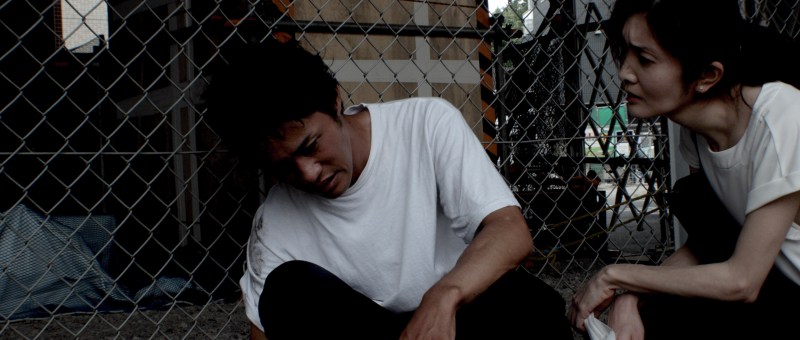
Japan has a relatively high recidivism rate with 50% of those released from prison convicted of reoffending within five years. To some this figure simply proves that “criminals“ are, as one woman puts it, “an entirely different race” who have no place in mainstream society and can never be rehabilitated. In many ways it’s a vicious circle, those who’ve spent time in prison are rejected on their release and unable to find steady employment have no other option than to return to criminality in order to support themselves. Atsushi Funahashi’s socially-minded docudrama The Burden of the Past (過去負う者, Kako Ou Mono) explores this contradiction through the stories of a series of former prisoners and the organisation that attempts to help them reintegrate into mainstream society, Change. 

“Change” might in some ways be an ironic name, placing a demand on the people they’re trying to help that implies they are necessarily at fault for their involvement with criminality. The well-meaning staff members are committed to helping the former prisoners reform, but are otherwise powerless to address the systemic social circumstances that led them into crime while prioritising the individual and advocating for conventionality as the only path towards a settled life. That said, each of the people the film spotlights are involved in quite specific kinds of crimes which lean towards the individualistic with only the backstories of Taku, who killed a teenage boy in a hit and run but is also revealed to be dealing with unresolved trauma from childhood physical abuse, and Ai who turned to drug use to overcome her problems with interpersonal communication, loosely explored. 

It is however Ai who suffers most from the hypocritical attitudes of mainstream society. After being taken on as a cleaner she encounters a man smoking who ironically reveals to her that he used to smoke pot but was never caught which is perhaps the only difference between them but on explaining that she spent time in prison for possession of crystal meth he calls her “a real mess” and a “junkie”, telling her that she has no right to hope for a future and should have stayed in jail. His rant results in Ai going temporarily missing with a fear that she may being using drugs again to overcome her sense of hopelessness. Her circumstances are dictated by her existing sense of alienation in her inability to communicate, something which could have been better addressed either by finding ways for her to communicate more effectively or for encouraging others to accommodate her way of communicating rather than insist she conform to theirs. 

Yet it’s clear that the issue is more to do with the stigmatisation of criminality than it is about any fear of potential reoffending as the team from Change discover on talking to a man hoping to recruit a large number of people quickly for pandemic-related cleaning services. The first issue is that he specifically mentions hiring women seeing as it’s a job in cleaning, but also that he says he’ll have to discuss with his boss about hiring people who’ve been involved with sexual or drug-related crimes rather than those which might present a more practical anxiety such as theft, violence, or fraud. 

Close to the end of the film, Change stages a play featuring some of the former prisoners which ends in a confrontational Q&A session in which members of the audience direct their anger towards not only the cast but Change itself for helping them rather than focussing on the welfare of victims of crime. Change also receives a fair amount of harassment, as do a couple who live close by and complain that they feel personally uncomfortable knowing that people with criminal pasts are wandering around where they live while also bringing up that it’s bringing down the price of their property. One of the case workers tries to explain that they’re trying to stop the cycle of recidivism, which would result in lower crime all round and less chance of becoming a victim, but the audience members cannot see her point. They simply feel that these people are not quite human by virtue of their transgression and are in some way weak or defective for being unable to control their impulses or emotions. It may be a comforting thought, to believe these people are so different from oneself is to deny that anyone at anytime could become involved with a crime for a variety of different reasons. After all, laws are socially constructed device for defining conventional morality and what’s considered “criminal” today may not be tomorrow or vice vera. 

But then how do we deal with those whose crimes are so deeply offensive to a conventionally held morality that they cannot really be forgiven? Misumi is a former teacher convicted of an indecent act with a child and fears that he may end up reoffending. He obviously cannot return to his previous employment, and given the nature of his crime can find no other but also must find a way to live. Many at the Q&A session seem to feel that those who’ve been convicted of crimes should be segregated into an alternate prison society so that they do not corrupt the mainstream, but this is in its own way a social death sentence that effectively says they no longer deserve to live even if unlike the extreme case of Misumi their “crimes” were relatively minor and of the sort many others may have committed and faced no penalty for. 

Still, Funahashi doesn’t exactly let Change off the hook suggesting that they are overly idealistic and fundamentally ill-equipped to deal with some of the more serious problems the former prisoners face especially those that would benefit from more comprehensive psychological care. He does though criticise the justice system in which the prison sentence is essentially a fine that’s paid in time and is geared towards punishment rather than rehabilitation leaving the prisoners no different on their release than they were when incarcerated some like Taku still not having fully addressed or accepted their crime and therefore unable to move on with their lives. In any case, the conclusion seems to imply that simple acts of human trust and compassion can go a long way helping to restore a former prisoner’s self-esteem and allowing them to process the realities of their crimes so that they can avoid committing them again even if it is also society which must change. 


The Burden of the Past had its World Premiere as part of this year’s Osaka Asian Film Festival.

Original trailer (English subtitles)

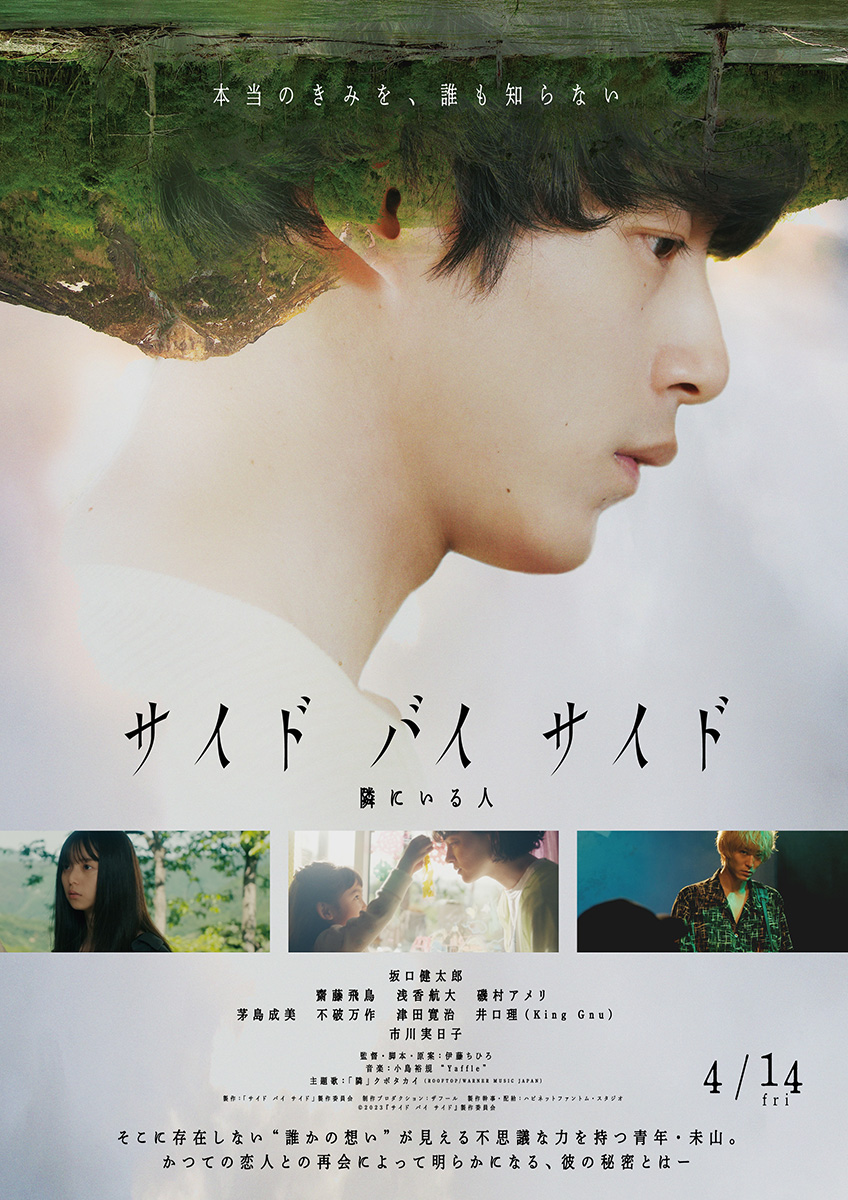
Side by Side (サイド バイ サイド 隣にいる人, Chihiro Ito, 2023)

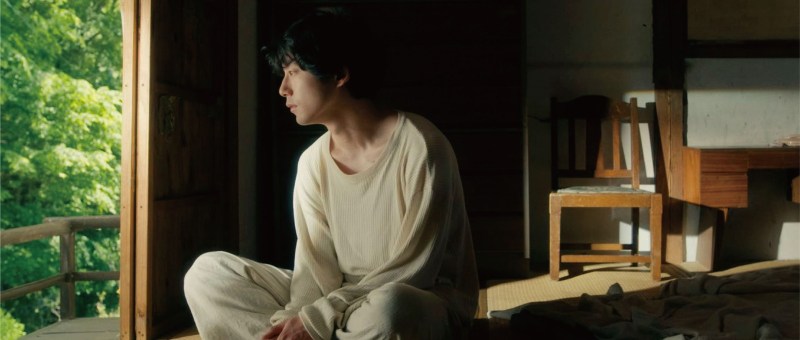
The unresolved past conspires against present happiness in the supernaturally-tinged second feature from Chihiro Ito, Side By Side (サイド バイ サイド 隣にいる人, Side by Side: Tonari ni Iru Hito). Ito began her career as a screenwriter often working with director Isao Yukisada penning the screenplay for his 2004 junai mega hit Crying Out Love in the Center of the World before making directorial debut just last year with In Her Room, produced by Yukisada and selected for the Tokyo International Film Festival. Like many of the films Ito scripted, Side by Side bears an unusual sensitivity and gentleness of spirit in the way it sees the world which may in its way be filled with pain and longing but also warmth and light even if some may ultimately feel that they can never become a part of it. 

Miyama (Kentaro Sakaguchi) is indeed a haunted man in more ways that one, though the most obvious is that he’s continually followed around by a blond man dressed in black (Kodai Asaka) who says nothing but just stares blankly much like Miyama himself. Working as a physiotherapist, Miyama travels the country and often discovers that the physical pain his patients experience is linked to an emotional trauma as manifested in the various ghosts he sees around them which don’t seem to speak to him. Having left the city of Tokyo where he was raised, he wandered around before eventually finding a home with the welcoming nurse Shiori (Mikako Ichikawa) and her young daughter Mimi (Ameri Isomura) in a tranquil rural village in picturesque Nagano. Yet there are ways in which Miyama doesn’t seem to fit inside the familial environment, almost like a ghost himself somehow there and also not. 

The ghosts are in their way a visual representation of the unresolved past that endangers the new family Miyama has begun to build with Shiori and Mimi but fears he can never really be a part of. Shiori recalls seeing a light fitting in a film that she wants to hang over their dinner table to bathe it in the warm light of family, but is unable to find it even with Miyama’s help. It’s she that makes the rather unusual decision to invite a another ghost of Miyama’s past into their home in the gothic vision that is Riko (Asuka Saito), a woman Miyama “abandoned” who has since experienced some kind of breakdown and is then “abandoned” once again by another man who may or may not be the father of the child she is carrying. The unconditional love and support of Shiori and her daughter begin to bring Riko back to life, no longer dressing all in black and eating only white-coloured foods as colour and warmth are slowly returned to her. 

Even so, there are times it becomes difficult to tell the living from the “dead” when even Miyama seems like a ghost dressed all in white haunting his own life with his eerie stillness and not quite vacant eyes but those which express, as someone later puts it, a deep regret in his past. Like everyone else he struggles to emerge from past trauma in parental abandonment and physical abuse while acknowledging that his father suffered as a child and passed that suffering on to him because he did not know how to be a father. Miyama doesn’t know how to be a father either which is perhaps why he fears the depths of his new relationships and his role as a paternal figure while filled with shame and regret for those he failed in the past. 

But then there are others so undeniably alive such as Shiori and her daughter, often dressed in a vibrant yellow and basking in the warm sunshine which streams through the large windows of Shiori’s beautifully designed home. The family take solace in the beauty and comfort of the natural world, protected by its rhythms and the serenity it often offers them. Miyama may feel that he can never recover from his past and has no right to be drawn to this one solitary source of light, as Shiori describes it, like the bugs he is forever trying to keep out of the house but in the end gives them something else in the unconventional family that arises founded on human compassion and unconditional love that asks few questions and simply accepts those who are willing to accept it.


Side by Side had its World Premiere as part of this year’s Osaka Asian Film Festival.

Original trailer (no subtitles)

Images: (C) 2023 “Side by Side” Film Partners

The Pledge (博奕打ち外伝, Kosaku Yamashita, 1972)

The gangster code slowly consumes series of men each trying to do the right thing but hamstrung by the actions of others in Kosaku Yamashita’s yakuza tragedy, The Pledge (博奕打ち外伝, Bakuchiuchi Gaiden). It is indeed a promise between brothers which damns them all, but the roots of it lie in repressed emotion and a desire to protect other people’s feelings by keeping a destructive secret while trying to satisfy oneself that one has behaved properly even if no one else understands. 

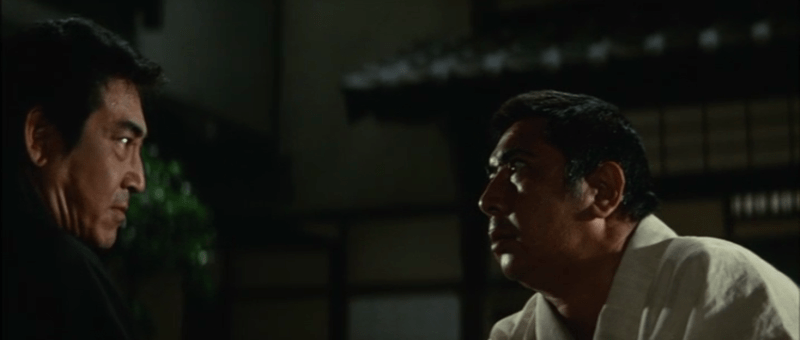
The battleground is Wakamatsu, Kyushu, where outsider Egawa (Koji Tsuruta) has united the local boatmen and is undercutting the prices of a rival gang led by Omuro (Tomisaburo Wakayama). While Omuro is out of town, his right-hand man Taki (Hiroki Matsukata) has decided to take advantage of a minor squabble between some of his guys and Egawa’s to initiate a small scale turf war hoping to take the river back under their control. He does this by kidnapping Egawa’s younger brother Masakazu (Goro Ibuki) to lure him to their headquarters alone, something of which Omuro does not approve on his return but decides to go with as an excuse to bring his rivalry with Egawa to a head. Just as the pair are squaring off, a mutual friend, Hanai (Ken Takakura), arrives and intervenes convincing the two men to lay down their arms for the moment at least.

It could be argued that it is this interrupted fight that is resolved in the film’s conclusion if only by inexorable fate. In a repeated motif, Omuro keeps to the code and is exasperated and disapproving of Taki’s underhanded tactics but accepts the responsibility for them himself knowing that Taki acted only on his behalf and his recklessness is only an expression of his love for him. There is indeed something homoerotic in the relationship between the two men as Omuro cradles a wounded Taki and attempts to comfort him that the fault is all his own, while resolving to accept Taki’s actions and build on them rather than try to deescalate or try to apologise. 

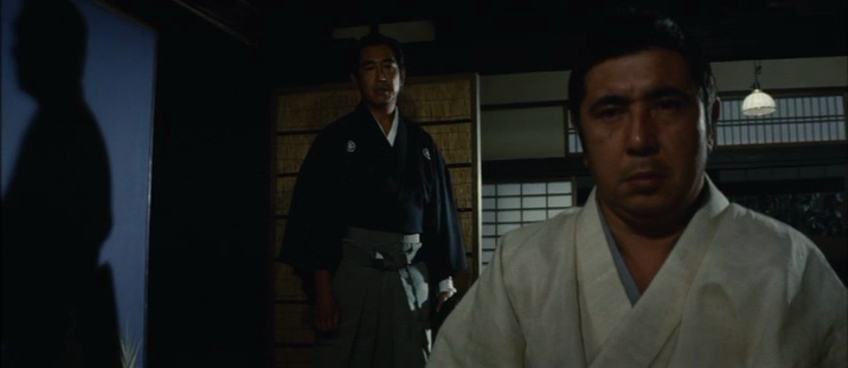
The real crisis occurs when the boss, approaching 60 which represents the full circle of a life, decides to name Omuro as a successor rather than the anticipated Hanai. Hanai stoically accepts though intending to leave the gang and travel to another part of Japan but other members of the clan are perplexed, little understanding the boss’ decision in feeling that Omuro is not of good character whereas Hanai is easily the better choice. As it transpires, the boss has made his decision deliberately in order to mitigate the fact that Hanai is secretly his illegitimate son whose origins he has kept secret in deference to his legal wife. He chooses not to name him as a successor in order to avoid causing him problems in his later life while justifying himself that he has not made the decision for dynastic reasons or out of simple favouritism. Yet the relationship between the two men, father and son, is raw and painful if founded on a deep understanding that leaves them unable to meet each other directly with emotional honesty. 

Because of his father’s decision, Hanai forces Egawa to promise that he will not antagonise Omuro which leads to problems in his own gang with his men angry and confused, unable to understand why Egawa is letting Omuro walk all over him. Compounding the problem, Egawa’s errant brother Tetsu (Bunta Sugawara) returns unexpectedly and as Egawa cannot tell him about the pledge without disclosing Hanai’s secret, thinks his brother is being messed around and raids Omuro’s offices to reclaim money he had extorted from Egawa. He learns the truth from devoted geisha Hideko (Yuko Hama) who is deeply in love with Egawa yet largely unable to act on it again because of the gangster code while pledging that she’d sooner die and prove her devotion to him than summit herself to Taki, who is also in love with her, even when he threatens her with a knife. 

The yakuza code dictates that Omuro must die though he is little more than a passive antagonist all too willing to accept the evil deeds that Taki did on his behalf because of the code of loyalty though he would not have dared to do them himself. Secrecy and repressed emotion drag all into a dark web of self-destructive violence until reaching their inevitable conclusion and perhaps bringing one cycle to a close if only in the birth of another. 


Original trailer (no subtitles)

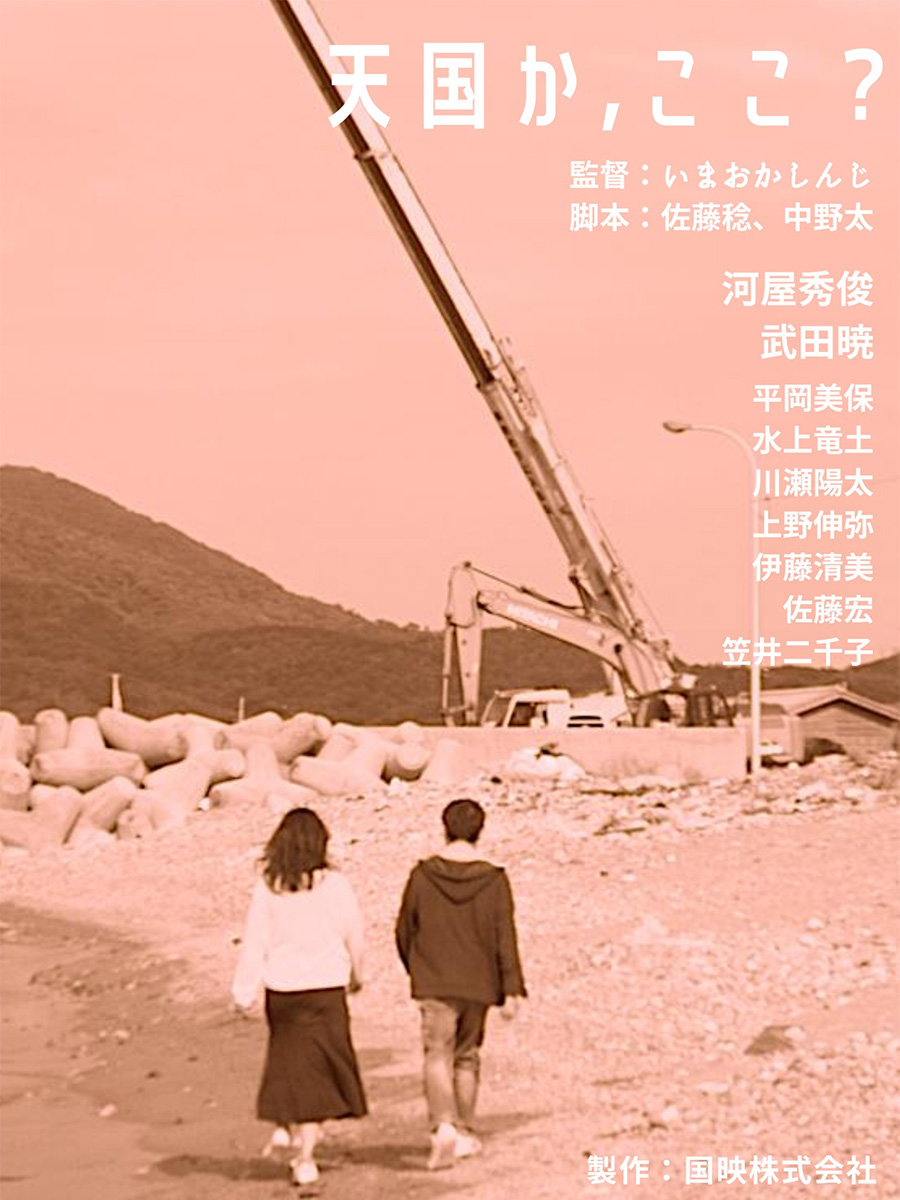
Is This Heaven? (天国か、ここ?, Shinji Imaoka, 2023)

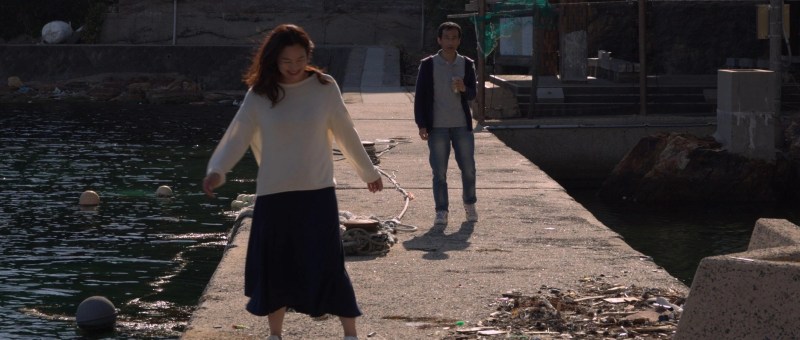
A middle-aged couple ponder loss and regret on a surreal odyssey into the afterlife , or something like it at least, in Shinji Imaoka’s cheerfully absurdist dramedy Is This Heaven? (天国か、ここ?, Tenkokuka, Koko?). Reuniting with several actors who starred in Imaoka’s previous film Reiko and the Dolphin, the film addresses several of the same themes in its exploration of grief and the inability of moving on but perhaps paradoxically sees its central couple arrive at a happier destination having begun to repair a marital rift. 

How they end up in “Heaven” isn’t exactly clear. Nobuo (Hidetoshi Kawaya), a middle-aged man who likes a drink, dances along a highway with half a can of chuhai in his hand and suddenly finds a flier with the word “Heaven” written on it. Everyone he meets seems to be doing an odd dance, even his wife Mayuko (Aki Takeda) who soon snaps out of her trance to tell him off for drinking in public again. While wandering around wondering where they are and how to get back because stationery stores don’t run themselves, the couple run into an old friend, Ueno, which is nice but also weird because Ueno died a week ago having hanged himself in shame over the failure of his business. 

Like everyone else in this strange place, Ueno is irrepressibly cheerful and seems to know nothing of his suicide. “When we die, we go to Earth, right?” he asks perplexed while Nobuo begins to wonder what it might mean if he’s really in Heaven, if he’s alive or dead or something in-between. Gradually we come to understand that there is tension in the marriage, much of it born of Nobuo’s insecurity. He fears that Mayuko only married him out of lonely desperation following the death of her first husband Takeshi (Yohta Kawase) whom she may never have got over, and that absolutely anyone would have done it just happened to be him. He resents Mayuko pointing out they’ll be in trouble if they close the stationery store because he’s never had a proper a job and his drinking problem won’t allow him to get one. 

It may be drinking that’s brought him on this strange odyssey. The film is divided into four chapters each bearing the title of a progressively harder drink as things get ever stranger while Nobuo wanders around meeting various other strange people including one who may have appeared in one of Imaoka’s previous films along a with a young woman obsessed with shogi and sex. Nobuo later describes them as people he’ll never meet again, standing this time on the other shore of life and death shouting back at the void in a defiant memorial of all he’s lost. Yet his weird journey to the other side has perhaps helped both he and Mayuko deal with the unresolved past and with it the cracks in their marriage.

In a strange way it may be that “Heaven” really is “here” as the couple rediscover an appreciation for all that they have now in the shadow of past and future loss. Indeed, one of the things that convinces Nobuo that he’s not really “dead” is the fact that he can still get drunk and is at least able to feel something while experiencing the sensations of life in taste and touch that the dead can no longer enjoy. “It’s such a miraculous thing” Mayuko sadly tells the younger woman of meeting and falling in love, reminding her not to waste the gift she’s been given. 

Then again, Nobuo’s conception of Heaven is very much that of a middle-aged man with its drinking and hostess clubs even if Mayuko opts for the more wholesome option of a trip to the onsen while the young woman rebels against her unwholesome life by embracing the comparatively respectable game of shogi. The strangely dreamlike, elliptical quality of the other world Nobuo and Mayuko find themselves in has its qualities of whimsy in the weird dancing, the death god wine, random cake, and underwater voice effects but also a deep melancholy and a kind yearning for something, well, more Earthy that the pair may eventually rediscover at the end of their journey.


Is This Heaven? had its World Premiere as part of this year’s Osaka Asian Film Festival.

Original trailer (no subtitles)

When Morning Comes, I Feel Empty (朝がくるとむなしくなる, Yuho Ishibashi, 2022)

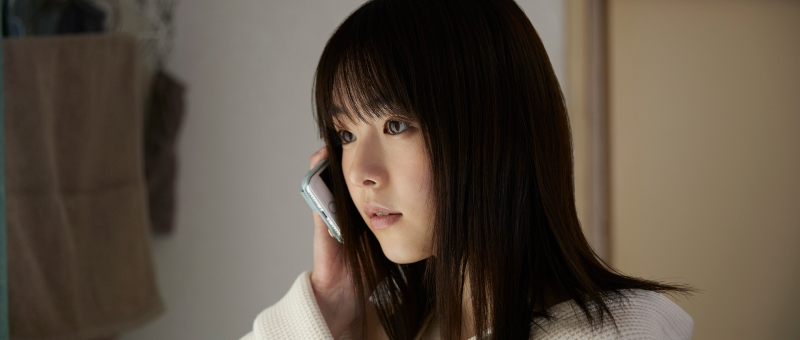
A young woman finds herself dealing with feelings of inadequacy and worthlessness after giving up on the corporate life in Yuho Ishibashi’s zeitgeisty indie drama When Morning Comes, I Feel Empty (朝がくるとむなしくなる, Asa ga Kuru to Munashiku Naru). Set against the backdrop of a society in which death from overwork is not uncommon and there have been countless reports of young people taking their own lives because of workplace exploitation, the film seems to ask if there isn’t another choice and if one can really be forgiven for rejecting the conventional path in an intensely conformist society. 

Nozomi (Erika Karata) quit her job at an ad agency six months previously and is currently working part-time in a convenience store not far from where she lives. So ashamed is she of her failure to live up to the demands of corporate life that she can’t bring herself to tell her parents that she no longer works in an office. Her co-workers at the store seem to know, but when they ask questions she tells them that she quit because of too much overtime which is ironic as her boss is forever asking her to work an additional late shift because of poor staffing levels and she always meekly agrees though never seems all too happy about it despite the extra money. 

Then again, she doesn’t seem too happy about anything. In a repeated motif, her mother sends her fresh vegetables from back home but she never has the energy to cook for herself and is usually seen eating bento from the store or slurping cup ramen. The fact her life is out of kilter is brought home to her when one side of the curtain rail in her room suddenly collapses in a bid for freedom from its imprisonment on the wall. Barely speaking and aloof from her colleagues, she seems to carry a deep-seated sense of shame that she “failed” to settle in to company life, later telling an old friend she’s unexpectedly reconnected with that she couldn’t cope with the intense overtime that often meant she’d miss the last train and have to overnight in a manga cafe or fork out for a taxi. Her boss always yelled at her, but she felt like everyone else seemed to be managing so the fault must be with her. She regards her decision to leave as a defeat and not a victory even as she recounts feelings of despair and hopelessness crossing the bridge every day to work with only a sense of emptiness in the hollowness of the salaryman dream. 

But then the film takes it title from a reflection something her younger colleague said about earnestly feeling that it was wonderful just to get up every day and come to work. Ayano doesn’t mean it as some kind of cultish devotion to the combini life or a toxic commitment to an unreasonable worth ethic, but more that she manages to find joy in the seemingly mundane even as she jokes about her nerdy college boyfriend who wears glasses, and sheepishly reveals that she’s been saving money with the intention of studying abroad. Nozomi’s only in her mid-20s, but perhaps it is a little different for these contemporary college kids who have bigger dreams and don’t feel the need to throw themselves into the corporate straightjacket just so they can feel like legitimate “members of society”. Their relative youth and sense of possibility may fuel Nozomi’s sense of failure, that she’s back doing a college kid’s part-time job at 24 and surrounded by students as if accidentally arrested in adolescence, but perhaps also shows her that there are other options and making a different choice doesn’t necessarily equate to failure. 

More than anything, it’s an accidentally encounter with a former middle school classmate (Haruka Imo) that finally allows her to make peace with herself and feel like a human being again, someone worthy of love and respect and with new hope for the future. Evoking a sense of disillusionment with the salaryman dream and the emptiness of corporate success that is devoid of human connection, Ishibashi shoots with a laidback ease that on one level reflects the heroine’s malaise but soon gives way to a comforting breeziness as Nozomi discovers a new home for herself in the wholesome pleasures of friendship and mutual acceptance as a bulwark against the vagaries of a capitalistic society. 


When Morning Comes, I Feel Empty screened as part of this year’s Osaka Asian Film Festival.

Images: (C)Ippo

R 21 aka Restoring Solidarity (Mohanad Yaqubi, 2022)

The occupation had ended in 1952, but America’s influence on Japanese society continued in other ways not least among them defence. 1960 saw the biggest protest movement Japan has ever experienced against the renewal of the security treaty with the Americans that underpinned the pacifist constitution, though the treaty was eventually signed anyway in defiance of public opinion. Student protestors and radicals came to feel oppressed by American imperialism and objected to the hypocrisies of Japan’s role in America’s foreign in policy in Asia. For these reasons, those on the political left came to feel a solidarity with the Palestinian struggle against colonialism and began to travel to Palestine in order to learn and share support often filming what they’d observed for those back home. 

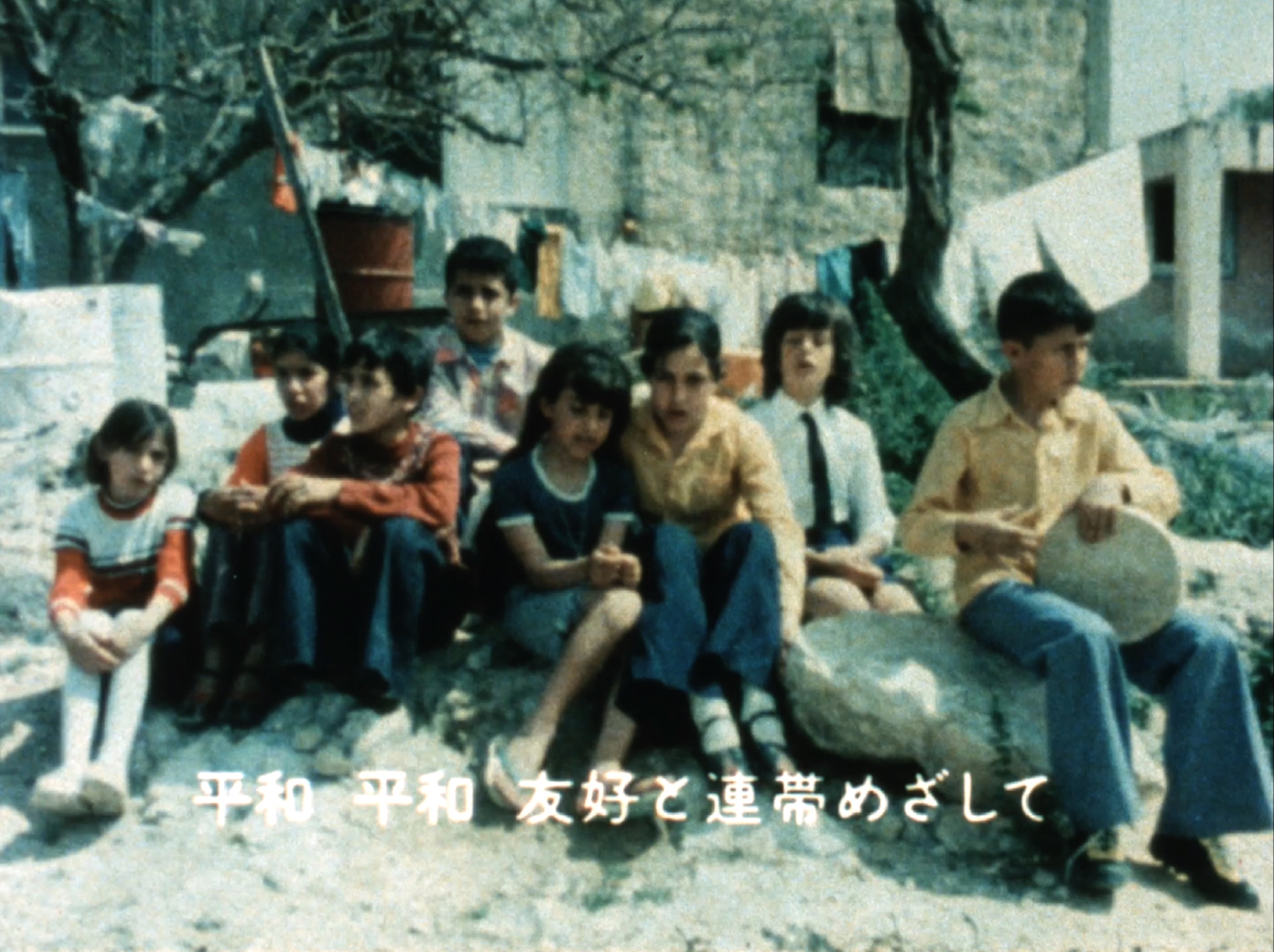
R 21: Restoring Solidarity is a collection of 20 such films kept safe in Japan and later handed to the director, Mohanad Yaqubi, after a screening of his previous film, Off Frame. Film number 21 is the film itself intended as a message of solidarity in the overarching contemporary voice over narration in Japanese. The films themselves are in several languages, many of them subtitled or dubbed for audiences in Japan, some shot by Japanese activists in Palestine and others produced by news organisations or other observers. A few feature upsetting footage of bodies and rubble, tanks on the streets, and shoes without owners while others record children singing cheerfully about peace or displaced students talking about their hopes of one day restoring their country.  

A lengthy sequence contains an interview with an old woman recounting how her village was slowly erased to a British reporter, a more obvious parallel with Japan occurring with the direct allusion to the devastation of the atom bomb in ruined landscapes now devoid of all human life existing only as the symbol of societal collapse. The old woman tells the reporter that they should leave the town the way it is as a reminder of the evils which have gone before. Yet also included in the archive is footage from a programme with a British voice over which seems to be much more propagandistic in tone, raising questions of the purpose and objectivity of the videos and the role they were intended to play. 

Perhaps the most interesting segment features a short film starring a collection of children who come across an abandoned missile launcher and start playing with it only to be confronted with the realities of conflict on coming across the body of another child. The children then appear in military uniforms, radicalised to avenge their friend by fighting for their country. The reels also include direct to camera statements and interviews from prominent people that may also in their own way contain a degree of artifice. Yaqubi frequently cuts in with images of the reels themselves or restoration process reminding us that what we’re seeing is a constructed image that’s being reconstructed before our eyes and quite literally repurposed but also “restored” and repaired as an archive of struggle. 

The voice over reminds us of the struggles still ongoing, the indifferent self-interest of global powers that led to the early ‘70s oil crisis which threatened to derail the Japanese economic miracle and itself fostered a desire for closer relationships with Middle Eastern nations. A reporter for a Japanese newspaper, however, states that he thinks most people in Japan would be broadly in favour of the Palestinian cause if superficially knowing little of it while political support can be fickle and lacking in depth. As the voice over suggests, video is and was a powerful way of keeping memories alive but also of expressing solidarity with an otherwise distant cause in the shared struggle against colonial oppression.


R 21 aka Restoring Solidarity screens March 18 at New York’s Museum of the Moving Image as part of this year’s First Look.

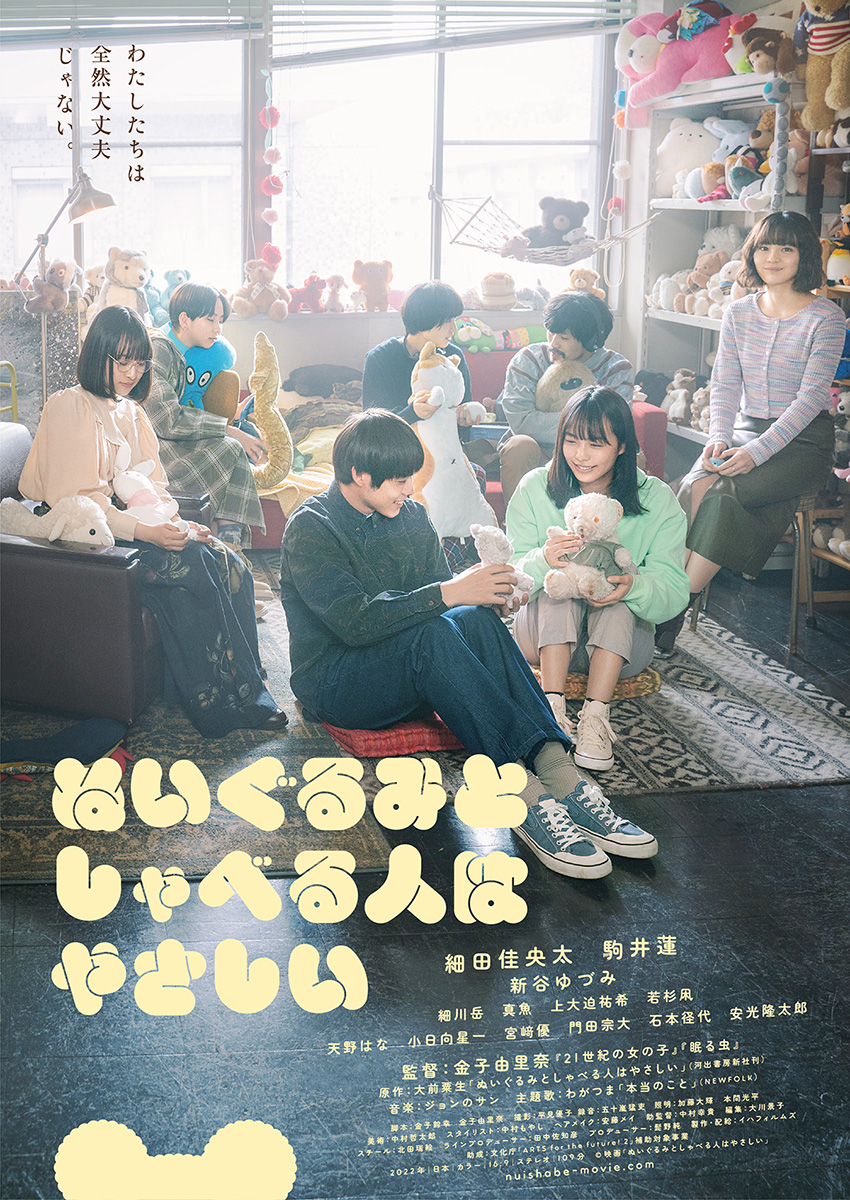
People Who Talk to Plushies Are Kind (ぬいぐるみとしゃべる人はやさしい, Yurina Kaneko, 2023)

How is it possible to go on living in a society which is often unkind and at times hostile? A collection of sensitive university students find themselves struggling to accept the world around them in Yurina Kaneko’s charmingly empathetic adaptation of the novel by Ao Omae, People who Talk to Plushies are Kind (ぬいぐるみとしゃべる人はやさしい), but discover a kind of solidarity in softness after joining a club where they don headphones and unburden themselves to cuddly toys. 

As they point out, it’s good to talk. But talking to someone else about your worries can end up making them worried too and that’s the last thing any of the members of the Plushie Club want which is why they’ve decided to talk to plushies instead. Yet what’s worrying them isn’t just their worries, but a sense of their powerlessness and complicity in having behaved as if they believed the problems of others were nothing to do with them until they were shown otherwise. The hero, Nanamori (Kanata Hosoda) regrets that he “laughed things away with everyone else” rather than speaking up when he saw something that seemed wrong to him and should change while acknowledging that simply by existing as a man he may make someone feel afraid or uncomfortable without meaning to. 

Nanamori is careful not to hurt others by his own actions, trying to turn down a confession of love from a classmate in high school as kindly as he can but perhaps failing in his awkwardness even as he straightforwardly tells her that he doesn’t understand the concept of romantic desire. He simply doesn’t know what it means to “like” someone, and feels that there must be something wrong with him that he can’t grasp this simple facet of human behaviour. On a trip home uniting with some boys from school, he is immediately put off by their stereotypically masculine banter in which they ask him about girls and crushes and mock him for being a virgin until he finally leaves and tells them not to laugh at him just because he is different. 

Everyone at the Plushie Club is “different” in their own way, but has come to find a place to belong where they are simply allowed to be without needing to offer anything else. As another of the members, Nishimura (Mimori Wakasugi), puts it there’s something between kindness and indifference that is simply gentle, a quiet yet powerful quality of acceptance. When she casually revealed one day that she had a girlfriend, most of her friends were supportive but perhaps superficially. Her revelation had made them uncomfortable and regardless of how they felt about it, their perception of her had changed and she was no longer the person she had been to them before. They began to treat her differently, but at the Plushie Club there was no real difference and everyone carried on reacting to her the same way they always had. 

The Plushie Club is a place where it’s permitted to be soft in a hard world, where the members can allow themselves to feel drained by the process of living and find relief from their sense of powerlessness in acknowledging that they have made a choice to continue being kind rather than become what the world wants them to be. In an effort to understand romantic desire, Nanamori begins dating a fellow member, Shiraki (Yuzumi Shintani), but discovers that she has chosen the opposite path laughing at women who complain about societal misogyny and insisting that it’s pointless to resist because nothing will ever change. She joined the Plushie Club because she was sick of being sexually harassed at other uni gatherings but later decides to deliberately join another club filled with sexist guys because the real world isn’t so nice and the only way to survive it is to become hard yourself. 

Shiraki claims that she finds Nanamori’s “righteousness” “exhausting” and wishes she could free him and a similarly minded classmate, Mugito (Ren Komai), from their “tormenting kindness” which has in its way hurt her though unavoidably so even as she continues to be kind despite herself if rebelling by refusing to talk to plushies. Kaneko sometimes shifts to a blurry plushie vision with shimmering pastel-coloured edges and a kind of glitter snow effect that makes it seem as if the stuffed toys really are watching over their human friends as they silently, or not, agree to shoulder some of the burden of living. “They’re the ones talking to us,” Nanamori points out though in a way perhaps it’s more that the plushies reflect a part of themselves allowing them to exteriorise their internal dialogue and reach an accommodation with their fear and loneliness amid a world which consistently proves immovable and disappointing.


People Who Talk to Plushies Are Kind had its World Premiere as part of this year’s Osaka Asian Film Festival.

Original trailer (no subtitles)

Images: (C) 映画「ぬいぐるみとしゃべる人はやさしい」