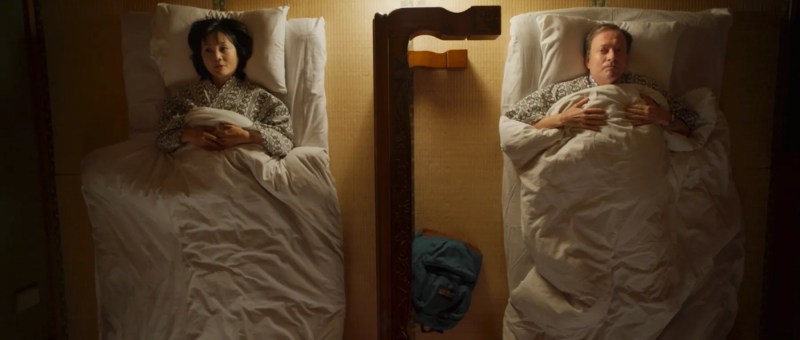

A lost tourist finds a begrudging sanctuary in the home of a reluctant middle-aged woman in Greg Dale’s cross-cultural comedy, Rules of Living (ルール・オブ・リビング). Well intentioned as it may be, the film has some outdated humour and suffers from an unbalanced perspective that prioritises that of the American hero and at times uncomfortably pushes a message of Western individualism as he somehow “liberates” there heroine, Mikako (Kaho Minami), from her sense of obligation to her family and wider community.
In a case in point, Mikako doesn’t want a roommate because her well-appointed home is a private sanctuary from the outside world and its constant judgement but is more or less forced to let Vincent (Greg Dale) in out of guilt and politeness. For his part fleeing a messy divorce and his own dissatisfaction with life under capitalism, Vincent arrives in Japan only to be somehow surprised that everything’s in Japanese and he can’t communicate with anyone because they are all too embarrassed about their English ability to respond to his questions. This results in a little well-worn humour in which his asking a portly middle-aged lady about a cheap place to stay is misunderstood and leads to an awkward situation as the apparently sexually insatiable older woman drags the naive and wholesome Vincent to a love hotel. Yet Vincent, an aficionado of Lafcadio Hearn, continues to wander round with wide-eyed wonder before rocking up Mikako’s office for more language-barrier banter and subsequently at her house despite not having made any attempt to contact her to make arrangements having befriended her daughter Chieko in Bali.
The film seems to directly contrast Mikako with her daughter who has given up a prestigious job and corporate career to go travelling leaving Mikako overstretched trying to care for her own mother alone as her health declines. Chieko’s decision is to a degree selfish in that she doesn’t answer her mother’s calls and does not even return home for her grandmother’s funeral while ironically looking down on Mikako for being a doormat who always puts the needs of others above her own as, the films argues, is expected by Japanese society. That’s not entirely wrong, though there must be a middle ground between total abandonment and selfless sacrifice in which not everything would simply be left for Mikako alone to deal with and she would have more freedom to fulfil herself outside of the expectations of others including those of Vincent. It’s notable that Mikako also seems to be dissatisfied in her career because of persistent sexism and office mores in which, at 49, she’s been more or less demoted to the ranks of office ladies after spending the rest of her working life in accounts and likely won’t be offered any further promotions, therefore justifying Chieko’s decision to quit. At the office, Mikako is treated as a maternal figure unfairly over relied upon by the boss because of her advanced skills while the younger women make too many mistakes and are slapdash in their work because they aren’t planning to stay in these jobs long term.
Meanwhile, Mikako is also under pressure to remarry especially as many seem to remark on the fact her family home is too large for her as a single woman. She’s been in a semi-serious relationship with a divorced childhood friend for some time but neither of them seem keen to give marriage another go until he too is pressured by his father to find another wife in order to take over the family business. Koichi (Kippei Shiina) is apparently the perfect man, nice, polite, well turned out and professionally successful yet there’s no real spark and Mikako feels guilty that she can’t learn to love Koichi in the way everyone else seems to love him for her. If she marries him, it will be for convenience and companionship along with the expectations of others much more than for herself.
Her romance with Vincent is not all that convincing but born of frustration with these same social expectations and desire to put herself and her feelings first as manifested in her sudden desire to learn English. Vincent teaches English around the neighbourhood and spreads these individualist ideas around while enlivening the community through the simple act of communication as if no one had ever thought to speak to anyone else before. Yet he meets a more cynical force in the head of the language school he eventually gets a job at who is from India and offers yoga classes on the side despite never having practiced it before coming to Japan in another example of the pernicious qualities of these “expectations”. Vincent partially falls victim to them too in assuming a young woman in the staffroom is a lost student rather than a teacher simply because she looks Japanese. Nana complains no one takes her seriously because of her appearance despite her native level English and American accent. Before arriving at Mikako’s Vincent had tried to rent an apartment only to be told they don’t rent to foreigners and those that do either offer inappropriate accommodation or ask for a series of spurious additional fees. A man in the street also yells at him to go out with his own kind when seeing him with Mikako.
Essentially, Mikako’s choice is between two men, Vincent who apparently represents “freedom”, and Koichi who represents conventionality. This rather undermines the central thesis of Mikako rediscovering herself and taking agency over her life rather than as her daughter had said devoting herself entirely to the service of others. The film’s title is taken from a series of rules Mikako pastes up as condition for Vincent staying with her which included not using the bathroom or disturbing her while she’s in the living room, symbolising her desire for privacy and reluctance to let the relentlessly friendly Vincent into her life (even though being reluctant to let a total stranger and especially a man you’ve never met before stay in your house with you is completely understandable), but also hints at the “rules” that govern her own life in a conformist and patriarchal society. Some of these at least she may escape in deciding to follow her heart even if the place it leads her to has rules of its own that may not in the end be all that better.
Rules of Living screened as part of this year’s Cinema at Sea.
Trailer (English subtitles)







 Yasushi Sato, a Hakodate native, has provided the source material for some of the best films of recent times including Mipo O’s The Light Shines Only There and Nobuhiro Yamashita’s
  Nobuhiko Obayashi may have started out as an experimental filmmaker and progressed to a lengthy narrative film career but he remains best known for his “what the hell am I watching?” cult classic Hausu. Aside from his 1983 take on The Girl Who Leapt Through Time, very little of his other work has travelled outside of Japan. In the case of 1987’s The Drifting Classroom (漂流教室, Hyoryu Kyoshitsu), this is doubly surprising firstly because it’s based on a hugely popular manga by the godfather of horror comics Kazuo Umezu and secondly because it’s set in an international school so around 80% of the dialogue is in English.
 Kabukicho Love Hotel (さよなら歌舞伎町, Sayonara Kabukicho), to go by its more prosaic English title, is a Runyonesque portrait of Tokyo’s red light district centered around the comings and goings of the Hotel Atlas – an establishment which rents by the hour and takes care not to ask too many questions of its clientele. The real aim of the collection of intersecting stories is more easily seen in the original Japanese title, Sayonara Kabukicho, as the vast majority of our protagonists decide to use today’s chaotic events to finally get out of this dead end town once and for all.
 Windows on Worlds