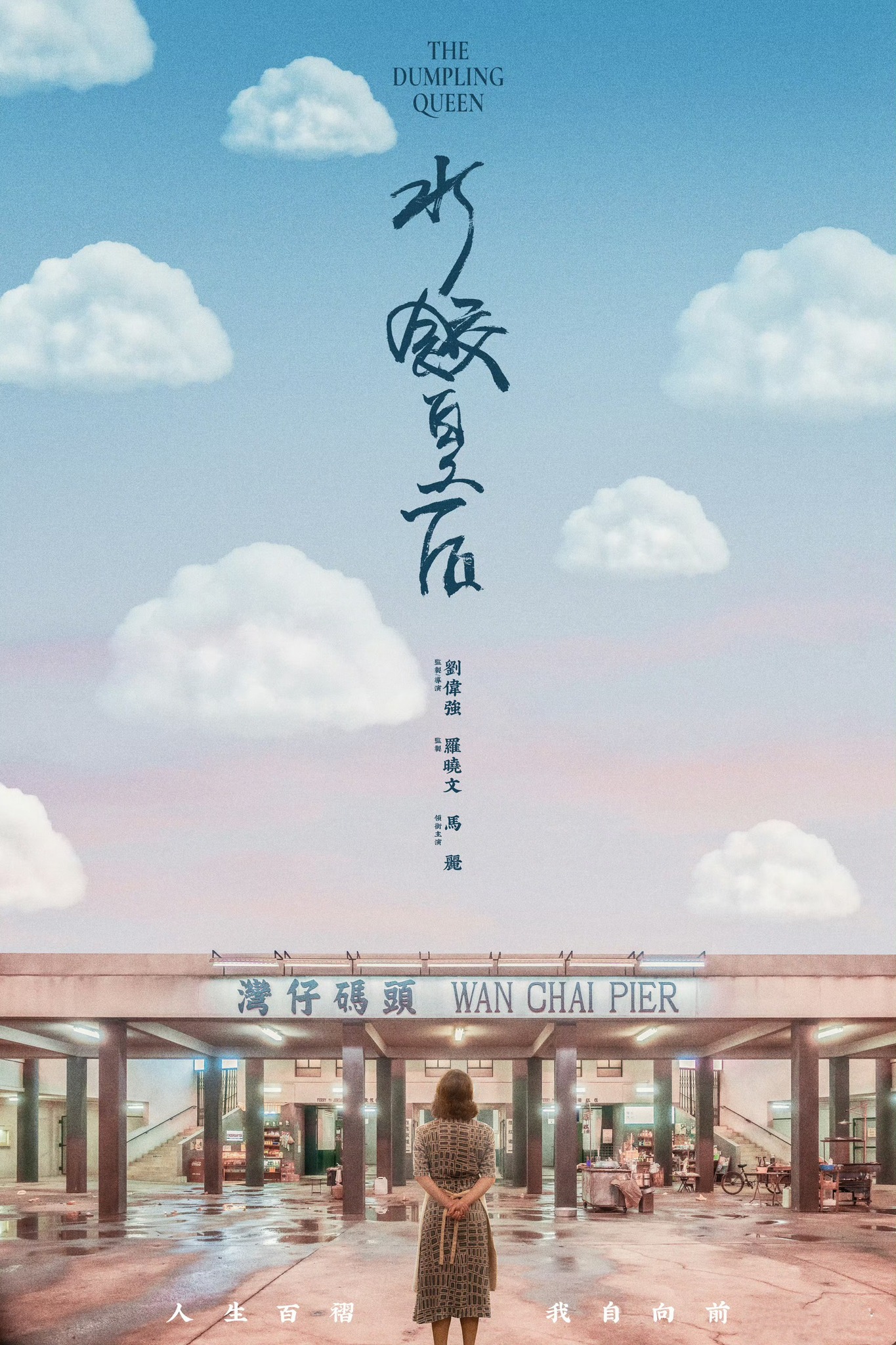
The Dumpling Queen (水饺皇后, Andrew Lau, 2025)

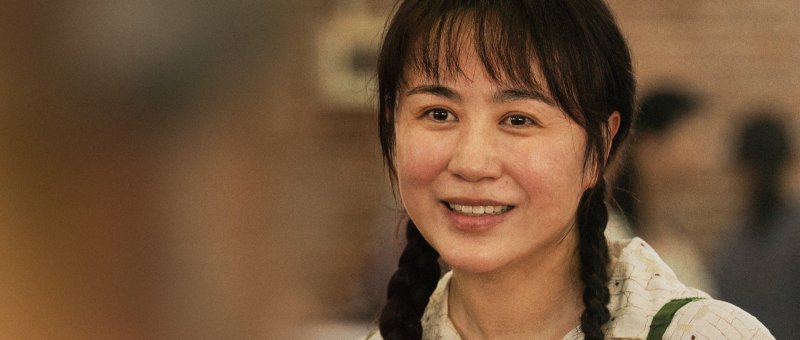
There are a lot of ironies and contradictions at the heart of Andrew Lau’s Dumpling Queen (水饺皇后, shuǐjiǎo huánghòu) inspired by the life of Zang Jianhe who founded the international dumpling empire Wanchai Ferry, but there’s no getting away from the celebratory joy it finds in the heroine’s hard-won transition from jilted spouse to successful entrepreneur. Then again, there might be something uncomfortable in the film’s framing and the repeated claim that Jianhe’s dumplings are about the warmth of familial bonds and reunion. Zong’s desire to kick back at American imperialism as manifested in the ubiquity of hamburgers and US-style delivery pizza by making Chinese dumplings accessible across the world is also an advocation for the One China philosophy in which the greater Chinese diaspora is connected as a family through “the taste of home.”

Beginning in 1977, the film is noticeably quiet about why anyone would be risking their lives to escape from Mainland China to Hong Kong, though this is what Jianhe is doing in her quest to be reunited with her husband, Hanzhou, who has been away for four years. Unfortunately, when she reaches the station at the border, Hanzhou’s mother (Nina Paw Hee-ching) rudely explains that she had him marry another woman in Thailand who has since borne him a son. Branding Jianhe a failure for giving birth to only daughters, she tells her that she can come with them but that she will be the second wife subservient to the mother of the family heir. She repeatedly claims this does not make Hanzhou a bigamist because Thai law supposedly gives him the right to marry more than one woman, though it seems the mother-in-law may not be aware that the pair were legally married in Mainland China as Jianhe’s traditional wedding photos would otherwise suggest. 

The fact that Jianhe is discarded for giving birth to daughters contributes to the film’s feminist undertones and sense of female solidarity as Jianhe strives to pass on the dumpling recipe she learnt from her own mother to the next generation of women and beyond. Jianhe must now find a way to fend for herself, which she eventually does through a combination of hard work, excellent business sense, and the supportive community around her. Though Jianhe and her children face some instances of prejudice against Mainlanders when they first arrive, they are helped by various people including enigmatic landlady Hong Jie (Kara Wai Ying-hung) who makes her a part of her boarding house community and tries not to pressure her about the rent out of consideration for the children,

But times are sometimes hard and Jianhe is directly contrasted with the woman across the way whose husband has a gambling problem and beats her. Having been injured in a workplace accident that leaves her unable to work as she had been before, Jianhe begins to feel hopeless and considers taking her own life only to be saved by her children and a neighbour who sells dessert soups, but the other woman is not as lucky and eventually makes a fateful decision, blaming herself for the man her husband has become. Jianhe is also given another shot at romance with a sympathetic policeman (Zhu Yawen) who comes from the same area of Mainland China and is taken by her dumplings, but he also wants to move abroad and Jianhe has already followed one husband to another country and it didn’t work out so well. It’s not so much that she sacrifices love for career success, the policeman could after all simply chose not to go, but that she no longer needs to compromise herself for marriage because she’s fulfilling herself through her business enterprise.

Just as the film doesn’t mention why Mainlanders came to Hong Kong, it doesn’t really go into why some Hong Kongers choose to leave save for a brief onscreen text mention about the beginning of the negotiations for the Handover though Jianhe is repeatedly keen to emphasise the universal Chineseness of her dumplings. She makes a deal with a Japanese department store, but threatens to walk when they try to make her change her packaging to bring it into line with their house style and thereby erase its cultural identity. She also refuses to allow them a monopoly after they demonstrate their lack of trust in her as a businesswoman, quickly realising she’s better off making deals with every supermarket on the island as well international flour companies. Jianhe is pretty quick to cotton to new technologies such as household refrigerators and the possibilities for frozen foods. But at the end of the day, she’s earnest and hardworking, sharing her success with her many friends who helped her along the way and always repaying kindness when she can. It’s an oddly utopian vision at times in which everyone seems to recognise Jianhe’s greatness and get out of her way, including a triad boss who helps her because she reminded him of his mother when she threatened one of his men with a meat cleaver,) but it also reinforces a sense of the One China family with the dumplings, now refined to suit local tastes, as the glue binding it together in the face of an onslaught of hamburgers and pizzas as harbingers of a cultural apocalypse.


International trailer (Simplified Chinese / English subtitles)
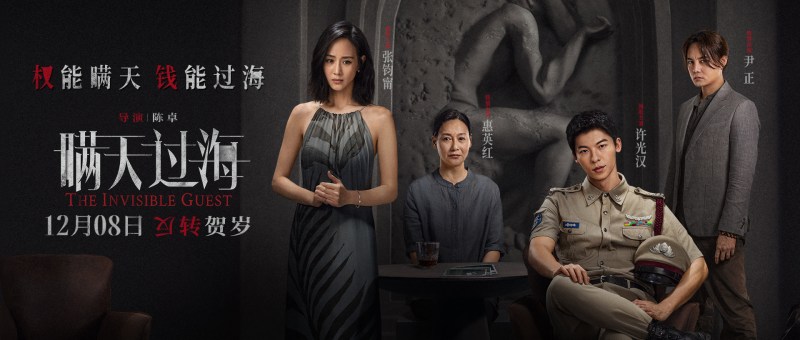
The Invisible Guest (瞒天过海, Chen Zhuo, 2023)

Prestige mystery thrillers are definitely having a moment at the Chinese box office and like last summer’s Lost in the Stars, The Invisible Guest (瞒天过海, mántiānguòhǎi) takes place in a fictional South East Asian nation among a largely Chinese community where the policemen mainly speak English and almost everyone else Mandarin. Like many similarly themed films that might partly be because there is a strong suggestion of normalised judicial corruption which would otherwise be a difficult sell for the Mainland censorship board even if very much on message in its anti-elitist themes in which it is repeatedly stated that money cannot in fact solve everything. 

Adapted from a Spanish film which was a huge hit on its Chinese release and recently remade in Korea under the title Confession, the film opens as a locked room mystery. A well-known architect, Minghao (Yin Zhung), who is also the adopted son of the nation’s only Chinese lawmaker, has been brutally murdered in a luxury hotel. Joanna (Chang Chun-ning), the wife of a filthy rich real estate magnate, has been arrested but maintains her innocence. She claims that they were attacked soon after entering the room and that she was temporarily knocked out waking up to find Minghao with his throat cut, the attacker vanished, and police kicking down the door.  

The twist is that she’s then approached by Zheng (Greg Hsu), a local cop, who offers to “help” her for a small fee promising to sort out all the problematic evidence against her if only she’s honest with him about what really happened in the room. Obviously, the depiction of such an openly corrupt law enforcement officer would not be possible on the Mainland which explains the international setting but it soon becomes clear that Joanna may not be a very reliable narrator and Zheng obviously knows a little more about what’s really going on than he pretends.

Joanna had only recently married her superwealthy husband whose business interests have been very badly affected by the scandal, suggesting at least that she may be a patsy at the centre of a corporate conspiracy with her husband’s firm possibly hoping to get rid of her or someone else’s using her to get to him. But the most essential message is that the rich and powerful shouldn’t have a right to assume that everything can be solved with money and they can get away with anything so long as they have financial means to pay for it. In a flashback which we can’t be sure is completely reliable, someone suggests that the victim’s life was meaningless and killing them no different from crushing an ant, a view somewhat validated by Zheng when he tells Joanna that he isn’t interested in people like that only people like her, wealthy. 

Conversely, a tangenital victim of the case later insists that you shouldn’t underestimate what poor people will do for their families because in the end that’s all they have. The film is sympathetic to those like them who do not have the means to face off against someone like Joanna who probably could, if she is not actually innocent as she claims, evade justice thanks to her vast wealth and social standing assuming her husband’s company don’t decide to drop her in it. There is also, however, the implication that Joanna was once herself poor and downtrodden and has been corrupted by her desire for the illusionary freedom of wealth, abandoning her integrity while carrying the innocent dream of buying an idyllic orchard where she could live in peace and comfort. 

Playing out in near realtime, Chen keeps the chamber drama tension high with frequent on-screen graphics reminding us that Joanna only has a couple of hours left to clear her name before the dossier of evidence against her will be presented to the prosecution and she’ll be charged with murder. Zheng says he can help but keeps pressing her not only for more money but more information, the “real” truth, rather than a favourable narrative though arguably the flow of hypotheses made more sense in the context of a lawyer prepping a client than a policeman probing for evidence in order to neutralise it as did the accused’s willingness to trust the person poking holes in their story. A kind of justice, at least, is done and not least poetic as the truth begins to emerge though the guilty parties or invisible guests of latent classism and social inequality are very much here to stay. 


The Invisible Guest is in UK cinemas now courtesy of CMC.

International trailer (English subtitles)

Sakra (天龍八部之喬峰傳, Donnie Yen & Kam Ka-Wai, 2023)

Donnie Yen returns to the (co-)director’s chair in an adaptation of Jin Yong’s classic wuxia Demi-Gods and Semi-Devils, Sakra (天龍八部之喬峰傳, Tiānlóng Bā Bù zhī Qiáo Fēng Zhuàn). 59-year-old Yen also stars as the tragic wuxia hero Qiao Feng who is repeatedly stated to be around 30, though he also appears in a handful of scenes as Qiao’s father which might help to explain the casting choice. Even so, Yen mostly pulls it off while striking an authoritative figure fighting for justice in an unjust world. 

As the opening titles reveal, this was a fairly tragic age in which “those who had feelings were all caught in it”. The Northern Song Dynasty faces invasion by the Khitan-led Liao, while the Yan are also vying to restore their lost power. Discovered as a foundling and raised by a Song couple, Qiao Feng joins the notorious Beggar Gang and becomes a powerful martial artist often defending their territory against Khitan raiders. After rescuing a young man held captive by a monk who describes him as a human sacrifice, Qiao returns to be accused of treachery by the Beggars. His leader, Ma, has been murdered, and Ma’s wife Min (Grace Wong Kwan-hing) claims she saw Qiao do it. Ma had apparently told her that he feared Qiao would kill him because he had come into an incriminating letter which suggests that Qiao’s biological parents were in fact Khitans and he is some kind of treacherous sleeper agent. 

Qiao realises there’s nothing he can really do to counter their suspicion except leave and discover the truth about his origins for himself. Unfortunately, however, everyone he could have asked ends up dead with him framed as the killer. Meanwhile, he wrestles with questions of identity asking himself if he can be both a “good” person and a “Khitan” but later coming to doubt his allegiance to Song after witnessing some soldiers massacre a group a of Khitan peasants out on the road. While investigating he ends up saving the life of mysterious spy Azhu (Chen Yuqi) who like him is looking for her origins, having been told by Yan warlord Murong Fu (Wu Yue) for whom she is working that he would tell her if she stole a scroll from the Shaolin temple. Azhu is the only one continues to believe in him, reassuring Qiao that regardless of his identity he is still a “good person”, and the pair soon fall in love vowing to leave the martial arts world behind to raise cattle in the country once their respective quests are concluded successfully. 

Even so, he later claims not to fight only for his land but for a righteous world against the amoral machinations of the villainous Murong Fu and all those who conspired with him. The Beggar Gang is not entirely innocent either, subject to a struggle for succession that made Liao’s existence inconvenient to some while Qiao is later confronted by the realities of a situation he may have misunderstood. Qiao may learn the secret of his origins, but is also left with a new mission in the necessity of stopping Yan’s despotic bid to reclaim Song, riding straight into battle with only a loyal companion at his side. 

Though struggling under the sheer complexity of Jin Yong’s sprawling novel, Yen and Kam showcase the key incidents such as the opening rescue of Duan Zhengchun’s son, and Liao’s epic battle against the Beggars after wading straight into a meeting knowing he’d likely be killed but looking for a doctor for Azhu. The action scenes are visceral and impressive, making the most of the movie’s high production values with a mixture of CGI and practical effects as Qiao faces off against hundreds of men at once or makes daring wire-assisted leaps from under a dome of enemy shields. There is also a genuine poignancy in the tragic romance between Azhi and Qiao who just want to be free of their legacies and the machinations of the martial arts world to live quiet lives as innocent farmers but are reminded there is no real escape from the political reality. Having covered half of Liao’s arc in Jin Yong’s text, a door is left open for a sequel in which Qiao continues to pursue justice and clear his name while hinting at a battle still to come in world in which “those who have feelings are all caught”.


Sakra is released in the US on DVD & Blu-ray June 13 courtesy of Well Go USA.

Original trailer (English subtitles)

Sunshine of My Life (一路瞳行, Judy Chu, 2022)

A young woman comes to a better understanding of her family and her relationship with it after a series of crises some more serious than others in Judy Chu’s semi-autobiographical drama, Sunshine of My Life (一路瞳行). More a coming-of-age tale than an exploration of the difficulties faced by those with disabilities in the recent past, Chu’s heartfelt film nevertheless stresses familial solidarity as the heroine comes to realise that her misplaced resentment is mostly teenage angst and that at the end of the day her parents just want her to be happy.

Yan (Karena Ng) was born to two parents who are each blind. A perfectly ordinary though dangerous accident that could easily happen to a sighted mother leaves a toddler Yan scalded and unkind relatives questioning the couple’s decision to have a child at all implying it is somehow irresponsible and that they are incapable of caring for her. Nevertheless, Yan’s mother Hung (Kara Wai) resolves to do everything she can to keep her daughter safe beginning with attaching bells to her so she has a better idea of where she is and what she’s doing at all times. This early incident does in one sense colour Hung’s parenting style, constantly questioning herself as to whether she’s a good mother and preoccupied with the judgement of others all of which later feeds into her teenage daughter’s resentment as the older Yan grows tired of feeling responsible for her parents’ care. 

As a child, Yan had helped her parents by reading out menus and describing the world she sees around her but as a high school student she resents having to rush home after school rather than hanging out with her friends and also seems to be ashamed of her parents’ disability never telling anyone about her family and instead claiming that her mother is ill in hospital. She tells her art teacher that she just wants to get out of Hong Kong and doesn’t care where she goes so long as it’s far away while later telling her no good rich kid boyfriend that she’s searching for “freedom”. On one level she feels intense guilt for leaving her parents behind as if she were abandoning them, worried that they really can’t manage without her, but also fears for her own future and feels trapped as if she’s being asked to sacrifice her own hopes and dreams to stay by her parents’ side forever.  

Yan is indeed a teenage girl and has a slightly self-centred way of looking at things, never quite stopping to appreciate how difficult her parents lives can be in a conservative society that is often unwilling to accommodate difference. When her classmates all mock and jeer at a poster advertising a star gazing event for the blind all she can do is smile politely, and at one point she even walks straight past Hung waiting for her outside the school gates perhaps on one level simply embarrassed to have her mother meet her as any teenage girl might be but also anxious to hide her existence from her boyfriend. After being arrested by the police for illegal street selling, Yan’s father Keung (Hugo Ng) gets a job as a masseuse but is later exploited by his employer who tries to force him to sign a new contract accepting a 20% pay cut while increasing the manager’s commission. Keung refuses and is fired but vows to fight for the other workers to end discrimination against the blind and ensure they enjoy the same labour rights as sighted workers. 

Faced with a series of crises from a brush with criminality to her boyfriend’s sudden absence and her father’s failing health, Yan is forced to reconsider her relationship with her parents. On witnessing Hung stand up for herself and take her father’s corner Yan realises that she might have underestimated her mother’s capability and what she took for dependency was more a general sense of warmth in receiving care that made her life easier. Tinged with ’90s nostalgia from the ubiquitous cassette tapes Hung uses to record precious moments to pagers and pinups, Chu’s warmhearted drama finds a mother and daughter coming to a better understanding of each other as they both learn to embrace independence and freedom if in a slightly different way than originally anticipated.


Sunshine of My Life screened as part of this year’s Five Flavours Film Festival and is available to stream in Poland until 4th December.

Original trailer (Traditional Chinese / English subtitles)

My People, My Country (我和我的祖国, Chen Kaige, Zhang Yibai, Guan Hu, Xue Xiaolu, Xu Zheng, Ning Hao, Wen Muye, 2019)

My People My COuntry poster 3Oct. 1, 2019 marks the 70th anniversary of the People’s Republic of China. Supervised by Chen Kaige, My People, My Country (我和我的祖国, Wǒ hé Wǒ dě Zǔguó) presents seven short films by seven directors featuring several notable historical events from the past 70 years though not quite one for every decade (perhaps for obvious reasons). Though different in tone, what each of the segments has in common is the desire to root these national events in the personal as they were experienced by ordinary people rather than how the history books might have chosen to record them.

Told in roughly chronological order, the film opens with the founding of the Republic as comedian Huang Bo plays an eccentric engineer charged with ensuring the operation of an automatic flag pole doesn’t embarrass Chairman Mao at the big moment. In the context of the film as a whole which is fond of flags, this is rather odd because every other flag in the film is raised by hand usually by a soldier taking the responsibility extremely seriously. Yet the point is less the flag itself than the symbolic pulling together of the community to find a solution to a problem. Realising the metal on the stopper is too brittle, the engineers put out an appeal for more with seemingly the entire town turning up with everything from rusty spoons to grandma’s necklace and even a set of gold bars!

This same sense of personal sacrifice for the greater good works its way into almost all of the segments beginning with the story of China’s first atom bomb in the ‘60s for which a pure hearted engineer (Zhang Yi) first of all sacrifices his one true love and then the remainder of his life when he exposes himself to dangerous radiation all in the name of science, while in the film’s most charming episode a young boy is devastated to realise his crush is moving abroad and has to choose between chasing after her and fixing up a TV aerial so his village can see China beat the US at volleyball during the ’84 Olympics. Visions of flag waving glory eventually convince him where his duty lies, but his sacrifice is later rewarded twice over as he becomes a little local hero even if temporarily heartbroken in the way only a small boy can be.

Then again, some people are just a little self-centred like the hero (Ge You) of Ning Hao’s Welcome to Beijing who keeps trying to reconnect with his earnest teenage son only to end up connecting with a fatherless young boy during the 2008 Beijing Olympics. Chen Kaige’s sequence, meanwhile, is inspired by the story of two earthbound astronauts but similarly finds two roguish, orphaned young men connecting with a patient father figure who is able to bring them “home” by showing them a space miracle in the middle of the desert, and in the final and perhaps most directly propagandistic sequence, a tomboyish fighter pilot eventually overcomes her resentment at being relegated to a supporting role to rejoice in her colleagues’ success. Despite the overly militaristic jingoism of the parades with their obvious showcasing of China’s military power, Wen Muye’s “One for All” is in its own sense surprisingly progressive in its advancement of gender equality and mildly subversive LGBT positive themes were it not for a shoehorned in scene featuring a milquetoast “boyfriend”.

Sensitivity is not, however, very much in evidence in the sequence relating to the extremely topical issue of the Hong Kong handover. Out of touch at best, the constant references to the continuing reunification of the One China are likely to prove controversial though admittedly those they would most upset are unlikely to want to sit through a 2.5hr propaganda epic celebrating the achievements of Chinese communism. Nevertheless, it is a little galling to see the “return” to China so warmly embraced by the people of Hong Kong given current events in the city. This perhaps ill-judged sequence is the most overt piece of direct propaganda included in the otherwise unexpectedly subtle series which, despite the flag waving and eventual tank parade, tries to put the spotlight back on ordinary people living ordinary lives through the history of modern China. Of course, that necessarily also means that it leaves a lot out, deliberately refusing to engage with the less celebratory elements of China’s recent history, even as it closes with the fiercely patriotic song of the title performed by some of the ordinary heroes who have inspired its various tales of everyday heroism.


Original trailer featuring Faye Wong’s cover of the well known patriotic anthem from 1985 (no subtitles)

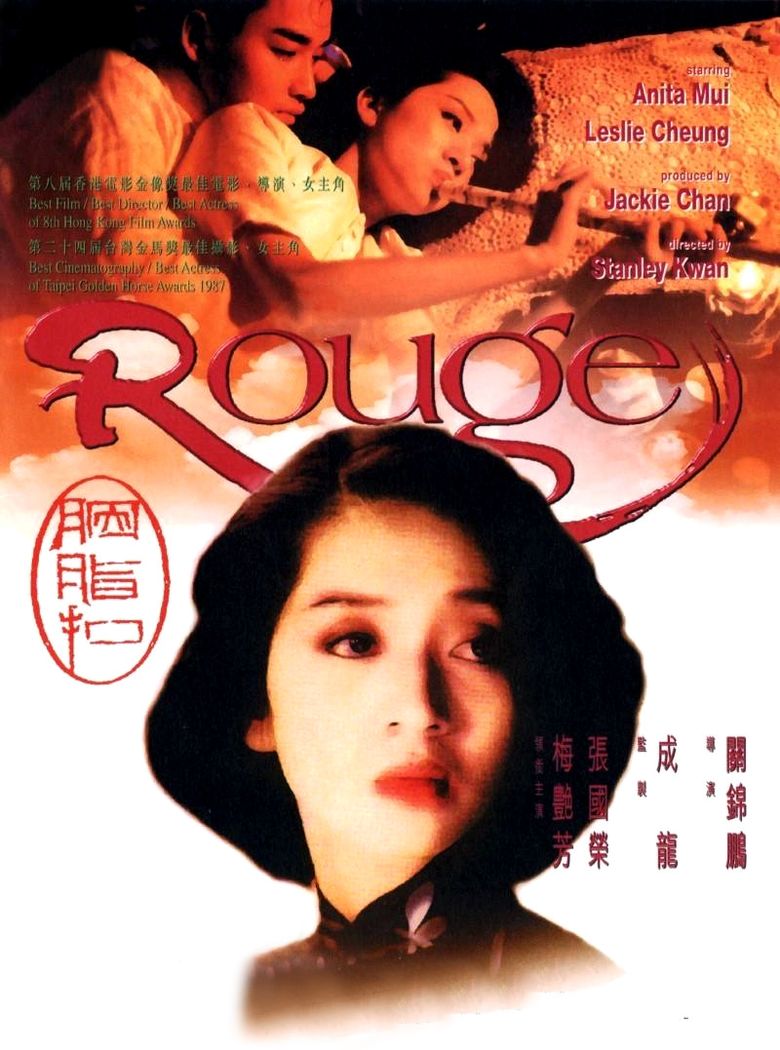
Rouge (胭脂扣, Stanley Kwan, 1988)

Rouge poster 2How long should you wait for love? They say every love story is a ghost story, and Stanley Kwan’s Rouge (胭脂扣) is a love story in more ways than one. A love letter to old Hong Kong, Rouge laments the passing of time and defeat of beauty by efficiency but then stops to wonder if perhaps that isn’t better and if we’re all secretly happier in world in which dying for love has gone out of fashion.

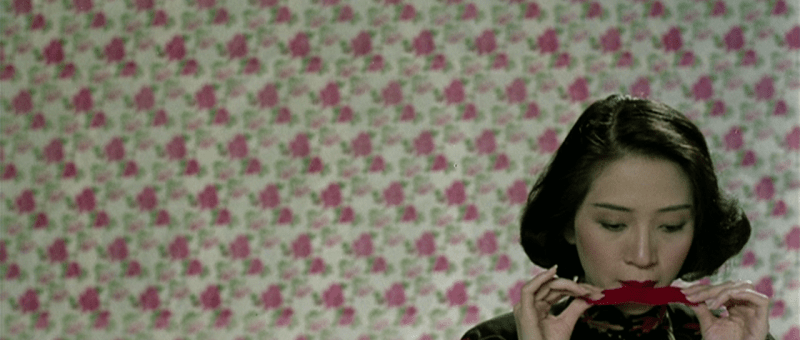
We begin in the early 1930s as courtesan Fleur (Anita Mui Yim-fong), dressed as a man and singing of doomed love, catches the eye of nobleman Master 12 Chan Chen-Pang (Leslie Cheung Kwok-wing). He lavishes gifts on her and the pair fall madly in love, but his family do not approve of the match and are set on Chen-pang marrying their chosen bride. Out of options, the pair decide on double suicide, but Fleur finds herself all alone in the afterlife and, after 50 years have passed, makes her way to the Hong Kong of the late 1980s in search of lost love.

Many things have changed in the Hong Kong of 1988, but luckily they still have classified ads which is how Fleur decides to find Chen-pang. Of course, ghosts don’t generally have need of money which means she’s still out of luck, but for some reason she finds herself attached to the kindly clerk, Yuen (Alex Man Chi-leung), who eventually agrees to “admit” her while he and his reporter girlfriend Chu (Irene Wan Bik-ha) help track down Chen-pang in the hope that Fleur can find him before the next memorial of her passing in two days’ time.

Kwan contrasts the opulence of the 1930s with the stark efficiency of the modern city in which pleasure palaces have been replaced with convenience stores. Fleur wanders through a world much changed, and sees its ghosts everywhere she goes. The Yi Hung teahouse is place of decadent delight filled with music, colour, and elegance but it’s also one built on misery in which young women are trapped and exploited as a direct result of generalised poverty. Hong Kong has moved on and is now one of the wealthiest cities in Asia, bustling with industry and ambition. The modern cityscape may be less aesthetically pleasing, but perhaps that’s not altogether a bad thing if that beauty had existed only to mask an unpalatable reality.

It is true enough that Fleur struggles to make herself understood to Yuen and Chu – her language is no longer current and her way of thinking arcane considering they are only two generations apart. Fleur wonders why the pair of them aren’t married, to which Yuen bemusedly replies that perhaps it’s that there’s no particular pressure urging them towards a more formal union. In any case their relationship seems solid enough in a pleasant, ordinary sort of way. Where Chen-pang gives Fleur the gift of an empty rouge case, Yuen notices Chu’s shoes are worn and thinks to buy her new ones seeing she’s always running about. They wonder if they’d commit suicide for love and come to the conclusion that they wouldn’t, but that doesn’t mean they don’t love each other only that life is precious and that kind of grand romanticism seems so absurd in the much more down to earth 1980s.

Still, Chu and Yuen can’t help but be captivated by the grandeur of Fleur’s romantic longing. They too want to see a happy ending to her tragic story that makes 50 years in limbo worth the wait, but what if Chen-pang was just a selfish coward who woke up from a romantic daydream and went back to his ordinary life of familial obligation and frustrated desire? Fleur died for love, but 50 years later it all seems so senseless and her return is, in a sense, an attempt to come to terms with disappointment – in love and in the world. The Hong Kong of 1988 may have been anxious too, if in a different way, as another uncertain dawn hovered on the horizon but Fleur’s parting gift is to accept that there’s no point waiting for someone who has no intention of coming. She says goodbye to the past, and walks into a new future with a lightness in her step while the past, suddenly burdened, can only look on with regret.


Rouge screens at the BFI on 4th May with director Stanley Kwan in attendance for a Q&A as part of the 2019 Chinese Visual Festival.

International trailer (dialogue free, English captions)