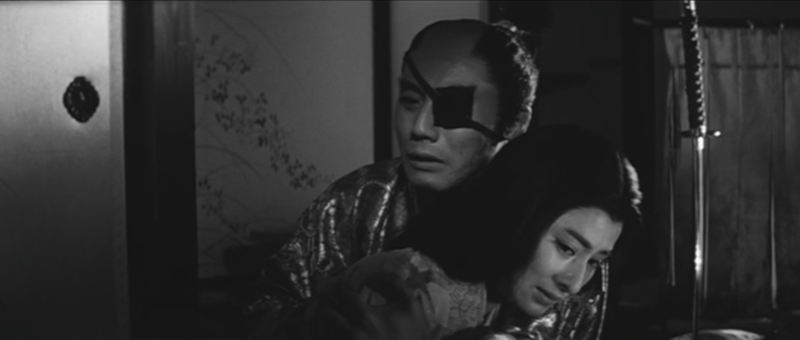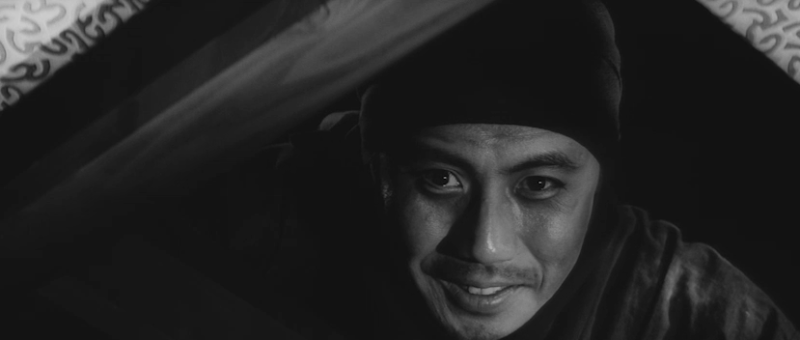
Shinobi No Mono 5: Return of Mist Saizo (忍びの者 続・霧隠才蔵, Kazuo Ikehiro, 1964)

At the end of the previous instalment, Saizo (Raizo Ichikawa) had escaped from the fall of Osaka Castle spiriting away Sanada Yukimura (Tomisaburo Wakayama) who, in contrast to what the history books say, did not die. The pair make their way towards Shimazu, where they are also not well disposed to Ieyasu (Eitaro Ozawa), but as Saizo is informed the Tokugawa clan will never die. Knocking off Nobunaga put an end to the Oda clan, getting rid of Hideyori took the Toyotomi out of the running, but killing Ieyasu will make little difference because another retainer will swiftly take his place.

As a reminder, that’s bad for Saizo because what he wanted was the chaos of the Warring States era back to restore the ninja to their previous status. Nevertheless, at the end of the previous film he claimed to have rediscovered a human heart in his devotion to Yukimura though it may of course be simply another ruse to meet an end. In any case, Ieyasu seems to be putting his ninjas to good use and is once again waiting it out apparently aware that Yukimura is alive and well in Shimazu.

Meanwhile, times are changing. Yukimura is convinced the future of warfare lies in firearms and whoever controls Tanegashima where the weapons are made will prove victorious. They think they can gain it by figuring out how they get access to high-quality iron when trading with anyone outside of Portugal is illegal and the Portuguese don’t have any. It’s access to foreign trade which is becoming a crunch issue as Ieyasu tries to solidify his power, later giving a deathbed order to ban Christianity to stop European merchants taking over the country. Saizo travels to Tanegashima to investigate and figures out that the secret is they’re trading with China, which is pretty good blackmail material, but also encounters two sisters who turn out to be the orphaned daughters of a Tokugawa ninja with vengeance on their mind.

In a surprising turn of events, it turns out that his main adversary is Hanzo Hattori (Saburo Date) but the fact he keeps outsmarting him eventually convinces Ieyasu that the ninja have outlived their usefulness. Hanzo becomes determined to kill Saizo to restore his honour, filling the palace with various ninja traps though unlike Goemon Saizo seems to be one step ahead of them. This lengthy final sequence is played in near total silence, and ironically finds Goemon just waiting, after dispatching several of Hanzo’s men, to see if his poison dart has taken effect and Ieyasu is on his way out. Only in the end Ieyasu just laughs at him. He’s 75. Saizo’s gone to too much effort when he could have just waited it out. Ieyasu has already achieved everything he wanted to. His control over Japan is secured given he’s just been appointed chancellor. He can quite literally die happy because nothing matters to him anymore. A title card informs us that when Ieyasu did in fact die, no one really cared. The Tokugawa peace continued. 

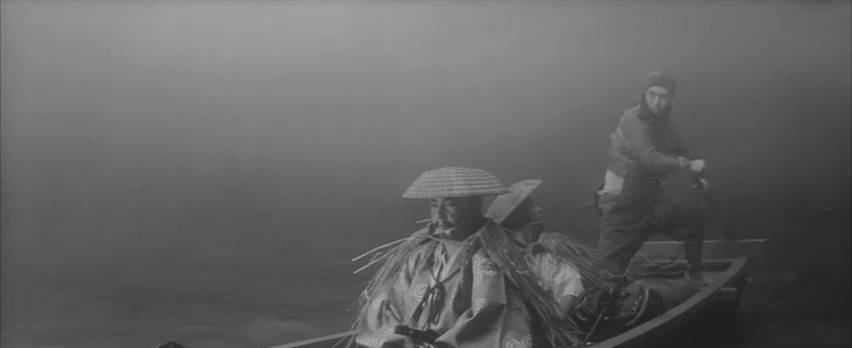
Here, once again, the Ninja too are powerless victims of fate despite their constant machinations. Yukimura tells Saizo to live and be human, advice he gives to the sisters in Tanegashima but does not take for himself staking everything on his revenge against Ieyasu which is, as he points out, pointless for Ieyasu was at death’s door anyway and his demise changed nothing. In his first of two entries in the series, Kazuo Ikehiro crafts some impressive set pieces beginning with a mist-bound underwater battle as Saizo and Yukimura make their escape by water to an epic flaming shuriken battle, though this time around the deaths are noticeably visceral. Men are drowned, stabbed, or caught on wooden spikes. Those who do not obey the ninja code are stabbed and pushed off cliffs while once again emotion is a weakness that brings about nothing more than death. Ikehiro’s frequent use of slow dissolves adds to the dreamlike feel of Saizo’s shadow existence even as the ninja themselves seem to be on the point of eclipse for what lies ahead for them in a world of peace in which there is no longer any need for stealth?
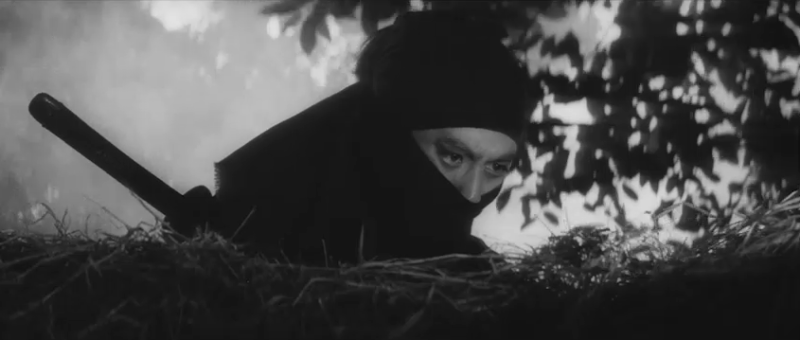

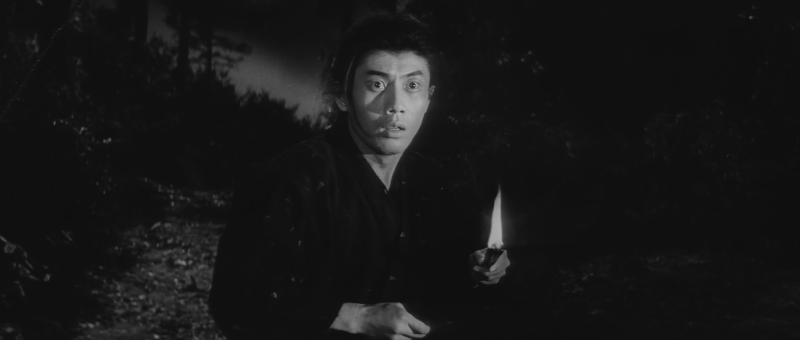
Shinobi no Mono 4: Siege (忍びの者 霧隠才蔵, Tokuzo Tanaka, 1964)

When he began what would become the Shinobi no Mono series, Satsuo Yamamoto had wanted to put a more realistic spin on the ninja movie, shifting from the fantasy-esque wuxia with which the genre had been associated since the silent days to something that was largely devoid of romanticism. In the films he directed, the ninja are powerless manipulators doomed to live unhappy lives defined by a cruel and heartless code. Though still based on the same novel, the third film began to compromise that vision in the hero’s miraculous escape from certain death, ending on a note of ambivalent positivity in which Goemon declines the offer to join Ieyasu and instead walks out into independent freedom. 

The first three films had covered all of the action in Tomoyoshi Murayama’s serialised novel, and so the following four are based on original ideas by screenwriter Hajime Takaiwa save for episode six which is scripted by Kei Hattori and Kinya Naoi. Many of the same actors appear but in different roles while the action has moved on 15 years, skipping ahead from the unseen battle of Sekigahara to the siege of Osaka and the end of the Toyotomi. Raizo Ichikawa stars as another displaced Iga ninja nominally in the service of the Toyotomi but secretly longing to bump off Ieyasu not for reasons of revenge but because there is no place for ninja in his new and peaceful society. If they’re able to unseat him, they assume the situation will revert to the civil war society with the effete Hideyori (Junichiro Narita) too ineffective to assume control over the nascent nation. 

It has to be said, this version of events has rather misogynistic overtones with frequent speeches from Sanada Yukimura (Tomisaburo Wakayama) avowing that it’s all Lady’s Yodo’s (Otome Tsukimiya) fault for giving her son bad advice that he is too naive to know not to follow. In negotiating to end the siege at Osaka castle, Yukimura had advised it was better to strike back against Ieyasu and kill him as soon as possible, but Lady Yodo vetoed it and insisted she and her son remain locked up in relative safety. His conviction is somewhat born out seeing as Ieyasu had deliberately targeted the area of the castle where they assumed she was staying in order to further frighten her.

Nevertheless, he’s astute in realising it was all essentially a ruse and part of Ieyasu’s plan to force the Toyotomi into submission. The attack on the castle was only ever intended to engineer a peace treaty which Ieasyu himself presented and forced Hideyori to sign. Then again, there’s some strange symmetry in play. When Saizo enters the castle in an attempt to assassinate Ieyasu he mangles to trick him into killing his double instead, then when Ieyasu’s ninja try to assassinate Yukimura after following Saizo having known he would pretend to be dead and dig himself out of his own grave they also kill his double much to Ieyasu’s consternation. 

It’s this similarity that Saizo hints at when he pities a retainer of Ieyasu’s explaining that Nobunaga and Hideyoshi had tried to eliminate them but they survived while Ieyasu now wants to use them for his own ends but will likely do the same when they are no longer necessary to him. Thus what they want is a kind of chaos, desperate to assassinate Ieyasu to return to the world in which the ninja are able to influence events from the shadows. Even so his conviction is apparently shaken. As in the previous series, Saizo gains a love interest, Lady Akane (Midori Isomura), who has become a sex worker as an apparent act of self-harm after being raped by Tokugawa soldiers during the fall of Osaka castle. But as we’ve been repeatedly told, a ninja’s heart lies under the blade. Born in darkness, they shall die in darkness and are not permitted to fall in love. Thus Saizo rejects her affections, but eventually declares himself corrupted by wanting to die alongside Yukimura as a loyal soldier. The in-film lore would have us believe that Yukimura did not in fact die during the final assault but was spirited away by Saizo to plot Ieyasu’s downfall in the shadows. 

Directed by Tokuzo Tanaka in his only instalment in the series, the film is shot more like a conventional jidaigeki but returns something of the fantasy aesthetic to the ninja as they somersault through the forest. Saizo’s surname effectively means “hidden in the mist”, which is partly ironic seeing as Akane also describes her rape as being overcome by a thick fog, but is also symbolic of his frequent use of smoke bombs as a disappearing trick which again undermines the sense of realism with which the series began. Yukimura is fond of declaring that the clock cannot be turned back, a sentiment echoed by Akane and emphasising the sense of melancholy fatalism that cannot be avoided in a historical drama in which the outcome is already very well known, imbuing Tanaka’s take with the sense of elegy and legend Yamamoto had so deliberately rejected. 


Ninja, A Band of Assassins (忍びの者, Satsuo Yamamoto, 1962)

Ninja in Japanese cinema had largely been relegated to the realms of childish fantasy prior to Satsuo Yamamoto’s Ninja, A Band of Assassins (忍びの者, Shinobi no Mono) which cast a distinctly less heroic light on the famed mercenary spies of the feudal era. Indeed, there’s something reminiscent of the cult of militarism in the repressive nature of the ninja code and the hero Goemon’s (Raizo Ichikawa) original allegiance to it despite his father’s wariness and attempt to warn him that human happiness has no place in the life of a ninja. 

As the leader of Goemon’s clan, Sandayu (Yunosuke Ito), explains the ninja are obliged to serve whichever lords require their service, but he refuses to work with Oda Nobunaga (Tomisaburo Wakayama, billed as Kenzaburo Jo) owing to his famous animosity towards them. He even goes so far as to call Nobunaga a greater threat to the ninja than demons or devils. Opening in 1573, the film takes place at a tumultuous moment as Nobunaga continues to solidify his plan to unite the whole of the land under his banner by absorbing or defeating rival clans. The pre-credits sequence finds Goemon playing dead on a battlefield surrounded by ominous crows and encountering another ninja from a rival clan, Kizaru (Ko Nishimura), who has become a more literal kind of vulture in stealing from the dead.

Stealing is against the ninja code and something of which the young and idealistic Goemon fiercely disapproves. Nevertheless, in a cruel irony he’s forced to become a burglar in an effort to raise funds for more weapons to combat Nobunaga whom he has also been ordered to assassinate in return for his life after having been caught having an affair with Sandayu’s wife, Inone (Kyoko Kishida). Goemon is inspired by the legendary figure dubbed the Japanese Robin Hood for his mission stealing money from the rich to give to the poor, but here is far from heroic. When his affair with Inone is discovered by a servant, Goemon kills him to maintain the silence. He then believes that Inone has also been killed after falling into a well and attempts to flee the scene only to be confronted by Sandayu. 

Only too late does to he begin to understand what his father tried to warn him about, that the code of the ninja is cruel and unforgiving. It cannot grant him pride or happiness despite the self-satisfied glow he feels on having been singled out by Sandayu as a protege. A ninja must be ready to sever all ties to those he loves and endure intense torture without speaking. If caught in an impossible situation he must scar his face and take his own life as one of Goemon’s acquaintances eventually does after being captured by Nobunaga. Goemon assumes he has no reason to be afraid because he is the most skilled ninja in the garrison and a single ninja can take down a fortress all on his own, but in reality he is powerless, merely a puppet manipulated by Sandayu for his own ends. After falling in love with a sex worker, Maki (Shiho Fujimura), he grows tired of his missions, gives up on burglary, and makes no move to assassinate Nobunaga but is pursued by Sandayu’s minions, the irony being that not even a ninja can escape from the confined space of ninjadom.

This world is so steeped in secrecy that nothing is as it seems and Goemon discovers the rug pulled out from under him in more ways than one before beginning to realise that Sandayu has deliberately engineered his downfall and was most likely behind his father’s murder in an attempt to get his hands on his recipe for gunpowder which is, as Nobunaga says, the future of warfare. Nevertheless, even within its commitment to realism the film contains plenty of ninja tricks from sudden appearances to superhuman leaps and expert shuriken throwing and grappling hooks.  The sense of melancholy futility implied by the presence of the crows in the opening scenes never recedes, Yamamoto frequently descending into mists as Goemon sinks into his confusion and eventual disillusionment with the tenets of ninjadom. Rival ninja clans more obsessed with their reputation and status vie for the head of Nobunga while all Goemon wants is the right to live a quiet life with Maki though that’s something that largely cannot be found amid the constant chaos of the feudal era. 

The Third Shadow Warrior (第三の影武者, Umetsugu Inoue, 1963)

“In this world the weak are playthings of the strong” according to the hidden villain concealing himself slightly to the side in Umetsugu Inoue’s dark identity drama The Third Shadow Warrior (第三の影武者, Daisan no Kagemusha). Adapting a novel by Norio Nanjo, Inoue, most closely associated with sophisticated musicals, shoots in the manner of a ghost story adapting the trappings of a minor parable on the consequences of selling one’s soul for advancement in complicity with an inherently broken feudal order. 

Opening in 1564, the film wastes no time reminding us that the samurai were cruel and duplicitous, a troop of them riding through the contested mountain territory of Hida bearing the severed heads of their enemies casually insulting peasants as they go. Young farmer Kyonosuke (Raizo Ichikawa), however, can’t help but think that they’re heroic and dashing, longing like many young men as the voiceover explains to make his fortune as a samurai in this the age of war. Kyonosuke gets his wish when retainer Shinomura (Nobuo Kaneko) turns up and offers him a job at the castle, only it’s not quite what he expected. Bearing a striking similarity to lord Yasutaka, he has been hired as his third “shadow”, a decoy intended to shield the lord from harm. 

Sitting down with his two new brothers, Kyonosuke remarks how ironic it is that he’s here to escape the land but Kuwano (Katsuhiko Kobayashi) is patiently saving up his pay with the intention of using it to buy a farm and settle down with a beautiful wife. His is the most dangerous of doubling roles as the lord’s battlefield stand-in, while Ishihara (Yuji Hamada), a former actor apparently not much good with the sword, takes his place behind closed walls. Kyonosuke is quite taken with the world of the samurai, but Ishihara cautions that he’ll soon tire of this “phoney life”. In accepting this devil’s bargain, Kyonosuke has in essence consented to his own murder. A shadow man, he can no longer call himself Kyonosuke, but nor can he say he is Yasutaka. He has no fixed identity and is merely in waiting for a veil. Worse still as Ishihara has begun to suspect, they no longer have bodily autonomy because their physicality must match that of the lord. When he is blinded in a battlefield mishap with an arrow, so must they be. Deciding he’d rather not lose an arm, Kyonosuke finds himself in an altercation with his other self which leads to his demise. He intends to make a life for himself under his own name with another clan, but is forced to permanently assume Yasutaka’s identity after being cornered by Shinomura intent on manipulating him for his own ends. 

“I’m no puppet, I no longer need a puppeteer” Kyonosuke exclaims drawing strength from embracing his new identity as a samurai lord, but perhaps overreaches himself in ambitious desire failing to see the various ways he is still merely a pawn in a bigger game as Yasutaka himself once was because the lord is only ever an empty vessel and far more expendable than might be assumed. Princess Teru (Hizuru Takachiho), Yasutaka’s conquest bride, declares that she is “just a doll, the strongest will win me” but is of course playing a role herself, one which she does not desire but has been thrust upon her while her cousin, Sadamitsu (Shigeru Amachi), is engaged in a much more active piece of long form role play. Only the lord’s concubine (Masayo Banri) sees through him, falling for the gentle peasant after the rough lord who toyed with her, but their complicated love eventually seals his fate even as he believes it offers him victory. Kyonosuke became a samurai to escape his lack of agency but is arguably much less free than he ever was, driven slowly out of his mind by his fractured sense of identity and realising that in killing the only man who knew who he “really” was, he also killed himself. 

Quite literally imprisoned, Kyonosuke finds himself a shadow once again neither one man nor another, denied an identity and forever a puppet of duplicitous game players better versed in the realities of the samurai existence. “How ugly fighting over this transient kingdom” the princess disdainfully remarks while herself engaging this apparently meaningless foolishness, reminded by her cousin that a princess may hold the keys to a castle or even a nation even if he implies she is little more than his tool, a puppet to be manipulated if knowingly. Shooting with deep, expressionist shadows, chiaroscuro lighting, and a melancholy voiceover Inoue frames his tale as a parabolic caution against selling one’s soul for gold but also a crushing indictment of the inequalities of the feudal order built on wilful hypocrisy and cynical exploitation. 


A Taxing Woman (マルサの女, Juzo Itami, 1987)

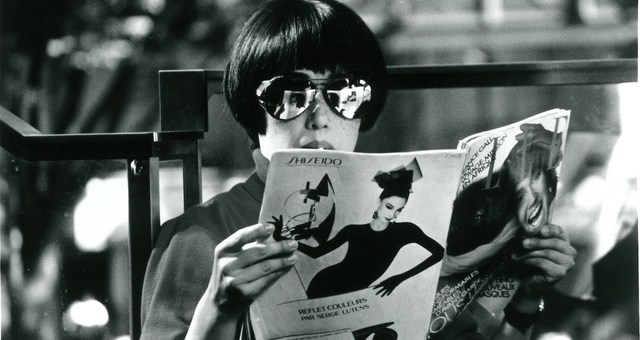
A Taxing Woman posterIn bubble era Japan where the champagne flows and the neon lights sparkle all night long, even the yakuza are incorporating. Having skewered complicated social mores in The Funeral and then poked fun at his nation’s obsession with food in Tampopo, Juzo Itami turns his attention to the twin concerns of money and collective responsibility in the taxation themed procedural A Taxing Woman (マルサの女, Marusa no Onna). Once again starring the director’s wife Nobuko Miyamoto, A Taxing Woman is an accidental chronicle of its age as Japanese society nears the end of a period of intense social change in which acquisition has divorced mergers, and individualism has replaced the post-war spirit of mutual cooperation.

Ryoko Itakura (Nobuko Miyamoto), a single mother and assistant in the tax office, has a keen eye for scammers. She demonstrates this on a stakeout with a younger female colleague in which she keeps a shrewd eye on the till at her local cafe and comes to the conclusion that they’ve been running a system where they don’t declare all of their cheques. Running her eyes over the accounts of a mom and pop grocery store, she notices some irregularities in the figures and figures out the elderly couple feed themselves from the supplies for the shop but don’t “pay” themselves for their own upkeep. That might seem “perfectly reasonable” to most people, but it’s technically a small form of “embezzlement” and Ryoko doesn’t like figures which don’t add up. Seeing as the couple probably didn’t realise what they were doing was “wrong” she lets them off, this time, as long as they go by the book in the future. A more complicated investigation of a pachinko parlour finds a more concrete form of misappropriation, but Ryoko is fooled by the owner’s sudden collapse into inconsolable grief after being caught out and leaves him in the capable hands of his confused accountant.

Nevertheless, Ryoko may have met her match in sleezy corporate yakuza Hideki Gondo (Tsutomu Yamazaki). Dressing in a series of sharp suits, Gondo walks with a pronounced limp that hints at a more violent past but as his rival from the Nakagawa gang points out, violence is a relic of a bygone era – these days gangsters go to jail for “tax evasion” as means of furthering their “business opportunities” and facilitating ongoing political corruption. Gondo’s business empire is wide ranging but mainly centres on hotels, which is how he arouses Ryoko’s interest. She looks at the numbers, does a few quick calculations, and realises either the business isn’t viable or the correct figures aren’t being reported. Ryoko doesn’t like it when the books don’t balance and so she sets her sights on the seedy Gondo, but quickly discovers she has quite a lot in common with her quarry.

Itami was apparently inspired to make A Taxing Woman after the success of Tampopo shoved him into a higher tax bracket. Given Japanese taxes (at the time) were extremely high, getting around them had become something of a national obsession even if, in contrast to the preceding 30 years or so, there was plenty of money around to begin with. More than the unexpected tendency towards civil disobedience the times seemed to cultivate, Itami homes in on the increasingly absurd desire for senseless acquisition the bubble era was engendering. Thus Gondo who owns a large family home well stocked with symbols of his rising social status, also occupies a bachelor pad where he keeps a mistress which reflects the gaudy excess of the age right down to its random stuffed hyena. Nevertheless when one of the tax clerks asks for some advice as to how to have it all, Gondo replies that that’s easy – to save money, you simply avoid spending it. Gondo lets his glass run over and delights in licking the edges. It’s all about delayed gratification, apparently, and having a secret room full of gold bars to gaze at in order to relieve some of that anxiety for the future.

Gondo, like many of his ilk, has “diversified” – yakuza are no longer thuggish gangsters but incorporated organisations operating “legitimate” businesses through “illegitimate” means. Thus we first find him using a nurse who allows herself to be molested by an elderly, terminally ill client whose identity they will steal to found a company they can quickly dissolve when he dies to shift their assets around and avoid the tax man. Later he pulls another real estate scam by pressing a desperate family but his real focus is the love hotels, whose slightly embarrassing existence ensures that not many come poking around. Ryoko, however, is unlikely to let such a large scam slide and delights as much in closing loopholes as Gondo does in finding them. Noticing a kindred spirit, Gondo quite openly asks his new tax inspector “friend” what she’d think if he married his mistress, gave her all his money, and divorced her – divorce proceeds are after all tax free. Sounds great, she tells him, as long as you trust your wife not to skip town with all the doe.

Ryoko, a modern woman of the bubble era, single and career driven, is a slightly odd figure with her officious approach to her job and unforgiving rigour. Unlike her colleague who dresses in the glamorous and gaudy fashions of the times, Ryoko wears dowdy suits and her mentor boss is always reminding her about her “bed hair”, meanwhile she stays late at the office and offers instructions to her five year old son over the phone as to how to microwave his dinner. Though there is another woman working with her at the tax office, when she’s finally promoted to full tax inspector status she finds herself in a room full of guys who apparently hardly ever go home. On her first job she’s only really brought along because she’s a woman and they want to threaten a mob boss’ mistress with a strip search to find a missing key for a safety deposit box. The mistress, however, tries to throw them off the sent by publicly stripping off and encouraging them to check her “cavity” if they’re so keen to find this key, only for Ryoko to find it under the sink while all the guys are busy being shocked. Ryoko’s methods are occasionally as underhanded as Gondo’s and, like his schemes, built on gaming the system but she’s certainly a force to be reckoned with for those considering defrauding the Japanese government.

Gondo’s schemes excel because they aren’t entirely illegal, only clever ways of manipulating the system, but they’re also a symptom of a large conspiracy which encompasses improprieties right up the chain as banks, corporations, and politicians are all part of the same dark economy managed by a corporatising yakuza. Gondo takes frequent calls from a local representative who often “helps him out”. Later the same representative tries to put pressure on the tax office to back off, but Ryoko’s boss points out that he doesn’t need to because the press are already on the story so he should probably get started on his damage control rather than bothering public servants. Gondo and Ryoko, perhaps as bad as each other, lock horns in a battle wills but discover a strange degree of respect arising between them in having discovered a worthy adversary. There’s something undeniably absurd in Ryoko’s firm determination to catch out struggling businesses and the confused elderly with the same tenacity as taking on a yakuza fronted conspiracy, and there’s something undeniably amusing in Gondo’s attempts to beat the man by playing him at his own game, but the overall winner is Itami who once again succeeds in skewering his nation’s often contradictory social codes with gentle humour and a dispassionate, forgiving eye.


Currently available to stream in the US/UK via FilmStruck.

Original trailer (no subtitles)