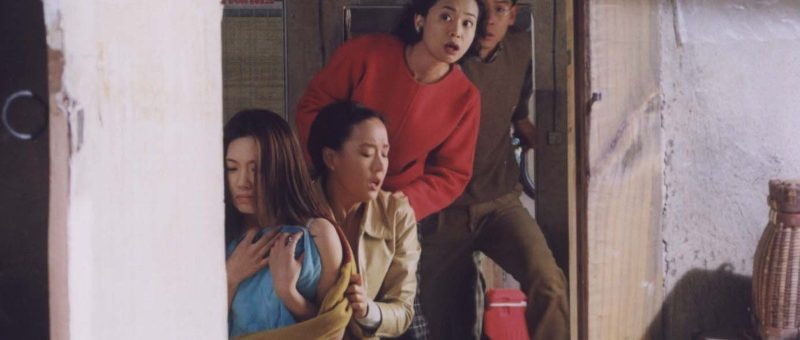

The hypocrisies of contemporary civility pass under the microscope in Park Chong-won’s creepingly intense drama, Rainbow Trout (송어, Song-o). As a collection of urbanites pile into a car and journey far into the mountains to rescue an old friend who’s dropped out and returned to the land as a fish farmer, they find themselves stepping into a world entirely contrary to their understanding but eventually expose themselves as petty, jealous, resentful and shockingly violent even in their disdain towards the “backwards” woodsmen they feel are harassing them.
The film both begins and ends with a tollbooth as the car carrying the urbanites first leaves and then returns to the “safety” of Seoul. Ominous signs pepper their journey, one of the men wondering if the pits on a mirror at a dangerous curve are bullet holes while his friend insists they’re more like pockmarks from small rocks swept up in a storm. Swept up in a storm might be one way to describe what later happens to the city dwellers, but it’s fair enough to say that they are fairly puffed up on the superiority of their urban civility over the earthy lives of the rural hunters. None of them can understand why their friend has made the choice to leave Seoul behind and live a primitive existence in a cabin in the woods.
Chang (Hwang In-sung) even remarks that his fish sometimes commit suicide, Min (Yu In-chon) suggesting that being cooped up in a small space makes them feel anxious. The urbanites are not in a small space, they’re in the wide open countryside, but to them it is claustrophobic in its unfamiliarity. Though the trip starts off well enough as they reminisce with Chang and enjoy a night round the camp fire, the two men, bank clerk Min and his bbq restaurant owner friend Byung (Kim Se-dong), soon fall foul of a local hunter who doesn’t like where they’ve parked their car or possibly that they’ve parked it at all. Byung is forever performing his masculinity, making a show of chopping wood and lifting weights outside the cabin, but like Min otherwise unable to challenge the hunters and entering a mini vendetta of pettiness with them that is destined to end badly. Min meanwhile is preoccupied in knowing that his wife, Jun-hwa (Kang Soo-yeon), is still in love with Chang while Chang’s decision to leave the city seems in part to have been provoked by their marriage. Byung’s wife, on the other hand, ironically submits to her carnal desires after being caught stealing a rabbit from a trap by a lecherous hunter who later shows up with a gift of yet more meat which seems somehow like even more of a betrayal given that her husband runs a barbecue meat restaurant but is obviously not quite red-blooded enough for her.
It’s the presence of Jun-hwa’s younger sister Se-hwa (Lee Eun-ju), however, that provokes further tensions in the group not least as she develops a fondness for Chang while local dog breeder Tae-joo (Kim In-kwon) develops a fascination for her. Tae-joo peeps on Se-hwa in the outhouse and creepily lurks around the cabin though he is perhaps just awkward if a little strange more than actively dangerous. Nevertheless he becomes the target for the husbands’ frustrated masculinity as they decide to exorcise some of their frustration on a mountain boy who is ill-equipped to resist them, unleashing uncivilised violence and barbarity that would bring them to the point of homicide. They assume Chang is like them, that he will side with the city, but Chang is now a mountain man and has shades of barbarity the husbands’ little suspect. As the crisis intensifies, the urbanites shift the blame and turn on each other, uncomfortably blaming Se-hwa as if it were her fault that the boy took a liking to her or that the men took it in the direction that they did. Se-hwa also finds herself a victim of male violence from an unexpected source but is again blamed for it less for her naivety than the simple fact of her existence as a young woman in this incredibly primal environment.
The urbanites thought the hunters to be savage, but in reality were savage themselves only to convince themselves that they had done nothing wrong pleading with Chang to cover up their violence because Tae-joo is only a mountain boy while they are civilised people from the cities who could not have acted in anything other than a civilised way. They are in a sense like the rainbow trout, raised within a narrow frame and little understanding how to live outside of it, driven out of their minds by the removal of the guardrails of civility. On returning to the city they may convince themselves that the dark shadows within have disappeared but the fragility of their sophistication has already been exposed rendering them at least less honest than the huntsmen who made no pretence of their carnality.
Rainbow Trout screened as part of this year’s London Korean Film Festival.
 You gotta know how to hold ‘em, know when to fold ‘em, know when to walk away and know when to run. Apparently these rules of the table are just as important in the cutthroat world of the Korean card game Hwatu as they are in the rootinest tootinest saloon bar. Like most card games, having the winning hand is less important than the ability to play your opponent and so it’s more a question of who can cheat the best (without actually breaking the rules, or at least being caught doing so) than it is of skill or luck. A second generation sequel to 2006’s Tazza: The High Rollers, The Hidden Card (타짜-신의 손, Tajja: Shinui Son) is a slick, if overlong, journey into the dark, underground world of gambling addicted card players which turns out to be much more shady than the shiny suits and cheesy grins would suggest.
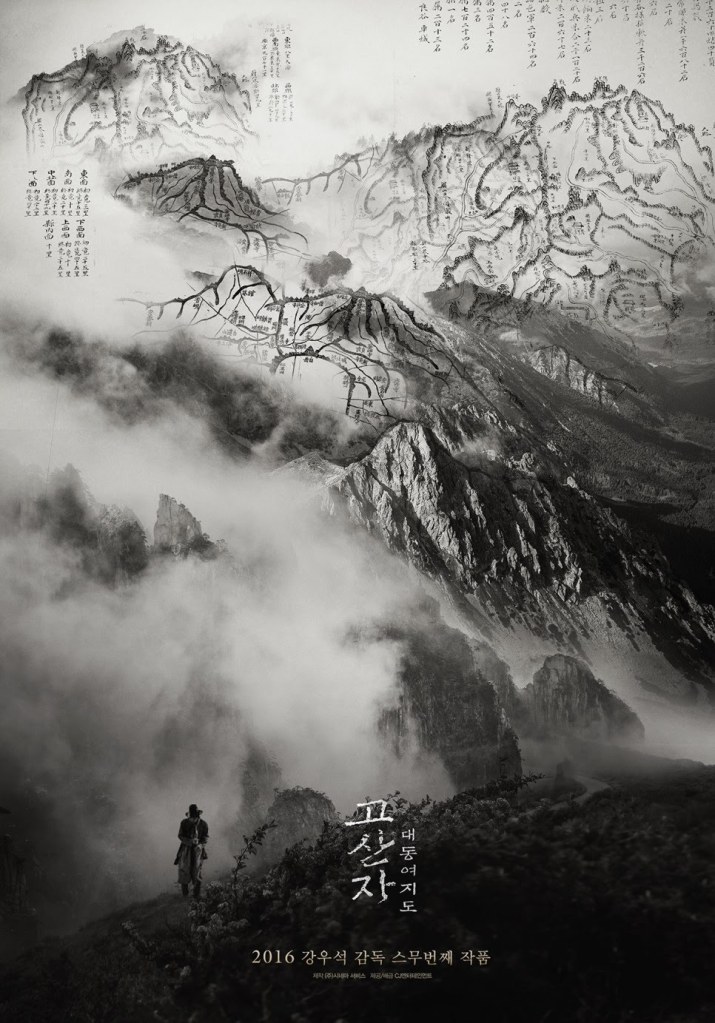 The map is not the territory – as the old adage goes. There’s always a difference between the thing itself and the perception of it but, as the “hero” of The Map Against the World (고산자, 대동여지도, Gosanja, Daedongyeojido) points out, if you’re about to set off on a long journey it’s a good idea to not to rely on a linear map else you’ll run out of good shoes long before you reach your destination. Kim Jeong-ho (Cha Seung-Won) was, apparently, a real person (though little is known about him) who set out to make a proper map of the Korean peninsula after a cartographic error led to the death of his father and many other men from his village when they ran out of resources crossing what they thought was one mountain but turned out to be one mountain range.
 Because it’s there. As good a reason as any for doing anything but these were the only three words of explanation offered by George Mallory in answer to the question “Why climb Everest?”. In Powell & Pressburger’s The Red Shoes, the heroine reacts in a similarly philosophical fashion when asked “Why do you want to dance?” replying with the question “Why do you want to live?”. What makes some people prepared to dance until their feet bleed and their toes break, and sends others to the peaks of snowcapped mountains staring death in the face as they go, is something which cannot be fully explained in words but cannot be denied by those who hear its calling.
 Windows on Worlds