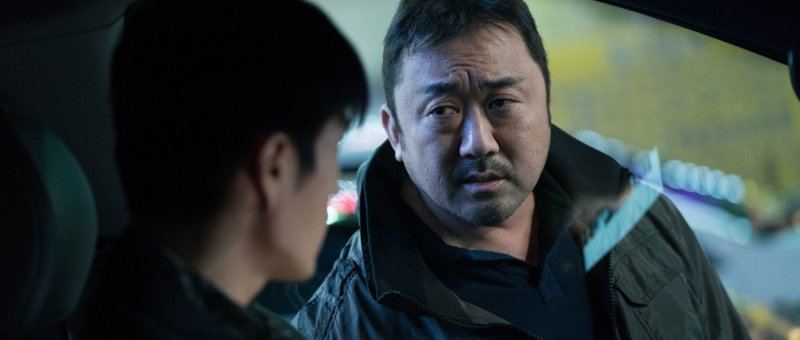
The Roundup: Punishment (범죄도시 4, Heo Myeong-haeng, 2024)

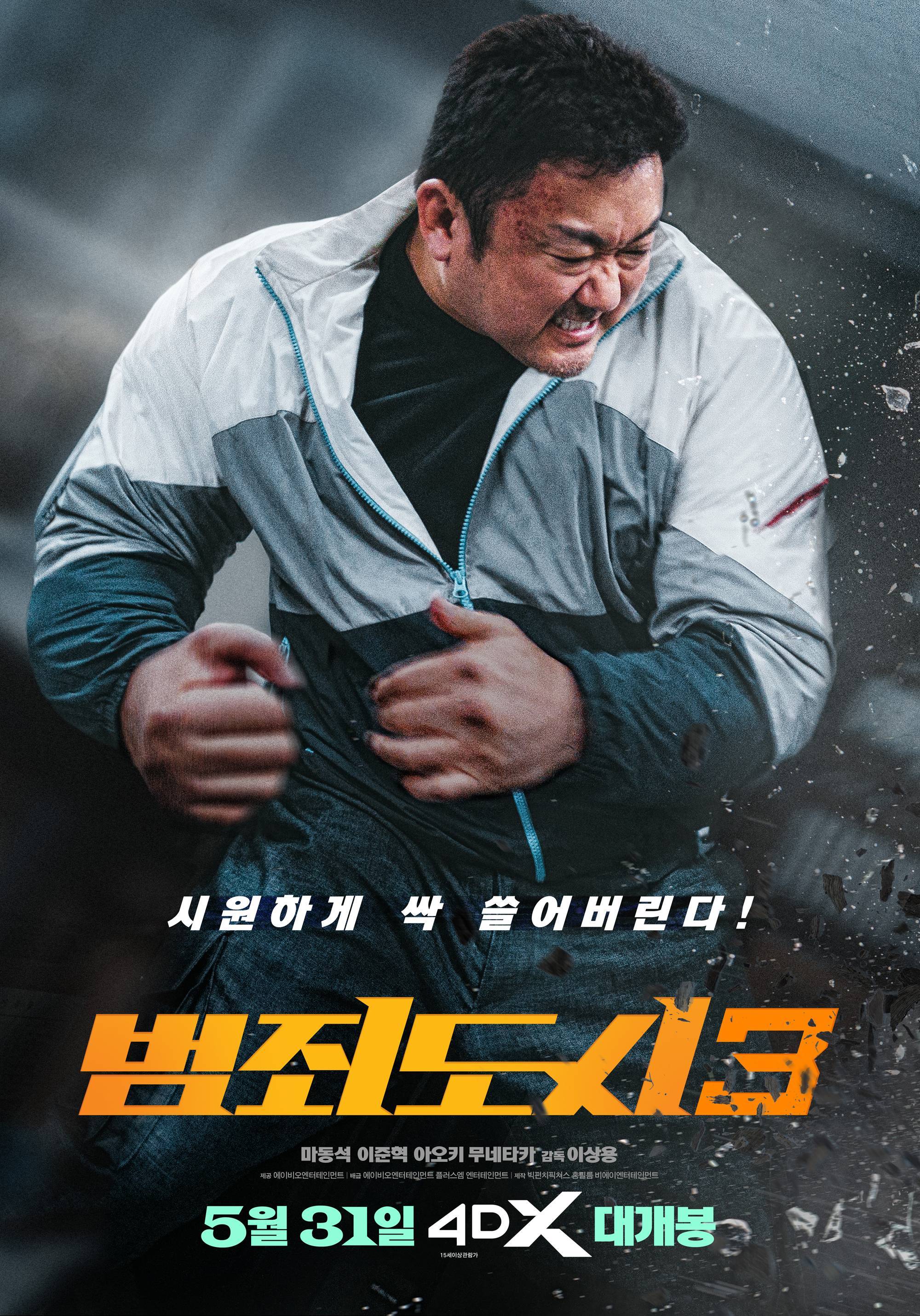
There’s a moment in the fourth instalment of the Roundup series when monster cop Seok-do’s boss asks him what good his fists are in the age of cyber crime. More so than in previous episodes, Punishment (범죄도시 4, Beomjoedosi 4) seems to lean hard into the idea that Seok-do iMa Dong-seok) is a dinosaur stuck in the 1970s and unable to understand the modern world. He’s a bruiser cop in an era of supposedly compassionate policing, a thug sent to catch a thug. Yet he’s also presented, as is actually said by his superior officer, as everything a good cop should be in his determination to nail the bad guys to keep a promise to a murder victim’s devastated mother.

But as in the previous films, the victim largely gets forgotten until the very end when Seok-do and his colleagues pay a visit to his grave. Set in 2018, the film is apparently inspired by a real life case and in an echo of the kinds of explanatory title cards seen at the end of Chinese films, ends with a reminder that the government began cracking down on cybercrime in that year. Reminiscent of anti-gambling drama No More Bets, the victim here is also a computer programmer effectively enslaved after being lured to the Philippines on a promising job offer only to be forced to work on casino websites by organised crime. Seok-do is mostly concerned with catching the bad guys rather than exposing this nefarious practice or its effects on those who fall victim to its addictive gambling scam. 

In any case, a running joke sees Seok-do once again cast as a dinosaur apparently unable to grasp simple concepts of modern technology. “Right, we’ll go get it before it closes, then,” he replies when informed the villains used “open source software”. He thinks syncing to the cloud means a crowd of people will come help you set up your phone and he never replaces his because it’s a bother to put in all those numbers into your contacts again. The team end up having to recruit a new team member from cybercrime, the only woman in the room which comes in handy when they need her to pose as the girlfriend of familiar comic foil Jang Yi-soo (Park Ji-hwan) who is tricked into thinking he’s been deputised with a shiny badge that looks like it fell out of a serial packet and has the telltale letters FDA at the top which Seok-do convinces him stands for Police Dark Army.

Despite all the thuggery, there’s something essentially childlike about Seok-do’s roguishness that sees him delight in playing a trick on Jang Yi-soo. After wrecking the first class cabin of a soon to depart plane, he walks off sheepishly like naughty little boy ignoring his boss’ frantic calls to come back and explain himself. In this instalment, we get less of the overt references to police brutality with one brief scene of Seok-do putting a motorbike helmet on a suspect and beating him over the head while his colleague keeps watch outside as we peek in through the widow. To remind us he’s still the good neighbourhood cop, we see several scenes of him visiting a restaurant run by the widow of a colleague killed in the line of duty and secretly slip his teenage daughter wads of cash to buy something nice for herself. 

What it all amounts to is a slightly awkward advocation for the police who are directly stated to be always there to protect the citizens and catch criminals who harm them even if they do It abroad. To this extent, Seok-do is a good cop literally smacking some sense into bad guys because it turns out his giant fists can fight “digital” crime after all and there’s no denying that it does feel good to see Ma Dong-seok smack bad guys. The action scenes this time around are visceral and surprisingly bloody not to mention loud with the sound of Ma’s thunderous fists flailing around. The film’s distinctly retro sensibility is echoed in the ‘70s score which seems to hark back to an era of maverick cop movies about men like Seok-do who keep order on the streets while Seok-do himself seems increasingly like a man out of time, a throwback to a bygone era perhaps uncomfortably romanticised in the quasi-authoritarian sensibility which seems to underpin it.


Festival trailer (English subtitles)

Cobweb (거미집, Kim Jee-woon, 2023)

An insecure filmmaker becomes entangled within the movie in his mind in Kim Jee-woon’s homage to golden age Korean cinema, Cobweb (거미집, Geomijip). The film has caused some controversy with the family of director Kim Ki-Young attempting to file an injunction to prevent its release complaining that it shows him in a bad light, which is one reason earlier prints of the film listed the protagonist’s name as “Kim Ki-yeol” while it has now been changed to simply “Kim Yeol”. Kim Jee-woon argues that the character is not intended to represent Kim Ki-Young but is an amalgam of various directors of that time, yet it is true that his filmmaking has more than a little in common with that of the late director of The Housemaid.

Another reason they may have been upset is that the film turns on a tragic studio fire that cost the life of a director while Kim Ki-Young himself really did die in a house fire though 20 years later at the age of 78. Meanwhile, the director who dies in the studio is clearly modelled on Shin Sang-ok. The actor who plays him (Jung Woo-sung) is styled to look exactly like Shin who often appeared wearing sunglasses. The film’s Shin Sang-ho (Song Kang-ho) is an example of an artist who gave all of himself for his art and then was quite literally consumed by it, stepping into the flames to get the perfect shot while burning with artistic passion. 

Kim Yeol (Song Kang-ho) by contrast can only watch. He’s hassled by some film critics in a diner who call him a “trash” director while suggesting that only his debut was any good and that was probably because it was Shin Sang-ho’s script though Kim Yeol is forever telling everyone that he really did write it himself. They ask him if he is still a servant in Shin’s house, a question that deeply wounds him not least because he has become the inheritor of Shin’s production company but struggles to emerge from his shadow. 

These themes of servitude and oppressive hierarchies are expressed through the film that Kim Yeol is making, itself titled Cobweb, which he has a sudden urge to reshoot in order to make it a “masterpiece” and prove that he is more than just a hack director of “trashy” genre films. The problem is that in the authoritarian 70s in which the film takes place, Korean cinema was constrained by an ever tightening censorship regime which prohibited any criticism of the government and required that films push conservative moral messages. Kim Yeol wants to take his conventional melodrama in which a young woman takes her own life in sacrifice for her family, and turn it into a story about a “modern woman” who refuses to do so. The wife, Mi-ja (Im Soo-jung), will now be a woman plotting a slow-burn revenge against the wealthy family who callously cast out her pregnant mother who had been their maid eventually teaming up with a Housemaid-esque factory girl who had given birth to her husband’s child, along with a former servant turned forest-dwelling hunter. 

Getting that past the censors might be difficult, even if they weren’t already on high alert after finding out about Kim Yeol’s unauthorised changes to the script which had already been passed. Kim Yeol is confident he can get it all shot within two days, but his cast aren’t very happy about being brought back or about the new direction of the film. “Why is it all so corny and overblown?” an exasperated veteran actress sighs unconvinced by Kim Yeol’s “vision”. Fiction and reality are increasingly blurred. The leading man really is having an affair with the woman who plays the factory girl who is secretly pregnant, a huge scandal in the waiting in the stringent 70s society where adultery is a criminal offence. A method acting policeman claims he has a prison cell in his home and spies on the illicit couple in noir fashion making little notes in his notebook. Kim Yeol meanwhile is so wrapped up in the film that he answers the phone on set rather than the one on the lot which is actually ringing. At a climatic real life moment, it’s the music cue from the melodrama which finally breaks in.

There’s a striking contrast between the full colour set design as we see it and the way it appears in the high contrast black and white of the film within the film which is full of gothic touches such as driving rain and thunderstorms not to mention film noir lighting and eerie composition. Kim Jee-woon includes a series of homages to golden age directors from the obvious nods to The Housemaid to echoes of The Devils Stairway while director Lee Man-Hee gets a name check as, perhaps ironically, a more established figure whom Kim Yeol fears his AD will leave him for.

Lee Man-Hee also had a fair amount of trouble with the censors and was actually arrested for breaking the National Security Law due to his overly sympathetic depiction of North Korean soldiers. In an attempt to get the censors off his back, Kim Yeol lies that the film is “anti-communist” while the head of the censor’s board relents because he’s just so excited about seeing North Korean spies get burned to death in Kim Yeol’s incendiary long shot. In a running gag, no one but Kim Yeol really understands the ending of the film though calling it anti-communist might be a stretch even if it might satisfy the censor’s moral concerns. In any case it remains uncertain if Kim Yeol, who has a hallucination of Shin Sang-ho giving him a fiery pep talk while hopped up on anxiety mediicine that might be destabilising his sense of reality, is really happy with his work and has finally managed to overcome his insecurity or is still entangled in Shin’s web and in the end slowly consumed by it.


Cobweb screens 13/14th October as part of this year’s BFI London Film Festival.

International trailer (English subtitles)
The Roundup: No Way Out (범죄도시 3, Lee Sang-yong, 2023)

Ma Dong-seok has been cultivating an image of himself as an action star for quite some time. The kind of marquee name who generally plays the hero, Ma looks back to the genre’s heyday presenting an uncomplicated vision of righteous masculinity, a bruiser with a heart of gold. The Roundup: No Way Out (범죄도시 3, Beomjoedosi 3) is the third in a series of films that began with The Outlaws and is projected to total at least eight instalments each starring Ma as the maverick detective his superiors hate to love. 

It’s true enough that you can’t get away from the more problematic elements of his unreconstructed good bad cop persona. We often see Seok-do (Ma Dong-seok) beat information out of suspects which the film treats as a cheeky joke in an otherwise tacit endorsement of police brutality that suggests red tape is the reason the guilty often evade justice. Meanwhile, in a step back from other Ma vehicles there are almost no women in the film and none in the police force. The heart of the case is the death of a 28-year-old woman who “fell” from a hotel room window and is later discovered to have died of a heart attack after being drugged in a club and dragged off by a random man who then literally threw her away to distance himself from the crime. The murder which Seok-do is supposed to be investigating is totally forgotten in his all encompassing drive to find out where the drugs are coming from which eventually descends into a battle of wits with a corrupt police officer who’s teamed up with a Korean-Japanese yakuza to skim his boss’ supply of new designer drug Hiper. 

There is a distinctly uncomfortable thread of xenophobia that runs through the series even if in this case the villainy is discovered closer to home in the form of police corruption. This time around, the threat is once again Japan which is apparently where Hiper originated though petty yakuza Tomo (An Se-ho) now manufactures it in Korea where he’s cut a freelance deal with dodgy cop Joo (Lee Joon-hyuk) to distribute it in the local night life scene without the knowledge of his boss back in Japan, Ichijo (Jun Kunimura). Joo has also cut a deal to sell the drugs to a Chinese gang, so it’s quite bad news for him when Ichijo gets wind of the situation and Tomo takes off with a suitcase full of pills for his own protection. Unluckily for him, Ichijo has already sent his most intimidating assassin, Riki (Munetaka Aoki), to find out what’s been going on behind his back. 

Problematic as it may be, Ma’s retro take on the action star is undeniably entertaining with his frequent hero moments and penchant for one liners. The first time he appears, we see him break up a street fight but mostly interested in finding out if the guy on the ground started it the implication being that perhaps if he did it’s none of his business but otherwise he’s going to have to intervene. Then again as he tells his exasperated boss, his personal motto is “punish and serve” and he’s here to get the job done even if that means wading in all fists blazing without much thought for regulations or procedure. At one point Seok-do and his guys stumble on a crime scene and walk around it touching everything in sight without bothering to even put on so much as gloves. 

In any case, Lee makes every punch land and quite literally as the screen seems to vibrate on contact almost as if the camera itself were taking a blow. Ma’s thunderous fists clash with the sound of justice as he all too easily disables hardened gangsters with one well placed slap. At times, his invincibility borders on the ridiculous but he does eventually allow himself be “defeated” if only temporarily as in his miraculous recovery from being run over by a gangster’s car. In many ways, Joo is Seok-do’s mirror, a bad bad cop with crazy eyes who kills without a second thought and behaves with narcissistic recklessness, overconfident in his abilities to sort his problems through his status as a law enforcement officer. Bruiser he may be, but Seok-do likes arresting people and never uses lethal force even when the opportunity is presented to him, symbolically snapping Riki’s katana and then proceeding to slap him seven ways to Sunday leaving the ice cool assassin collapsed amid a display of Japanese parasols. An end credits scene set three years later in 2018 sets up a fourth instalment and the return of a familiar face besides that of Seok-do himself who continues to charm as the world weary bruiser slapping down crime wherever it rears its ugly head. 


The Roundup: No Way Out is in UK cinemas now.

International trailer (English subtitles)

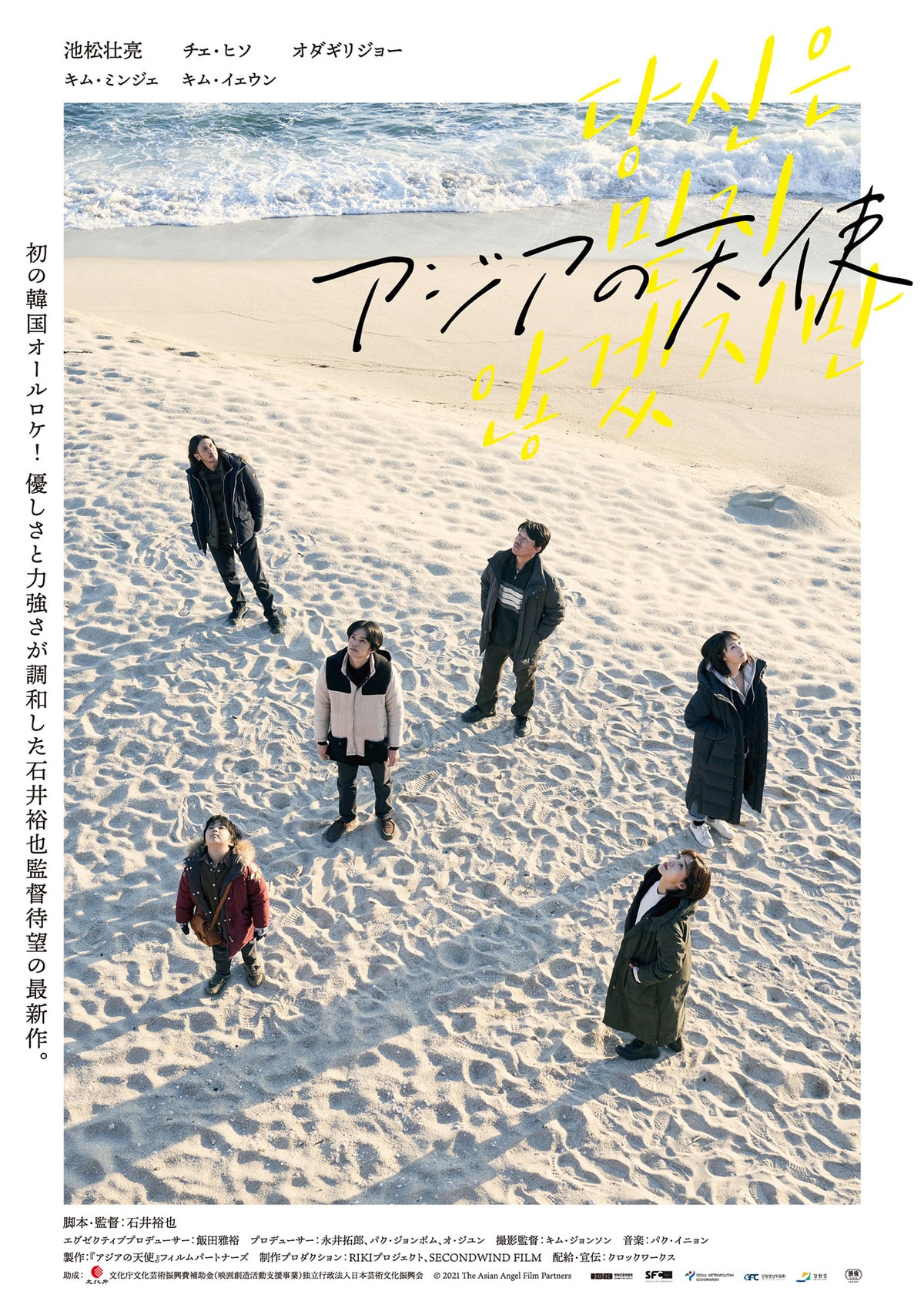
The Asian Angel (アジアの天使, Yuya Ishii, 2021)

A collection of lonely souls is brought together by angelic intervention in Yuya Ishii’s grief-stricken appeal for “mutual understanding”, The Asian Angel (アジアの天使, Asia no Tenshi). Brokering the sometimes difficult subject of Japan-Korea relations, Ishii makes a plaintive case for a pan-Asian family while his wounded protagonists each search for meaning and possibility in the wake of heartbreak and disappointment. Yet what they discover is less the urge to move forward than the gentle power of solidarity, bonding in shared sense of displacement and forging a new home from an apparently fated connection. 

Displacement is a feeling which immediately hits struggling author Tsuyoshi (Sosuke Ikematsu) as he struggles to make himself understood to a grumpy Seoul taxi driver after taking his brother up on an offer to relocate to Korea with his young son following the death of his wife some time previously. Toru (Joe Odagiri), however, has not quite been honest about his life in the Korean capital, housed above a church where they always seem to be rehearsing the hymn Angels We Have Heard on High. Wandering into the apartment, Tsuyoshi is physically thrown out by Toru’s grumpy business partner (Park Jung-bum) obviously unaware they were coming as even Toru himself seems to have forgotten inviting them. In any case, the trio eventually find themselves on the street after Toru’s Korean friend with whom he’d started an illicit business smuggling cosmetics betrays them. 

Meanwhile, across town melancholy songstress Sol (Choi Moon) has been supporting her brother and sister with her music career which seems to be on the slide with a faintly humiliating gig in a shopping mall which briefly brings her into contact with Tsuyoshi, apparently captivated by her sadness. Abruptly informed her contract has been terminated, she tries to take the matter up with her manager/lover but gradually realises she’s merely one of several ladies on his books. Feeling lost, she agrees to follow up on a suggestion from her brother Jun-woo (Kim Min-jae) to pay a visit to the grave of their parents who passed away while she was only a child. 

Running into each other on the train after Toru talks Tsuyoshi into a possible seaweed venture in Gangwon, the two trios end up travelling together if originally struggling to find the “mutual understanding” that Tsuyoshi had been looking for. The first message Tsuyoshi sees on his phone on after arriving informs him that Korean-Japanese relations are at an all time low, though perhaps one would think national tension might not descend to the interpersonal level even if he appears to feel slightly awkward as a Japanese man in Korea aside from his inability to speak the language, but after a few too many drinks at a Chinese restaurant Jun-woo starts in on how 69.4% percent of Koreans apparently disapprove of Japan while 61% of Japanese apparently disapprove of Korea which is one reason he wouldn’t be keen on his sisters dating a Japanese guy. Describing himself as a “progressive”, he claims it’s the relatives who wouldn’t accept it but ends the conversation by cheerfully looking forward to when they can finally “part from these Japanese forever”. 

Yet, they do not part despite several opportunities and in fact end up travelling together for a significant distance during which they begin to bond, discovering that they have much in common including the loss of loved ones to cancer and the improbable sighting of angels who appear not like those on the Christmas cards but a weird old Asian man with a tendency to bite. Several times they are told they shouldn’t be together, Toru lamenting that love between Japanese and Koreans is as impossible as that between angels and humans while a police officer later bemusedly remarks that they don’t look like a family but family is in a sense what they become as they each sort out their respective traumas and resentments to reach a healthy equilibrium. Perhaps you couldn’t quite call it love, but almost and it might be someday if only you let it. “Seeing the world through your eyes I might come to like it a little more” Tsuyoshi admits, while Sol too begins to awaken to a new sense of freedom and possibility brokered by an angelic intervention. Marrying the melancholy poetry of The Tokyo Night Sky is Always the Densest Shade of Blue with the gently surreal sense of humour of his earlier work, Ishii’s deeply moving drama makes a quiet plea for a little more “mutual understanding” between peoples but also for the simple power of human connection as evidence of the divine. 


The Asian Angel screened as part of the 2021 Osaka Asian Film Festival.

Images: (c) 2021 The Asian Angel Film Partners

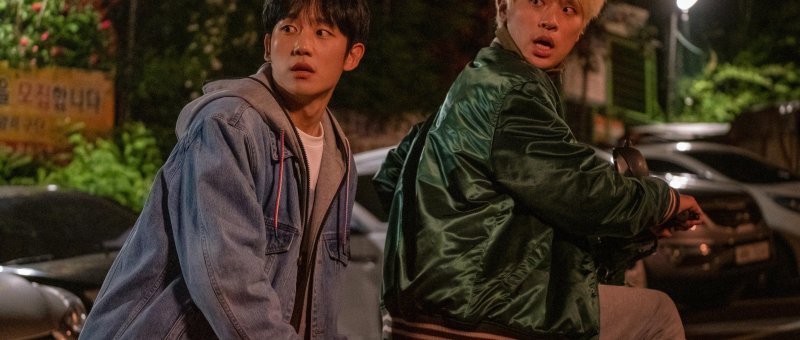
Start-Up (시동, Choi Jung-yol, 2019)

Two young men experience a failure to launch in Choi Jung-yol’s Start-Up (시동, Sidong), a much gentler coming of age tale than his 2016 feature debut One Way Trip. Like the earlier film, however, Start-Up finds its two heroes pulled in different directions while experiencing the same dilemmas, these being in the main a kind of toxic masculinity that sees them in part reject their respective maternal figures in internalised shame as sons who feel they should be but are fundamentally incapable of taking of care of them and perhaps concluding that their only familial connection must be disappointed and resentful.

We can see the boys’ sense of futility in the opening sequence in which they literally fail to kickstart a scooter that 18-year-old Taek-il (Park Jung-min), the hero, has somehow managed to buy on the internet but seems to be a dud. Eventually they wind up having an accident and being taken to the police station where Taek-il’s mother Jeong-hye (Yum Jung-ah) has to bail them out leaving even the desk officers looking quite embarrassed as she takes Taek-il to task for his irresponsibility, disappointed to learn he spent money intended for lessons to help him (belatedly) get his high school diploma on the useless scooter. He tells her he’s dropped out of school and has no interest uni, fiercely resenting her refusal to accept his decision while unwisely cutting in that she doesn’t have the money to send him anyway which earns him one of her trademark volleyball slaps. 

Taek-il’s unwise words perhaps hint at part of the reason he’s rejecting the life his mother wants for him in that he knows how much she’s suffered and sacrificed on his behalf and doesn’t want to add to her burden by encouraging her to overwork herself to pay for college when he doesn’t think he’s worth it anyway. Of course, he can’t say any of this to her, and she can’t tell him she only wants the best for him, so they alternate between silence and blazing rows with Taek-il retreating into peaceful visions of life on a desert island when everything gets too hard. Wanting to prove himself independent, he ends up running away but doesn’t have money to get very far so ends up working in a Chinese noodle restaurant in provincial Gun-san. 

His friend Sang-pil (Jung Hae-in), meanwhile, is an orphan living with his elderly grandmother (Go Doo-shim) who appears to be suffering from dementia and has been supporting the pair of them by peeling chestnuts. Like Taek-il, Sang-Pil desperately wants to be able to take care of his grandmother and make her life as easy as possible but is largely out of options which might be why he lets a shady friend, Dong-hwa (Yoon Kyung-ho), introduce him to his “company” which turns out to be a local loansharking gang for which Dong-hwa is an enforcer and debt collector. Sang-pil tells Taek-il that he’s got a job “in finance”, and though he’s conflicted enjoys the sense of self worth he gains as a working man earning money to look after grandma. He is too naive to realise that the first family they visit is aggressively nice to Dong-hwa because he’s probably been less than nice to them in the past, coming away with the mistaken idea that the job’s not so bad and people are grateful for the “service” they’re providing. 

A repeated gag sees both boys getting repeatedly beaten up, literally struck down every time they attempt to move forward. Taek-il finds himself punched in the stomach by an amateur boxer with problems of her own and thereafter knocked around by the eccentric chef at the Chinese restaurant (Ma Dong-seok), while Sang-pil is finally awakened to the dark side of his new job when he’s thrown through a glass doorway by a drunken client very clearly at the end of his tether. The answer is less fighting back than it is standing together and up for oneself as the boys begin to make mutual decisions about the future directions of their lives and the kind of men they’d like to be even if they still don’t quite know where they’re going. 

Start-Up’s genesis as an online webmanga might help to explain its myriad unresolved plot strands including the backstory of the mysterious boxing high school girl (Choi Sung-eun) who appears to have lost or become estranged from her family but ends up becoming the surrogate daughter of the kindly man who owns the Chinese restaurant (Kim Jong-Soo) which seems to be a haven for lost people of all ages looking for a place to call home, while Jeong-hye’s past success as a volleyball star is resolved as little more than an awkward punchline and her desire to start her own business which she is then swindled out of presented as something done solely for her son rather than for herself. The difficult economic circumstances of contemporary South Korea are certainly a factor in the boys’ malaise and general sense of hopelessness but it’s less Hell Joseon that’s trapping them than a complex web of familial love and resentment coupled with their desire as a young men to feel in control of their own lives rather than being constrained by parental expectation. “You should decide where to go first” Taek-il is repeatedly told, but when it comes right down to it the most important thing is figuring out how to start the engine, everything else you can figure out later.


International trailer (English subtitles)

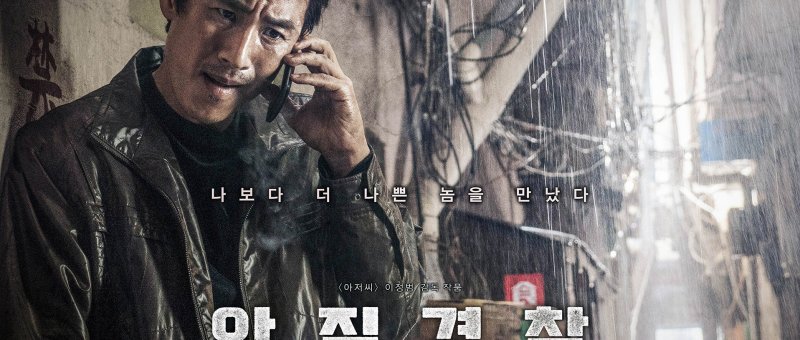
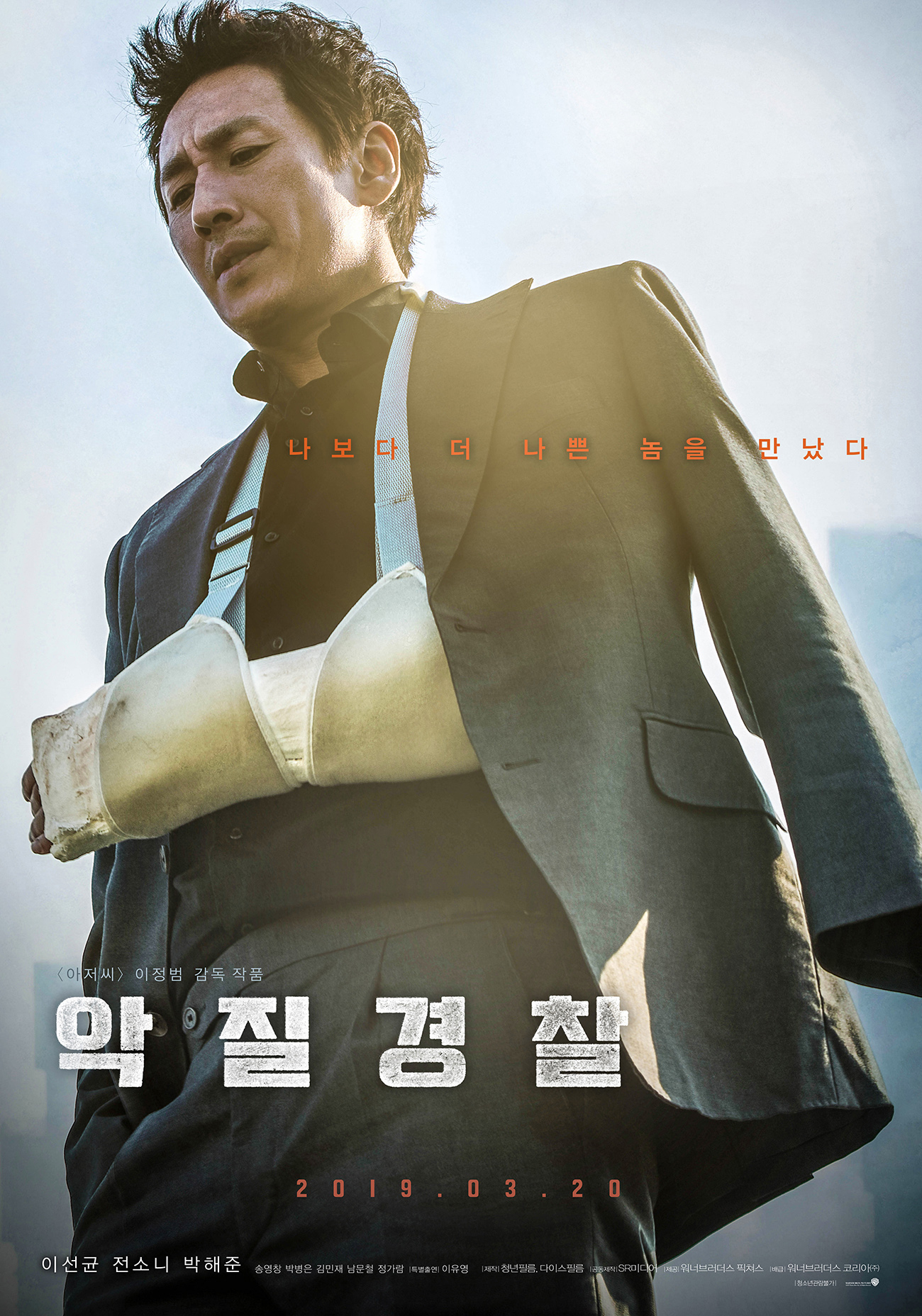
Jo Pil-ho: The Dawning Rage (악질경찰, Lee Jeong-beom, 2019)

Jo Pil-ho- The Dawning Rage posterThe Man From Nowhere’s Lee Jeong-beom returns five years after No Tears for the Dead with another retro crime thriller, though this time one with additional bite as he digs into a nation quite clearly failing its young. Another of the recent films set in the post-Sewol world, Jo Pil-ho: The Dawning Rage (악질경찰, Akjilkyungchal) is a noirish voyage through an intensely corrupt society in which Chaebols act with impunity while goodhearted schoolgirls are branded delinquents and left to fend for themselves by the “adults” who seem to have abandoned all sense of social responsibility.

Our hero and the titular “bad cop” of the Korean title, is Jo Pil-ho (Lee Sun-kyun) – a corrupt police officer who abuses his position to force criminals to commit crime on his behalf. Recently, he’s teamed up with a teenage safecracker, Gi-chul (Jung Ga-ram), and is also involved in an ill-advised business relationship with a petty gangster. IA are all over him, but they don’t have anything yet. Everything is about to change, however, when an angry Pil-ho decides it would be a good idea to rob the police warehouse. The gangster’s minion makes a mistake and the place blows up with Gi-chul trapped inside. Suddenly it’s not looking so rosy for Pil-ho who is now implicated in a series of crimes only to discover that there is far more going on than he could have anticipated. The warehouse fire appears to be connected to an ongoing corruption case involving one of Korea’s biggest conglomerates and Pil-ho may have just destroyed key evidence without realising in an attempt to save his own skin.

Despite himself, Pil-ho is not such a bad guy. He’s corrupt and greedy, but he has a moral compass and probably sees himself as kicking back against the system rather than abusing it seeing as he only seems to take money from sources he feels could stand to lose. This is perhaps why he finds himself increasingly shaken by his investigations, eventually forced to pick a side – surrender to Chaebol influence as a willing underling or expose the corruption possibly at the cost of his own life.

In true noir fashion his own past comes back to haunt him as he re-encounters the father of a young woman (Im Hyeong-gook), Song Ji-won (Park So-eun), who died in the ferry tragedy and had wanted to become a policewoman when she grew up. Pil-ho was the officer charged with the empty gesture of presenting him with a police uniform with his daughter’s name on it. In an unlikely coincidence, the girl Pil-ho needs to find, Mina (Jeon So-nee), was Ji-won’s best friend. Alone and without family, Mina has been living by her wits on the streets but as Mr. Song points out she’s not a bad kid at heart and goes to great lengths to protect those close to her.

Despite their original mutual distrust, a kind of camaraderie eventually builds up between the cynical cop and the jaded teen who views the so-called “adults” around her with nothing more than contempt. Her admiration for Pil-ho begins when he beats up a sleazy backstreet doctor who tries to swap treatment for sexual favours and then continues as Pil-ho, against the odds, begins to look out for her in ways no one else ever has. Mina, like many kids, is simply trying to survive in a world which is often actively hostile to her existence, but unlike Pil-ho she has avoided becoming cynical and remains committed to protecting those weaker than herself even if others may write her off as a lost cause delinquent.

Set in Ansan which, as an ironic sign tells us before falling to the ground, is the “city of happiness”, Dawning Rage locates itself in a haunted land in which the lingering effects of the ferry tragedy are impossible to ignore. Pil-ho begins catching sight of teenagers everywhere but their presence only seems to highlight absence while providing a kind of chorus watching and observing the adults around them in order to learn how to live. The corrupt Chaebol cites his provision of scholarships as evidence of his commitment to building a fairer society, all while knowing that by doing so he is really buying influence and loyalty. He spins a yarn about his humble origins and makes a show of inspiring the next generation, but thinks nothing of silencing those who stand in the way of his selfish aims.

The corruption rains down from above – the Chaebols make their money and they cut corners, leaving ordinary people squeezed. Fear and deference are the primary contributors to the societal decline which placed innocent young people directly, if unwittingly, in harm’s way. This is Pil-ho’s “dawning rage” as he awakens himself to the depths of injustice within his own society with which he had blindly gone along thinking only of himself. With a distinctly 1970s aesthetic, Dawning Rage is a dark conspiracy thriller in which the system is so hopelessly corrupt as to be beyond saving. Pil-ho is a “bad cop” who turns out to be acting for the public good after all but finds himself pushed towards the dark side by the intransigence of his society and forced into an act of violent revenge both personal and social.


Currently available to stream online via Netflix in the UK and possibly other territories.

Original trailer (English subtitles)

Swing Kids (스윙키즈, Kang Hyeong-cheol, 2018)

Swing Kids poster 2“Fuck Ideology” the embittered hero of Kang Hyeong-cheol’s Swing Kids (스윙키즈) exclaims, pushing back against his casually cruel commanding officer from the comparative safety of the stage on which he decides to cast off his frustration through a natural love of dance. It may be too much of a truism to suggest you can dance your way to freedom while a very literal prisoner of war, but in any case Kang eventually shows us that sooner or later someone will be along to crush even the smallest of dreams and it may not be the people you’d most expect.

The film opens with a propaganda newsreel that eventually skews pro-North in lamenting the poor conditions at the Koje POW camp where a small civil war recently broke out between those who remain fiercely loyal and those who have been seduced by American freedoms and no longer wish to return. Unfavourably comparing Koje with a camp in the North which is run under strict adherence to the Geneva convention so you’d hardly even think there was a war on at all, the film ends by casting shade on the American forces’ casual cruelty and inability to keep their house in order. The old commander having been sacked, newbie General Roberts (Ross Kettle) is keen to reform the camp’s image and so he hatches on the idea of getting Sergeant Jackson (Jared Grimes), who used to be a Broadway tap dancer, to teach the “commies” the American dance of freedom which seems tailor-made for front page photo sensation.

Jackson is reluctant to take the job but is persuaded when Roberts attempts to threaten him over his complicated personal life which has seen him breaking regulations to earn extra bucks in the hope of getting transferred back to Okinawa where he apparently had a woman he wanted to marry and a child he needed to make legitimate. Time and again we’re told that getting sent to the Korean War is something that happens to soldiers who’ve made mistakes, which might explain why the camp appears to be staffed by a collection of thoroughly unpleasant, incompetent foot soldiers while Roberts himself is mostly interested in raising its profile to save his own reputation.

“Communism, Capitalism. If nobody knew what they were, no one will kill or be killed” a young woman points out, quite reasonably before awkwardly wading into an ill-advised debate over who is more oppressed – ethnic minorities or women in a time of war. Sgt. Jackson who hails from the land of the free had to abandon his dream of the stage because of racism and continues to experience persistent micro aggressions from junior soldiers who refuse to follow his orders. The Korean internees are often no better, throwing up their own racial slurs and parading their cultural ignorance by reserving a special layer of scorn just for him in addition to that they feel for the Americans who have, after all, wandered onto their land and decided to have a war on it while making them join in. Communism and Capitalism, another soldier intones, are concepts made by and for the Russians and Americans, they have precious little to do with him so why are he and his loved ones supposed to die over an ideological disagreement?

Hero of the North Ki-soo (Do Kyung-soo) remains conflicted. He was loyal and truly believed in his cause, but secretly has the heart of a dancer and longs for the freedom of physical movement. He can’t talk to Jackson, or to another of the Swing Kids who is a lonely Chinese soldier who can only speak Mandarin (Kim Min-Ho), but discovers that they do have a shared language in dance and are able to communicate on an elemental level that makes culture an irrelevance. Feisty young woman Yang Pallae (Park Hye-su), who, out of necessity, has learned to speak three additional languages (English, Mandarin, and Japanese), discovers something much the same as she reluctantly begins dancing even though there’s no money it, while lovelorn Kang Byung-sam (Oh Jung-se) wants to dance to become famous because he’s become separated from his wife and thinks that then she’d be able to find him again. 

As Pallae puts it, when she puts the tap shoes on all the awful things go away. Pointedly introducing the big dance number, Jackson describes the Swing Kids as longing for freedom and liberalism while fighting for their rights, speaking as much for himself thoroughly fed up with the manipulative Roberts who seems set to hang the bunch of them out to dry as he is for the disparate collection of dancers whose young lives have been ruined by the chaos of war. “Fuck ideology” indeed, all they want to do is dance but repressive regimes aren’t good with people having fun expressing themselves and so even this small dream seems to grow ever more distant. What started off as a cheerful musical comedy undergoes a decidedly Brechtian tonal shift in its final moments, neatly underlining the terror and unpredictability of life in war but nevertheless extremely hard to reconcile with the inspirational cheerfulness of all that’s gone before. Still for the vast majority of its running time, Swing Kids is a joyful celebration of the universal language of movement and an ode to the power of escapist fantasy in a cruel and confusing world.


Swing Kids screens for free in Chicago on Sept. 14 as part of the ninth season of Asian Pop-Up Cinema where actor Jared Grimes is expected to appear for a Q&A. It is also available on US blu-ray courtesy of Well Go USA.

International trailer (English subtitles)

Money (돈, Park Noo-ri, 2019) [Fantasia 2019]

money poster 1“Could you ask him something for me,” the beleaguered yet victorious protagonist of Park Noo-ri’s Money (돈, Don) eventually asks, “what was he going to use the money for?”. Wealth is, quite literally it seems, a numbers game for the villainous Ticket (Yoo Ji-tae) whose favourite hobby is destabilising the global stock market just for kicks. As for Cho Il-hyun (Ryu Jun-yeol), well, he just wanted to get rich, but where does getting rich get you in the end? There’s only so much money you can spend and being rich can make you lonely in ways you might not expect.

Unlike most of his fellow brokers, Cho Il-hyun is an ordinary lad from the country. His parents own a small raspberry farm and he didn’t graduate from an elite university or benefit from good connections, yet somehow he’s here and determined to make a success of himself. In fact, his only selling point is that he’s committed the registration numbers of all the firms on the company books to memory, and his ongoing nervousness and inferiority complex is making it hard for him to pick up the job. A semi-serious rookie mistake lands the team in a hole and costs everyone their bonuses, which is when veteran broker Yoon (Kim Min-Jae) steps in to offer Il-hyun a way out through connecting him with a shady middle-man named “The Ticket” who can set him up with some killer deals to get him back on the board.

Il-hyun isn’t stupid and he knows this isn’t quite on the level, but he’s desperate to get into the elite financial world and willing to cheat to make it happen. As might be expected his new found “success” quickly goes to his head as he “invests” in swanky apartments and luxury accessories, while his sweet and humble teacher girlfriend eventually dumps him after he starts showering her with expensive gifts and acting like an entitled elitist. It’s not until some of his fellow brokers who also seem to have ties to Ticket start dying in mysterious circumstances that Il-hyun begins to wonder if he might be in over his head.

Unlike other similarly themed financial thrillers, it’s not the effects of stock market manipulation on ordinary people which eventually wake Il-hyun up from his ultra capitalist dream (those are are never even referenced save a brief reflective shot at the end), but cold hard self-interest as he finally realises he is just a patsy Ticket can easily stub out when he’s done with him. Yoon only hooked him up in the first place because he knew he’d be desperate to take the bait in order to avoid repeated workplace humiliation and probably being let go at the end of his probationary period. What he’s chasing isn’t just “money” but esteem and access to the elite high life that a poor boy from a raspberry farm might have assumed entirely out of his reach.

It’s difficult to escape the note of class-based resentment in Il-hyun’s sneering instruction to his mother that she should “stop living in poverty” when she has the audacity to try and offer him some homemade chicken soup from ancient Tupperware, and it’s largely a sense of inferiority which drives him when he eventually decides to take his revenge on the omnipotent Ticket. Yet there’s a strangely co-dependent bond between the two men which becomes increasingly difficult pin down as they wilfully dance around each other.

The world of high finance is, unfortunately, a very male and homosocial one in which business is often conducted in night-clubs and massage parlours surrounded by pretty women. There is only one female broker on Il-hyun’s team. The guys refer to her as “Barbie” and gossip about how exactly she might have got to her position while she also becomes a kind of trophy conquest for Il-hyun as he climbs the corporate ladder. Meanwhile, there is also an inescapably homoerotic component to Il-hyun’s business dealings which sees him flirt and then enjoy a holiday (b)romance with a Korean-American hedge fund manager (Daniel Henney) he meets at a bar in the Bahamas, and wilfully strip off in front of Ticket ostensibly to prove he isn’t wearing a wire while dogged financial crimes investigator Ji-cheol (Jo Woo-jin) stalks him with the fury of a jilted lover.

Obsessed with “winning” in one sense or another, Il-hyun does not so much redeem himself as simply emerge victorious (though possibly at great cost). Even his late in the game make up with Chaebol best friend Woo-sung (Kim Jae-young), who actually turns out to be thoroughly decent and principled (perhaps because unlike Il-hyun he was born with wealth, status, and a good name and so does not need to care about acquiring them), is mostly self-interest rather than born of genuine feeling. In answer to some of Il-hyun’s early qualms, Ticket tells him that in finance the border between legal and illegal is murky at best and it may in fact be “immoral” not to exploit it. What Il-hyun wanted wasn’t so much “money” but what it represents – freedom, the freedom from “labour” and from from the anxiety of poverty. Life is long and there are plenty of things to enjoy, he exclaims at the height of his superficial success, but the party can only last so long. What was the money for? Who knows. Really, it’s beside the point.


Money was screened as part of the 2019 Fantasia International Film Festival.

International trailer (English subtitles)
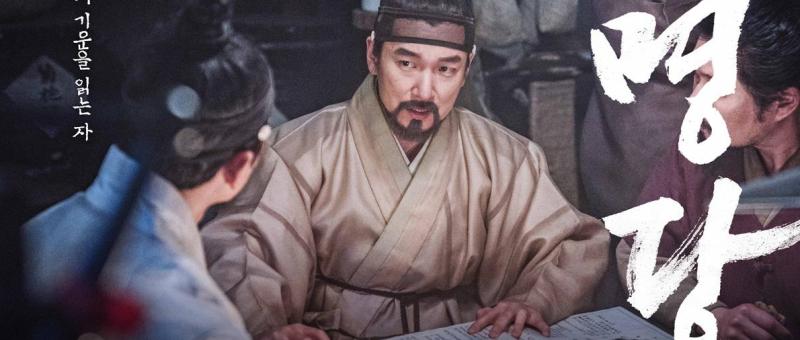
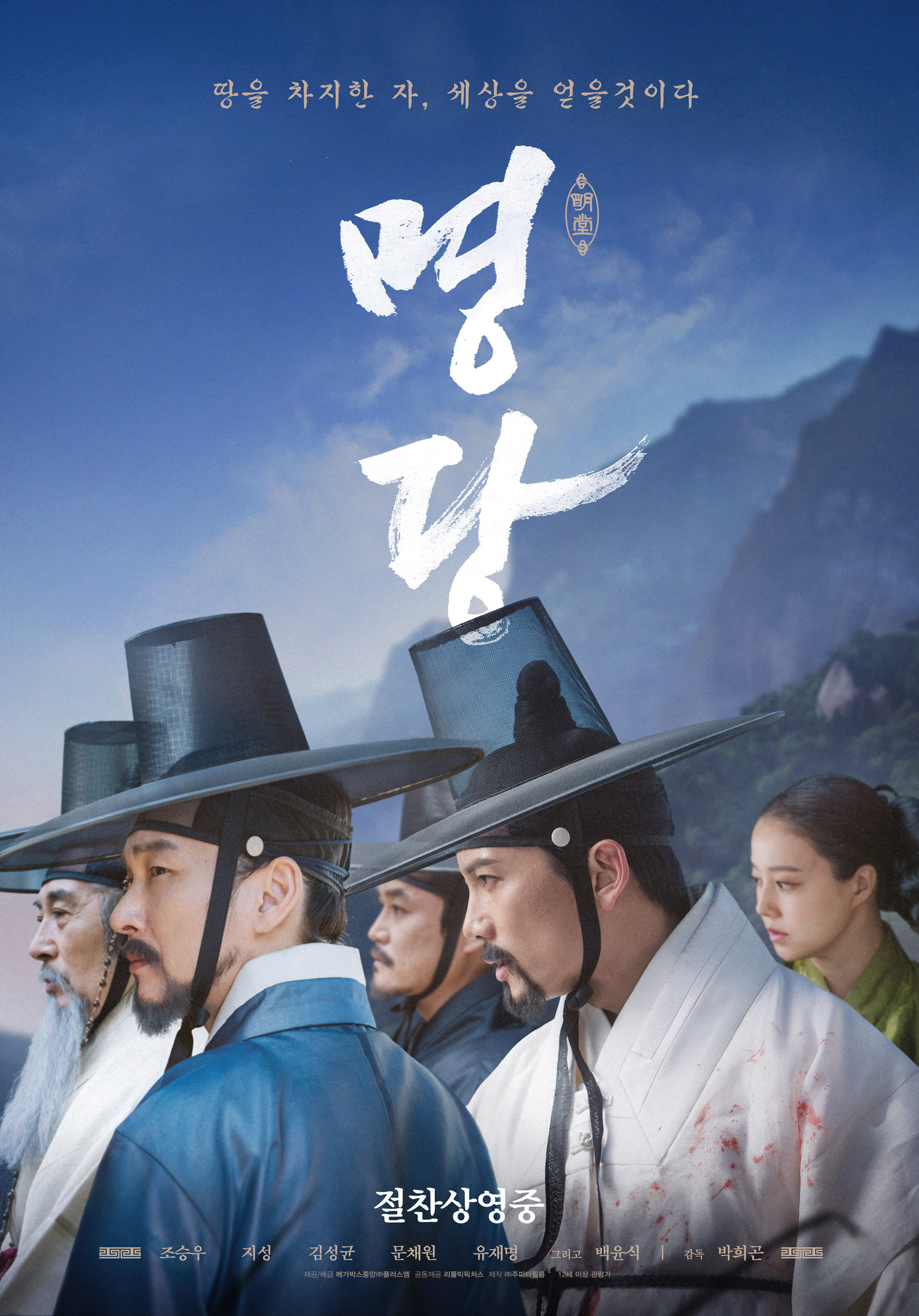
Fengshui (명당, Park Hee-gon, 2018)

FengShui poster 1A would-be-dynast gets overly involved with a weird spiritualist and almost (?) ruins the nation. Does that sound a little familiar? As metaphors go, it might be a stretch but then so much of Park Hee-gon’s Fengshui (명당, Myeong-dang) is just that. Set in the late 19th century, Park’s film is the third in a loose trilogy themed around Korean fortune telling traditions (following The Face Reader, and The Princess and the Matchmaker), but rather than questioning the efficacy of its art asks a series of questions about its application and the internecine lengths those who lust for power or otherwise feel themselves unfairly oppressed will go to to reclaim their rightful position.

Our hero, unwisely honest fengshui master Jae-sang (Cho Seung-woo), is the only one brave enough to point out that the site chosen for the burial of the late king is cursed, but inevitably he is ignored. He is of course right, which means he must be eliminated which is why a troop of soldiers working for the nefarious Kim clan show up and burn his house down, executing his wife and child by the sword when they manage to escape. 13 years later, he finds his expertise called on again when the weak and inexperienced king begins to suspect the Kim clan is plotting against him and that their shenanigans over his father’s grave may have something to do with it.

Like any typical Korean period drama, Fengshui is chiefly concerned with palace intrigue, only this intrigue is stranger than most in its bizarre obsession with the possibilities of manipulating spiritual power through acquiring “auspicious” land for whichever purpose one might wish from conceiving an heir to making sure your line holds power. The Kims are convinced they can win the throne (if by proxy) through digging up their ancestors and replanting them in more advantageous places only to discover that the grass is (literally) always greener. Still, they will stop at nothing from outright murder to psychological game playing in order to manipulate the teenage king into acting as their puppet.

One might ask themselves what the point is, what’s so great about being king anyway? The actual king might say not much, as he discovers himself a humiliated, hollow figure who wields no real power seeing as his soldiers seem set to side with Kim. Heungseon (Ji Sung), however, his “cheerful” uncle might feel differently after experiencing a lifetime of just the same. Forced to prance about doing party tricks for the Kims, barking and eating scraps from the floor like a mangy dog, he might say that being king is the only way to reclaim your self-respect and ensure you will never be at the mercy of ruthless men ever again.

The real key, however, is presented at the end when Jae-sang and his money loving friend Yong-shik (Yoo Jae-myung) are visited some years later by two men in suits who want to know the best place to start a military school to train Independence fighters. Jae-sang, having vowed to stop looking for places to bury people so he can find one to save them, is only too happy to oblige and even comes up with the name “Shinheung Military Academy” (a real school which is also, quite bizarrely, the subject of a smash hit musical). The point is further brought home with Kim’s descendent standing next to a family grave and lamenting that it can’t have been auspicious enough because they’ve lost all their power since the Japanese arrived. The subtext seems to be that feudal corruption and a subversion of traditional values such as ancestor worship and filial piety contributed to the gradual weakening of the Korean state which was plagued by insecure kings and political finagling until finally “sold” to foreign powers in the early 20th century.

Indeed, the ambitious usurpers eventually burn the soul of Korea in order to ensure their own, or rather their children’s, futures even at the expense of their nation’s. Literally fighting over a grave, the elites waste their time on pointless, internecine dynastic squabbling while ordinary people continue to suffer. Jae-sang, having given up on his own petty quest for revenge, comes to the conclusion that all this looking back is a waste of time when what they should be thinking about is the future – not burying things, but planting them. It is a good lesson, but, Park seems to suggest, perhaps one that has not yet been fully learned.


Screened as the latest teaser for the upcoming London Korean Film Festival. The next teaser screening, Zhang Lu’s Ode to the Goose, takes place on 19th August at Picturehouse Central.

International trailer (English subtitles)
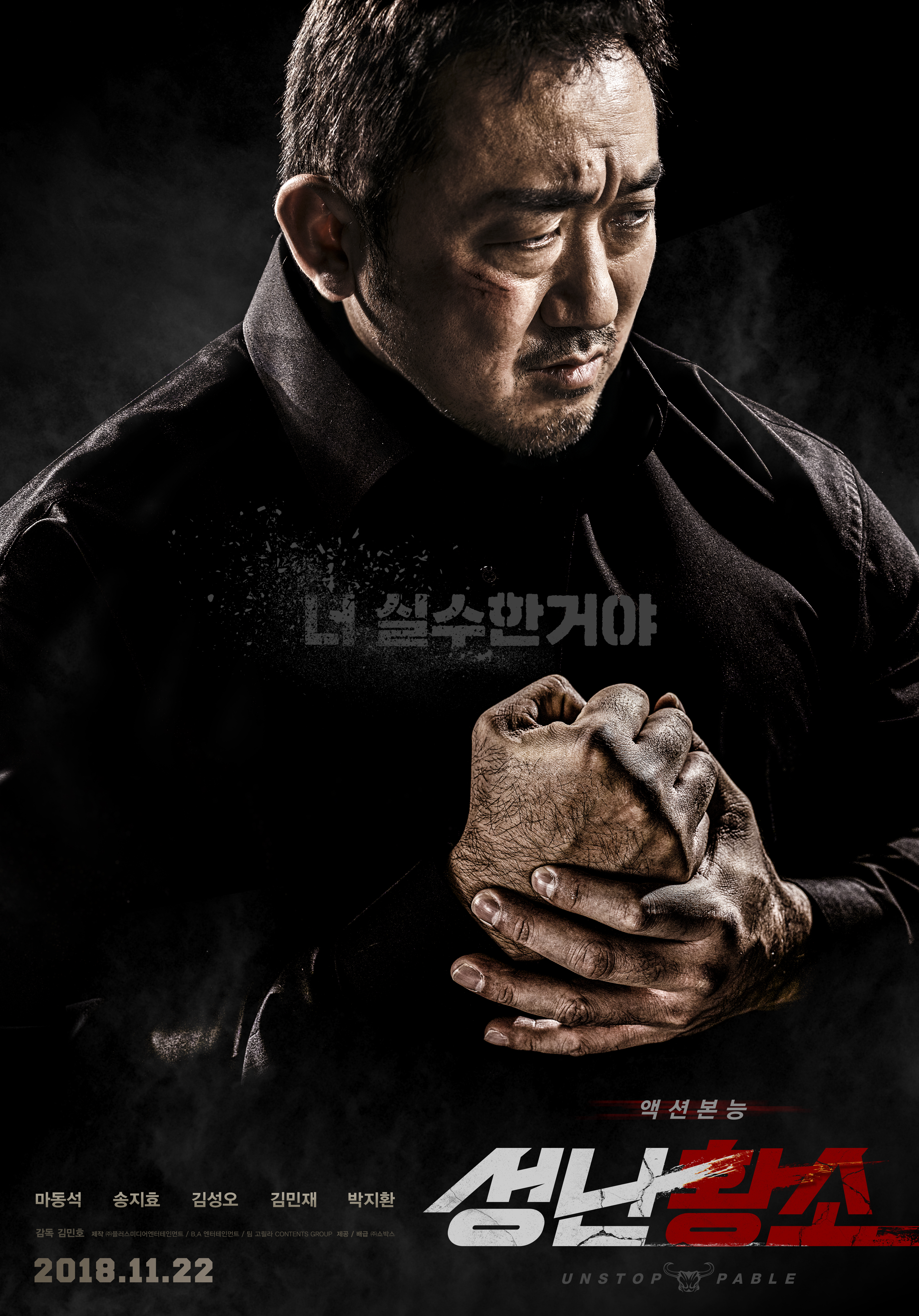
Unstoppable (성난황소, Kim Min-ho, 2018)

Unstoppable poster 5Can a person ever really change? The answer might be more complex than it seems but then again, you might not quite want them to change as much as you might think you do. Ma Dong-seok is quickly becoming Korean cinema’s MVP, in the genre stakes at least, and has begun to make a career for himself as a big hearted teddy bear of a man with gigantic heavy fists. It’s a legacy he very much embraces in the oddly light hearted Unstoppable (성난황소, Seongnan Hwangso) which sees him play a former gangster gone straight whose latent violent streak is reawakened when he becomes a warrior for love.

Dong-cheol (Ma Dong-seok) was once a notorious tough guy but gave up the streets when he met “an angel”, nurse Ji-soo (Song Ji-hyo), and married her. These days, he works a regular low pay labour job at the fish market but is always dreaming of better things which is why he’s constantly getting scammed by the latest get rich quick scheme proposed by one of his dodgy friends. The trouble starts when Dong-cheol is rear ended by some shady types and gets out of his car to ask for insurance details. Sensing danger but now fully reformed, Dong-cheol remains calm and refuses to engage but Ji-soo isn’t having any of it. She verbally lays into the gangsters and insists on compensation. When Dong-cheol returns home to find his apartment in disarray after arguing with Ji-soo about his unwise financial decisions during a birthday dinner at a fancy restaurant they can’t afford, he has an inkling about what may have occurred but finds the police slow and unsympathetic leaving him to take matters into his own hands.

Unlike many a similarly themed action drama, Unstoppable is keen to emphasise the sweet and innocent love between Dong-cheol and Ji-soo with even the climactic argument between them neutered shortly before Ji-soo is taken. Dong-cheol is not a violent man at heart, but is prepared to meet violence with violence where necessary and he does not like to lose. He takes damage, but never gives up the fight not because he’s angry and hellbent on revenge but because he loves his wife and is desperate to make sure nothing bad happens to her while he is around to prevent it. Meanwhile, Ji-soo is far from a damsel in distress. Refusing to be cowed, she keeps her wits about her and protects the other women kidnapped by the gang while she looks for a way to escape.

The fact is, there seem to have been a lot of unexplained disappearances of young women in this city – something which Dong-cheol becomes aware of while hanging around the police station, yet the authorities have not made much headway on the case. Dong-cheol quickly works out that he’s potentially dealing with an organised crime network which makes its money out of trafficking kidnapped women all over Asia and that, unlike himself, the families of these women largely opted to take the “compensation” money left in their place by the gangsters rather than fight back. This in itself annoys him, though not quite as much as being forced to play the gangsters’ game in order to maximise the chances of getting to Ji-soo before it’s too late.

What quickly becomes apparent to flamboyant gangster Ki-tae (Kim Sung-oh) is that he’s made quite a big mistake, even if that mistake might be more fun than hassle. Ji-soo is not the victim type and her husband will stop at nothing to get her back which means he’s fighting a war on two fronts, both surprised and somewhat amused to be met with such unexpected resistance. Still, Dong-cheol is determined to barrel through fists flying while his bumbling sidekicks – old comrade Choon-sik (Park Ji-hwan) and fast talking fixer Gomsajang (Kim Min-jae), handle the investigation from the sidelines. Undercutting the essential darkness of the “lone vigilante takes on heinous human trafficking ring” narrative with warmhearted humour, Unstoppable proves an ideal vehicle for the increasingly popular Ma Dong-seok which finds unexpected sweetness in the genuine connection between its perfectly matched husband and wife team.


Unstoppable was screened as part of the 2019 Udine Far East Film Festival.

International trailer (English subtitles)