The Romantic President (피아노 치는 대통령, Jeon Man-bae, 2002)

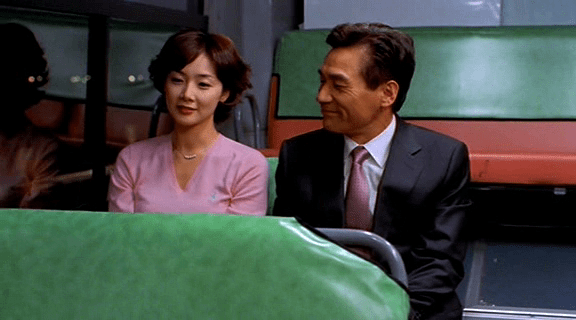
A pure-hearted politician finds himself falling for an uncompromising teacher in Jeon Man-bae’s nonsense comedy Romantic President (피아노 치는 대통령, Piano chineun daetongnyeong). This president is indeed “romantic” in the sense that he is an idealised vision of a political leader. The film doesn’t go into his politics at all and it’s ambiguous where he belongs on the political divide. Instead, he is depicted as a man of integrity who is good and kind. In short, the kind of political leader that might not really exist in real life.

Min-wook (Ahn Sung-ki) first appears in disguise having gone undercover to talk to a group of homeless people living at the station. While talking to them, he himself is harassed by a policeman overstepping the bounds of his authority. The policeman calls the men “trash” and says that they disgust ordinary people. Little knowing who he is, the policeman bullies Min-wook who then identifies himself by striking the same pose as on as his campaign photo.

Something similar happens later when Min-wook decides to take a day driving a taxi in order to get closer to the people he is supposed to be serving. All of which marks him out as someone who is genuinely interested in the lives of the electorate and how to make them better. Though references are made to other political scandals, Min-wook seems to be held to a different standard and is a figure of integrity and incorruptibility. This is, however, why his romance is so dangerous in that It complicates his image and the secrecy involved because of his position makes it seem like he’s done something wrong or that there is an illicit quality to his relationship with schoolteacher Eun-soo (Choi Ji-woo). However, at the film’s conclusion, Min-wook admits that the “piano-playing president” was a persona he constructed for the purpose of winning the election, which is to say inauthentic. He has been lying all along, but his romance with Eun-soo has made it impossible for him to continue with the subterfuge. Only by being his true self can he gain romantic fulfilment even if it comes at the cost of his political career.

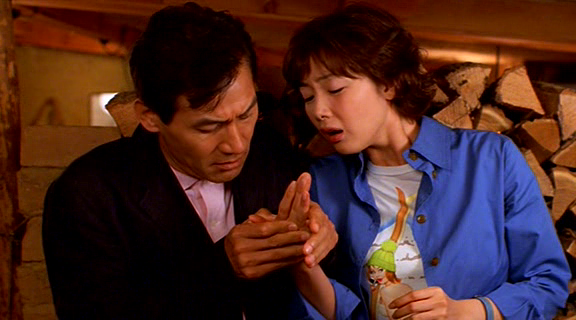
For her part, Eun-soo may also be harbouring a secret that paints her as something of a political rebel and possible extremist. She has failed to keep a job for more than six months because of her eccentric behaviour and intense interest in teaching in which, like Min-wook, she is invested in her pupils lives and wants to do what she can to make them better. On arrival at her new school she poses as a pupil to find out the class gossip and then becomes determined to save Young-hee (Im Soo-jung) who has become a delinquent little knowing she is the president’s daughter. No one else is willing to go against the Blue House with the consequence that Young-hee has become drunk on power, rebelling in the hope that someone will push back. Eun-soo is that person and soon earns Young-hee’s trust precisely because of the genuine interest she takes in her that is undaunted by her father’s position.

Young-hee too responds to authenticity and gradually becomes more authentic herself through her interactions with Eun-soo. Nevertheless, at the same time, the film suggests that society remains judgemental and is not always prepared to recognise an individual’s authentic identity. Eun-soo’s roommate is a transwoman who is repeatedly deadnamed and then eventually outed by the invasive press when Eun-soo’s relationship with Min-wook is exposed. Nevertheless, Eun-soo strives to protect her friend while accepting that she may have to deny her feelings to protect Min-wook’s position.

Despite all the silliness and zany antics, the film has a degree of earnestness at its heart in which it believes that it shouldn’t be wrong to express one’s true feelings. Authority figures can fall in love too, and it’s better for everyone if they do, otherwise you end up with the toxic combination of power and unhappiness that causes the policeman to abuse his authority to bully the homeless. Even so, the irony is that on becoming Min-wook’s official partner, Eun-soo must again play another role, radically altering her appearance to conform to the image of the president’s wife. Nevertheless, once authentically embraced, their love is accepted by the wider society which is then itself improved as a result.


Trailer (English subtitles)

Swing Kids (스윙키즈, Kang Hyeong-cheol, 2018)

Swing Kids poster 2“Fuck Ideology” the embittered hero of Kang Hyeong-cheol’s Swing Kids (스윙키즈) exclaims, pushing back against his casually cruel commanding officer from the comparative safety of the stage on which he decides to cast off his frustration through a natural love of dance. It may be too much of a truism to suggest you can dance your way to freedom while a very literal prisoner of war, but in any case Kang eventually shows us that sooner or later someone will be along to crush even the smallest of dreams and it may not be the people you’d most expect.

The film opens with a propaganda newsreel that eventually skews pro-North in lamenting the poor conditions at the Koje POW camp where a small civil war recently broke out between those who remain fiercely loyal and those who have been seduced by American freedoms and no longer wish to return. Unfavourably comparing Koje with a camp in the North which is run under strict adherence to the Geneva convention so you’d hardly even think there was a war on at all, the film ends by casting shade on the American forces’ casual cruelty and inability to keep their house in order. The old commander having been sacked, newbie General Roberts (Ross Kettle) is keen to reform the camp’s image and so he hatches on the idea of getting Sergeant Jackson (Jared Grimes), who used to be a Broadway tap dancer, to teach the “commies” the American dance of freedom which seems tailor-made for front page photo sensation.

Jackson is reluctant to take the job but is persuaded when Roberts attempts to threaten him over his complicated personal life which has seen him breaking regulations to earn extra bucks in the hope of getting transferred back to Okinawa where he apparently had a woman he wanted to marry and a child he needed to make legitimate. Time and again we’re told that getting sent to the Korean War is something that happens to soldiers who’ve made mistakes, which might explain why the camp appears to be staffed by a collection of thoroughly unpleasant, incompetent foot soldiers while Roberts himself is mostly interested in raising its profile to save his own reputation.

“Communism, Capitalism. If nobody knew what they were, no one will kill or be killed” a young woman points out, quite reasonably before awkwardly wading into an ill-advised debate over who is more oppressed – ethnic minorities or women in a time of war. Sgt. Jackson who hails from the land of the free had to abandon his dream of the stage because of racism and continues to experience persistent micro aggressions from junior soldiers who refuse to follow his orders. The Korean internees are often no better, throwing up their own racial slurs and parading their cultural ignorance by reserving a special layer of scorn just for him in addition to that they feel for the Americans who have, after all, wandered onto their land and decided to have a war on it while making them join in. Communism and Capitalism, another soldier intones, are concepts made by and for the Russians and Americans, they have precious little to do with him so why are he and his loved ones supposed to die over an ideological disagreement?

Hero of the North Ki-soo (Do Kyung-soo) remains conflicted. He was loyal and truly believed in his cause, but secretly has the heart of a dancer and longs for the freedom of physical movement. He can’t talk to Jackson, or to another of the Swing Kids who is a lonely Chinese soldier who can only speak Mandarin (Kim Min-Ho), but discovers that they do have a shared language in dance and are able to communicate on an elemental level that makes culture an irrelevance. Feisty young woman Yang Pallae (Park Hye-su), who, out of necessity, has learned to speak three additional languages (English, Mandarin, and Japanese), discovers something much the same as she reluctantly begins dancing even though there’s no money it, while lovelorn Kang Byung-sam (Oh Jung-se) wants to dance to become famous because he’s become separated from his wife and thinks that then she’d be able to find him again. 

As Pallae puts it, when she puts the tap shoes on all the awful things go away. Pointedly introducing the big dance number, Jackson describes the Swing Kids as longing for freedom and liberalism while fighting for their rights, speaking as much for himself thoroughly fed up with the manipulative Roberts who seems set to hang the bunch of them out to dry as he is for the disparate collection of dancers whose young lives have been ruined by the chaos of war. “Fuck ideology” indeed, all they want to do is dance but repressive regimes aren’t good with people having fun expressing themselves and so even this small dream seems to grow ever more distant. What started off as a cheerful musical comedy undergoes a decidedly Brechtian tonal shift in its final moments, neatly underlining the terror and unpredictability of life in war but nevertheless extremely hard to reconcile with the inspirational cheerfulness of all that’s gone before. Still for the vast majority of its running time, Swing Kids is a joyful celebration of the universal language of movement and an ode to the power of escapist fantasy in a cruel and confusing world.


Swing Kids screens for free in Chicago on Sept. 14 as part of the ninth season of Asian Pop-Up Cinema where actor Jared Grimes is expected to appear for a Q&A. It is also available on US blu-ray courtesy of Well Go USA.

International trailer (English subtitles)