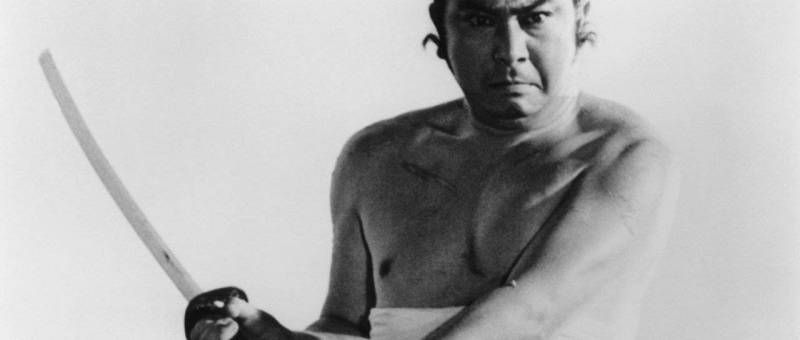
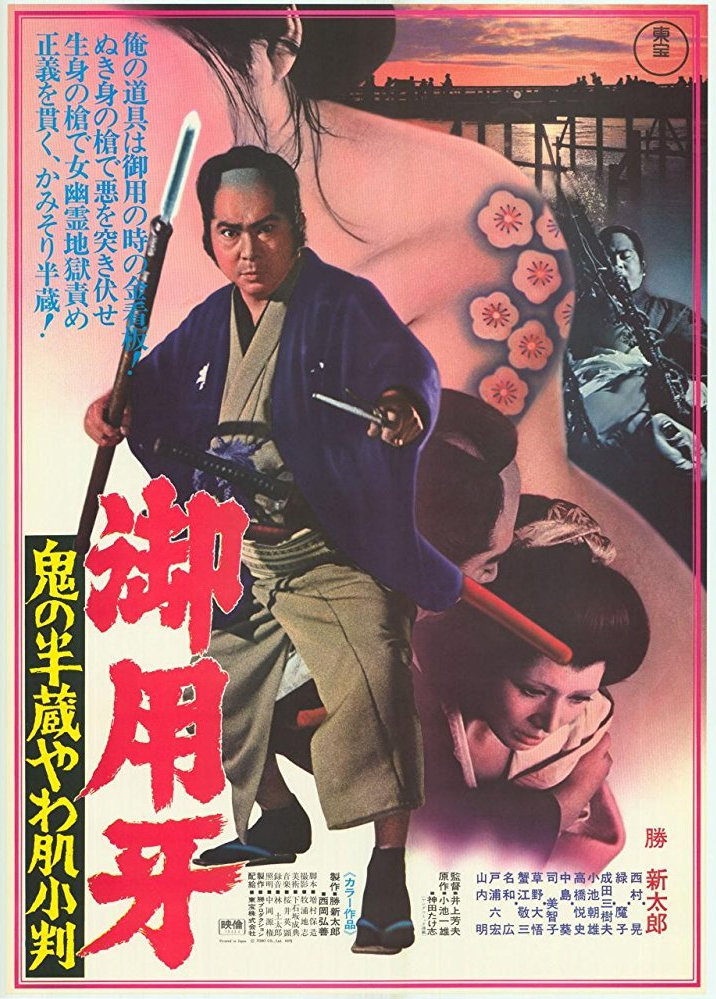
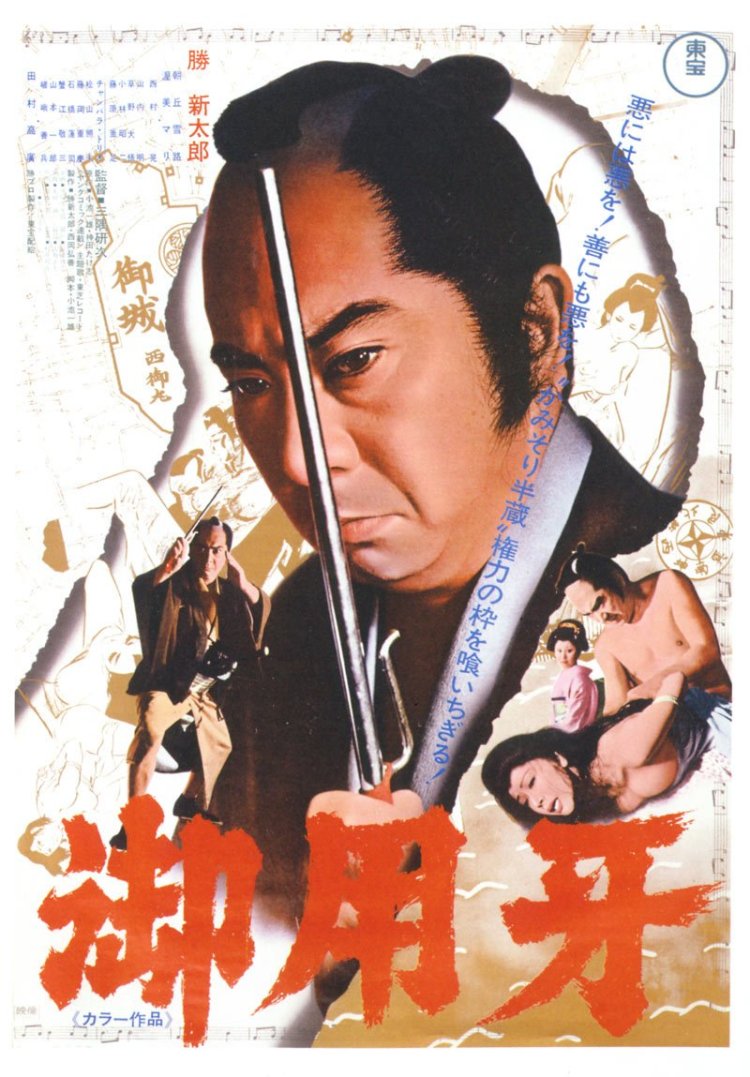
 All things must come to an end, and so the third instalment in the Hanzo the Razor series, Who’s Got the Gold? (御用牙 鬼の半蔵やわ肌小判, Goyokiba: Oni no Hanzo yawahada koban) is the last. To be frank the central tenet is wearing a bit thin (not least because Hanzo’s been bashing away at it with a mallet for the last two movies), and though scripted by the previous film’s director, Yasuzo Masumura, direction has been handed to the less experienced studio director Yoshio Inoue. Consequently, Who’s Got the Gold? is the most obviously parodic entry in the series, camping it up in grand style as Hanzo (Shintaro Katsu) goes after a more obvious kind of vice in the form of greedy, entitled lords, corrupt priesthood, and a nation too obsessed with its past to survive in a rapidly modernising era.
Inoue opts for a purely theatrical opening as Hanzo’s two ex-con underlings, Devil and Viper, enjoy a spot of night fishing whilst dreaming about having enough money to head to the red light district. They get the fright of their lives when they think they see a creepy ghost woman emerging from the lake. Being Devil and Viper they panic and run home screaming to report this terrifying incident to their brave protector Hanzo. Hanzo is in the middle of his usual “tool polishing” routine but fancies paying a visit this mysterious lake because, well, it might be fun to try having sex with a ghost for once. Devil and Viper are very confused by this idea, but it’s par for the course with Hanzo and so off they go.
Of course, the ghost lady is not a real ghost so only part of Hanzo’s lusts are satisfied as he performs his normal sort of “special torture” on her and finds out that she’s part of an ongoing scam in which treasury officials have been skimming off some of the gold they’re supposed to be protecting. Sadly, Hanzo’s investigations hit a snag when the woman’s husband turns up and kills her for having been raped by Hanzo before promptly getting killed himself.
Hanzo does not approve of any of these goings on and fully intended to arrest the treasury officers if only they hadn’t gone and died first. Accordingly he reports all of this to his superiors but advises against prosecutions because he sympathises with the difficult position these men found themselves in. Being a samurai is not cheap and these lowly jobs are very badly paid – how are you supposed to maintain your house to the manner required without resorting to extreme measures when your lord is snaffling all the money and not paying his retainers what they’re owed. It will not come as a surprise that the lord didn’t want to hear this, and so Hanzo marks his card. It didn’t really help that Hanzo’s walk into the castle involved running a gauntlet of unfortunate samurai forced to kneel along the path all day just hoping that the lord would show them some favour. Among them was a old friend of Hanzo’s who receives a tactless offer of fixed employment if only he will give up a family heirloom that the lord has been admiring.
The gold smuggling subplot runs in parallel with another problem – a doctor whom the lord has ordered Hanzo to arrest because he was advocating the adoption of Western technologies, fearing that the nation was leaving itself dangerously vulnerable if it refused to modernise. The doctor, like the girl’s father in the first film, is dying of a terminal illness and so Hanzo thinks the sentence can wait. Hiding the doctor in his house he listens to his ideas and then comes to the same conclusion, allowing him to finish building a cannon to prove to the lord just how destructive these new weapons really are and just how dangerous it would be to fight them with only katanas and samurai spirit. Hanzo lives in interesting times, but this dilemma says something both about the precarious position of the samurai order in the face of increasing modernisation and about the 1970s background in which a small war was currently being waged against American imperialism.
As usual Hanzo refuses to bow. He will not give in to bullies or those who abuse their authority to add additional oppression onto an already oppressed populace which he has pledged his life to protecting. The contradiction of being a rapist so well endowed that afterwards no one seems to mind has still not been solved, but by this third instalment in the series the “joke” is so well worn as to receive little attention. Who’s Got the Gold? is weakest of the three adventures for Hanzo and his well conditioned razor but it has its charms, if only in the troublingly easy way that its central conceit has become so essentially normalised as to be barely noticed.
Original trailer (no subtitles)

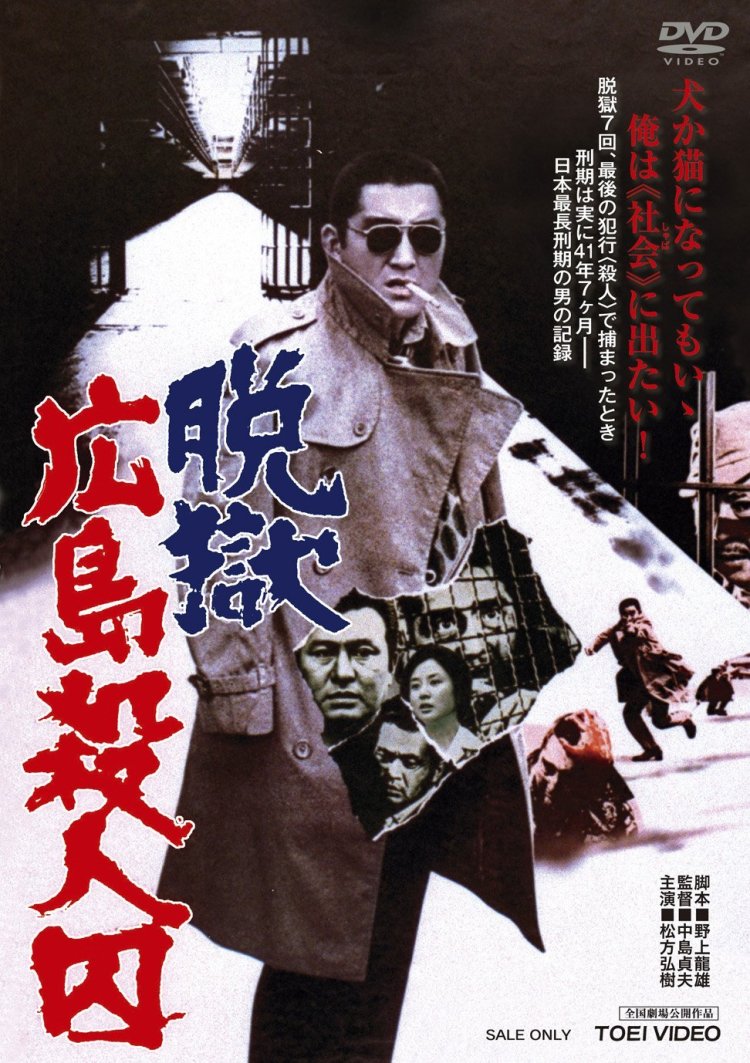 Sadao Nakajima had made his name with Toei’s particular brand of violent action movie, but by the early seventies, the classic yakuza flick was going out of fashion. Datsugoku Hiroshima Satsujinshu (脱獄広島殺人囚, AKA The Rapacious Jailbreaker) follows in the wake of seminal genre buster,
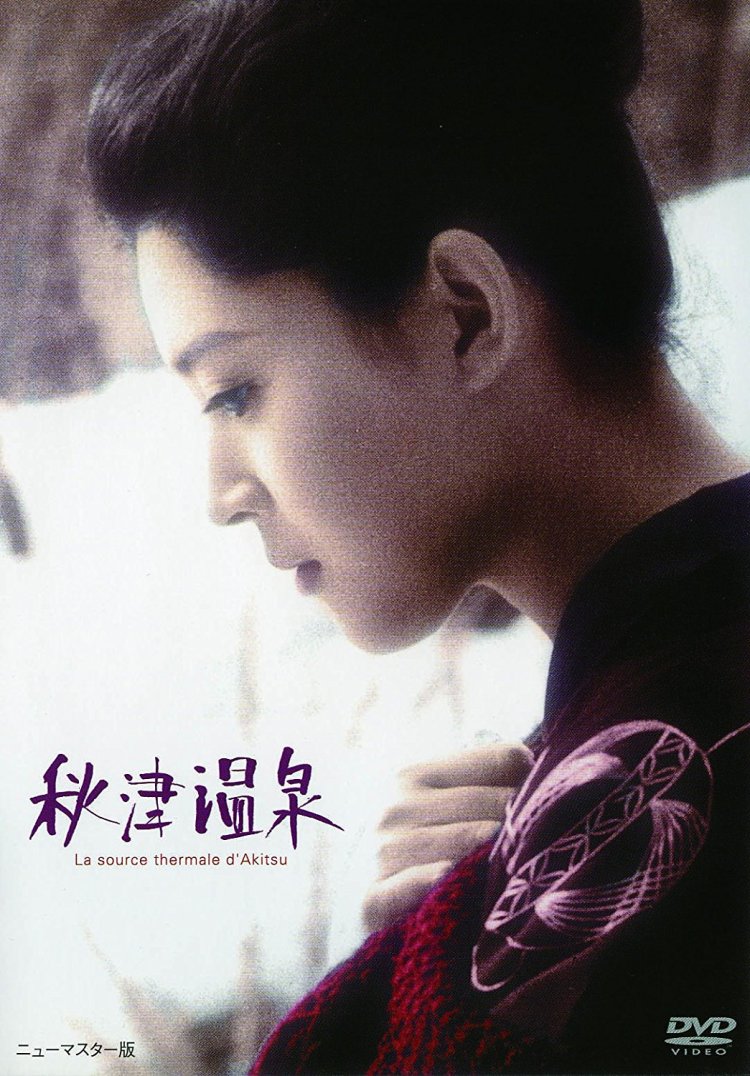 Kiju (Yoshishige) Yoshida is best remembered for his extraordinary run of avant-garde masterpieces in the late 1960s and early 1970s, but even he had to cut his teeth on Shochiku’s speciality genre – the romantic melodrama. Adapted from a best selling novel, Akitsu Springs (秋津温泉, Akitsu Onsen) is hardly an original tale in its doom laden reflection of the hopelessness and inertia of the post-war world as depicted in the frustrated love story of a self sacrificing woman and self destructive man, but Yoshida elevates the material through his characteristically beautiful compositions and full use of the particularly lush colour palate.
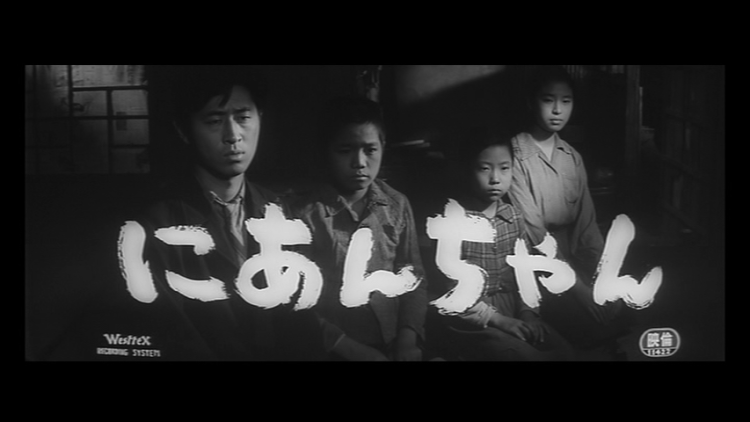 Like most directors of his era, Shohei Imamura began his career in the studio system as a trainee with Shochiku where he also worked as an AD to Yasujiro Ozu on some of his most well known pictures. Ozu’s approach, however, could not be further from Imamura’s in its insistence on order and precision. Finding much more in common with another Shochiku director, Yuzo Kawashima, well known for working class satires, Imamura jumped ship to the newly reformed Nikkatsu where he continued his training until helming his first three pictures in 1958 (Stolen Desire, Nishiginza Station, and Endless Desire). My Second Brother (にあんちゃん, Nianchan), which he directed in 1959, was, like the previous three films, a studio assignment rather than a personal project but is nevertheless an interesting one as it united many of Imamura’s subsequent ongoing concerns.
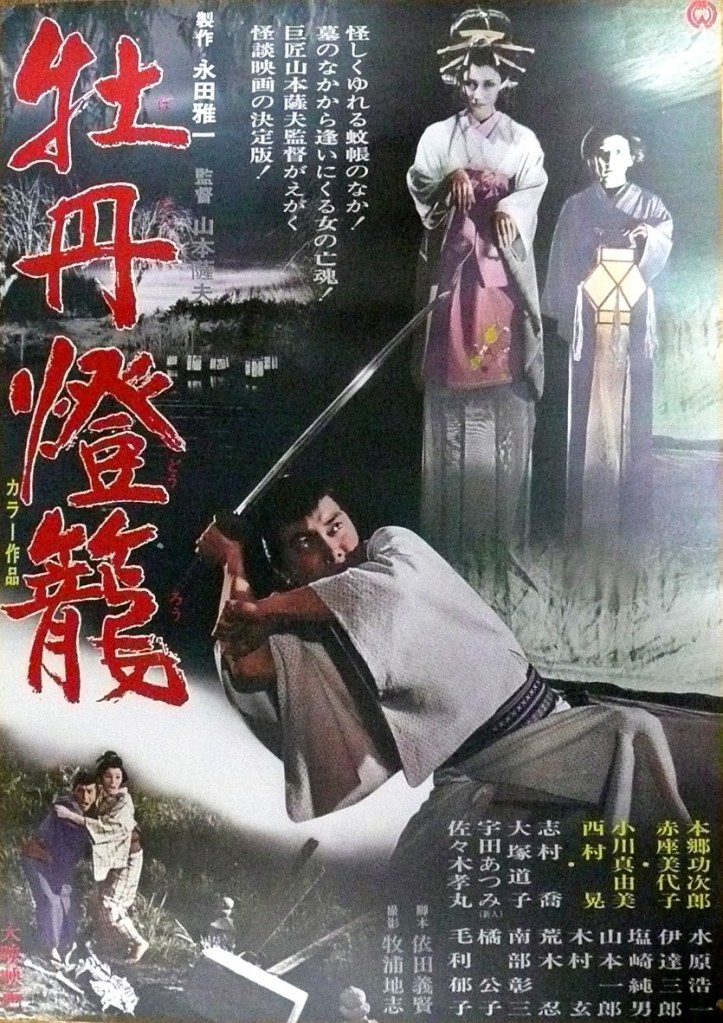 The Peony Lantern (牡丹燈籠, Kaidan Botan Doro) has gone by many different names in its English version – The Bride from Hades, The Haunted Lantern, Ghost Beauty, and My Bride is a Ghost among various others, but whatever the title of the tale it remains one of the best known ghost stories of Japan. Originally inspired by a Chinese legend, the story was adapted and included in a popular Edo era collection of supernatural tales, Otogi Boko (Hand Puppets), removing much of the original Buddhist morality tale in the process. In the late 19th century, the Peony Lantern also became one of the earliest standard rakugo texts and was then collected and translated by Lafcadio Hearn though he drew his inspiration from a popular kabuki version. As is often the case, it is Hearn’s version which has become the most common.
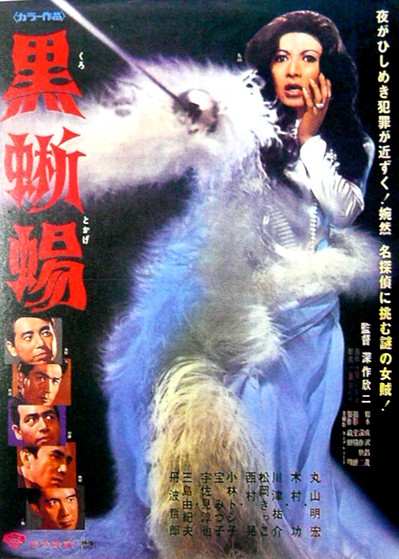 Those who only know Kinji Fukasaku for his gangster epics are in for quite a shock when they sit down to watch Black Rose Mansion (黒薔薇の館, Kuro Bara no Yakata). A European inflected, camp noir gothic melodrama, Black Rose Mansion couldn’t be further from the director’s later worlds of lowlife crime and post-war inequality. This time the basis for the story is provided by Yukio Mishima, a conflicted Japanese novelist, artist and activist who may now be remembered more for the way he died than the work he created, which goes someway to explaining the film’s Art Nouveau decadence. Strange, camp and oddly fascinating Black Rose Mansion proves an enjoyably unpredictable effort from its versatile director.
 Windows on Worlds