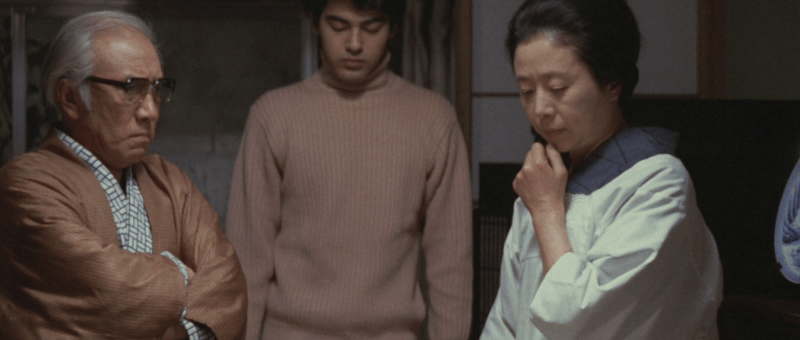
In some ways, the themes of Kaneto Shindo’s The Strangling (絞殺, Kosatsu) may have seemed a little outdated even on its original release in 1979, though it was in fact based on a recent event in which a boy from an elite high school was murdered by his father because he had become violent towards his parents and they feared he would eventually become a criminal, while it was also reported that that he was being sexually abused by his mother. The main controversy may be, however, that the father was given a significantly lighter sentence than might be expected with a crime of this magnitude, partly because his wife had strongly supported him in court.
The film’s title implies that a noose has already been placed around Tsutomu’s (Tsutomu Kariba) neck and it’s the society that is slowly strangling him. His family moved into this area because he succeeded in getting into a prestigious high school which, they hope, will enable him to win a place at Tokyo University and then be set for life. It is never really clear what Tsutomu wants, though it seems he’s growing resistant to the pressure that’s being placed on him. The 4:3 screen ratio seems to bear out this sense of claustrophobia as Tsutomu is regularly cautioned not to get left behind and if that you fall from the ladder before reaching the top, that’s it, you’re out of the game.
His father, Yasuzo (Ko Nishimura), echoes this survival of the fittest mentality in remarking it doesn’t matter how much pesticide they drop, it just makes the flies who survive stronger. If his generation isn’t strong enough, it’ll perish. When a girl in Tsutomu’s class, Hatsuko, takes her own life after killing her abusive stepfather, the other students are asked for their opinions, but they don’t really have any. She was a rival, not a friend, many of them say. They’re all in competition for places at top universities, and now there’s one less person standing in their way. Several of the students call the girl stupid, one remarking that she should simply have tried to manipulate her stepfather instead to turn the situation to her advantage. “We can’t help students who can’t hack it,” the teacher callously explains.
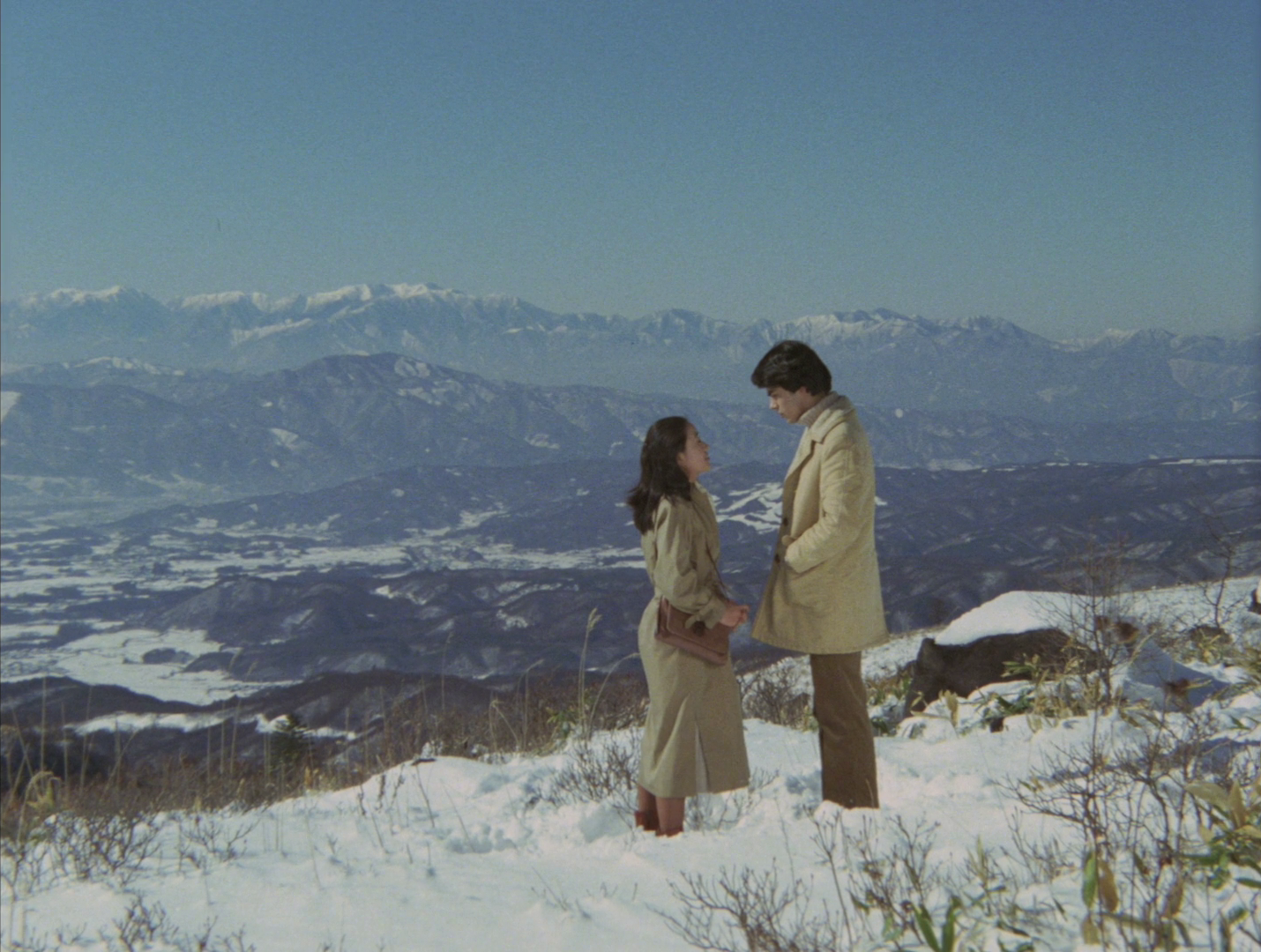
In any case, with all this studying, the kids haven’t had any time to develop social skills or emotional bonds with other people which might be one reason that Tsutomu has become alienated from his parents. The unnaturally loud sound of their walking on en masse to school takes on an ominous quality. Tsutomu becomes interested in a girl, but tries to rape her, and is then confused when she starts avoiding him. The film seems to forget that this happened as the girl, Hatsuko, calls Tsutomu after murdering her stepfather and asks him to have purifying sex with her in the snow before she takes her own life. Hatsuko’s death seems to deepen Tsutomu’s resentment towards the older generation, though he’s incapable of seeing that perhaps he isn’t much different given that he also tried to force himself on Hatsuko.
He sees his father as the same as hers in that he accuses him of raping his mother, attacking the idea of patriarchal marriage in part because there’s was arranged and not a love match. Meanwhile, he feels Yasuzo to be a hypocrite and is ashamed of him because he continues to live on the inherited wealth of his father. Unlike the other parents, Yasuzo owns a small cafe which would not ordinarily permit living in this kind of home in this kind of area nor support their comfortable upper-middle-class lifestyle. This class-based resentment perhaps also makes Tsutomu feel generally out of place, while also convincing him that his father is a small and petty man which might not be entirely unfair.
He has a boy working in his cafe who has failed the entrance exam for Tokyo University several times and has now decided to go wherever he gets in on the next round. For Yasuzo, maybe he’s just a fly who didn’t make it. When he catches him stealing from the till, he extends him no compassion and doesn’t stop to ask why he did or if there’s any way he could help. He doesn’t offer him the opportunity to pay the money back and is offended when the boy pleads with him not to tell his teachers or the police because he doesn’t want his mother, whom he’s been sending money home to, to know what he’s become. Rather, Yasuzo makes a point of humiliating him by making the boy kneel and apologise before his female waitress ends up quitting too in solidarity with the belittled worker.
It seems to be this incident that makes clear to Tsutomu that his father uses violence and status to control those around him, but his relationship with his mother is problematic too in that he partly blames her for allowing herself to be dominated by his father while her latent incestuous desire for him sees her mollycoddling her son by sucking on his finger when he cuts himself though he is nearly a grown man. Eventually he tries to rape her too, which is equal parts an attempt to overcome his father and misplaced sexual desire.
Throughout it all, the parents are surrounded by a greek chorus of noisy neighbours who are also all firmly on the father’s side. The implication seems to be that they think they did the right thing in ending their son’s life because he’d already veered off the path and was not going to become a respectable member of society. Though an attempt to take Tsutomu to a doctor only ends up with a diagnosis of “adolescence” which he says can be cured through “good parenting”, the judge seems to have some sympathy for the father with the implication that he’s cleaned up his own mess in being unable to raise his son to be a model citizen. The films seems uncertain whether it agrees with him, but is otherwise convinced that the whole society has gone to pot. When Tsutomu smashes up his father’s pointlessly expensive Buddhist altar, it’s like he takes a bat to the patriarchal order, but in the end achieves very little of anything at all as his rebellion appears to generate only more pain and suffering until the system finally snuffs it out.
 Windows on Worlds